B2B Appointment Setting in 2026: The Complete Playbook
B2B appointment setting is where pipeline is won or lost. Here is the 2026 playbook: process, scripts, KPIs, tools, and the data layer that makes booked meetings actually show up.
(title rendered separately)
Most "booked meetings" never happen. A B2B appointment setting program lives or dies on two numbers: how many qualified meetings you book, and how many of those prospects actually show up. The teams that win in 2026 treat appointment setting as a system — clean data, a tight process, and disciplined follow-up — not a numbers game where reps dial random lists and hope.
This guide breaks down exactly how to build that system, whether you run it in-house or outsource it.
TL;DR#
- B2B appointment setting is the process of identifying, contacting, and qualifying prospects to book a sales meeting for a closer — it sits between prospecting and the demo.
- Show rates beat booking rates. A calendar full of no-shows is worse than five meetings that convert. Confirmation sequences and qualification fix this.
- Data quality is the lever. Bad contact data wastes 30–40% of outreach effort. Verified emails and direct dials are non-negotiable.
- In-house vs outsourced is a cost-and-control trade-off — both can work; the data and process underneath them matter more than the org chart.
- Track 6 KPIs: dials/sends, connect rate, meetings booked, show rate, qualified-meeting rate, and meeting-to-opportunity conversion.
What is B2B appointment setting?#
B2B appointment setting is the structured process of turning a cold or warm prospect into a scheduled, qualified meeting with someone who can actually buy. Think of it like a restaurant host: the host doesn't cook the meal (that's the closer's job), but if they seat the wrong people at the wrong time, the kitchen's effort is wasted. The appointment setter's entire job is to put the right buyer in front of the right rep at the right moment.
In practice, the appointment setter (often an SDR or BDR) handles the top of the funnel: research, first touch, objection handling, qualification, and the booking itself. Once the meeting is set and confirmed, an Account Executive takes over to run the demo and close.
Here's how the role splits across the funnel:
- Identify — Build a target list that matches your ICP (industry, headcount, role, tech stack, trigger events).
- Enrich — Attach verified email, direct phone, and LinkedIn to every contact so outreach actually lands.
- Engage — Run a multi-channel sequence (email, phone, LinkedIn) with a clear, single ask.
- Qualify — Confirm budget, authority, need, and timing before you book anything.
- Book & confirm — Lock the calendar slot, then run a confirmation sequence to protect the show rate.
- Hand off — Pass full context (notes, pain points, qualification) to the closer.
Why do most appointment setting programs fail?#
They optimize for the wrong metric. Booking 40 meetings sounds great until 22 are no-shows and 10 were never qualified. The teams that consistently fill a closer's calendar fix three root causes.
1. Dirty data. If a quarter of your emails bounce and a third of your phone numbers are dead, you've effectively cut your team in half before they make a single dial. This is the single biggest hidden tax on appointment setting. Run every list through an email verifier and validate phone numbers before reps touch them.
2. No qualification gate. Setters chasing a "meetings booked" quota will book anyone with a pulse. Define a hard qualification bar — a marketing qualified lead is not the same as a sales-ready meeting — and hold setters to qualified meetings, not raw bookings.
3. No confirmation loop. A meeting booked five days out with zero follow-up will no-show 30–50% of the time. A simple confirm-the-day-before email plus a same-morning reminder routinely lifts show rates by 15–25 points.
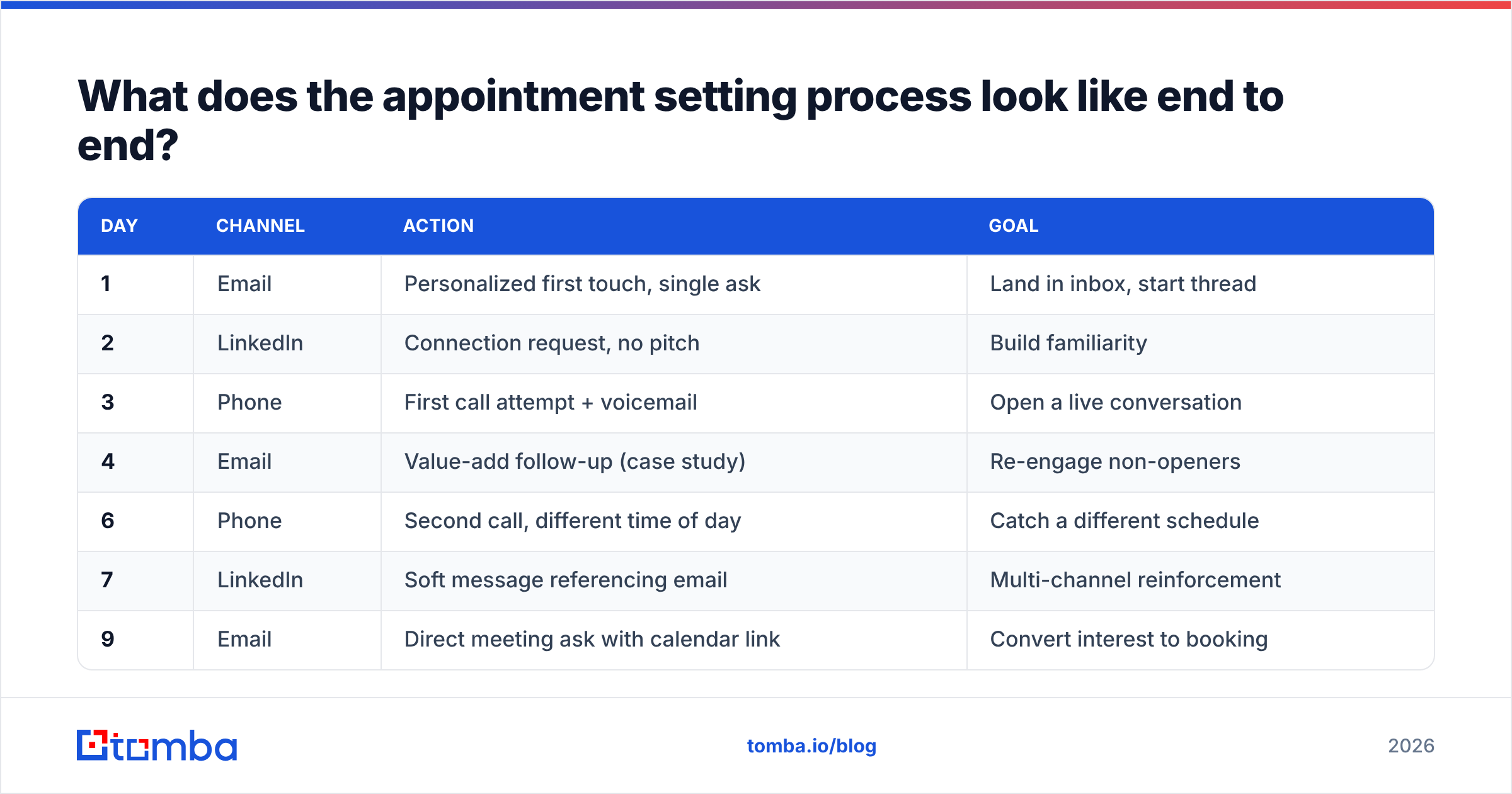
What does the appointment setting process look like end to end?#
A repeatable cadence beats heroics. Below is a proven 10-business-day multi-channel sequence you can adapt to your sales cycle and team size.
| Day | Channel | Action | Goal |
|---|---|---|---|
| 1 | Personalized first touch, single ask | Land in inbox, start thread | |
| 2 | Connection request, no pitch | Build familiarity | |
| 3 | Phone | First call attempt + voicemail | Open a live conversation |
| 4 | Value-add follow-up (case study) | Re-engage non-openers | |
| 6 | Phone | Second call, different time of day | Catch a different schedule |
| 7 | Soft message referencing email | Multi-channel reinforcement | |
| 9 | Direct meeting ask with calendar link | Convert interest to booking | |
| 10 | Phone | Breakup call + final voicemail | Last attempt, create urgency |
The discipline is in the consistency. Reps who skip the phone steps or stop at day 4 leave the majority of bookable meetings on the table — most replies come after the third touch.
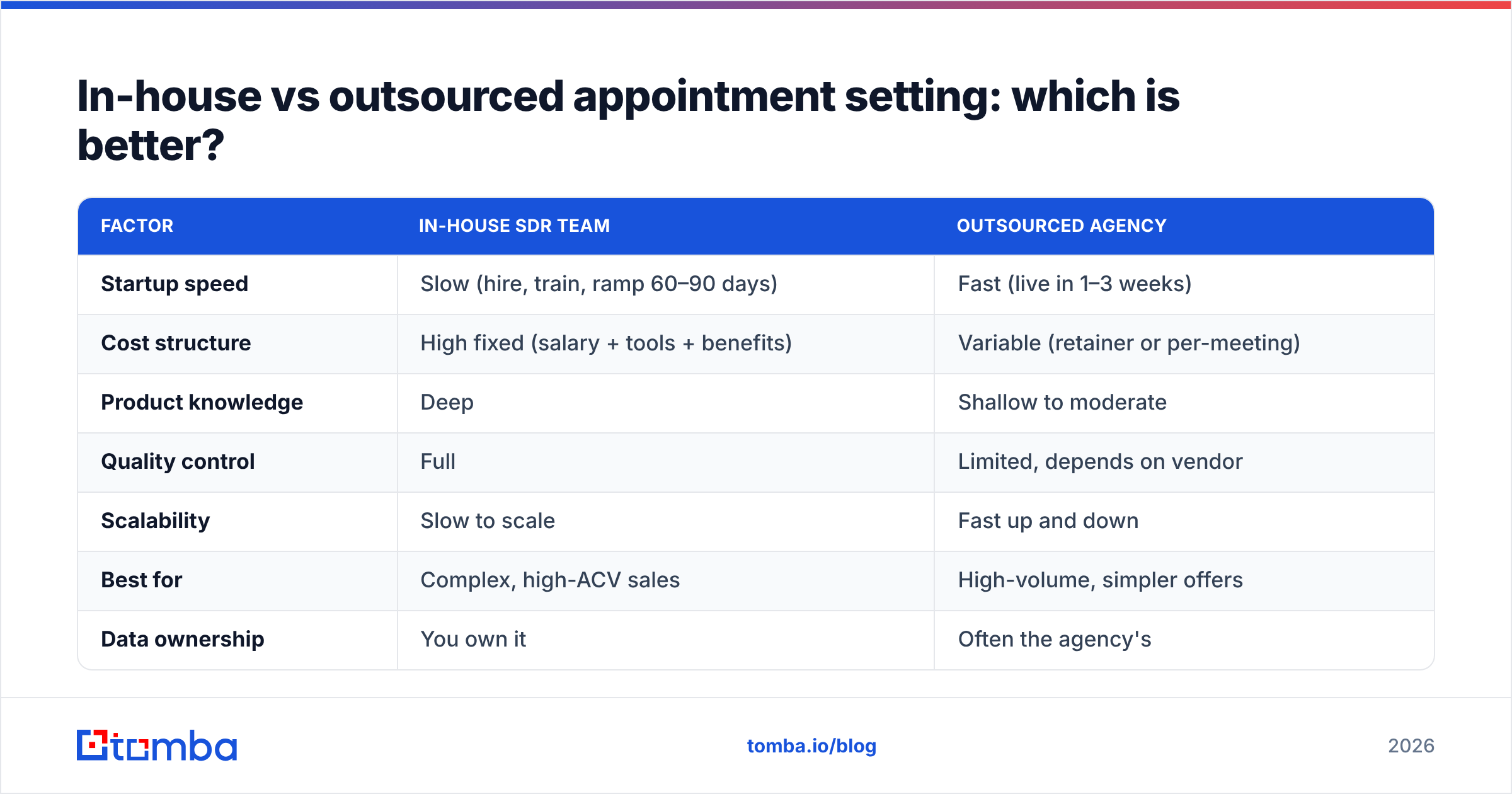
In-house vs outsourced appointment setting: which is better?#
Neither is universally better — it depends on your sales cycle, margin, and how specialized your pitch is. In-house gives you control and product depth; outsourcing gives you speed and lower fixed cost. Here's the honest comparison.
| Factor | In-House SDR Team | Outsourced Agency |
|---|---|---|
| Startup speed | Slow (hire, train, ramp 60–90 days) | Fast (live in 1–3 weeks) |
| Cost structure | High fixed (salary + tools + benefits) | Variable (retainer or per-meeting) |
| Product knowledge | Deep | Shallow to moderate |
| Quality control | Full | Limited, depends on vendor |
| Scalability | Slow to scale | Fast up and down |
| Best for | Complex, high-ACV sales | High-volume, simpler offers |
| Data ownership | You own it | Often the agency's |
A practical middle path many teams use in 2026: keep strategy, ICP, and data in-house, and outsource only the dialing volume — while insisting the agency uses your verified data and CRM so you keep ownership of every contact and outcome.
What scripts and messaging actually book meetings?#
Short, specific, and prospect-centered. The setter's job in the first 10 seconds is to earn the next 30. Avoid the "how are you today?" opener — it signals a pitch and triggers the brush-off.
Cold call opener that works:
"Hi [Name], this is [You] from [Company] — I know I'm calling out of the blue. I'll be quick: we help [role] at [similar companies] cut [specific pain] by [specific outcome]. Is that something on your radar this quarter, or am I way off?"
That last clause — giving them an easy out — disarms the reflex to hang up and gets a real answer.
Cold email that books:
Subject: quick question, [Company]
Hi [Name] — noticed [trigger event / specific detail]. We help [peer companies] solve [pain] without [common objection]. Worth a 15-minute look next Tuesday or Wednesday? If not, no worries — point me to the right person?
Notice the single ask, the specific times (decisions are easier than open-ended "let me know your availability"), and the referral fallback. Pair messaging with a strong response rate baseline so you can A/B test what moves the needle.

Which KPIs should you track?#
If you can't measure the funnel stage by stage, you can't fix it. Track these six and review them weekly.
- Activity volume — Dials and emails sent per rep, per day. The leading indicator.
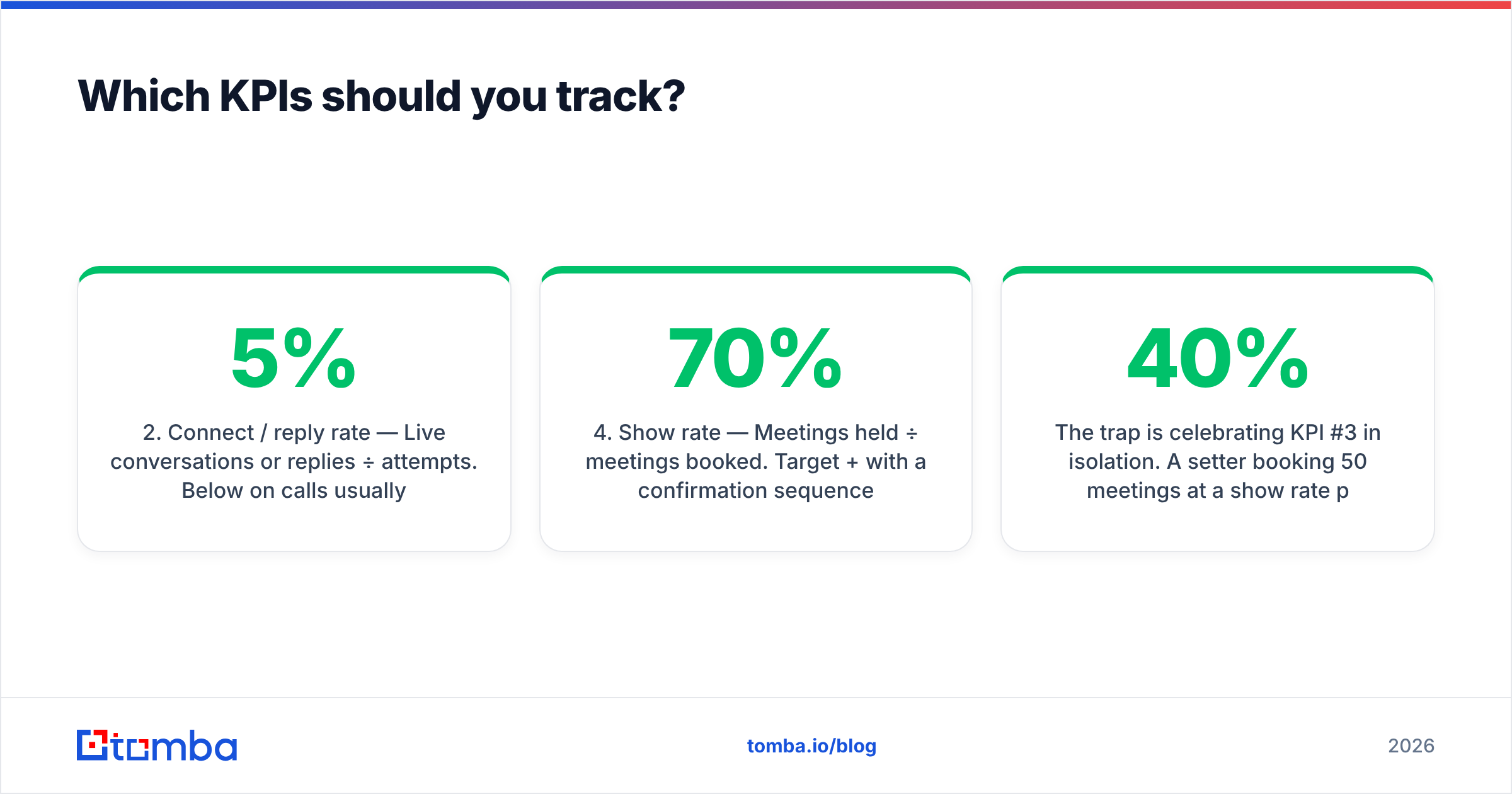
- Connect / reply rate — Live conversations or replies ÷ attempts. Below 5% on calls usually means a data or list problem.
- Meetings booked — Raw bookings. Useful, but never the headline metric.
- Show rate — Meetings held ÷ meetings booked. Target 70%+ with a confirmation sequence.
- Qualified meeting rate — Meetings that pass your closer's bar ÷ meetings held. This is the quality gate.
- Meeting-to-opportunity rate — Opportunities created ÷ qualified meetings. Ties appointment setting to revenue.
The trap is celebrating KPI #3 in isolation. A setter booking 50 meetings at a 40% show rate produces fewer real conversations than one booking 30 at an 80% show rate. Optimize for the back half of the funnel.
How does data quality drive appointment setting results?#
Garbage in, empty calendar out. The fastest way to double a setter's output isn't more dials — it's better data so every dial reaches a real person. Three data layers matter:
- Verified email — So sequences land instead of bouncing and torching your sender reputation.
- Direct dials — Mobile and direct lines beat switchboards by a wide margin for connect rates.
- Enrichment context — Title, company, tech stack, and trigger events that make personalization possible at scale.
This is where a purpose-built data tool earns its keep. Use a domain search to map every contact at a target account, an email finder to get verified addresses by name and company, and a phone finder to attach direct dials. Feeding clean, enriched records into your sequence is the difference between a 3% and an 8% connect rate — and at scale, that doubles your booked meetings without adding a single rep.
For broader context on building and qualifying lists, vendor-neutral resources like HubSpot's sales blog and peer reviews on G2 are worth bookmarking as you refine your stack.
How do you protect your show rate?#
Confirm, remind, add value. A booked meeting is a fragile thing — treat the gap between booking and meeting as an active sequence, not dead time.
- Immediate confirmation — Calendar invite + a one-line "looking forward, here's what we'll cover" email within minutes of booking.
- Value drip — One relevant resource (case study, short Loom) a day or two before. It re-sells the value of showing up.
- Day-before confirm — A short "still good for tomorrow at 2pm ET?" reply. Easy to say yes; easy to reschedule instead of ghosting.
- Same-day reminder — A morning-of nudge with the join link front and center.
Teams that run all four steps routinely see show rates climb from the low 50s into the 75–85% range. That's free pipeline — no extra prospecting required.
What tools make up a 2026 appointment setting stack?#
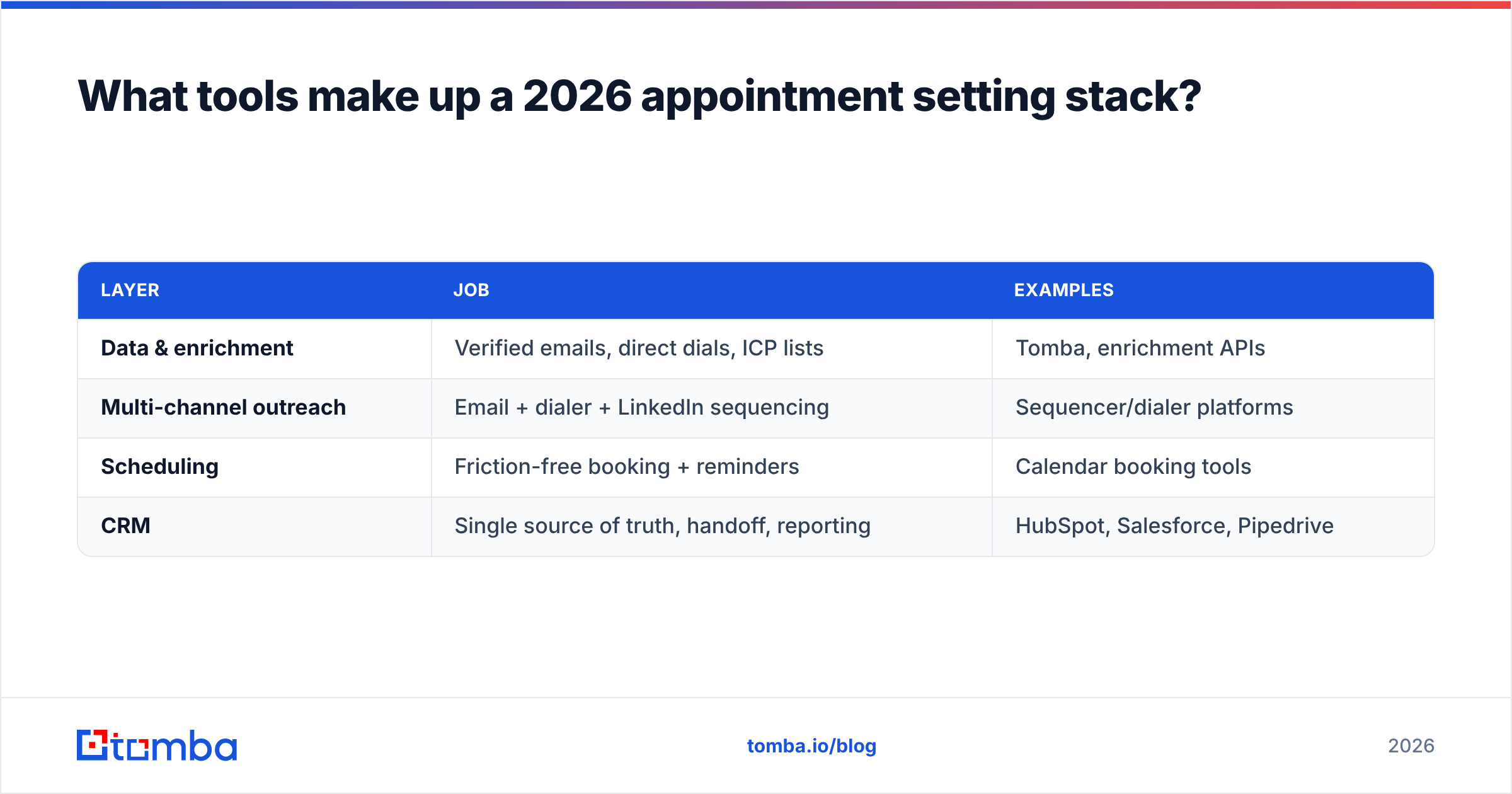
You need four layers: data, outreach, scheduling, and CRM. Keep it lean — tool sprawl creates data silos that quietly re-introduce the dirty-data problem.
| Layer | Job | Examples |
|---|---|---|
| Data & enrichment | Verified emails, direct dials, ICP lists | Tomba, enrichment APIs |
| Multi-channel outreach | Email + dialer + LinkedIn sequencing | Sequencer/dialer platforms |
| Scheduling | Friction-free booking + reminders | Calendar booking tools |
| CRM | Single source of truth, handoff, reporting | HubSpot, Salesforce, Pipedrive |
The non-negotiable is that the data layer feeds everything cleanly. If your enrichment, outreach, and CRM don't share verified records, you'll rebuild the same broken list three times. Tomba connects to most stacks through native integrations and the Tomba API, so verified contacts flow straight into your sequencer and CRM. Compare options against your budget on the Tomba pricing page before you commit.
Start with the data layer#
The cheapest, highest-leverage fix in any B2B appointment setting program is the contact data underneath it. Before you hire another setter or test another script, make sure every record your team touches has a verified email and a real direct dial — because a perfect script aimed at a dead inbox books zero meetings.
Start free with the Tomba Email Finder: find and verify professional emails by name, company, or domain, attach direct phone numbers, and feed clean records straight into your outreach. The free tier gives you 25 searches a month to test it on your next target account; paid plans start at $49/mo when you're ready to scale. Fill your calendar with meetings that actually show up — starting with data you can trust.
Ready to find emails that actually work?
Join 150,000+ professionals who stopped guessing and started sending. Free credits on signup — no credit card required.
Get the Tomba newsletter
Practical outbound tactics and product updates — once every two weeks.
About the author