B2B Appointment Setting Services in 2026: The Buyer's Guide
A practical 2026 guide to B2B appointment setting services: pricing models, in-house vs outsourced, what to vet, and how clean data makes or breaks every booked meeting.
TL;DR
- B2B appointment setting services book qualified sales meetings on your behalf, either through an outsourced agency, a dedicated SDR team, or a hybrid software-plus-human model.
- Pricing splits into three models: pay-per-appointment ($150–$400 per meeting), monthly retainer ($3,000–$10,000+), and per-SDR seat ($4,000–$8,000/mo). Each rewards a different sales motion.
- The single biggest predictor of cost-per-meeting is data quality. A setter dialing stale or unverified contacts burns hours before booking anything.
- Outsourcing buys speed; in-house buys control and brand fidelity. Most teams under $5M ARR start outsourced, then bring it in-house as the playbook stabilizes.
- Whatever you choose, own your contact data. Verified emails and direct dials feed every channel — and that's where a tool like Tomba pays for itself.
What are B2B appointment setting services?#
B2B appointment setting services are outsourced or specialized teams that handle the top of your sales funnel — prospecting, qualifying, and booking meetings — so your closers only talk to people worth talking to. Think of it like a restaurant host: the host greets, checks reservations, and seats the right party at the right table, freeing the chef to cook. The setter qualifies and books; your account executive closes.
The work usually spans cold calling, cold email, LinkedIn outreach, and follow-up cadences. A setter's job ends the moment a qualified prospect agrees to a meeting and it lands on an AE's calendar. They don't negotiate, demo, or close — they manufacture pipeline.
This matters because the math of B2B sales is brutal at the top. If it takes 100 conversations to book 10 meetings to close 1 deal, the conversation layer is pure volume and grind. Appointment setting services exist to absorb that grind at a predictable cost.
How do B2B appointment setting services actually work?#
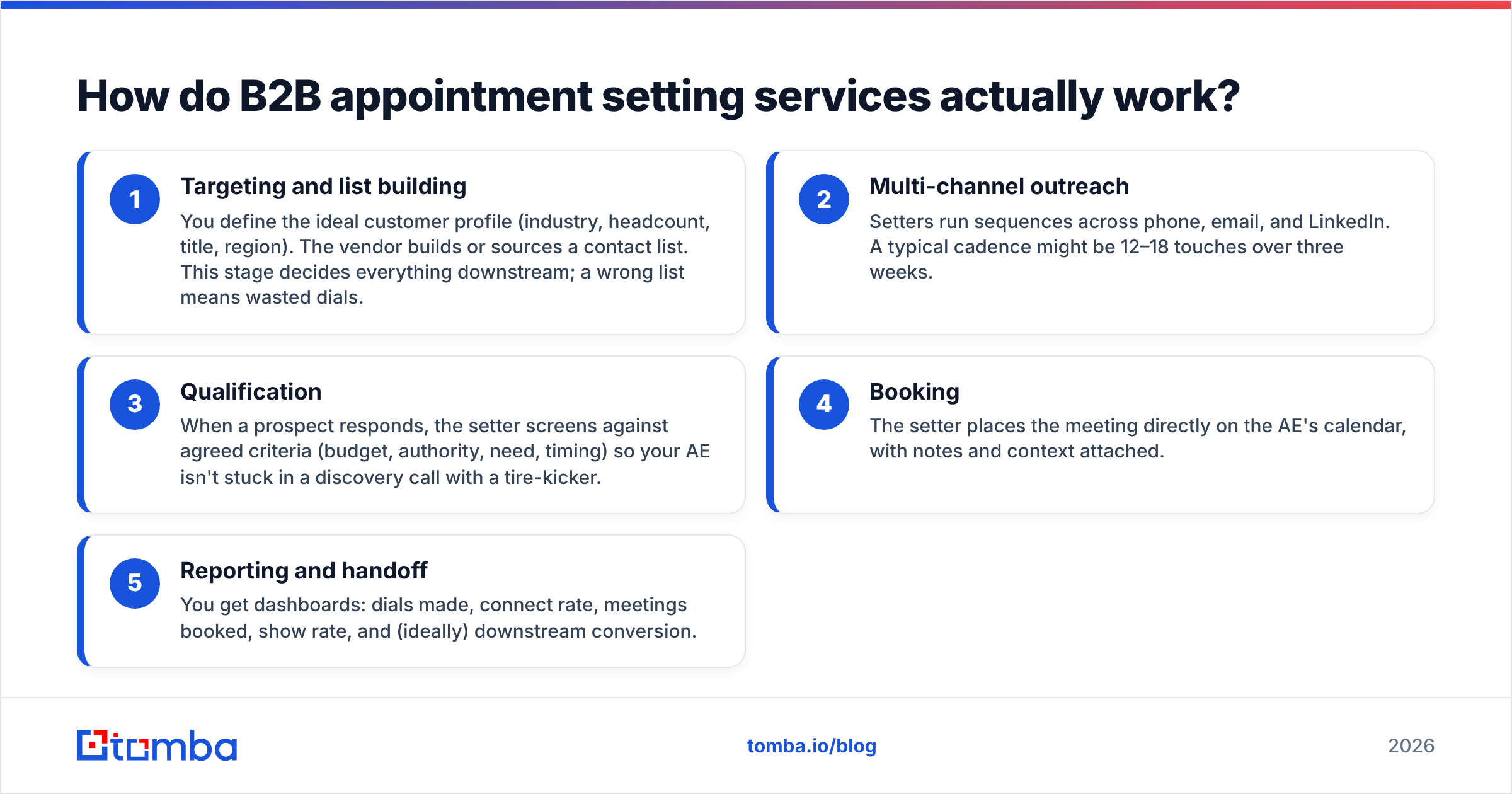
Most engagements follow the same five-stage motion, regardless of vendor:
- Targeting and list building — You define the ideal customer profile (industry, headcount, title, region). The vendor builds or sources a contact list. This stage decides everything downstream; a wrong list means wasted dials.
- Multi-channel outreach — Setters run sequences across phone, email, and LinkedIn. A typical cadence might be 12–18 touches over three weeks.
- Qualification — When a prospect responds, the setter screens against agreed criteria (budget, authority, need, timing) so your AE isn't stuck in a discovery call with a tire-kicker.
- Booking — The setter places the meeting directly on the AE's calendar, with notes and context attached.
- Reporting and handoff — You get dashboards: dials made, connect rate, meetings booked, show rate, and (ideally) downstream conversion.
The quiet failure point is stage 1. A setter can be a phone wizard, but if the B2B database behind the list is full of role-changers, bounced emails, and disconnected numbers, the connect rate collapses and your cost-per-meeting doubles. That's why mature buyers separate two questions: who is doing the dialing and where is the data coming from. The best vendors are transparent about both.
What are the main types of appointment setting models?#
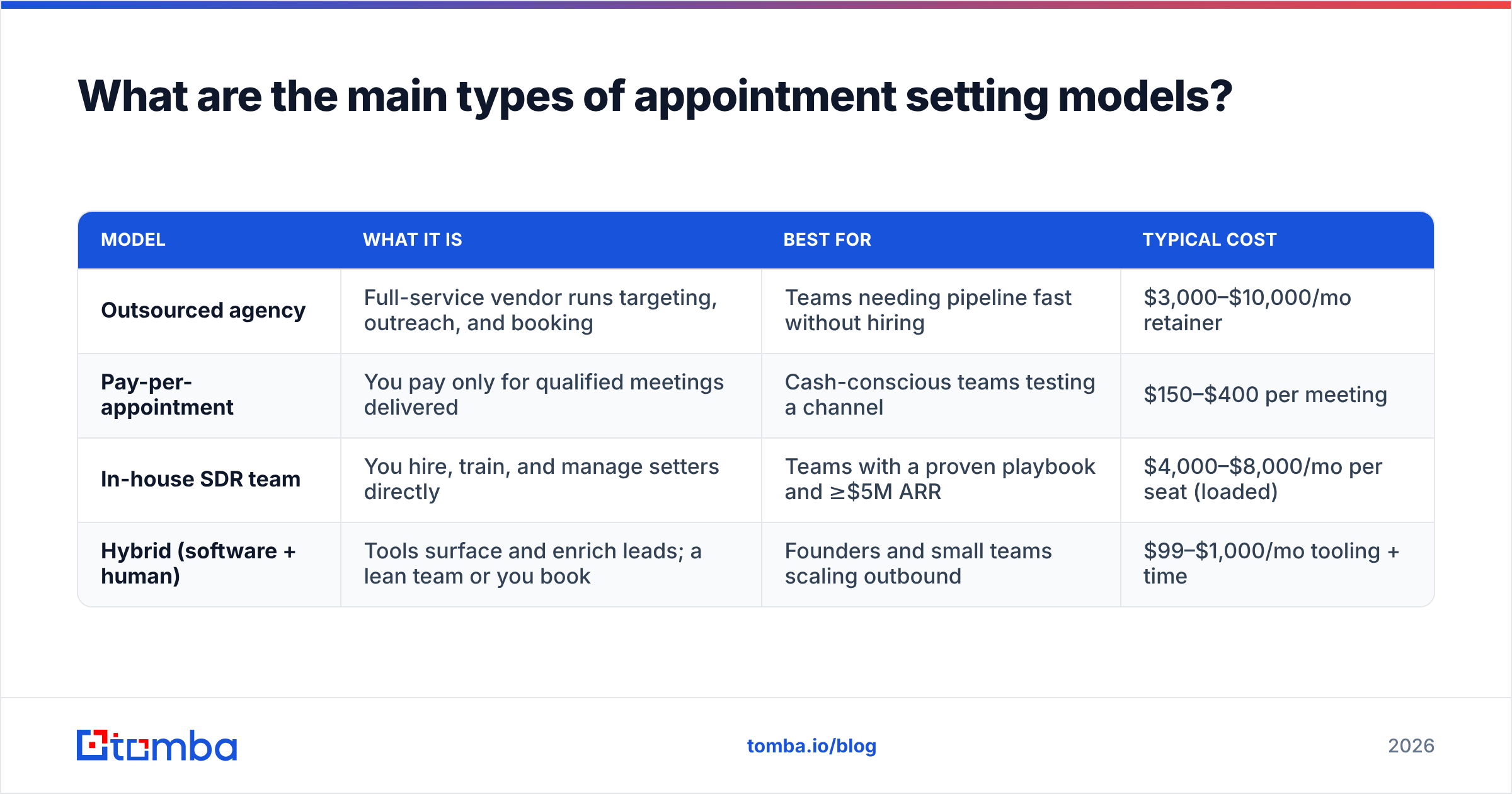
There are three structural ways to buy appointment setting, and they suit very different teams.
| Model | What it is | Best for | Typical cost |
|---|---|---|---|
| Outsourced agency | Full-service vendor runs targeting, outreach, and booking | Teams needing pipeline fast without hiring | $3,000–$10,000/mo retainer |
| Pay-per-appointment | You pay only for qualified meetings delivered | Cash-conscious teams testing a channel | $150–$400 per meeting |
| In-house SDR team | You hire, train, and manage setters directly | Teams with a proven playbook and ≥$5M ARR | $4,000–$8,000/mo per seat (loaded) |
| Hybrid (software + human) | Tools surface and enrich leads; a lean team or you book | Founders and small teams scaling outbound | $99–$1,000/mo tooling + time |
Each model trades cost against control. Pay-per-appointment looks cheapest until you realize you have little say over how the meeting was sold — show rates and deal quality can suffer when the vendor is incentivized purely on volume. Retainers align better on quality but cost more upfront. In-house gives you total brand control and institutional learning, at the price of management overhead and ramp time.
Is outsourced appointment setting better than in-house?#
Neither is universally better — it depends on your stage, margin, and how repeatable your sales motion is. Here's the honest tradeoff.
Outsourcing wins on speed and flexibility. You can have setters dialing within two to four weeks instead of the two to three months it takes to hire, onboard, and ramp an SDR. You can scale up for a product launch and scale down after, without severance. And you offload the management headache. Gartner and other analysts have long noted that sales development is one of the highest-turnover roles in B2B, so outsourcing the churn problem has real appeal.
In-house wins on control and compounding knowledge. Your setters live your brand, learn your product deeply, and feed objections and competitive intel straight back into product and marketing. The institutional memory stays with you. For complex, high-ACV sales where every conversation shapes the deal, that fidelity is worth the overhead.
The pattern most successful teams follow: outsource to learn, insource to scale. Use an agency to validate which segments, scripts, and channels actually book meetings. Once you have a playbook that works, bring it in-house where the unit economics improve and the knowledge compounds.

One caveat regardless of model: don't outsource your data ownership. If the vendor disappears, you should keep the verified contacts, the response rate benchmarks, and the enriched records. Build that asset on your own infrastructure.
How much do B2B appointment setting services cost in 2026?#
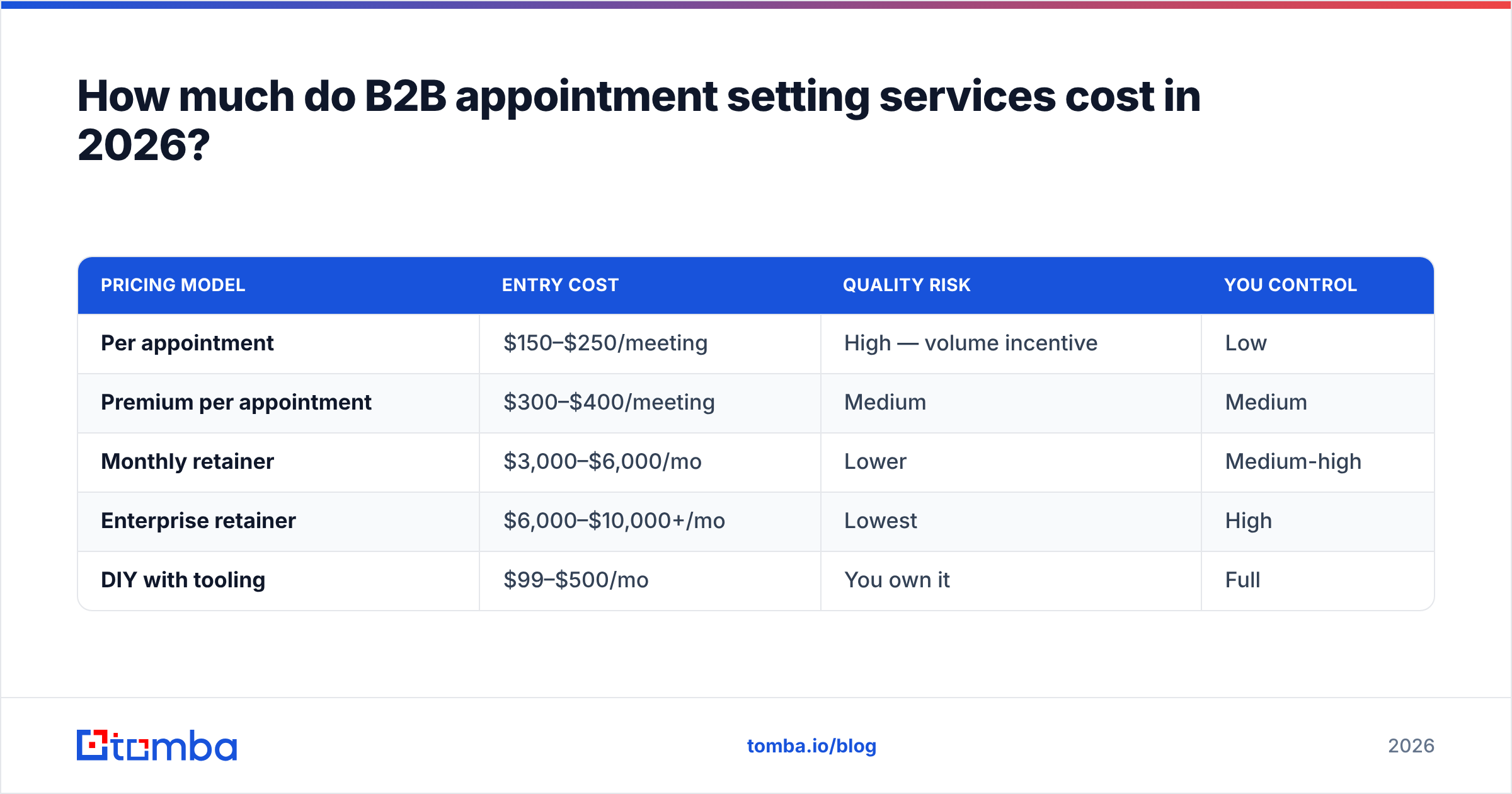
Expect to pay somewhere between $150 per booked meeting and $10,000 per month, depending on model and complexity. The wide range reflects how much the vendor does and how hard your market is to reach.
| Pricing model | Entry cost | Quality risk | You control |
|---|---|---|---|
| Per appointment | $150–$250/meeting | High — volume incentive | Low |
| Premium per appointment | $300–$400/meeting | Medium | Medium |
| Monthly retainer | $3,000–$6,000/mo | Lower | Medium-high |
| Enterprise retainer | $6,000–$10,000+/mo | Lowest | High |
| DIY with tooling | $99–$500/mo | You own it | Full |
A few things move these numbers:
- Title seniority. Booking a VP of Engineering costs far more than booking an office manager — fewer prospects, harder to reach, more gatekeepers.
- Deal complexity. Technical or compliance-heavy sales need setters who can hold a credible conversation, which commands premium rates.
- Geography and timezone. Multi-region coverage adds cost.
- Data quality. This is the hidden multiplier. If 30% of your list bounces or rings dead, you're paying for activity that can never convert.
That last point is why the DIY-with-tooling row is more competitive than it looks. If you already have a founder or a junior rep who can run calls, the bottleneck isn't the dialing — it's getting accurate contacts in front of them. A focused stack of an email finder, an email verifier, and a phone finder can replace a chunk of agency spend for early-stage teams. For reference on tooling tiers, see Tomba pricing, which starts free at 25 searches/mo and scales to $49/mo Starter and $99/mo Growth.
What should you look for when vetting a vendor?#
Vet on outcomes and process, not on promises. Any vendor will claim great results — make them prove the inputs. Use this checklist:
- Show rate, not just booked rate. A meeting that no-shows is worthless. Ask for show rate (target ≥70%) and how they confirm meetings.
- Where does the data come from? Ask directly about data sources and verification. If they can't explain it, assume the list is scraped and stale.
- Qualification criteria in writing. Vague qualification means you'll inherit junk meetings. Get the BANT-style rubric documented before signing.
- Downstream conversion reporting. Good vendors track meetings to opportunities to closed-won, not just to the calendar.
- Ramp time and dedicated headcount. Know whether you're getting a dedicated setter or a shared pool, and how long until full productivity.
- Compliance. Confirm they follow GDPR, CAN-SPAM, and TCPA rules for the regions you sell into. The FTC's CAN-SPAM guidance is a reasonable baseline.
- Contract flexibility. Avoid 12-month lock-ins before you've seen 60–90 days of data.
A useful tactic: ask to review the actual contact list before they start dialing. Run a sample through your own email verification and check a handful of direct dials. If the sample is dirty, every meeting you buy will cost more than quoted.
How does data quality change the economics?#
Data quality is the lever that decides whether appointment setting is profitable or a money pit. The setter's time is fixed; the only variable is how many of their dials and emails reach a real, relevant human.
Consider two teams running identical 20-touch cadences against 1,000 contacts:
- Team A (dirty list, ~70% accuracy): 300 contacts are wrong from the start. Bounces hurt sender reputation, calls hit dead numbers, and setters waste a third of their day on noise. Effective cost-per-meeting climbs.
- Team B (verified list, ~97% accuracy): Nearly every touch reaches the target. Sender reputation stays healthy, email deliverability holds, connect rates rise, and the same setter books more meetings in the same hours.
Same people, same scripts — wildly different unit economics, purely because of the data layer. This is why enriching and verifying contacts before outreach isn't a nice-to-have; it's the highest-ROI step in the entire process. Pulling verified emails and direct dials with a domain search or bulk email finder, then enriching records with firmographics, turns a generic list into a targeting weapon. Vendors like ZoomInfo and Apollo sell this bundled; standalone tools let you keep ownership and control cost. Independent reviews on G2 are a fair place to compare accuracy claims across providers.
Which approach is right for your team?#
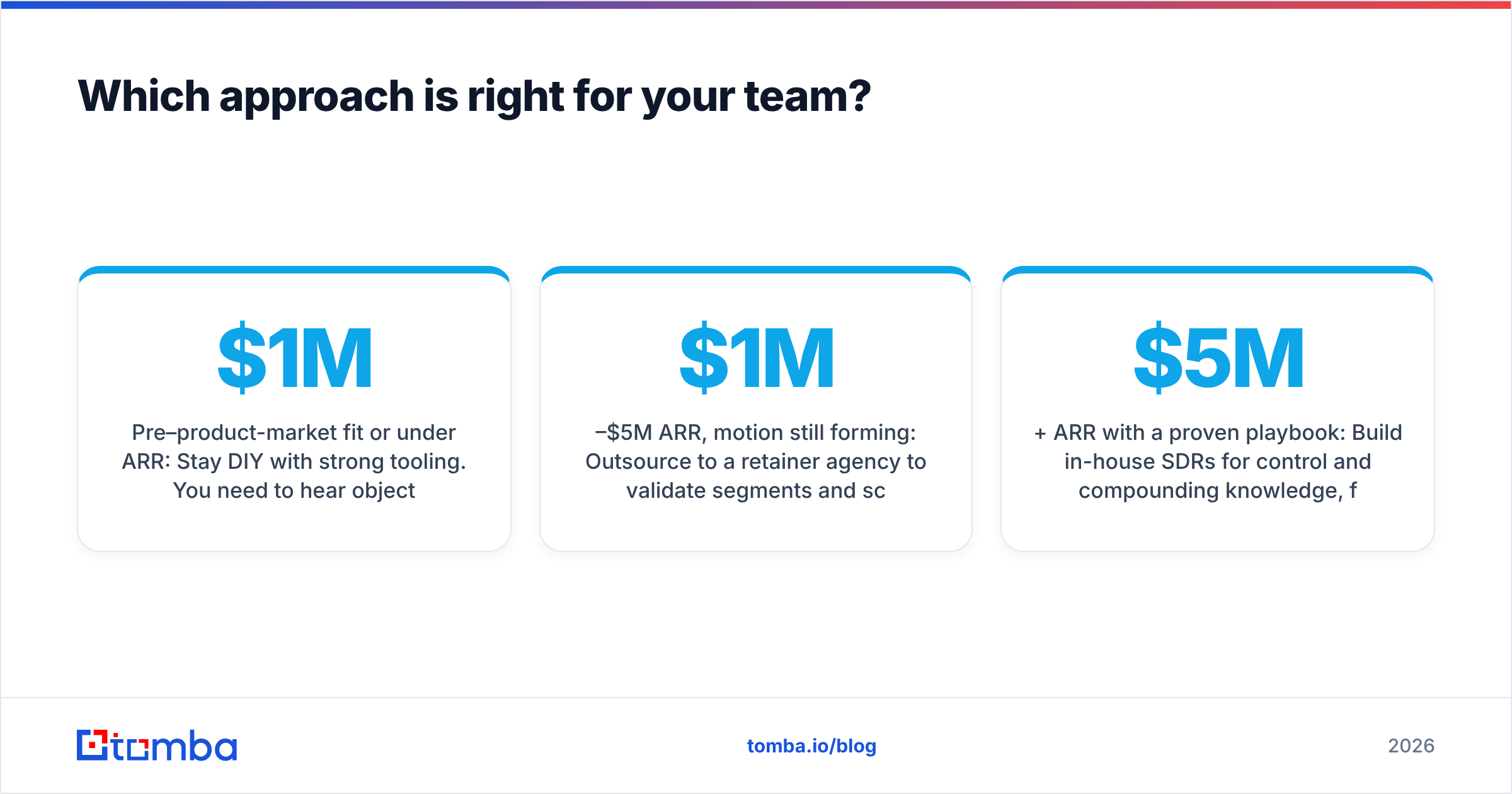
Match the model to your stage and motion:
- Pre–product-market fit or under $1M ARR: Stay DIY with strong tooling. You need to hear objections firsthand. Use an email finder, a verifier, and a Chrome extension to build clean lists, and have founders or early reps run the calls.
- $1M–$5M ARR, motion still forming: Outsource to a retainer agency to validate segments and scripts fast, while you keep the verified contact data on your own infrastructure.
- $5M+ ARR with a proven playbook: Build in-house SDRs for control and compounding knowledge, feeding them enriched data through your CRM via HubSpot or Salesforce integrations.
- Bursty or seasonal demand: Use pay-per-appointment as a flex valve on top of a small core team.
Whatever tier you sit in, the constant is data. The vendor relationship may change; the need for accurate, verified, enriched contacts never does.
The bottom line#
B2B appointment setting services can be one of the fastest ways to manufacture pipeline — but only when the contact data underneath is clean. Outsourcing buys speed, in-house buys control, and pay-per-appointment buys flexibility, yet all three rise or fall on whether your setters are reaching real, relevant people. Decide your model by stage, vet vendors on show rate and data transparency, and never hand over ownership of your contact asset.
Start by fixing the input. Use the Tomba Email Finder to build verified, enriched lists by domain, name, or company — feed those into your own setters or hand them to an agency. The free tier gives you 25 searches a month to test the difference clean data makes; Starter at $49/mo and Growth at $99/mo scale with your outbound. Better data, more booked meetings, lower cost per meeting — that's the whole game.
// get started
Find, verify and enrich your first contacts today
Start on the free plan with 25 searches a month, then scale when your team is ready.
Free plan · No credit card required · GDPR & CCPA
// about the author