B2B Brand Positioning in 2026: A Practical Framework Guide
Most B2B brands sound identical. This 2026 guide breaks down a practical b2b brand positioning framework, with examples, a comparison table, and the data work that makes it stick.
TL;DR
- B2B brand positioning is the deliberate choice of who you serve, what category you compete in, and why a buyer should pick you over the obvious alternative — written down and enforced everywhere.
- Most B2B companies fail at positioning by describing features instead of claiming a distinct place in the buyer's mind. "Powerful, easy-to-use, all-in-one" is not a position.
- A workable position has five parts: target segment, competitive frame, differentiator, proof, and the value that differentiator unlocks.
- Positioning is a research problem before it is a copywriting problem. You validate it against real accounts, real titles, and real objections — not a whiteboard.
- This guide gives you a framework, a comparison of three positioning strategies, examples, and the data steps to ground it in reality.
What is B2B brand positioning, really?#
B2B brand positioning is the place your company occupies in a buyer's head when they think about solving a specific problem. It is not your logo, your tagline, or your color palette. It is the answer to a blunt question: when a VP of Sales has this exact problem, why does your name come up, and why do they trust it over the default option?
Think of it like seating at a crowded conference. Hundreds of vendors are in the room, all shouting some version of "we save you time and money." Positioning is choosing one table, putting your name on it, and making sure the right people know that is where the conversation they care about happens. You cannot own every table. The companies that try end up owning none.
The classic definition comes from April Dunford's work and the older Ries-and-Trout school: positioning is context-setting. You tell the buyer what you should be compared against, then you win that comparison on the one or two dimensions that matter most to them. Everything else — messaging, content, sales decks, pricing pages — is downstream of that decision.
In B2B specifically, positioning carries extra weight because buying committees are large (Gartner pegs the typical B2B buying group at six to ten stakeholders), sales cycles are long, and the cost of a wrong choice is a career risk for the buyer. A sharp position reduces perceived risk. A muddy one increases it.
Why do most B2B positioning attempts fail?#
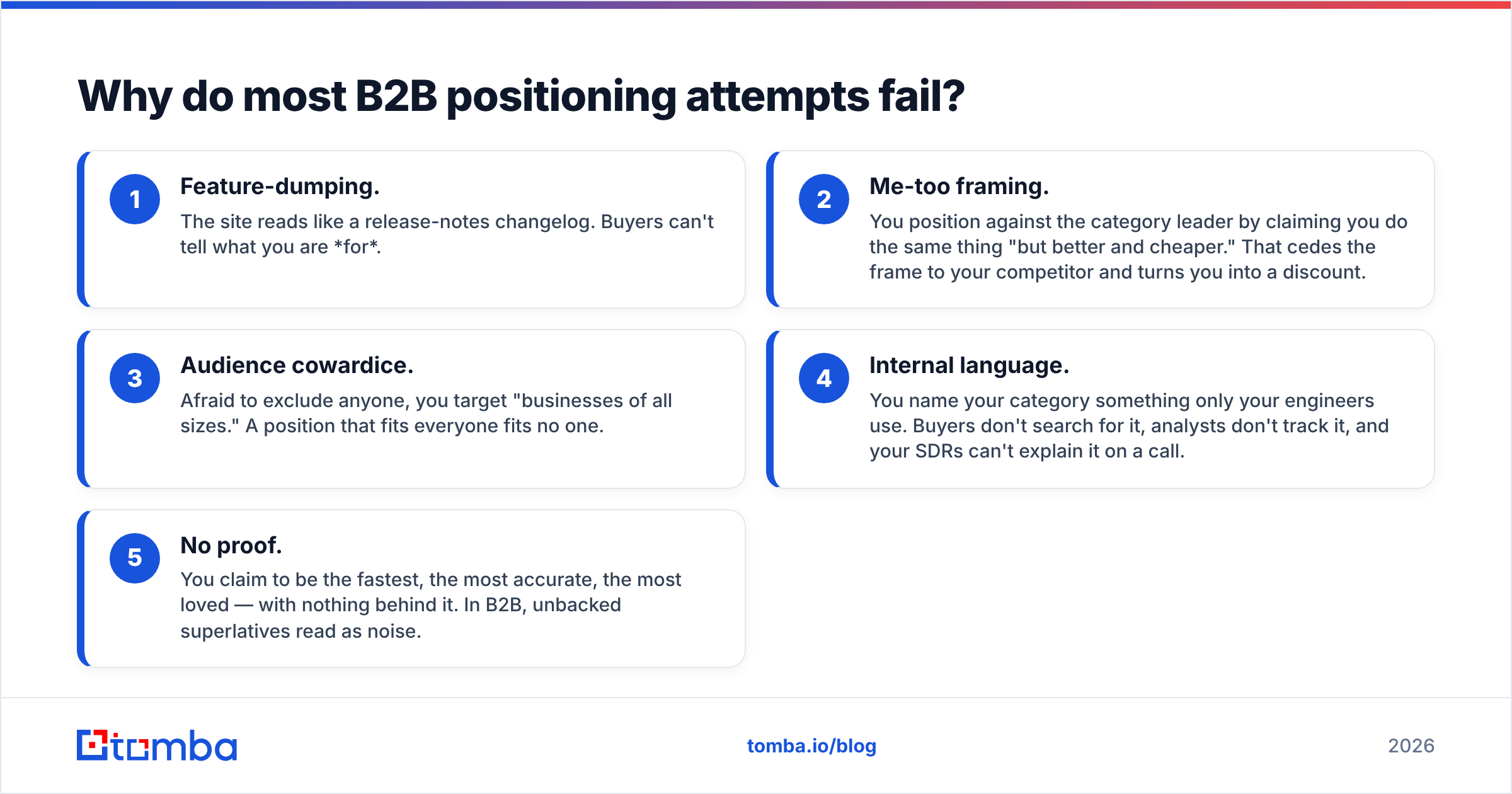
Conclusion first: most attempts fail because teams confuse description with differentiation. They list what the product does and assume the market will infer why it matters. It won't.
Here are the recurring failure modes:
- Feature-dumping. The site reads like a release-notes changelog. Buyers can't tell what you are for.
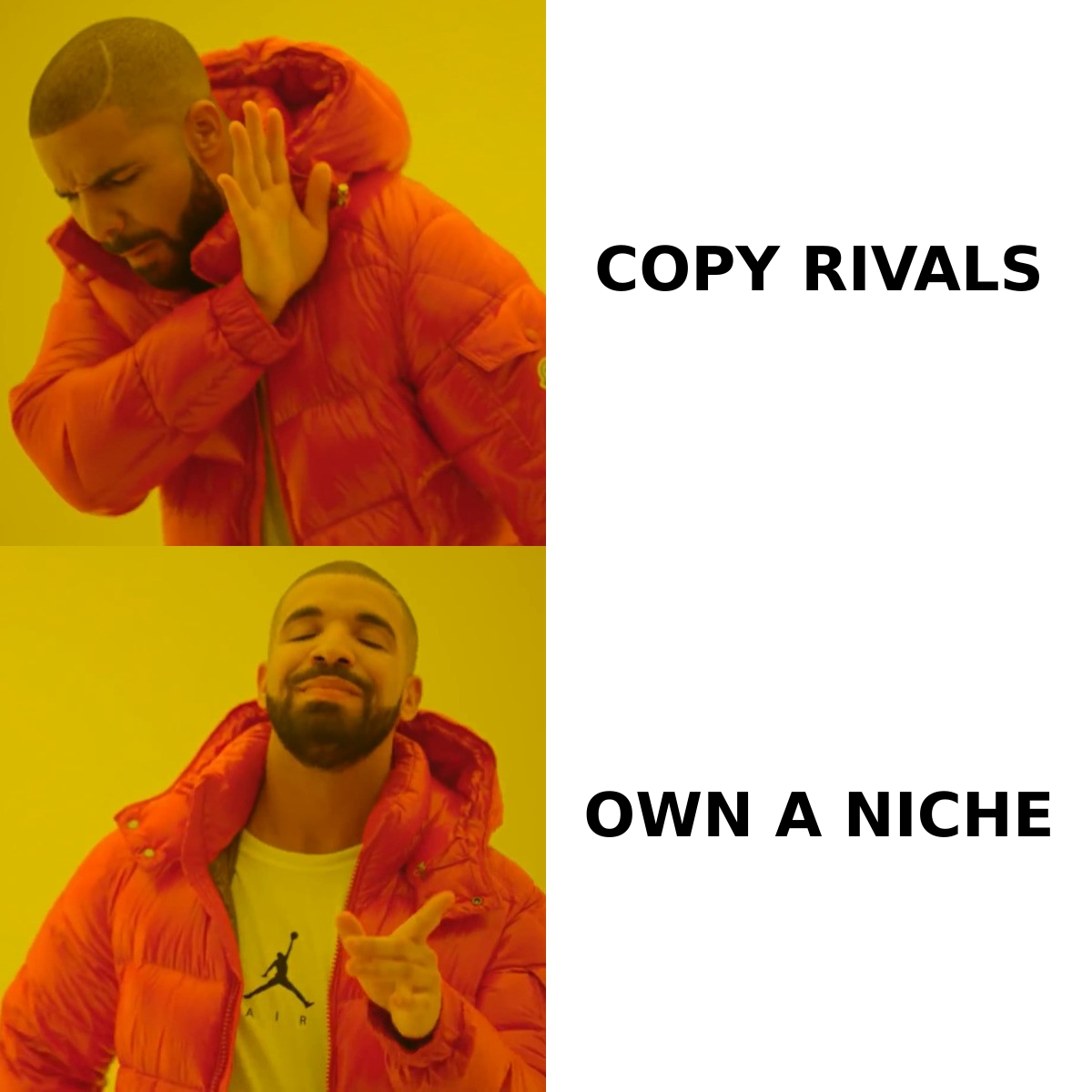
- Me-too framing. You position against the category leader by claiming you do the same thing "but better and cheaper." That cedes the frame to your competitor and turns you into a discount.
- Audience cowardice. Afraid to exclude anyone, you target "businesses of all sizes." A position that fits everyone fits no one.
- Internal language. You name your category something only your engineers use. Buyers don't search for it, analysts don't track it, and your SDRs can't explain it on a call.
- No proof. You claim to be the fastest, the most accurate, the most loved — with nothing behind it. In B2B, unbacked superlatives read as noise.
The fix for all five is the same discipline: pick a fight you can win, in a category buyers already understand, against a clearly named alternative, backed by evidence. That is the whole game.
What does a B2B brand positioning framework look like?#
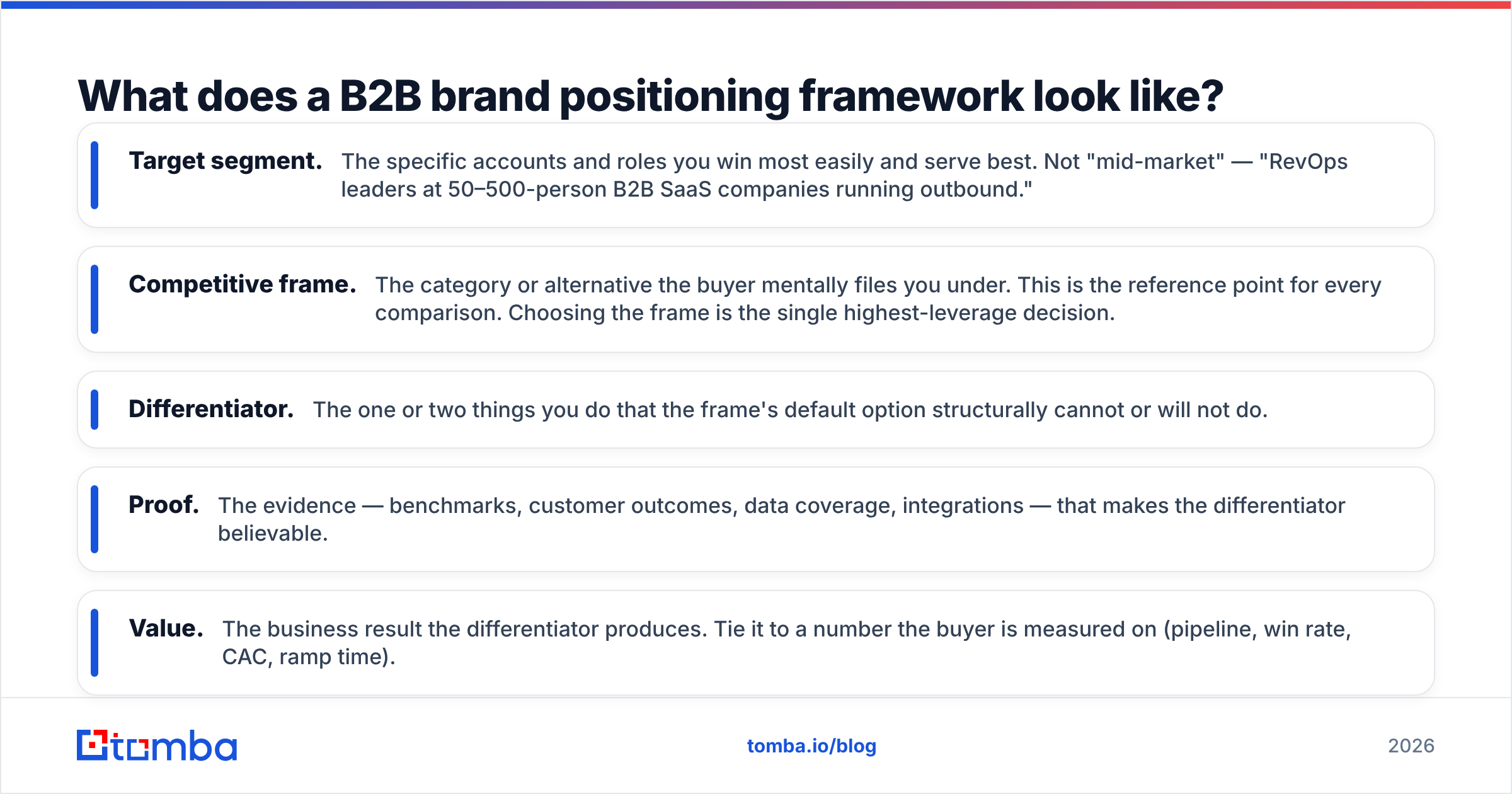
A position you can actually operationalize has five components. Write one sentence for each, then stress-test them as a unit.
- Target segment. The specific accounts and roles you win most easily and serve best. Not "mid-market" — "RevOps leaders at 50–500-person B2B SaaS companies running outbound."
- Competitive frame. The category or alternative the buyer mentally files you under. This is the reference point for every comparison. Choosing the frame is the single highest-leverage decision.
- Differentiator. The one or two things you do that the frame's default option structurally cannot or will not do.
- Proof. The evidence — benchmarks, customer outcomes, data coverage, integrations — that makes the differentiator believable.
- Value. The business result the differentiator produces. Tie it to a number the buyer is measured on (pipeline, win rate, CAC, ramp time).
If any one of these is vague, the whole position wobbles. A great differentiator with the wrong target is a solution looking for a problem. A perfect target with no proof is a pitch nobody believes.
For shared vocabulary across your go-to-market team, it helps to anchor terms in a common reference. Tomba's B2B glossary and its entry on revenue operations are useful when marketing and RevOps need to agree on what a "segment" or a "qualified account" actually means before they argue about positioning.
Which positioning strategy fits your company?#
There is no universal best strategy — there is the one that matches your wedge, your stage, and your competitive reality. Three dominate B2B.
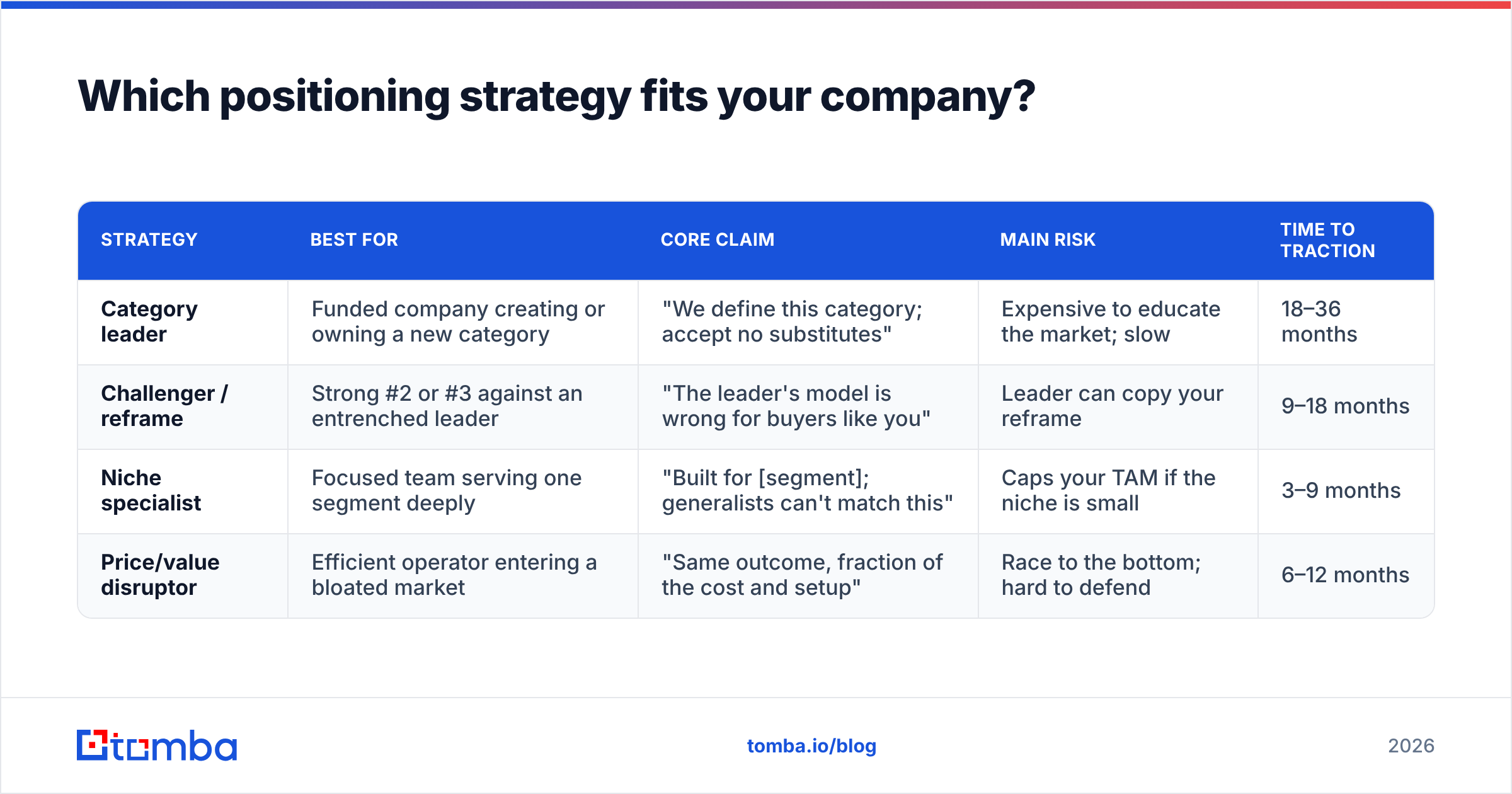
| Strategy | Best for | Core claim | Main risk | Time to traction |
|---|---|---|---|---|
| Category leader | Funded company creating or owning a new category | "We define this category; accept no substitutes" | Expensive to educate the market; slow | 18–36 months |
| Challenger / reframe | Strong #2 or #3 against an entrenched leader | "The leader's model is wrong for buyers like you" | Leader can copy your reframe | 9–18 months |
| Niche specialist | Focused team serving one segment deeply | "Built for [segment]; generalists can't match this" | Caps your TAM if the niche is small | 3–9 months |
| Price/value disruptor | Efficient operator entering a bloated market | "Same outcome, fraction of the cost and setup" | Race to the bottom; hard to defend | 6–12 months |
Most B2B startups should start as a niche specialist or a challenger, then graduate toward category leadership once they have proof and revenue. Trying to play category leader on day one — without the funding to educate a market — is the most common way to burn 18 months.
A note on the price/value lane: competing on price is only defensible when your cost structure is genuinely different, not just your margins. Transparent pricing helps here. The way Tomba's pricing lays out a free tier (25 searches/month), Starter at $49/mo, Growth at $99/mo, and Pro at $249/mo is itself a positioning move — it signals "self-serve, no sales gauntlet" to a buyer who is tired of "contact us for a quote." Your pricing page is a positioning artifact whether you treat it like one or not.
How do you validate positioning with real buyer data?#
Conclusion first: positioning written from inside a conference room is a hypothesis, not a strategy. You validate it against the accounts you actually win, the titles that actually champion you, and the objections that actually kill deals.
Here is the data loop that separates a real position from a slogan:
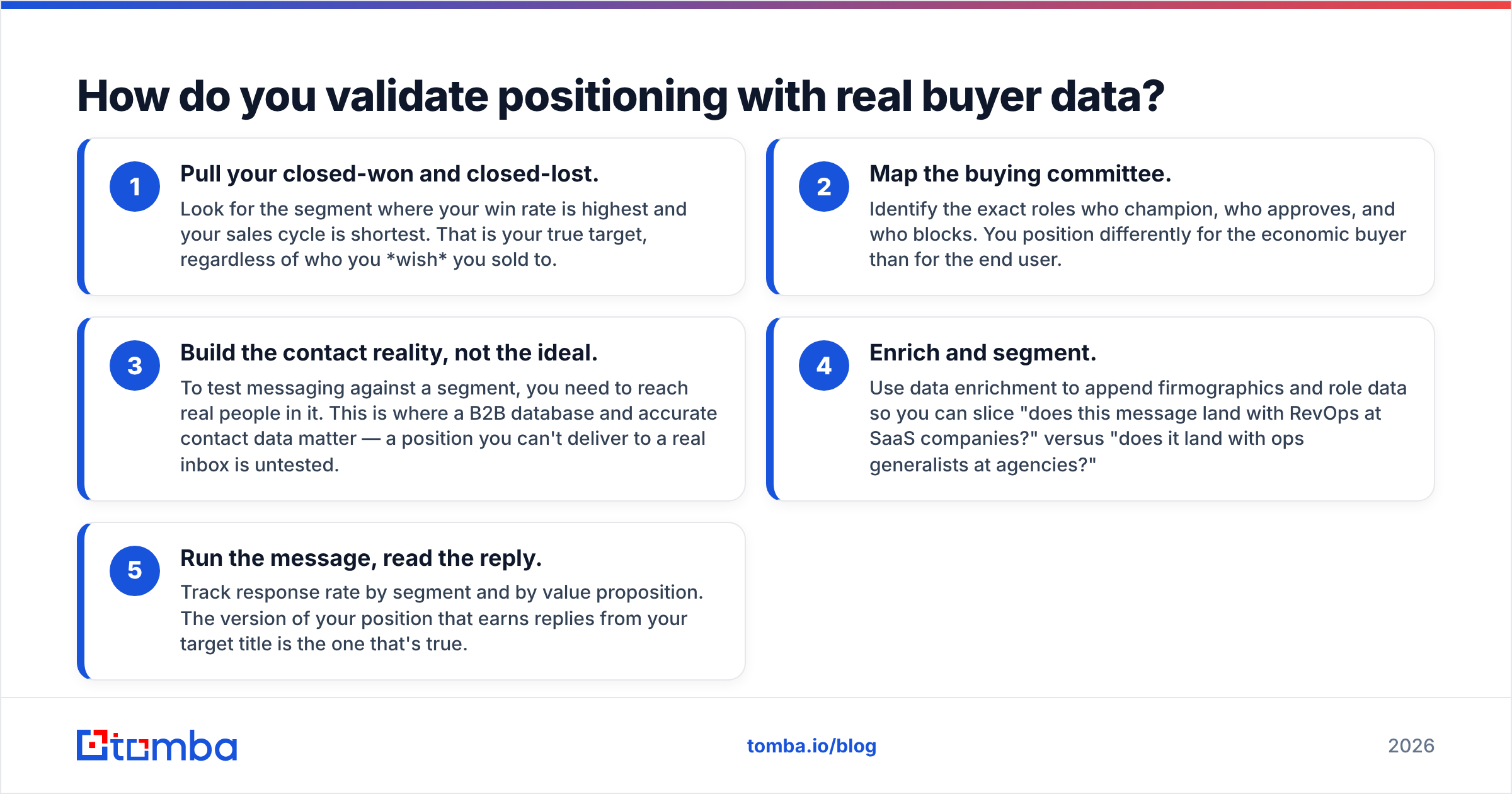
- Pull your closed-won and closed-lost. Look for the segment where your win rate is highest and your sales cycle is shortest. That is your true target, regardless of who you wish you sold to.
- Map the buying committee. Identify the exact roles who champion, who approves, and who blocks. You position differently for the economic buyer than for the end user.
- Build the contact reality, not the ideal. To test messaging against a segment, you need to reach real people in it. This is where a B2B database and accurate contact data matter — a position you can't deliver to a real inbox is untested.
- Enrich and segment. Use data enrichment to append firmographics and role data so you can slice "does this message land with RevOps at SaaS companies?" versus "does it land with ops generalists at agencies?"
- Run the message, read the reply. Track response rate by segment and by value proposition. The version of your position that earns replies from your target title is the one that's true.
This is the unglamorous half of positioning that consultants skip. Sharp language is necessary but not sufficient — you need the contact data and the feedback loop to know which sharp language is correct. When your outbound list is built on verified, well-segmented data, every campaign doubles as a positioning test.
What are some concrete B2B positioning examples?#
Abstractions are easy to nod at and hard to apply. Here are three patterned examples you can adapt.
Example 1 — The reframe. A mid-tier sales-engagement tool stops positioning against the market leader on feature parity. Instead it reframes: "Enterprise sequencers are built for 200-rep teams. We're built for the 10-rep team that needs to be running by Friday." The competitive frame shifts from "feature checklist" to "time-to-value," where the leader is structurally weak. Same product, a frame they can win.
Example 2 — The niche claim. A data vendor stops saying "B2B contact data for everyone" and says "the most accurate emails for European B2B companies." Narrower TAM, but in that niche it beats the generalists on the one axis — regional accuracy — that the target segment is measured on. Buyers in that niche now have a reason to pick it over a bigger name.
Example 3 — The proof-led position. A verification tool leads with a published, repeatable benchmark rather than an adjective. "98.x% deliverable on a standard 10k-record test, methodology public." The position is the proof. This works because B2B buyers discount claims and reward evidence. If you go this route, the supporting email verifier or accuracy data has to be real and reproducible, or the position collapses on first contact.
The common thread: each example chooses a frame, names the alternative implicitly or explicitly, and wins on a single dimension that the target segment already cares about.
How do you roll positioning out across go-to-market?#
A position that lives only in a slide deck is decoration. To change buyer perception, it has to show up consistently everywhere a prospect touches you. Sequence it like this:
- Source of truth. One internal positioning doc, owned by one person, with the five components above. Everything references it.
- Website hierarchy. Homepage hero states the category and the differentiator in one breath. Don't bury it under "Welcome to the future of work."
- Sales narrative. Reps open with the competitive frame, not the feature tour. Train them to set the comparison before they demo.
- Content and SEO. Publish against the problems your target segment searches for, using the category language they use. This is also where outbound prospecting and content compound — consistent language across a HubSpot or Salesforce-managed funnel keeps the position intact from first ad to closed deal.
- Proof library. Maintain live benchmarks, case studies, and third-party validation. Reviews on G2 are positioning infrastructure — they're where buyers check whether your claim survives contact with reality.
Revisit the position when your win/loss data shifts, when a new competitor reframes the category, or when you move upmarket. Positioning is not a one-time launch; it's a quarterly hygiene check against the market.
Putting it to work#
B2B brand positioning is a decision about where you compete and why you win, made deliberately and enforced everywhere — not a tagline you brainstorm once and forget. Pick a target you genuinely win with, choose a frame you can dominate, lead with proof, and then validate the whole thing against real buyer data instead of internal optimism.
That last step is where most teams stall, and it's a data problem as much as a messaging one. You can't test how a position lands with "RevOps leaders at B2B SaaS companies" until you can actually reach them. Start by building a clean, segmented list of your real target accounts and decision-makers with the Tomba Email Finder — find verified professional emails by domain, name, or company, then run your sharpest positioning message against the exact segment you claim to serve. The reply rate will tell you whether your position is true. Sign up on the free tier, build your first target segment, and let the market grade your positioning before your competitors do.
Ready to find emails that actually work?
Join 150,000+ professionals who stopped guessing and started sending. Free credits on signup — no credit card required.
Get the Tomba newsletter
Practical outbound tactics and product updates — once every two weeks.
About the author