The B2B Buyer Journey in 2026: Stages, Maps & Tactics
The B2B buyer journey is longer, less linear, and more self-directed than ever. Here's how to map every stage in 2026 and meet buyers where they actually are.
TL;DR
- The B2B buyer journey is the full path a buying group takes from recognizing a problem to choosing (and renewing with) a vendor — and in 2026 it is mostly self-directed and non-linear.
- Modern B2B deals involve 6–10 stakeholders who complete ~70% of their research before they ever talk to sales.
- The three classic stages — awareness, consideration, decision — still hold, but buyers loop between them rather than marching in a straight line.
- Winning teams map the journey to buyer questions, not internal sales steps, and arm reps with accurate contact data the moment intent appears.
- Clean, verified contact data is the connective tissue: it lets you reach the right stakeholder at the right stage instead of guessing.
What is the B2B buyer journey?#
The B2B buyer journey is the sequence of stages a company's buying group moves through when evaluating and purchasing a product or service. Think of it like planning a group vacation: one person notices the family is overdue for a trip (awareness), several people research destinations and compare options (consideration), and finally the group debates budget and books (decision) — except in B2B there are more travelers, more veto power, and a finance team auditing every receipt.
Unlike a B2C purchase, where one shopper buys a pair of shoes in ten minutes, a B2B purchase is a committee sport. Gartner's research consistently shows the typical buying group for a complex B2B solution involves six to ten decision-makers, each armed with their own information and often conflicting priorities. That's why the journey stretches across weeks or months and rarely follows a tidy line.
The distinction that matters most in 2026: the buyer journey is owned by the buyer, not by your sales process. Your pipeline stages describe what you do. The buyer journey describes what they do. Confusing the two is the single most common reason forecasts slip.
What are the stages of the B2B buyer journey?#
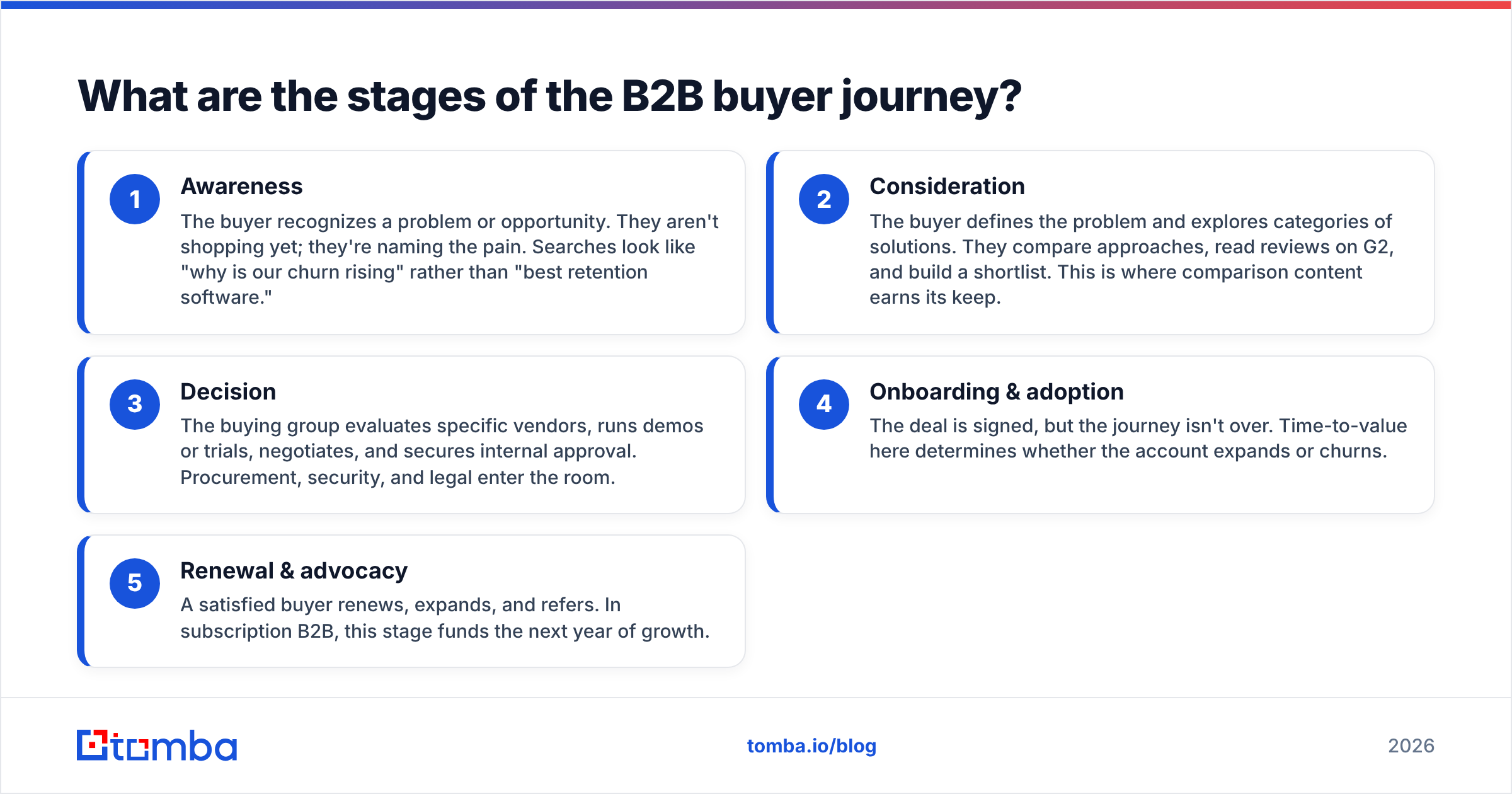
There are three core stages, with two bookends most teams forget. Here's the full picture:
- Awareness — The buyer recognizes a problem or opportunity. They aren't shopping yet; they're naming the pain. Searches look like "why is our churn rising" rather than "best retention software."
- Consideration — The buyer defines the problem and explores categories of solutions. They compare approaches, read reviews on G2, and build a shortlist. This is where comparison content earns its keep.
- Decision — The buying group evaluates specific vendors, runs demos or trials, negotiates, and secures internal approval. Procurement, security, and legal enter the room.
- Onboarding & adoption — The deal is signed, but the journey isn't over. Time-to-value here determines whether the account expands or churns.
- Renewal & advocacy — A satisfied buyer renews, expands, and refers. In subscription B2B, this stage funds the next year of growth.
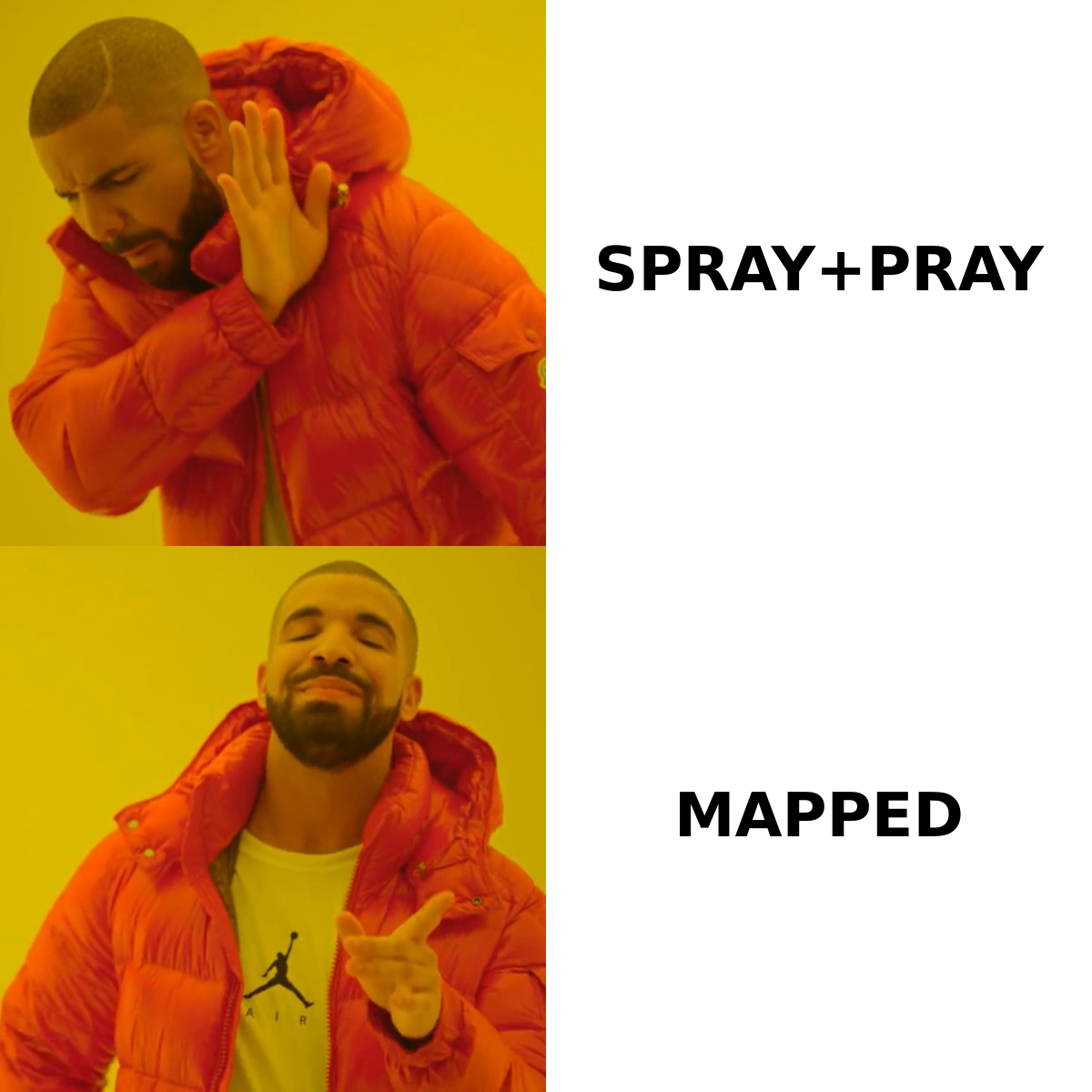
The trap is treating these as gates a buyer passes through once. In reality, a champion might reach the decision stage, hit a budget freeze, and bounce back to consideration three months later. Your job is to recognize which stage a given stakeholder is in — because the same email blast that converts a decision-stage buyer annoys an awareness-stage one.
How has the B2B buyer journey changed in 2026?#
The short answer: buyers do far more on their own, and they do it before you know they exist.
Forrester and Gartner have both documented the shift toward self-service. Buyers now complete the majority of their research independently — reading content, watching peer reviews, polling their network on LinkedIn — before they raise a hand. By the time a prospect books a demo, they've often already decided you're on the shortlist and are looking for reasons to disqualify you.
Three forces define the 2026 journey:
- The buying group expanded. More stakeholders means more internal selling. Your champion has to convince their CFO, their IT lead, and a skeptical end user.
- Information is abundant and self-served. Pricing pages, comparison articles, and review sites do the early work that an SDR used to do on a discovery call.
- AI-assisted research compresses the front end. Buyers use AI tools to summarize options in minutes, so weak differentiation gets filtered out before a human ever evaluates you.
The implication for sales and marketing teams is blunt: you cannot wait for a form fill. You have to detect intent signals, identify the right stakeholders, and reach out with accurate data while the buyer is still forming an opinion. That requires reliable data enrichment and a way to find the people who match your buying-group profile.
B2B buyer journey vs. the sales funnel: what's the difference?#
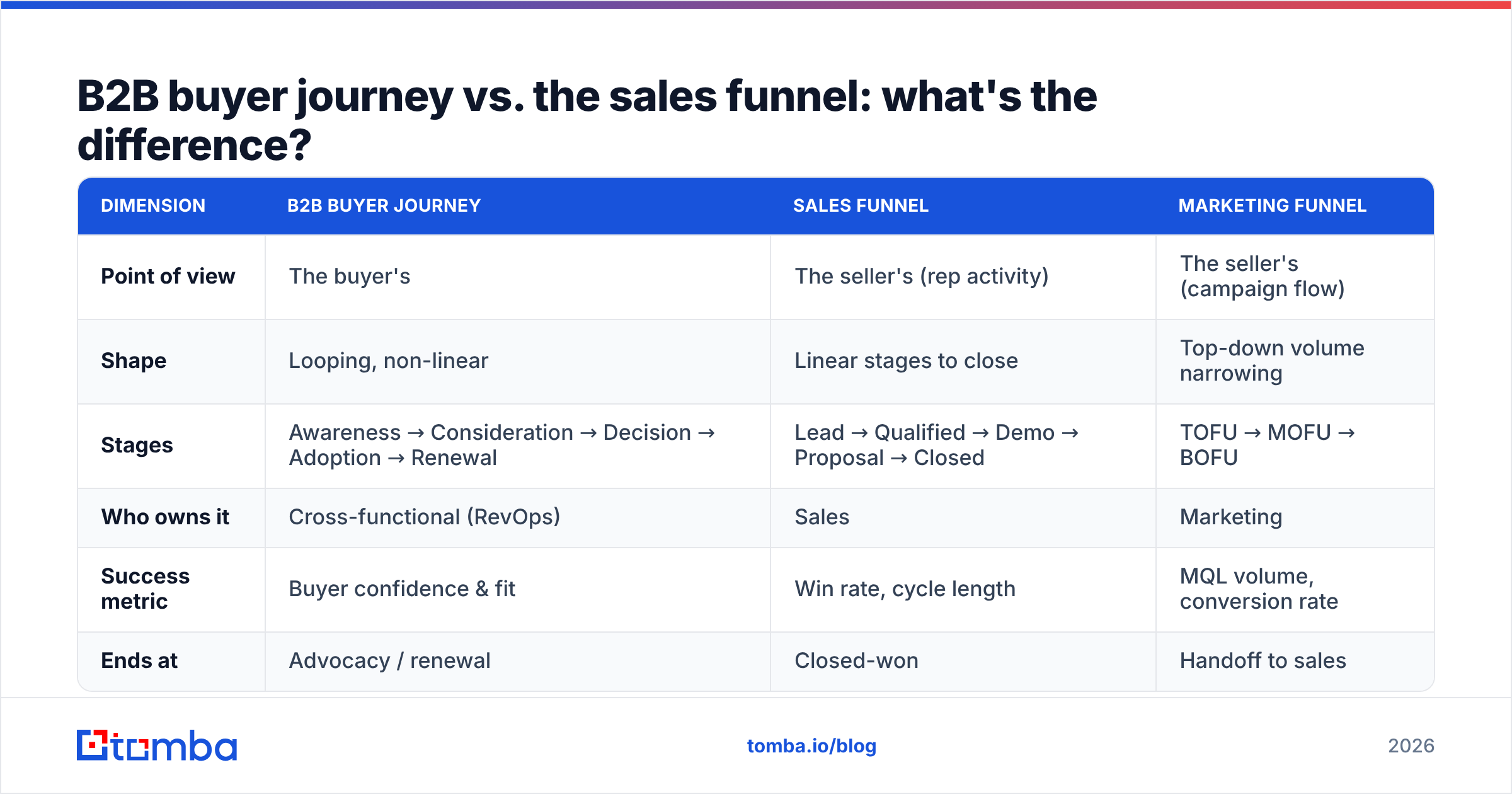
People use "buyer journey," "sales funnel," and "marketing funnel" interchangeably. They are not the same thing, and conflating them produces misaligned teams.
| Dimension | B2B Buyer Journey | Sales Funnel | Marketing Funnel |
|---|---|---|---|
| Point of view | The buyer's | The seller's (rep activity) | The seller's (campaign flow) |
| Shape | Looping, non-linear | Linear stages to close | Top-down volume narrowing |
| Stages | Awareness → Consideration → Decision → Adoption → Renewal | Lead → Qualified → Demo → Proposal → Closed | TOFU → MOFU → BOFU |
| Who owns it | Cross-functional (RevOps) | Sales | Marketing |
| Success metric | Buyer confidence & fit | Win rate, cycle length | MQL volume, conversion rate |
| Ends at | Advocacy / renewal | Closed-won | Handoff to sales |
The takeaway: the buyer journey is the territory; the funnels are two different maps of it. When marketing optimizes for MQL volume while sales optimizes for win rate, both can hit their numbers while the buyer has a fragmented, frustrating experience. Aligning everyone to the buyer journey — a practice that sits at the heart of revenue operations — is how high-growth teams close the gap.
How do you map the B2B buyer journey?#
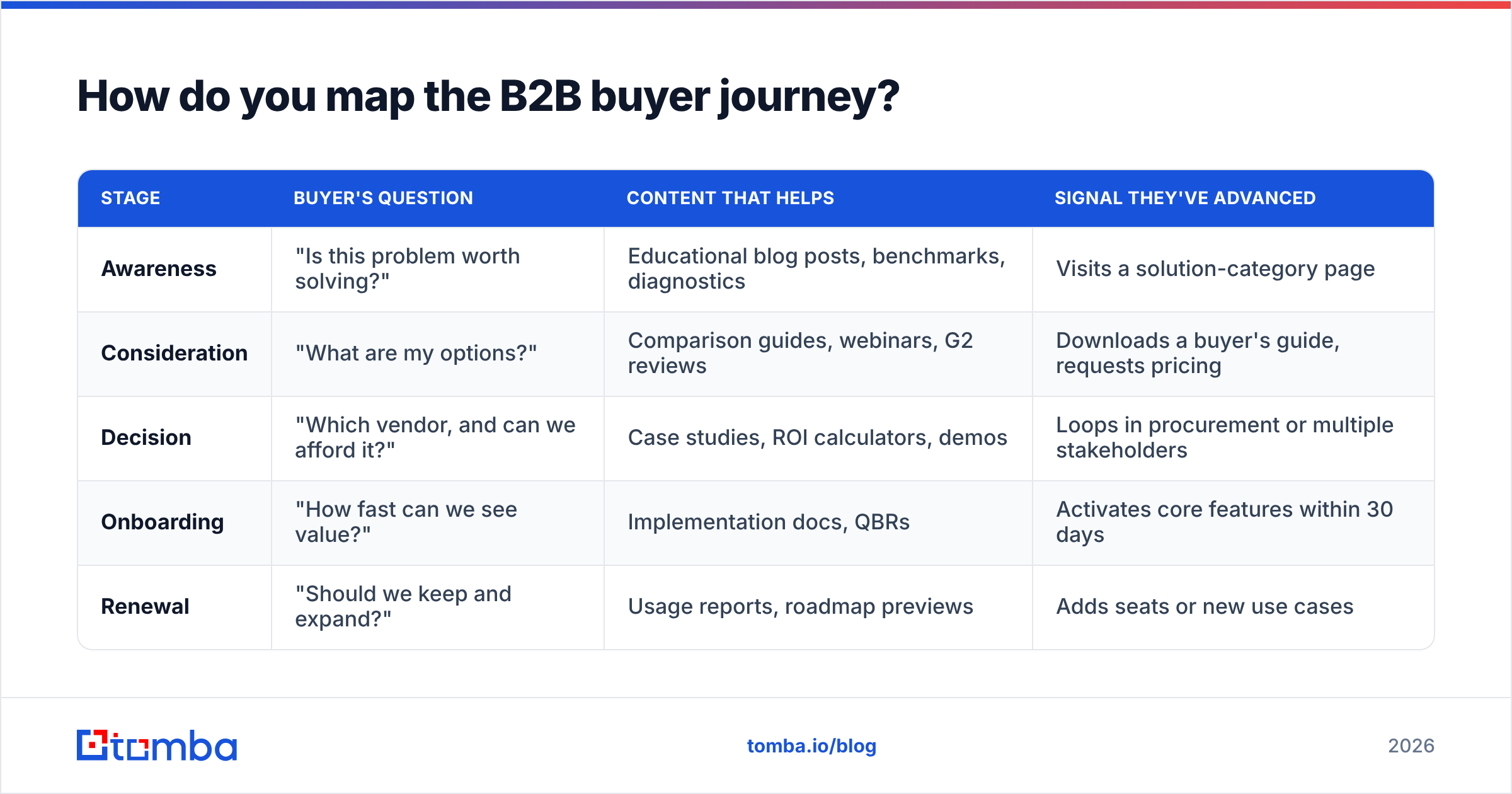
Mapping means documenting, for each stage, what the buyer is thinking, what questions they're asking, what content or contact they need, and what signals tell you they've moved. Here's a practical model you can fill in today.
| Stage | Buyer's question | Content that helps | Signal they've advanced |
|---|---|---|---|
| Awareness | "Is this problem worth solving?" | Educational blog posts, benchmarks, diagnostics | Visits a solution-category page |
| Consideration | "What are my options?" | Comparison guides, webinars, G2 reviews | Downloads a buyer's guide, requests pricing |
| Decision | "Which vendor, and can we afford it?" | Case studies, ROI calculators, demos | Loops in procurement or multiple stakeholders |
| Onboarding | "How fast can we see value?" | Implementation docs, QBRs | Activates core features within 30 days |
| Renewal | "Should we keep and expand?" | Usage reports, roadmap previews | Adds seats or new use cases |
A few rules that separate useful maps from wall art:
- Map to questions, not assets. Buyers don't want "a whitepaper"; they want an answer. Lead with the question.
- Identify the stakeholder per stage. The end user dominates awareness; the economic buyer dominates decision. You need contact data for both.
- Instrument the signals. A map with no triggers is a poster. Tie each "signal they've advanced" to a CRM field or an alert.
- Keep it living. Review the map quarterly against closed-won and closed-lost deals. The journey shifts; your map should too.
Which tools support the B2B buyer journey in 2026?#
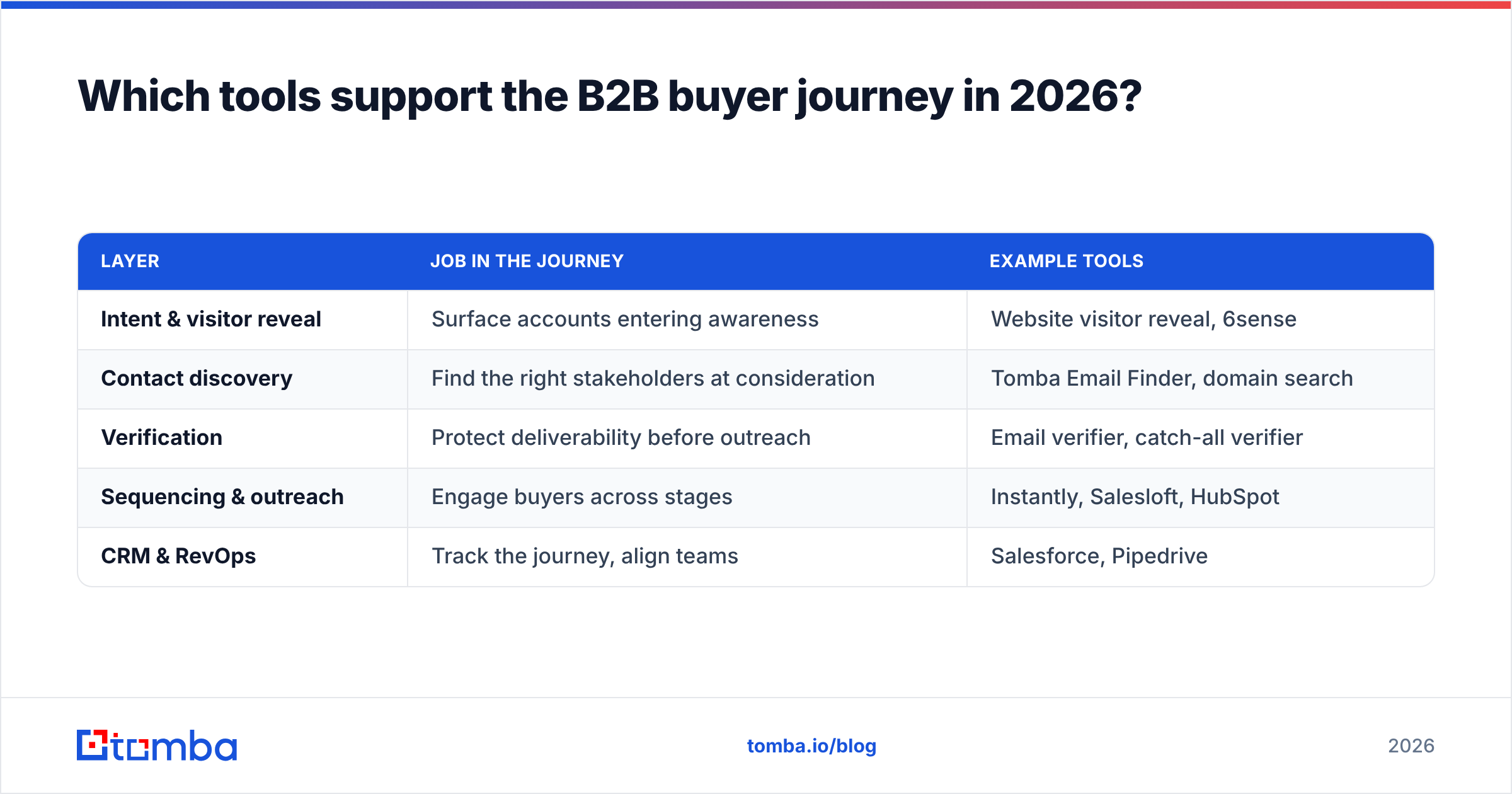
No single tool owns the journey, but a few categories matter most. You need something to detect intent, something to identify and contact the right people, something to sequence outreach, and a CRM to tie it together.
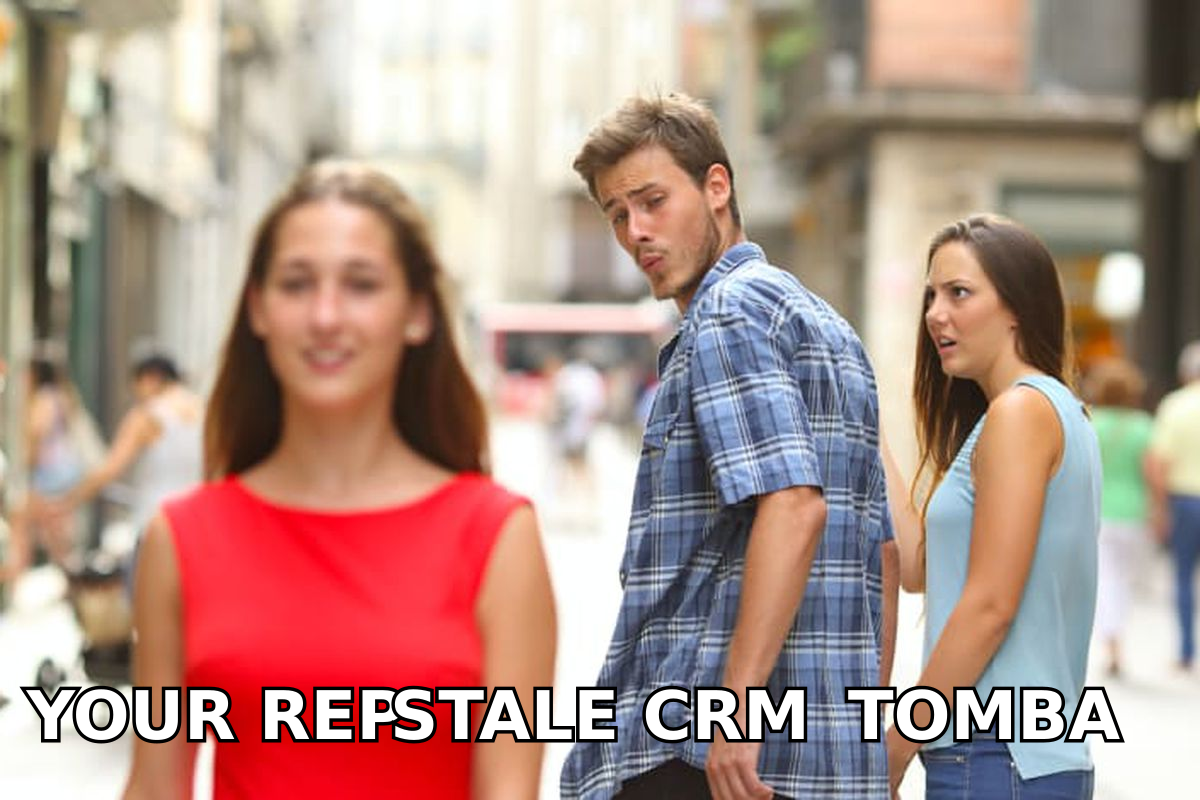
The most underrated layer is contact data. Mapping the journey is useless if, when a high-intent account appears, your reps burn an afternoon guessing email formats and dialing dead numbers. This is where an accurate email-finder and verification stack earns its place: it converts "we know Acme Corp is in-market" into "here is the VP of Ops, her verified email, and her direct line."
Here's how the core tooling layers map to journey stages:
| Layer | Job in the journey | Example tools |
|---|---|---|
| Intent & visitor reveal | Surface accounts entering awareness | Website visitor reveal, 6sense |
| Contact discovery | Find the right stakeholders at consideration | Tomba Email Finder, domain search |
| Verification | Protect deliverability before outreach | Email verifier, catch-all verifier |
| Sequencing & outreach | Engage buyers across stages | Instantly, Salesloft, HubSpot |
| CRM & RevOps | Track the journey, align teams | Salesforce, Pipedrive |
The point isn't to buy all of it. It's to recognize that a mapped journey only pays off when you can act on it — and acting starts with reaching a real human at a verified address.
How do you accelerate the B2B buyer journey without rushing the buyer?#
You can't force a buying group to move faster, but you can remove the friction that slows them down. The teams that shorten cycles in 2026 do five things consistently:
- Reach the full buying group early. A single champion can't carry a deal alone. Use a bulk email finder to map and contact every relevant stakeholder once an account shows intent, so internal selling starts sooner.
- Answer decision-stage questions in consideration-stage content. Put pricing ranges, security posture, and integration details where buyers self-serve. Hiding them only delays the conversation.
- Verify before you send. Bounces wreck sender reputation and your outreach silently dies in spam. Clean lists keep you in the inbox at the exact moment buyers are receptive.
- Personalize by stage, not by name. A "{{first_name}}" merge tag isn't personalization. Referencing the buyer's actual problem and stage is.
- Reduce internal handoffs. Every time a buyer is passed from SDR to AE to onboarding, context leaks. Keep notes and contact records clean so the baton doesn't drop.
Notice that three of those five depend on data quality. You cannot reach the buying group, verify sends, or keep records clean without accurate, enriched contact data underneath. That's the unglamorous foundation most journey strategies skip — and then wonder why the map didn't move the number.
What metrics tell you the buyer journey is working?#
Track stage-level metrics, not just the final win rate. Conversion between stages tells you where deals stall:
- Stage-to-stage conversion rate — the percentage of buyers advancing from awareness to consideration, and so on. A cliff between two stages points to a content or contact gap.
- Time in stage — how long buyers linger. Decision-stage stalls usually mean a missing stakeholder or unanswered objection.
- Buying-group coverage — how many of the known stakeholders you've actually engaged. Low coverage predicts losses.
- Response rate by stage — your email response rate should differ by stage; falling rates signal stale data or mistimed outreach.
- Cycle length trend — is the overall journey shortening quarter over quarter? That's the scoreboard.
Wire these into your CRM and review them in your RevOps cadence. Metrics turn the journey map from a static diagram into a feedback loop.
Conclusion: meet buyers where they actually are#
The B2B buyer journey in 2026 rewards teams that stop selling at buyers and start guiding them. Map the stages to real buyer questions, identify the right stakeholder for each phase, instrument the signals that show movement, and — critically — back it all with contact data accurate enough to act on the moment intent appears.
That last piece is where most journey strategies quietly fail. A beautiful map is worthless if your reps can't reach the people on it. Tomba's Email Finder turns a known account into verified, contactable stakeholders in seconds — across the whole buying group, validated before you hit send. Start free with 25 searches a month, and scale to the Starter plan at $49/mo when your pipeline grows; see full Tomba pricing for details. Map the journey, then actually walk it with your buyers.
// get started
Find, verify and enrich your first contacts today
Start on the free plan with 25 searches a month, then scale when your team is ready.
Free plan · No credit card required · GDPR & CCPA
// about the author