The B2B Buyer Journey AI Playbook for 2026: A Real Guide
AI now shapes how B2B buyers research, shortlist, and decide before they ever talk to sales. Here is how to map the AI-driven buyer journey in 2026 and act on intent signals fast.
The b2b buyer journey ai shift has rewritten how deals get made. The way B2B buyers move from "we have a problem" to "here's the PO" looks almost nothing like the funnel your CRM still draws. AI now sits in the middle of nearly every step. It summarizes vendors, drafts requirements, and scores options. Often this happens before anyone on your team knows the account exists. If your go-to-market motion still assumes a linear, sales-led path, you are reacting to decisions made weeks ago.
This guide maps the b2b buyer journey ai reality for 2026. You will see what changed, where AI inserts itself, and how to meet buyers at each stage with the right signal and the right contact.
TL;DR#
- Buyers self-educate with AI first. By the time a rep gets a reply, 70%+ of the research is done — often by an assistant the buyer trusts more than your website.
- The journey is a loop, not a funnel. Discovery, evaluation, and validation now overlap and repeat across a buying committee of 6–10 people.
- Intent signals beat firmographics. Knowing who is researching now matters more than knowing who fits your ICP on paper.
- Speed of contact is the new moat. Whoever reaches the verified decision-maker first, with relevant context, usually wins the meeting.
- Clean contact data is the bottleneck. AI can find intent, but you still need accurate emails and phone numbers to act — that's where an email finder earns its keep.
What is the b2b buyer journey ai model?#
The b2b buyer journey ai model is the buying process as it actually happens in 2026. Buyers use AI assistants, review aggregators, and community content to research, shortlist, and pre-decide before they engage a vendor.
Think of it like buying a car today versus in 2005. Twenty years ago you visited dealerships to learn. Now you arrive knowing the trim, the invoice price, and three competitor quotes. The dealer's job shrank from educator to closer. The same collapse has hit B2B. Your prospect's "dealership visit" — the sales call — happens at the very end, after an AI has already done the comparison shopping.
This means the old awareness → consideration → decision funnel has been scrambled. A single buyer might hit decision-stage content on day one, such as a pricing page surfaced by an AI summary. The same buyer might read awareness-stage content on day ten. Stages no longer arrive in order.
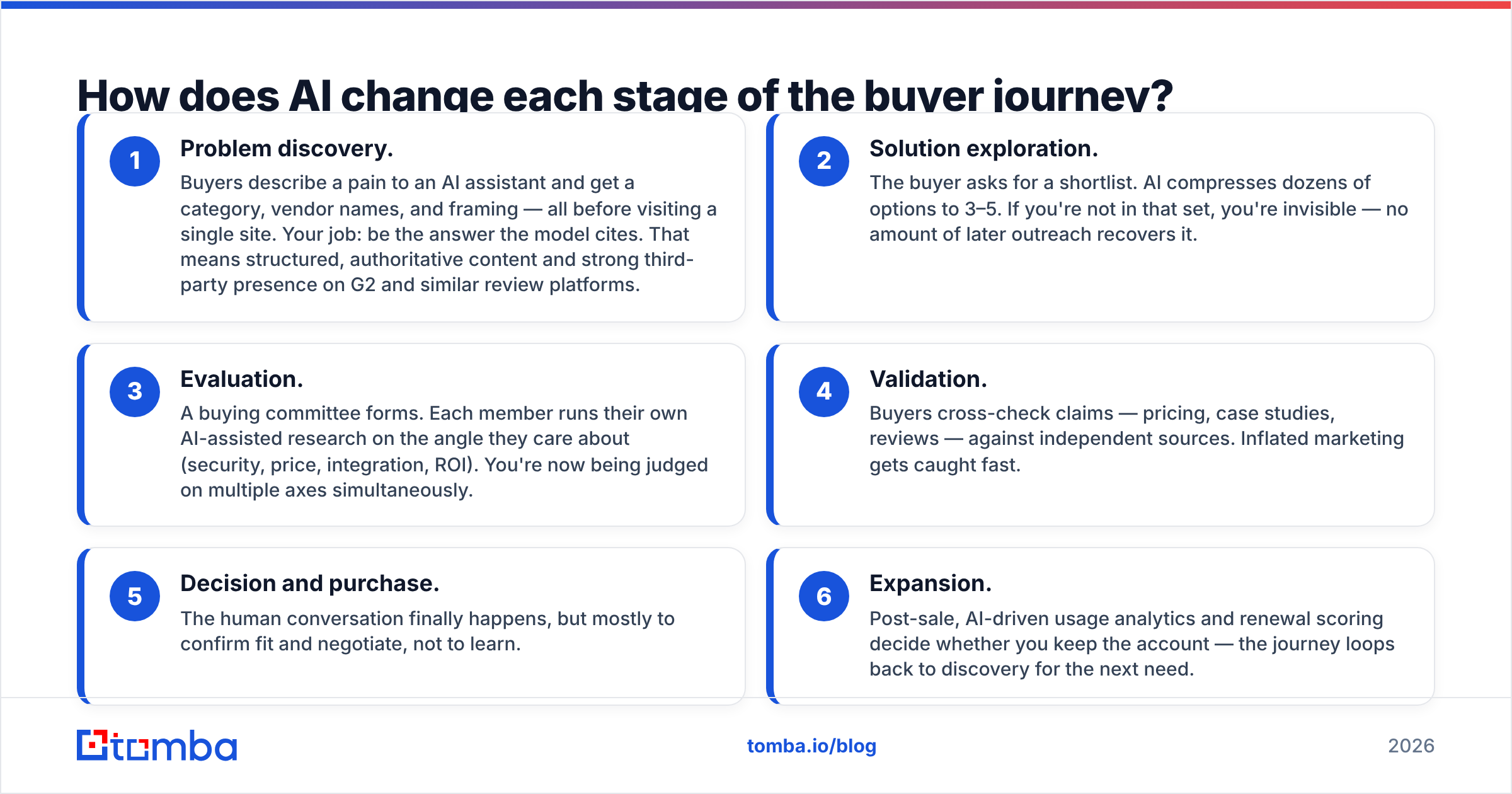
How does AI change each stage of the buyer journey?#
Here is the practical breakdown of the b2b buyer journey ai at each stage. Every stage now has an AI layer sitting between the buyer and you.
- Problem discovery. Buyers describe a pain to an AI assistant and get a category, vendor names, and framing — all before visiting a single site. Your job: be the answer the model cites. That means structured, authoritative content and strong third-party presence on G2 and similar review platforms.
- Solution exploration. The buyer asks for a shortlist. AI compresses dozens of options to 3–5. If you're not in that set, you're invisible — no amount of later outreach recovers it.
- Evaluation. A buying committee forms. Each member runs their own AI-assisted research on the angle they care about (security, price, integration, ROI). You're now being judged on multiple axes simultaneously.
- Validation. Buyers cross-check claims — pricing, case studies, reviews — against independent sources. Inflated marketing gets caught fast.
- Decision and purchase. The human conversation finally happens, but mostly to confirm fit and negotiate, not to learn.
- Expansion. Post-sale, AI-driven usage analytics and renewal scoring decide whether you keep the account — the journey loops back to discovery for the next need.
Notice that sales gets a seat only at stages 4–5. To influence stages 1–3, you need revenue operations and marketing working from the same signal data, not a hand-off wall.
Why does intent data matter more than firmographics now?#
Firmographics tell you who could buy. Intent tells you who is buying right now. In an AI-compressed journey, timing is everything. A perfect-fit account that isn't in-market is worth less than a marginal-fit account researching your category this week.
Intent signals come from several places:
- First-party: pricing-page visits, demo requests, repeat content views, and de-anonymized website traffic via tools like visitor reveal.
- Second-party: review-site activity, community questions, comparison-page traffic.
- Third-party: broader research patterns aggregated across the web.
The catch is simple. A signal is useless without a person and a way to reach them. "Acme Corp is researching CRMs" is a headline. "Dana Liu, VP RevOps at Acme, dana.liu@acme.com, viewed your pricing page twice this week" is an action. Closing that gap — from anonymous intent to a verified, contactable human — is the highest-leverage step in the modern journey.
What does the modern b2b buyer journey ai funnel look like?#
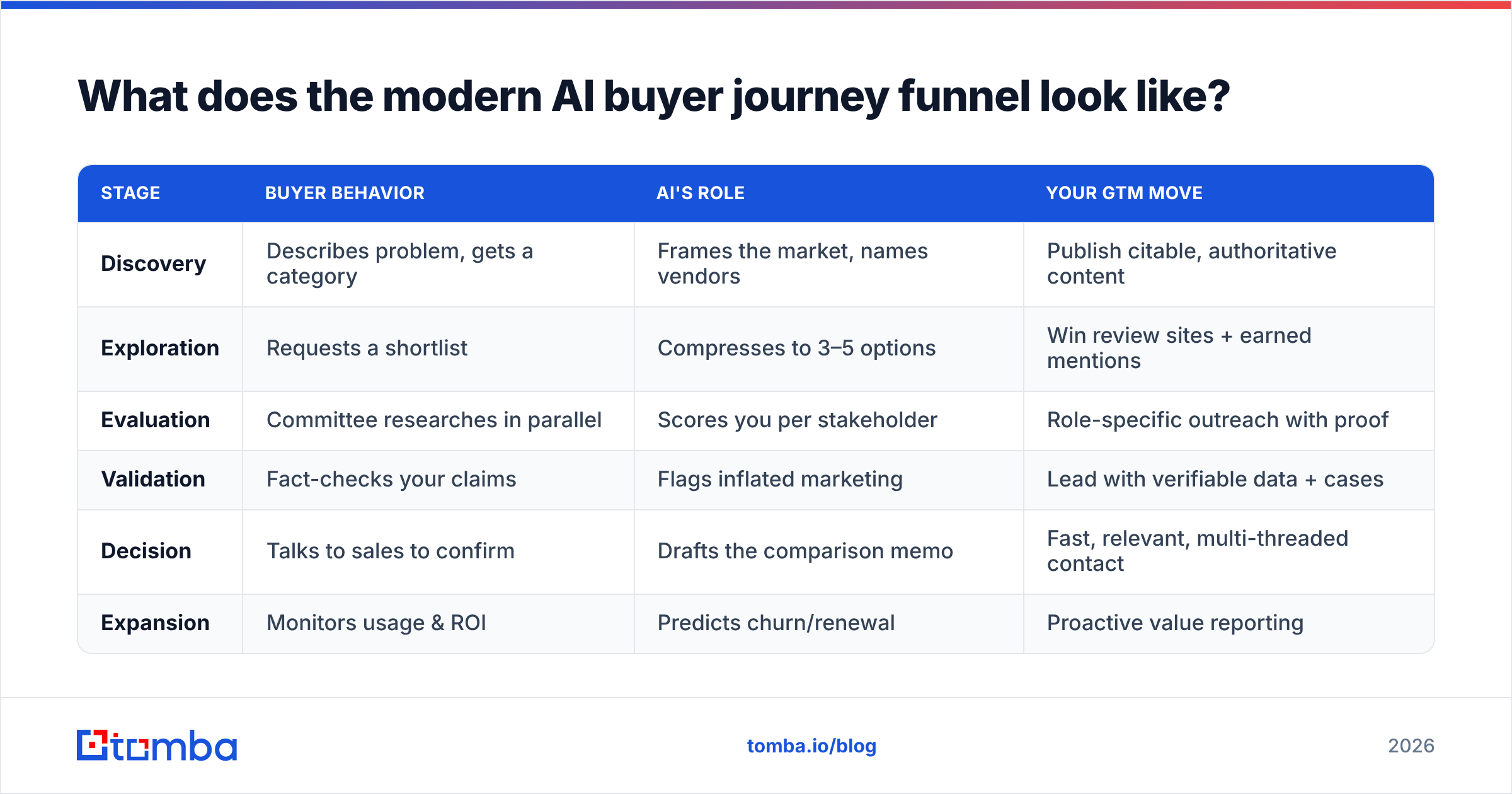
It is less a funnel and more a set of overlapping loops, each gated by an AI checkpoint. Here is a stage-by-stage view of where the buyer is, what AI is doing, and what your team should do in response.
| Stage | Buyer behavior | AI's role | Your GTM move |
|---|---|---|---|
| Discovery | Describes problem, gets a category | Frames the market, names vendors | Publish citable, authoritative content |
| Exploration | Requests a shortlist | Compresses to 3–5 options | Win review sites + earned mentions |
| Evaluation | Committee researches in parallel | Scores you per stakeholder | Role-specific outreach with proof |
| Validation | Fact-checks your claims | Flags inflated marketing | Lead with verifiable data + cases |
| Decision | Talks to sales to confirm | Drafts the comparison memo | Fast, relevant, multi-threaded contact |
| Expansion | Monitors usage & ROI | Predicts churn/renewal | Proactive value reporting |
The takeaway is clear. Most of your influence happens before the sales conversation, in stages where the buyer never identifies themselves. You earn the meeting two ways: by showing up in AI outputs, and by spotting intent early enough to reach out with context.
Which tools support an AI-driven buyer journey in 2026?#
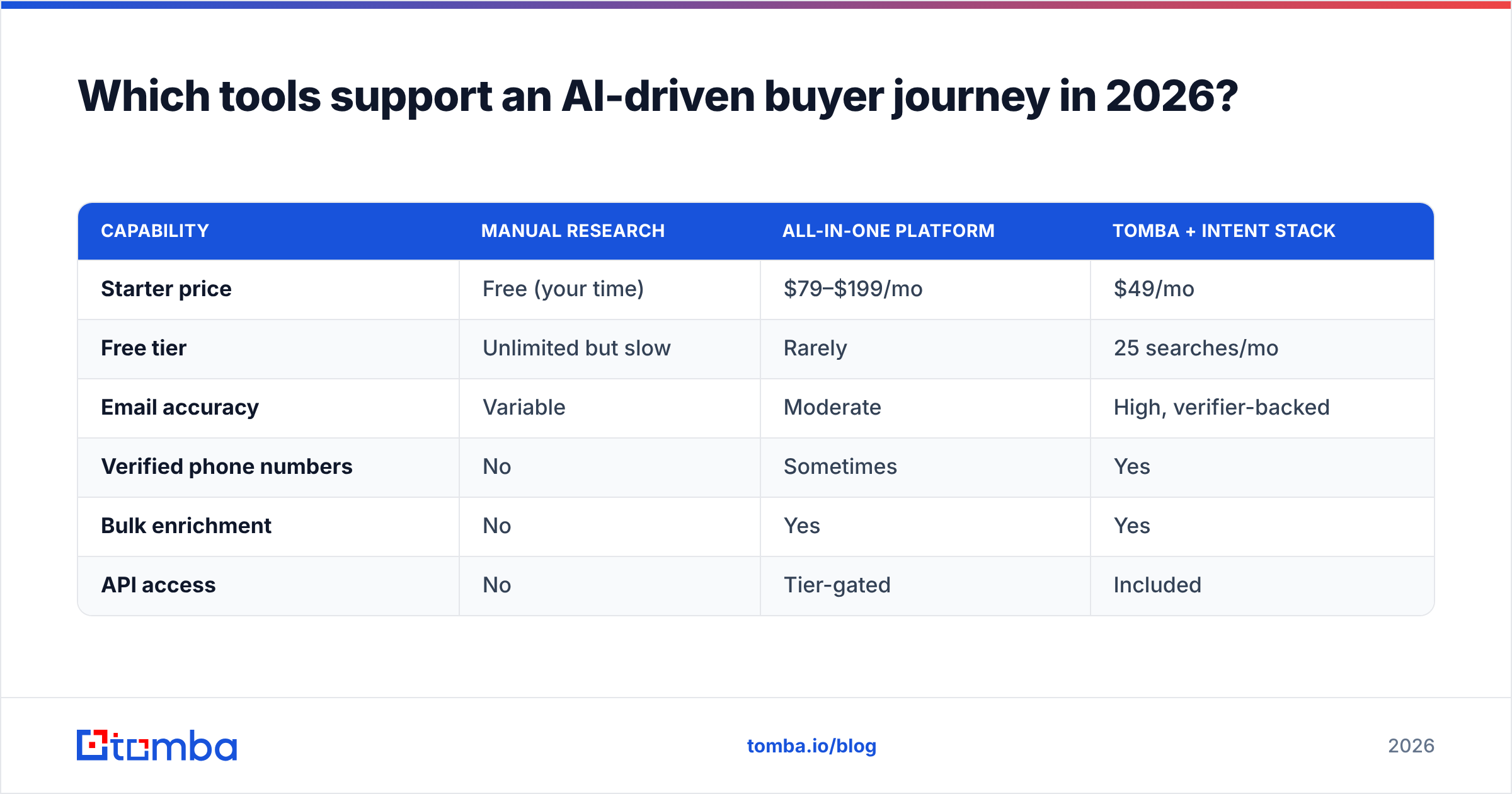
You don't need one mega-platform. You need a stack that covers intent detection, contact data, and activation. Here is how common approaches compare on the part that matters most: turning a signal into a reachable, verified contact.
| Capability | Manual research | All-in-one platform | Tomba + intent stack |
|---|---|---|---|
| Starter price | Free (your time) | $79–$199/mo | $49/mo |
| Free tier | Unlimited but slow | Rarely | 25 searches/mo |
| Email accuracy | Variable | Moderate | High, verifier-backed |
| Verified phone numbers | No | Sometimes | Yes |
| Bulk enrichment | No | Yes | Yes |
| API access | No | Tier-gated | Included |
A few honest notes. All-in-one platforms bundle sequencing and intent, which is convenient. But you pay for breadth and often inherit stale contact records. A focused approach works better for many teams. Pair your intent source with a high-accuracy data enrichment and verification layer. This usually produces cleaner outreach lists at a lower entry price. You can compare Tomba plans against your current spend. The Starter tier is $49/mo, not the $39 you'll see misquoted elsewhere.
Whatever you choose, two rules are non-negotiable. Every email gets verified before send, because bounce rates wreck sender reputation. And every signal maps to a real decision-maker, not just a company name.
How do you act on AI buyer signals without being creepy?#
The line between "relevant" and "stalker" is context, not data volume. Buyers expect you to know they're in-market in 2026. But they resent outreach that recites their browsing history back to them.
Practical rules:
- Reference the category, not the click. "Saw you're evaluating RevOps tooling" lands fine. "I saw you visited our pricing page at 9:14pm" does not.
- Multi-thread early. Buying committees average 6–10 people. Use a domain search to map the relevant contacts at the account, then tailor by role.
- Lead with proof, because AI already fact-checked you. Vague claims get filtered out at the validation stage. Bring numbers, named customers, and specifics.
- Match the channel to the stage. Early discovery rewards helpful content. Late evaluation rewards a fast, direct human reply. Reaching the right inbox quickly depends on verified contact data, because guesswork emails bounce and burn the account.
This is also where speed compounds. Say your intent tool flags an account on Monday. If your list isn't enriched and verified until Friday, the buyer has already booked demos with two competitors. Tightening that loop — signal to verified contact to first message — is the highest-ROI process change most teams can make this year.
What metrics actually matter in an AI-driven journey?#
Stop optimizing for top-of-funnel volume. Optimize for signal-to-meeting velocity. The b2b buyer journey ai is shorter and looped, so vanity metrics like raw impressions or unqualified MQLs mislead you.
Track instead:
- Time from intent signal to first verified contact — your operational moat.
- Committee coverage — how many of the 6–10 stakeholders you've reached, not just one champion.
- Reply-to-meeting response rate — quality of targeting and relevance.
- Data accuracy rate — bounced or wrong-person emails are pure waste and a deliverability tax.
For context on how buying groups and self-directed research have grown, Gartner's research on the B2B buying journey remains the standard reference. It has only intensified since AI assistants entered the mix.
How do you get started this quarter?#
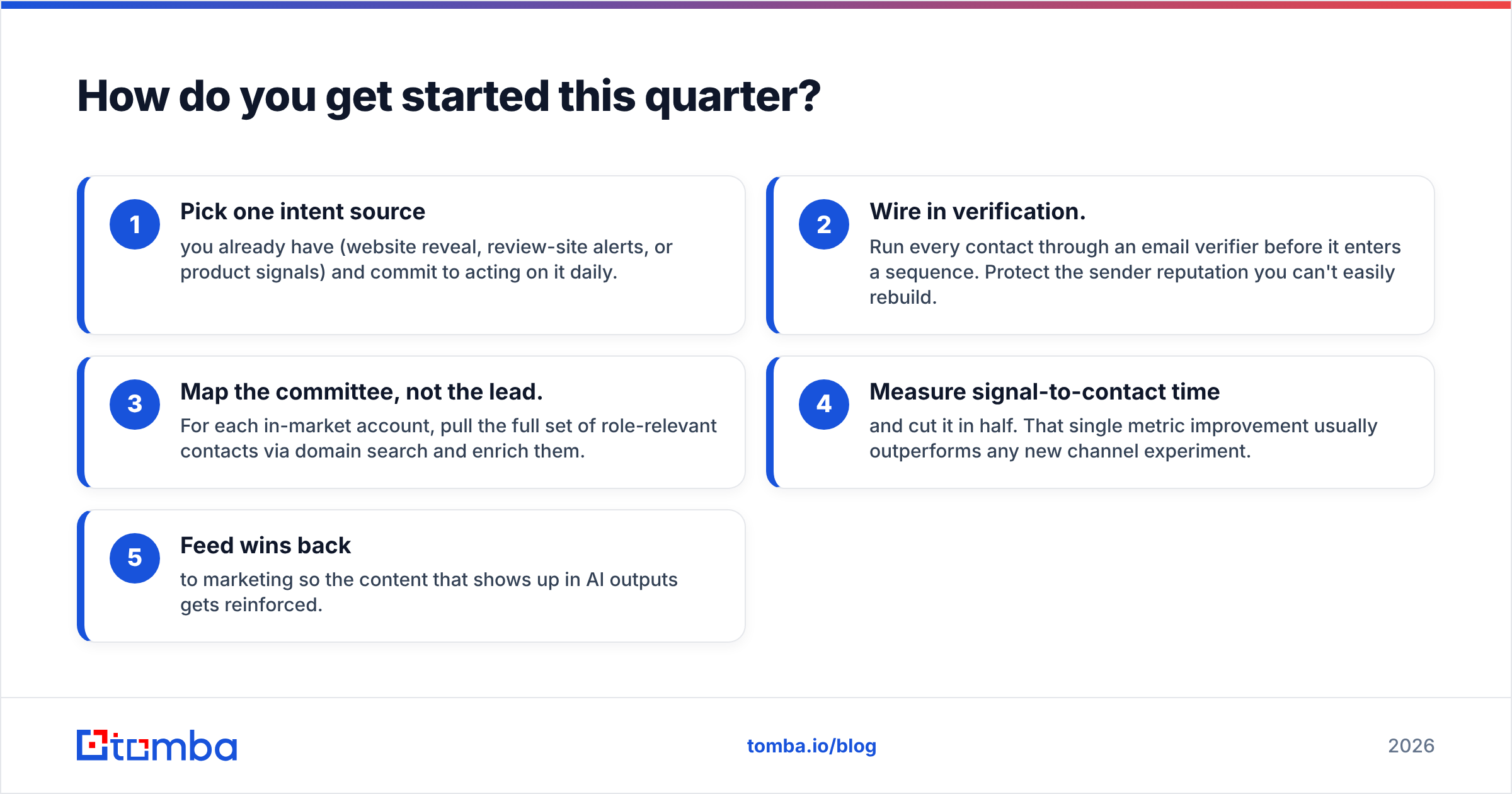
Start narrow and fix the weakest link first. That is almost always contact data quality and speed. Here is a focused 30-day plan:
- Pick one intent source you already have (website reveal, review-site alerts, or product signals) and commit to acting on it daily.
- Wire in verification. Run every contact through an email verifier before it enters a sequence. Protect the sender reputation you can't easily rebuild.
- Map the committee, not the lead. For each in-market account, pull the full set of role-relevant contacts via domain search and enrich them.
- Measure signal-to-contact time and cut it in half. That single metric usually outperforms any new channel experiment.
- Feed wins back to marketing so the content that shows up in AI outputs gets reinforced.
You don't have to rebuild your GTM overnight. You do have to stop treating the buyer journey as something that starts when a form gets filled. By then, the AI-assisted buyer has already done the work.
The bottom line#
AI didn't kill the B2B buyer journey. It moved most of it out of your view and sped up the parts you can see. Winning in 2026 means three things: be present in AI-driven discovery, detect intent early, and convert anonymous signals into verified, reachable people faster than your competitors.
That last mile is a data problem, and it's solvable today. Start free with the Tomba Email Finder — find and verify the decision-makers behind your intent signals, map entire buying committees by domain, and turn "an account is researching" into "the right person just replied." The Free tier gives you 25 searches a month to test against your current stack. Scale up to Starter at $49/mo when the loop is paying off.
Ready to find emails that actually work?
Join 150,000+ professionals who stopped guessing and started sending. Free credits on signup — no credit card required.
Get the Tomba newsletter
Practical outbound tactics and product updates — once every two weeks.
About the author