How to Build a B2B Buyer Persona in 2026 (Template + Examples)
A B2B buyer persona turns vague guesses about your market into a repeatable targeting system. Here's the 2026 framework, a fill-in template, and real examples.
A B2B buyer persona is the difference between an outbound motion that compounds and one that quietly burns your sender reputation. Most teams write one once, paste it into a Notion doc, and never look at it again. This guide treats the persona as a living targeting system — built from real data, wired into your prospecting tools, and refreshed on a schedule.
TL;DR#
- A B2B buyer persona is a research-based profile of the specific human who evaluates, champions, or signs off on your product — not a demographic cartoon.
- It is different from an Ideal Customer Profile (ICP): the ICP describes the account, the persona describes the person inside it.
- The strongest personas are built from three data layers: firmographic, behavioral, and qualitative interview data.
- A persona you cannot act on is decoration. Each one should map to a channel, a message angle, and a list you can actually build.
- Refresh personas every two quarters; buying committees, titles, and triggers shift faster than they used to.
What is a B2B buyer persona?#
A B2B buyer persona is a semi-fictional but evidence-backed profile of a specific role that participates in purchasing your product. It captures who they are, what outcome they're accountable for, what makes them act, and what kills a deal for them.
Think of it like a casting brief for a film. A director doesn't write "a person" — they write "a 42-year-old VP of Engineering who has been burned by a migration before and now reads every security doc twice." That specificity tells the writer, the marketer, and the SDR exactly how to show up. A vague brief produces vague outreach, and vague outreach gets ignored.
The technical definition: a persona is a structured record combining firmographics (company size, industry, geography), role attributes (title, seniority, reports-to), psychographics (goals, fears, objections), and behavioral signals (the triggers and content that move them). According to HubSpot's research on buyer personas, companies that exceed lead and revenue goals are significantly more likely to have documented personas than those that miss.
Buyer persona vs ICP: what's the difference?#
People use these interchangeably and it costs them. The ICP filters which companies deserve your attention. The persona filters which people inside those companies you talk to, and how.
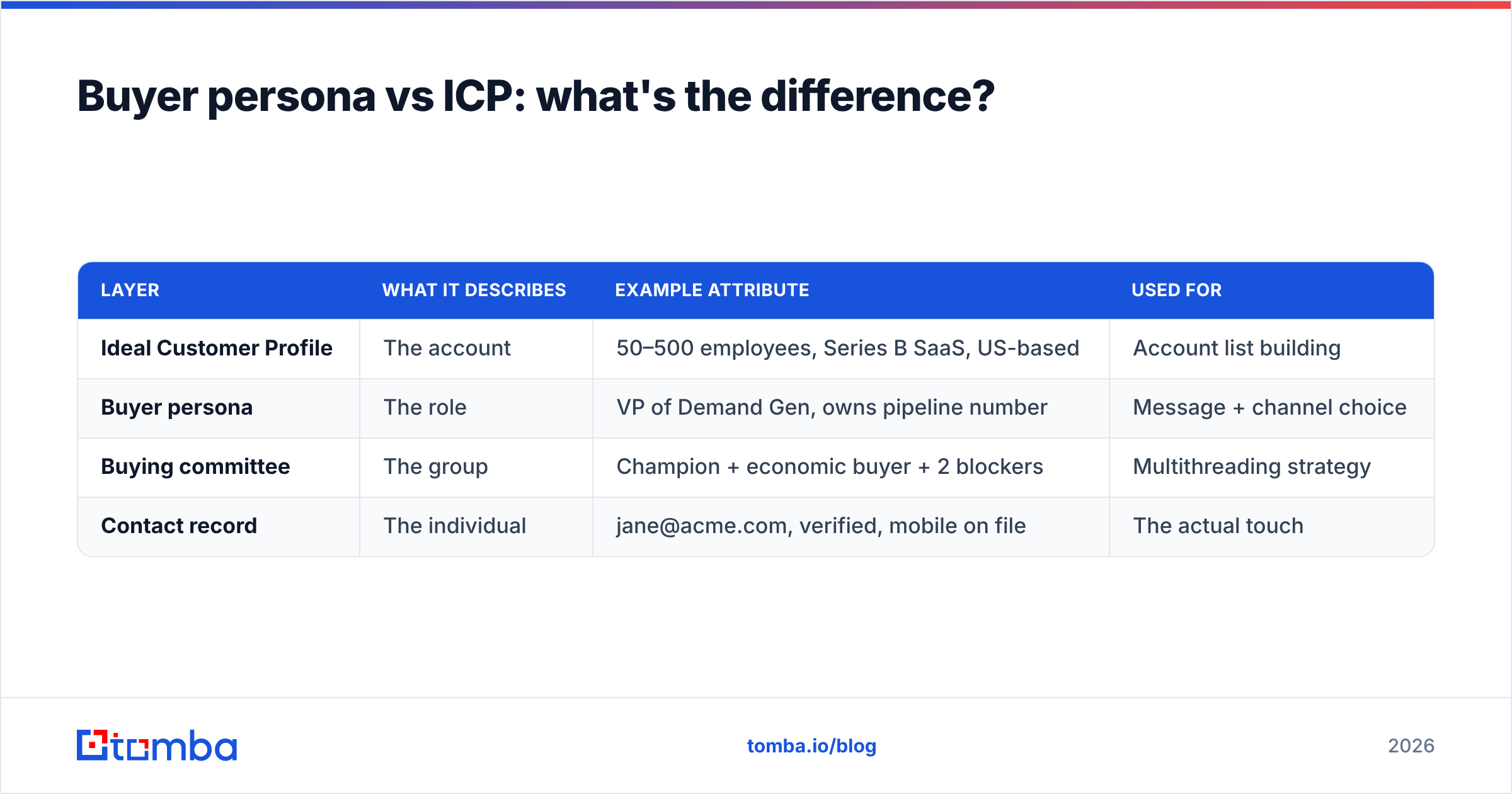
Here's how the two layers stack against the individual contact record you actually prospect against:
| Layer | What it describes | Example attribute | Used for |
|---|---|---|---|
| Ideal Customer Profile | The account | 50–500 employees, Series B SaaS, US-based | Account list building |
| Buyer persona | The role | VP of Demand Gen, owns pipeline number | Message + channel choice |
| Buying committee | The group | Champion + economic buyer + 2 blockers | Multithreading strategy |
| Contact record | The individual | jane@acme.com, verified, mobile on file | The actual touch |
You need all four. An ICP without personas means you reach the right companies and pitch the wrong person. Personas without verified contact records means you know exactly who to reach and have no way to reach them — which is where a reliable email finder and accurate data enrichment close the gap.
What goes into a B2B buyer persona? (The framework)#
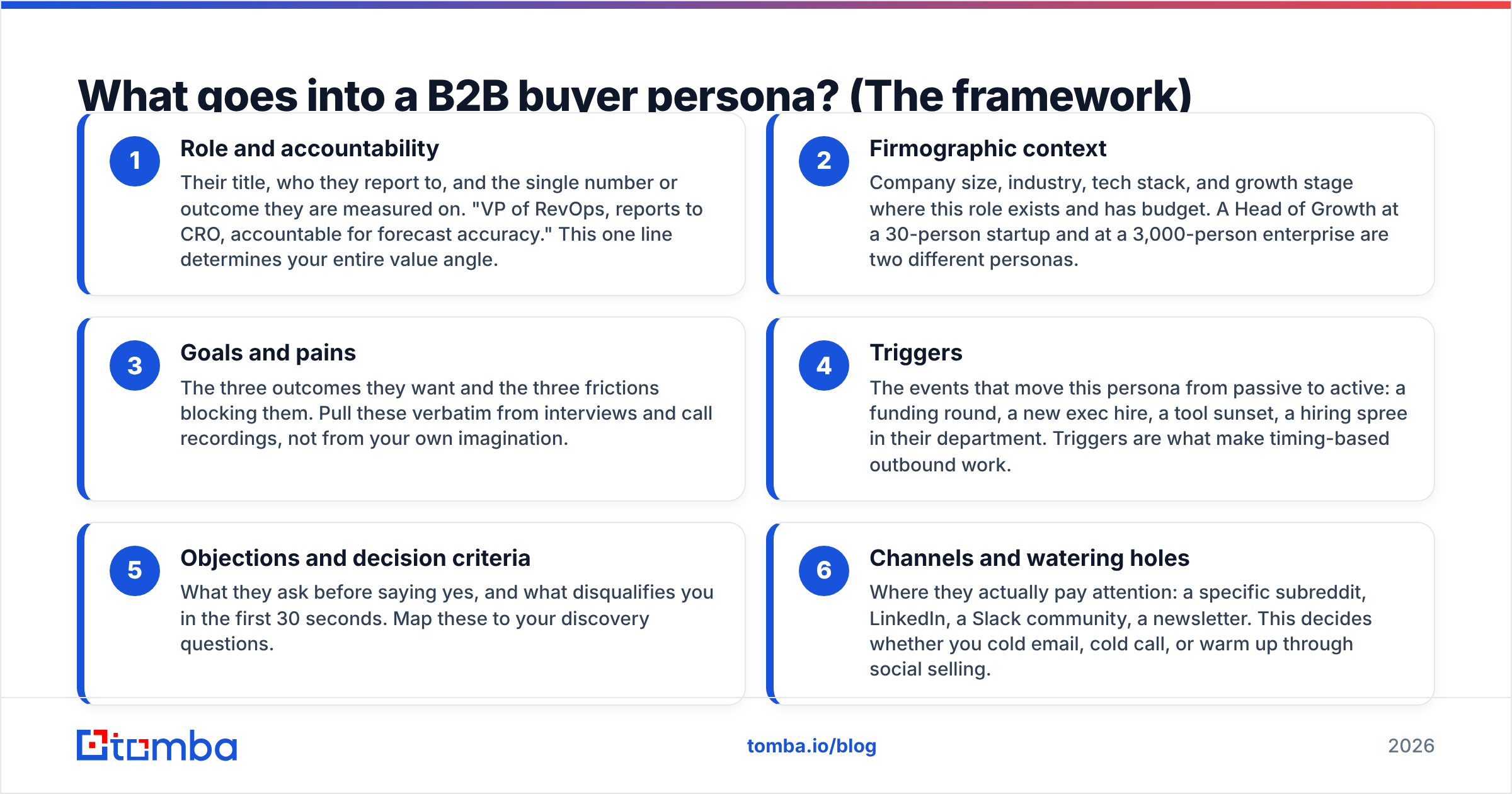
A persona that drives action has six components. Skip any of them and the document becomes a personality quiz instead of a targeting tool.
- Role and accountability — Their title, who they report to, and the single number or outcome they are measured on. "VP of RevOps, reports to CRO, accountable for forecast accuracy." This one line determines your entire value angle.
- Firmographic context — Company size, industry, tech stack, and growth stage where this role exists and has budget. A Head of Growth at a 30-person startup and at a 3,000-person enterprise are two different personas.
- Goals and pains — The three outcomes they want and the three frictions blocking them. Pull these verbatim from interviews and call recordings, not from your own imagination.
- Triggers — The events that move this persona from passive to active: a funding round, a new exec hire, a tool sunset, a hiring spree in their department. Triggers are what make timing-based outbound work.
- Objections and decision criteria — What they ask before saying yes, and what disqualifies you in the first 30 seconds. Map these to your discovery questions.
- Channels and watering holes — Where they actually pay attention: a specific subreddit, LinkedIn, a Slack community, a newsletter. This decides whether you cold email, cold call, or warm up through social selling.
If you want a single artifact that captures all six, build it as a one-page table per persona so a new rep can absorb it in two minutes.
How do you build a buyer persona with real data?#
Conclusion first: interview your existing customers, then validate the patterns against hard data. Opinion-only personas drift; data-validated personas hold.
Step 1 — Mine your closed-won deals#
Start with the accounts that already bought and stayed. Pull 15–20 of your best customers and look for the common thread in title, company size, industry, and the trigger that started the deal. Your CRM and a clean B2B database give you the firmographic backbone here.
Step 2 — Interview 5–10 buyers#
Get on calls with real buyers — ideally a mix of champions and economic buyers. Ask what their day looked like before they bought, what finally pushed them to evaluate, and what almost killed the deal. Record everything. The exact phrases they use become your email copy.
Step 3 — Validate against behavioral data#
Cross-check your interview patterns against product usage, intent signals, and engagement data. If interviews say "security is the top concern" but your highest-converting content is an ROI calculator, trust the behavior. Per Gartner's research on B2B buying, a typical buying group for a complex solution involves six to ten decision-makers — so validate that you're modeling the whole committee, not just the loudest voice.
Step 4 — Enrich and operationalize#
Turn the persona into a filterable list. Translate "VP of RevOps at Series B SaaS" into actual contact records with verified emails and phone numbers. This is where the persona stops being a doc and becomes a campaign.

B2B buyer persona example (filled in)#
Here's a condensed, realistic example for a sales-tech company selling to mid-market revenue teams.
| Attribute | Detail |
|---|---|
| Persona name | "Pipeline Paula" |
| Role | VP of Revenue Operations |
| Reports to | Chief Revenue Officer |
| Accountable for | Forecast accuracy and rep productivity |
| Company profile | 100–600 employees, B2B SaaS, Series B–C |
| Top goal | Hit forecast within 5% three quarters running |
| Top pain | Dirty CRM data and reps wasting time on bad contacts |
| Trigger | New CRO hire, or a missed quarter |
| Decision criteria | Data accuracy, native CRM integration, fast onboarding |
| Disqualifier | Long implementation, no Salesforce integration |
| Channel | LinkedIn + email; lurks in RevOps Slack communities |
Notice that every row is actionable. "Trigger: new CRO hire" tells your SDR to monitor for executive changes. "Disqualifier: long implementation" tells marketing to lead with time-to-value. A persona this concrete also tells you when to treat a contact as a marketing qualified lead versus a sales-ready one.
How many personas should a B2B company have?#
Fewer than you think. Most early-stage and mid-market teams need three to five personas, not twelve. The committee for a single deal might include a champion, an economic buyer, a technical evaluator, and a blocker — that's four personas for one sale, and they often repeat across deals.
A useful rule: create a new persona only when the message, channel, or value angle genuinely changes. If your pitch to a "Director of Sales" and a "VP of Sales" is 90% the same, they're one persona with a seniority variable, not two. Over-segmenting is how teams end up with personas nobody maintains.
What are the most common buyer persona mistakes?#
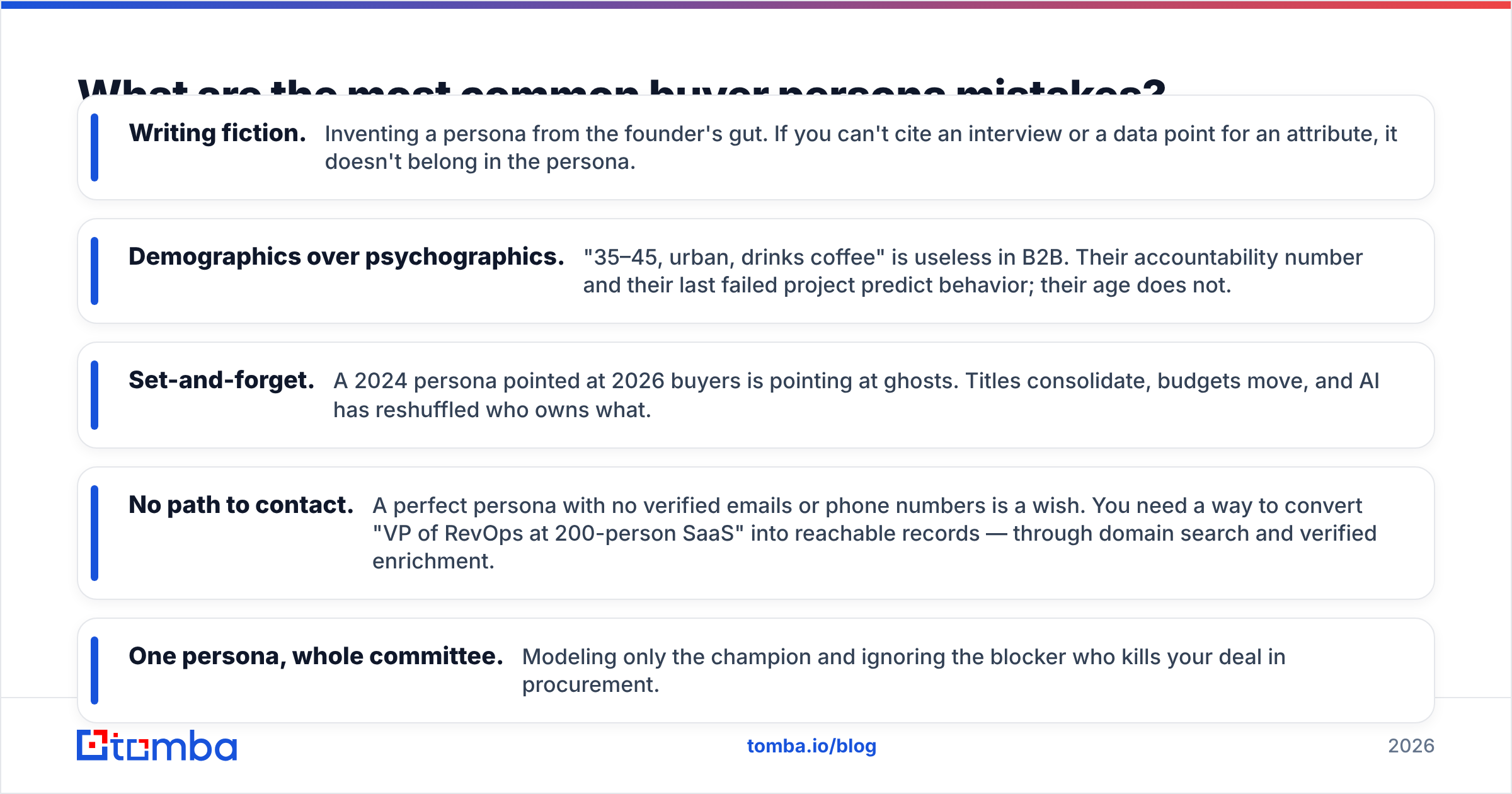
- Writing fiction. Inventing a persona from the founder's gut. If you can't cite an interview or a data point for an attribute, it doesn't belong in the persona.
- Demographics over psychographics. "35–45, urban, drinks coffee" is useless in B2B. Their accountability number and their last failed project predict behavior; their age does not.
- Set-and-forget. A 2024 persona pointed at 2026 buyers is pointing at ghosts. Titles consolidate, budgets move, and AI has reshuffled who owns what.
- No path to contact. A perfect persona with no verified emails or phone numbers is a wish. You need a way to convert "VP of RevOps at 200-person SaaS" into reachable records — through domain search and verified enrichment.
- One persona, whole committee. Modeling only the champion and ignoring the blocker who kills your deal in procurement.
How do personas connect to your prospecting workflow?#
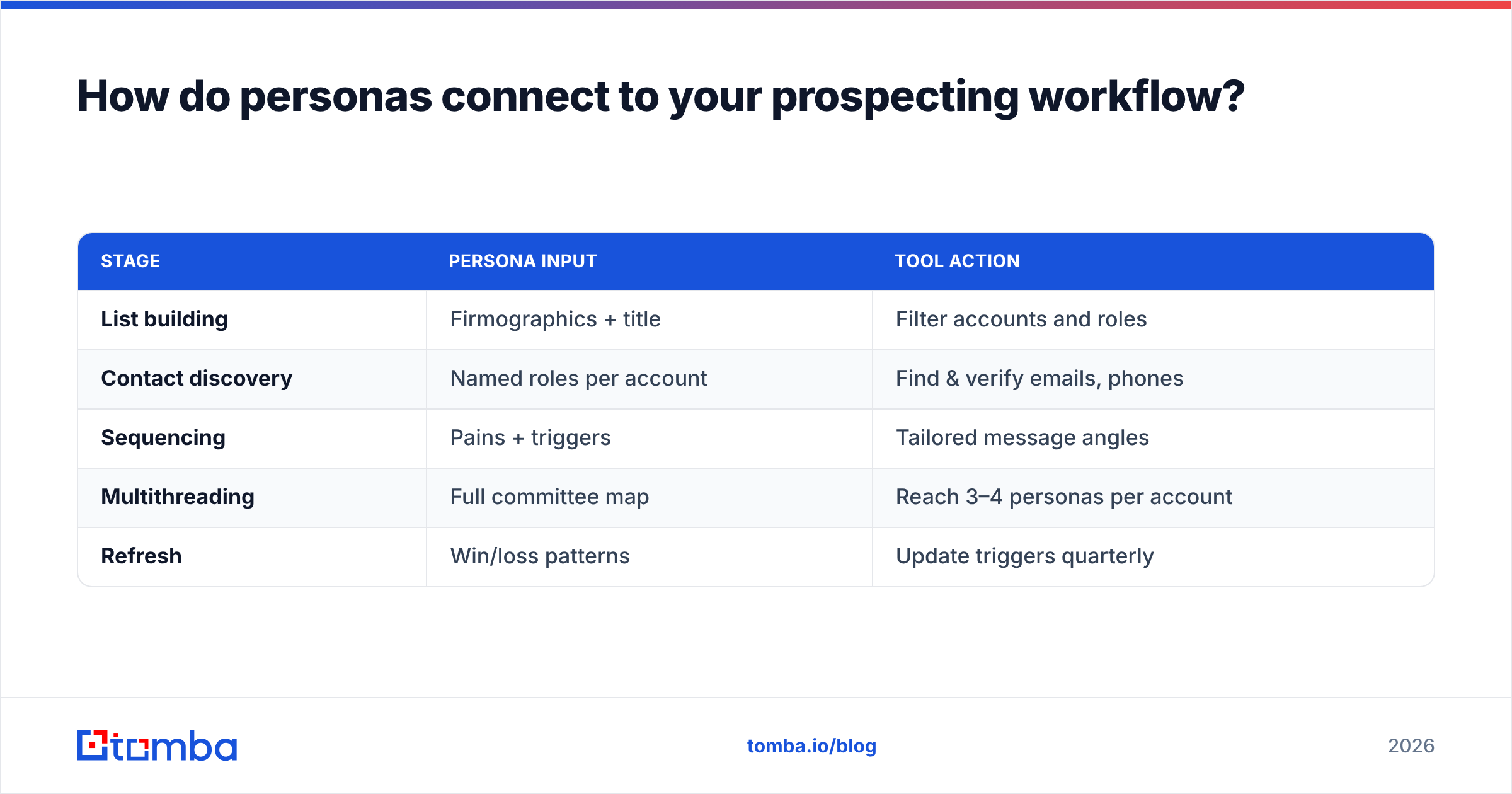
A persona earns its keep only when it's wired into the tools your team uses daily. Here's the handoff:
| Stage | Persona input | Tool action |
|---|---|---|
| List building | Firmographics + title | Filter accounts and roles |
| Contact discovery | Named roles per account | Find & verify emails, phones |
| Sequencing | Pains + triggers | Tailored message angles |
| Multithreading | Full committee map | Reach 3–4 personas per account |
| Refresh | Win/loss patterns | Update triggers quarterly |
Each persona should resolve to a repeatable query: which titles, at which companies, with which signals. From there, contact discovery turns the query into verified records you can sequence. When a buyer fills out a form or replies, a quick reverse email lookup tells you which persona they map to before you even respond — so the first reply already speaks their language.
This is also where data hygiene compounds. A persona pointed at stale contacts bounces, and bounces damage sender reputation. Verified, persona-matched lists protect deliverability while you scale.
How often should you update a B2B buyer persona?#
Every two quarters at minimum, and immediately after any market shift. Re-run a lightweight version of the build process: pull your last quarter of closed-won and closed-lost, check whether titles and triggers still match, and update the disqualifiers. Cross-reference vendor review sites like G2 to see how the language buyers use to describe your category is evolving — that vocabulary shift is an early signal your persona's pains are drifting.
Treat the persona like a CRM field, not a museum piece. The teams that win keep a living document; the teams that lose keep a beautiful PDF from two years ago.
Build personas you can actually act on with Tomba#
A buyer persona is only as good as your ability to reach the people it describes. Once you've defined the roles, triggers, and target accounts, Tomba's Email Finder turns those personas into verified, reachable contact records — by name, company, or domain — so every persona resolves to a list your team can sequence today. Pair it with verification and enrichment to keep that list clean as titles change, and check the full Tomba pricing to match a plan to your volume: a free tier with 25 searches a month to test the workflow, and paid plans from $49/mo when you're ready to scale. Define the person, then go reach them.
// get started
Find, verify and enrich your first contacts today
Start on the free plan with 25 searches a month, then scale when your team is ready.
Free plan · No credit card required · GDPR & CCPA
// about the author