B2B Buyer Persona Research: The 2026 Data-Driven Guide
Most B2B personas are fiction built from internal guesswork. Here's a 2026 framework that grounds buyer persona research in real signals, interviews, and enrichment data.
Most B2B buyer personas are works of fiction. They get drawn up in a kickoff workshop, printed on a one-pager named "Marketing Mary," and then quietly ignored because nobody on the sales floor believes them. The problem is rarely the format. It's the research underneath.
This guide treats b2b buyer persona research as a data discipline, not a branding exercise. You'll get a repeatable framework, the exact inputs that separate a useful persona from a poster, and a way to keep personas current instead of letting them rot for three years.
TL;DR#
- A B2B buyer persona is only as good as the evidence behind it — interviews, win/loss data, intent signals, and firmographic enrichment, not internal opinion.
- Modern B2B deals involve a buying group of 6 to 10+ stakeholders (per Gartner), so you need a persona set per account, not a single hero buyer.
- Skip demographics-as-personality. Anchor research in jobs-to-be-done, trigger events, and the specific objections that stall deals.
- Validate every persona against real contact data; if you can't find and reach the role at scale, the persona is a hypothesis, not a target.
- Refresh personas quarterly using closed-deal data and enrichment, or they decay into the same guesswork you started with.
What is B2B buyer persona research, really?#
B2B buyer persona research is the process of building evidence-based profiles of the people who influence and approve a purchase, so your targeting, messaging, and outreach map to how they actually buy.
Think of it like casting a film instead of writing a horoscope. A horoscope ("our buyer is a forward-thinking innovator who values efficiency") flatters everyone and predicts nothing. Casting is specific: this role, this responsibility, this budget authority, this reason they'd take a meeting on a Tuesday. Good research produces a cast list. Bad research produces horoscopes.
The shift that trips teams up: in B2C you often profile one decision-maker. In B2B you're profiling a committee. The economic buyer signs, the champion advocates internally, the technical evaluator can veto, and an end user can quietly kill adoption after the deal closes. Research that only describes the VP who signs the contract misses the three people who decide whether the VP ever sees your proposal.
Why do most B2B personas fail?#
They fail for predictable, fixable reasons. Naming the failure mode is half the fix.
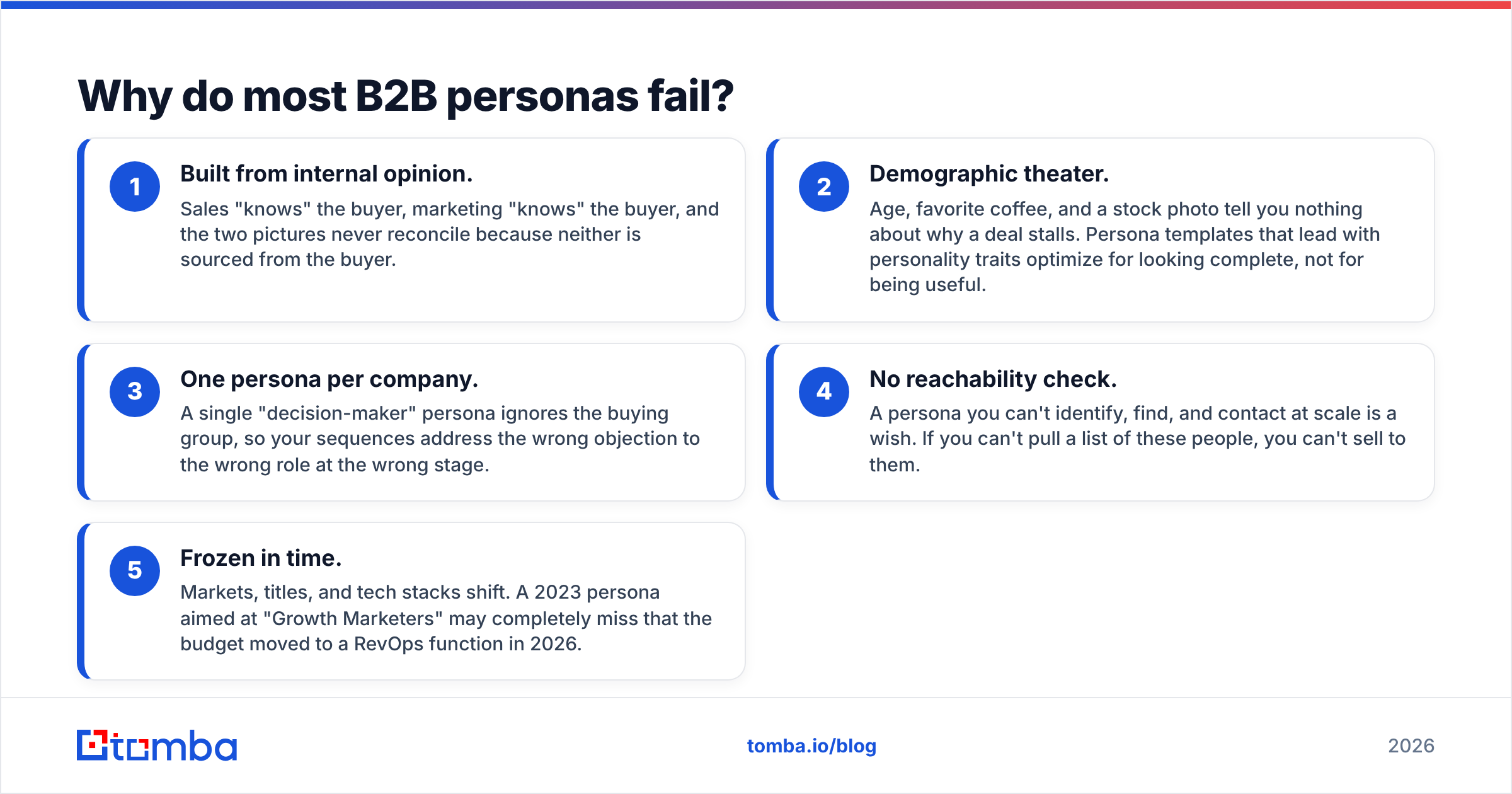
- Built from internal opinion. Sales "knows" the buyer, marketing "knows" the buyer, and the two pictures never reconcile because neither is sourced from the buyer.
- Demographic theater. Age, favorite coffee, and a stock photo tell you nothing about why a deal stalls. Persona templates that lead with personality traits optimize for looking complete, not for being useful.
- One persona per company. A single "decision-maker" persona ignores the buying group, so your sequences address the wrong objection to the wrong role at the wrong stage.
- No reachability check. A persona you can't identify, find, and contact at scale is a wish. If you can't pull a list of these people, you can't sell to them.
- Frozen in time. Markets, titles, and tech stacks shift. A 2023 persona aimed at "Growth Marketers" may completely miss that the budget moved to a RevOps function in 2026.
The throughline: personas fail when research stops at description and never reaches operational targeting. The next sections fix that.
What inputs make a persona evidence-based?#
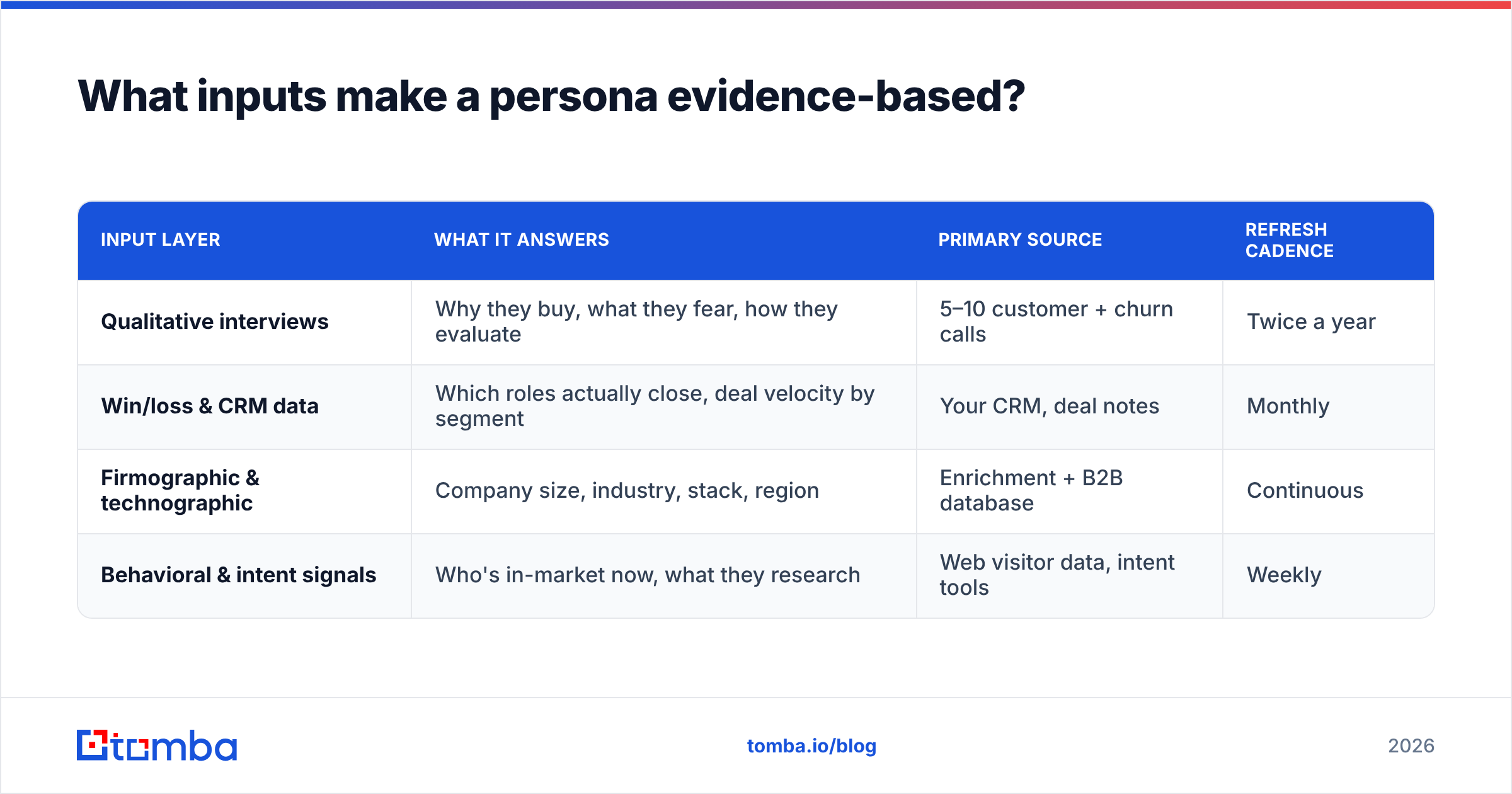
A defensible persona pulls from four input layers. Treat any persona missing two or more of these as a draft.
| Input layer | What it answers | Primary source | Refresh cadence |
|---|---|---|---|
| Qualitative interviews | Why they buy, what they fear, how they evaluate | 5–10 customer + churn calls | Twice a year |
| Win/loss & CRM data | Which roles actually close, deal velocity by segment | Your CRM, deal notes | Monthly |
| Firmographic & technographic | Company size, industry, stack, region | Enrichment + B2B database | Continuous |
| Behavioral & intent signals | Who's in-market now, what they research | Web visitor data, intent tools | Weekly |
The magic isn't any single layer — it's triangulation. Interviews tell you a CFO fears implementation risk; win/loss data confirms deals with no executive sponsor stall at procurement; enrichment tells you which accounts have a CFO reachable by email; intent data tells you which of those accounts is researching your category this week. Stacked, those four turn a persona from a description into a targeting instruction.
For the firmographic layer specifically, you want clean, current company and contact attributes. This is where data enrichment earns its keep — appending role, seniority, company size, and verified contact details so a persona isn't just a job title but a list you can act on. If you're unsure how reliable an enrichment source is, check where the data comes from before you trust it for segmentation.
How do you actually run the research? (Step by step)#
Here's the framework, start to finish. Budget two to three weeks for a first full pass; subsequent refreshes take a day.
Step 1 — Mine your closed-won deals first. Before any new interviews, pull your last 50–100 closed deals from the CRM. Tag each by industry, company size, the title that signed, and the title that championed. Patterns emerge fast: you'll often find 70% of revenue comes from two or three role+segment combinations you weren't deliberately targeting.
Step 2 — Interview across the buying group. Talk to 5–10 recent customers and, critically, 3–5 deals you lost or that churned. Ask about the trigger event ("what changed that made this a priority?"), the evaluation process, the internal skeptics, and the alternatives they considered. Lost deals reveal objections that happy customers have already forgotten.
Step 3 — Map the buying group, not the buyer. For your top segment, list every role that touches the decision: economic buyer, champion, technical evaluator, end user, and blocker. Gartner's research on the B2B buying journey puts the typical group at 6–10 stakeholders, each arriving with their own information. One persona can't carry that.
Step 4 — Synthesize into role-based personas. For each key role, capture: their job-to-be-done, top three objections, the metric they're measured on, where they get information, and the message that earns a reply. Drop the coffee preferences.
Step 5 — Pressure-test reachability. This is the step most frameworks skip. For each persona, confirm you can build a list of real people who match. Use domain search to pull the actual people in a target role at a target company, then verify the contacts are valid before they hit a sequence. If a persona looks great on paper but you can only find five matching contacts in your whole TAM, it's not a viable segment.
Step 6 — Document and version. Store personas where sales and marketing both work, date-stamp them, and note the data sources. A versioned persona invites updates; a laminated one invites neglect.
What does a finished B2B persona look like?#
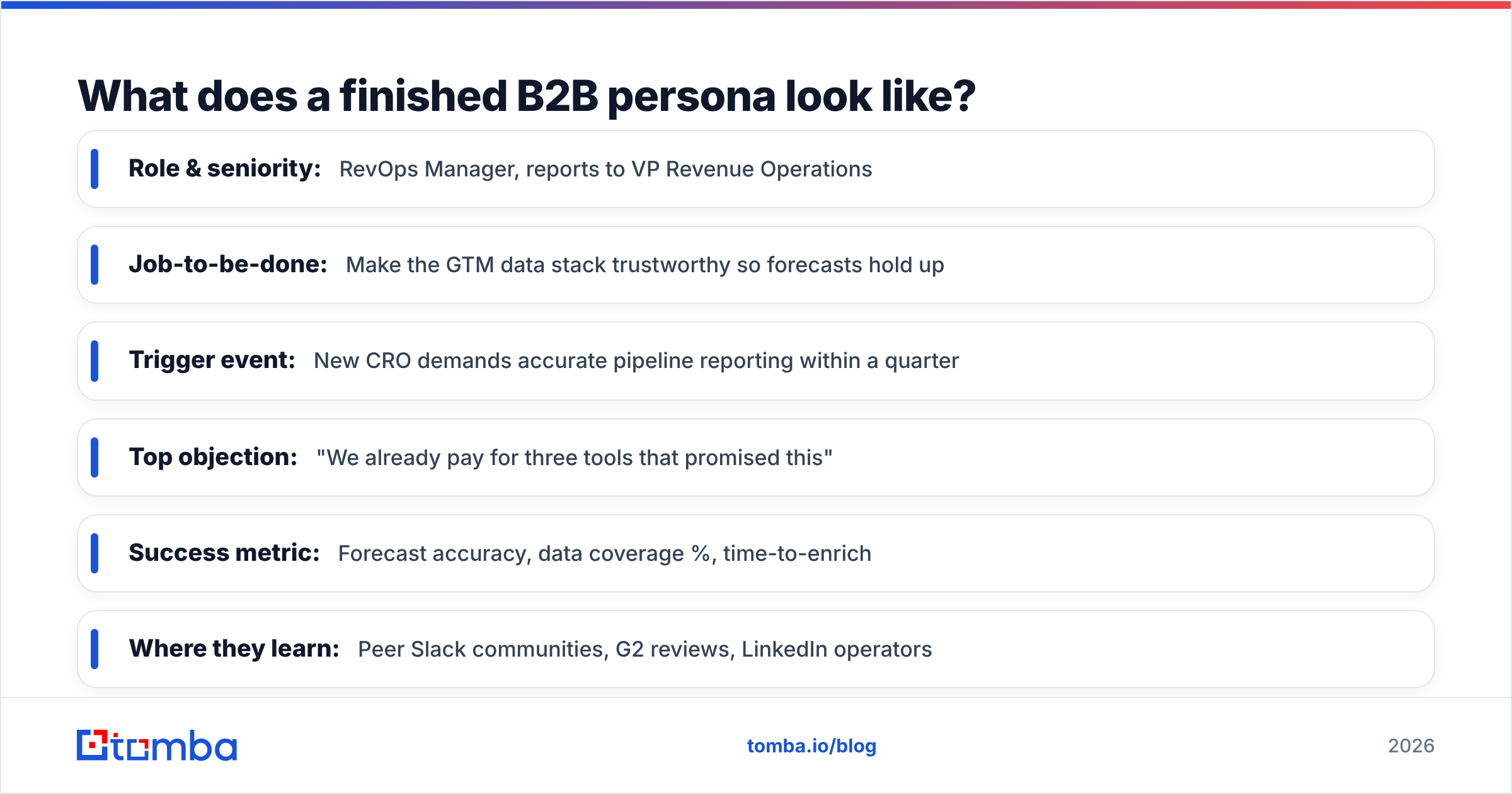
Strip it to what drives action. A research-backed persona for a single role reads like this:
- Role & seniority: RevOps Manager, reports to VP Revenue Operations
- Job-to-be-done: Make the GTM data stack trustworthy so forecasts hold up
- Trigger event: New CRO demands accurate pipeline reporting within a quarter
- Top objection: "We already pay for three tools that promised this"
- Success metric: Forecast accuracy, data coverage %, time-to-enrich
- Where they learn: Peer Slack communities, G2 reviews, LinkedIn operators
- Reachability: Findable via company domain; title stable across mid-market SaaS
Notice there's no age, no stock photo, no invented backstory. Every line either changes who you target or what you say. That's the test for whether a persona field deserves to exist.
You can validate the "where they learn" line against public review behavior on sites like G2, and sanity-check titling conventions with a quick scan on LinkedIn — both are free signal for whether your assumed role actually exists in the wild.
How is persona research different in 2026?#
Three shifts changed the work in the last two years.
First, buying groups got larger and more anonymous. More of the journey happens before anyone fills out a form. That makes intent and behavioral signals — not just declared data — central to knowing which persona is in-market now.
Second, titles fragmented. "Growth," "RevOps," "GTM Engineering," and "Marketing Ops" overlap and shift budgets between them. Persona research now has to track the function and budget authority behind a title, because the title alone is unstable.
Third, enrichment and verification got good enough to operationalize personas in real time. You no longer build a persona and hope your list matches. You define the persona's firmographic and role criteria, then programmatically pull and verify matching contacts. The persona becomes a query, not a poster.
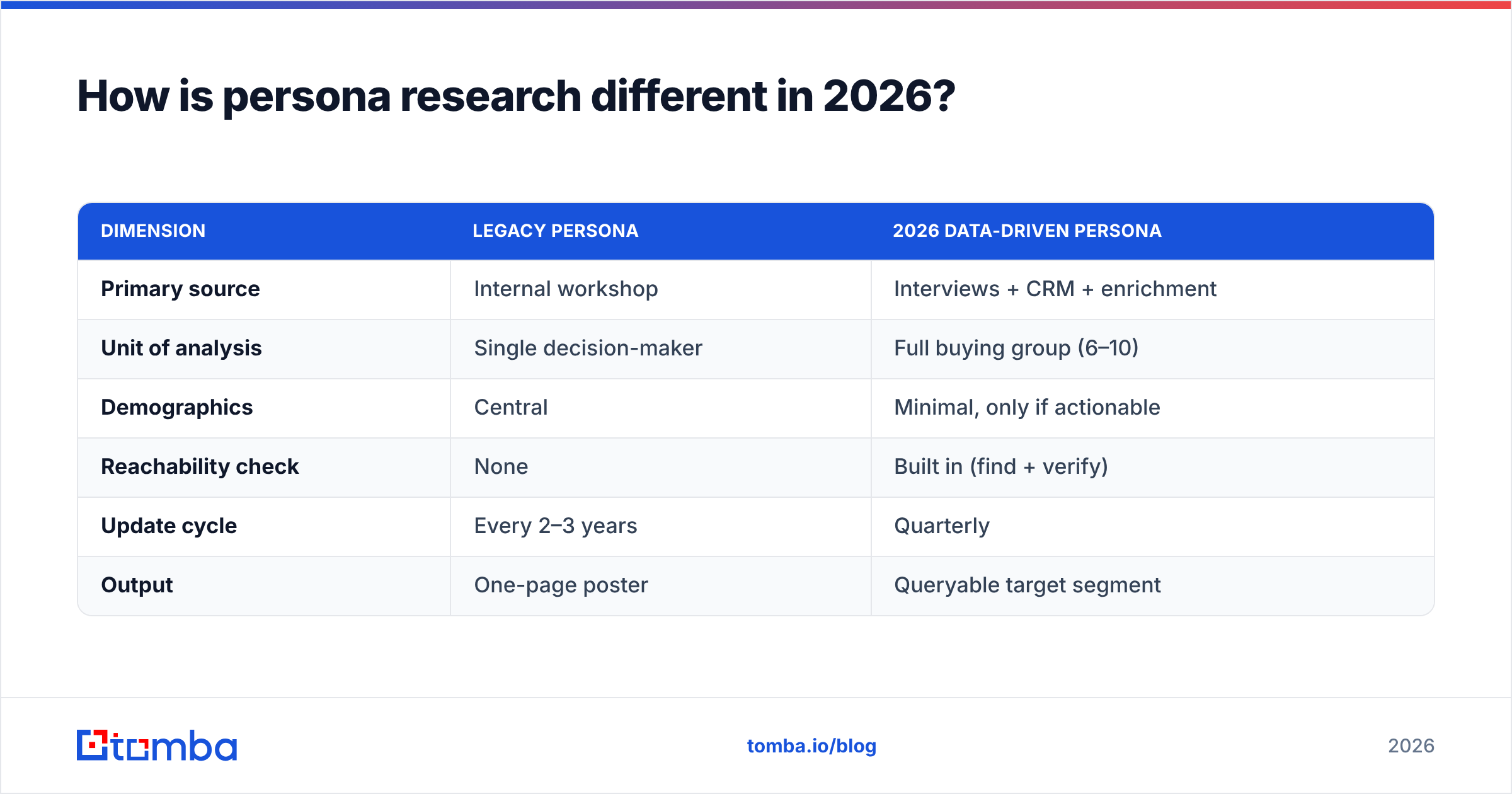
Here's how the old approach stacks against the data-driven one:
| Dimension | Legacy persona | 2026 data-driven persona |
|---|---|---|
| Primary source | Internal workshop | Interviews + CRM + enrichment |
| Unit of analysis | Single decision-maker | Full buying group (6–10) |
| Demographics | Central | Minimal, only if actionable |
| Reachability check | None | Built in (find + verify) |
| Update cycle | Every 2–3 years | Quarterly |
| Output | One-page poster | Queryable target segment |
If your current personas sit in the left column, the gap isn't talent — it's inputs and tooling.
How do you keep personas from going stale?#
Tie persona maintenance to data you already generate. Every closed deal is a free research update if you capture it.
A lightweight cadence that works:
- Monthly: Re-run win/loss tagging on new closed deals. Did a new role start championing? Flag it.
- Quarterly: Refresh firmographic and contact data on your top segments via enrichment so lists don't decay; bounce rates climbing is your early warning that a persona's reachability is eroding.
- Twice a year: Run three to five fresh interviews, weighted toward new logos and recent churn.
The failure mode to avoid is treating personas as a project with an end date. They're a living asset. The teams that win treat persona research the way they treat pipeline hygiene — small, constant, automated where possible. Pulling and verifying contacts for a defined persona is exactly the kind of repetitive task worth handing to an email finder so your researchers spend time on synthesis, not list-building.
Which tools support B2B persona research?#
You need three capabilities, which may come from one platform or several: a source of firmographic/contact data, a way to verify and enrich it, and a way to capture qualitative and intent signals. Interviews and CRM analysis stay human; everything else benefits from automation.
When you evaluate vendors, score them on data coverage for your segment (a tool strong in US enterprise may be thin in EU mid-market), verification accuracy, and how cleanly the data flows into your CRM. A persona is only as operational as the list you can build from it — so weight reachability heavily, the same way you should weight it inside the personas themselves.
The bottom line#
Strong B2B buyer persona research replaces opinion with evidence and ends with something you can act on, not just admire. Start with your own closed deals, interview across the buying group, anchor on jobs-to-be-done and objections, and — non-negotiable — validate that every persona maps to real, reachable people. Then keep it current.
If your personas are finally specific enough to target, the last step is reaching them. Tomba's email finder turns a defined persona into a verified contact list — search by company domain, role, and name, then confirm every address before it enters a sequence. Start on the free tier (25 searches/month), and when persona research becomes a weekly habit, Tomba's plans scale from $49/mo Starter to Pro without breaking your enrichment workflow. Build the persona on evidence; let the data layer handle the reach.
// get started
Find, verify and enrich your first contacts today
Start on the free plan with 25 searches a month, then scale when your team is ready.
Free plan · No credit card required · GDPR & CCPA
// about the author