B2B Buyer Personas in 2026: A Data-Driven Playbook
Most B2B buyer personas are fiction dressed up as strategy. Here is how to build data-backed profiles that actually sharpen targeting, messaging, and pipeline in 2026.
TL;DR
- B2B buyer personas are research-based profiles of the people who actually approve, influence, and block your deals — not invented characters with stock photos and cute names.
- The personas that move pipeline are built from real signals: CRM data, win/loss interviews, intent data, and verified contact records — not a one-afternoon brainstorm.
- Modern B2B deals involve 6–10 stakeholders, so you need a buying-committee view, not a single hero persona.
- A good persona answers four questions: who they are, what they're trying to fix, what stops them from buying, and where you reach them.
- Personas decay. Refresh them every two quarters against fresh data, or they quietly start lying to you.
What are B2B buyer personas, really?#
A B2B buyer persona is a research-based profile of a specific type of person involved in buying your product. Think of it like a casting sheet for a film: before you write a single line of dialogue (your messaging), you need to know who's on screen, what they want, and what's standing in their way. Skip that, and every line lands flat.
The problem is that most personas read like horoscopes. "Marketing Mary is a 38-year-old VP who values efficiency and hates wasting time." That's true of nearly everyone and useful to no one. A real persona is sharp enough that two reps reading it would target the same accounts and write the same opening line.
In 2026, the bar is higher than it used to be. According to Gartner research on B2B buying, a typical purchase now involves six to ten decision-makers, each armed with their own stack of independently gathered information. That single fact breaks the old "one persona per product" model. You're not selling to a person — you're selling to a committee, and each seat on that committee buys for different reasons.
Why do most B2B buyer personas fail?#
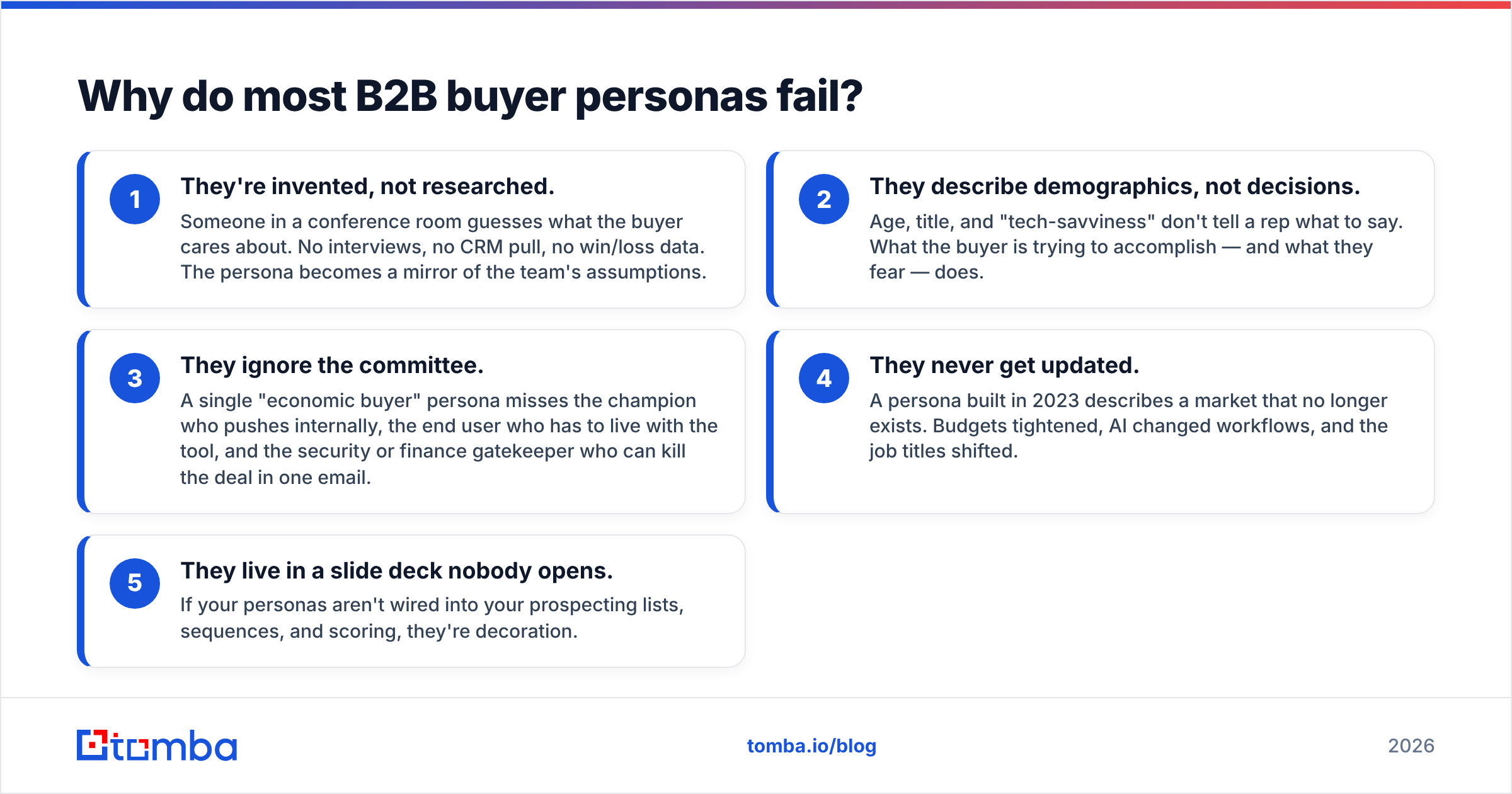
They fail because they're built backwards — from imagination toward data, instead of from data toward insight. Here are the failure modes worth naming:
- They're invented, not researched. Someone in a conference room guesses what the buyer cares about. No interviews, no CRM pull, no win/loss data. The persona becomes a mirror of the team's assumptions.
- They describe demographics, not decisions. Age, title, and "tech-savviness" don't tell a rep what to say. What the buyer is trying to accomplish — and what they fear — does.
- They ignore the committee. A single "economic buyer" persona misses the champion who pushes internally, the end user who has to live with the tool, and the security or finance gatekeeper who can kill the deal in one email.
- They never get updated. A persona built in 2023 describes a market that no longer exists. Budgets tightened, AI changed workflows, and the job titles shifted.
- They live in a slide deck nobody opens. If your personas aren't wired into your prospecting lists, sequences, and scoring, they're decoration.
The fix for all five is the same: anchor every claim in evidence. If you can't point to the interview quote, the closed-won pattern, or the data field behind a persona attribute, treat it as a hypothesis, not a fact.
What goes into a strong B2B buyer persona?#
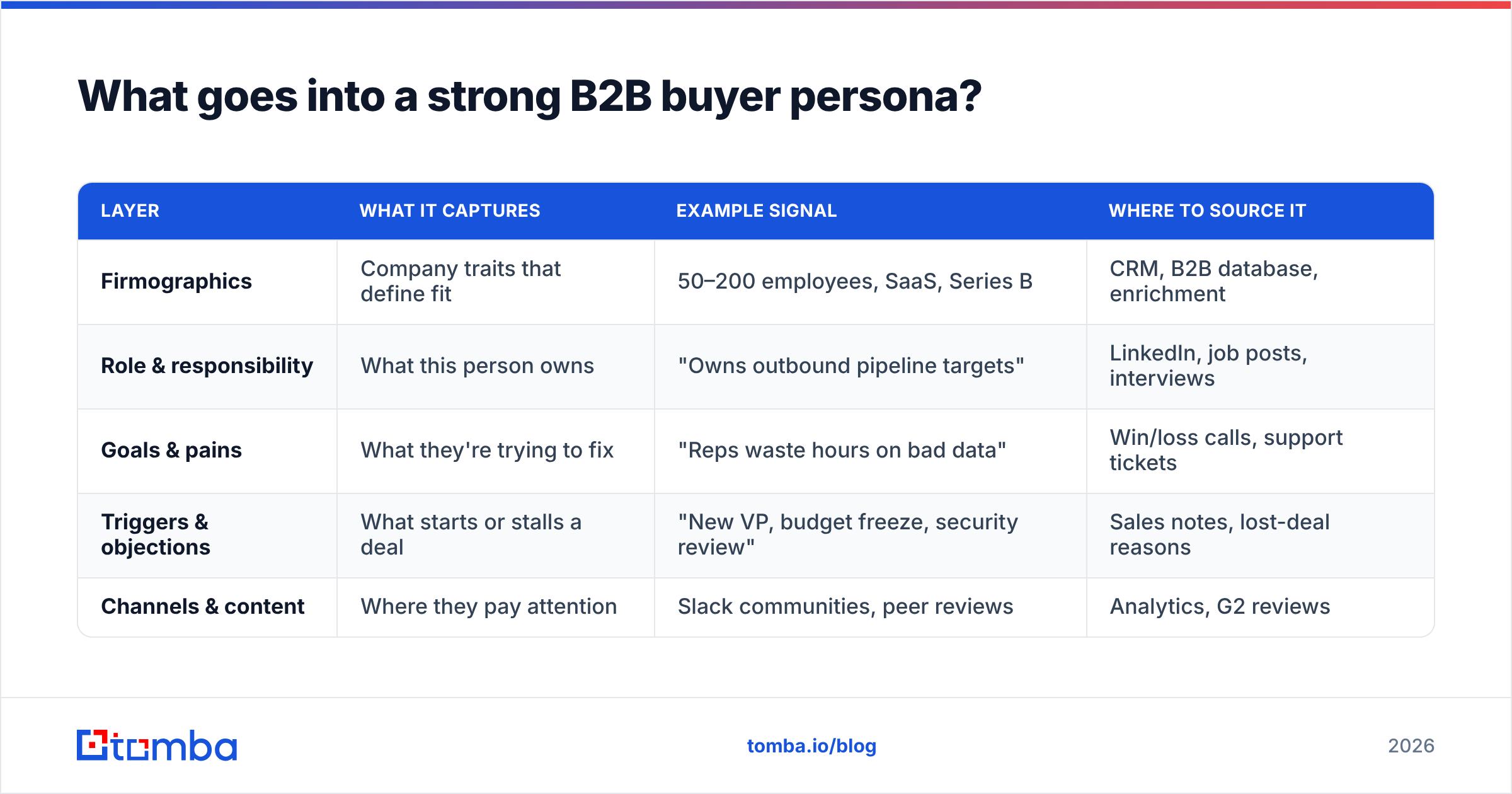
A persona that earns its place in your workflow covers four layers. Demographics are the thinnest and least important layer; the bottom three are where the value lives.
| Layer | What it captures | Example signal | Where to source it |
|---|---|---|---|
| Firmographics | Company traits that define fit | 50–200 employees, SaaS, Series B | CRM, B2B database, enrichment |
| Role & responsibility | What this person owns | "Owns outbound pipeline targets" | LinkedIn, job posts, interviews |
| Goals & pains | What they're trying to fix | "Reps waste hours on bad data" | Win/loss calls, support tickets |
| Triggers & objections | What starts or stalls a deal | "New VP, budget freeze, security review" | Sales notes, lost-deal reasons |
| Channels & content | Where they pay attention | Slack communities, peer reviews | Analytics, G2 reviews |
Notice that three of the five rows can't be filled from a data tool alone — they require talking to humans. The most useful persona work is half quantitative (who and how many) and half qualitative (why and what stops them). Tools get you the who; conversations get you the why.
How do you build B2B buyer personas step by step?#
Here's a sequence that produces personas you'll actually use, not laminate and forget.
Step 1 — Mine your closed-won deals. Pull your last 50–100 wins from the CRM. Look for patterns in company size, industry, the title of the person who signed, and the title of the person who first raised their hand. This is your evidence base, and it's free.
Step 2 — Interview real buyers. Talk to 8–12 recent customers. Ask what problem pushed them to look, what almost stopped them from buying, and who else was in the room. Record the exact language they use — that language becomes your copy later. HubSpot's guide to making buyer personas has a solid interview question bank if you need a starting script.
Step 3 — Map the buying committee. For each deal type, list the seats: champion, economic buyer, end user, and blocker. Write a mini-persona for each. The champion and the blocker often care about opposite things, and your outreach has to speak to both.
Step 4 — Enrich and quantify. Now layer in data. Use data enrichment to attach firmographics, technographics, and seniority to your existing contacts so you can see how big each segment actually is. A persona that describes 2% of your addressable market isn't worth a dedicated play.
Step 5 — Build target lists from the persona. This is the step most teams skip, and it's the one that turns a document into pipeline. Translate each persona into concrete search filters — title, industry, headcount, location — and pull a real contact list. With a domain search, you can take a list of fit-companies and surface the exact people matching each persona seat, with verified work emails.
Step 6 — Validate against reality. Run a small campaign per persona. If the "champion" persona replies at 8% and the "economic buyer" persona ghosts you entirely, your persona — or your message — is wrong. Let the data correct the document.
How many buyer personas should you have?#
Fewer than you think. The instinct is to create a persona for every job title you've ever sold to, and you end up with fifteen profiles nobody can keep straight. Start with three to five primary personas that map to your highest-value, highest-volume segments. Add committee sub-personas (champion vs. blocker) only where the buying motion genuinely differs.
A useful test: if you can't immediately recall what makes each persona distinct, you have too many. Personas are a tool for focus. The moment they create confusion instead of clarity, you've over-engineered them.
There's also a cost question. Every persona you maintain is a research and refresh commitment. Three personas you keep current beat ten that rot. Treat personas like a product backlog — ruthlessly prioritized, not infinitely expanded.
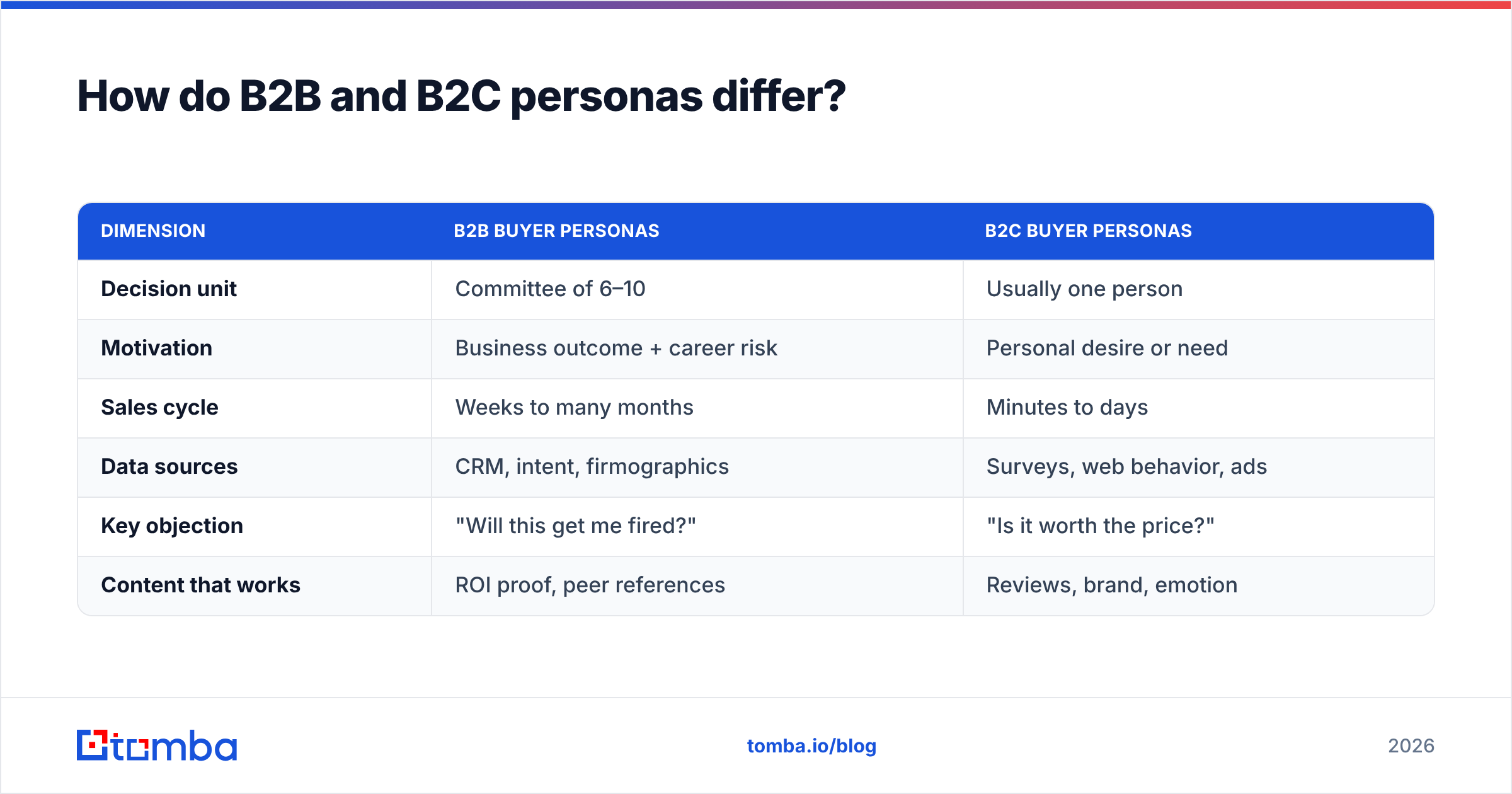
How do B2B and B2C personas differ?#
The gap is wider than most templates admit, which is why borrowing a B2C persona framework leads B2B teams astray.
| Dimension | B2B buyer personas | B2C buyer personas |
|---|---|---|
| Decision unit | Committee of 6–10 | Usually one person |
| Motivation | Business outcome + career risk | Personal desire or need |
| Sales cycle | Weeks to many months | Minutes to days |
| Data sources | CRM, intent, firmographics | Surveys, web behavior, ads |
| Key objection | "Will this get me fired?" | "Is it worth the price?" |
| Content that works | ROI proof, peer references | Reviews, brand, emotion |
The "career risk" row is the one B2B teams underweight. Your champion isn't just evaluating whether your product works — they're evaluating whether recommending it makes them look smart or exposes them. Personas that capture that hidden fear write better outreach than personas that only list features the buyer wants.
What tools and data feed accurate personas?#
Personas are only as honest as the data underneath them. Three data categories matter most:
- First-party CRM data — your own closed-won and closed-lost records. This is the highest-trust source you have, and it's already paid for.
- Enrichment and firmographic data — to quantify segment size and fill gaps. This tells you whether a persona is a niche or a market.
- Verified contact data — because a persona you can't reach is a fantasy. Once you've defined a persona, you need accurate, deliverable emails and phone numbers to act on it at scale.
That last point trips up more teams than the first two. You can build a beautiful persona and still stall out because your contact list is full of guessed, bounced, or outdated emails. This is where tooling earns its keep: an email finder with high deliverability turns "we should target VP-level RevOps leaders at Series B SaaS companies" into an actual, reachable list. Compare options on accuracy and verification depth — not just price — because a cheap list that bounces costs you sender reputation, which is far more expensive to repair. You can review the full Tomba pricing tiers to see where verified-contact volume fits your budget.
How often should you update your B2B buyer personas?#
Every two quarters, at minimum — and immediately after any major market shift. Personas decay quietly. The titles your buyers hold drift, budgets move between departments, and the triggers that started deals last year stop working this year. A persona you built and never revisited is making decisions for you based on a world that's gone.
Build a lightweight refresh ritual. Once a quarter, pull your most recent wins and losses and ask one question: does this match the persona? When the answer is "not quite," update the document the same day. The goal isn't a perfect persona — it's a persona that's never more than 90 days out of date.
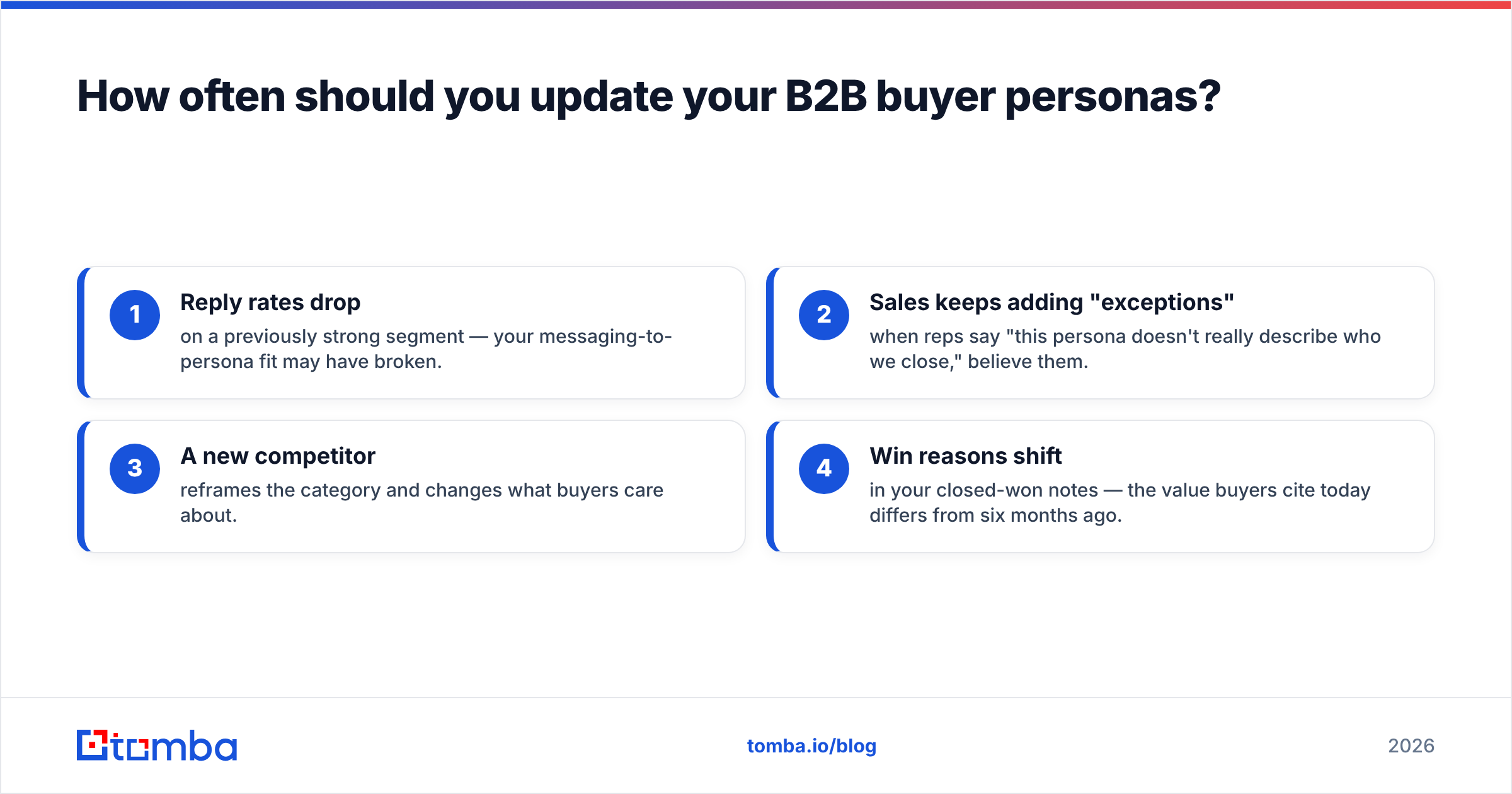
Watch for these decay signals between scheduled refreshes:
- Reply rates drop on a previously strong segment — your messaging-to-persona fit may have broken.
- Sales keeps adding "exceptions" — when reps say "this persona doesn't really describe who we close," believe them.
- A new competitor reframes the category and changes what buyers care about.
- Win reasons shift in your closed-won notes — the value buyers cite today differs from six months ago.
Putting it together#
Strong B2B buyer personas aren't a branding exercise — they're an operational asset that decides which accounts you chase, what you say, and who you say it to. Build them from evidence, map the whole buying committee, keep them few and sharp, and refresh them before they rot. Do that, and every downstream activity — list building, sequencing, scoring, qualification — gets more accurate, because it's all pointed at the right people.
The fastest place to feel the difference is the moment you turn a persona into a real contact list. When you've defined exactly who you're after, Tomba's Email Finder lets you go from "this is my ideal buyer" to a verified, deliverable list of those exact people — by name, company, or domain — so your well-researched personas actually reach the inboxes that matter. Start on the free tier (25 searches/month), and scale up once your persona-driven plays start booking meetings.
// get started
Find, verify and enrich your first contacts today
Start on the free plan with 25 searches a month, then scale when your team is ready.
Free plan · No credit card required · GDPR & CCPA
// about the author