The B2B Buying Cycle in 2026: Stages, Triggers & How to Win
Modern B2B deals involve 6-10 stakeholders and months of silent research. Here's how the B2B buying cycle actually works in 2026 — and how to map your sales process to it.
The B2B buying cycle is the structured journey a company moves through before it commits budget to a purchase — and in 2026 it looks almost nothing like the linear "awareness to decision" funnel reps were trained on a decade ago. Buyers self-educate in silence, decisions get made by committee, and the rep often enters the conversation when the deal is already two-thirds decided.
If your sales process still assumes a single champion and a tidy handoff, you are leaving revenue on the table. This guide breaks down what the modern B2B buying cycle is, who participates, the stages that matter, and how to align your selling motion to each one.
TL;DR#
- The B2B buying cycle is non-linear. Gartner research shows buyers loop back through stages — they don't march down a funnel.
- Buying groups now average 6–10 stakeholders, each with their own priorities, veto power, and information needs.
- Up to 70% of the journey happens before a vendor is contacted. Your content and data footprint do the early selling for you.
- Six core stages structure most deals: problem identification, solution exploration, requirements building, vendor selection, validation, and consensus.
- Winning means mapping your process to the buyer's, reaching the full committee early with accurate contact data, and reducing the friction of internal consensus.
What is the B2B buying cycle?#
The B2B buying cycle is the end-to-end process an organization follows to recognize a problem, evaluate options, and purchase a solution. Think of it like a mortgage approval rather than buying coffee: multiple people sign off, there are documentation checkpoints, and any one stakeholder can stall the whole thing.
Unlike B2C, where one person decides in minutes, B2B purchases involve formal procurement, risk assessment, and budget justification. The cycle can run anywhere from a few weeks for a low-cost tool to 12+ months for enterprise platforms.
The critical shift in 2026: the cycle is buyer-led, not seller-led. Prospects complete most of their research independently — reading reviews on G2, comparing vendors, and polling peers — long before they raise a hand. Your job is to be present, credible, and easy to verify during that silent phase.
What are the stages of the B2B buying cycle?#
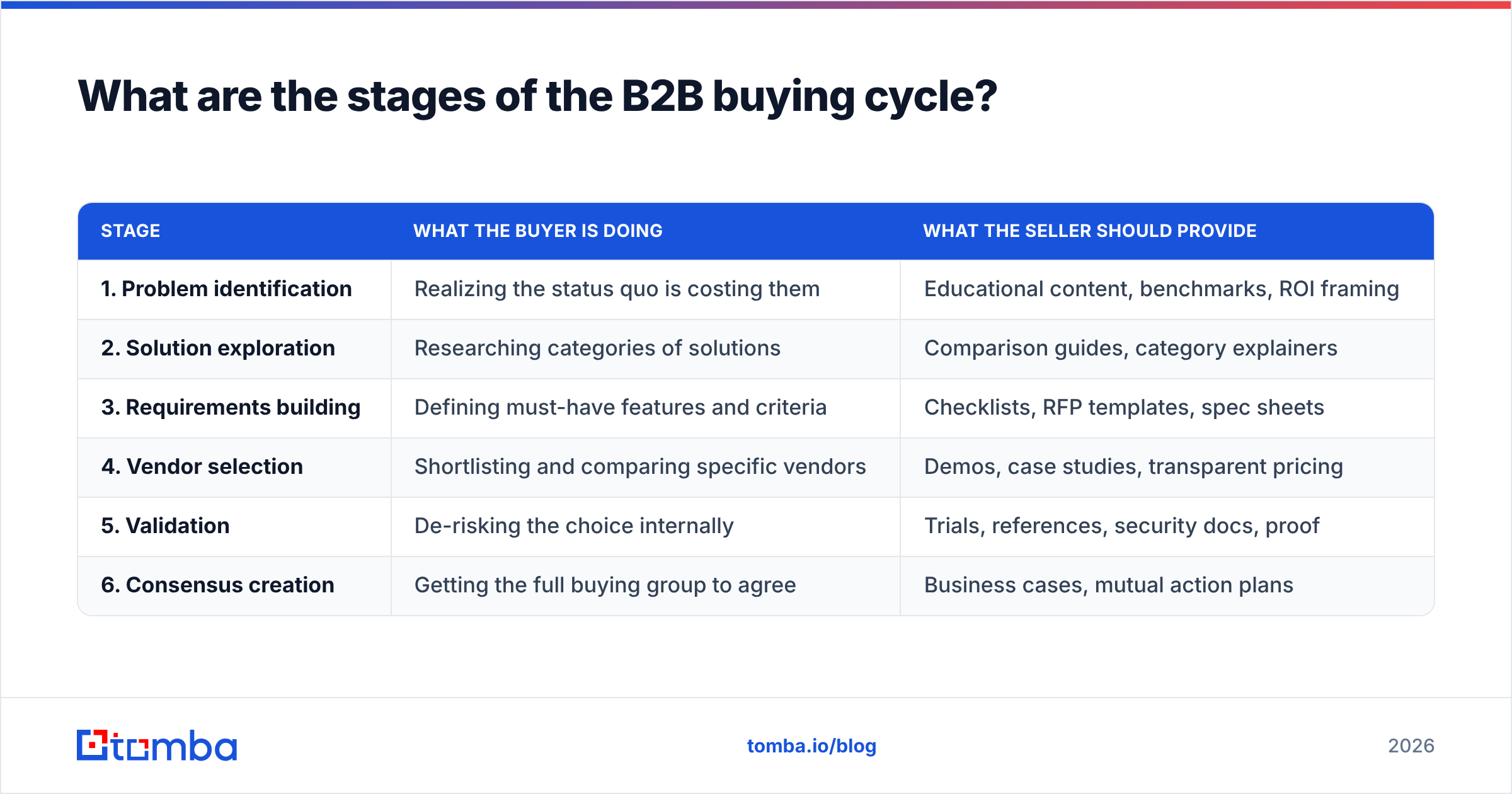
Gartner's B2B buying research frames buying as a set of "jobs" buyers must complete rather than a straight line. In practice, most deals move through six recognizable stages — though buyers frequently loop back to earlier ones.
| Stage | What the buyer is doing | What the seller should provide |
|---|---|---|
| 1. Problem identification | Realizing the status quo is costing them | Educational content, benchmarks, ROI framing |
| 2. Solution exploration | Researching categories of solutions | Comparison guides, category explainers |
| 3. Requirements building | Defining must-have features and criteria | Checklists, RFP templates, spec sheets |
| 4. Vendor selection | Shortlisting and comparing specific vendors | Demos, case studies, transparent pricing |
| 5. Validation | De-risking the choice internally | Trials, references, security docs, proof |
| 6. Consensus creation | Getting the full buying group to agree | Business cases, mutual action plans |
Notice that selling motions differ at every stage. Pushing a demo (stage 4 content) at a buyer still framing their problem (stage 1) is the single most common reason deals stall.
Who is in the B2B buying group?#
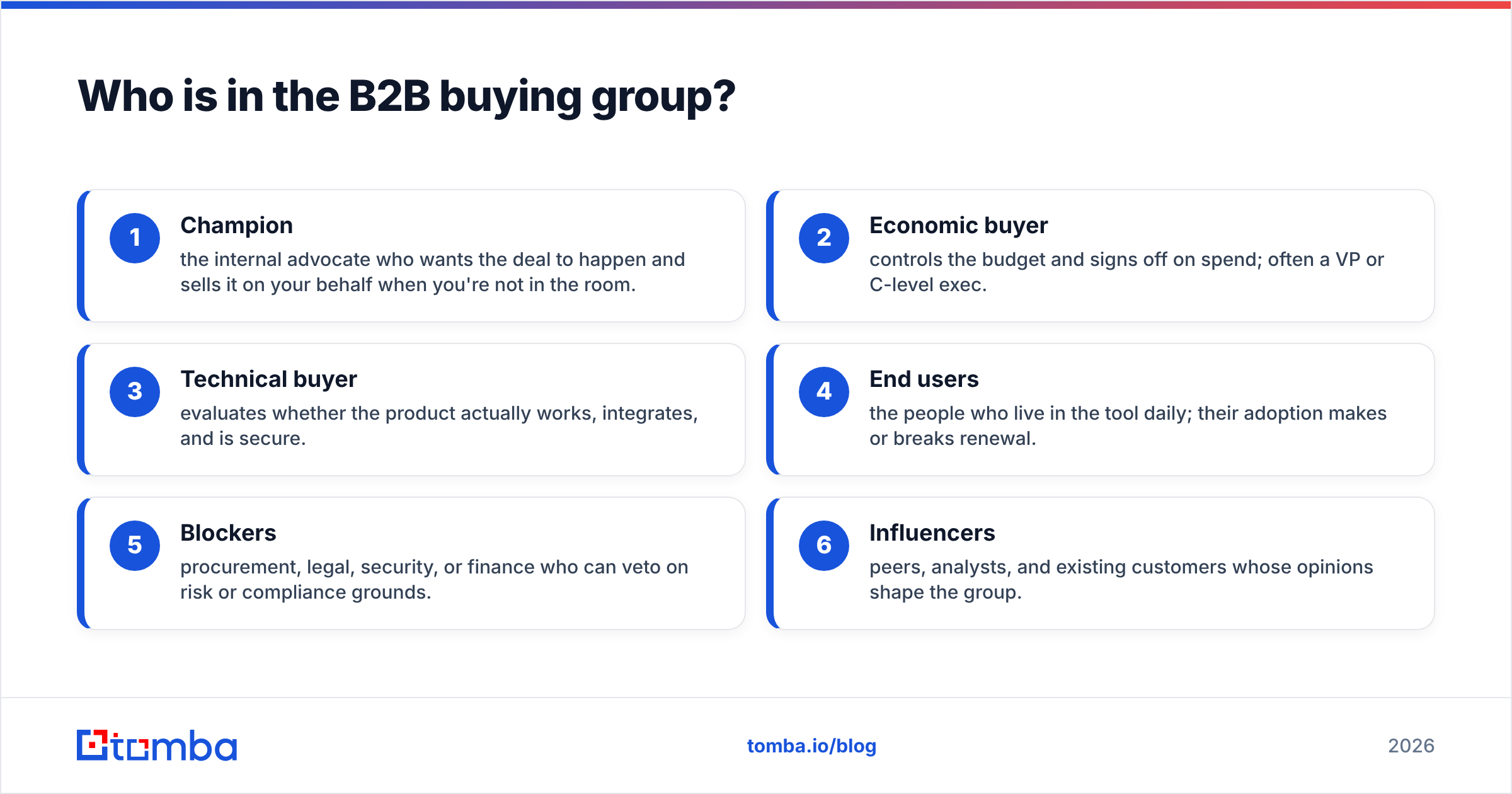
A "buying group" or "buying committee" is the set of people involved in a single purchase decision. Gartner pegs the average at 6 to 10 stakeholders for considered purchases, and larger enterprise deals can involve far more.
These roles typically appear:
- Champion — the internal advocate who wants the deal to happen and sells it on your behalf when you're not in the room.
- Economic buyer — controls the budget and signs off on spend; often a VP or C-level exec.
- Technical buyer — evaluates whether the product actually works, integrates, and is secure.
- End users — the people who live in the tool daily; their adoption makes or breaks renewal.
- Blockers — procurement, legal, security, or finance who can veto on risk or compliance grounds.
- Influencers — peers, analysts, and existing customers whose opinions shape the group.
The practical implication: reaching only your champion is a single point of failure. You need accurate contact data for the whole committee, which is where a reliable email finder and data enrichment earn their keep — you can't influence stakeholders you can't reach.
How long is the B2B buying cycle in 2026?#
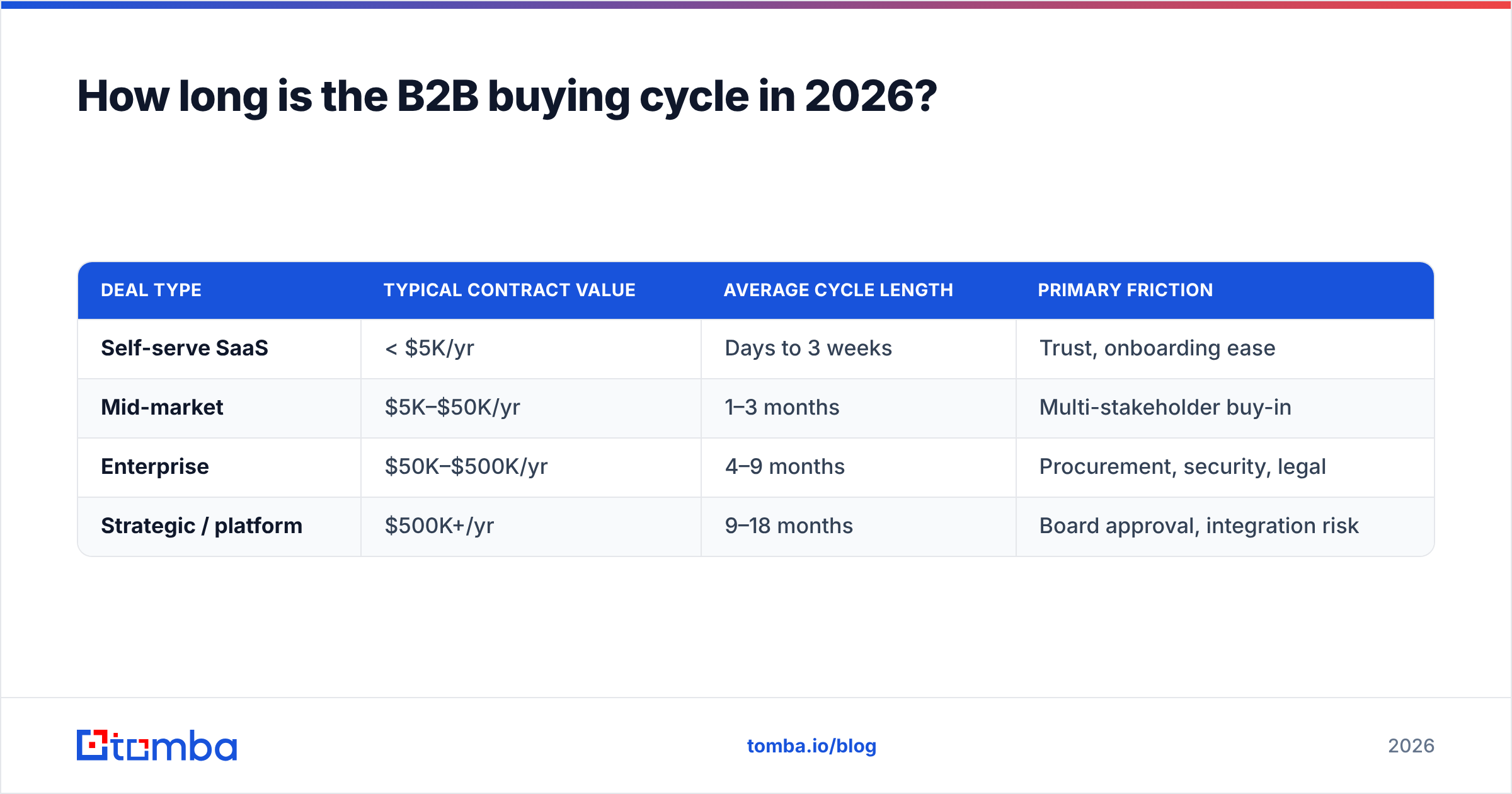
It depends on deal size and risk, but cycles have lengthened, not shortened, despite faster tooling. More stakeholders means more internal alignment, and economic caution means more scrutiny on every dollar.
| Deal type | Typical contract value | Average cycle length | Primary friction |
|---|---|---|---|
| Self-serve SaaS | < $5K/yr | Days to 3 weeks | Trust, onboarding ease |
| Mid-market | $5K–$50K/yr | 1–3 months | Multi-stakeholder buy-in |
| Enterprise | $50K–$500K/yr | 4–9 months | Procurement, security, legal |
| Strategic / platform | $500K+/yr | 9–18 months | Board approval, integration risk |
The takeaway: the bigger the deal, the more the cycle is about reducing perceived risk and manufacturing consensus rather than convincing one person of value.
Why is the modern B2B buying cycle so hard to sell into?#
Three structural changes make it tough.
First, information symmetry. Buyers have access to the same reviews, pricing pages, and comparisons you do. The seller no longer controls the narrative; you influence it.
Second, the consensus problem. Every additional stakeholder lowers the odds of a "yes." Forrester and Gartner both report that larger buying groups correlate with more "no decision" outcomes — deals die from indecision, not competition.
Third, the dark funnel. Much of the journey happens where you can't track it: Slack communities, podcasts, peer DMs, and private review sites. By the time a form is filled, the marketing qualified lead has already formed strong opinions.
How do you map your sales process to the buying cycle?#
The conclusion first: stop selling your stages and start serving theirs. Align every play to where the buyer actually is.
Stage 1–2 (Problem & exploration): Lead with insight, not product. Publish benchmarks and teardown content. Use intent signals and website visitor reveal to spot accounts researching your category before they fill a form.
Stage 3 (Requirements): Become the source of the criteria. Offer evaluation checklists and RFP templates. If you shape the requirements list, your strengths become their must-haves.
Stage 4 (Vendor selection): Make comparison easy and honest. Transparent pricing and side-by-side feature breakdowns reduce the buyer's research labor — and buyers reward the vendor who respects their time.
Stage 5 (Validation): Remove risk. Offer trials, security documentation, and warm references. This is where end users and technical buyers need direct access.
Stage 6 (Consensus): Arm your champion. Build a one-page business case and a mutual action plan they can forward internally. Your champion is selling for you in rooms you'll never enter.
What role does data and outreach play across the cycle?#
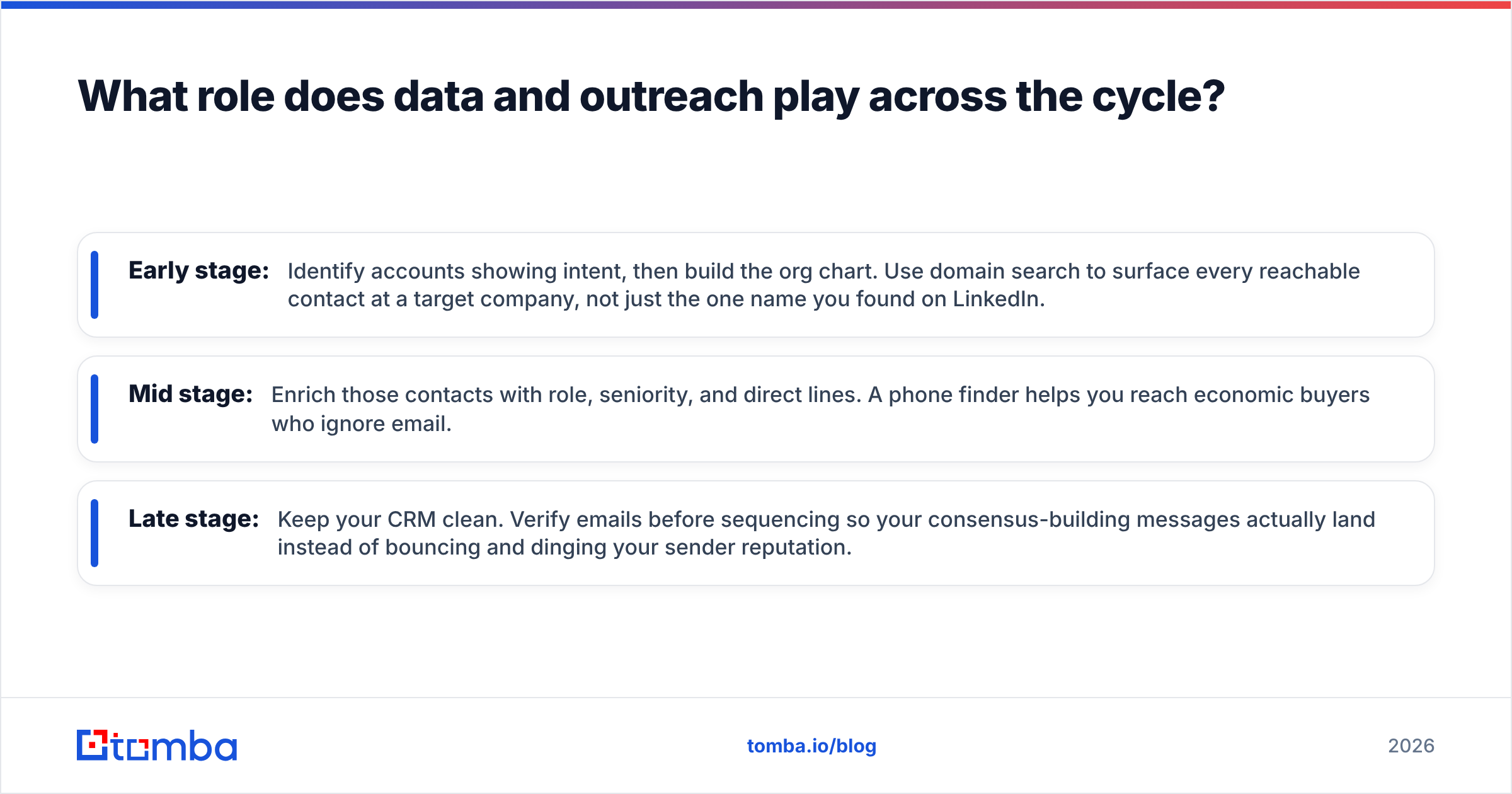
Accurate contact data is the connective tissue of the entire cycle. You cannot run a multithreaded play — the only reliable way to win committee deals — without reaching every member of the buying group.
Here's how data work maps to stages:
- Early stage: Identify accounts showing intent, then build the org chart. Use domain search to surface every reachable contact at a target company, not just the one name you found on LinkedIn.
- Mid stage: Enrich those contacts with role, seniority, and direct lines. A phone finder helps you reach economic buyers who ignore email.
- Late stage: Keep your CRM clean. Verify emails before sequencing so your consensus-building messages actually land instead of bouncing and dinging your sender reputation.
Multithreading a six-person committee with bad data means half your messages never arrive — and the half that do may hit the wrong person. Clean, verified data is not a nice-to-have; it's the precondition for the whole motion.
How is AI changing the B2B buying cycle?#
Buyers now use AI assistants to shortlist vendors, summarize reviews, and draft requirements — which compresses the early research stages and raises the bar for how discoverable and structured your information must be. If an AI can't parse your pricing or value proposition, you don't make the shortlist.
On the selling side, AI accelerates research, account mapping, and personalization at scale. But it amplifies whatever data you feed it. Garbage contact records produce confidently wrong outreach. The teams winning in 2026 pair AI personalization with rigorously verified underlying data — the model writes the message, but only after a trustworthy source confirms the person, role, and email exist.
A practical workflow: enrich and verify your target accounts first (so the foundation is accurate), then layer AI personalization on top. Reverse that order and you scale errors.
What are common mistakes that kill B2B deals?#
- Single-threading. Betting the deal on one champion who then changes jobs or loses internal influence.
- Stage mismatch. Pitching product to someone still scoping the problem.
- Ignoring blockers. Discovering procurement, security, or legal objections at the finish line instead of the start.
- Dirty data. Sequencing to bounced emails, wrong titles, or people who left the company.
- No mutual action plan. Leaving the consensus-building work to the buyer, who is busy and will deprioritize you.
Each of these is fixable with process discipline and accurate data — the two cheapest levers you control.
Frequently asked questions#
Is the B2B buying cycle the same as the sales funnel? No. The buying cycle is the buyer's journey; the sales funnel is the seller's view of pipeline. They overlap but are measured differently — the buyer cares about reducing risk, the seller cares about stage conversion. Align them and forecasting improves.
How many touchpoints does a B2B sale take? It varies, but multithreaded deals routinely require dozens of touches across the committee. The number matters less than the coverage: are you engaging every decision-maker, or just one?
Where do most B2B deals stall? Stages 5 and 6 — validation and consensus. Deals rarely die because of price; they die because the group can't align or the perceived risk of changing isn't worth it. "No decision" beats competitors as the top reason for lost deals.
What's the fastest way to shorten the cycle? Reduce the buyer's labor. Pre-build requirements lists, make pricing transparent, and proactively supply the security and reference materials buyers would otherwise have to chase. Speed comes from removing friction, not from pushing harder.
Win more committee deals with better data#
The B2B buying cycle rewards the seller who reaches the entire buying group early, with accurate information, at the right stage. That starts with knowing who to contact and being able to reach them.
Tomba's Email Finder lets you build the full org chart for any target account — verified professional emails by domain, name, or company — so you can multithread every deal instead of betting on one champion. Pair it with data enrichment to add roles and direct lines, and check Tomba pricing (free tier with 25 searches, paid plans from $49/mo) to find the fit for your team. Map your process to the buyer's, reach the whole committee, and stop losing deals to indecision.
Ready to find emails that actually work?
Join 150,000+ professionals who stopped guessing and started sending. Free credits on signup — no credit card required.
Get the Tomba newsletter
Practical outbound tactics and product updates — once every two weeks.
About the author