B2B Buying Process Marketing: A 2026 Playbook for GTM Teams
B2B buyers spend most of the journey invisible to you. Learn how to map the b2b buying process and build marketing that meets each stage with the right data.
TL;DR
- The modern B2B buying process is mostly self-directed: buyers complete a large share of research before they ever talk to sales, so your marketing has to do the selling while you're not in the room.
- Buying is done by committees, not individuals — typically 6 to 10 stakeholders — and each one consumes different content for different reasons.
- Effective b2b buying process marketing maps content, channels, and offers to six stages: problem identification, solution exploration, requirements building, supplier selection, validation, and consensus creation.
- None of it works without clean contact data. Targeting the wrong title or a dead inbox burns budget at every stage.
- Tools like the Tomba Email Finder and data enrichment keep your stage-by-stage outreach landing on the right people.
What is the B2B buying process?#
The B2B buying process is the structured series of steps an organization moves through before purchasing a product or service. Think of it like a group road trip rather than a solo drive: many people are in the car, they argue about the route, and nobody buys gas until everyone agrees on the destination.
That group dynamic is what separates B2B from B2C. A consumer can decide to buy running shoes in ten seconds. A company buying a $60,000 software contract pulls in procurement, finance, IT, security, and the actual end users — each with veto power and competing priorities.
According to Gartner research, buyers spend only a small fraction of the total buying journey actually meeting with sales reps. The rest is spent researching independently, talking to peers, and deliberating internally. That means your marketing assets — not your reps — carry most of the persuasion load.
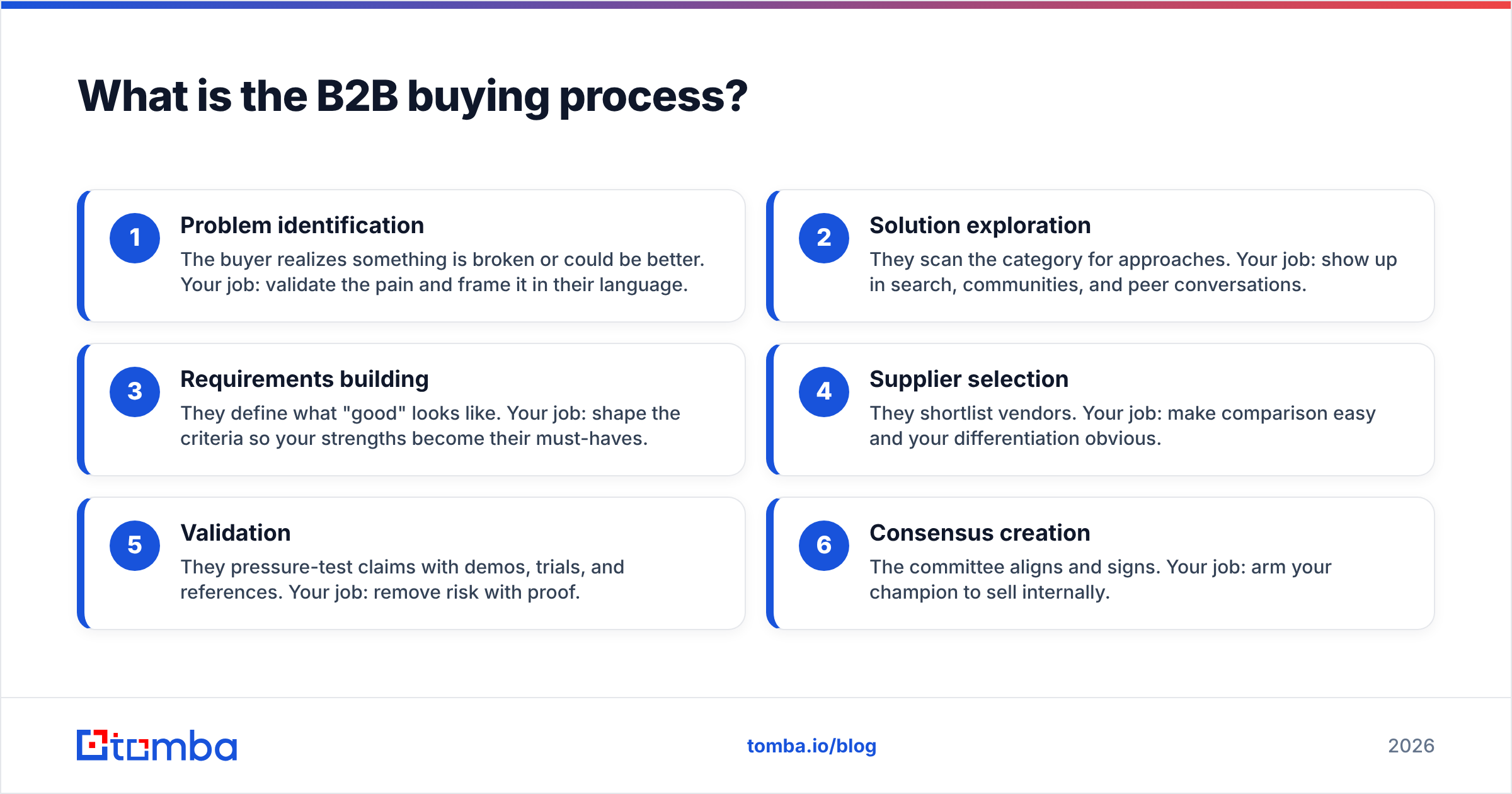
The six stages of B2B buying you need to market to:
- Problem identification — The buyer realizes something is broken or could be better. Your job: validate the pain and frame it in their language.
- Solution exploration — They scan the category for approaches. Your job: show up in search, communities, and peer conversations.
- Requirements building — They define what "good" looks like. Your job: shape the criteria so your strengths become their must-haves.
- Supplier selection — They shortlist vendors. Your job: make comparison easy and your differentiation obvious.
- Validation — They pressure-test claims with demos, trials, and references. Your job: remove risk with proof.
- Consensus creation — The committee aligns and signs. Your job: arm your champion to sell internally.
These stages rarely happen in a clean line. Gartner describes the journey as "looping" — buyers revisit earlier stages constantly. Your marketing has to be available at every loop, not just at the top of a tidy funnel.
Why does B2B buying process marketing matter in 2026?#
Because the buyer went dark, and most marketing teams haven't adjusted.
Here's the shift in plain terms: a decade ago, a curious prospect filled out a form and a rep took over. Today that prospect reads your blog, watches a third-party review, asks a Slack community, checks G2, and builds a shortlist — all anonymously. By the time they raise a hand, the deal is often half-decided.
If your marketing only activates after the form fill, you're showing up to a race that's three-quarters finished. B2B buying process marketing fixes this by putting useful, stage-appropriate content in front of buyers during the invisible phase.
Three forces make this urgent right now:
- Larger buying committees. More stakeholders means more content needs and more chances for a deal to stall. You can't market to a committee with one generic ebook.
- Tighter budgets and more scrutiny. Finance now sits in deals earlier. ROI proof has to be baked into mid-funnel content, not saved for the sales call.
- AI-assisted research. Buyers use AI tools to summarize categories and compare vendors. If your positioning isn't clear and well-documented across the web, the AI summary skips you.
The teams winning in 2026 treat marketing and sales as one motion across the revenue operations lifecycle, not two departments handing off a lead like a baton.
How is the B2B buying journey different from the sales funnel?#
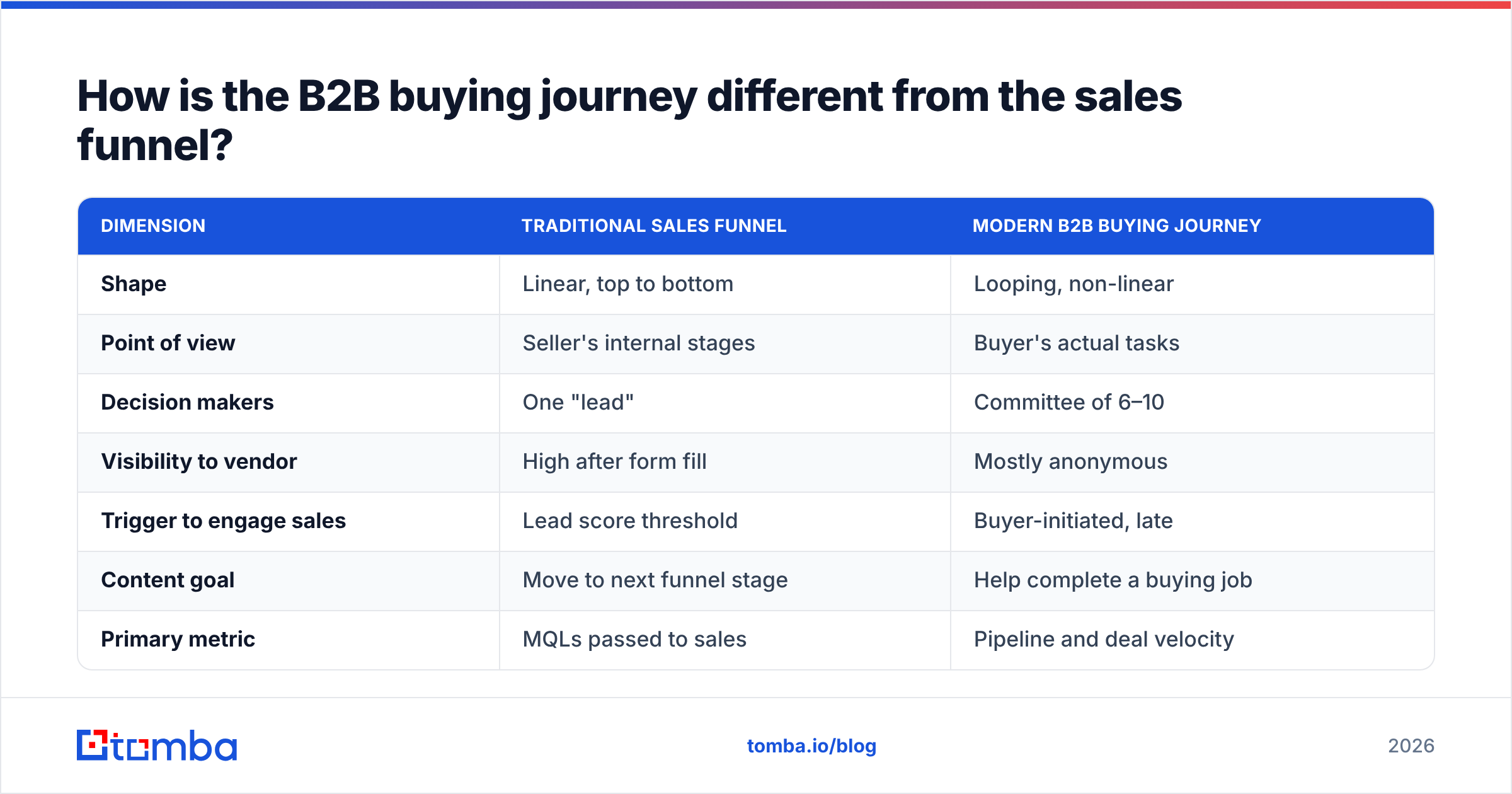
The funnel is what you see; the buying journey is what the buyer actually does. They are not the same shape, and confusing them is the most common mistake in B2B marketing.
| Dimension | Traditional Sales Funnel | Modern B2B Buying Journey |
|---|---|---|
| Shape | Linear, top to bottom | Looping, non-linear |
| Point of view | Seller's internal stages | Buyer's actual tasks |
| Decision makers | One "lead" | Committee of 6–10 |
| Visibility to vendor | High after form fill | Mostly anonymous |
| Trigger to engage sales | Lead score threshold | Buyer-initiated, late |
| Content goal | Move to next funnel stage | Help complete a buying job |
| Primary metric | MQLs passed to sales | Pipeline and deal velocity |
The practical takeaway: stop designing campaigns around your funnel stages and start designing them around the buyer's jobs-to-be-done. A buyer in "requirements building" doesn't care that your CRM labels them an MQL — they care about a checklist that helps them evaluate vendors. Give them that checklist and you shape the criteria in your favor.
This is also where the marketing qualified lead concept needs rethinking. An MQL based purely on form fills measures your funnel, not the buyer's intent. Pair behavioral signals with verified firmographic data so you act on real buying activity, not vanity engagement.
Who is in the B2B buying committee, and how do you market to each?#
The committee is the whole game. Marketing to a single "decision maker" is like pitching a movie to one person in a family of seven — everyone else still has to agree before tickets get bought.
Each role consumes content differently, so map your assets to the people, not just the stages:
- Economic buyer (VP/C-level): Wants business outcomes and ROI. Feed them case studies, benchmark data, and one-page business cases.
- Champion (manager/director): Wants to look smart for backing you. Arm them with internal-selling decks and comparison sheets.
- End users (ICs): Want their daily work to get easier. Feed them demos, tutorials, and free tools.
- Technical/IT evaluator: Wants security, integrations, and reliability. Feed them docs, SOC 2 details, and API references.
- Procurement/finance: Wants pricing clarity and risk reduction. Feed them transparent pricing and contract terms early.
Notice that a single piece of content can't serve all five. This is why account-based marketing pairs so well with buying-process marketing: you identify the account, map the committee, and deliver role-specific content to each contact. That mapping requires accurate contact records — names, titles, and verified emails — which is where a domain search across a target company pays for itself.
What does a stage-by-stage marketing plan look like?#
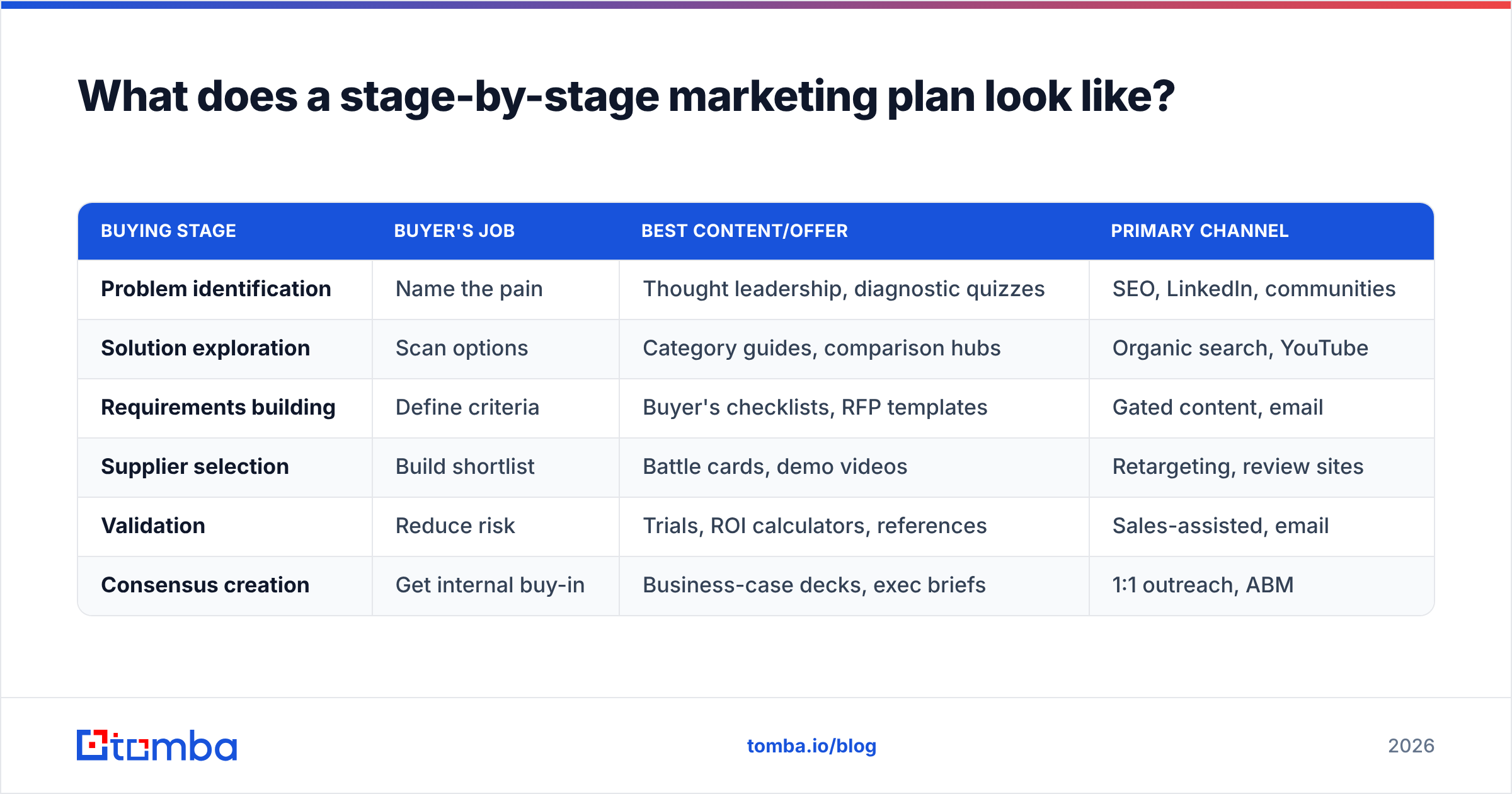
Here's a concrete playbook tying each buying stage to channels, content, and the data you need to execute. Treat it as a starting template, then tune the offers to your category.
| Buying stage | Buyer's job | Best content/offer | Primary channel |
|---|---|---|---|
| Problem identification | Name the pain | Thought leadership, diagnostic quizzes | SEO, LinkedIn, communities |
| Solution exploration | Scan options | Category guides, comparison hubs | Organic search, YouTube |
| Requirements building | Define criteria | Buyer's checklists, RFP templates | Gated content, email |
| Supplier selection | Build shortlist | Battle cards, demo videos | Retargeting, review sites |
| Validation | Reduce risk | Trials, ROI calculators, references | Sales-assisted, email |
| Consensus creation | Get internal buy-in | Business-case decks, exec briefs | 1:1 outreach, ABM |
A few execution notes that separate a plan that works from one that just looks good in a slide:
- Front-load the anonymous stages. Most of your budget should fund problem identification and solution exploration, because that's where the buyer spends most of their time and where you have the least visibility.
- Gate selectively. Don't lock your best top-of-funnel content behind a form — you want it consumed, indexed, and shared. Gate the requirements-stage tools (checklists, calculators) where capturing a contact is a fair trade.
- Outbound the dark funnel. When intent data or website-visitor reveal flags an account researching your category, reach the committee directly. This is where data enrichment and verified contact discovery turn an anonymous signal into a real conversation.
How does data quality affect B2B buying process marketing?#
Bad data quietly breaks every stage of the plan above. You can build perfect stage-mapped content and still lose if it lands on the wrong person or bounces into a dead inbox.
Picture it like mailing wedding invitations with a 30% wrong-address rate. The invitations are gorgeous, the event is perfect — but a third of your guests never hear about it. That's what stale contact data does to a committee-based deal: you reach two of the seven stakeholders, the other five never engage, and consensus never forms.
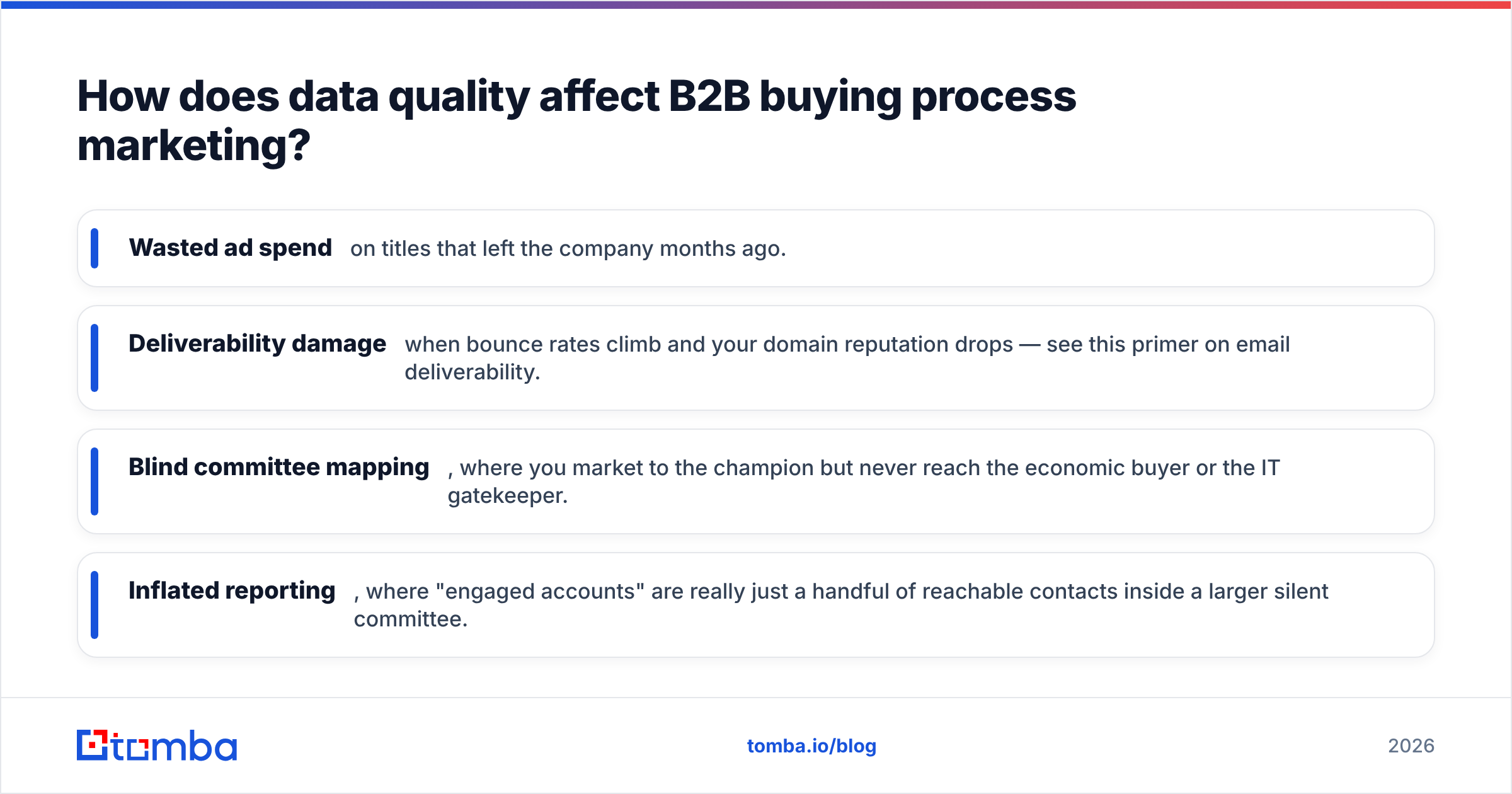
The damage compounds in B2B specifically because you're not targeting one buyer — you're targeting a committee, and missing any single member can stall the whole purchase. Concretely, poor data causes:
- Wasted ad spend on titles that left the company months ago.
- Deliverability damage when bounce rates climb and your domain reputation drops — see this primer on email deliverability.
- Blind committee mapping, where you market to the champion but never reach the economic buyer or the IT gatekeeper.
- Inflated reporting, where "engaged accounts" are really just a handful of reachable contacts inside a larger silent committee.
Industry analysts have long flagged data decay as a core revenue problem; B2B contact data goes stale fast as people change roles and companies. The fix isn't a one-time list buy — it's continuous verification and enrichment built into your workflow. Before any stage-based campaign launches, run your list through an email verifier to strip dead addresses, then enrich gaps so every committee member has a real, current record.
For teams running cold outreach into target accounts, this matters even more. Authoritative guides from HubSpot and review platforms like G2 consistently tie outbound success to list accuracy first, copy second. You can't A/B-test your way out of bad data.
How do you measure B2B buying process marketing?#
Measure deal progression and committee coverage, not just lead volume. The old scorecard — MQLs and form fills — rewards the wrong behavior because it treats one reachable contact as a "win" when the actual decision needs seven.
Track these instead:
- Committee coverage rate: What percentage of the known buying committee in a target account have you actually engaged? Low coverage predicts stalled deals.
- Stage velocity: How long do accounts spend in each buying stage? Bottlenecks tell you which content or contact is missing.
- Pipeline influenced, not just sourced: Credit marketing for assists across the journey, since buyers touch many assets before converting.
- Data health: Bounce rate, enrichment fill rate, and percentage of contacts verified in the last 90 days. Treat this as a leading indicator — when it slips, everything downstream slips too.
- Win rate by coverage tier: Compare win rate for accounts where you reached the full committee versus partial coverage. The gap is usually dramatic and makes the data-quality case for you.
The point of these metrics is to expose where the journey breaks. If accounts cluster in "validation" and never reach "consensus," your champion probably lacks an internal-selling asset — or you never identified the economic buyer's email to begin with.
Common mistakes in B2B buying process marketing#
A quick gut-check list before you ship your next campaign:
- Marketing to a person, not a committee. If your nurture track has one persona, you're missing four to nine stakeholders.
- Activating only after the form fill. The deal is mostly decided in the anonymous stages — fund them.
- Treating the journey as linear. Buyers loop. Keep stage-appropriate content available continuously, not as a one-time drip.
- Ignoring data decay. A list that was clean six months ago is leaking deliverability today.
- Confusing engagement with intent. A whitepaper download isn't buying intent. Pair behavior with firmographic and contact verification before you commit budget.
Fix these five and you're ahead of most B2B teams, who still run funnel-era playbooks against buying-era behavior.
The bottom line#
B2B buying process marketing is the discipline of meeting a buying committee where it actually is — mostly anonymous, mostly self-directed, looping across six stages — with the right content for the right role at the right moment. The strategy is only as strong as the data underneath it. Stage-mapped content delivered to wrong or dead contacts is wasted effort, and committee deals punish that waste harder than any other model because missing one stakeholder can sink the whole purchase.
That's where Tomba fits your stack. Use the Tomba Email Finder to identify and reach every member of a target buying committee by name and verified email, then enrich and re-verify on a schedule so your stage-based campaigns always land. Start free with 25 searches a month, and scale into the Starter plan at $49/mo when your account list grows. Map the journey, cover the committee, and let accurate data carry your marketing the whole way to consensus.
// get started
Find, verify and enrich your first contacts today
Start on the free plan with 25 searches a month, then scale when your team is ready.
Free plan · No credit card required · GDPR & CCPA
// about the author