B2B Buying Signals in 2026: How to Spot Ready-to-Buy Leads
Most reps chase accounts that will never buy. B2B buying signals tell you who is actually in-market — here is how to capture, score, and act on them in 2026.
TL;DR
- B2B buying signals are observable behaviors and data points that show an account or person is moving toward a purchase — research activity, hiring, tech changes, and engagement with your brand.
- They split into three buckets: first-party (your own properties), second-party (review sites, communities), and third-party (intent networks and firmographic shifts).
- The win is timing: a fit account showing fresh intent converts far better than a cold-but-perfect ICP match with no activity.
- You need a capture layer (web reveal, enrichment, CRM events), a scoring model, and an action playbook — tools without process just create noisy alerts.
- Start with the signals you already own, layer in enrichment to fill contact gaps, then reach out within hours, not weeks.
What are B2B buying signals?#
A B2B buying signal is any piece of evidence that an account is closer to a purchase decision than it was yesterday. Think of it like a smoke detector for revenue: the smoke (a signal) tells you something is happening before the fire (a closed deal or a competitor's win) is visible.
Concretely, a buying signal can be a prospect downloading your pricing page three times in a week, a company posting a job for the exact role your product supports, a target account adding a competitor's tool to their stack, or a champion changing jobs and landing somewhere new. None of these guarantees a sale. Together, and weighted correctly, they tell you where to spend your limited selling hours.
The opposite of signal-led selling is spray-and-pray: build a list that matches your ideal customer profile (ICP), then email everyone the same week regardless of whether they are in-market. That approach still works at volume, but it burns domain reputation and rep time. Buying signals let you do less outreach to better-timed accounts.
Why do B2B buying signals matter more in 2026?#
Conclusion first: buyers do most of their research before they ever talk to sales, so the only way to enter deals early is to detect intent instead of waiting for a form fill.
Gartner research has long pegged the share of the buying journey spent with sales reps at roughly 5–6%, with the rest happening across web research, peer conversations, and review sites. By 2026 that gap is wider, not narrower — generative search and self-serve product trials mean a buyer can shortlist three vendors without filling out a single "contact us" form.
If your pipeline depends on inbound demo requests, you only see the buyers who raised their hand. Signal-led teams see the buyers who are researching quietly and reach them while the budget conversation is still open. That is the difference between being one of five vendors invited to bid and being the one vendor who shaped the requirements.
There is also a cost angle. Outbound is expensive — sending more email to colder lists drags down email deliverability and gets domains flagged. Targeting in-market accounts means fewer sends, higher reply rates, and a healthier sender reputation.

What are the main types of B2B buying signals?#
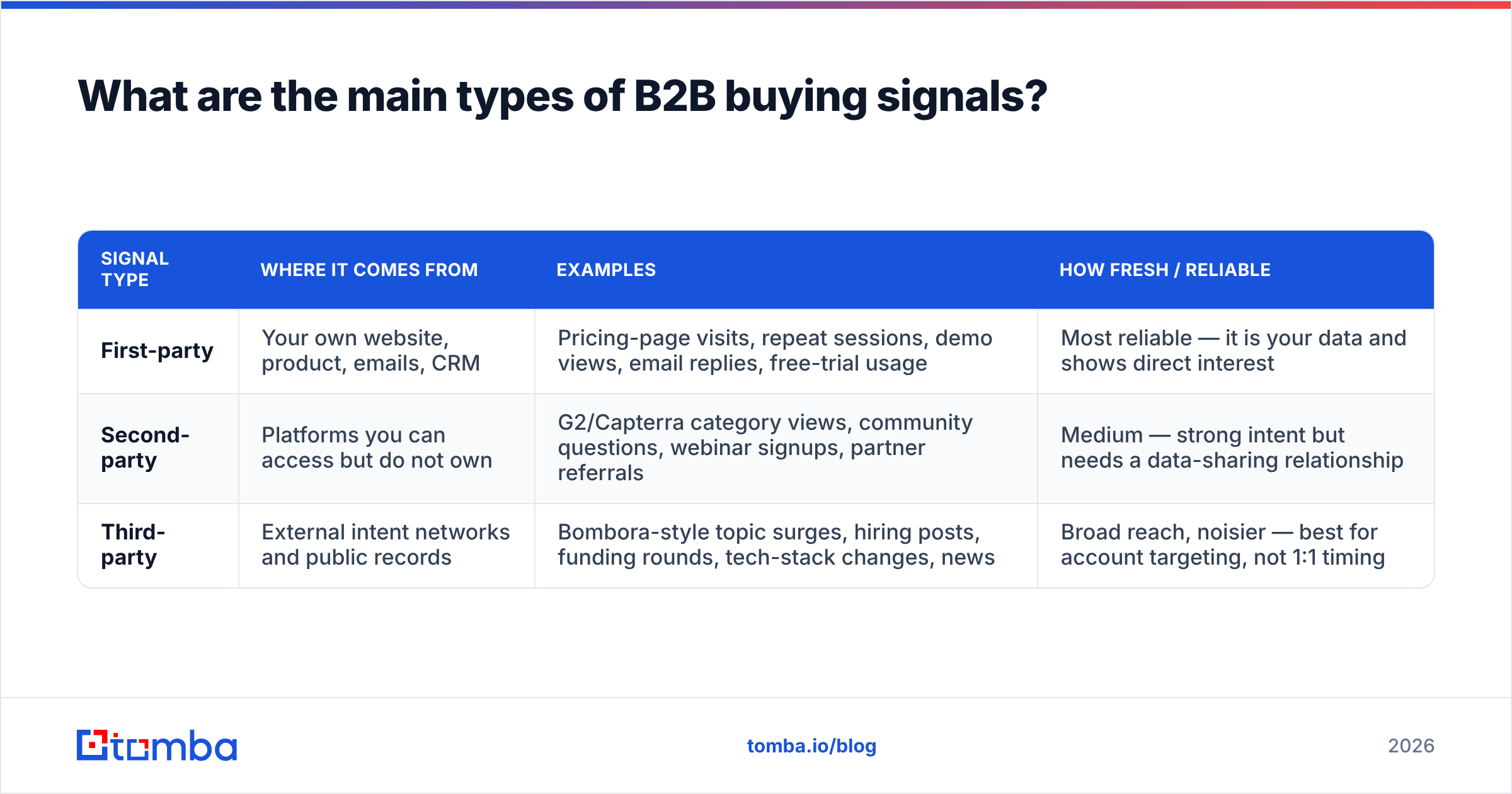
Buying signals are usually grouped by where the data comes from. This is the core concept to internalize, because your capture strategy differs for each source.
| Signal type | Where it comes from | Examples | How fresh / reliable |
|---|---|---|---|
| First-party | Your own website, product, emails, CRM | Pricing-page visits, repeat sessions, demo views, email replies, free-trial usage | Most reliable — it is your data and shows direct interest |
| Second-party | Platforms you can access but do not own | G2/Capterra category views, community questions, webinar signups, partner referrals | Medium — strong intent but needs a data-sharing relationship |
| Third-party | External intent networks and public records | Bombora-style topic surges, hiring posts, funding rounds, tech-stack changes, news | Broad reach, noisier — best for account targeting, not 1:1 timing |
A practical way to read this table: first-party signals tell you who to call today, third-party signals tell you which accounts to build a play around this quarter, and second-party signals bridge the two.
Within those buckets, the highest-value individual signals tend to be:
- Pricing and comparison page visits — bottom-of-funnel intent you capture on your own site.
- Job postings for relevant roles — a company hiring a "RevOps Manager" or "Head of Demand Gen" is reorganizing around a problem you may solve.
- Technographic changes — adding or dropping a tool in your category signals an active evaluation.
- Champion job changes — a happy user who switches companies is a warm intro into a brand-new account.
- Funding and expansion news — fresh capital and new offices mean new budget lines.
- Category research surges — third-party intent providers flag accounts spiking on topics tied to your product.
Is intent data the same as buying signals?#
No — intent data is one category of buying signal, not the whole picture. Conclusion first: intent data tells you a company is researching a topic; buying signals include that plus first-party engagement, firmographic events, and relationship triggers.
People conflate the two because third-party intent vendors market aggressively. But intent topic surges are probabilistic and account-level. They rarely tell you which person at the account is in-market, and they can be weeks stale. The strongest programs treat third-party intent as a prioritization input, then confirm it with first-party engagement and enrich the account down to named, contactable people. That last step — turning "Acme Corp is researching" into "email and direct dial for the three people who own this decision" — is where data enrichment earns its keep.
How do you capture B2B buying signals?#
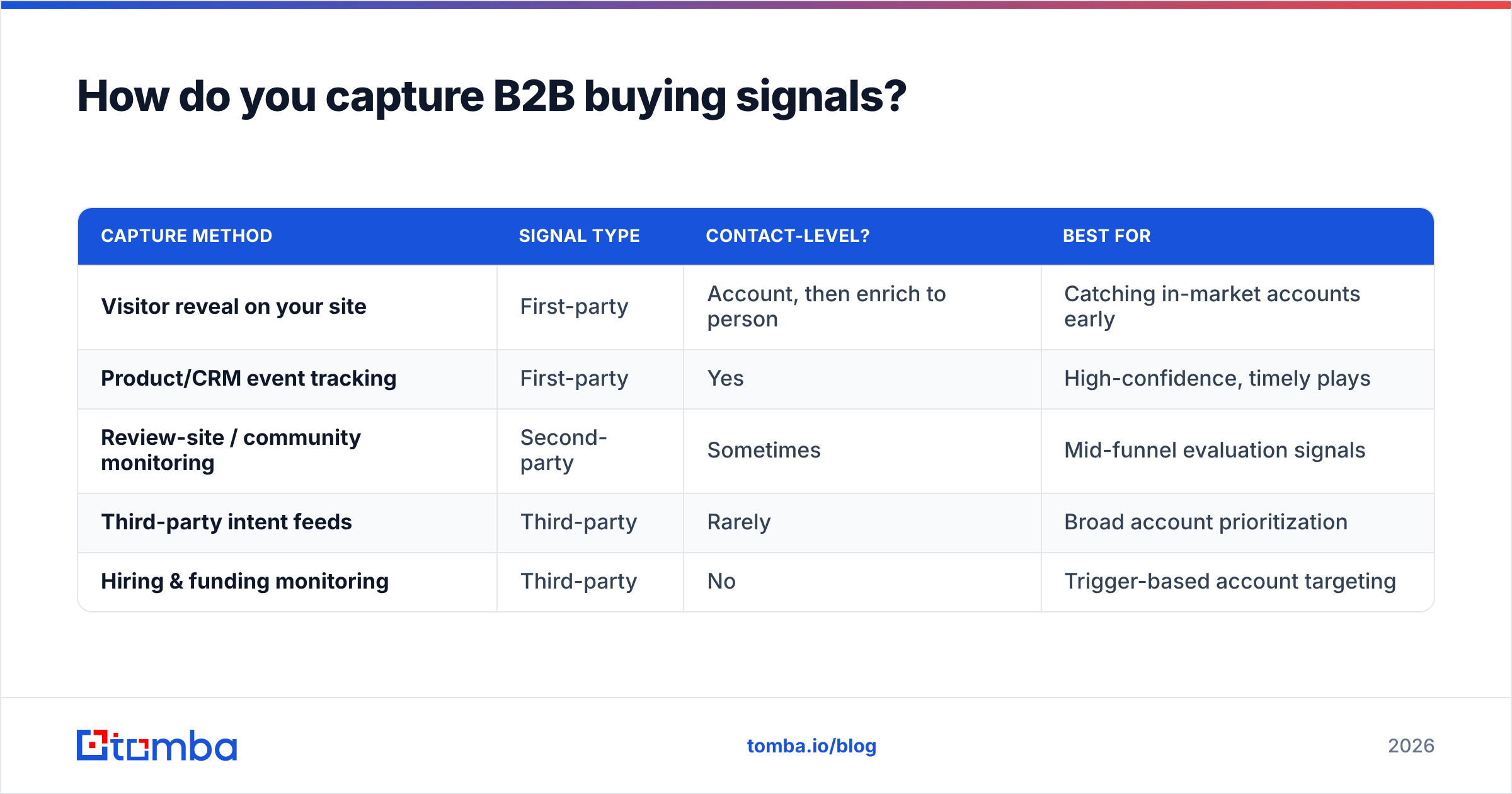
You capture signals across three layers, and most teams are missing at least one of them.
1. Identify anonymous traffic. The majority of your website visitors never fill out a form. A website visitor reveal tool matches anonymous company traffic to firmographic data so you can see which target accounts are reading your pricing page even when they stay anonymous. This converts a wasted visit into a first-party signal.
2. Wire up your product and CRM events. Free-trial milestones, repeat logins, feature usage, and email replies are gold-standard first-party signals because they reflect real behavior. Pipe these into your CRM as timestamped events so scoring can use them. If you do not log the event, it cannot trigger a play.
3. Layer external sources. Subscribe to a third-party intent feed, monitor hiring boards and funding databases, and track technographic changes for your ICP. These give you account-level coverage beyond the buyers already on your site.
The capture layer produces raw signals. The next two steps — enrichment and scoring — turn them into action.
| Capture method | Signal type | Contact-level? | Best for |
|---|---|---|---|
| Visitor reveal on your site | First-party | Account, then enrich to person | Catching in-market accounts early |
| Product/CRM event tracking | First-party | Yes | High-confidence, timely plays |
| Review-site / community monitoring | Second-party | Sometimes | Mid-funnel evaluation signals |
| Third-party intent feeds | Third-party | Rarely | Broad account prioritization |
| Hiring & funding monitoring | Third-party | No | Trigger-based account targeting |
How do you score and prioritize buying signals?#
Score on two axes and act on the overlap. The two axes are fit (does this account match your ICP?) and intent (are they showing behavior?). Neither alone is enough.
- High fit + high intent → call today. This is your hottest queue and deserves a personalized, multi-channel play.
- High fit + low intent → nurture and watch. Add to a light-touch sequence and wait for a signal to fire.
- Low fit + high intent → handle with care. Tire-kickers and students inflate this bucket; qualify before you spend rep time.
- Low fit + low intent → ignore. Removing these from your workflow is as valuable as adding the hot ones.
Build a simple weighted model before you reach for anything fancy. Assign points to each signal (pricing-page visit = 30, job post for relevant role = 20, funding round = 15, newsletter open = 2), decay the points over time so a signal from 60 days ago counts less than one from yesterday, and set a threshold that triggers a sales task. A spreadsheet model you understand beats a black-box AI score you cannot debug. You can always graduate to lead scoring automation once the manual model proves itself.
The decay point matters more than people expect. A buying signal has a half-life. According to multiple sales response studies summarized by HubSpot, the odds of qualifying a lead drop sharply when first contact slips from minutes to hours to days. A perfect signal acted on a week late is just noise.

Which buying signals convert best?#
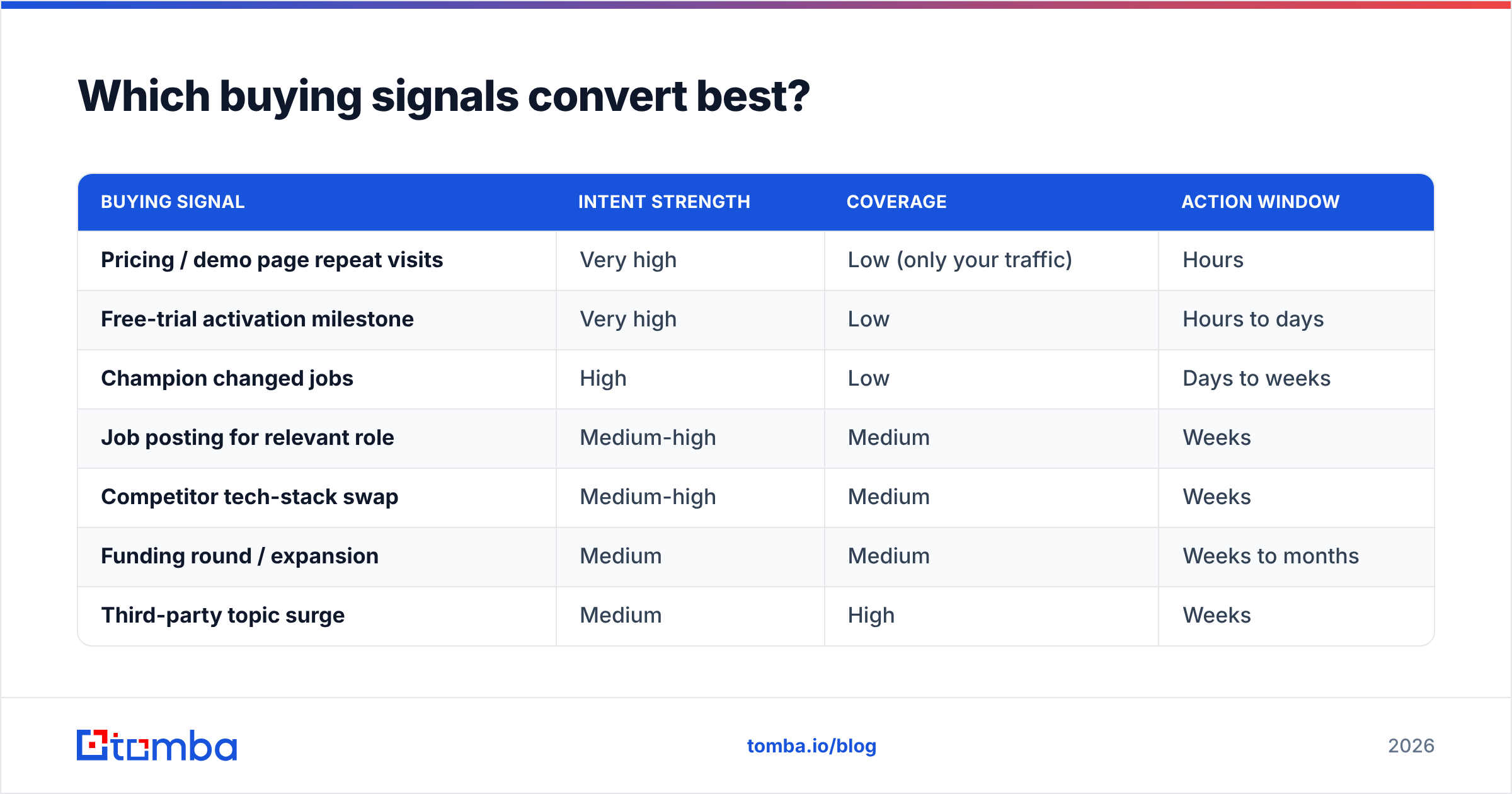
First-party, bottom-of-funnel signals win on conversion rate; third-party signals win on coverage. Here is how the common signals stack up in practice.
| Buying signal | Intent strength | Coverage | Action window |
|---|---|---|---|
| Pricing / demo page repeat visits | Very high | Low (only your traffic) | Hours |
| Free-trial activation milestone | Very high | Low | Hours to days |
| Champion changed jobs | High | Low | Days to weeks |
| Job posting for relevant role | Medium-high | Medium | Weeks |
| Competitor tech-stack swap | Medium-high | Medium | Weeks |
| Funding round / expansion | Medium | Medium | Weeks to months |
| Third-party topic surge | Medium | High | Weeks |
| Newsletter open / content download | Low-medium | High | Variable |
Read it as a portfolio. You want a few very-high-intent signals feeding a small, urgent queue, and broad third-party signals feeding your account-planning motion. Relying only on third-party intent gives you reach but soft conversion; relying only on first-party gives you precision but misses accounts not yet on your site.
What is the workflow from signal to closed deal?#
A signal is worthless until it reaches a rep with everything they need to act. The end-to-end loop looks like this:
- Detect — a signal fires (reveal match, intent surge, job post).
- Enrich — resolve the account to named decision-makers with verified contact details. This is the step most teams botch; an account-level signal with no email address dies on the vine.
- Score — apply your fit + intent model and decide if it clears the threshold.
- Route — push a task to the right rep with the signal context attached.
- Reach out — multi-channel, referencing the trigger without being creepy ("saw you're scaling the SDR team" beats "I noticed you visited our pricing page at 2:47pm").
- Measure — track which signals actually produced pipeline and feed that back into the scoring weights.
Step 2 is where Tomba lives. Once a signal identifies a target account, you can run a domain search to pull the company's email pattern and the people in relevant roles, then verify before you send so you protect deliverability. The signal told you who; enrichment gives you how to reach them.
What mistakes kill signal-led selling?#
- Alert overload. If every newsletter open pings a rep, they will mute the channel. Reserve real-time alerts for high-intent signals only.
- No decay. Treating a 90-day-old signal the same as a fresh one floods your queue with stale accounts.
- Account without contacts. Knowing "Acme is in-market" but not who to email means the signal never converts. Enrich every signal down to verified people.
- Generic outreach on a specific trigger. If you detected a precise signal, your message should reflect it. Otherwise you wasted the data.
- Ignoring fit. High intent from a company that will never buy your product is a trap. Always gate intent with ICP fit.
- Buying tools before defining process. A reveal tool plus an intent feed plus no playbook equals an expensive dashboard nobody opens.
How does Tomba support a buying-signals workflow?#
Tomba is not an intent network — it is the enrichment and contact layer that makes your signals actionable. When a signal surfaces an account, Tomba turns it into reachable, verified people.
| Capability | What it does in a signals workflow |
|---|---|
| Website visitor reveal | Converts anonymous in-market traffic into named accounts |
| Domain search | Lists people and email patterns at a triggered account |
| Email finder | Finds the specific decision-maker's address |
| Email verifier | Confirms deliverability before outreach protects your sender reputation |
| Data enrichment | Fills firmographic and contact gaps on signal accounts |
| API & integrations | Automates enrichment the moment a signal fires |
Pricing is straightforward and built to scale with signal volume. The Tomba pricing tiers run from a Free plan (25 searches/month) to Starter at $49/mo, Growth at $99/mo, Pro at $249/mo, and custom Enterprise. Most signal-led teams start on Growth, then move to the API once enrichment is automated against their CRM. You can compare features and credit limits on the G2 listings for the lead-intelligence category if you want third-party validation before committing.
Frequently asked questions#
What is the difference between a buying signal and a lead? A lead is a person or account in your pipeline. A buying signal is the evidence that tells you a lead — or a not-yet-lead — is moving toward a purchase. Signals create and prioritize leads.
Are third-party intent signals worth paying for? Yes for coverage, no as a standalone strategy. They are best as a prioritization input you confirm with first-party engagement and enrich into contactable people.
How fast should I act on a buying signal? As fast as the signal's half-life allows. High-intent first-party signals (pricing visits, trial activation) should trigger outreach within hours; account-level intent surges can run on a weekly cadence.
Do I need expensive software to start? No. Begin with the first-party signals you already have in your CRM and analytics, add a verified contact layer so you can act on them, and only buy a third-party intent feed once the basics are producing pipeline.
Start turning signals into pipeline#
Buying signals tell you who and when. The missing piece is how to reach them — and that is exactly where most signal programs stall, sitting on a list of in-market accounts with no verified contacts. Plug that gap with the Tomba Email Finder: the moment a signal identifies an account, find the right decision-maker's professional email, verify it, and reach out while the window is still open. Start free with 25 searches and connect it to your signal stack via the Tomba API when you are ready to automate. Stop chasing cold lists and start working the accounts that are already raising their hands.
// get started
Find, verify and enrich your first contacts today
Start on the free plan with 25 searches a month, then scale when your team is ready.
Free plan · No credit card required · GDPR & CCPA
// about the author