How to Find and Keep B2B Clients in 2026: A Practical Guide
A no-fluff playbook for finding, winning, and keeping B2B clients in 2026 — from ICP definition to data sourcing, outreach, and retention.
How to Find and Keep B2B Clients in 2026: A Practical Guide
Winning B2B clients is not about volume — it's about reaching the right accounts with accurate data and a relevant message, then keeping them long enough to expand. This guide gives you the full loop: define who you want, find their contact data, run outreach that gets replies, and build retention into the relationship from day one.
TL;DR#
- B2B clients are organizations, not individuals — so you sell to a buying committee of 6–10 people, not one inbox.
- Accuracy beats volume. A 300-contact list with verified emails outperforms a 3,000-contact scraped dump every time.
- Your ICP is the filter that decides everything downstream — data sourcing, messaging, and which deals you walk away from.
- Retention is cheaper than acquisition. Expanding an existing B2B client costs a fraction of landing a new one.
- Tooling matters. Pair a clean data source like the Tomba Email Finder with disciplined outreach and you compress the whole cycle.
What Are B2B Clients, Exactly?#
B2B clients are businesses that buy your product or service to run, grow, or support their own operations. Think of it like supplying a restaurant kitchen instead of feeding a single diner — you're not selling one meal, you're equipping an operation that has a chef, a purchasing manager, an owner, and an accountant who all weigh in before the order is placed.
That distinction changes everything. A B2C buyer decides alone in minutes. A B2B client decides as a committee over weeks or months, with budgets, procurement rules, and a champion who has to defend the purchase internally. According to Gartner research on buying groups, a typical B2B purchase involves six to ten decision-makers, each armed with their own information.
So when people say "we need more B2B clients," what they actually need is a repeatable way to identify the right organizations, reach the right people inside them, and earn enough trust to survive a committee review.
How Do You Define Your Ideal B2B Client?#
Start with your Ideal Customer Profile (ICP) before you touch a single contact list. The ICP is the difference between fishing with a net in the right lake versus spraying a hose in the parking lot.
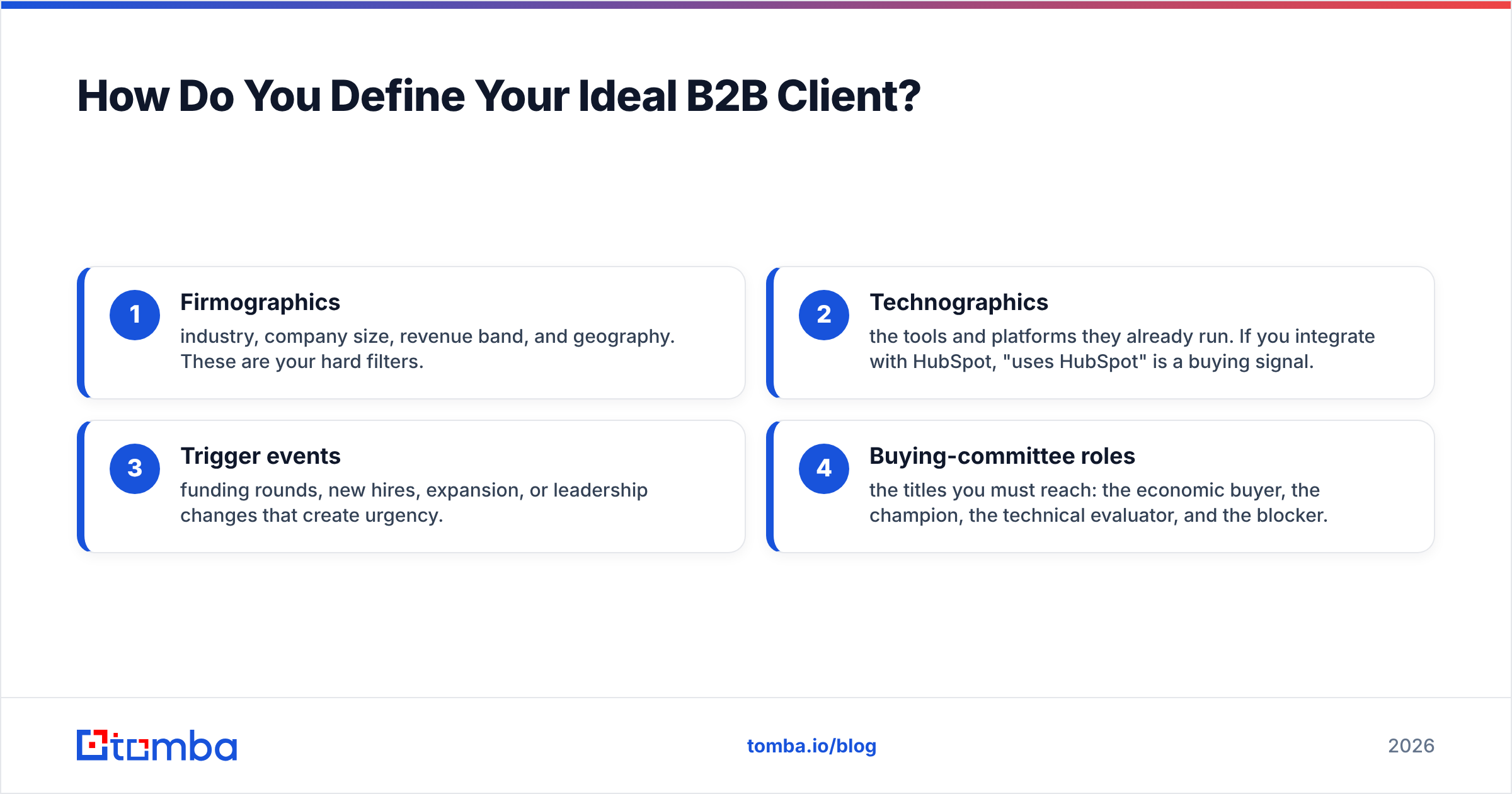
A workable ICP has four layers:
- Firmographics — industry, company size, revenue band, and geography. These are your hard filters.
- Technographics — the tools and platforms they already run. If you integrate with HubSpot, "uses HubSpot" is a buying signal.
- Trigger events — funding rounds, new hires, expansion, or leadership changes that create urgency.
- Buying-committee roles — the titles you must reach: the economic buyer, the champion, the technical evaluator, and the blocker.
Once the ICP is written down, it becomes the filter for every list you build. Anything that doesn't match gets cut — even if it looks tempting. Disciplined exclusion is what keeps your pipeline clean and your reps focused.
Where Do You Find B2B Clients?#
You find B2B clients where their digital footprint already lives. The trick is converting that footprint into verified, reachable contact data instead of guesses.
Here are the channels that actually produce qualified B2B clients in 2026:
- Company domains — run a domain search on a target account to surface the people and email patterns behind the website.
- LinkedIn — the richest source of titles and org structure; a LinkedIn finder turns a profile into a business email.
- Website visitors — anonymous traffic that's already researching you is your warmest audience; visitor reveal identifies those accounts.
- Referrals and existing clients — the highest-converting source, period.
- Communities and events — niche Slack groups, trade shows, and webinars where your ICP gathers.
The common failure is stopping at "I found the company." A company is not a contact. You still need the named person, their role, and a verified email or phone number before outreach means anything.
Why Does Data Accuracy Decide Whether You Win B2B Clients?#
Bad data quietly kills B2B sales motions. Every bounced email chips away at your sender reputation, and a damaged sender reputation means even your good messages land in spam.
Think of your sending domain like a credit score. A few bounces are forgivable; a list full of dead addresses tanks the score, and recovery takes weeks. That's why verification is not optional. Before any campaign, run your list through an email verifier and protect your deliverability. (If you want the underlying concept, here's a primer on email deliverability.)
The math is brutal in favor of quality:
- A 3,000-contact list at 35% deliverability reaches ~1,050 inboxes — and torches your domain doing it.
- A 300-contact list at 97% deliverability reaches ~291 inboxes — with your reputation intact and replies higher.
The smaller, cleaner list wins on replies, protects your domain, and respects your reps' time. Volume feels productive. Accuracy is productive.
Which Tools Help You Acquire B2B Clients?#
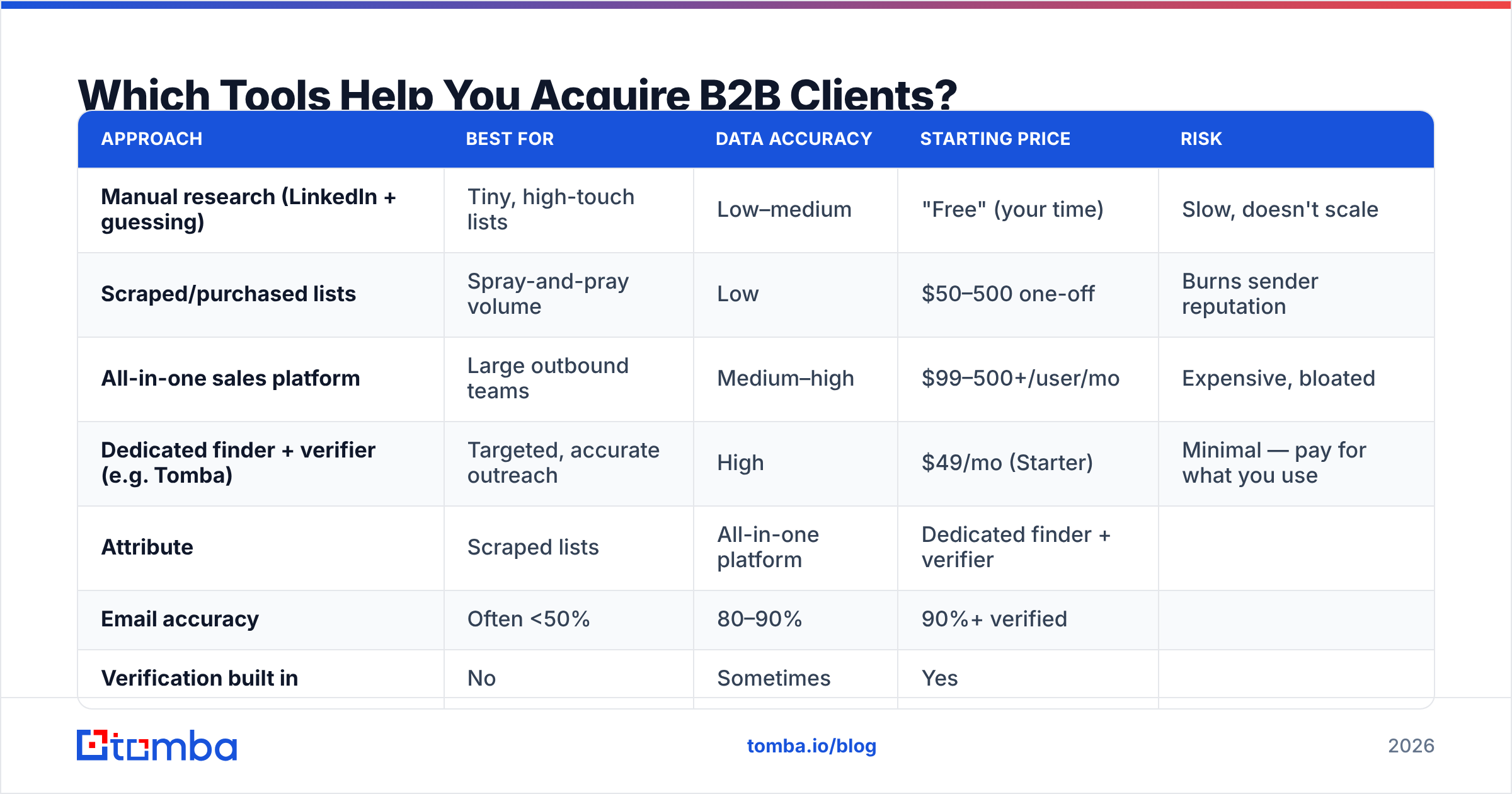
The market splits into a few categories, and most teams over-buy. You don't need a $15k/year platform to find B2B clients — you need accurate contact data, verification, and a way to push it into your workflow. Here's how the common approaches compare.
| Approach | Best for | Data accuracy | Starting price | Risk |
|---|---|---|---|---|
| Manual research (LinkedIn + guessing) | Tiny, high-touch lists | Low–medium | "Free" (your time) | Slow, doesn't scale |
| Scraped/purchased lists | Spray-and-pray volume | Low | $50–500 one-off | Burns sender reputation |
| All-in-one sales platform | Large outbound teams | Medium–high | $99–500+/user/mo | Expensive, bloated |
| Dedicated finder + verifier (e.g. Tomba) | Targeted, accurate outreach | High | $49/mo (Starter) | Minimal — pay for what you use |
For most teams chasing quality B2B clients, the dedicated finder-plus-verifier path gives the best ratio of accuracy to cost. You can review full Tomba pricing to match a plan to your volume — the free tier covers 25 searches a month to test the waters before you commit.
A quick comparison of how the categories stack up on the attributes that matter for client acquisition:
| Attribute | Scraped lists | All-in-one platform | Dedicated finder + verifier |
|---|---|---|---|
| Email accuracy | Often <50% | 80–90% | 90%+ verified |
| Verification built in | No | Sometimes | Yes |
| Cost predictability | One-off, no support | High, per-seat | Transparent, usage-based |
| Setup time | Minutes (then cleanup) | Days | Minutes |
| Protects deliverability | No | Partly | Yes |
How Do You Turn Contacts Into B2B Clients?#
Finding the contact is the start line, not the finish. Conversion comes from relevance, timing, and persistence applied to the buying committee — not a single hero email.
Here's a sequence that works:
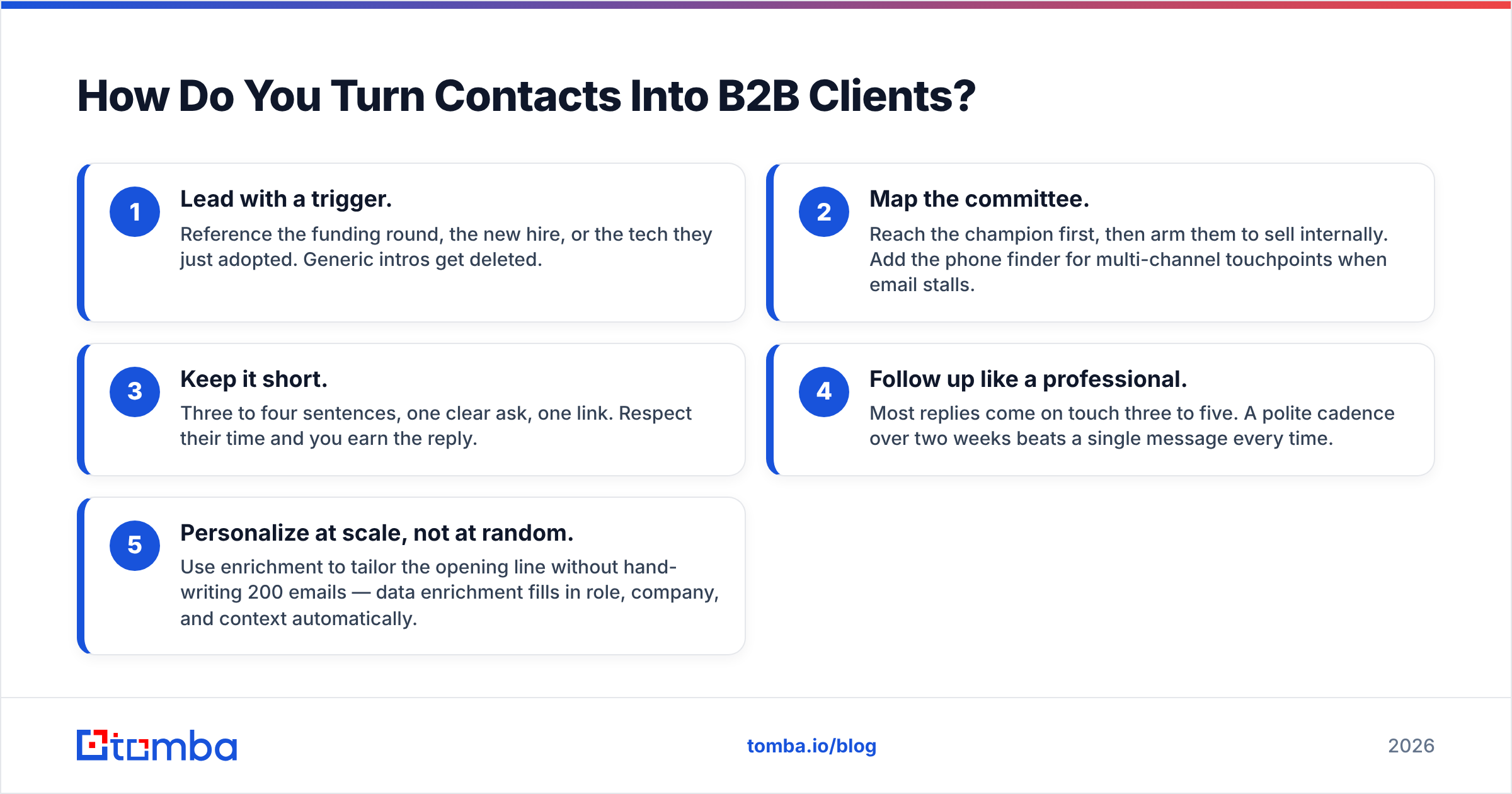
- Lead with a trigger. Reference the funding round, the new hire, or the tech they just adopted. Generic intros get deleted.
- Map the committee. Reach the champion first, then arm them to sell internally. Add the phone finder for multi-channel touchpoints when email stalls.
- Keep it short. Three to four sentences, one clear ask, one link. Respect their time and you earn the reply.
- Follow up like a professional. Most replies come on touch three to five. A polite cadence over two weeks beats a single message every time.
- Personalize at scale, not at random. Use enrichment to tailor the opening line without hand-writing 200 emails — data enrichment fills in role, company, and context automatically.
The teams that win B2B clients treat outreach as a system, not a lottery. They measure reply rate, meeting rate, and stage conversion — then fix the weakest number.
How Do You Keep B2B Clients Once You Win Them?#
Retention is where the real money is. It's far cheaper to expand an existing B2B client than to land a new one, and existing clients refer others. Per HubSpot research on customer retention, even small improvements in retention compound into outsized revenue gains because you stop replacing lost revenue and start stacking it.
Bake retention into the relationship from the first week:
- Deliver a fast first win. Time-to-value is the single biggest churn predictor. Get them a measurable result early.
- Track health, not just usage. A client who logs in but never hits their goal is a churn risk wearing a green dashboard.
- Schedule deliberate expansion. Quarterly reviews that tie your product to their goals open the door to upsell without a hard sell.
- Map the whole account. People leave; champions get promoted. Keep refreshing your contacts inside the account so a single departure doesn't end the relationship.
A simple way to think about it: acquisition fills the bucket, retention plugs the holes. Pour all your effort into the top and ignore the leaks, and you'll run forever just to stay level.
What's a Realistic 90-Day Plan to Land More B2B Clients?#
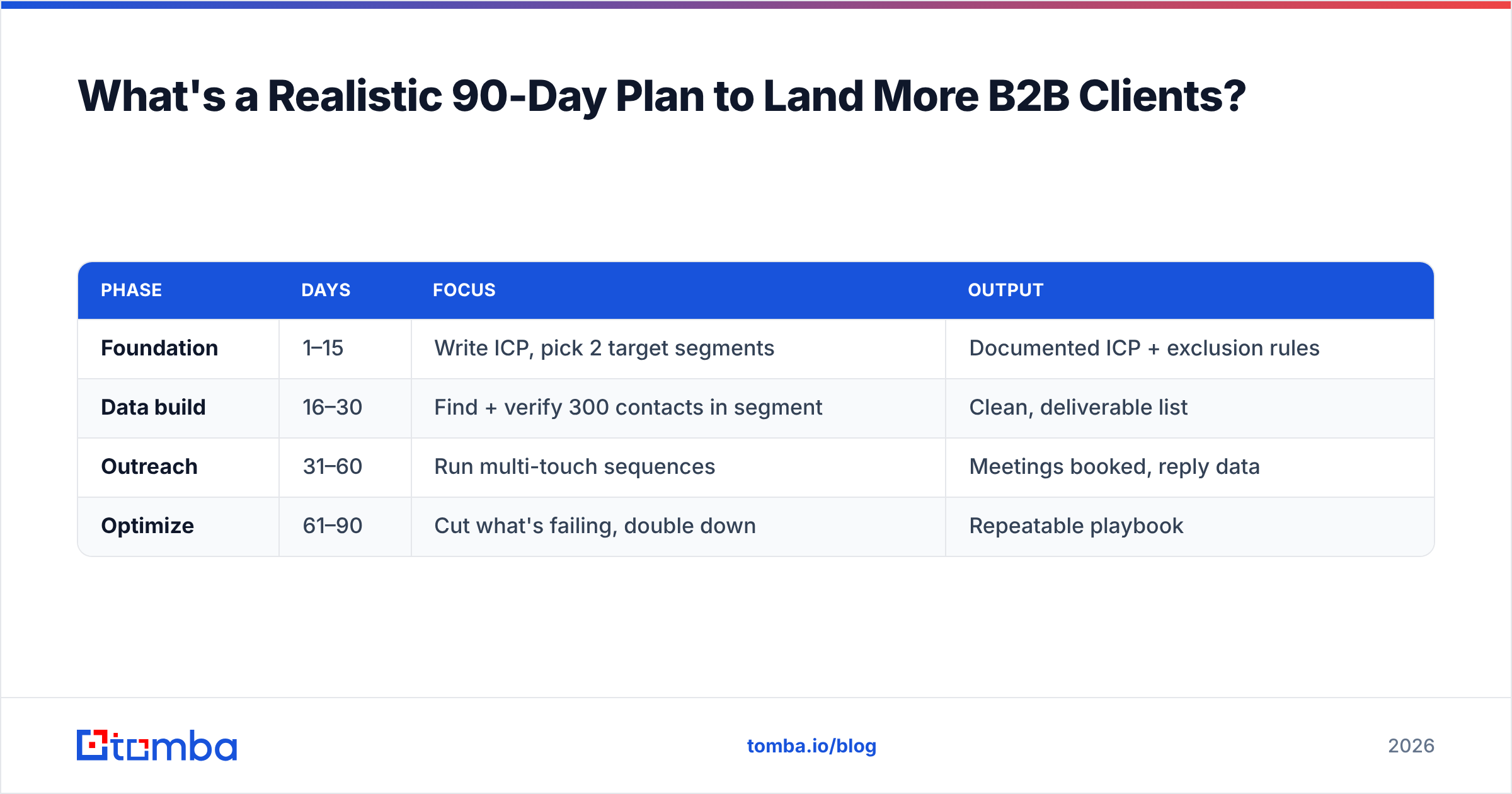
Aim for a focused sprint, not a boil-the-ocean campaign. Here's a 90-day shape that works for most teams.
| Phase | Days | Focus | Output |
|---|---|---|---|
| Foundation | 1–15 | Write ICP, pick 2 target segments | Documented ICP + exclusion rules |
| Data build | 16–30 | Find + verify 300 contacts in segment | Clean, deliverable list |
| Outreach | 31–60 | Run multi-touch sequences | Meetings booked, reply data |
| Optimize | 61–90 | Cut what's failing, double down | Repeatable playbook |
Notice that two full weeks go to foundation and data before a single email goes out. That front-loading is what separates teams that build a durable pipeline from teams that burn a domain in week one.
Common Mistakes That Cost You B2B Clients#
- Skipping verification. The fastest way to land in spam. Always verify before you send.
- Confusing companies with contacts. A logo on a list is not a buyer. Get the named human.
- One-and-done outreach. Most deals live in the follow-up. Stopping after one email leaves money on the table.
- Ignoring the committee. Selling to one person in a 7-person decision is how "we're interested" turns into silence.
- No retention plan. Winning a client and then going quiet is how you train them to churn.
Frequently Asked Questions#
What is the difference between a B2B lead and a B2B client? A lead is a potential buyer who has shown some interest or fits your ICP. A client is a business that has actually purchased. The job of your pipeline is to move qualified leads through the buying committee to become paying clients.
How many contacts do I need per target company? Plan for three to six contacts per account: the economic buyer, your champion, a technical evaluator, and anyone who can block the deal. Single-threaded deals are fragile.
Is buying a contact list a good way to find B2B clients? Rarely. Purchased lists are usually stale, unverified, and shared across hundreds of buyers, which means low accuracy and damaged deliverability. Building and verifying your own list around a tight ICP wins on every metric that matters.
How accurate does my email data need to be? Target 95%+ deliverability before launching a campaign. Below that, bounces accumulate and your sender reputation — and inbox placement — start to slide.
Start Finding Better B2B Clients Today#
Winning B2B clients in 2026 comes down to a simple loop: define a tight ICP, source verified contact data, run relevant multi-touch outreach, and build retention in from day one. Skip the data step and the rest collapses.
That's where the Tomba Email Finder earns its place in your stack. Find professional emails by name, domain, or company, verify them before you send, and push clean contacts straight into your outreach — so your reps spend time selling, not scrubbing lists. Start on the free tier with 25 searches a month, then scale to the Starter plan at $49/mo when your pipeline does. Build the accurate foundation first, and the clients follow.
// get started
Find, verify and enrich your first contacts today
Start on the free plan with 25 searches a month, then scale when your team is ready.
Free plan · No credit card required · GDPR & CCPA
// about the author