B2B Cold Calling in 2026: Scripts, Data & Win Rates
B2B cold calling still books pipeline in 2026 — if your data, scripts, and cadence are right. Here's the playbook, with benchmarks and tools.
TL;DR
- B2B cold calling is not dead in 2026 — it is just unforgiving of bad data and lazy scripts. Reps who dial verified mobile numbers connect 3–5x more often than those working stale office lines.
- Expect realistic benchmarks: ~5% connect rate on cold lists, ~15–20% conversation-to-meeting rate when targeting fits, and 6–8 dials per connect.
- A tight opener, permission-based framing, and one clear value hypothesis beat any "objection-crushing" gimmick.
- Cadence matters more than volume: blend calls with email and LinkedIn touches across 10–14 business days.
- Your phone list is the single biggest lever. Clean, validated mobile data turns the same script into a different result.
Is B2B cold calling still worth it in 2026?#
Yes — but only when the inputs are right. The reps and teams declaring cold calling "dead" are almost always describing a data problem wearing a strategy costume. They bought a list, dialed switchboard numbers that route to nowhere, read a script written for 2014, and concluded the channel failed them.
Cold calling works because it is synchronous. Email and LinkedIn are asynchronous and easy to ignore; a live conversation forces a decision. In a market where buyers are drowning in automated outreach, a competent human voice is a differentiator again. The catch is that the bar for "competent" has risen. Gatekeepers are sharper, mobile-first prospects screen unknown numbers, and one robotic pitch gets you blocked.
So the question is not whether to cold call. It is whether you can call the right person, on a number that rings, with a reason that earns 30 more seconds.
What are realistic B2B cold calling benchmarks?#
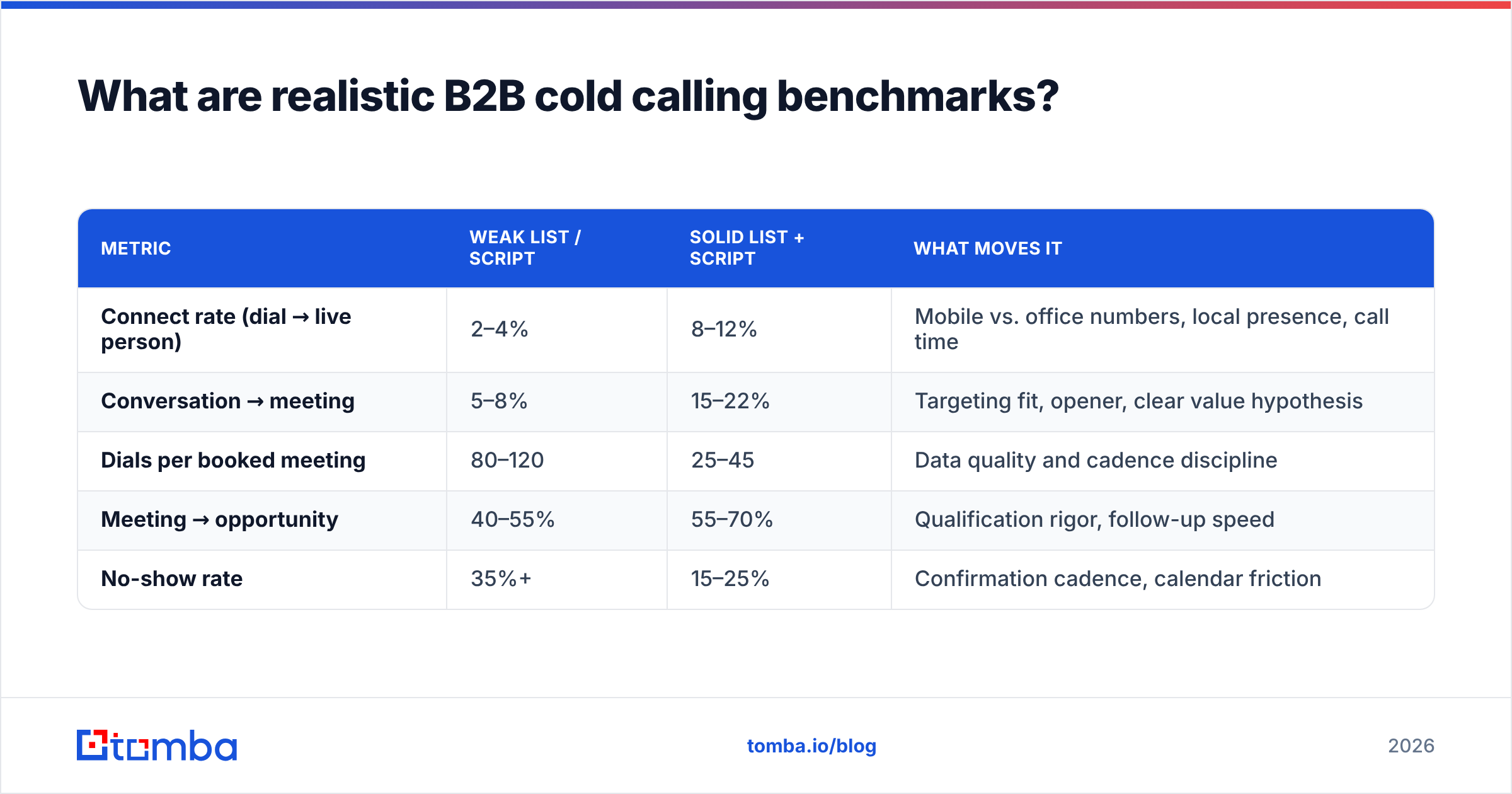
Set expectations with math, not hope. Here are defensible 2026 ranges for outbound SDR motions calling into mid-market and enterprise. Your numbers will vary by industry, seniority, and offer, but these are the gravity you are working against.
| Metric | Weak list / script | Solid list + script | What moves it |
|---|---|---|---|
| Connect rate (dial → live person) | 2–4% | 8–12% | Mobile vs. office numbers, local presence, call time |
| Conversation → meeting | 5–8% | 15–22% | Targeting fit, opener, clear value hypothesis |
| Dials per booked meeting | 80–120 | 25–45 | Data quality and cadence discipline |
| Meeting → opportunity | 40–55% | 55–70% | Qualification rigor, follow-up speed |
| No-show rate | 35%+ | 15–25% | Confirmation cadence, calendar friction |
The biggest swing in that table is the connect rate, and it is almost entirely a data story. A direct mobile line connects far more reliably than a desk phone that has been forwarded to voicemail since the last office move. This is why the data layer — not the script — is where most cold-calling improvement actually comes from. If you want the underlying definitions, see how response rate and sales win rate are calculated in the B2B glossary.
How do you build a cold call list that actually connects?#
Start from the account, not the contact. Define your ideal customer profile, then find the two or three people inside each account who own the problem you solve. Calling a junior analyst to pitch a CFO-level decision wastes the dial regardless of how good the number is.
Then you need three data points per contact, in priority order:
- A direct mobile number, not a switchboard. Mobiles connect; main lines route to a menu. A B2B phone number source that returns direct dials is worth more than ten generic office lines.
- A verified email for the multi-channel cadence. You will not reach everyone by phone, so pair each contact with a deliverable address. Run them through an email verifier so your follow-up touches do not bounce and torch your sender reputation.
- One relevance trigger. A funding round, a new hire in their function, a tech-stack change, an expansion. This becomes your reason for the call.
When you are working from a target account list, pull every reachable contact at once instead of hunting one by one. A domain search returns the people and email patterns at a company in a single pass, and a bulk email finder lets you enrich an entire account list before the dialing session starts. The goal is simple: when you sit down to call, every row already has a number, a verified email, and a reason. No mid-session research.
A quick note on numbers specifically: validate them before you dial. A phone validator flags disconnected and reassigned lines so your connect rate is not silently destroyed by dead data. Nothing kills momentum like 30 straight dials to nowhere.
What does a good B2B cold call script look like in 2026?#
A modern script is a flexible frame, not a monologue. It has four moves: open, earn time, hypothesize, and ask. Here is a structure that survives contact with real prospects.
1. Pattern-interrupt opener (5 seconds). Skip "How are you today?" — it signals "salesperson." Lead with their name and honesty:
"Hi Maria, this is Sam from Tomba. I know I'm an interruption — can I take 30 seconds to tell you why I called, and you tell me if it's worth continuing?"
That permission-based ask lowers defenses and gives them agency, which paradoxically makes them more likely to stay on.
2. Earn the next 30 seconds with relevance. Reference the trigger you found:
"I saw your team just opened five SDR roles. Usually when companies scale outbound that fast, connect rates drop because the data can't keep up. That's the reason I called."
3. State one value hypothesis — not a feature list. You are testing whether a problem exists, not presenting:
"We help outbound teams dial verified mobile numbers so reps spend time talking, not dialing dead lines. Some teams roughly double their connect rate. Worth a quick look, or not really a priority right now?"
4. Ask for a specific, small next step. Propose a concrete time. Specificity beats "Are you free sometime next week?" by a wide margin.
The script's job is to start a conversation, not win the deal on the call. If you talk more than 40% of the time, you are pitching, not qualifying.
How should you handle gatekeepers and objections?#
Treat the gatekeeper as an ally, not an obstacle. Be transparent, use the person's name if you have it, and ask for help directly: "I'm hoping you can point me in the right direction — is Maria the person who owns outbound, or is that someone else?" Honesty disarms; manipulation gets you flagged.
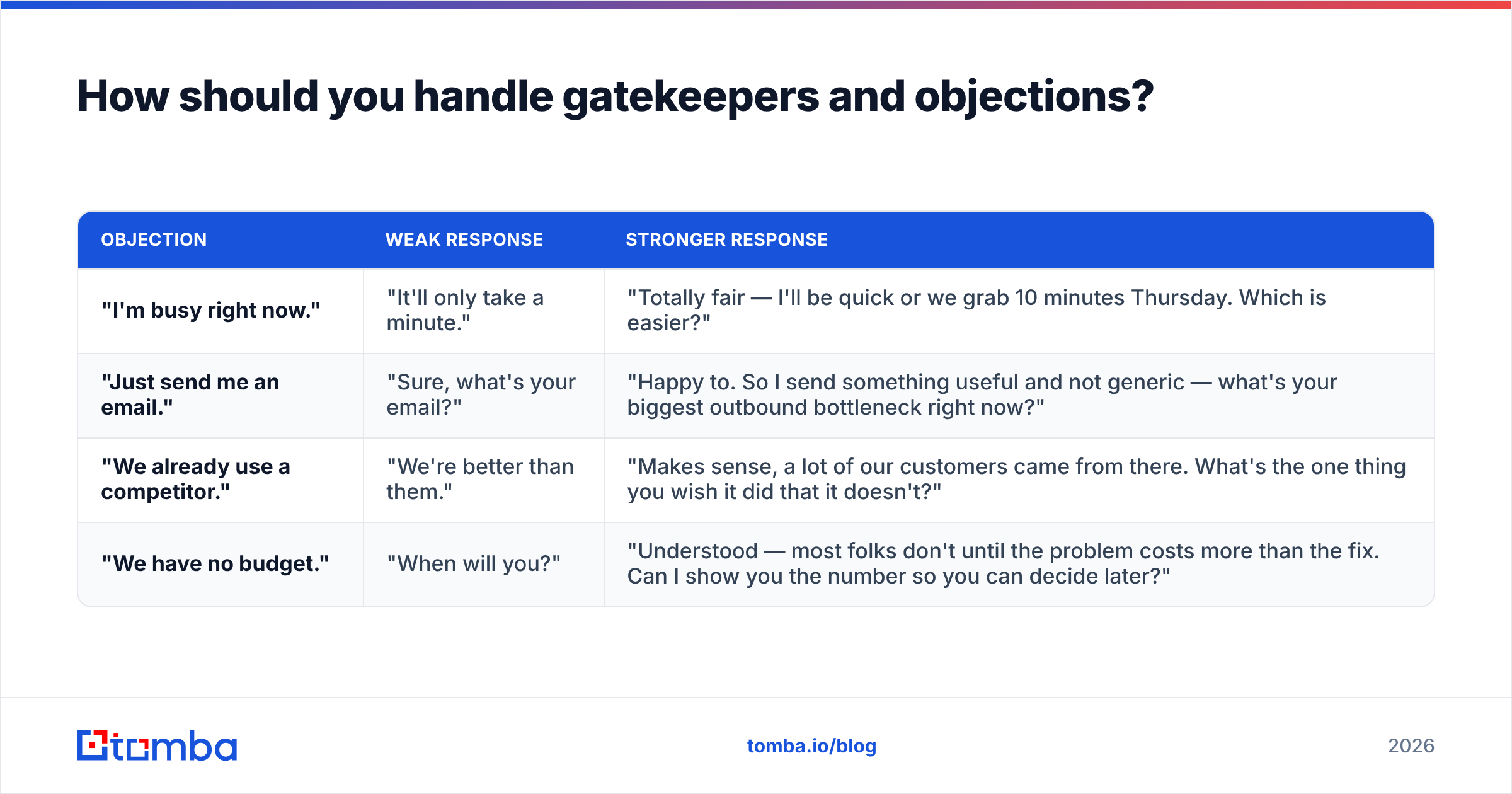
For objections, the rule is acknowledge, then redirect with a question. You are not crushing the objection; you are keeping the conversation alive.
| Objection | Weak response | Stronger response |
|---|---|---|
| "I'm busy right now." | "It'll only take a minute." | "Totally fair — I'll be quick or we grab 10 minutes Thursday. Which is easier?" |
| "Just send me an email." | "Sure, what's your email?" | "Happy to. So I send something useful and not generic — what's your biggest outbound bottleneck right now?" |
| "We already use a competitor." | "We're better than them." | "Makes sense, a lot of our customers came from there. What's the one thing you wish it did that it doesn't?" |
| "We have no budget." | "When will you?" | "Understood — most folks don't until the problem costs more than the fix. Can I show you the number so you can decide later?" |
The "send me an email" objection is the most common and the most misused. It is often a polite brush-off, but it is also a real opening — if you capture one piece of qualifying info before you hang up, that email becomes a warm, specific follow-up instead of a brochure into the void.
How does cold calling fit into a multi-channel cadence?#
Calling alone underperforms. Calling inside a coordinated sequence is where the channel earns its keep. The dial creates awareness; the email and LinkedIn touches create familiarity so the next dial lands warmer.
A workable 12-business-day cadence looks like this:
- Day 1 — Call + voicemail + follow-up email referencing the voicemail.
- Day 2 — LinkedIn connection request, no pitch.
- Day 4 — Call at a different time of day than Day 1.
- Day 6 — Value email (a relevant stat, a customer result, a short teardown).
- Day 8 — Call + voicemail.
- Day 11 — LinkedIn message referencing your email.
- Day 14 — "Breakup" call and email that gives them an easy out.
Vary your call times. Many teams over-index on 9 a.m. Monday; mid-morning and late afternoon mid-week often connect better. Track which slots produce live conversations for your specific market and let the data, not folklore, set your dialing windows. For the email side of the cadence, well-structured cold email templates keep your written touches consistent without sounding mass-produced.
What's the right tool stack for B2B cold calling?#
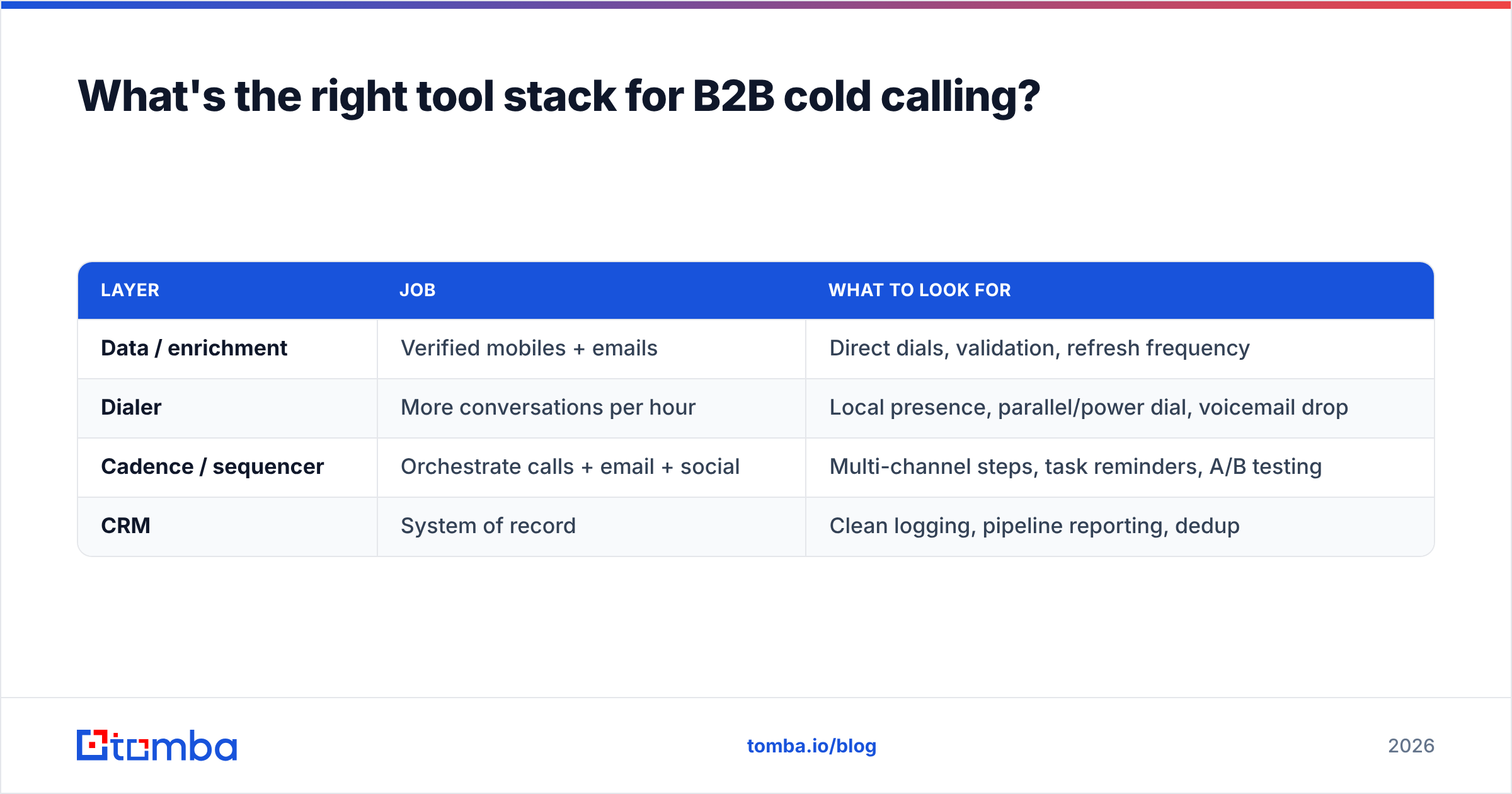
You need four layers: data, a dialer, a cadence tool, and a CRM. The data layer is the one teams under-invest in and then blame everything downstream.
| Layer | Job | What to look for |
|---|---|---|
| Data / enrichment | Verified mobiles + emails | Direct dials, validation, refresh frequency |
| Dialer | More conversations per hour | Local presence, parallel/power dial, voicemail drop |
| Cadence / sequencer | Orchestrate calls + email + social | Multi-channel steps, task reminders, A/B testing |
| CRM | System of record | Clean logging, pipeline reporting, dedup |
For the dialer and CRM categories, neutral review sites like G2 are a good starting point to compare options against verified user feedback. For the data layer, the deciding factor is accuracy and coverage of direct numbers — a beautiful dialer feeding on bad data just lets you reach voicemail faster.
This is where the data foundation pays off across both phone and email. The same enriched record that gives you a mobile number also feeds your sequencer's email steps. If you are evaluating where contact data comes from and how it is kept current, Tomba's data sources page is worth reading, and the public Tomba pricing ranges from a free tier (25 searches/month) to Starter at $49/mo and Growth at $99/mo — useful for sizing the data layer before you commit.
How do you stay compliant when cold calling?#
Compliance is not optional and the rules tightened again heading into 2026. In the U.S., honor the National Do Not Call registry for relevant contacts, identify yourself and your company immediately, and respect opt-out requests on the first ask. In the EU and UK, GDPR and PECR mean you need a lawful basis (legitimate interest is common for B2B, but document it) and you must stop on request.
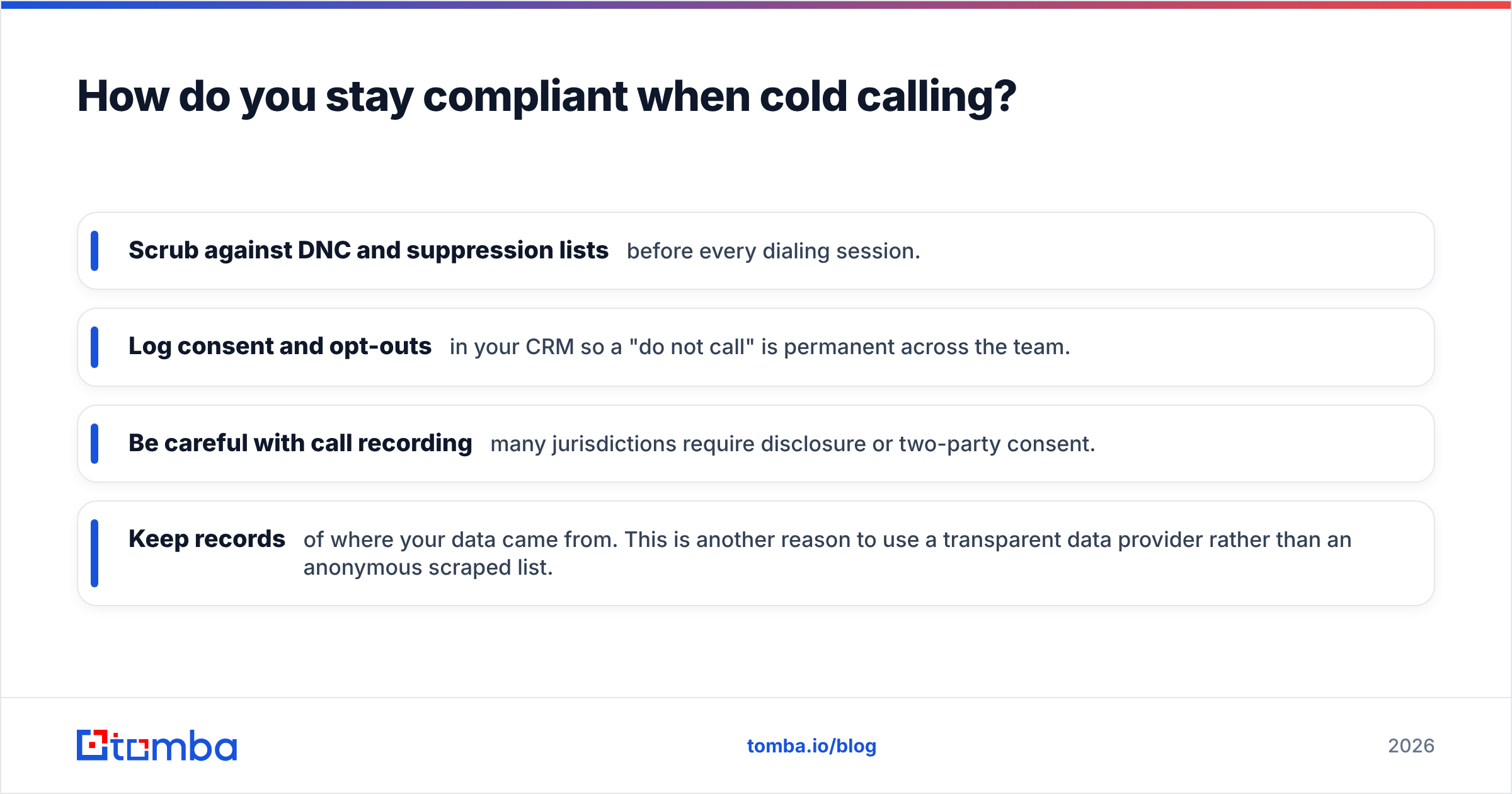
Practical guardrails:
- Scrub against DNC and suppression lists before every dialing session.
- Log consent and opt-outs in your CRM so a "do not call" is permanent across the team.
- Be careful with call recording — many jurisdictions require disclosure or two-party consent.
- Keep records of where your data came from. This is another reason to use a transparent data provider rather than an anonymous scraped list.
Authoritative guidance from bodies like the U.S. FTC is the reference of record; read it rather than relying on hallway rumor. Getting compliance wrong is not just a fine — it is a fast track to your numbers being flagged as spam, which destroys connect rates for the whole team.
What metrics should a B2B cold calling team track?#
Track inputs you control and outputs they produce, and review weekly. Vanity volume ("400 dials!") tells you nothing if connects are flat.
- Connect rate — your data-quality smoke alarm. If it drops, audit the list before blaming reps.
- Conversation-to-meeting rate — your script and targeting score.
- Meetings held vs. booked — your confirmation cadence and qualification rigor.
- Speed-to-lead on inbound-triggered calls — minutes matter; call hot triggers same day.
- Pipeline and revenue per rep — the only numbers the business ultimately cares about.
Feed these back into the system. A falling connect rate is almost always a signal to refresh data, not to demand more dials. You can keep your contact records current with ongoing data enrichment so the list does not rot between quarters.
The bottom line#
B2B cold calling in 2026 rewards teams that respect the prospect's time, lead with relevance, and — above all — call numbers that actually ring. The script is learnable in a week. The data discipline is what separates a 4% connect rate from a 12% one, and that gap is the difference between a channel you abandon and a channel that books pipeline every week.
Start at the foundation. Build target-account lists with verified direct dials and deliverable emails, validate before you call, and keep the records fresh. If you want a fast way to turn a list of target companies into reachable contacts, try the Tomba Email Finder to find the right people and pair it with the phone finder and verifier so every dial in your next session starts with a real number, a real address, and a real reason to call. Better data in, better conversations out.
// get started
Find, verify and enrich your first contacts today
Start on the free plan with 25 searches a month, then scale when your team is ready.
Free plan · No credit card required · GDPR & CCPA
// about the author