B2B Cold Email Best Practices for 2026: A Complete Playbook
The B2B cold email best practices that actually book meetings in 2026 — deliverability, data hygiene, copy frameworks, and a sending checklist you can ship today.
Cold email still works in 2026 — but only if you treat it like a system, not a numbers game. The teams getting replies are not sending more; they are sending cleaner lists, to the right people, with copy that respects an inbox. This is the practical playbook.
TL;DR#
- Deliverability is 50% of the result. Authenticate your domain (SPF, DKIM, DMARC), warm up new inboxes, and keep bounce rates under 3% before you scale.
- Data quality beats volume. A verified list of 200 prospects outperforms 2,000 scraped guesses every time.
- Personalization is a tiering decision, not an all-or-nothing rule — match research depth to deal size.
- Follow-ups drive most replies. A 3–5 step sequence over 12–18 days typically books more meetings than the first email alone.
- Measure replies and meetings, not opens. Open tracking is unreliable in 2026; positive reply rate is your north star.
What makes a B2B cold email "good" in 2026?#
A good cold email earns a reply by being relevant, brief, and easy to act on. That is the whole job. Everything below — deliverability, data, copy, cadence — exists to protect those three qualities.
Think of cold email like knocking on the right door at a reasonable hour with a clear reason for visiting. If you knock on 5,000 random doors at midnight (spray-and-pray), you get noise complaints (spam reports). If you knock on 200 doors where people actually have the problem you solve, you get conversations.
The mechanics that changed recently: mailbox providers like Google and Yahoo now enforce stricter sender requirements, open tracking is increasingly blocked or inflated, and buyers have seen every "I came across your website" template a hundred times. The bar for relevance is higher, and the tolerance for sloppy sending is near zero.
What are the core B2B cold email best practices?#
Here is the short version before we go deep. These six pillars decide whether your campaign books meetings or burns your domain.
- Fix deliverability first. Authenticate the domain, use a separate sending domain, and warm up inboxes before any volume.
- Build a verified, targeted list. Use accurate data and a real email verifier so you only contact valid, deliverable addresses.
- Write for one person. One clear value point, one ask, under 120 words.
- Personalize by tier. Deep research for big accounts, light merge fields for the rest.
- Sequence the follow-ups. Most replies arrive on emails 2 through 4, not the first.
- Measure, then iterate. Track reply and meeting rates, kill what underperforms, double down on what books calls.
Why does deliverability come first?#
Because the best email in the world earns nothing from a spam folder. Before you write a single line, get the plumbing right:
- SPF, DKIM, and DMARC records on your sending domain. These prove you are who you claim to be. Google and Yahoo treat missing authentication as a fast track to spam — see Google's sender guidelines for the current bar.
- A dedicated sending domain (for example,
tryyourbrand.cominstead of your primaryyourbrand.com) so a campaign mistake never poisons your main reputation. - Inbox warmup for 2–4 weeks on any new mailbox, ramping volume gradually. A free email warmup calculator helps you set a safe daily ceiling.
- Bounce control. Keep hard bounces under 3%. This is entirely a data-quality problem, which is why list hygiene is the next pillar.
If you only fix one thing this quarter, fix email deliverability. It compounds every other improvement.
How important is data quality in cold email?#
Data quality is the single biggest lever most teams ignore. Sending to bad addresses spikes your bounce rate, which tanks your sender reputation, which sends your good emails to spam. One dirty list can undo months of warmup.
The fix is a two-step discipline: find accurate contacts, then verify them before sending.
- Find the right contacts. Use an email finder to get role-based, professional addresses by name and company instead of guessing patterns.
- Verify before you send. Run every address through verification to remove invalids, role accounts you don't want, and risky catch-alls.
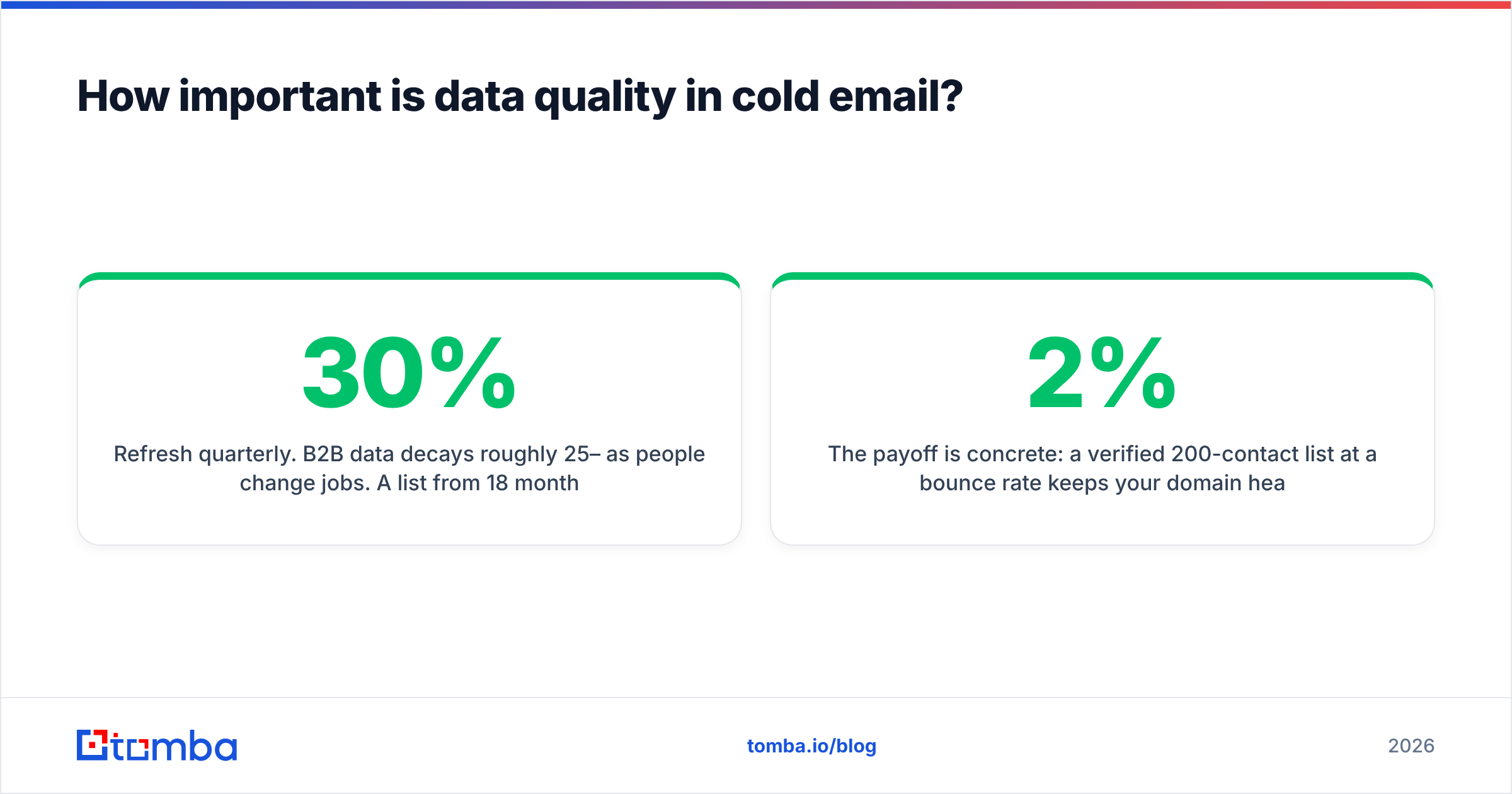
- Refresh quarterly. B2B data decays roughly 25–30% per year as people change jobs. A list from 18 months ago is half wrong.
The payoff is concrete: a verified 200-contact list at a 2% bounce rate keeps your domain healthy and your reply rate honest. A 2,000-contact scraped list at a 15% bounce rate gets you blocklisted by week two.
What is the best cold email structure?#
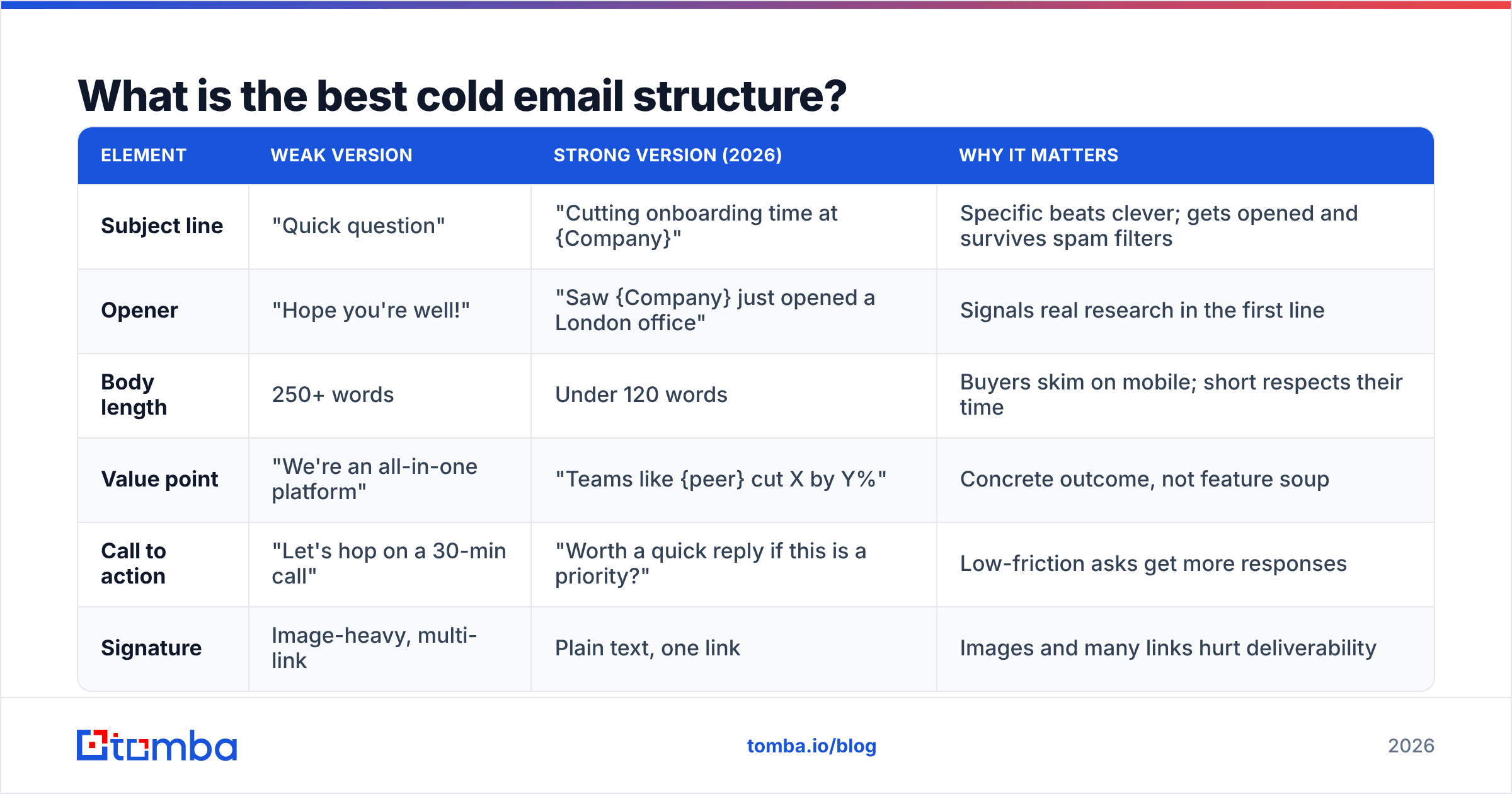
The structure that wins is boringly consistent: a specific subject line, a relevant opener, one value point, one ask, and a frictionless close. Here is how the elements compare in practice.
| Element | Weak version | Strong version (2026) | Why it matters |
|---|---|---|---|
| Subject line | "Quick question" | "Cutting onboarding time at {Company}" | Specific beats clever; gets opened and survives spam filters |
| Opener | "Hope you're well!" | "Saw {Company} just opened a London office" | Signals real research in the first line |
| Body length | 250+ words | Under 120 words | Buyers skim on mobile; short respects their time |
| Value point | "We're an all-in-one platform" | "Teams like {peer} cut X by Y%" | Concrete outcome, not feature soup |
| Call to action | "Let's hop on a 30-min call" | "Worth a quick reply if this is a priority?" | Low-friction asks get more responses |
| Signature | Image-heavy, multi-link | Plain text, one link | Images and many links hurt deliverability |
Notice the through-line: every "strong" column is shorter, more specific, and easier to say yes to. When in doubt, cut.
A reusable framework: PAS for cold email#
For the body itself, Problem – Agitate – Solve is hard to beat:
- Problem: Name a pain your prospect's role actually feels ("Reps waste hours hunting for valid emails").
- Agitate: Make the cost real ("That's a full day a week not selling").
- Solve: Position your fix in one sentence, then ask for a small next step.
If writing from scratch slows you down, start from proven cold email templates and adapt them to your voice rather than copying verbatim.
How much personalization do B2B cold emails need?#
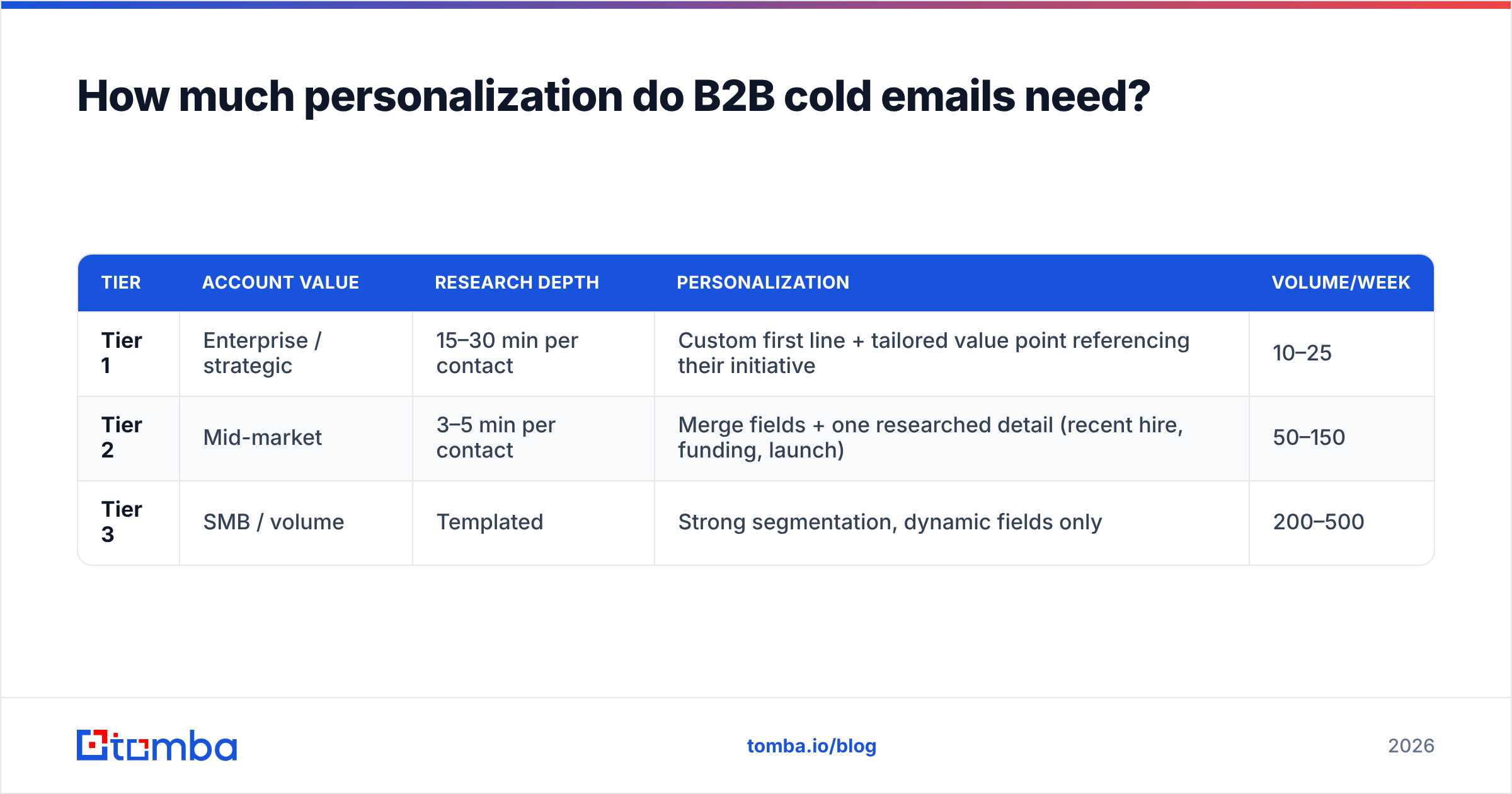
Personalization should scale with deal size — match effort to the prize. Treating every prospect identically wastes time on small accounts and underinvests in big ones.
| Tier | Account value | Research depth | Personalization | Volume/week |
|---|---|---|---|---|
| Tier 1 | Enterprise / strategic | 15–30 min per contact | Custom first line + tailored value point referencing their initiative | 10–25 |
| Tier 2 | Mid-market | 3–5 min per contact | Merge fields + one researched detail (recent hire, funding, launch) | 50–150 |
| Tier 3 | SMB / volume | Templated | Strong segmentation, dynamic fields only | 200–500 |
The mistake is collapsing all three into one. A "Dear {FirstName}" blast to enterprise buyers reads as lazy; spending 30 minutes researching a $99/month SMB lead destroys your unit economics. Segment first, then choose your depth.
A practical shortcut for Tier 2 and 3: personalize at the segment level. One genuinely relevant sentence about an industry trend or a shared trigger event (a funding round, a new compliance rule) can feel personal to a hundred similar prospects at once.
What does a winning follow-up sequence look like?#
Most replies come from follow-ups, so a single email is a campaign that quit early. The sweet spot is a 3–5 touch sequence spread across roughly 12–18 days, where each message adds something rather than just "bumping" the thread.
A reliable cadence:
- Day 1 — Initial email. Your best Problem-Agitate-Solve message with one clear ask.
- Day 3 — Short bump. Two sentences. Add a new angle or a proof point, not "just following up."
- Day 7 — Value add. Share a relevant case study, benchmark, or resource. No ask required.
- Day 12 — Different angle. Reframe around a second pain point or a different stakeholder.
- Day 18 — Polite break-up. "I'll close the loop on my end — reach out if timing changes." This often gets the most replies.
Keep each step short, keep them in the same thread, and stop the sequence instantly when someone replies or books. Tools like HubSpot or your sequencer can automate the timing, but the content of each step is on you.
Cold email and the law: what do you need to know?#
Cold email is legal in most B2B contexts, but compliance is non-negotiable. The basics:
- CAN-SPAM (US): Use a truthful subject and from-line, include a physical mailing address, and honor opt-outs promptly. The full rule is summarized on Wikipedia's CAN-SPAM overview.
- GDPR (EU): B2B cold email can rely on "legitimate interest," but you must offer an easy opt-out and only contact people whose role is genuinely relevant to your offer.
- Always include an unsubscribe path, even a plain-text "reply STOP and I won't email again." It protects your reputation and respects the recipient.
Treat compliance as part of deliverability: providers and recipients both punish senders who ignore opt-outs.
How do you measure cold email success in 2026?#
Measure replies and booked meetings — not opens. Open tracking became unreliable when mailbox privacy features started pre-loading images, so an "open" today is often a bot or a cache, not a human.
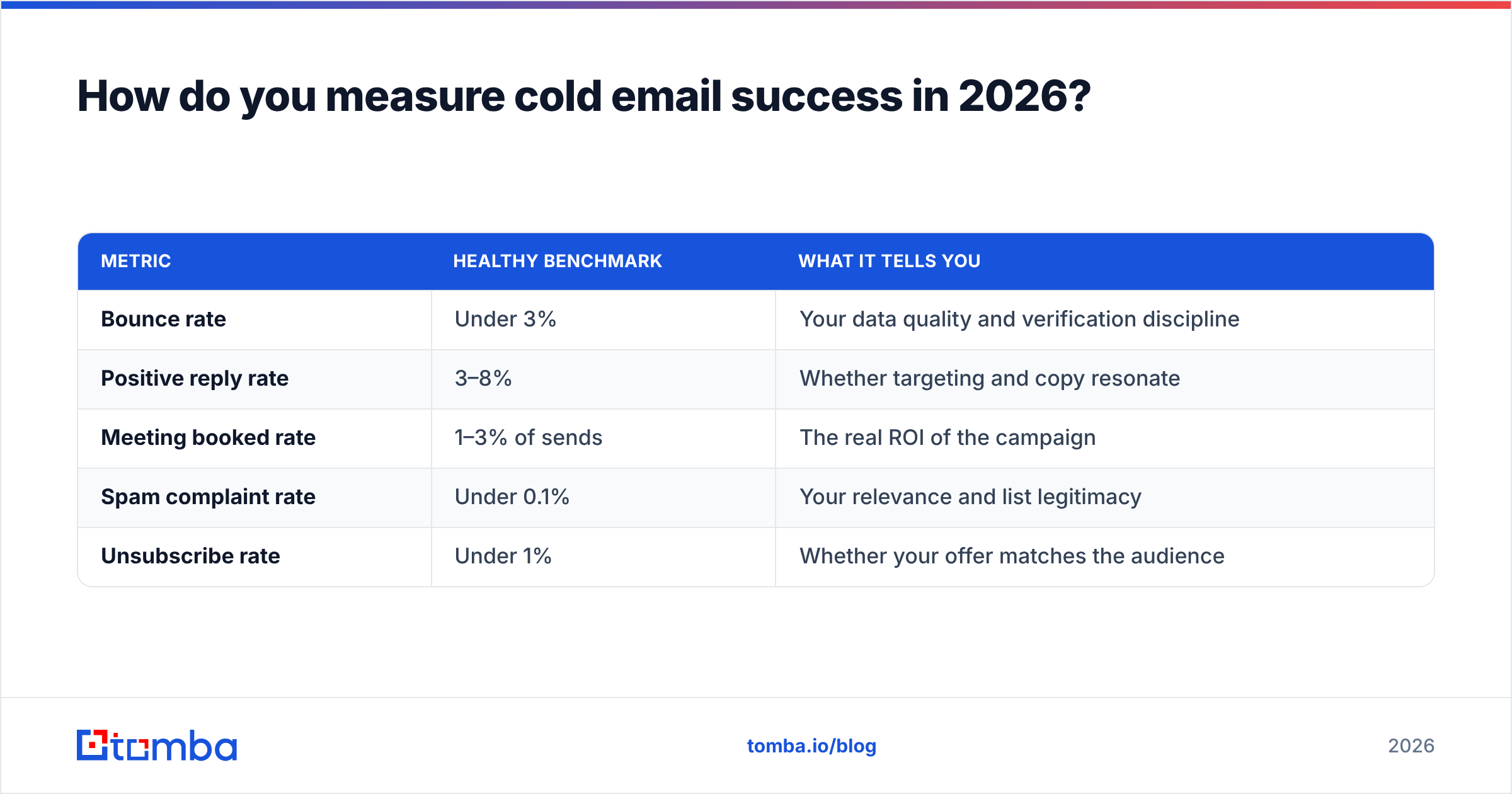
The metrics that actually matter:
| Metric | Healthy benchmark | What it tells you |
|---|---|---|
| Bounce rate | Under 3% | Your data quality and verification discipline |
| Positive reply rate | 3–8% | Whether targeting and copy resonate |
| Meeting booked rate | 1–3% of sends | The real ROI of the campaign |
| Spam complaint rate | Under 0.1% | Your relevance and list legitimacy |
| Unsubscribe rate | Under 1% | Whether your offer matches the audience |
Run one variable at a time. Test a subject line for a week, hold everything else constant, and keep the winner. Chasing five changes at once tells you nothing about what worked.
Cold email best practices: the pre-send checklist#
Before any campaign goes out, confirm:
- Authentication live — SPF, DKIM, DMARC all passing.
- List verified — bounces removed, catch-alls flagged, list refreshed within 90 days.
- Copy under 120 words — one value point, one ask.
- Personalization tier assigned — research depth matches account value.
- Follow-up sequence loaded — 3–5 steps, auto-stop on reply.
- Opt-out present — and your sending volume stays within warmup limits.
Tick all six and you have already beaten the majority of senders who skip straight to "send."
Put accurate data at the center of your cold email#
Every practice in this playbook depends on one thing: reaching real people at valid addresses. That starts with sourcing accurate, verified contacts before you write a word. Tomba's Tomba Email Finder gives you professional emails by name, domain, or company, with verification built in so your bounce rate stays low and your sender reputation stays clean. Pair it with the email verifier for a final pre-send pass, and check the Tomba pricing — the free tier includes 25 searches a month to test it, with paid plans from $49/mo when you scale. Clean data is the foundation; build the rest of your 2026 cold email program on top of it.
// get started
Find, verify and enrich your first contacts today
Start on the free plan with 25 searches a month, then scale when your team is ready.
Free plan · No credit card required · GDPR & CCPA
// about the author