7 B2B Cold Email Examples That Get Replies in 2026
Seven real B2B cold email examples — with subject lines, structure, and the data behind why they get replies. Steal the templates and ship today.
7 B2B Cold Email Examples That Get Replies in 2026
Most cold emails fail before the prospect reads a word. The list was wrong, the subject line screamed "template," or the ask was so big nobody could say yes. The fix is not magic copy — it is a repeatable structure aimed at a verified inbox. Below are seven B2B cold email examples you can adapt today, plus a breakdown of why each one works.
TL;DR#
- Seven copy-paste B2B cold email examples covering intro, pain-point, social-proof, trigger-event, breakup, referral, and value-first plays.
- Every example follows the same skeleton: relevant hook, one clear problem, one proof point, one tiny ask.
- Deliverability beats cleverness. A verified list and warmed domain matter more than the perfect adjective.
- Short wins. The best-performing templates here sit between 50 and 120 words.
- Personalization at scale is a data problem first, a writing problem second — start with accurate contact data, then templatize.
What makes a B2B cold email actually work?#
A cold email works when the right person opens it, recognizes their own problem in the first two lines, and sees a frictionless next step. That is it. Clever wordplay is a distant fourth.
Think of cold email like knocking on doors in an unfamiliar neighborhood. If you have the wrong address, the warmest pitch in the world lands on an empty house. That is why the foundation of every example below is a real, verified email — not a guess from a permutation tool. A 40% bounce rate doesn't just waste sends; it tanks your sender reputation and pushes future emails to spam.
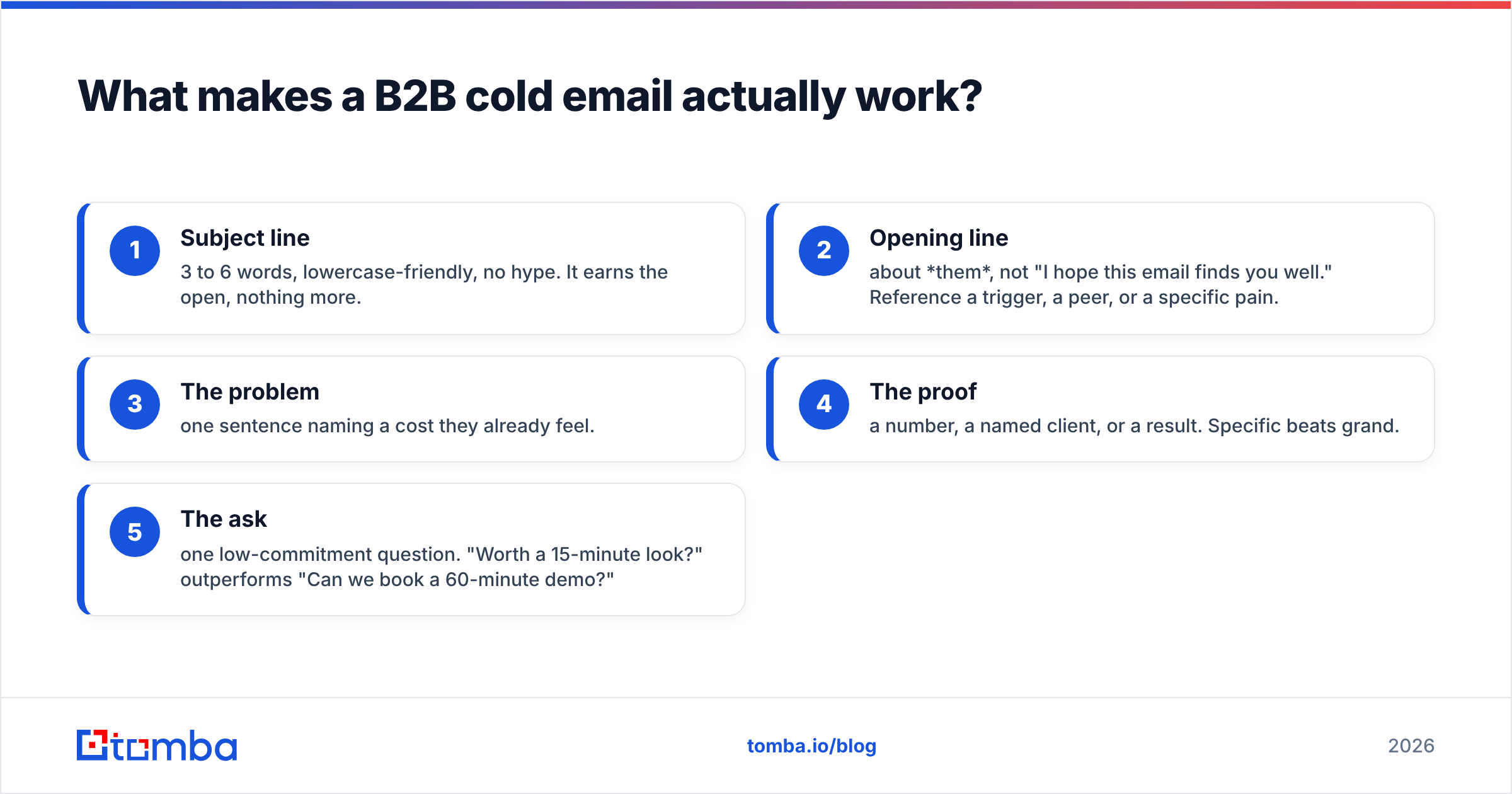
Here is the anatomy that every strong B2B cold email shares:
- Subject line — 3 to 6 words, lowercase-friendly, no hype. It earns the open, nothing more.
- Opening line — about them, not "I hope this email finds you well." Reference a trigger, a peer, or a specific pain.
- The problem — one sentence naming a cost they already feel.
- The proof — a number, a named client, or a result. Specific beats grand.
- The ask — one low-commitment question. "Worth a 15-minute look?" outperforms "Can we book a 60-minute demo?"

What are the 7 best B2B cold email examples?#
1. The classic intro email#
Subject: quick question about {{company}} onboarding
Hi {{first_name}},
Noticed {{company}} just rolled out self-serve signup — congrats. Teams that do this usually hit a wall when support tickets spike in week two.
We helped {{similar_company}} cut onboarding tickets 38% in a quarter. Worth a 15-minute look at how?
— {{your_name}}
Why it works: the hook references a real change, the proof is a number, and the ask is tiny.
2. The pain-point email#
Subject: reps spending 11 hrs/week on data entry?
Hi {{first_name}},
Most {{role}} leaders I talk to lose roughly a day a week to manual CRM updates. That is a deal slipping through the cracks every single week.
{{client}} automated theirs and added 6 hours of selling time per rep. Open to seeing the workflow?
Why it works: it leads with a quantified pain the buyer recognizes instantly.
3. The social-proof email#
Subject: how {{competitor}} fixed pipeline leakage
Hi {{first_name}},
{{competitor}} and two other {{industry}} teams switched to us last quarter after losing leads between marketing and sales.
They recovered 22% more MQLs without new headcount. Happy to share the exact playbook — want it?
Why it works: naming a peer or rival triggers competitive urgency.
4. The trigger-event email#
Subject: congrats on the Series B
Hi {{first_name}},
Saw the funding news — scaling outbound is usually the next fire drill after a raise.
We help post-raise teams stand up a predictable pipeline in 30 days. {{client}} booked 47 meetings in month one. Worth a chat before you hire 5 SDRs?
Why it works: timing. A trigger event makes a cold email feel warm.
5. The breakup email#
Subject: closing the loop
Hi {{first_name}},
I have reached out a couple of times about cutting your onboarding tickets — no worries if it is not a priority.
I will close your file, but if Q3 changes things, just reply "later" and I will circle back then.
Why it works: loss aversion. Breakup emails routinely pull the highest reply rate in a sequence.
6. The referral / "wrong person" email#
Subject: are you the right contact?
Hi {{first_name}},
I am trying to reach whoever owns demand gen at {{company}}. If that is not you, could you point me to the right person?
We just helped {{client}} lift reply rates 3x — would hate for it to miss the right inbox.
Why it works: it is easy to forward, and people like being helpful.
7. The value-first email#
Subject: teardown of your signup flow
Hi {{first_name}},
I recorded a 4-minute Loom spotting three drop-off points in {{company}}'s trial signup. No pitch — just sharing because we see this pattern a lot.
Want the link?
Why it works: you give before you ask, which disarms the usual cold-email defenses.
How do these B2B cold email examples compare?#
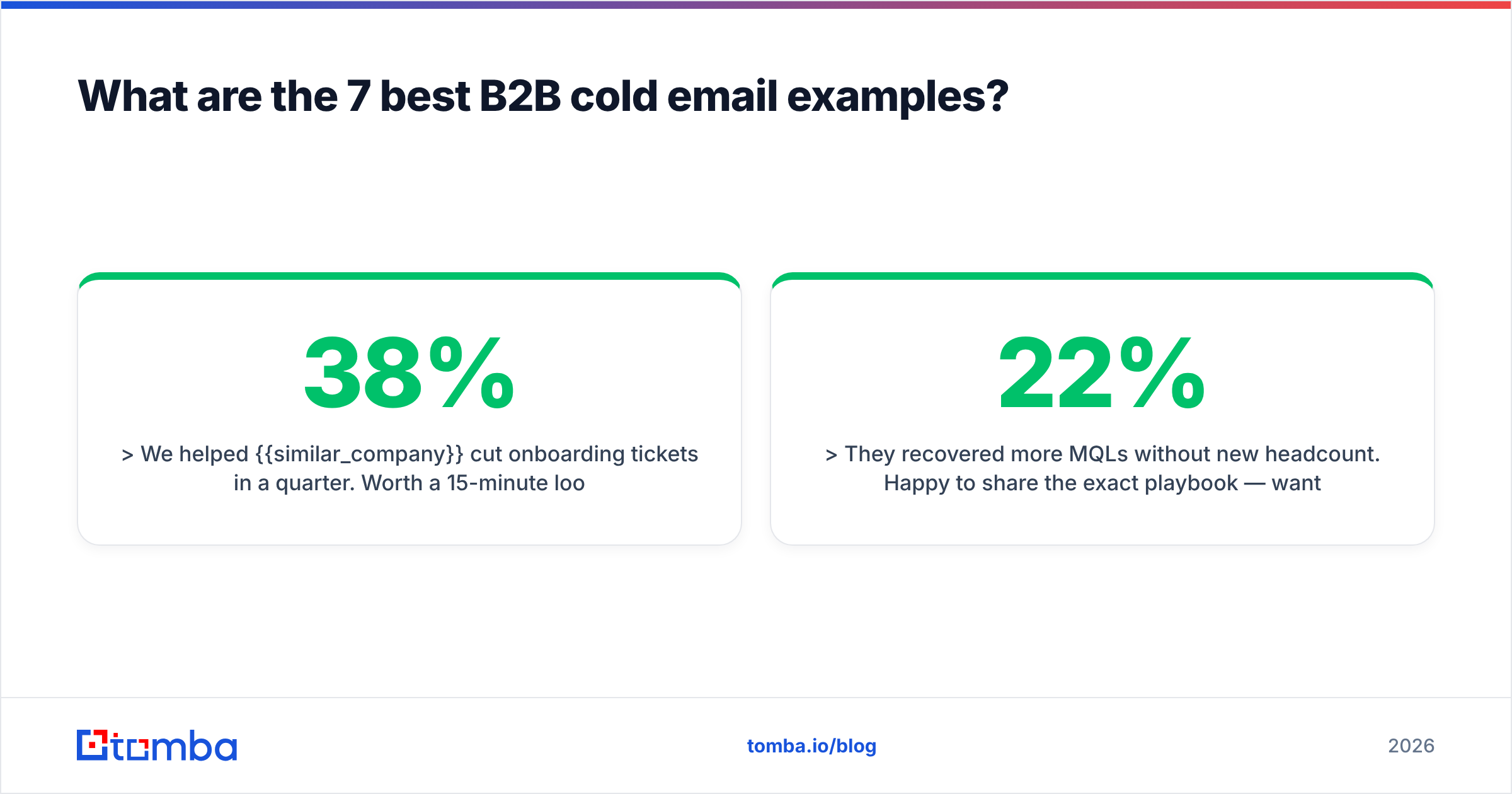
Different templates fit different stages and goals. Here is a side-by-side so you can pick the right one for the moment, not just the one you like writing.
| Example | Best for | Typical reply rate | Effort to personalize | Risk |
|---|---|---|---|---|
| Intro email | First touch, broad ICP | 4–8% | Low | Generic if rushed |
| Pain-point | Problem-aware buyers | 6–10% | Medium | Wrong pain = ignored |
| Social proof | Crowded markets | 5–9% | Medium | Needs real names |
| Trigger-event | Timely outreach | 8–14% | High | Trigger data required |
| Breakup | End of sequence | 7–12% | Low | Only works after prior touches |
| Referral | Unknown contact | 5–8% | Low | Can feel transactional |
| Value-first | High-value accounts | 9–15% | High | Time-intensive to produce |
Notice the pattern: the templates that demand better data (trigger-event, value-first) reward you with the highest reply rates. That is not a coincidence. Relevance is a data problem before it is a writing problem.
How do you personalize cold emails at scale?#
Personalization scales when you separate the variable from the template. Write one strong skeleton, then feed it accurate variables — name, company, role, trigger — pulled programmatically instead of by hand.
The workflow looks like this:
- Build the list with a domain search to pull every relevant contact at a target account.
- Find and verify each address so your bounce rate stays under 3%. Use the email finder for name-plus-domain lookups, then verify in bulk.
- Enrich each row with role, seniority, and company data so your
{{trigger}}and{{pain}}tokens are accurate. - Templatize the five-part skeleton above and map tokens to your enriched columns.
- Warm the domain before volume sends, and keep daily volume per inbox conservative.
Tools like HubSpot and Salesforce handle the sequencing and CRM side, but they assume you already have clean, deliverable contacts. Garbage in, garbage out — the enrichment and verification layer is what makes the templates fire.

What subject lines get B2B cold emails opened?#
Short, specific, and lowercase-leaning subject lines win because they read like a note from a colleague, not a campaign. Aim for 3 to 6 words and zero hype words ("FREE," "guaranteed," "act now" all trip filters).
High-performing patterns from the examples above:
- Question: "are you the right contact?"
- Trigger: "congrats on the Series B"
- Specific number: "reps spending 11 hrs/week on data entry?"
- Curiosity + brevity: "closing the loop"
Avoid the temptation to A/B test your way to a clever line before your fundamentals are solid. According to research compiled on G2, deliverability and list quality move reply rates far more than subject-line tweaks. If you want to pressure-test wording, a subject line tester will catch spam triggers before you hit send.
What mistakes kill B2B cold email reply rates?#
The fastest way to improve is to stop doing the things that guarantee silence:
- Sending to unverified lists. Every hard bounce damages your email deliverability. Verify first, always.
- Writing about yourself. "We are the leading platform for..." loses. Lead with their problem.
- Asking for too much. A 60-minute demo from a stranger is a non-starter. Ask for a reply, a yes/no, or a 15-minute look.
- Walls of text. If it scrolls on mobile, it gets archived. Keep it under 120 words.
- No follow-up. Most replies come from emails two through four. A single send is a coin flip you usually lose.
- Ignoring the trigger. Generic timing reads as spam; timely outreach reads as research.
Fix the list and the structure first. The copy is the last 10%, not the first.
How many follow-ups should a cold sequence have?#
Three to five touches over two to three weeks is the proven range for B2B. The first email earns attention, the middle ones add new angles or proof, and the final breakup email triggers loss aversion. Spacing matters — give 2 to 4 business days between sends so you are persistent without being annoying. Each follow-up should add something new, never just "bumping this to the top of your inbox."
Frequently asked questions#
How long should a B2B cold email be? 50 to 120 words. Short enough to read on a phone in under 20 seconds, long enough to land one problem and one proof point.
Are these cold email examples GDPR and CAN-SPAM compliant? The templates are a starting point. You are responsible for a legitimate-interest basis, accurate sender details, and a working opt-out. Keep targeting tight and relevant.
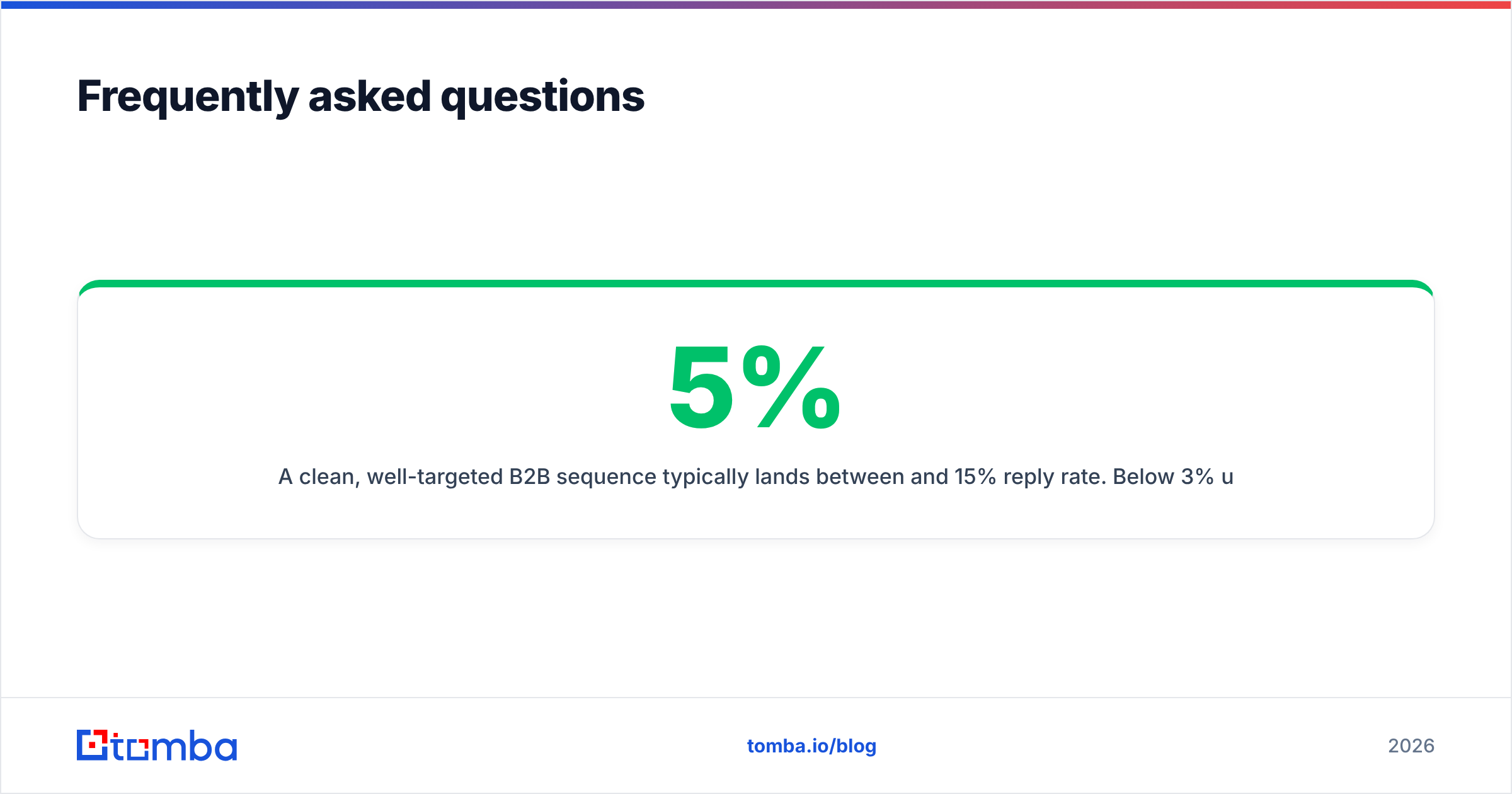
What reply rate is realistic? A clean, well-targeted B2B sequence typically lands between 5% and 15% reply rate. Below 3% usually points to a data or deliverability problem, not a copy problem.
Do I need a separate domain for cold outreach? Yes. Use a secondary sending domain, warm it gradually, and keep daily volume per inbox low to protect your primary domain's reputation.
Start with data, not just copy#
The best cold email template in the world dies on a bounced address. Before you obsess over verbs and subject lines, make sure every send reaches a real, verified inbox at the right person. That is where reply rates are won or lost.
Tomba's Email Finder lets you find and verify professional email addresses by name, company, or domain — so the seven examples above actually reach human beings. Start free with 25 searches a month, then scale on the Starter plan at $49/mo when your outbound takes off. Build the list right, ship the templates, and let the replies roll in.
// get started
Find, verify and enrich your first contacts today
Start on the free plan with 25 searches a month, then scale when your team is ready.
Free plan · No credit card required · GDPR & CCPA
// about the author