B2B Cold Email Template: 9 Proven Frameworks for 2026
Steal 9 B2B cold email templates that book replies in 2026 — plus the structure, personalization, and verified data that make them work.
You can copy the best B2B cold email template in the world and still get zero replies. The template is the easy part. What separates a 1% reply rate from a 12% reply rate is the structure underneath it, the personalization on top of it, and whether the email even reaches a real inbox. This guide gives you all three.
TL;DR#
- A b2b cold email template is a reusable skeleton — opener, relevance hook, value, and a single soft ask — not a script you paste unchanged.
- Replies come from research and verified data, not clever copy. Bad lists kill good templates.
- Keep it under 120 words, one CTA, and a subject line under 40 characters.
- Below are 9 frameworks (AIDA, PAS, BAB, and more) with fill-in-the-blank examples you can ship today.
- Always verify addresses before sending — bounces above 3% wreck your sender reputation.
What makes a B2B cold email template actually work?#
The conclusion first: a template works when it earns the next 10 seconds of attention at every line. Your subject line earns the open. Your first sentence earns the second sentence. Your value prop earns the CTA. Break that chain anywhere and the prospect is gone.
Think of a cold email like a hallway pitch to a busy executive. You have one floor of the elevator ride. You wouldn't open with your company history — you'd lead with why they should care. Cold email is the same physics in text.
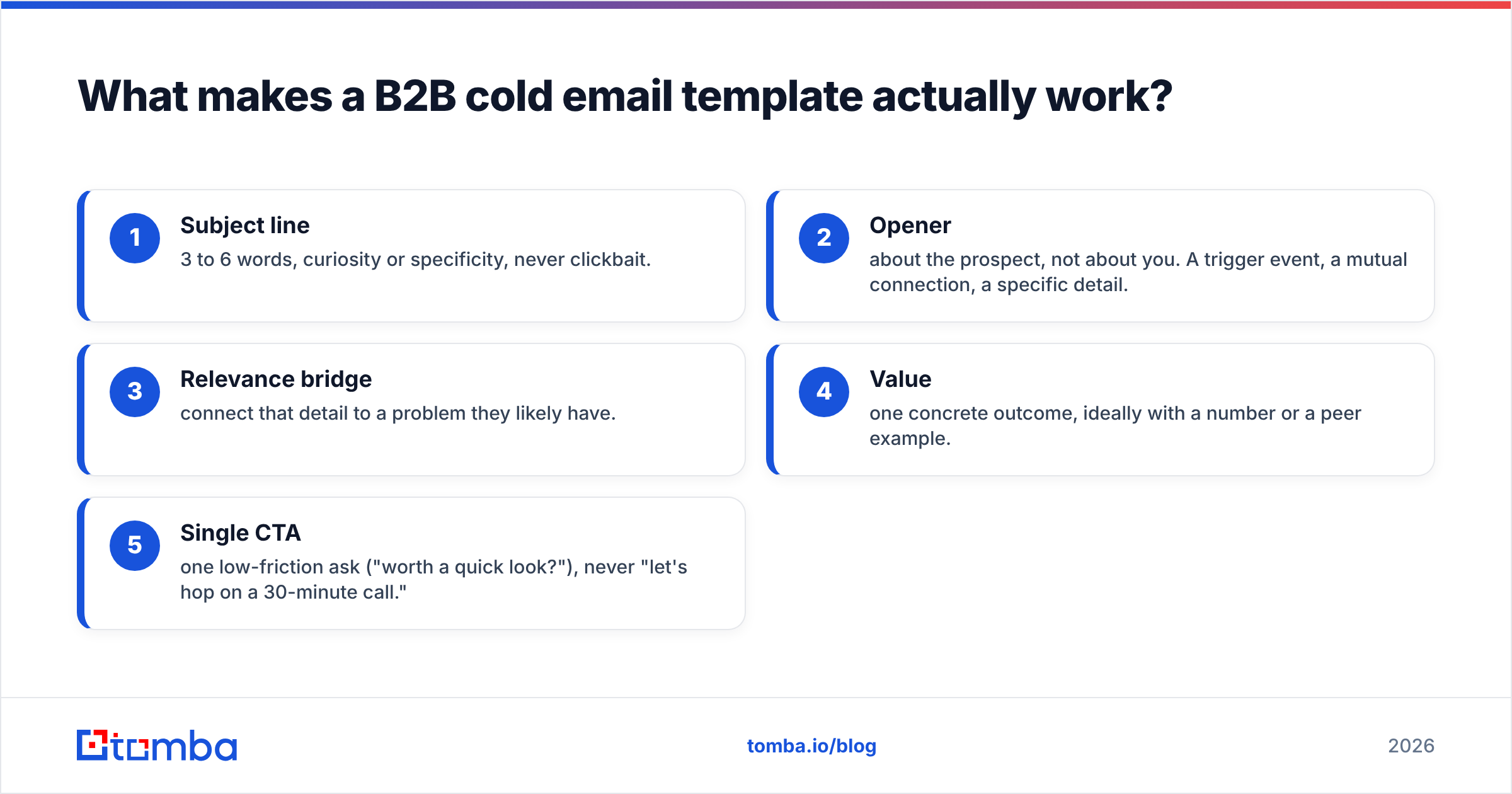
Every high-performing B2B cold email template shares the same five components:
- Subject line — 3 to 6 words, curiosity or specificity, never clickbait.
- Opener — about the prospect, not about you. A trigger event, a mutual connection, a specific detail.
- Relevance bridge — connect that detail to a problem they likely have.
- Value — one concrete outcome, ideally with a number or a peer example.
- Single CTA — one low-friction ask ("worth a quick look?"), never "let's hop on a 30-minute call."
)
Notice what's missing from that list: features, paragraphs about your funding round, and three different calls to action. Cold email is subtraction, not addition.
What are the 9 best B2B cold email templates?#
Here are nine frameworks that consistently outperform. Each uses brackets [like this] for the variables you personalize. Don't ship them raw — they're starting points.
1. The AIDA template (Attention, Interest, Desire, Action)#
Subject: Quick question, [First Name]
Hi [First Name],
Saw [Company] just [trigger event — opened a new office / hired 5 SDRs]. Teams scaling that fast usually hit [specific problem] within a quarter.
We helped [peer company] cut [metric] by [X%] without adding headcount.
Worth a 10-minute look next week?
2. The PAS template (Problem, Agitate, Solve)#
Subject: [Pain point] at [Company]?
Hi [First Name],
Most [job title]s I talk to lose [X hours] a week to [problem]. Left alone, it quietly drags [downstream metric] down all quarter.
[Your product] removes that step entirely — [peer] got [result] in [timeframe].
Open to seeing how?
3. The Before-After-Bridge (BAB) template#
Subject: From [bad state] to [good state]
Hi [First Name],
Right now your team probably [before state]. Imagine [after state] instead.
The bridge is [your product] — [peer] made that jump in [timeframe].
Want the 2-minute version?
4. The "trigger event" template#
Subject: Congrats on [event]
Hi [First Name],
Congrats on [funding round / award / launch]. Companies at this stage usually need [relevant capability] fast.
We do exactly that for [similar companies]. Happy to share how [peer] handled it.
Worth a chat?
5. The mutual-connection template#
Subject: [Mutual name] suggested I reach out
Hi [First Name],
[Mutual name] mentioned you're owning [initiative] at [Company]. We've helped a few teams in [industry] with exactly that.
Mind if I send a short example relevant to your stack?
6. The "I did my homework" template#
Subject: Noticed [specific detail]
Hi [First Name],
Read your post on [topic] — the point about [specific idea] hit home. It's the same gap we close for [peer].
Can I send a 90-second breakdown of how?
7. The question-only template#
Subject: Who owns [function]?
Hi [First Name],
Quick one — are you the right person for [function] at [Company], or should I talk to someone else?
Either way I'll keep it short.
8. The social-proof template#
Subject: How [competitor] solved [problem]
Hi [First Name],
[Competitor or peer] was struggling with [problem]. After switching to [product], they hit [result] in [timeframe].
Curious whether [Company] is seeing the same issue?
9. The break-up (last-touch) template#
Subject: Should I close your file?
Hi [First Name],
I've reached out a few times about [value]. Haven't heard back, so I'll assume the timing's off and stop here.
If it's worth a look later, just reply "next quarter" and I'll circle back.
Which framework should you use, and when?#
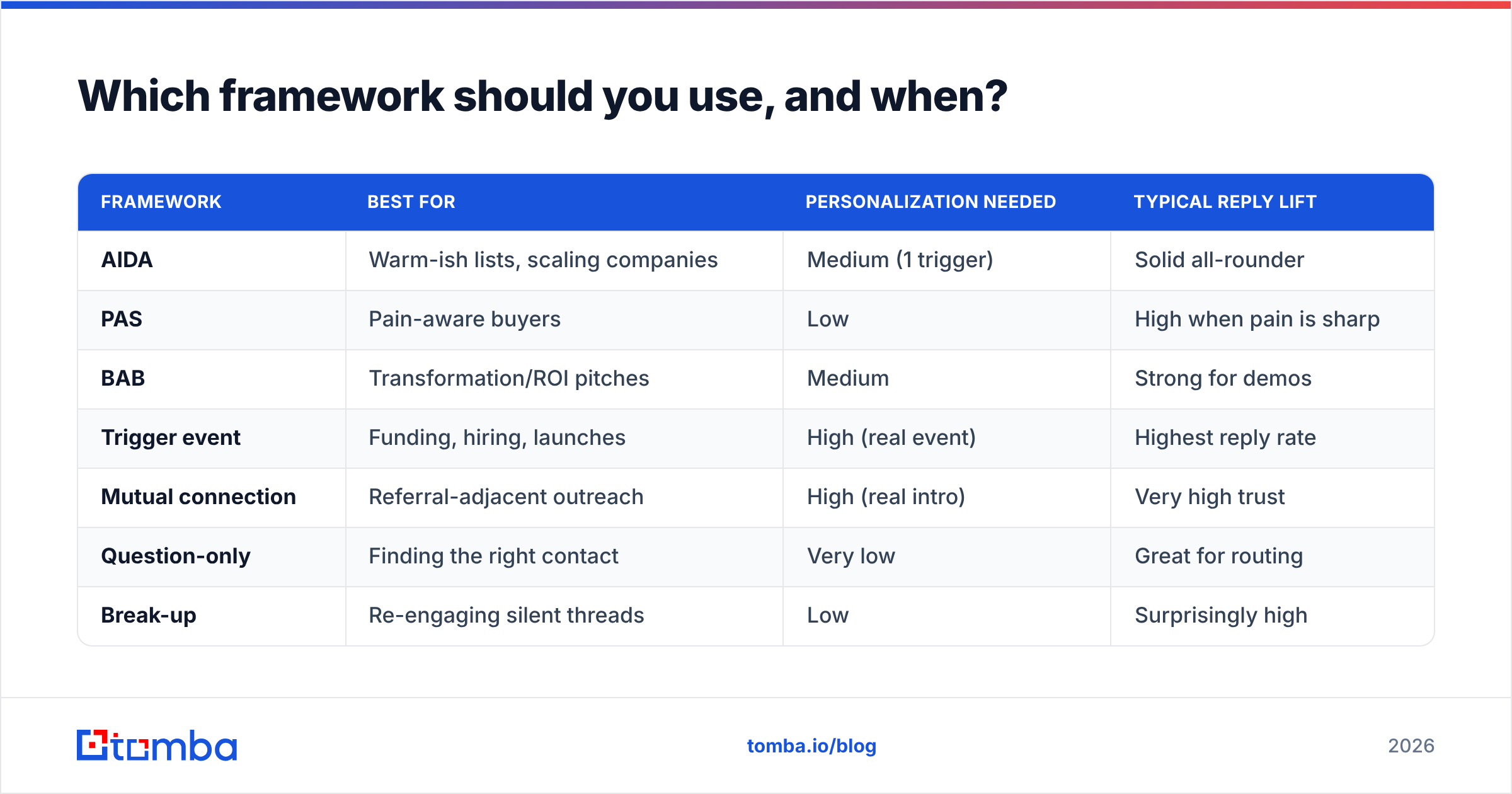
Pick the framework that matches what you actually know about the prospect. If you have a trigger event, use it. If all you have is a name and title, lean on a question-only or PAS structure that doesn't fake intimacy you don't have.
| Framework | Best for | Personalization needed | Typical reply lift |
|---|---|---|---|
| AIDA | Warm-ish lists, scaling companies | Medium (1 trigger) | Solid all-rounder |
| PAS | Pain-aware buyers | Low | High when pain is sharp |
| BAB | Transformation/ROI pitches | Medium | Strong for demos |
| Trigger event | Funding, hiring, launches | High (real event) | Highest reply rate |
| Mutual connection | Referral-adjacent outreach | High (real intro) | Very high trust |
| Question-only | Finding the right contact | Very low | Great for routing |
| Break-up | Re-engaging silent threads | Low | Surprisingly high |
The pattern: the more specific your input data, the more aggressive a framework you can run. Generic data forces generic templates, and generic templates get deleted.
How do you personalize a template at scale without sounding like a robot?#
Short answer: personalize the opener and the relevance bridge, templatize everything else. You don't need to rewrite the whole email for each prospect — you need the first two lines to feel like they were written for one person.
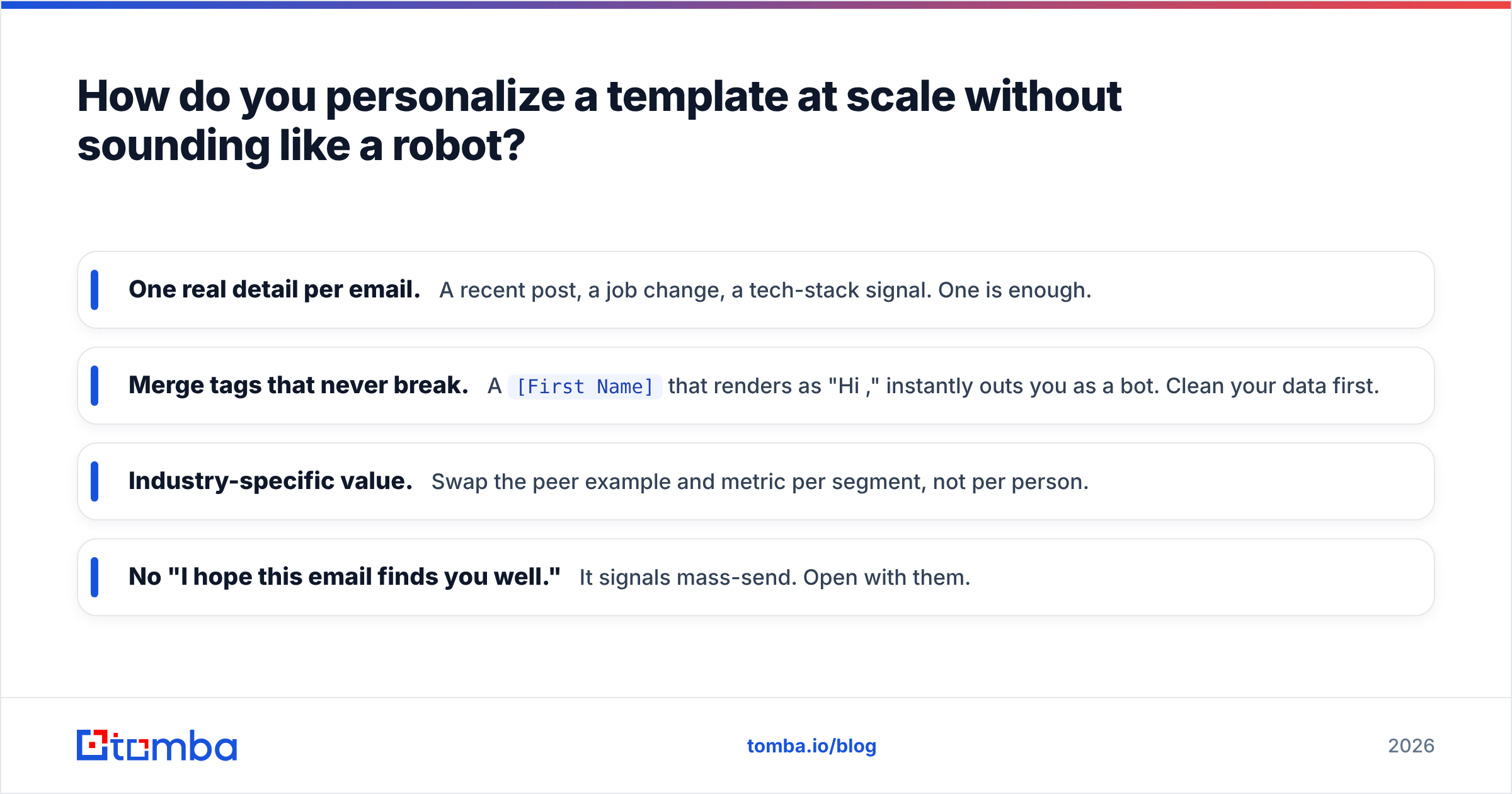
The mechanics that make this work:
- One real detail per email. A recent post, a job change, a tech-stack signal. One is enough.
- Merge tags that never break. A
[First Name]that renders as "Hi ," instantly outs you as a bot. Clean your data first. - Industry-specific value. Swap the peer example and metric per segment, not per person.
- No "I hope this email finds you well." It signals mass-send. Open with them.
This is where most outbound dies, and it dies upstream of the copy. If your list is full of info@, role accounts, and guessed addresses, no amount of personalization survives contact. Pull verified, named contacts with a real email finder and run a domain search to map the actual people behind each target account before you write a single line.
)
What about subject lines and length?#
Lead with the subject line, because it decides whether anything else gets read. Keep it short, lowercase-friendly, and specific. Data from outreach platforms and HubSpot's own research consistently shows that shorter, personalized subject lines outperform clever ones. If you're stuck, generate and A/B options with a subject line generator, then test them.
Length rules that hold up in 2026:
- Body: 50–120 words. If it scrolls on mobile, cut it.
- Subject: under 40 characters so it doesn't truncate.
- Paragraphs: 1–2 sentences each. White space is your friend.
- CTA: one sentence, one ask, zero calendar links in the first email.
A useful gut check from the team at HubSpot: if your email could have been sent to 500 people unchanged, it will perform like it was. Add the one line that proves you're talking to this person.
Why does deliverability decide whether your template ever gets a chance?#
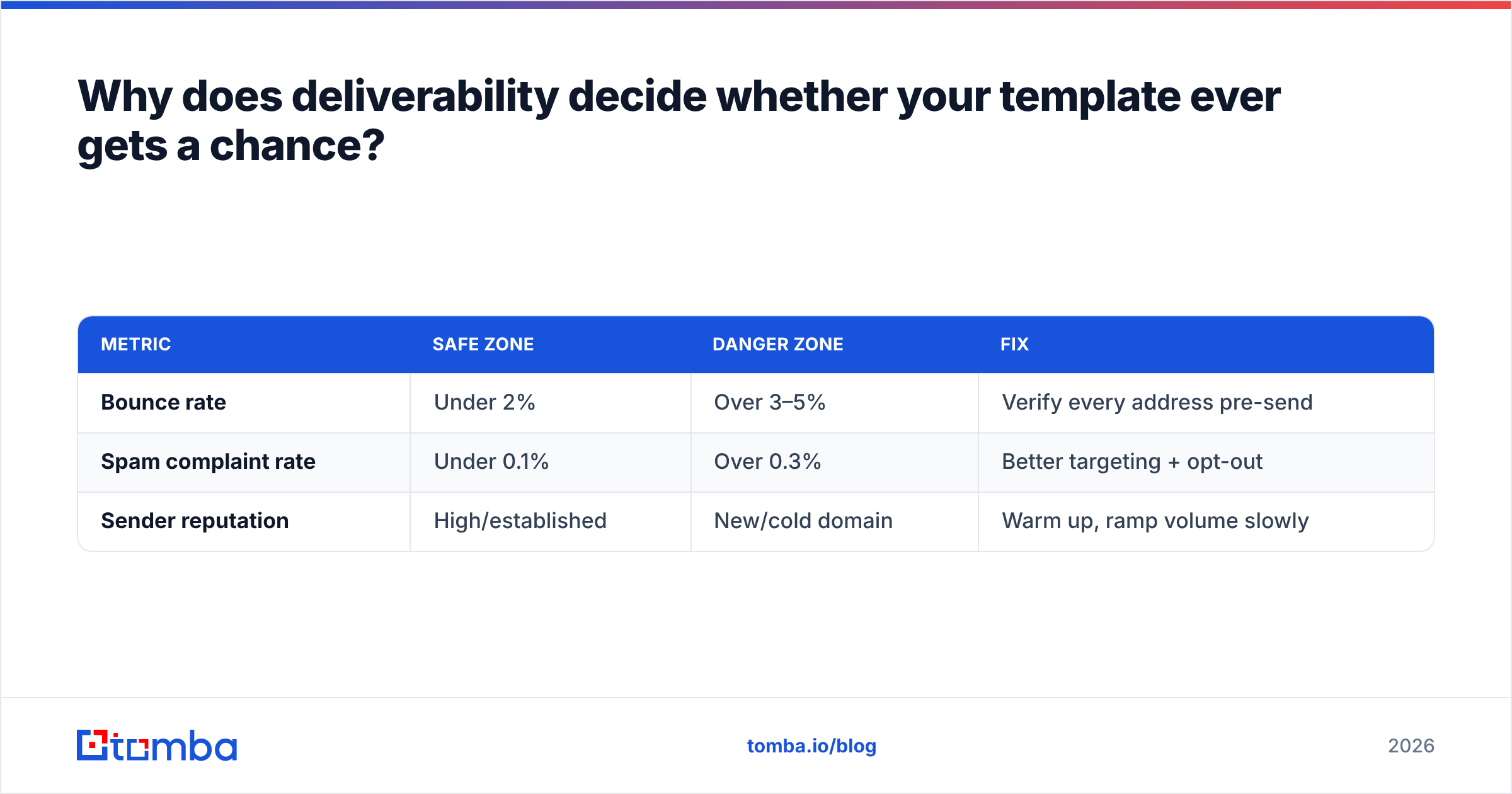
Because the best b2b cold email template on earth scores zero replies if it lands in spam — or bounces before delivery. Deliverability is the silent reply-rate killer, and it starts with list hygiene.
Three numbers to protect:
| Metric | Safe zone | Danger zone | Fix |
|---|---|---|---|
| Bounce rate | Under 2% | Over 3–5% | Verify every address pre-send |
| Spam complaint rate | Under 0.1% | Over 0.3% | Better targeting + opt-out |
| Sender reputation | High/established | New/cold domain | Warm up, ramp volume slowly |
Before any send, run your list through an email verifier to strip invalid and risky addresses. High bounce rates tell mailbox providers you're a spammer, and once your sender reputation tanks, even your warm replies stop landing. Authenticate your domain with SPF, DKIM, and DMARC — Google and Yahoo now effectively require it for bulk senders, and you can sanity-check records with a free SPF checker.
For a deeper dive into ramping a new sending domain safely, vendors like Instantly and the broader cold email community document warmup schedules worth following — but the foundation is always the same: clean data in, good reputation out.
What does a complete, ready-to-send example look like?#
Here's framework #4 (trigger event) fully filled in, so you can see the parts working together:
Subject: Congrats on the Series B
Hi Maria,
Congrats on the $40M round last week. Most RevOps leaders we work with scale headcount right after a raise — and data quality is usually the first thing that breaks.
We helped Acme keep their CRM 98% accurate while doubling their SDR team in one quarter.
Worth a 10-minute look at how they did it?
— Sam
Count it: 58 words, one trigger, one peer proof point with a number, one soft CTA. That's the whole game.
Common mistakes that sink B2B cold emails#
- Two or more CTAs. Choice creates friction. Ask for one thing.
- Talking about yourself first. Nobody opens an email hoping to read about your company.
- Unverified lists. Bounces destroy reputation faster than any single email helps.
- Walls of text. If it looks like work to read, it won't get read.
- No follow-up. Most replies come on touches 2–4, not touch 1. Build a short, polite sequence.
- Fake personalization. "I love what you're doing at [Company]" fools no one.
Final word: data first, template second#
The honest takeaway: spend more time on your list than on your copy. A mediocre template sent to 100 verified, well-targeted, decision-maker inboxes will beat a brilliant template sprayed at 1,000 scraped addresses every single time. Frameworks are commodities now — anyone can copy the nine above. Clean, verified contact data and genuine relevance are the real moat.
Start there. Use the Tomba Email Finder to pull verified, named decision-maker emails by name, company, or domain — then layer these templates on top of data that actually reaches the inbox. Check the Tomba pricing plans (free tier with 25 searches to start, Starter at $49/mo) and build your next campaign on contacts that won't bounce. Better data makes every template better.
// get started
Find, verify and enrich your first contacts today
Start on the free plan with 25 searches a month, then scale when your team is ready.
Free plan · No credit card required · GDPR & CCPA
// about the author