B2B Company Data in 2026: Sources, Accuracy & How to Use It
What B2B company data actually is, where it comes from, how to judge accuracy, and how to turn firmographic records into pipeline in 2026.
TL;DR
- B2B company data is the structured profile of a business — firmographics, technographics, contact records, and intent signals — that powers targeting, routing, and enrichment.
- The single biggest cost driver is not coverage, it's decay: roughly 2-3% of records go stale every month, so a 12-month-old list can be ~30% wrong.
- Accuracy depends on how data is collected (crawled, contributed, verified) far more than on how many records a vendor claims.
- Buy data for breadth, verify it for trust, and enrich it on demand so records are fresh at the moment of outreach.
- A lean stack — a verified company database plus a real-time enrichment API like Tomba — beats a giant static dump you bought once and never refreshed.
What is B2B company data?#
B2B company data is everything you know about an organization as a buying entity, stored in a structured, queryable form. Think of it like a nutrition label for a business: a single record tells you the company's size, location, industry, technology, and the people you can reach inside it — at a glance, in fields you can filter and sort.
It usually breaks into four layers:
- Firmographics — the company's "demographics": legal name, domain, headcount, revenue band, industry code (NAICS/SIC), founding year, and HQ location. This is the foundation every other layer attaches to.
- Technographics — the tools a company runs: CRM, cloud provider, analytics, payment stack. Knowing a prospect runs Shopify or Salesforce tells you whether your product even fits.
- Contact data — the people: names, titles, departments, professional email addresses, and phone numbers tied to the company domain.
- Intent and engagement signals — behavioral data suggesting a company is actively researching a category, such as content consumption spikes or hiring surges.
The reason this matters: every downstream go-to-market motion — lead scoring, territory routing, account-based targeting, personalization — is only as good as the company record underneath it. Garbage firmographics produce garbage segmentation, no matter how clever your sequence is.
Where does B2B company data come from?#
There are three collection methods, and the method tells you almost everything about quality. Most vendors blend all three, but the mix matters.
- Public web crawling. Bots scrape company websites, registries, job boards, and press releases. Cheap and broad, but it ages instantly — a crawl from last quarter already misses this quarter's funding round or layoff.
- Contributed / community data. Users connect inboxes or upload contacts, and the vendor aggregates them. Rich and current for connected accounts, but coverage is uneven and raises consent questions you need to vet.
- Verified / validated data. The vendor actively confirms records — pinging mail servers to confirm an address resolves, cross-checking firmographics against multiple independent sources. Slower and more expensive to produce, but it's the layer that earns trust.
The structured, multi-source approach is what separates a usable B2B database from a spreadsheet someone exported in 2024. If you want to see how this plays out in practice, vendors that publish their methodology — like Tomba's breakdown of where its data comes from — are easier to trust than ones that just quote a record count.
A useful gut check: ask any vendor "when was this record last verified?" If they can't answer per-record, you're buying a snapshot, not a live feed. Industry analysts like Gartner have flagged data quality — not data quantity — as the recurring failure point in go-to-market tech stacks.
What fields actually matter in a company record?#
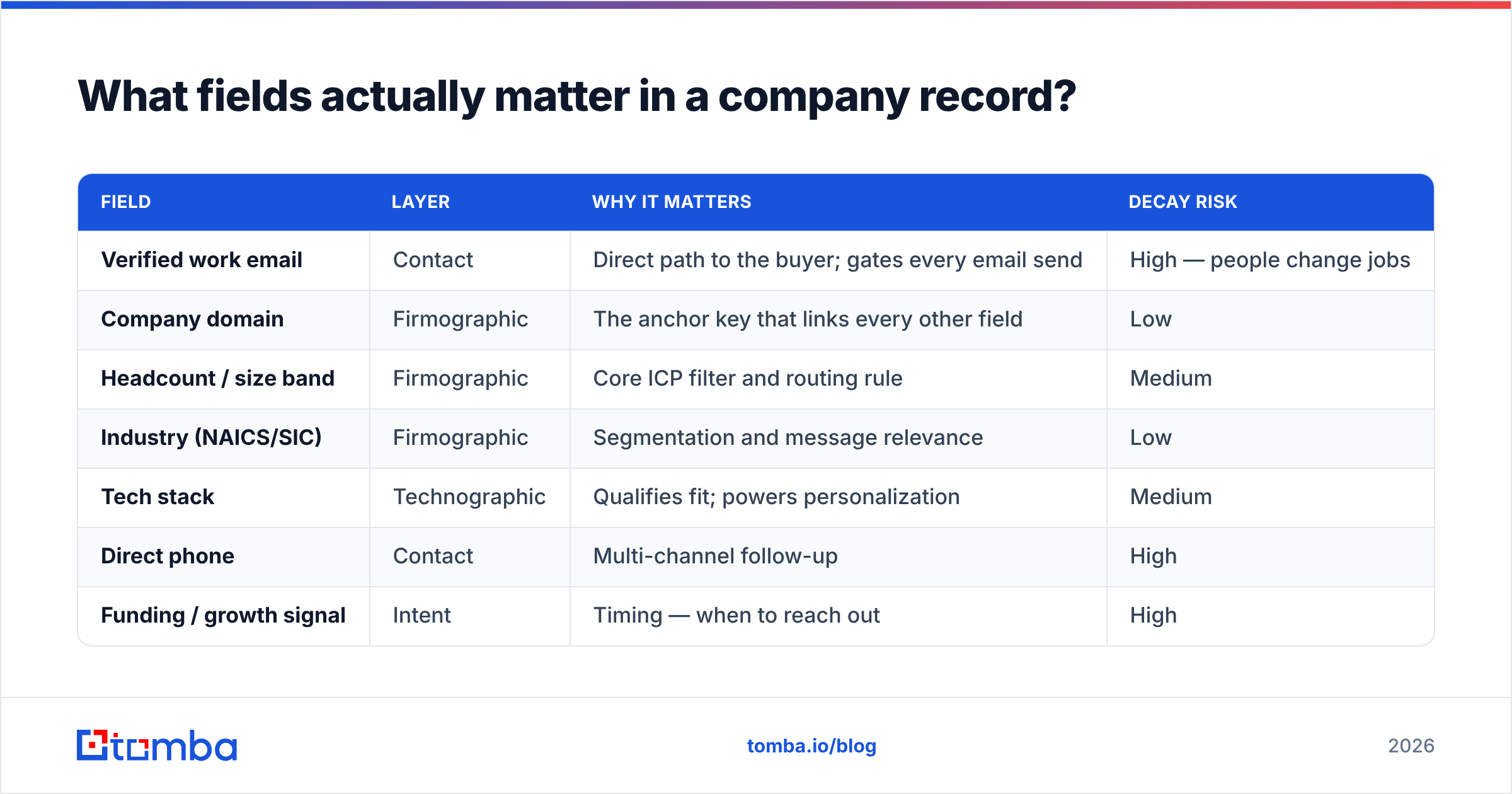
Not all fields earn their place. Here's how the common ones rank by practical impact on a typical outbound or ABM motion.
| Field | Layer | Why it matters | Decay risk |
|---|---|---|---|
| Verified work email | Contact | Direct path to the buyer; gates every email send | High — people change jobs |
| Company domain | Firmographic | The anchor key that links every other field | Low |
| Headcount / size band | Firmographic | Core ICP filter and routing rule | Medium |
| Industry (NAICS/SIC) | Firmographic | Segmentation and message relevance | Low |
| Tech stack | Technographic | Qualifies fit; powers personalization | Medium |
| Direct phone | Contact | Multi-channel follow-up | High |
| Funding / growth signal | Intent | Timing — when to reach out | High |
| HQ location | Firmographic | Territory, timezone, compliance | Low |
The takeaway: the highest-value fields (verified email, direct phone, funding signals) are also the fastest to decay. That's the core tension in this whole category — the data you most want to act on is the data most likely to be wrong by the time you use it.
This is exactly why a static purchase underperforms. You want the durable firmographic skeleton stored, and the volatile contact layer refreshed at the moment of outreach through contact enrichment rather than baked into a file months ago.
How accurate is B2B company data, really?#
Short answer: less accurate than every vendor's homepage claims, and it gets worse every month you don't touch it.
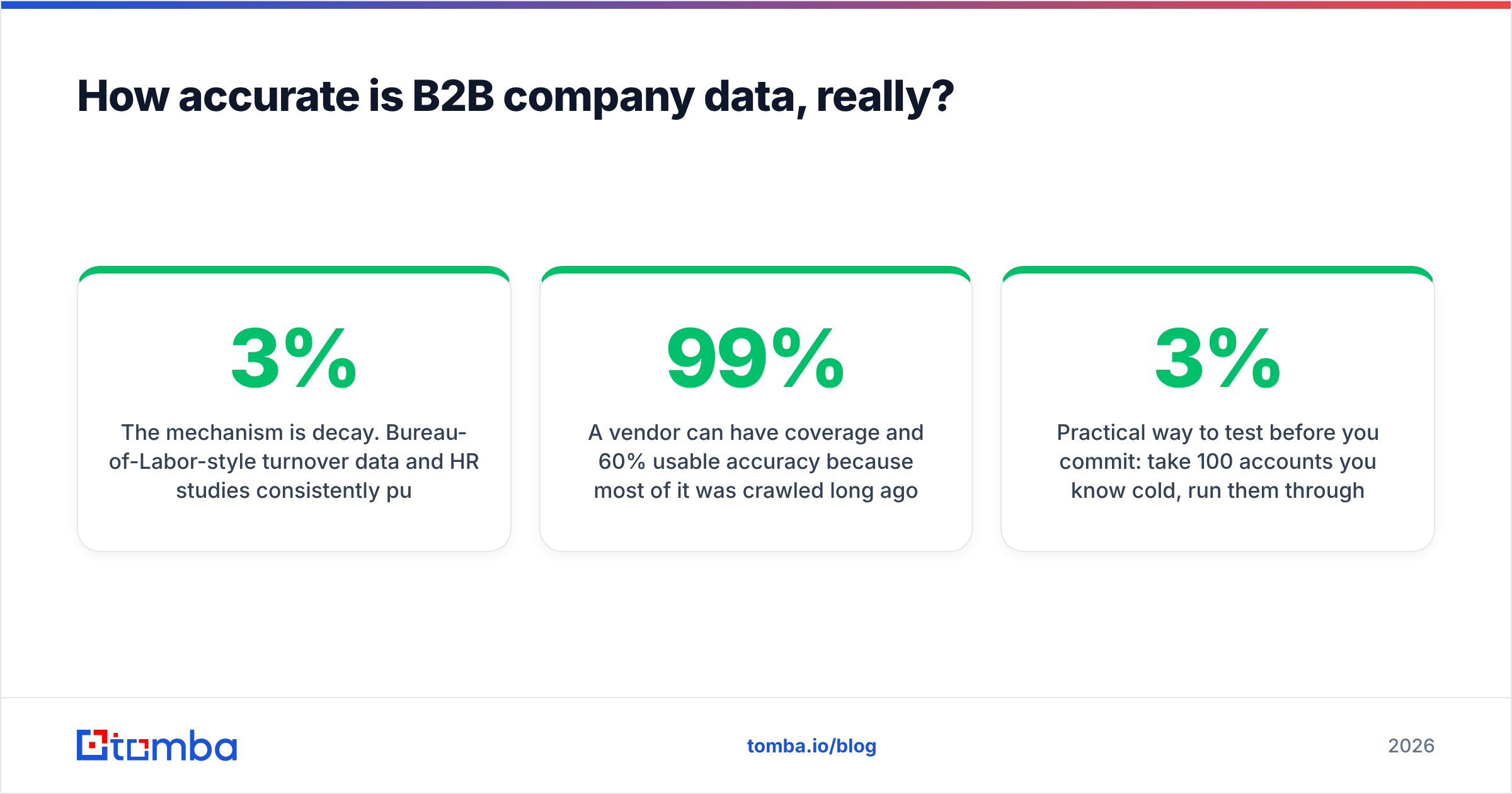
The mechanism is decay. Bureau-of-Labor-style turnover data and HR studies consistently put B2B contact churn at roughly 2-3% per month — people switch jobs, companies rebrand, get acquired, or shut down. Compound that and a database left untouched for a year is wrong about a quarter to a third of its contact records, even if it was 95% accurate on day one.
So "accuracy" is really two numbers you should ask about separately:
- Coverage — what fraction of your target accounts the vendor has any record for at all.
- Verification freshness — what fraction of those records were confirmed recently, and how.
A vendor can have 99% coverage and 60% usable accuracy because most of it was crawled long ago. Conversely, a smaller but continuously verified set can be far more valuable per record. When you're comparing options, weigh the data accuracy methodology over the headline record count every time.
Practical way to test before you commit: take 100 accounts you know cold, run them through a free tier or trial, and manually check 25 of the returned records. Bounce rate on emails is the cleanest proxy — under 3% means the verification layer is doing its job; double digits means you're buying a snapshot.
How do the main types of data sources compare?#
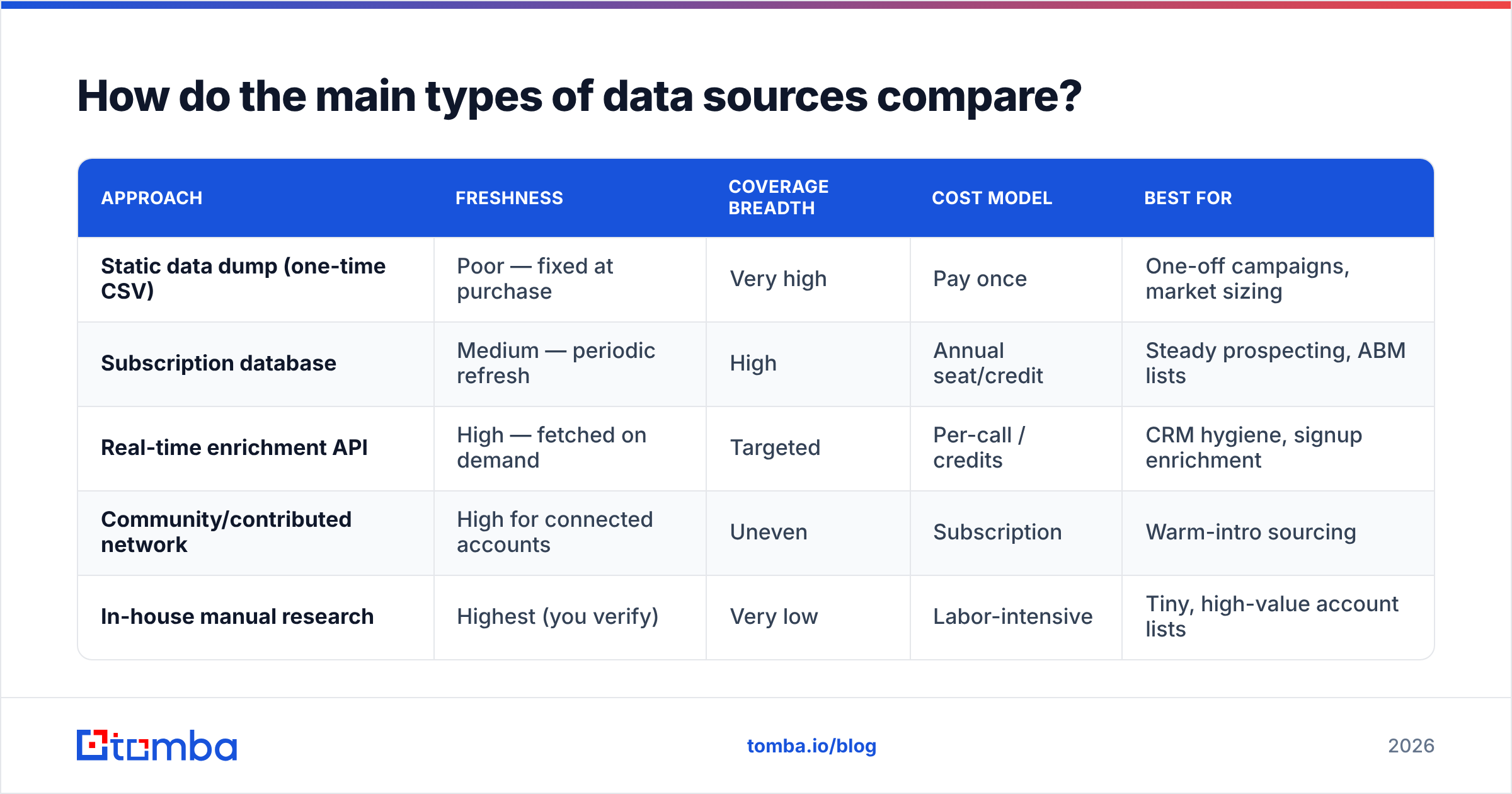
Most teams don't buy "a database" anymore — they assemble a stack. Here's how the building blocks stack up on the tradeoffs that actually matter.
| Approach | Freshness | Coverage breadth | Cost model | Best for |
|---|---|---|---|---|
| Static data dump (one-time CSV) | Poor — fixed at purchase | Very high | Pay once | One-off campaigns, market sizing |
| Subscription database | Medium — periodic refresh | High | Annual seat/credit | Steady prospecting, ABM lists |
| Real-time enrichment API | High — fetched on demand | Targeted | Per-call / credits | CRM hygiene, signup enrichment |
| Community/contributed network | High for connected accounts | Uneven | Subscription | Warm-intro sourcing |
| In-house manual research | Highest (you verify) | Very low | Labor-intensive | Tiny, high-value account lists |
No single column wins outright, and that's the point. The strongest 2026 setups pair a subscription database for breadth with a real-time enrichment API for freshness — buy the skeleton once, refresh the volatile fields on every use. That hybrid is consistently cheaper per usable record than either extreme alone.
How do you turn company data into revenue?#
Data sitting in a table earns nothing. The value shows up only when it triggers an action. Here's the operational loop that separates teams who have data from teams who use it.
- Define the ICP in fields, not adjectives. "Mid-market SaaS in North America" becomes
headcount 50-500 AND industry=software AND country IN (US, CA). If you can't express your ICP as filters, your data can't either. - Pull the matching accounts from your B2B database and dedupe against what's already in the CRM so reps don't double-touch.
- Enrich on the way in. As records enter a sequence or land from a web form, fire a real-time call to fill the verified email and phone — this is where the Tomba API replaces stale stored fields with confirmed ones.
- Verify before you send. Run addresses through an email verifier so your bounce rate stays low and your sender reputation survives.
- Route and personalize using technographic and firmographic fields — the tech stack line that powers a relevant first sentence.
- Feed outcomes back. Bounces, replies, and meetings are themselves data; loop them back so your scoring and source-quality judgments improve.
That feedback loop is the difference between a database that decays and a system that compounds. Each cycle teaches you which sources actually convert, so your spend concentrates where the response rate is highest.
For teams that live in spreadsheets or no-code tools, you don't even need engineering to run this loop — the same enrichment is available through a Google Sheets add-on and a Chrome extension, so a single ops person can keep records fresh without a pipeline build.
What should you look for when buying B2B company data?#
Cut through the marketing with a short checklist. Before you sign anything, confirm:
- Verification method, per record. Can they tell you how and when each record was confirmed? Real-time SMTP-level verification beats "we refresh quarterly."
- Compliance posture. GDPR/CCPA handling, opt-out mechanics, and lawful basis for processing. Reputable platforms document this; cross-check vendor claims against neutral review sites like G2.
- Coverage in your segment. Global record counts are a vanity metric. Test against your actual target accounts.
- Delivery flexibility. Can you get data by API, bulk export, CRM sync, and browser tool — or only one rigid format? Flexibility is what lets the data reach the moment of action.
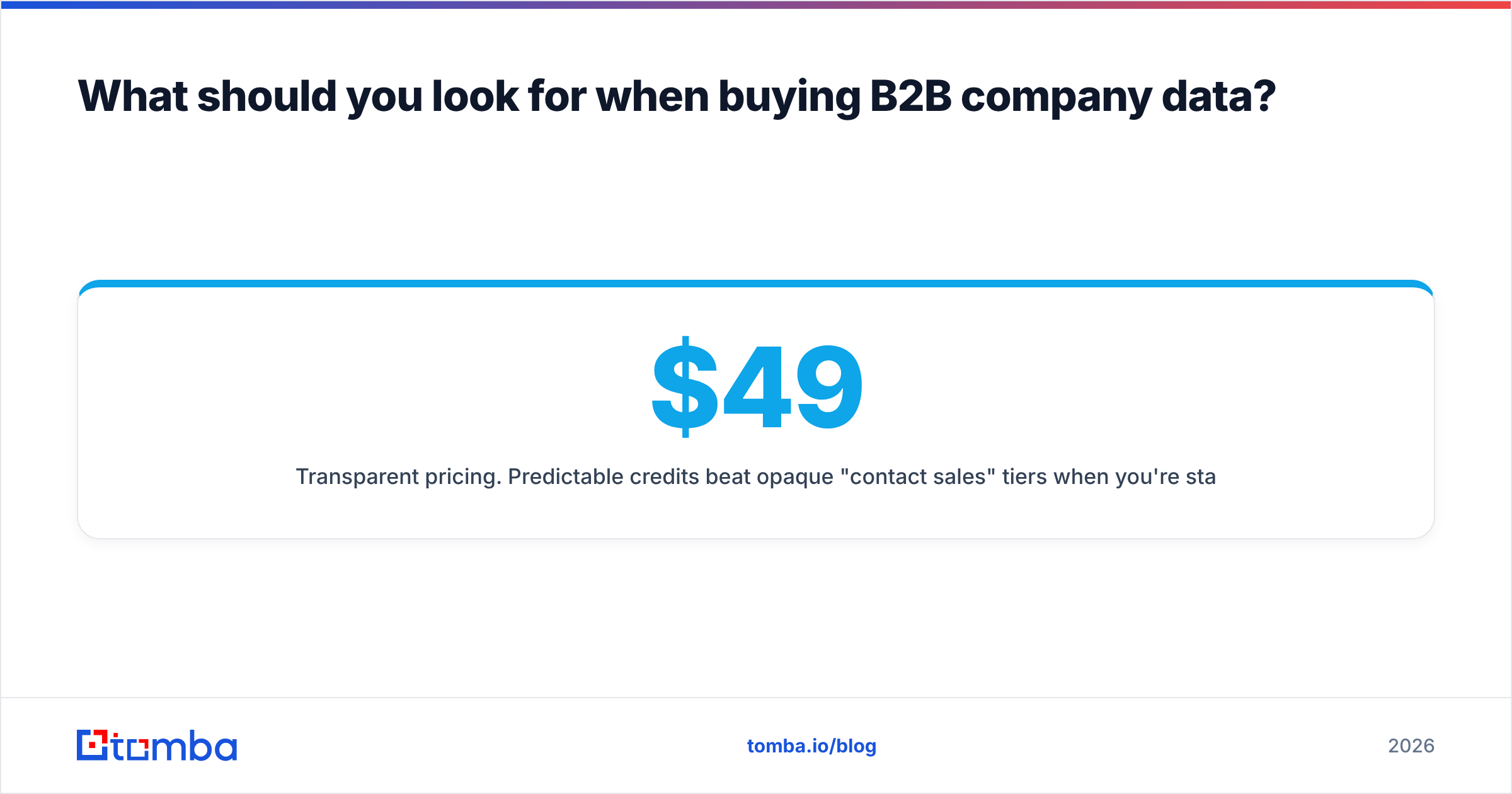
- Transparent pricing. Predictable credits beat opaque "contact sales" tiers when you're starting out. Tomba publishes its pricing openly — Free (25 searches/mo), Starter $49/mo, Growth $99/mo, and Pro $249/mo — so you can model cost per record before committing.
- A real free tier. You should be able to test accuracy on your own list before you pay. If you can't trial it, treat the accuracy claims as unproven.
Run the bounce-rate test from earlier against two or three finalists. The numbers will tell you more in an afternoon than any sales deck.
Is buying a giant database still worth it in 2026?#
Usually not as your primary play. The static megabase made sense when data aged slowly and outreach was a numbers game. In 2026, with decay rates where they are and inbox providers punishing bad sends, a stale list is an active liability — every bounce dents your sender reputation and shrinks the inbox you can reach.
The better default: keep a focused, verified database for breadth, and lean on real-time enrichment so the fields you act on are confirmed the day you use them. You spend less, you bounce less, and your reps stop chasing people who left 14 months ago. Quality of action beats quantity of rows, every quarter.
The bottom line#
B2B company data is the operating system for go-to-market — but only when it's fresh at the moment you act on it. Get the firmographic skeleton from a trustworthy database, verify the volatile contact layer continuously, and wire enrichment into the exact step where a record turns into outreach.
If you want the contact layer to be right on the day you send, start with the Tomba Email Finder. Find verified professional emails by name, company, or domain, plug them straight into your CRM, Sheets, or sequence through the Tomba API, and keep your bounce rate — and your reputation — clean. Spin up the free tier with 25 searches and test it against your own account list before you spend a dollar.
// get started
Find, verify and enrich your first contacts today
Start on the free plan with 25 searches a month, then scale when your team is ready.
Free plan · No credit card required · GDPR & CCPA
// about the author