B2B Compliance in 2026: GDPR, CAN-SPAM & Data Rules Guide
A practical 2026 guide to B2B compliance: GDPR, CAN-SPAM, CASL and CCPA rules for outreach, plus how to source, verify and use contact data without legal risk.
B2B compliance is the set of legal and ethical rules that govern how you collect, store, and use business contact data for sales and marketing. Get it wrong and you risk fines, blocklists, and a wrecked sender reputation. Get it right and you build a durable outbound engine that regulators, inboxes, and prospects all trust.
This guide breaks down the laws that actually apply to B2B outreach in 2026, where the common myths are, and how to keep your data pipeline clean from the first lookup to the final follow-up.
TL;DR#
- B2B compliance is not optional in 2026. GDPR, CAN-SPAM, CASL, PECR, and CCPA/CPRA all touch business outreach, and enforcement is rising.
- "It's just B2B" is not a legal exemption. A named person's work email is still personal data under GDPR and CASL.
- Legitimate interest, not consent, is usually your basis for cold B2B email in the EU/UK — but you must document it and offer easy opt-out.
- Clean data is compliant data. Verifying contacts and tracking source provenance reduces both legal and deliverability risk.
- Process beats panic. A documented workflow for sourcing, verifying, suppressing, and honoring opt-outs is what auditors and ISPs both want to see.
What is B2B compliance?#
B2B compliance is the practice of running your sales and marketing data operations inside the boundaries of privacy law, anti-spam law, and platform terms of service. Think of it like food safety in a restaurant: customers never see your kitchen, but the rules about sourcing, labeling, and handling protect everyone — and one violation can shut you down.
In practice, B2B compliance covers four things:
- Lawful sourcing — where your contact data comes from and whether you had a legal right to collect it.
- Transparency — telling people what data you hold and why, usually through a privacy notice.
- Lawful use — only contacting people for purposes that the law and your stated basis allow.
- Rights and suppression — honoring opt-outs, deletion requests, and do-not-contact lists promptly.
The hard part is that B2B data feels low-risk. A work email like jane@acme.com looks like company property, not personal information. Regulators disagree, and that gap is where most teams get into trouble.
Which laws govern B2B outreach in 2026?#
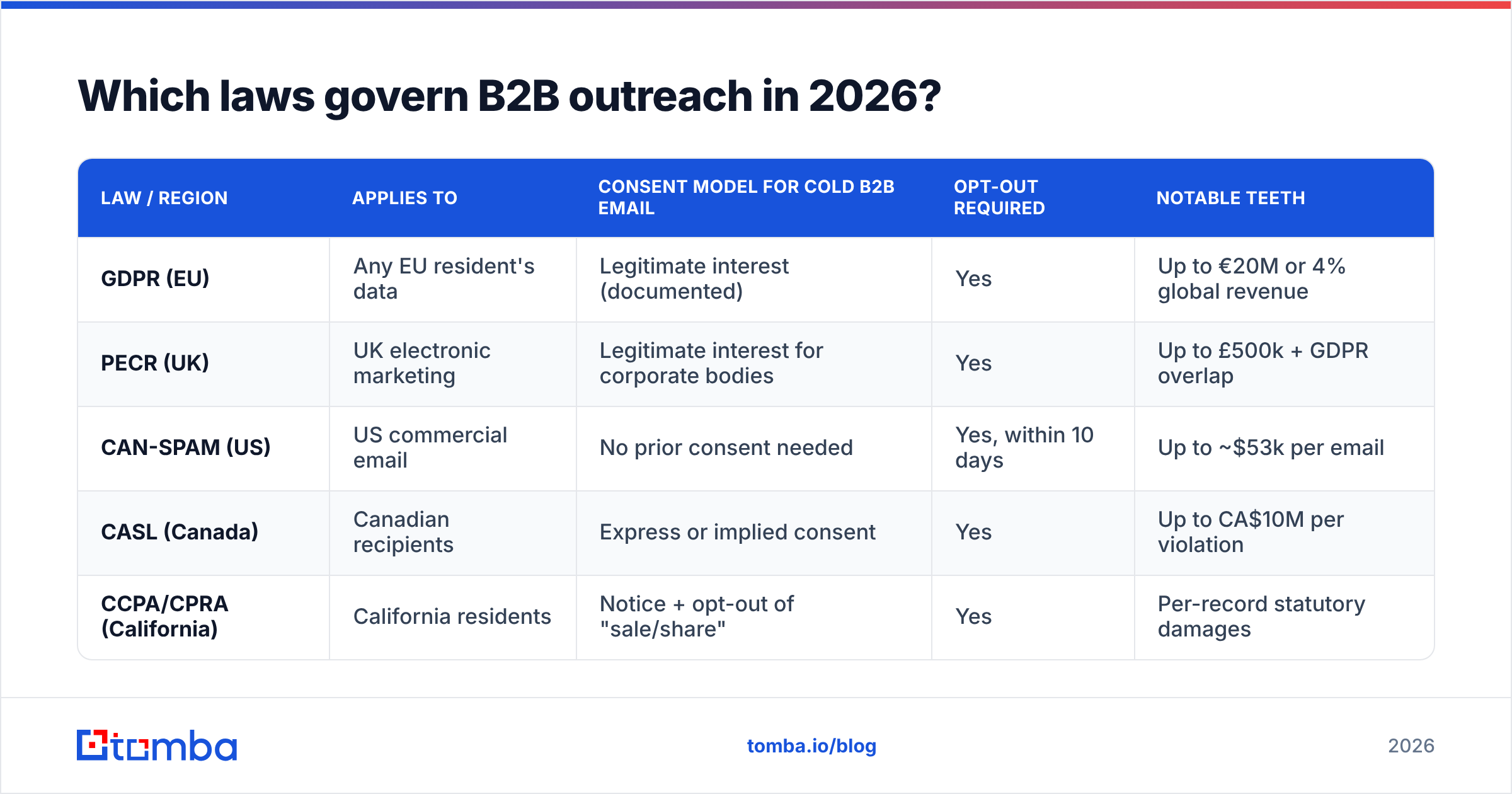
Several overlapping regimes apply depending on where your prospect sits, not where you sit. If you sell across borders, assume the strictest rule wins.
| Law / Region | Applies to | Consent model for cold B2B email | Opt-out required | Notable teeth |
|---|---|---|---|---|
| GDPR (EU) | Any EU resident's data | Legitimate interest (documented) | Yes | Up to €20M or 4% global revenue |
| PECR (UK) | UK electronic marketing | Legitimate interest for corporate bodies | Yes | Up to £500k + GDPR overlap |
| CAN-SPAM (US) | US commercial email | No prior consent needed | Yes, within 10 days | Up to ~$53k per email |
| CASL (Canada) | Canadian recipients | Express or implied consent | Yes | Up to CA$10M per violation |
| CCPA/CPRA (California) | California residents | Notice + opt-out of "sale/share" | Yes | Per-record statutory damages |
A few takeaways that trip people up:
- The US is the most permissive but not a free-for-all. CAN-SPAM lets you cold-email without prior consent, but you must use accurate headers, a real physical address, a clear opt-out, and you must honor it fast. The FTC's CAN-SPAM guidance spells out the seven main rules.
- The EU and UK lean on legitimate interest. You generally don't need prior consent to email a relevant business contact, but you must run and record a legitimate-interest assessment and give an easy way out. The official GDPR text is the source of record.
- Canada is the strictest. CASL requires consent (express or implied) before you send, which makes documented data provenance essential.
Is cold email legal under B2B compliance rules?#
Yes — cold B2B email is legal in every major market in 2026, but only when you follow that market's rules. The legality hinges less on "did they say yes" and more on "can you justify the contact and let them leave easily."
A compliant cold email almost always has these traits:
- A relevant reason to contact this specific person. Emailing a VP of Sales about a sales tool is defensible legitimate interest. Emailing the same person about unrelated crypto is not.
- Accurate sender identity. Real company, real "from" name, real reply path, no deceptive subject lines.
- A working, honored opt-out. One click, no login wall, processed quickly, and never re-contacted.
- A physical mailing address in the footer (a CAN-SPAM requirement that also boosts trust).
- A documented basis and data source. If a regulator asks "where did you get this?", you have an answer.
Where teams cross the line: buying scraped lists with no provenance, hiding the opt-out, emailing personal Gmail addresses as if they were business contacts, or ignoring deletion requests. Those are the behaviors that turn a legal channel into a liability.
How do you collect and use B2B data compliantly?#
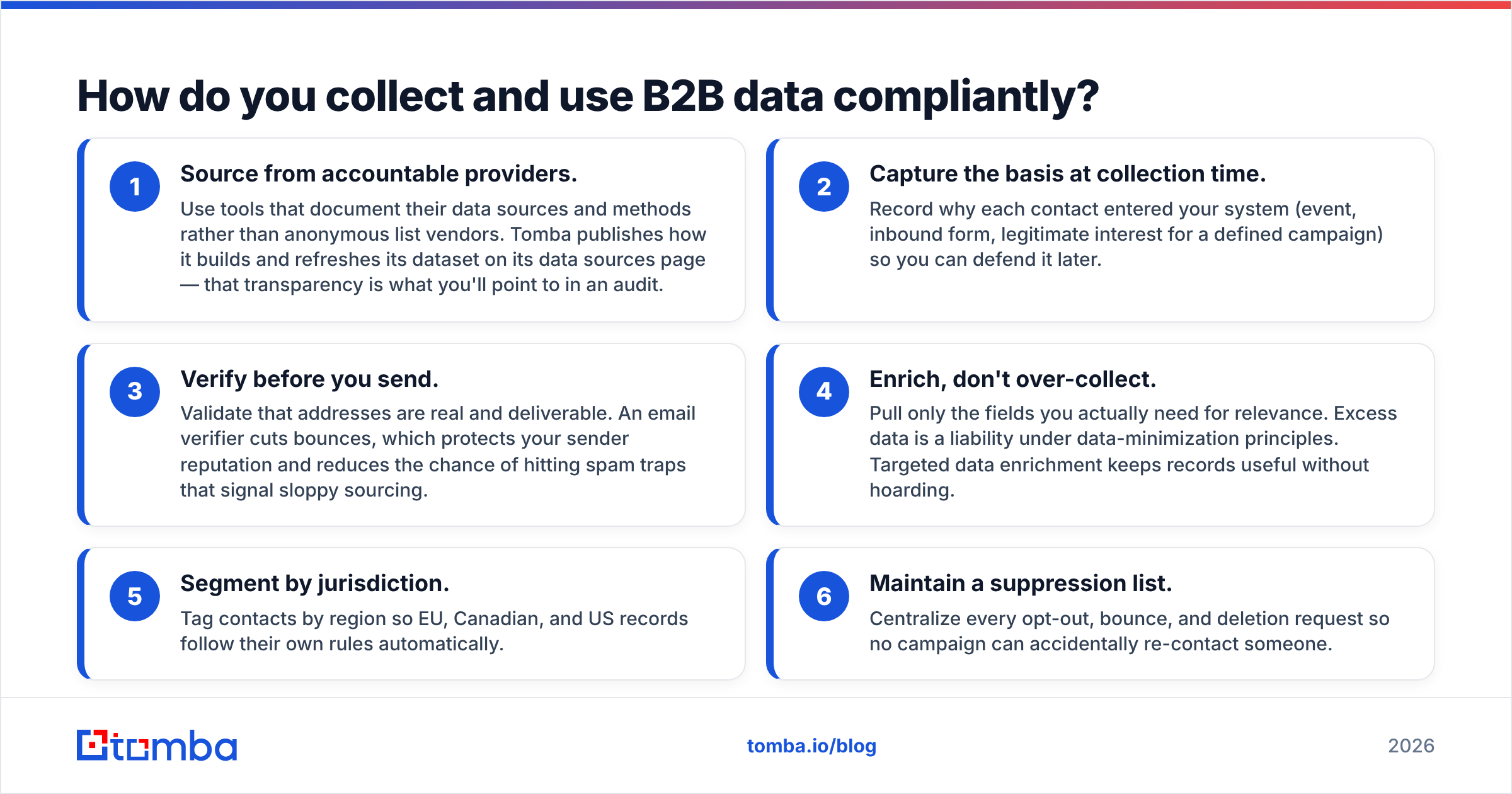
Compliant data collection is mostly about provenance and accuracy. You want to know where every contact came from and confirm it's real before you use it. Here's the framework most mature teams follow:
- Source from accountable providers. Use tools that document their data sources and methods rather than anonymous list vendors. Tomba publishes how it builds and refreshes its dataset on its data sources page — that transparency is what you'll point to in an audit.
- Capture the basis at collection time. Record why each contact entered your system (event, inbound form, legitimate interest for a defined campaign) so you can defend it later.
- Verify before you send. Validate that addresses are real and deliverable. An email verifier cuts bounces, which protects your sender reputation and reduces the chance of hitting spam traps that signal sloppy sourcing.
- Enrich, don't over-collect. Pull only the fields you actually need for relevance. Excess data is a liability under data-minimization principles. Targeted data enrichment keeps records useful without hoarding.
- Segment by jurisdiction. Tag contacts by region so EU, Canadian, and US records follow their own rules automatically.
- Maintain a suppression list. Centralize every opt-out, bounce, and deletion request so no campaign can accidentally re-contact someone.
Clean inputs do double duty: they keep you legal and they keep you out of the spam folder. Poor list hygiene is one of the fastest paths to bad email deliverability, because mailbox providers read high bounce and complaint rates as a signal that your sourcing isn't trustworthy.
What does a compliant outreach workflow look like?#
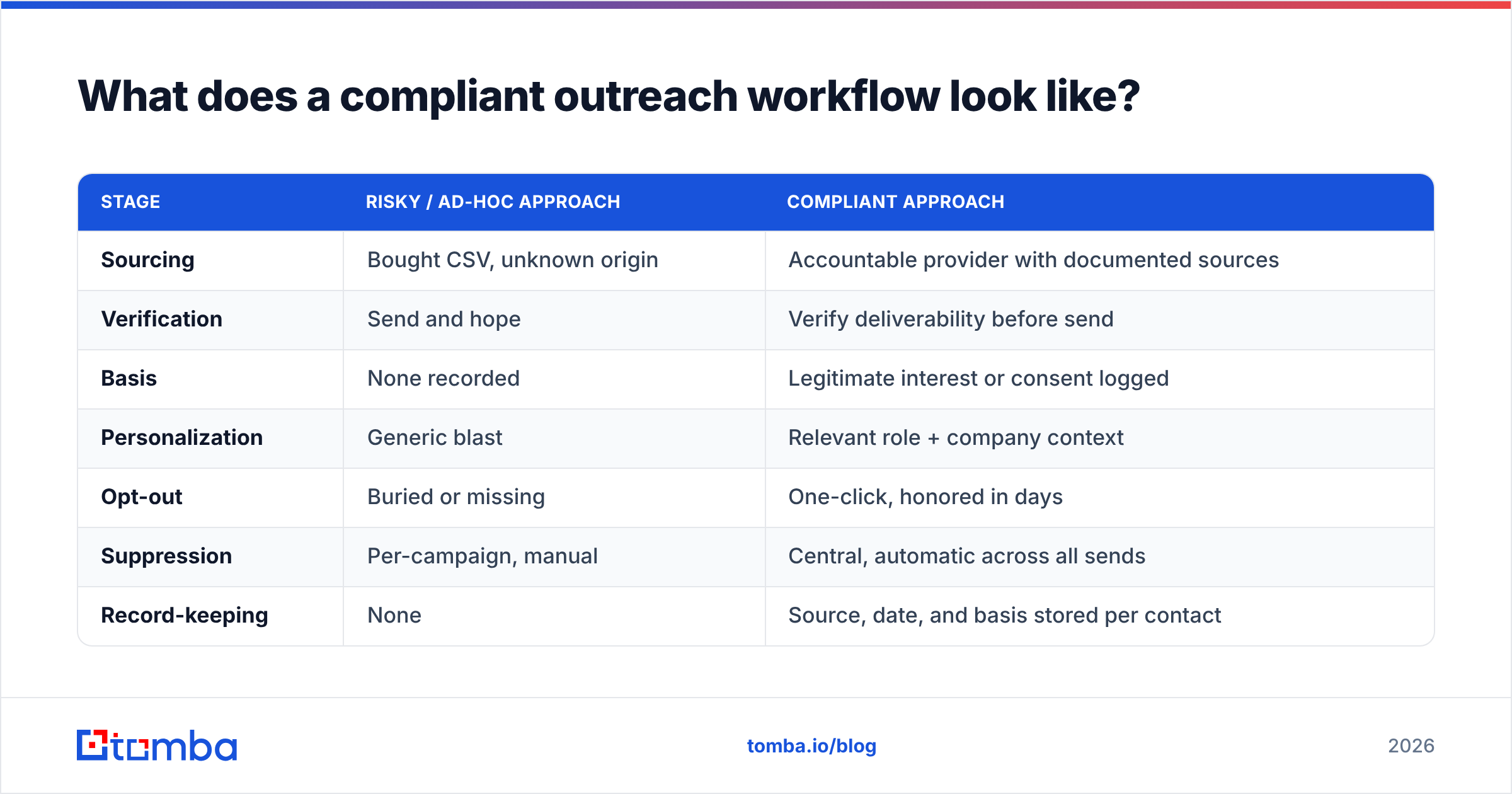
The difference between a risky program and a defensible one is rarely a single tool — it's a repeatable process. Here's how a compliant workflow compares to the ad-hoc approach most teams start with.
| Stage | Risky / ad-hoc approach | Compliant approach |
|---|---|---|
| Sourcing | Bought CSV, unknown origin | Accountable provider with documented sources |
| Verification | Send and hope | Verify deliverability before send |
| Basis | None recorded | Legitimate interest or consent logged |
| Personalization | Generic blast | Relevant role + company context |
| Opt-out | Buried or missing | One-click, honored in days |
| Suppression | Per-campaign, manual | Central, automatic across all sends |
| Record-keeping | None | Source, date, and basis stored per contact |
You don't need enterprise software to run this. A connected stack — your data tool, your verifier, your CRM, and a suppression list — covers most of it. The key is that each stage is documented and each contact carries its history with it.
For a deeper look at the trade-offs between major data vendors, Gartner's market research on sales tech is a useful neutral reference when you're building the case for switching providers.
What are the most common B2B compliance mistakes?#
Most violations aren't malicious — they're the result of speed beating process. These are the patterns that get teams in trouble:
- Treating "B2B" as an exemption. It isn't. A named person at a company is still an identifiable individual under GDPR and CASL.
- Buying lists with no provenance. If you can't say where data came from, you can't defend it, and you've likely inherited spam traps and dead addresses.
- Ignoring jurisdiction. Applying US rules to EU or Canadian contacts is one of the most common — and expensive — mistakes.
- Slow or broken opt-outs. An unsubscribe link that 404s or takes weeks to process is a direct violation under CAN-SPAM and GDPR alike.
- Skipping verification. High bounce rates don't just hurt deliverability; they suggest to regulators and ISPs that your list is poorly maintained.
- No deletion path. GDPR and CCPA both give people the right to be forgotten. If you can't delete a record on request, you have a gap.
The fix for nearly all of these is the same: document your sources, verify your data, segment by region, and centralize suppression. Once those four habits are in place, compliance stops being a fire drill and becomes a property of your pipeline.
How does Tomba support compliant B2B data?#
Tomba is built around accountable, verifiable data — the foundation of any compliant program. Instead of opaque list dumps, it gives you transparent sourcing, built-in verification, and the tooling to keep records clean as they age.
Here's how the pieces map to compliance:
- Transparent sourcing through documented data sources, so you can answer "where did this come from?"
- Built-in verification so addresses are confirmed deliverable before they ever enter a campaign.
- Targeted enrichment that respects data minimization by pulling only the fields you need.
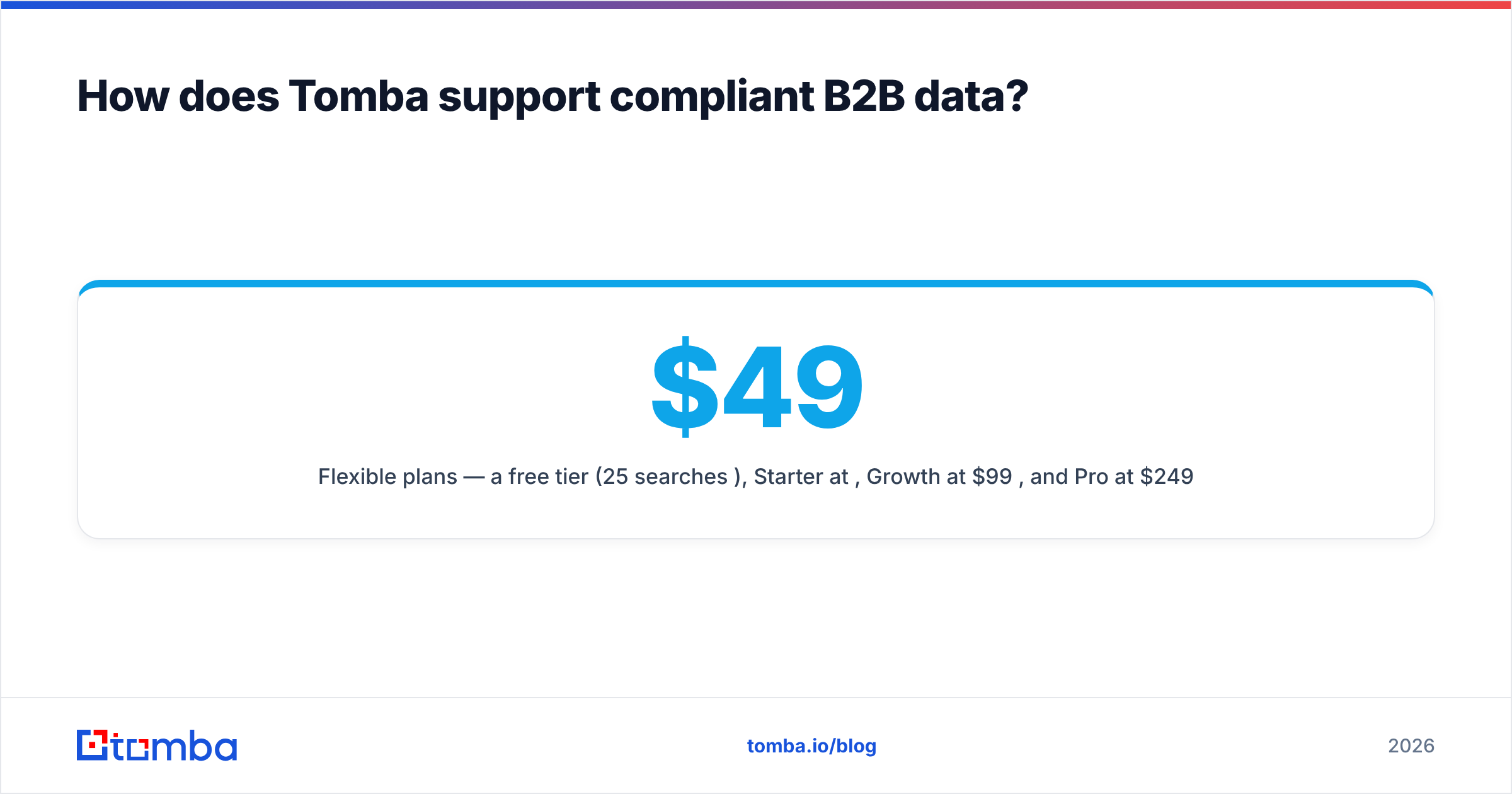
- Flexible plans — a free tier (25 searches/mo), Starter at $49/mo, Growth at $99/mo, and Pro at $249/mo — so you can scale a clean pipeline without overbuying. See full Tomba pricing for details.
None of this replaces legal advice — your privacy notice, your legitimate-interest assessments, and your retention policy are still your responsibility. But the data layer is where most programs either earn or lose their compliance footing, and that's exactly the layer Tomba is designed to keep clean.
The bottom line#
B2B compliance in 2026 is less about memorizing every statute and more about running a disciplined data process: source accountably, verify before you send, document your basis, segment by region, and honor every opt-out fast. Teams that bake those habits into their workflow get the upside of outbound — pipeline and revenue — without the regulatory and deliverability downside.
Start where the risk is highest: your data. The Tomba Email Finder gives you accurate, verifiable contact data with transparent sourcing, so every email you find is one you can stand behind. Spin up the free tier, find your first 25 contacts, and build an outbound engine that's compliant by design — not by luck.
// get started
Find, verify and enrich your first contacts today
Start on the free plan with 25 searches a month, then scale when your team is ready.
Free plan · No credit card required · GDPR & CCPA
// about the author