B2B Cost Per Lead in 2026: Benchmarks, Formula & How to Cut It
What is a healthy B2B cost per lead in 2026? See real benchmarks by channel, the exact CPL formula, and seven tactics to cut your cost per lead fast.
B2B Cost Per Lead in 2026: Benchmarks, Formula & How to Cut It
If your pipeline math feels off, cost per lead is usually where the leak starts. You pour budget into ads, content, and SDRs, and somewhere between spend and a booked meeting the numbers stop adding up. This guide fixes that. It gives you current benchmarks, the formula, and concrete ways to lower your B2B cost per lead without flooding your CRM with junk.
TL;DR#
- B2B cost per lead (CPL) is total marketing and sales spend divided by the number of leads generated in a period. In 2026, blended B2B CPL commonly lands between $40 and $300+, depending heavily on channel and deal size.
- Channel matters more than industry. SEO and referrals routinely beat paid search and paid social on cost, but they scale slower.
- A low CPL is not the goal. A low cost per qualified lead (CPQL) that converts to revenue is. Cheap leads that never close are the most expensive thing you can buy.
- The fastest CPL wins come from data quality — verified contacts, less wasted ad spend, and fewer SDR hours chasing bounced emails.
- Tools like a precise email finder move spend away from broad paid channels toward targeted, lower-cost outbound.
What is B2B cost per lead?#
Cost per lead is what you pay, on average, to generate a single lead. Think of it like the price tag on a fishing trip: it is not the cost of one fish you keep, it is the full cost of the boat, bait, and fuel divided by every fish that landed in the net — keepers and throwbacks alike.
In B2B, a "lead" usually means someone who raised a hand: filled a form, booked a demo, downloaded a gated asset, or replied to outbound. Because B2B deals are larger and sales cycles longer than B2C, B2B CPL is almost always higher than consumer benchmarks. A $120 lead can be a bargain when the average contract is $25,000.
CPL sits upstream of nearly every other go-to-market metric. It feeds your customer acquisition cost (CAC), your marketing qualified lead economics, and ultimately your payback period. Get CPL wrong and every downstream forecast inherits the error.
How do you calculate cost per lead?#
The formula is simple. Discipline about what goes into it is the hard part.
Cost Per Lead = Total Spend ÷ Total Leads Generated
"Total spend" should include more than ad budget. A defensible CPL accounts for:
- Media spend — paid search, paid social, display, sponsorships.
- Content and creative — writers, designers, agencies, tools.
- Software — your CRM, automation platform, data and enrichment tools.
- People — the loaded cost of the marketers and SDRs running the programs.
- Overhead allocation — a fair slice of shared costs if you want CPL to reflect reality.
Here is a worked example. Say in Q1 you spent $48,000 across all of the above and generated 600 leads:
$48,000 ÷ 600 = $80 cost per lead
Now split it by quality. If only 180 of those were sales-accepted, your cost per qualified lead is $48,000 ÷ 180 = $267. That gap between $80 and $267 is the number that should keep you up at night, not the headline CPL.
What is a good B2B cost per lead in 2026?#
There is no single "good" number — there is a good number for your channel and deal size. A $250 CPL is excellent for enterprise software and terrible for a $99/month SaaS tool. Use benchmarks as a sanity check, not a target.
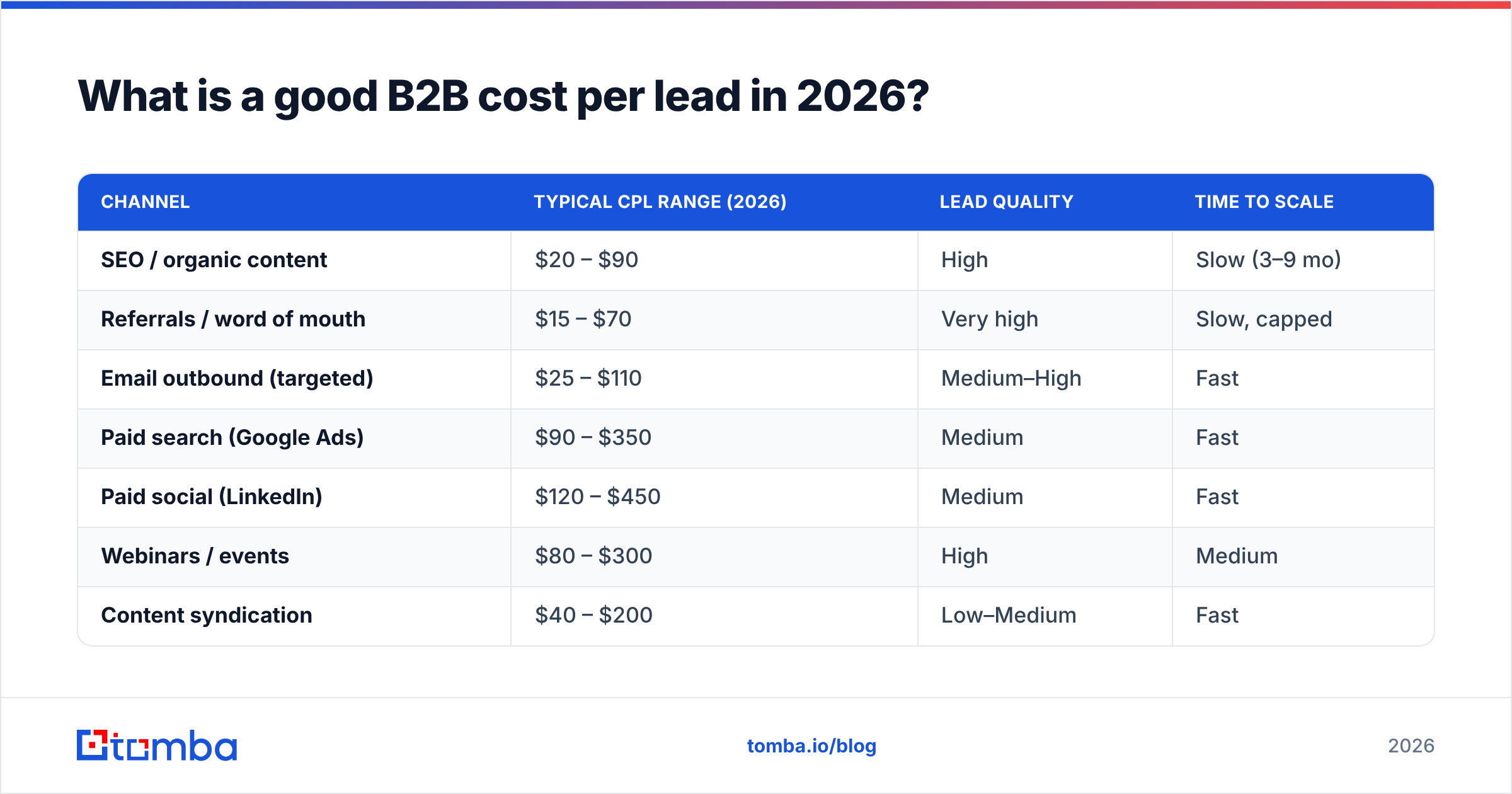
The table below reflects commonly cited 2026 ranges for blended B2B programs. Treat them as directional; your mileage varies with audience, geography, and offer.
| Channel | Typical CPL range (2026) | Lead quality | Time to scale |
|---|---|---|---|
| SEO / organic content | $20 – $90 | High | Slow (3–9 mo) |
| Referrals / word of mouth | $15 – $70 | Very high | Slow, capped |
| Email outbound (targeted) | $25 – $110 | Medium–High | Fast |
| Paid search (Google Ads) | $90 – $350 | Medium | Fast |
| Paid social (LinkedIn) | $120 – $450 | Medium | Fast |
| Webinars / events | $80 – $300 | High | Medium |
| Content syndication | $40 – $200 | Low–Medium | Fast |
Two patterns hold across almost every B2B company. First, owned channels (SEO, email, referrals) beat rented channels (paid) on cost but take longer to ramp. Second, the cheapest channel rarely produces the best-fit leads — content syndication is cheap and often low-intent, while LinkedIn is expensive and often high-intent. The right portfolio mixes both.
For a deeper baseline on how acquisition costs vary, the HubSpot research library publishes regularly updated benchmarks across industries and company sizes worth bookmarking.
Why is your B2B cost per lead too high?#
Most CPL problems trace back to four root causes. Diagnose before you optimize.
- You are paying for reach, not relevance. Broad targeting on paid channels burns budget on people who will never buy. Tightening your ICP filters often cuts CPL faster than any bidding tweak.
- Your data is dirty. Bounced emails, wrong titles, and stale phone numbers mean you pay to contact people who can't or won't respond. Every bad record is wasted spend.
- You optimize for volume, not fit. Lowering form friction spikes lead counts and tanks quality, so CPL looks great while response rate and close rate collapse.
- Your channels are siloed. Without attribution, you keep funding channels that look cheap per lead but never produce revenue, and starve the ones that do.
The single highest-leverage fix is usually data quality. When your outbound list is verified, your SDRs spend their hours talking to real prospects instead of chasing dead addresses — and your paid retargeting audiences stop wasting impressions on invalid contacts.
How do you lower B2B cost per lead?#
Here are seven tactics, ordered roughly from fastest payoff to longest. You do not need all seven; pick the two or three that match your biggest leak.
- Verify every contact before you spend on it. Run lists through an email verifier so you stop paying — in ad dollars or SDR time — to reach addresses that bounce. This is the cheapest CPL win available and it compounds across every channel.
- Shift budget from paid to targeted outbound. Instead of bidding against competitors for the same clicks, build precise lists with a domain search of your ICP accounts and reach decision-makers directly. Targeted outbound often beats paid search CPL by 3–4x.
- Double down on SEO and owned content. It is slow, but an article that ranks generates leads for years at a near-zero marginal cost, dragging your blended CPL down month after month.
- Tighten your ICP and lead scoring. Fewer, better-fit leads lower your qualified CPL even if raw CPL rises. Use lead management and scoring to route only sales-ready contacts to reps.
- Enrich leads to cut sales waste. When a form fills, enrich the lead automatically with firmographics and verified contact data so reps prioritize correctly and skip manual research.
- Kill underperforming channels fast. Set a CPQL ceiling per channel and pause anything that blows past it for two consecutive periods. Reallocate to your winners.
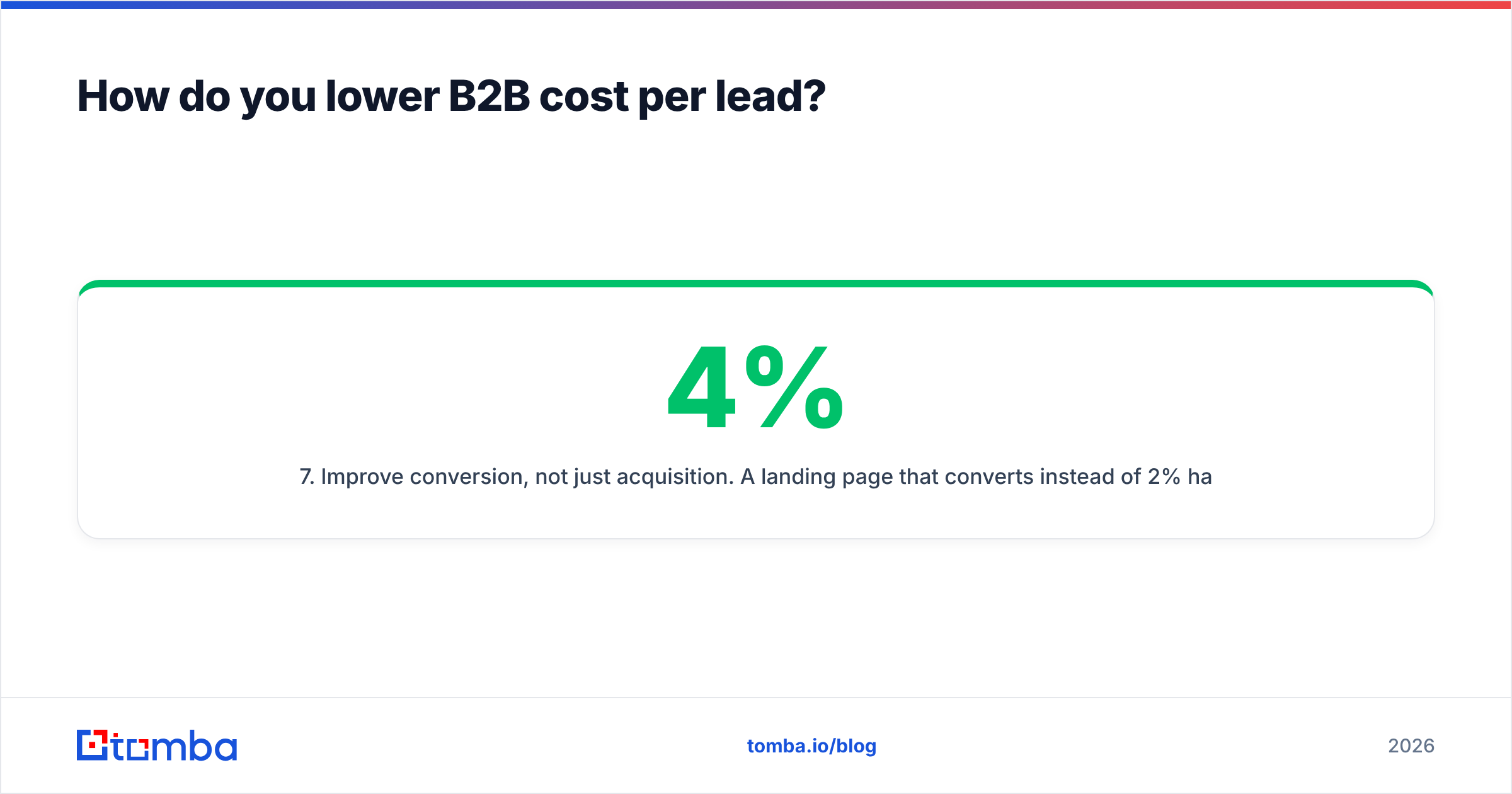
- Improve conversion, not just acquisition. A landing page that converts 4% instead of 2% halves your effective CPL with zero extra spend. Test offers, headlines, and form length relentlessly.
How does data quality change your cost per lead?#
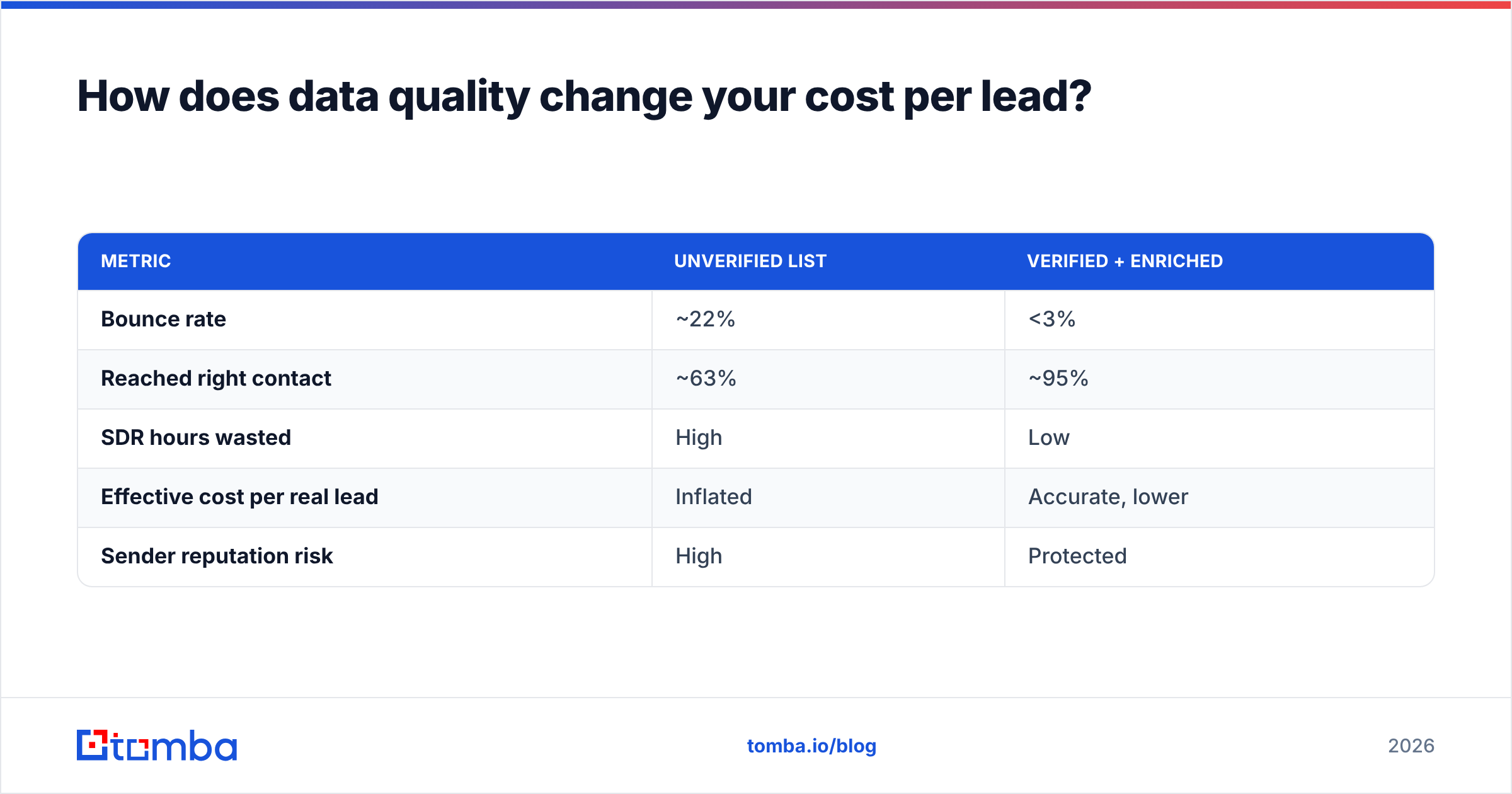
Clean data is the difference between a CPL number that lies and one you can trust. Imagine two teams running identical $10,000 outbound campaigns to 5,000 contacts.
- Team A uses an unverified list. 22% of emails bounce, another 15% reach the wrong person. Effective reach: ~3,150. Their real cost per delivered, relevant contact is far higher than the spreadsheet says.
- Team B verifies and enriches first. 97% deliverability, accurate titles. Effective reach: ~4,850. Same spend, 54% more genuine conversations.
Team B's CPL on usable leads is dramatically lower, even though both teams "spent the same per lead" on paper. This is why deliverability and data hygiene belong in any serious CPL conversation. If your sender reputation suffers from high bounce rates, your future emails land in spam, quietly inflating CPL across every campaign that follows — the team at Tomba's data sources page documents how verification feeds accuracy.
| Metric | Unverified list | Verified + enriched |
|---|---|---|
| Bounce rate | ~22% | <3% |
| Reached right contact | ~63% | ~95% |
| SDR hours wasted | High | Low |
| Effective cost per real lead | Inflated | Accurate, lower |
| Sender reputation risk | High | Protected |
How does CPL relate to CAC and pipeline?#
CPL is one link in a chain; optimizing it in isolation can backfire. The full chain looks like this:
Spend → Leads (CPL) → Qualified Leads (CPQL) → Opportunities → Customers (CAC)
If you slash CPL by buying cheap, low-intent leads, your CPQL and CAC both rise because conversion craters downstream. The leads were cheap; the customers got expensive. That is the classic trap.
The healthier move is to optimize for cost per qualified lead and pipeline contribution, then let CPL settle wherever it needs to. A $150 lead that converts at 25% is worth more than a $40 lead that converts at 3%. Tie your CPL targets to revenue, not vanity volume. Platforms like G2 and analyst firms such as Gartner consistently show that B2B teams who measure pipeline-weighted CPL outperform those chasing raw lead counts.
A practical rule of thumb: your fully loaded CAC should stay under one-third of your average customer lifetime value. Work backward from there to set CPL guardrails for each channel rather than picking a number out of the air.
What tools help reduce B2B cost per lead?#
The stack you need depends on where your leak is, but most CPL-reduction stacks share three layers:
- A finder layer to build targeted lists without paying per-click — an email finder plus a phone finder for multichannel outreach.
- A verification layer to protect deliverability and stop wasted spend — email and catch-all verification.
- An enrichment and routing layer to qualify and prioritize — data enrichment feeding your scoring model.
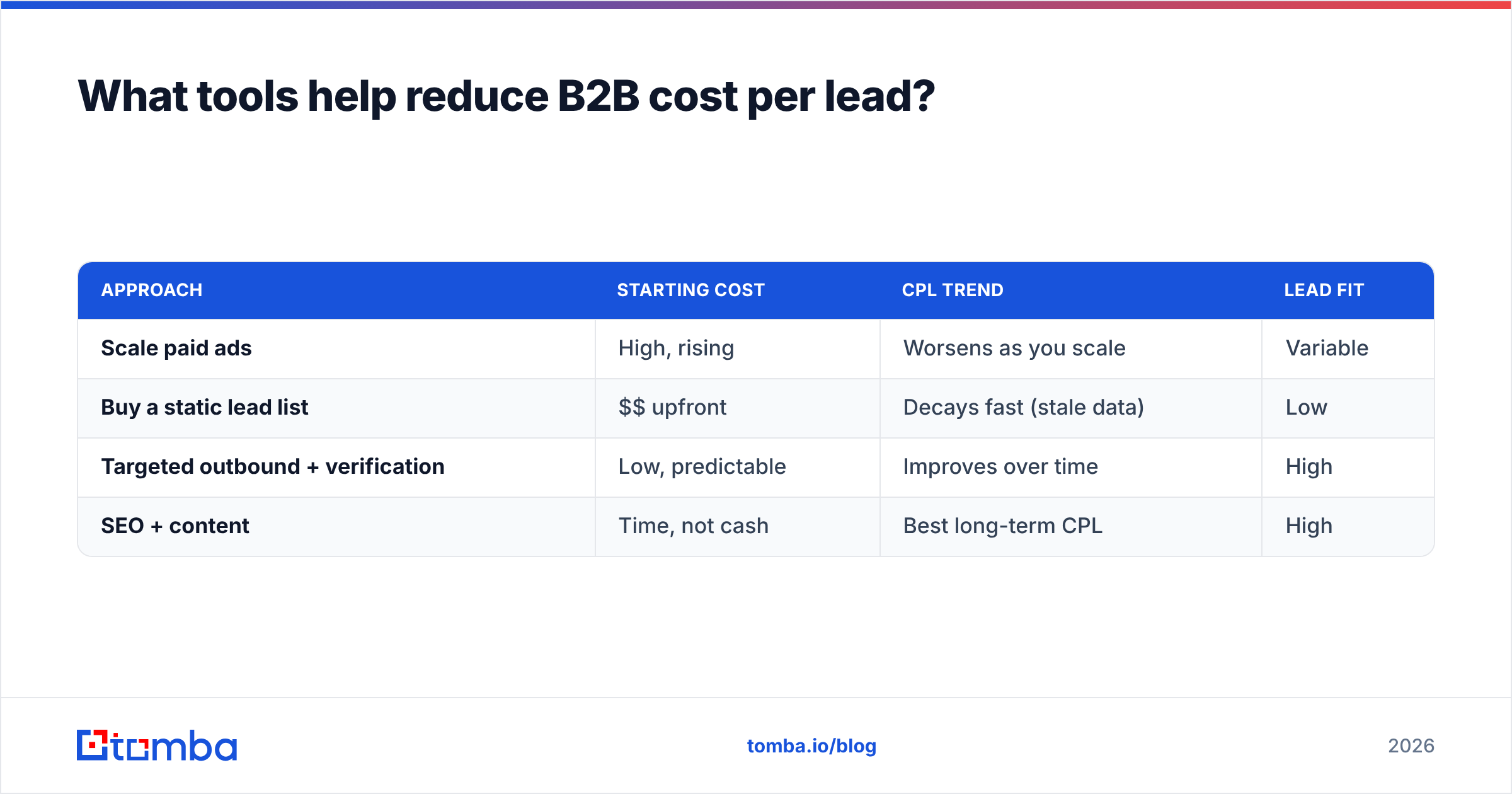
Here is how a focused data-driven approach compares to the default "just buy more ads" reflex:
| Approach | Starting cost | CPL trend | Lead fit |
|---|---|---|---|
| Scale paid ads | High, rising | Worsens as you scale | Variable |
| Buy a static lead list | $$ upfront | Decays fast (stale data) | Low |
| Targeted outbound + verification | Low, predictable | Improves over time | High |
| SEO + content | Time, not cash | Best long-term CPL | High |
Tomba sits in the targeted-outbound row. With a free tier (25 searches per month) and paid plans starting at $49/month, you can test list-driven outbound against your current paid CPL before committing budget. Full Tomba pricing runs from Starter at $49/mo to Growth at $99/mo and Pro at $249/mo, so the data layer is a fraction of what most teams burn on a single week of paid social.
Frequently asked questions#
What is the average B2B cost per lead in 2026? Blended B2B CPL commonly falls between $40 and $300, but channel and deal size swing it wildly. Owned channels like SEO sit at the low end; LinkedIn and paid search sit at the high end.
Is a low cost per lead always good? No. A low CPL paired with poor lead quality produces a high cost per customer. Optimize for cost per qualified lead and pipeline contribution instead.
How is CPL different from CAC? CPL measures the cost to generate a lead; CAC measures the cost to acquire a paying customer. CAC includes everything that happens after the lead, so it is always higher.
What is the fastest way to lower CPL? Verify and enrich your contact data. It cuts wasted spend on every channel immediately, before you touch bidding, creative, or targeting.
Bring your cost per lead back down to earth#
Your cost per lead is a symptom. The disease is usually wasted spend on the wrong people with bad data. Fix the data, target tighter, and measure quality — not just volume — and CPL falls on its own.
Start where the payoff is fastest. Build a verified, ICP-matched list with the Tomba Email Finder, reach real decision-makers directly, and watch your blended cost per lead drop as you shift dollars away from expensive rented channels toward outbound you actually control. Spin up the free tier, test it against your current paid CPL, and let the numbers make the case.
// get started
Find, verify and enrich your first contacts today
Start on the free plan with 25 searches a month, then scale when your team is ready.
Free plan · No credit card required · GDPR & CCPA
Get the Tomba newsletter
Product and data updates
// about the author