B2B Customer Acquisition in 2026: A Practical Playbook
A concrete, channel-by-channel guide to B2B customer acquisition in 2026 — costs, CAC benchmarks, the funnel math, and the data layer that makes it all work.
TL;DR#
- B2B customer acquisition is the end-to-end system for turning strangers into paying accounts — not a single channel, but a funnel where targeting, outreach, and data accuracy compound.
- Median B2B CAC sits between $200 and $900 per customer depending on deal size; the biggest hidden cost is wasted outreach to wrong or unverified contacts.
- A repeatable acquisition engine has five stages: define ICP, source contacts, qualify, engage across channels, and convert.
- Channel mix matters more than channel choice — outbound, inbound, paid, and partnerships each carry different CAC and payback periods.
- Clean, verified contact data is the cheapest lever you have: it lifts deliverability, reply rates, and rep productivity at the same time.
What is B2B customer acquisition?#
B2B customer acquisition is the repeatable process of attracting, qualifying, and converting other businesses into paying customers. Think of it like fishing with a sonar rig instead of a single line — you decide which waters hold your fish (your ideal customer profile), you cast where the signal is strong (targeted channels), and you measure every catch so the next trip is cheaper.
The technical definition: it's the coordinated set of marketing and sales motions that move an account from unaware to closed-won, measured by customer acquisition cost (CAC), conversion rate at each stage, and payback period. Unlike B2C, B2B acquisition deals with buying committees of 6–10 people, longer sales cycles, and higher contract values, so precision beats volume.
The mistake most teams make is treating acquisition as "more leads." More leads at the top of a leaky, badly-targeted funnel just means more money burned. The teams that win in 2026 optimize the whole system: who they target, how accurate their data is, and how efficiently reps spend their hours.

Wait — that placeholder belongs below. Here is the real one:
What are the main B2B customer acquisition channels?#
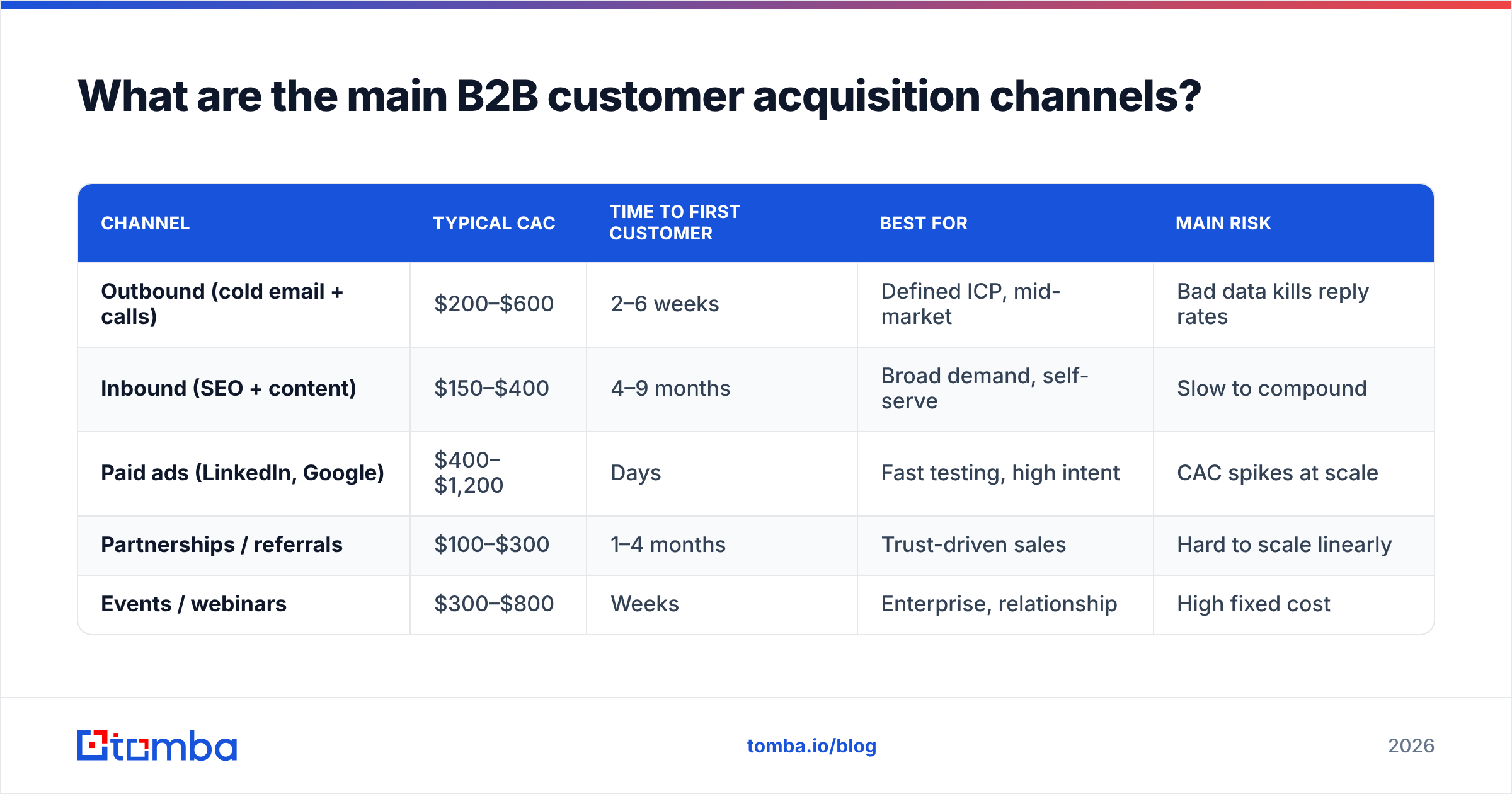
There is no single best channel — there is the best mix for your deal size and sales motion. A $500/year self-serve product and a $150k enterprise platform should not acquire customers the same way. Below is how the core channels compare on the metrics that actually drive decisions.
| Channel | Typical CAC | Time to first customer | Best for | Main risk |
|---|---|---|---|---|
| Outbound (cold email + calls) | $200–$600 | 2–6 weeks | Defined ICP, mid-market | Bad data kills reply rates |
| Inbound (SEO + content) | $150–$400 | 4–9 months | Broad demand, self-serve | Slow to compound |
| Paid ads (LinkedIn, Google) | $400–$1,200 | Days | Fast testing, high intent | CAC spikes at scale |
| Partnerships / referrals | $100–$300 | 1–4 months | Trust-driven sales | Hard to scale linearly |
| Events / webinars | $300–$800 | Weeks | Enterprise, relationship | High fixed cost |
The pattern: outbound and partnerships have the fastest, cheapest path when your targeting is precise, while inbound is the lowest long-run CAC but takes months to pay off. Most efficient teams run a portfolio — inbound to compound, outbound to control volume, paid to test messaging quickly.
A practical rule from HubSpot's research on acquisition costs: if a channel's CAC exceeds one-third of the customer's first-year value, it only works when retention and expansion are strong. Track payback period, not just CAC.
How do you build a B2B customer acquisition funnel?#
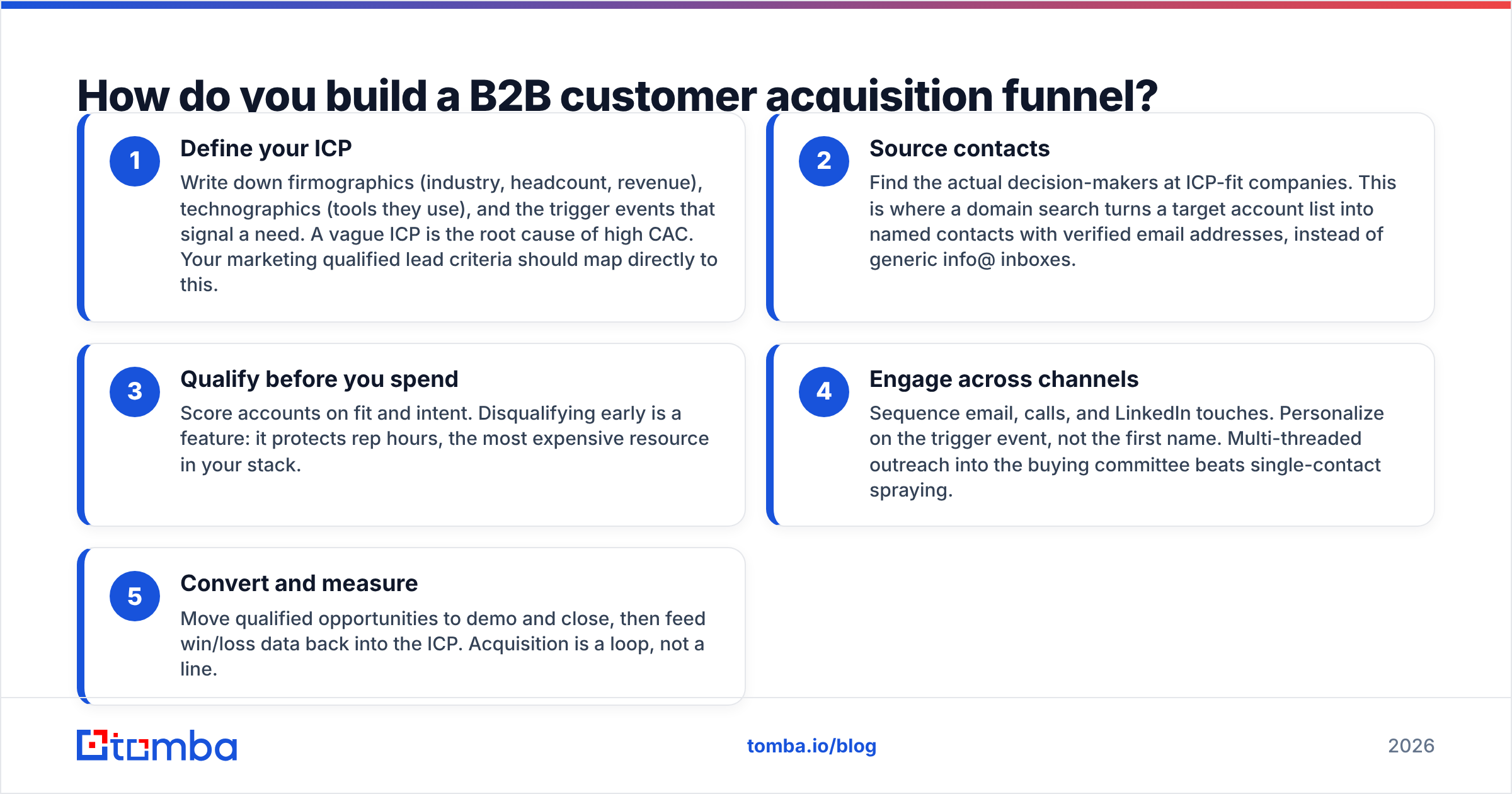
Build it in five stages, each with a single job. The goal is that every stage removes the wrong accounts cheaply so your expensive sales time only touches qualified ones.
- Define your ICP — Write down firmographics (industry, headcount, revenue), technographics (tools they use), and the trigger events that signal a need. A vague ICP is the root cause of high CAC. Your marketing qualified lead criteria should map directly to this.
- Source contacts — Find the actual decision-makers at ICP-fit companies. This is where a domain search turns a target account list into named contacts with verified email addresses, instead of generic info@ inboxes.
- Qualify before you spend — Score accounts on fit and intent. Disqualifying early is a feature: it protects rep hours, the most expensive resource in your stack.
- Engage across channels — Sequence email, calls, and LinkedIn touches. Personalize on the trigger event, not the first name. Multi-threaded outreach into the buying committee beats single-contact spraying.
- Convert and measure — Move qualified opportunities to demo and close, then feed win/loss data back into the ICP. Acquisition is a loop, not a line.
The stage that quietly determines the other four is sourcing. If your contact data is stale or unverified, every downstream metric — deliverability, reply rate, rep efficiency — degrades at once. That is why the data layer deserves its own section.
Why does data accuracy decide your CAC?#
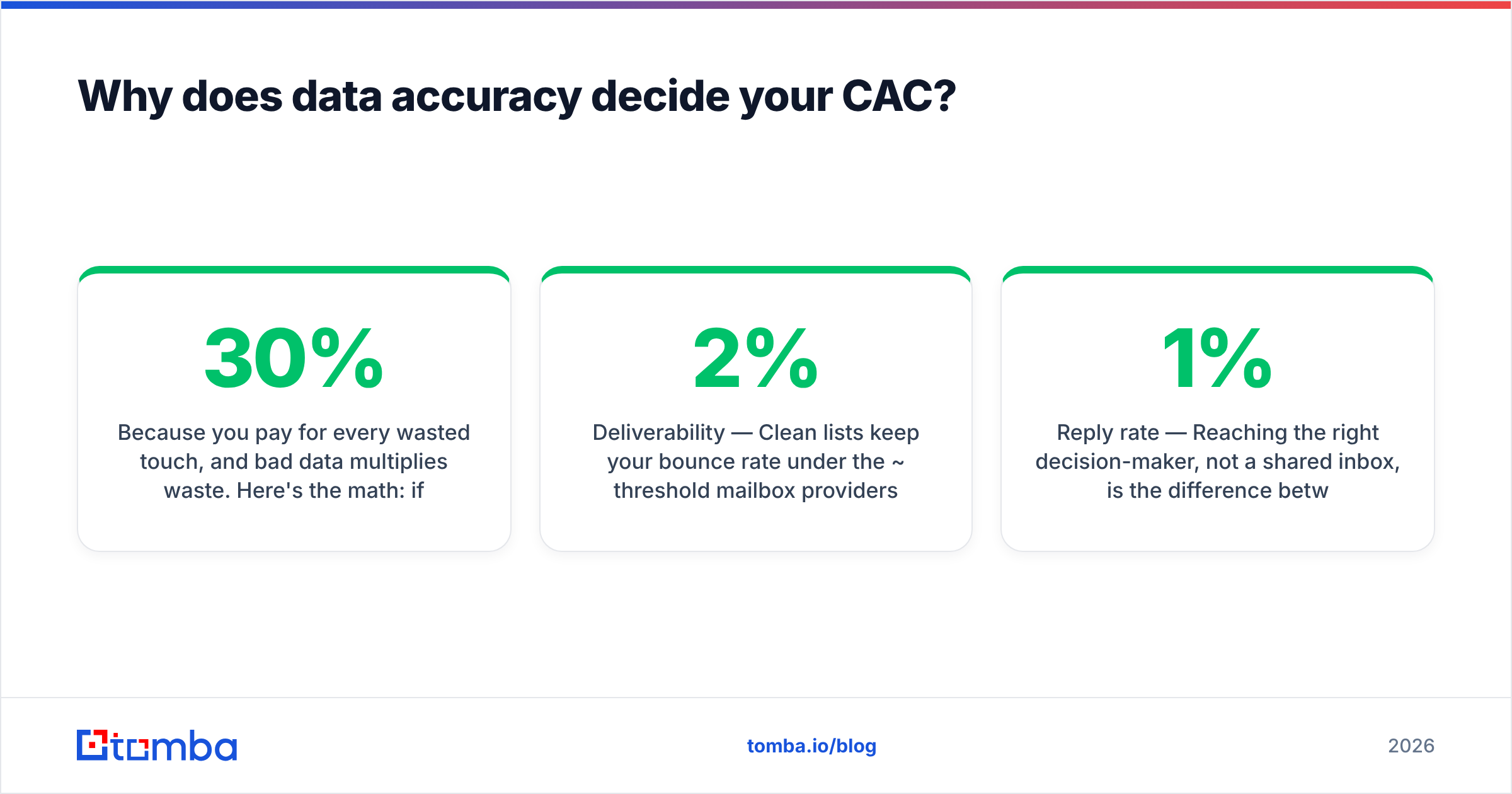
Because you pay for every wasted touch, and bad data multiplies waste. Here's the math: if 30% of your list bounces or routes to the wrong person, you've inflated CAC by roughly 30% before a single conversation happens — and you've damaged sender reputation, which then suppresses delivery to the good contacts too.
Verified contact data lowers CAC on three fronts simultaneously:
- Deliverability — Clean lists keep your bounce rate under the ~2% threshold mailbox providers watch. High bounces tank email deliverability and silently kill campaigns.
- Reply rate — Reaching the right decision-maker, not a shared inbox, is the difference between a 1% and a 6% reply rate on the same copy.
- Rep productivity — SDRs spend up to a third of their time researching and correcting contact info. Accurate data hands that time back to selling.
This is the cheapest lever in the entire acquisition system. You can rewrite copy, swap channels, or hire more reps — or you can simply stop emailing addresses that don't exist. Start with a reliable email finder to get named contacts, then run them through an email verifier so only deliverable addresses enter your sequences.
For accounts where the email is a catch-all domain, don't guess — confirm them with a dedicated catch-all verifier before you commit a sequence to them. And when you need to enrich a thin lead into a full profile for scoring, data enrichment fills in title, company size, and social handles so qualification is accurate from the first touch.
What does a 2026 acquisition stack look like?#
The modern stack is lean and data-first. You do not need fifteen tools; you need a tight loop of source → verify → engage → measure, wired into your CRM. Here is how the layers compare and what each is responsible for.
| Layer | Job | Example tools | What to optimize |
|---|---|---|---|
| Data sourcing | Find ICP-fit contacts | Tomba, Apollo, Clearbit | Coverage + accuracy |
| Verification | Remove undeliverable contacts | Tomba verifier, |
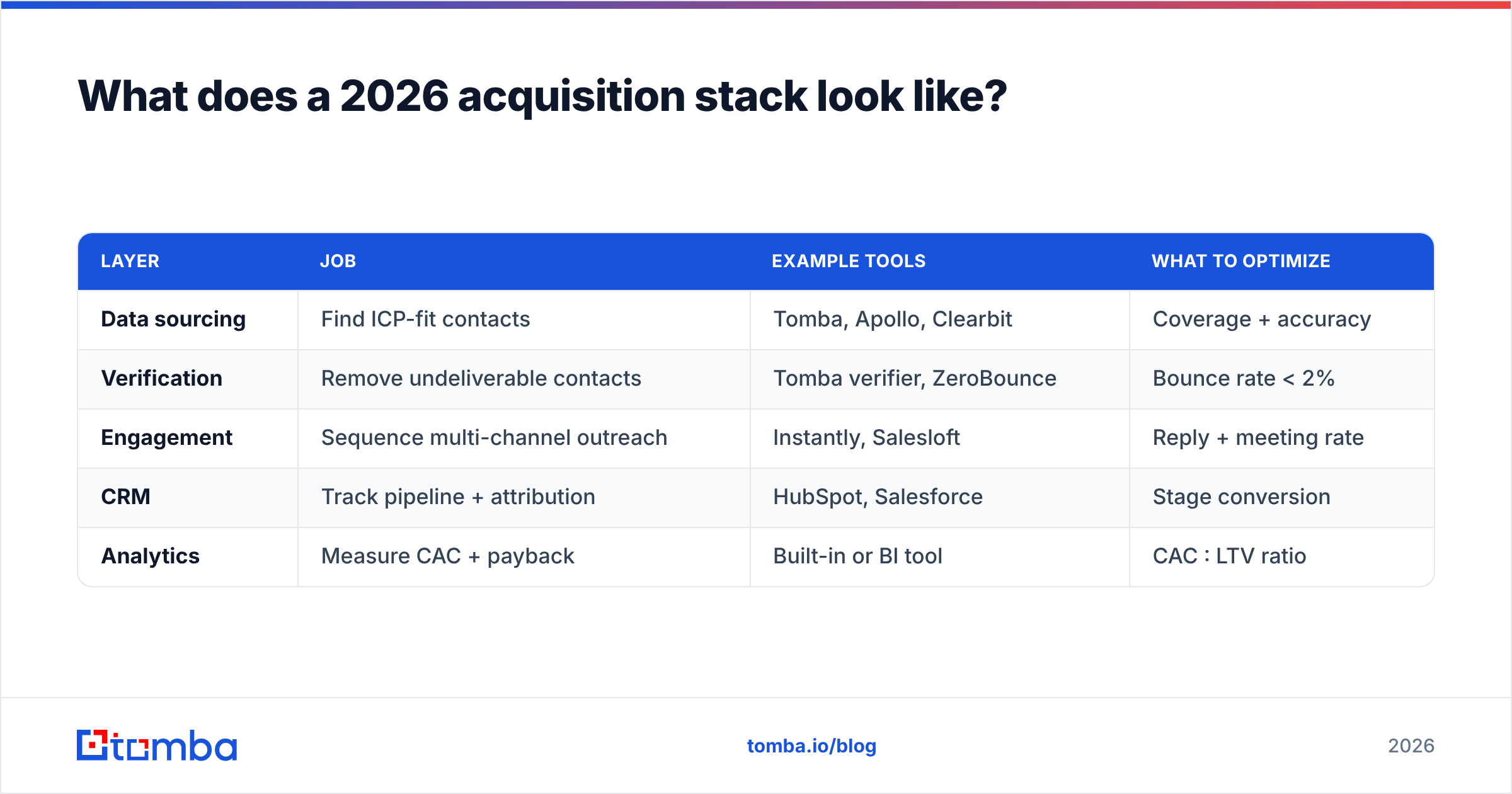
ZeroBounce | Bounce rate < 2% | | Engagement | Sequence multi-channel outreach | Instantly, Salesloft | Reply + meeting rate | | CRM | Track pipeline + attribution | HubSpot, Salesforce | Stage conversion | | Analytics | Measure CAC + payback | Built-in or BI tool | CAC : LTV ratio |
A few notes on choosing tools. Compare vendors on independent review sites like G2 rather than vendor claims, and check that your data source publishes its accuracy methodology — see how Tomba sources its data for the level of transparency to expect. If you run high volumes, a bulk email finder plus an email finder API lets you wire sourcing directly into your enrichment workflow instead of exporting CSVs by hand.
On budget: pick a data tool whose pricing scales with your actual search volume, not a flat enterprise tax. You can review Tomba pricing — a free tier with 25 searches/month, Starter at $49/mo, Growth at $99/mo, and Pro at $249/mo — as a baseline for what verified sourcing should cost a mid-market team.
How do you measure B2B customer acquisition success?#
Track four numbers, and track them as a system rather than in isolation:
- CAC — Total sales and marketing spend divided by new customers in a period. Segment it by channel so you can cut the expensive ones.
- CAC payback period — Months to recover CAC from gross margin. Under 12 months is healthy for most B2B SaaS; under 6 is excellent.
- LTV:CAC ratio — Aim for 3:1 or better. Below that, you're buying revenue at a loss; far above it, you're probably underinvesting in growth.
- Stage conversion rates — Where accounts drop between source, qualified, opportunity, and closed. The leakiest stage is your highest-ROI fix.
A useful discipline from analyst firms like Gartner: instrument the funnel before you scale spend. Pouring budget into a funnel you can't measure just buys you expensive confusion. Get attribution working at the stage level, find the leak, fix it, then turn up volume.
One more measurement habit: tie CAC back to data quality. If you A/B test verified versus unverified lists on the same sequence, the verified cohort almost always shows lower bounce, higher reply, and lower effective CAC. That experiment pays for your data tooling in a single campaign.
Is outbound still worth it in 2026?#
Yes — but only with precise targeting and clean data. The "spray 10,000 contacts" era is over; mailbox providers and buyers both punish it. What works now is narrow and verified: a tight ICP, a named decision-maker, a relevant trigger, and a deliverable email address.
The economics are straightforward. A 5,000-contact blast at 30% bad data wastes 1,500 sends, drags your domain reputation down, and converts poorly. The same effort aimed at 1,000 verified, ICP-fit contacts with personalized copy will out-convert it — at a fraction of the reputational risk. Quality of targeting, not quantity of sends, is the 2026 outbound game.
Outbound also pairs best with the rest of your motion. Use it to accelerate accounts that inbound surfaced, to break into target logos partnerships can't reach, and to test messaging faster than content can. Treated as one instrument in a portfolio — backed by verified data — outbound remains one of the most controllable, fastest-payback acquisition channels available.
Putting it together#
B2B customer acquisition in 2026 rewards systems thinking. Pick a channel mix matched to your deal size, build a five-stage funnel that disqualifies cheaply, instrument every stage, and — above all — fix your data layer first, because it's the one lever that lowers CAC on deliverability, reply rate, and rep time at the same time.
If you want the highest-leverage starting point, begin where the funnel begins: sourcing verified, decision-maker contacts. The Tomba Email Finder turns your target-account list into named, deliverable contacts by domain, name, or company — so your sequences reach real buyers instead of bouncing. Pair it with the built-in verifier, start on the free tier, and measure the CAC difference yourself before you scale spend. Lower cost per customer almost always starts with cleaner data, not a bigger budget.
Ready to find emails that actually work?
Join 150,000+ professionals who stopped guessing and started sending. Free credits on signup — no credit card required.
Get the Tomba newsletter
Practical outbound tactics and product updates — once every two weeks.
About the author