B2B Customer Acquisition Cost: Calculate & Cut It in 2026
Your B2B customer acquisition cost decides whether growth is profitable or a slow bleed. Here's how to calculate CAC, benchmark it, and cut it in 2026 without starving the pipeline.
TL;DR
- B2B customer acquisition cost (CAC) is total sales and marketing spend divided by new customers won in the same period — it tells you what each logo actually costs.
- Healthy SaaS targets a LTV:CAC ratio of 3:1 or better and a CAC payback under 12 months; anything worse means you're buying growth you can't afford.
- The biggest CAC killers are bad data, long sales cycles, and channel mix — not your ad budget.
- Cleaning your prospecting data with accurate contact discovery and verification can cut wasted outreach spend by 20–40% before you touch a single campaign.
- This guide gives you the formula, 2026 benchmarks by channel, and a step-by-step playbook to lower CAC without choking the pipeline.
What is B2B customer acquisition cost?#
B2B customer acquisition cost is the total amount you spend to win one new customer. Think of it like the price tag on a vending machine: you put money in (salaries, ads, tools, commissions), and a customer drops out. CAC is simply how much money you had to feed the machine per customer.
Technically, CAC is the sum of all sales and marketing costs over a period, divided by the number of new customers acquired in that same period. It is the single most honest number in your go-to-market motion, because it ignores vanity metrics like impressions and clicks and asks one blunt question: did the money turn into customers?
Most teams underestimate their real CAC because they only count ad spend. A true CAC includes fully loaded costs — rep salaries, SDR tooling, content production, agency retainers, and the software stack. When you count everything, the number is usually 2–3x higher than the "media cost" leaders quote in board decks.
How do you calculate B2B customer acquisition cost?#
The core formula is short:
CAC = (Total Sales Costs + Total Marketing Costs) ÷ New Customers Acquired
Here's what belongs in each bucket so you don't lie to yourself:
- Salaries and commissions — fully loaded comp for SDRs, AEs, marketers, and a fair slice of sales leadership.
- Paid media and advertising — Google, LinkedIn, retargeting, sponsorships, and events.
- Software and tooling — CRM, sequencing tools, data and enrichment platforms, and your email finder.
- Content and creative — agency fees, freelance writers, designers, and production.
- Overhead allocation — the portion of general overhead that supports revenue teams.
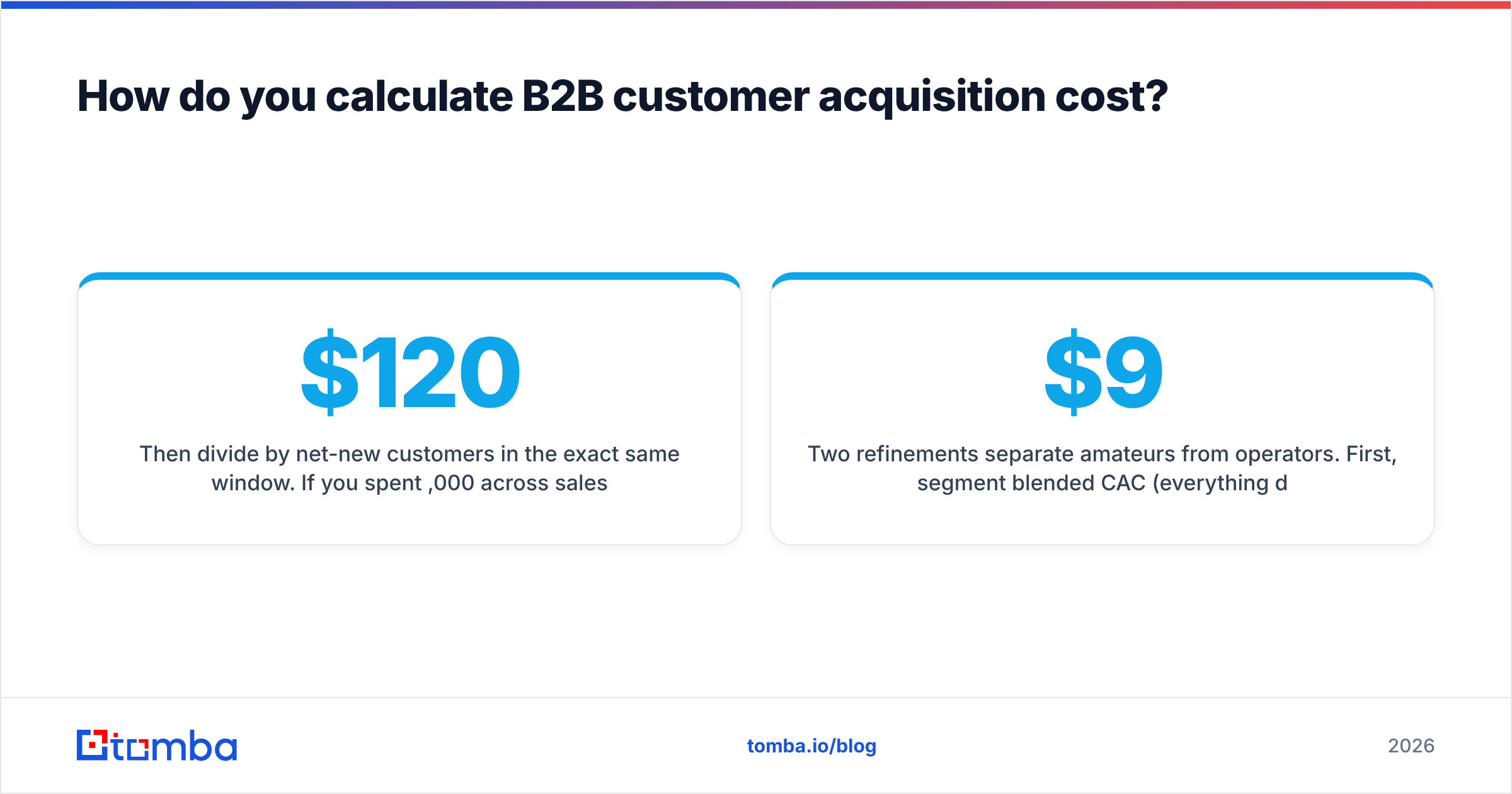
Then divide by net-new customers in the exact same window. If you spent $120,000 across sales and marketing in Q1 and closed 40 new customers, your CAC is $3,000.
Two refinements separate amateurs from operators. First, segment blended CAC (everything divided by everyone) from paid CAC (only paid channels and the customers they produced) — blended CAC hides how expensive your paid motion really is. Second, always pair CAC with lifetime value (LTV) and payback period, because a $9,000 CAC is fantastic for a $200k contract and catastrophic for a $1,200 one.
What is a good CAC and LTV:CAC ratio in 2026?#
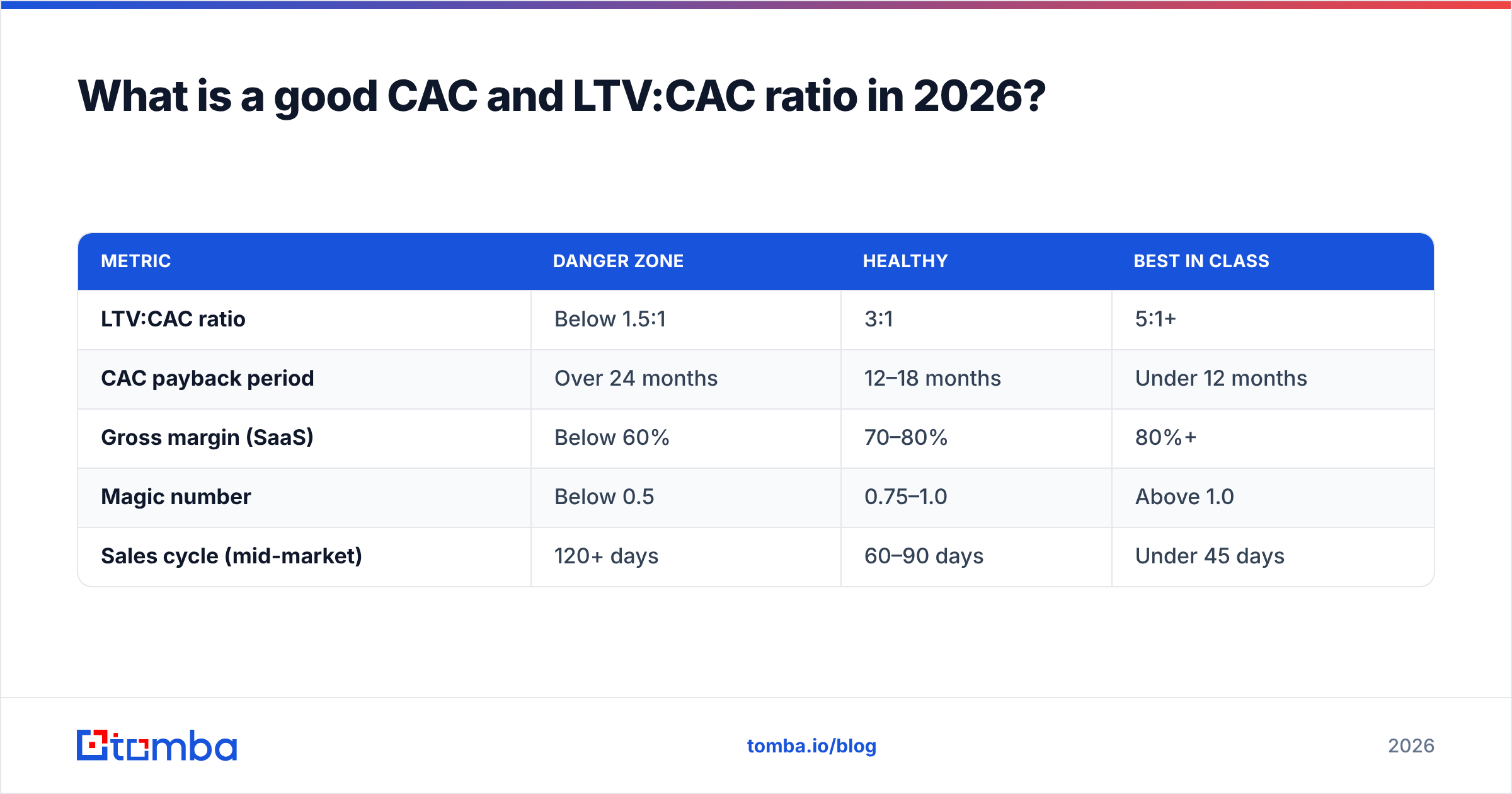
A good CAC is one your customer lifetime value can comfortably repay. The benchmark most B2B SaaS teams aim for is an LTV:CAC ratio of 3:1 — you earn three dollars of lifetime gross profit for every dollar spent acquiring the customer. Below 1:1 you're losing money on every deal. Above 5:1 you may actually be under-investing in growth.
The second guardrail is CAC payback period: how many months of gross margin it takes to earn back the acquisition cost. Top-quartile SaaS recovers CAC in under 12 months; mid-market and enterprise motions often run 12–18 months and still stay healthy because contracts are larger and stickier.
| Metric | Danger zone | Healthy | Best in class |
|---|---|---|---|
| LTV:CAC ratio | Below 1.5:1 | 3:1 | 5:1+ |
| CAC payback period | Over 24 months | 12–18 months | Under 12 months |
| Gross margin (SaaS) | Below 60% | 70–80% | 80%+ |
| Magic number | Below 0.5 | 0.75–1.0 | Above 1.0 |
| Sales cycle (mid-market) | 120+ days | 60–90 days | Under 45 days |
These are directional, not gospel. A PLG motion with a 14-day free trial lives in a different universe than an enterprise team selling six-figure annual contracts. Use the ratios as a compass, and compare yourself to peers at your ACV and motion — resources like G2 and analyst data from Gartner help you find the right cohort instead of comparing against companies nothing like yours.
Why is B2B customer acquisition cost rising?#
CAC has crept up across nearly every B2B category for a few stubborn reasons. Ad inventory on LinkedIn and Google keeps getting more expensive as more vendors bid for the same buyers. Buying committees have grown — the average B2B deal now involves 6 to 10 stakeholders, which lengthens sales cycles and multiplies the touches needed to close. And buyers are more skeptical, so the easy wins from generic cold outreach have dried up.
The hidden tax, though, is bad data. When 20–30% of your contact list is wrong — stale emails, job-changers, catch-all domains that bounce — every dollar of outreach spend gets diluted. Reps burn hours chasing dead addresses, deliverability tanks, and your domain reputation suffers, which quietly raises the cost of every future campaign. You're paying full price for a half-full tank.
This is why the cheapest CAC reduction usually starts upstream, in the data layer, long before anyone touches creative or bidding strategy.
How do you reduce B2B customer acquisition cost?#
Lowering CAC is rarely about spending less — it's about wasting less. Here is a practical playbook, ordered from fastest payback to longest.
1. Fix your data before your funnel. Verify every address before it enters a sequence. A clean list improves deliverability, protects sender reputation, and stops you from paying reps to email ghosts. Run new lists through an email verifier and screen risky domains with a catch-all verifier so bounces never touch your primary domain.
2. Tighten your ICP. Broad targeting is the most expensive habit in B2B. Narrow your ideal customer profile until your win rate climbs — fewer, better-fit accounts close faster and cost less per logo.
3. Shorten the sales cycle. Every extra week a deal sits open adds carrying cost. Multi-threading early, sending tighter follow-ups, and qualifying out bad fits fast all compress the cycle and shrink CAC.
4. Shift mix toward lower-cost channels. Referrals, partnerships, and well-run outbound usually beat paid ads on CAC. Reallocate budget toward whatever channel shows the best LTV:CAC, not the most clicks.
5. Enrich and prioritize. Use data enrichment to score and route leads so reps spend their time on accounts most likely to convert, not on whoever filled out a form first.
Which channels have the lowest CAC for B2B?#
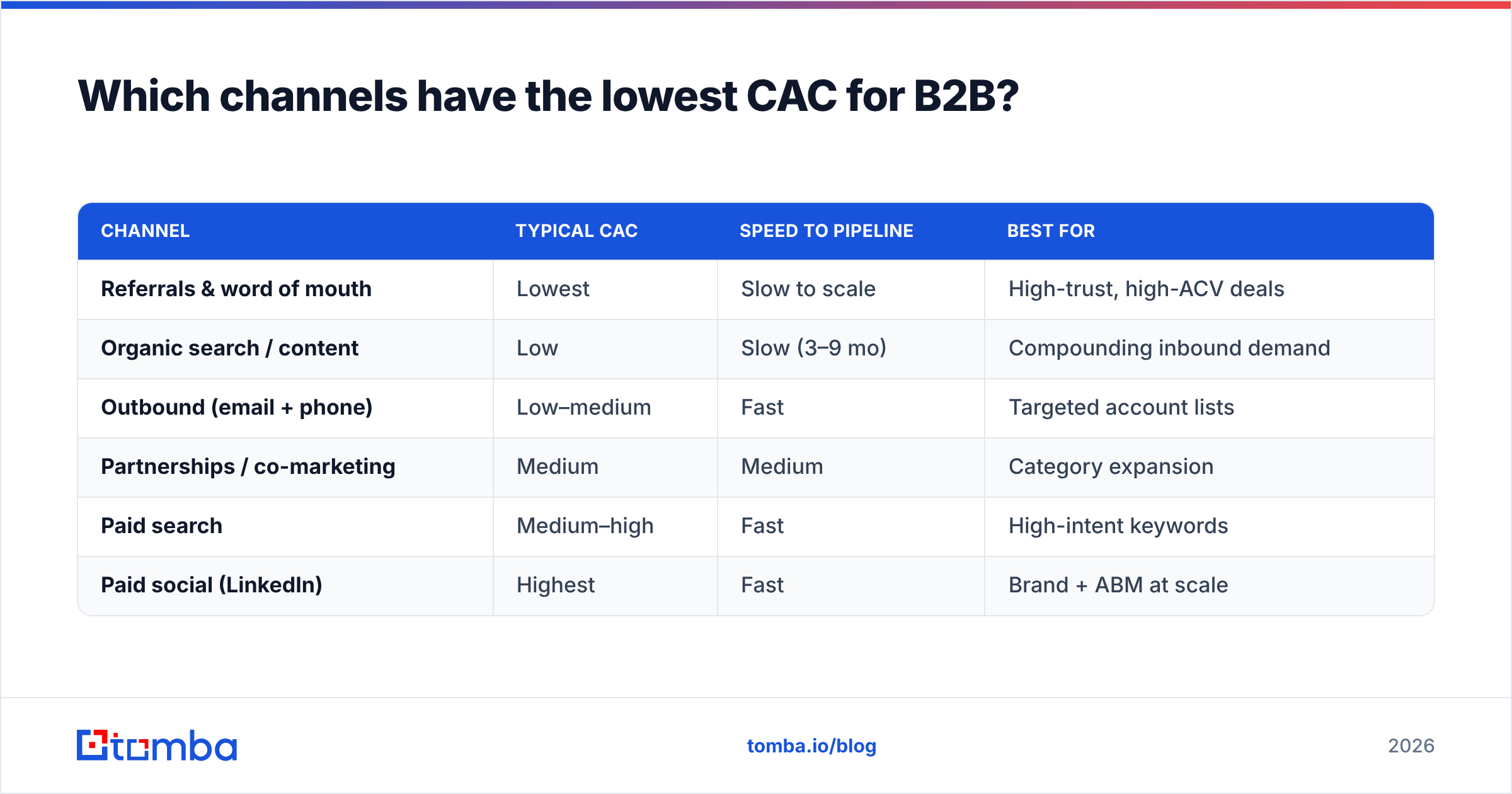
Channel choice swings CAC more than almost any other lever. The table below shows typical relative cost and payback characteristics in 2026 B2B motions. Treat the dollar ranges as ballpark — they vary wildly by ACV and industry — but the relative ordering holds up across most teams.
| Channel | Typical CAC | Speed to pipeline | Best for |
|---|---|---|---|
| Referrals & word of mouth | Lowest | Slow to scale | High-trust, high-ACV deals |
| Organic search / content | Low | Slow (3–9 mo) | Compounding inbound demand |
| Outbound (email + phone) | Low–medium | Fast | Targeted account lists |
| Partnerships / co-marketing | Medium | Medium | Category expansion |
| Paid search | Medium–high | Fast | High-intent keywords |
| Paid social (LinkedIn) | Highest | Fast | Brand + ABM at scale |
Outbound deserves special attention because it is the channel where data quality most directly controls cost. A precise, verified list turns outbound into one of the lowest-CAC channels you have; a bloated, unverified one turns it into a money pit. This is exactly where finding accurate contacts at scale pays for itself — a bulk email finder lets you build clean, targeted lists in minutes instead of paying reps to hand-research accounts or buying stale databases that bounce.
For phone-led motions, the same logic applies: pairing verified emails with accurate B2B phone numbers lets you multi-thread accounts across channels without inflating spend on dead contacts.
How does data quality affect customer acquisition cost?#
Data quality is the silent variable in every CAC calculation. Two teams can run identical campaigns with identical budgets, and the one with cleaner data will post a dramatically lower CAC — purely because more of its spend reaches real, reachable buyers.
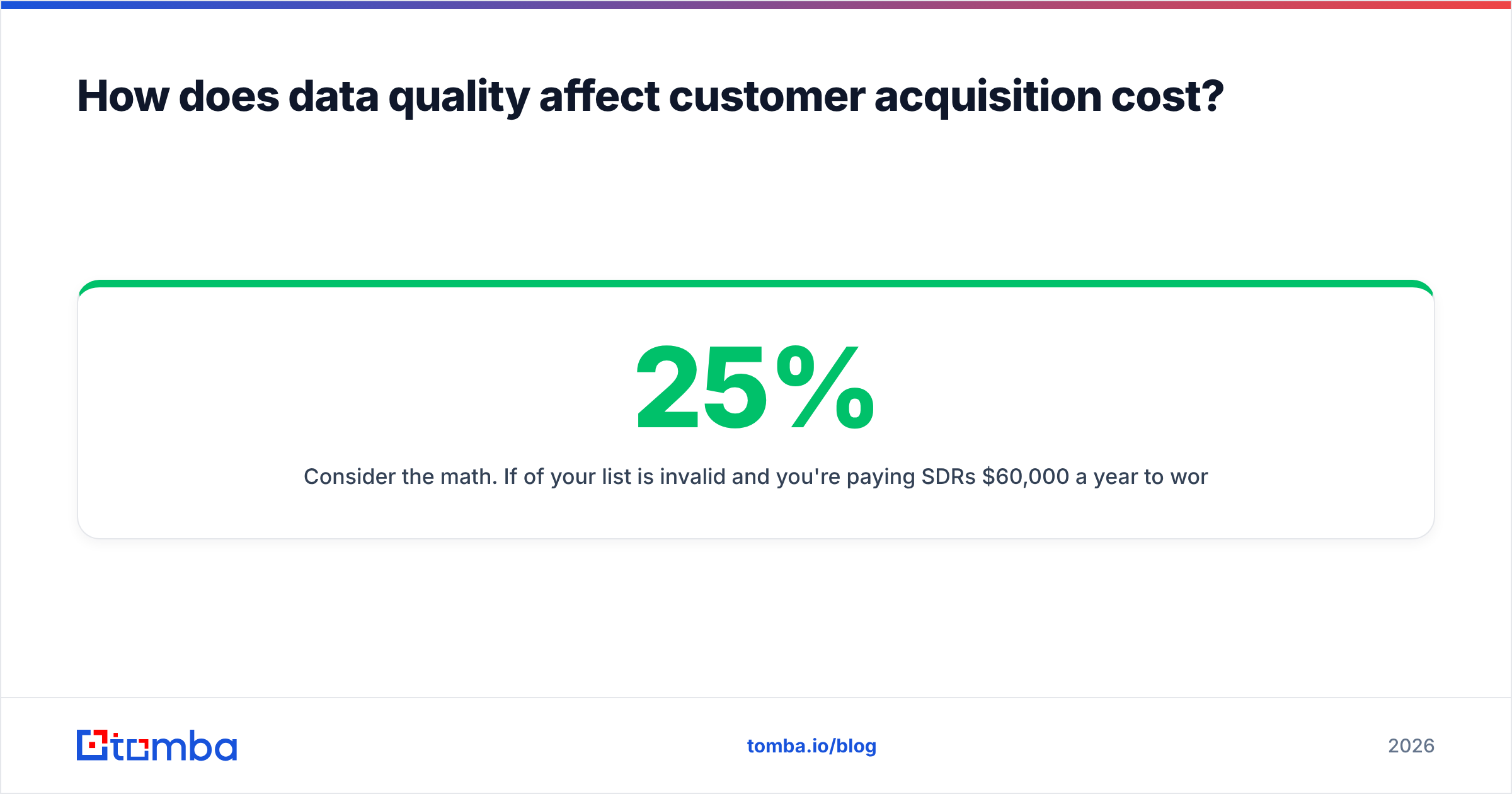
Consider the math. If 25% of your list is invalid and you're paying SDRs $60,000 a year to work it, you're effectively burning $15,000 per rep on contacts that will never reply. Multiply that across a team and the leak is enormous. Worse, high bounce rates drag down email deliverability, so even your valid contacts stop seeing your messages — a compounding penalty that quietly inflates the cost of every campaign that follows.
The fix is unglamorous but high-leverage: verify before you send, re-verify on a schedule, and enrich records so reps always work from current titles and companies. Tools like HubSpot's sales benchmarks consistently show that data hygiene and segmentation move conversion rates more than creative tweaks ever do. Clean data isn't a nice-to-have — it's the cheapest CAC reduction available, and it's available today.
What metrics should you track alongside CAC?#
CAC in isolation can mislead. Track it inside a small dashboard of companion metrics so you see the whole picture:
- LTV:CAC ratio — the profitability of acquisition over a customer's life.
- CAC payback period — how fast cash comes back, which governs how aggressively you can reinvest.
- Win rate — rising win rates usually pull CAC down; track it via your win rate reporting.
- Pipeline coverage — enough qualified pipeline to hit targets without panic-spending.
- Magic number — net new ARR divided by prior-period sales and marketing spend, a quick efficiency read.
Reviewed together, these metrics tell you whether a falling CAC is genuine efficiency or a warning sign that you've throttled growth too hard. The goal is sustainable, profitable acquisition — not the lowest possible number on a spreadsheet.
The bottom line on B2B customer acquisition cost#
B2B customer acquisition cost is the clearest signal you have for whether growth is profitable or just expensive. Calculate it honestly with fully loaded costs, benchmark it against an LTV:CAC of 3:1 and a payback under 12–18 months, and attack it upstream — at the data layer — before you ever touch ad budgets.
The fastest, most durable CAC win is feeding your pipeline accurate, verified contacts so every dollar of outreach lands on a real buyer. Tomba's email finder helps you build clean, targeted prospect lists by domain, name, or company — with verification baked in — so your reps stop paying full price for half-empty lists. Start on the free tier with 25 searches a month, and scale to the Starter plan at $49/mo when you're ready to lower CAC across your whole outbound motion.
// get started
Find, verify and enrich your first contacts today
Start on the free plan with 25 searches a month, then scale when your team is ready.
Free plan · No credit card required · GDPR & CCPA
// about the author