B2B Customer Engagement in 2026: Strategy, Data and Tools
A practical 2026 playbook for B2B customer engagement: the metrics that matter, the data layer that powers it, and the tools that turn cold lists into real relationships.
B2B customer engagement is the sum of every meaningful interaction a buyer has with your company — from the first cold email to the renewal call three years later. In 2026, the teams winning at it are not the ones sending the most messages. They are the ones sending the right message to the right contact at the right moment, backed by clean data.
This guide breaks down what B2B customer engagement actually means, the metrics that prove it is working, the channel mix that drives it, and the data foundation that makes all of it possible.
TL;DR#
- Engagement is two-sided. It is not just acquisition outreach — it covers onboarding, expansion, and retention across the entire customer lifecycle.
- Bad data kills engagement before it starts. Roughly a quarter of B2B contact data decays every year; outreach to dead inboxes tanks your sender reputation and your numbers.
- The metric that matters is response, not volume. Reply rate, meeting rate, product usage, and net revenue retention beat "emails sent" every time.
- A clean data layer is the multiplier. Verified emails, enriched firmographics, and accurate phone numbers make every channel perform better.
- Tooling consolidates in 2026. Buyers want fewer point solutions and one reliable source of contact truth — which is where an email finder and enrichment stack earns its place.
What is B2B customer engagement?#
B2B customer engagement is the ongoing, two-way relationship between your company and the people inside your target accounts. Think of it like tending a garden rather than picking fruit once: you plant (prospect), water (nurture), harvest (close), and keep tending (retain and expand). Most teams obsess over the harvest and neglect everything else.
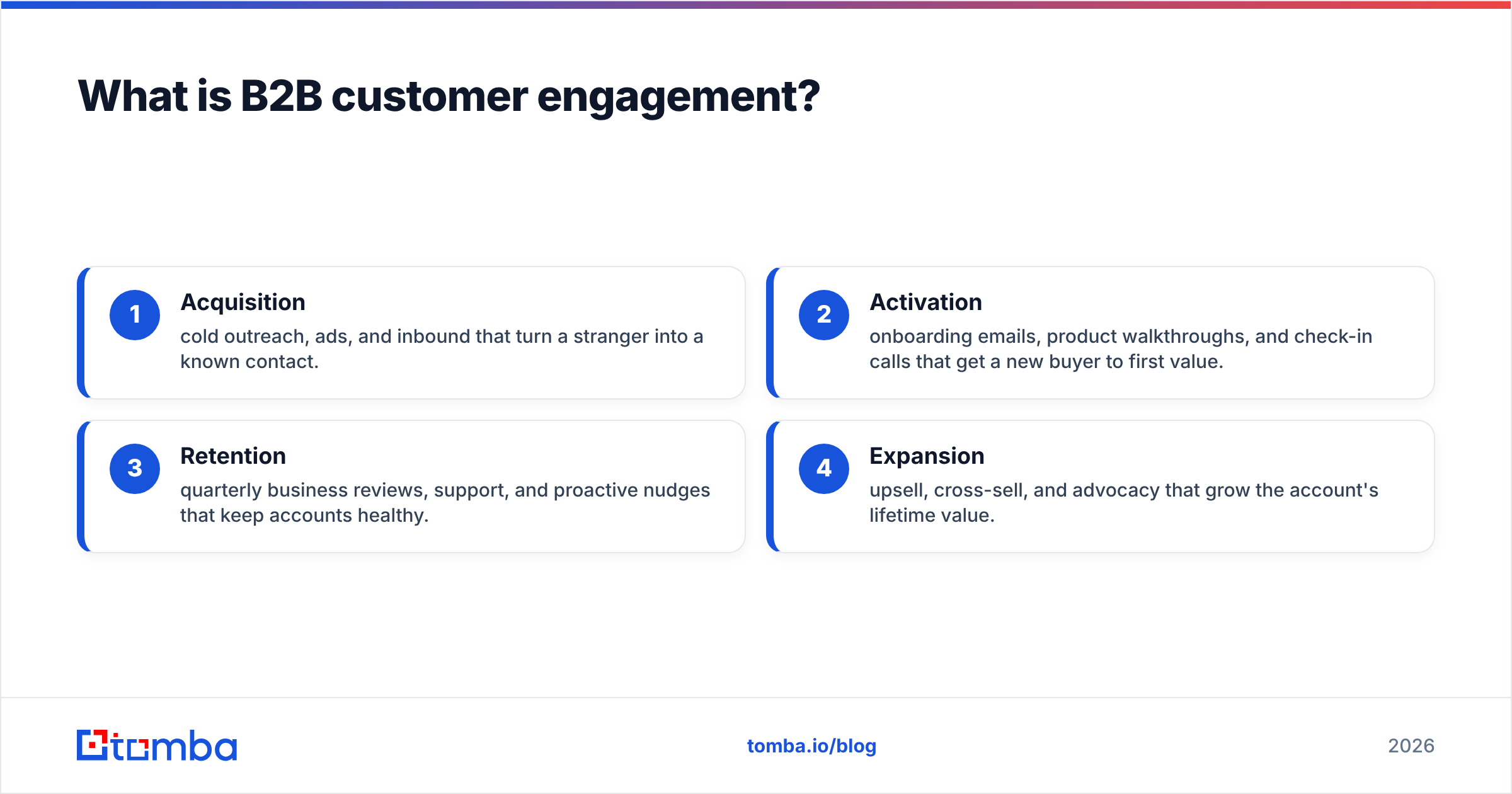
Technically, engagement spans four lifecycle stages, and each one demands a different motion:
- Acquisition — cold outreach, ads, and inbound that turn a stranger into a known contact.
- Activation — onboarding emails, product walkthroughs, and check-in calls that get a new buyer to first value.
- Retention — quarterly business reviews, support, and proactive nudges that keep accounts healthy.
- Expansion — upsell, cross-sell, and advocacy that grow the account's lifetime value.
The mistake most revenue teams make is treating engagement as a top-of-funnel acquisition problem. It is actually a full-funnel discipline that sits at the heart of revenue operations, connecting marketing, sales, and customer success around a single view of the account.
)
Why does B2B customer engagement matter in 2026?#
Because attention is scarcer and buyers are more self-directed than ever. The average B2B buying committee now involves 6–10 stakeholders, and most of the buying journey happens before a rep is ever contacted. If your engagement is generic, you are invisible.
Three forces make 2026 different:
- Data decay accelerated. People change jobs faster, companies restructure, and contact records rot. Outreach built on stale lists bounces, and bounces wreck email deliverability.
- Inbox protections tightened. Google and Yahoo's bulk-sender requirements punish senders who can't keep complaint and bounce rates low. Clean lists are now a deliverability requirement, not a nicety.
- Buyers expect relevance. A message that ignores a prospect's role, industry, or recent trigger event gets deleted in under three seconds.
Engagement is the antidote. When you reach verified contacts with context, every downstream metric — open rate, reply rate, meeting rate, pipeline — improves at once.
What are the core B2B customer engagement metrics?#
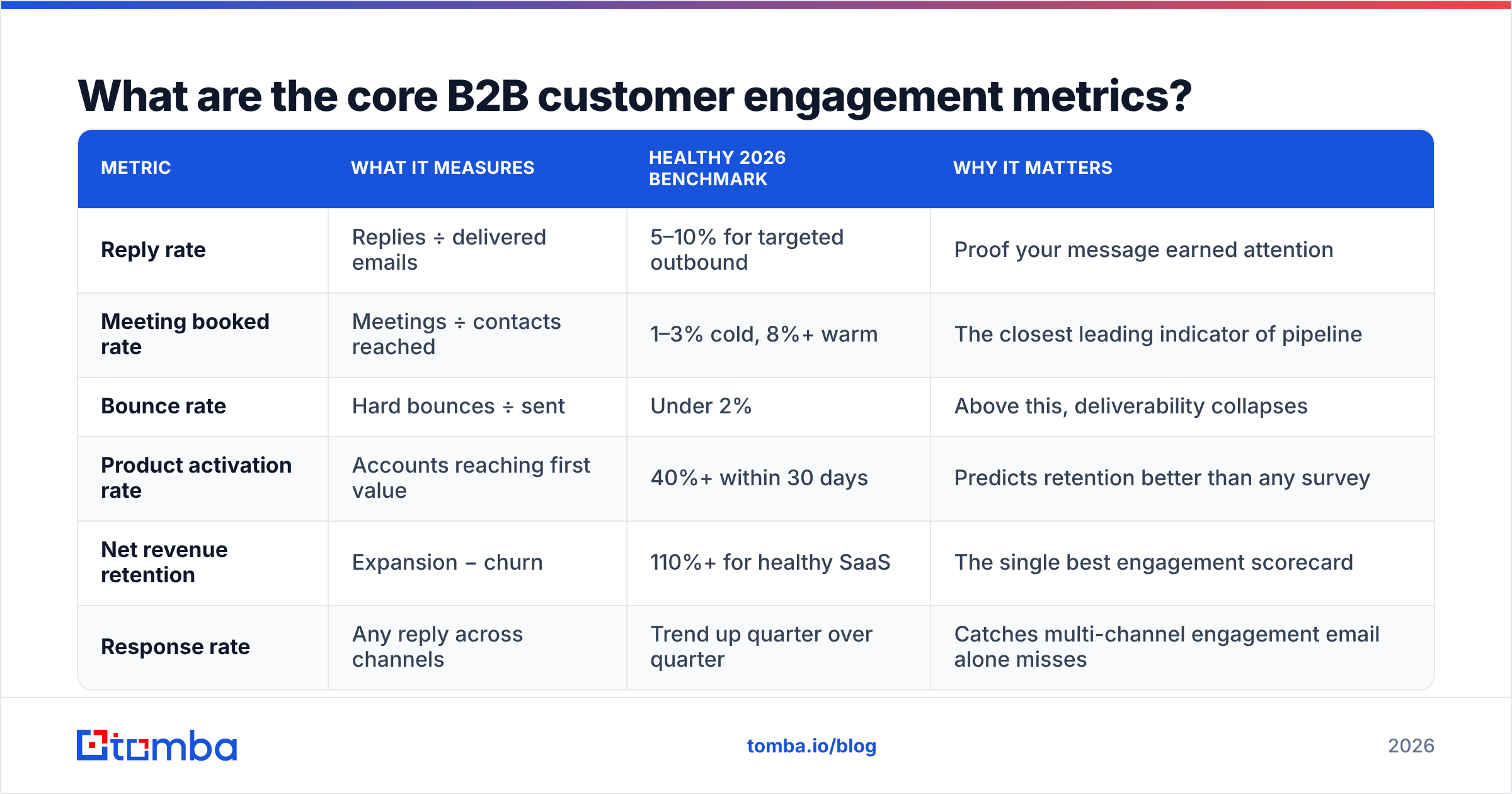
Stop measuring activity. Start measuring outcomes. The metrics below separate teams that look busy from teams that are effective. Track them per segment, not just in aggregate, so you can see which motions actually move accounts forward.
| Metric | What it measures | Healthy 2026 benchmark | Why it matters |
|---|---|---|---|
| Reply rate | Replies ÷ delivered emails | 5–10% for targeted outbound | Proof your message earned attention |
| Meeting booked rate | Meetings ÷ contacts reached | 1–3% cold, 8%+ warm | The closest leading indicator of pipeline |
| Bounce rate | Hard bounces ÷ sent | Under 2% | Above this, deliverability collapses |
| Product activation rate | Accounts reaching first value | 40%+ within 30 days | Predicts retention better than any survey |
| Net revenue retention | Expansion − churn | 110%+ for healthy SaaS | The single best engagement scorecard |
| Response rate | Any reply across channels | Trend up quarter over quarter | Catches multi-channel engagement email alone misses |
Notice that volume is absent. "Emails sent" and "calls dialed" are inputs, not engagement. A rep sending 50 verified, researched emails a day will beat one blasting 500 unverified addresses on every metric in this table.
How do you build a B2B customer engagement strategy?#
Start with data, then layer on channels and cadence. A great strategy on a rotten contact list still fails. Here is the sequence that works.
1. Define the engaged account. Decide what "engaged" means for your business — a reply, a demo, a feature used twice, a renewal conversation. Without a definition you cannot measure progress.
2. Build a clean data layer. Before a single message goes out, verify the email, confirm the role, and enrich firmographics. This is the unglamorous foundation that makes everything else work. Use a domain search to map decision-makers at a target account, then verify each address.
3. Choose channels by buyer, not by habit. Some personas live in email, some on LinkedIn, some only answer the phone. Map your committee and meet them where they are.
4. Sequence with context, not just timing. A good cadence references a trigger — funding, a new hire, a product launch — instead of "just following up." Context is what turns a touch into a conversation.
5. Close the loop with the data layer. Every reply, bounce, and meeting should feed back into your records so the next touch is smarter than the last.
)
Which channels drive the most B2B engagement?#
There is no single winning channel — there is a winning mix. The best-performing teams in 2026 run coordinated multi-touch sequences across at least three channels, because a buyer who ignores email may answer a call, and a prospect who ghosts a call may reply on LinkedIn.
- Email remains the workhorse for scale, but only on verified lists. Pair it with an email verifier to keep bounce rates under 2%.
- Phone is making a comeback for high-intent accounts. Accurate mobile numbers from a phone finder turn voicemail roulette into real conversations.
- LinkedIn is where buying committees research and validate. Social touches warm up cold email and add a human face to your brand. (See social selling for the discipline behind it.)
- In-product and lifecycle messaging drives activation and expansion — the half of engagement most outbound teams ignore.
The thread connecting all four is contact accuracy. A multi-channel sequence amplifies whatever data you feed it: clean data multiplies results, dirty data multiplies waste.
How does data quality affect customer engagement?#
Data quality is the ceiling on your engagement, full stop. You can hire elite reps, write brilliant copy, and design a perfect cadence — and a 30% bounce rate will cap all of it. Here is the chain reaction bad data sets off:
- Unverified addresses bounce, which signals mailbox providers that you are a careless sender.
- Your sender reputation drops, so even your good emails land in spam.
- Reply rates crater because your best messages never reach the inbox.
- Reps lose trust in the CRM and start working around it, which corrupts your data further.
The fix is a verification-first workflow. Find the email, verify it, enrich the record, then engage — in that order. For catch-all domains that resist standard checks, a dedicated catch-all verifier reduces the guesswork that quietly inflates your bounce rate.
According to research summarized by HubSpot, B2B databases degrade by roughly 22–30% per year through job changes alone. That is not a one-time cleanup project; it is a continuous enrichment discipline. Independent reviews on G2 consistently rank verification accuracy as the top differentiator buyers cite when choosing engagement and data tools — ahead of price.
What tools support B2B customer engagement?#
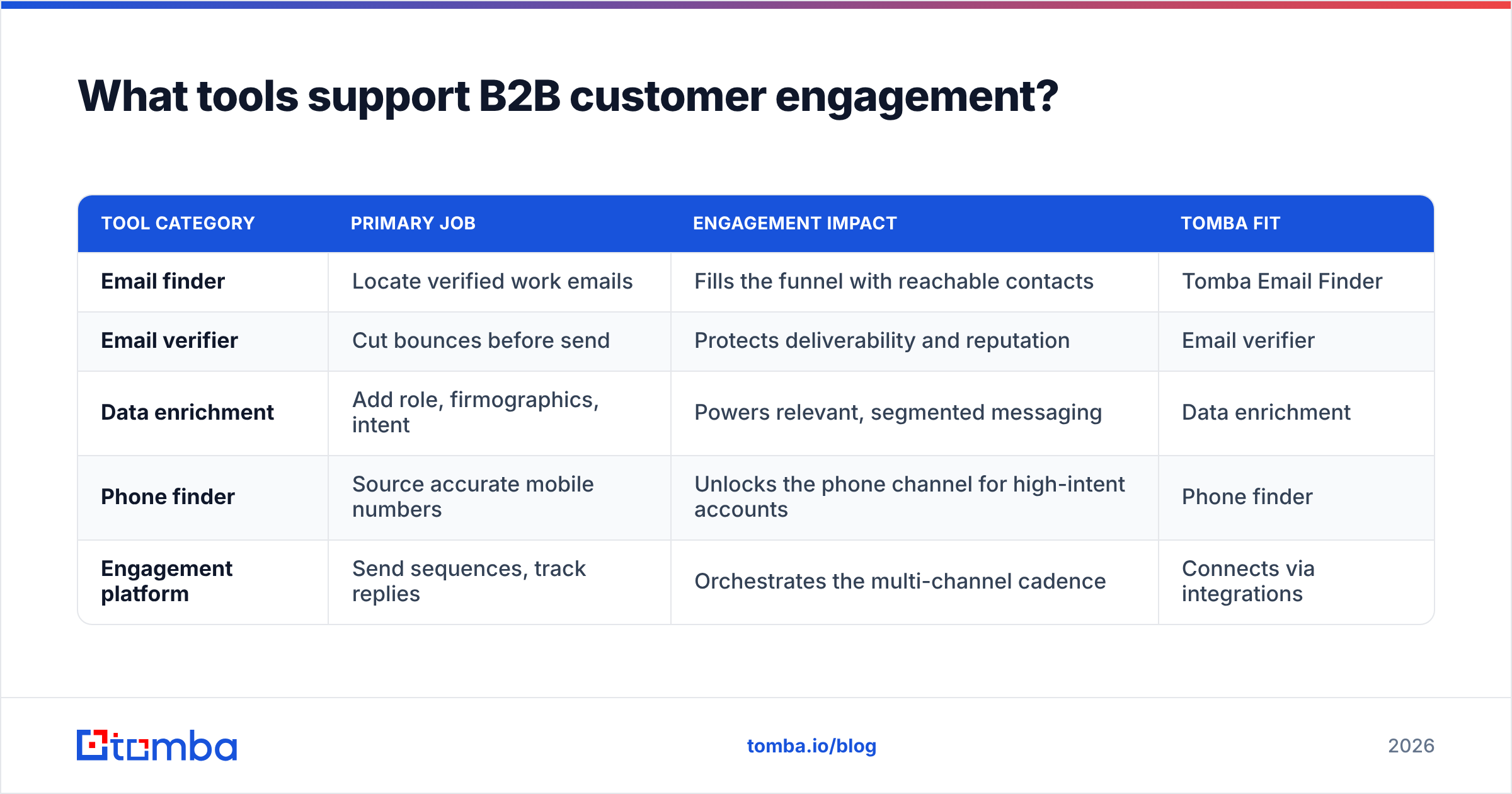
The 2026 stack is consolidating. Buyers are tired of stitching together a finder, a verifier, an enrichment vendor, and three integrations. They want a reliable source of contact truth that plugs into the engagement tools they already run. Here is how the categories compare.
| Tool category | Primary job | Engagement impact | Tomba fit |
|---|---|---|---|
| Email finder | Locate verified work emails | Fills the funnel with reachable contacts | Tomba Email Finder |
| Email verifier | Cut bounces before send | Protects deliverability and reputation | Email verifier |
| Data enrichment | Add role, firmographics, intent | Powers relevant, segmented messaging | Data enrichment |
| Phone finder | Source accurate mobile numbers | Unlocks the phone channel for high-intent accounts | Phone finder |
| Engagement platform | Send sequences, track replies | Orchestrates the multi-channel cadence | Connects via integrations |
The pattern is clear: engagement platforms sequence and track, but they are only as good as the contacts you load into them. The data layer underneath — finding, verifying, and enriching — is what determines whether your sequences reach humans or bounce into the void.
For teams that want to plug accuracy directly into their workflow, the Tomba API, browser extension, and spreadsheet add-ons let you verify and enrich at the point of work instead of in a separate batch job. Pricing scales from a free tier (25 searches/mo) through Starter at $49/mo and Growth at $99/mo — see full Tomba pricing for the breakdown.
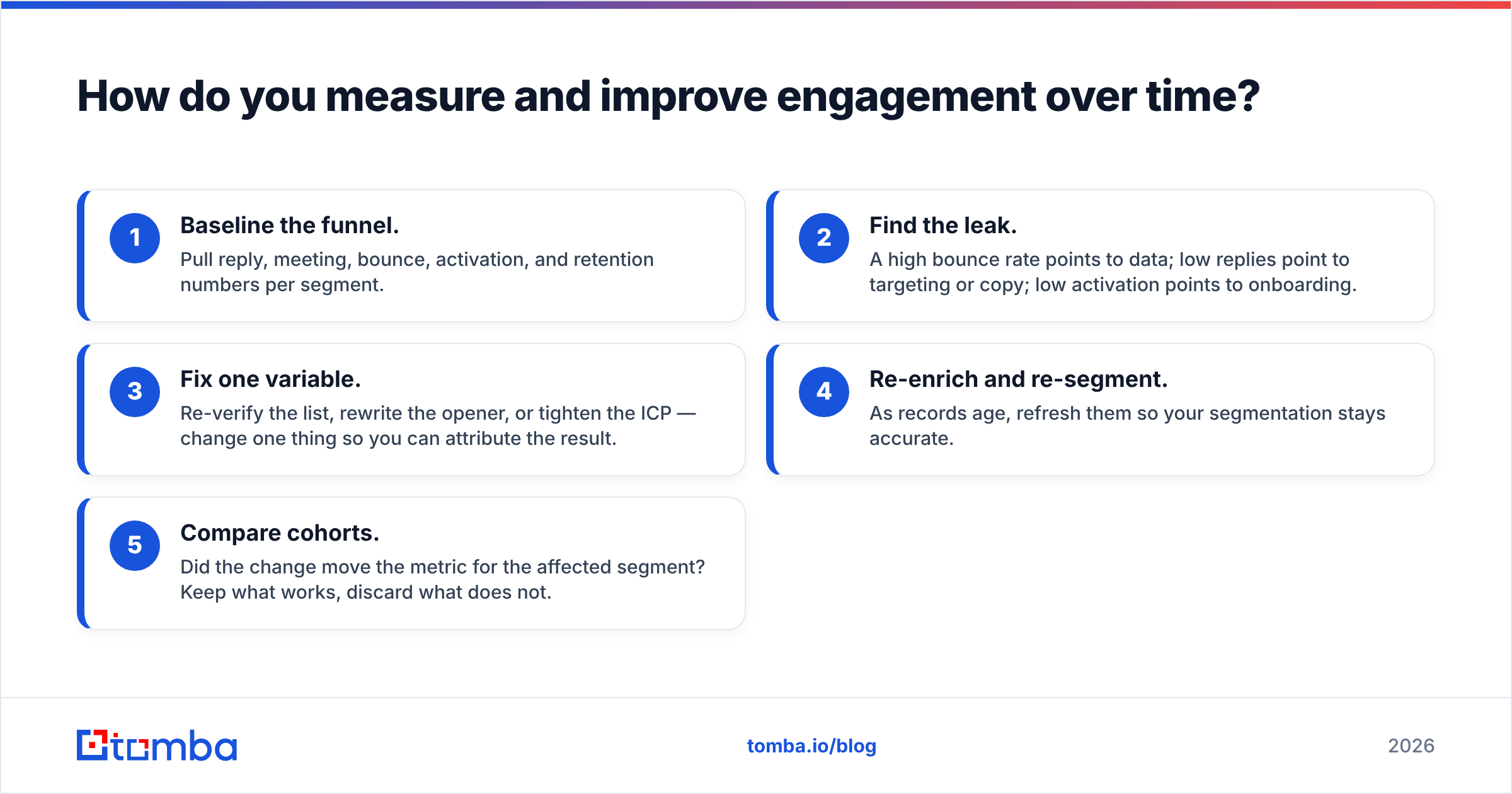
How do you measure and improve engagement over time?#
Engagement is a flywheel, not a campaign. You measure it continuously, feed the learnings back in, and let each cycle compound. Run this loop monthly:
- Baseline the funnel. Pull reply, meeting, bounce, activation, and retention numbers per segment.
- Find the leak. A high bounce rate points to data; low replies point to targeting or copy; low activation points to onboarding.
- Fix one variable. Re-verify the list, rewrite the opener, or tighten the ICP — change one thing so you can attribute the result.
- Re-enrich and re-segment. As records age, refresh them so your segmentation stays accurate.
- Compare cohorts. Did the change move the metric for the affected segment? Keep what works, discard what does not.
The teams that win at B2B customer engagement are not the most aggressive — they are the most disciplined about data hygiene and measurement. Relevance beats volume, and relevance is built on accurate contacts.
Where should you start?#
Start where the leverage is highest: your data layer. Before you redesign sequences or add channels, make sure every contact you reach is real and reachable. The cleanest engagement strategy in the world fails on a list full of dead inboxes — and the simplest one wins when every message lands.
That is exactly the gap the Tomba Email Finder closes. Find verified professional emails by name, company, or domain; confirm them before you send; and enrich each record with the context that makes your outreach relevant. Spin up the free tier, verify your next list, and watch your bounce rate fall and your reply rate climb. Better engagement starts with better data — give your sequences contacts worth sending to.
// get started
Find, verify and enrich your first contacts today
Start on the free plan with 25 searches a month, then scale when your team is ready.
Free plan · No credit card required · GDPR & CCPA
// about the author