B2B Customer Engagement Strategies: 9 Proven Plays for 2026
Most B2B engagement programs stall because they confuse activity with relationship. Here are nine data-backed strategies — and the metrics that prove they work — for 2026.
B2B customer engagement is not a dashboard number you watch go up. It is the sum of every relevant, well-timed interaction a buyer or customer has with your company — and in 2026, the teams winning at it treat engagement as a discipline, not a campaign. This guide breaks down nine strategies that actually move retention, expansion, and pipeline, plus the metrics that tell you whether each one is working.
TL;DR#
- Engagement is relationship velocity, not activity volume. More emails sent is not more engagement — relevance and timing are.
- Segment before you personalize. Personalization on top of bad data is just faster spam; clean, enriched records are the prerequisite.
- Go multi-channel on the buyer's terms — email, LinkedIn, phone, and product — sequenced, not blasted in parallel.
- Tie every play to a metric: response rate, product adoption, NPS, expansion revenue, and net revenue retention.
- Tooling matters less than data quality. The best cadence fails on stale contacts; accurate contact data is the foundation under all nine plays.
What are B2B customer engagement strategies?#
B2B customer engagement strategies are the repeatable systems a company uses to build and sustain relationships across the full lifecycle — from first touch to renewal and expansion. Unlike B2C engagement, which optimizes for high-volume, emotional, fast-cycle purchases, B2B engagement deals with multi-stakeholder buying committees (Gartner pegs the typical group at six to ten people), long sales cycles, and relationships measured in years rather than transactions.
That changes what "engagement" means. A B2C brand wants clicks and add-to-carts. A B2B company wants the VP of Engineering to forward your case study to the CFO, the champion to bring you into the QBR, and the admin to actually log in next Tuesday. Engagement here is about advancing a relationship inside an account, not racking up opens.
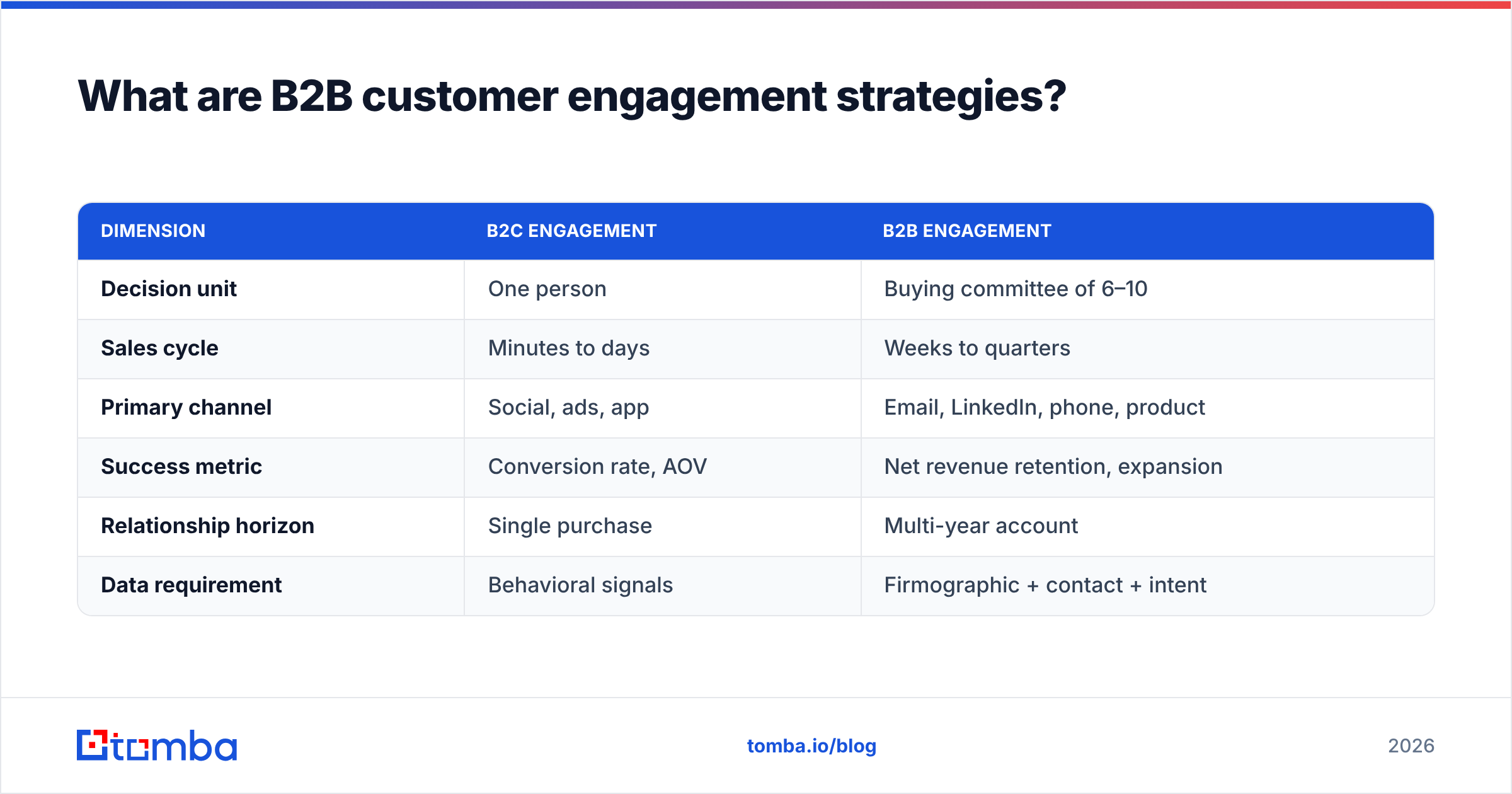
Here is how the two models diverge:
| Dimension | B2C engagement | B2B engagement |
|---|---|---|
| Decision unit | One person | Buying committee of 6–10 |
| Sales cycle | Minutes to days | Weeks to quarters |
| Primary channel | Social, ads, app | Email, LinkedIn, phone, product |
| Success metric | Conversion rate, AOV | Net revenue retention, expansion |
| Relationship horizon | Single purchase | Multi-year account |
| Data requirement | Behavioral signals | Firmographic + contact + intent |
The practical takeaway: B2B engagement lives or dies on data and orchestration, not creative volume. You cannot engage a committee you cannot reach, and you cannot personalize for a stakeholder whose role you do not know.
Why do most B2B engagement programs fail?#
Most programs fail because they optimize the wrong thing. Teams measure emails sent, sequences launched, and touches logged — proxies for effort — instead of relationship progress. The result is high activity and flat outcomes.
The three most common failure modes:
- Spray-and-pray outreach. Generic messaging blasted to a purchased list. It burns sender reputation and trains buyers to ignore you.
- Stale or wrong contact data. Roughly a quarter to a third of B2B contact data decays every year as people change jobs. A "personalized" email to someone who left 14 months ago is worse than no email.
- Single-channel dependence. Email-only programs cap out fast. Buyers research on LinkedIn, take calls, and evaluate inside your product — engagement has to follow them.
Fix the data layer first. A clean, current, enriched contact record is what makes every downstream play — segmentation, personalization, multi-channel timing — actually land. This is why teams pair their engagement stack with data enrichment before scaling cadence.
What are the 9 core B2B customer engagement strategies?#
Below are the nine plays, ordered roughly by dependency — earlier ones unlock the later ones.
1. Segment by account and persona, not by list. Group accounts by ICP fit, industry, and stage; then map the personas inside each (economic buyer, champion, end user). Engagement copy written for "marketers" converts worse than copy written for "RevOps leaders at 200-person SaaS firms."
2. Personalize on verified data. Use role, company event, tech stack, and recent trigger — not just {{first_name}}. Personalization only works when the underlying record is accurate, so verify emails and refresh enrichment before each push.
3. Build a multi-channel cadence. Sequence email → LinkedIn → phone → email over 2–3 weeks instead of firing all channels at once. Coordinated, spaced touches feel like a relationship; simultaneous ones feel like a swarm.
4. Lead with value, not the ask. Share a relevant benchmark, teardown, or insight before requesting a meeting. The first three touches should give before they take.
5. Engage the whole buying committee. Multi-thread early. A deal anchored to one champion dies when that champion leaves. Map and reach the other stakeholders deliberately.
6. Trigger on behavior and intent. Tie outreach to real signals — pricing-page visits, product usage drops, funding events — so timing matches buyer context.
7. Operationalize onboarding engagement. The highest-leverage engagement window is the first 30–90 days post-sale. Drive activation milestones, not just check-in calls.
8. Run a deliberate expansion motion. Engagement is not just acquisition. Usage reviews, feature nudges, and exec business reviews drive the net-revenue-retention number that compounds.
9. Close the loop with measurement. Every play reports to a metric (see the metrics section). Kill what does not move the number.
You do not need all nine on day one. Start with 1–3, because segmentation, data accuracy, and multi-channel sequencing are the foundation the other six stand on.
How do you personalize engagement at scale without faking it?#
Personalization at scale works when the data scales, not when a human hand-writes 500 emails. The pattern: enrich records with structured attributes (role, seniority, company size, tech stack, recent trigger), then template around those variables so each message is genuinely specific without manual effort.
That requires reliable contact discovery. Pulling correct, verified addresses for named stakeholders inside a target account is the difference between reaching the buying committee and guessing at it — which is exactly what a domain search and a quality email finder are for. Feed those verified contacts into your sequencing tool with enrichment attributes attached, and "personalization at scale" stops being a contradiction.
Two guardrails keep it honest:
- Verify before send. Bounces above ~3% drag your sender reputation and push future messages to spam. Run lists through verification first.
- Personalize the insight, not just the field. Merge-tagging a first name is table stakes. Referencing the prospect's recent product launch or a hiring spike is what earns a reply.
Which channels should a B2B engagement strategy use?#
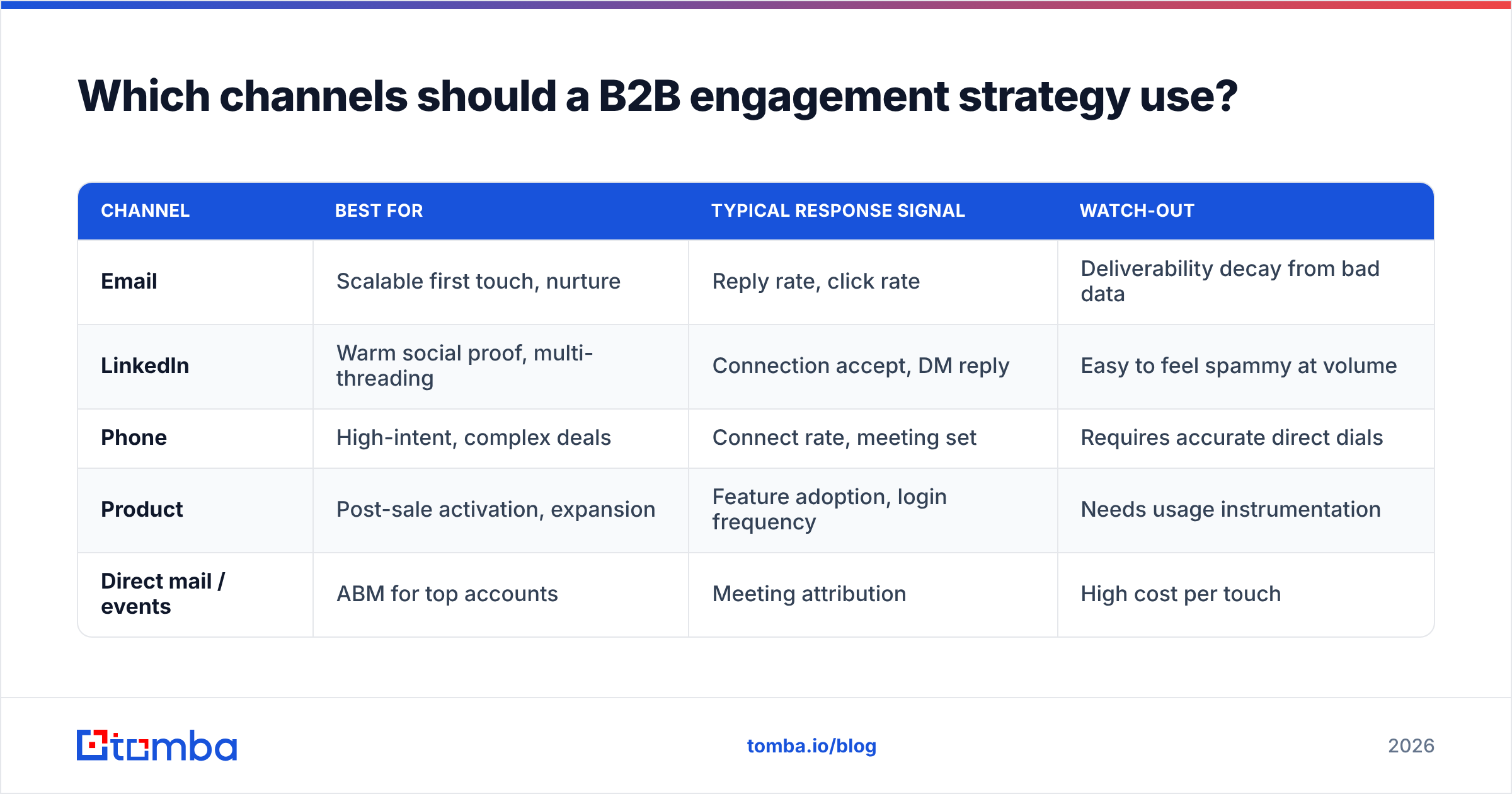
Use the channels your buyers already use — typically email as the backbone, LinkedIn for warm social touches, phone for high-intent moments, and the product itself for post-sale engagement. The mistake is treating these as separate programs instead of one orchestrated cadence.
Here is a comparison of the primary channels and where each fits:
| Channel | Best for | Typical response signal | Watch-out |
|---|---|---|---|
| Scalable first touch, nurture | Reply rate, click rate | Deliverability decay from bad data | |
| Warm social proof, multi-threading | Connection accept, DM reply | Easy to feel spammy at volume | |
| Phone | High-intent, complex deals | Connect rate, meeting set | Requires accurate direct dials |
| Product | Post-sale activation, expansion | Feature adoption, login frequency | Needs usage instrumentation |
| Direct mail / events | ABM for top accounts | Meeting attribution | High cost per touch |
The orchestration rule: never let one channel run blind to the others. A LinkedIn touch should reference the email; a call should follow a viewed asset. For phone-led motions, accurate direct dials matter as much as accurate emails — a phone finder keeps that channel from collapsing into wrong-number waste. HubSpot's research on multi-channel sequences consistently shows coordinated cadences outperform single-channel by a wide margin; their sales engagement guidance is a solid free reference for cadence design.
How do you measure B2B customer engagement?#
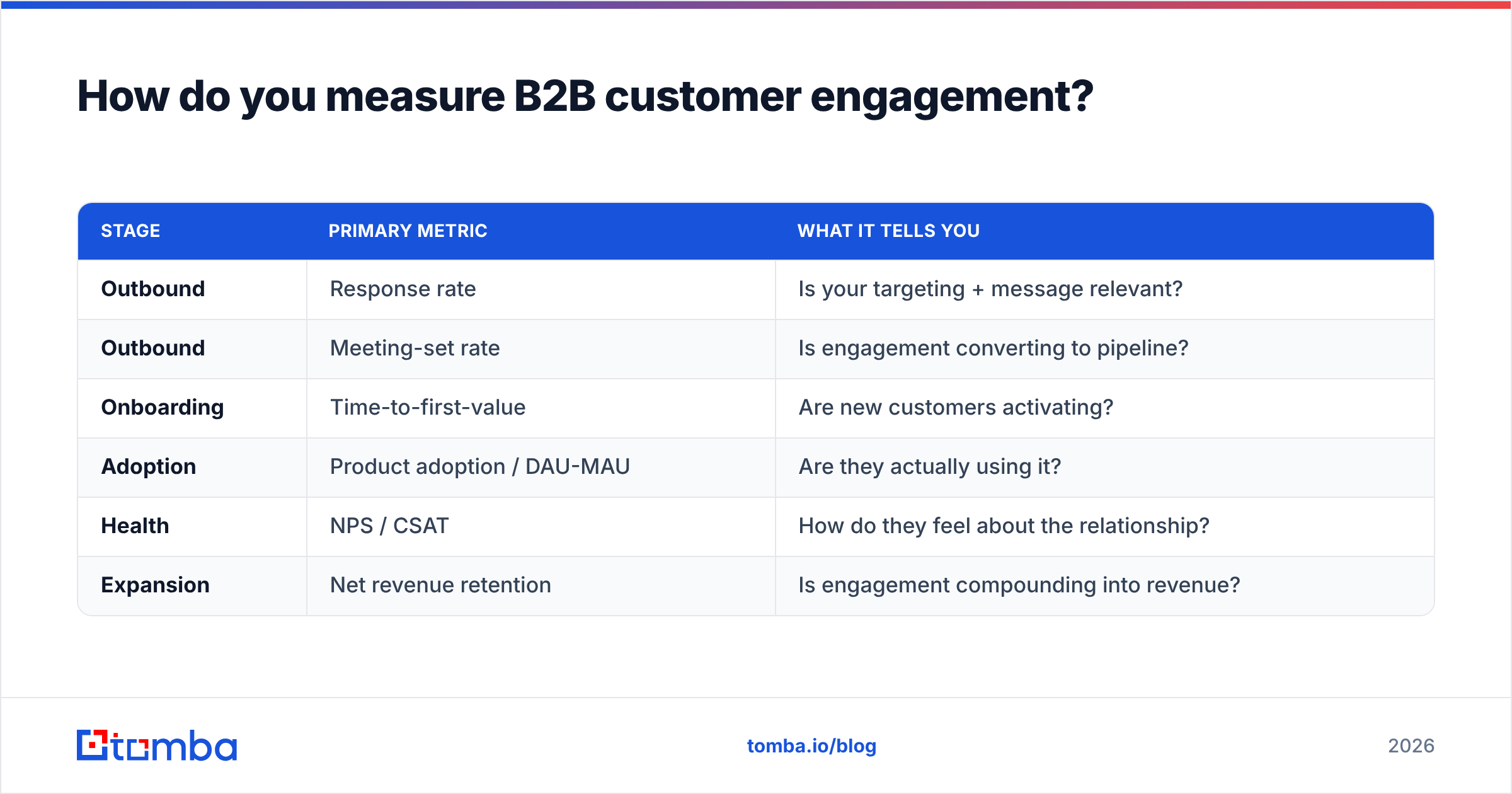
Measure engagement at three levels: interaction quality, relationship health, and revenue outcome. Vanity metrics (emails sent, total touches) belong to none of these.
The metrics that matter, by lifecycle stage:
| Stage | Primary metric | What it tells you |
|---|---|---|
| Outbound | Response rate | Is your targeting + message relevant? |
| Outbound | Meeting-set rate | Is engagement converting to pipeline? |
| Onboarding | Time-to-first-value | Are new customers activating? |
| Adoption | Product adoption / DAU-MAU | Are they actually using it? |
| Health | NPS / CSAT | How do they feel about the relationship? |
| Expansion | Net revenue retention | Is engagement compounding into revenue? |
Net revenue retention (NRR) is the metric that ties engagement to the business. According to widely cited SaaS benchmarks tracked by analysts and review platforms like G2, best-in-class B2B SaaS companies run NRR above 120% — meaning engagement and expansion outpace churn. If your engagement program is working, NRR is where you will see it, not in open rates.
A practical reporting cadence: review response and meeting-set rates weekly (leading indicators), adoption and health quarterly, and NRR every quarter against your renewal cohort.
What tools support a B2B engagement strategy?#
Your stack has four layers, and most teams over-invest in the top layer (sequencing) while neglecting the bottom (data). The layers, bottom-up:
- Data layer — accurate, enriched, verified contact and account data. This is the foundation; everything above it inherits its quality.
- CRM layer — your single source of truth. See CRM fundamentals if you are formalizing this.
- Engagement layer — sequencing, multi-channel cadence, and triggers.
- Analytics layer — attribution and the metrics above.
The data layer is where engagement programs quietly win or lose. A flawless cadence built on a list that is 30% decayed will underperform a mediocre cadence on clean data every time. That is why teams plug a contact-data source like Tomba into the bottom of the stack — finding and verifying the right people inside target accounts — and let the engagement tools do what they are good at on top. Tomba's HubSpot integration and Salesforce integration sync verified contacts directly into the CRM so the engagement layer always works from current data.
For reference on plans and what each tier includes, see Tomba pricing: a Free tier (25 searches/month), Starter at $49/mo, Growth at $99/mo, and Pro at $249/mo cover most team sizes before you hit Enterprise.
What does a 90-day engagement rollout look like?#
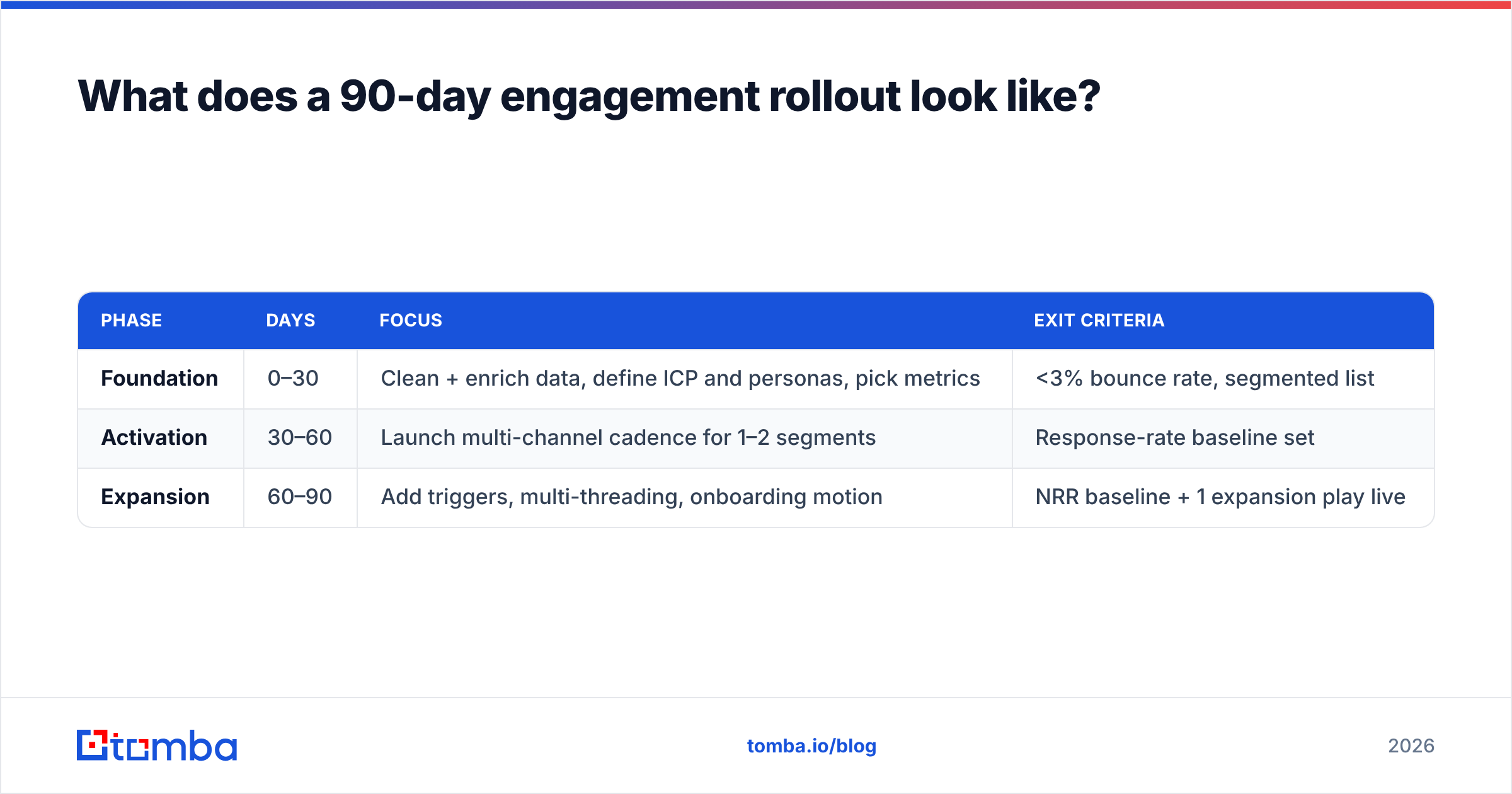
Do not try to deploy all nine plays at once. A staged 90-day rollout beats a big-bang launch because each phase produces the data the next one needs.
| Phase | Days | Focus | Exit criteria |
|---|---|---|---|
| Foundation | 0–30 | Clean + enrich data, define ICP and personas, pick metrics | <3% bounce rate, segmented list |
| Activation | 30–60 | Launch multi-channel cadence for 1–2 segments | Response-rate baseline set |
| Expansion | 60–90 | Add triggers, multi-threading, onboarding motion | NRR baseline + 1 expansion play live |
The Foundation phase is non-negotiable. If you skip data cleanup, you spend the next two phases optimizing a leaky bucket. Verify, enrich, and segment first — then layer cadence and triggers on a base you can trust.
Frequently asked questions#
How is B2B customer engagement different from customer experience? Engagement is the set of deliberate interactions you initiate and the buyer responds to; customer experience is the buyer's holistic perception across all of them. Engagement is a lever; experience is the outcome.
What is a good response rate for B2B outreach? It varies by channel and targeting, but well-segmented, verified, multi-channel cadences typically outperform generic email-only blasts by several multiples. Track your own baseline and improve against it rather than chasing a universal number.
Do I need an expensive platform to start? No. Start with clean data, a CRM you already own, and a simple email-plus-LinkedIn cadence. Add tooling as volume and complexity grow.
How often should contact data be refreshed? At least quarterly, and before any major campaign. With ~25–30% annual decay, a list untouched for a year is meaningfully degraded.
Where should you start?#
Start at the bottom of the stack: get the data right. Every engagement strategy in this guide — segmentation, personalization, multi-channel cadence, multi-threading the committee — depends on reaching the correct person at the correct company with a verified address. That is precisely what the Tomba Email Finder is built for: find professional email addresses by domain, name, or company, verify them before you send, and feed clean records straight into HubSpot, Salesforce, or your sequencer.
Build the engagement program on accurate data, tie each play to a metric, and roll it out in 90-day phases. Do that, and engagement stops being a vanity dashboard and starts showing up where it counts — in net revenue retention. Try Tomba's Free tier (25 searches/month) to clean up your first target segment, then scale the cadence on top of data you can trust.
// get started
Find, verify and enrich your first contacts today
Start on the free plan with 25 searches a month, then scale when your team is ready.
Free plan · No credit card required · GDPR & CCPA
// about the author