B2B Customer Journey Map: A 2026 Framework for Sales Teams
A practical 2026 guide to building a B2B customer journey map: the six stages, the data each one needs, and the tools that turn the map into pipeline.
A B2B customer journey map is the single most useful document most revenue teams never finish. Marketing draws one version, sales keeps another in their heads, and customer success works from a third. This guide gives you one map, the stages that actually matter in 2026, and the data you need at each step so the map drives pipeline instead of decorating a Notion page.
TL;DR#
- A B2B customer journey map is a visual model of every stage a buying committee moves through, from first awareness to renewal and advocacy.
- B2B journeys are non-linear and involve 6–10 stakeholders, so map the buying committee, not a single persona.
- The six core stages are Awareness, Consideration, Evaluation, Purchase, Onboarding, and Expansion — each needs its own content, owner, and KPI.
- A map is only as good as the contact data behind it; stale emails and missing roles break attribution at every stage.
- Start with one segment, instrument the touchpoints you already have, then enrich the gaps with tools like a data enrichment layer.
What is a B2B customer journey map?#
A B2B customer journey map is a visual representation of the end-to-end experience a company has with your product, broken into stages and touchpoints. Think of it like a subway map for a city you sell into: stations are the moments that matter (a demo, a security review, a renewal call), and the colored lines are the different people on the buying committee riding through.
The difference from a B2C map is the cast. In B2C, one person decides. In B2B, Gartner puts the typical buying group at six to ten people, each with veto power and their own definition of "value." Your map has to account for the champion who loves you, the CFO who only cares about ROI, and the security lead who can stall a deal for six weeks.
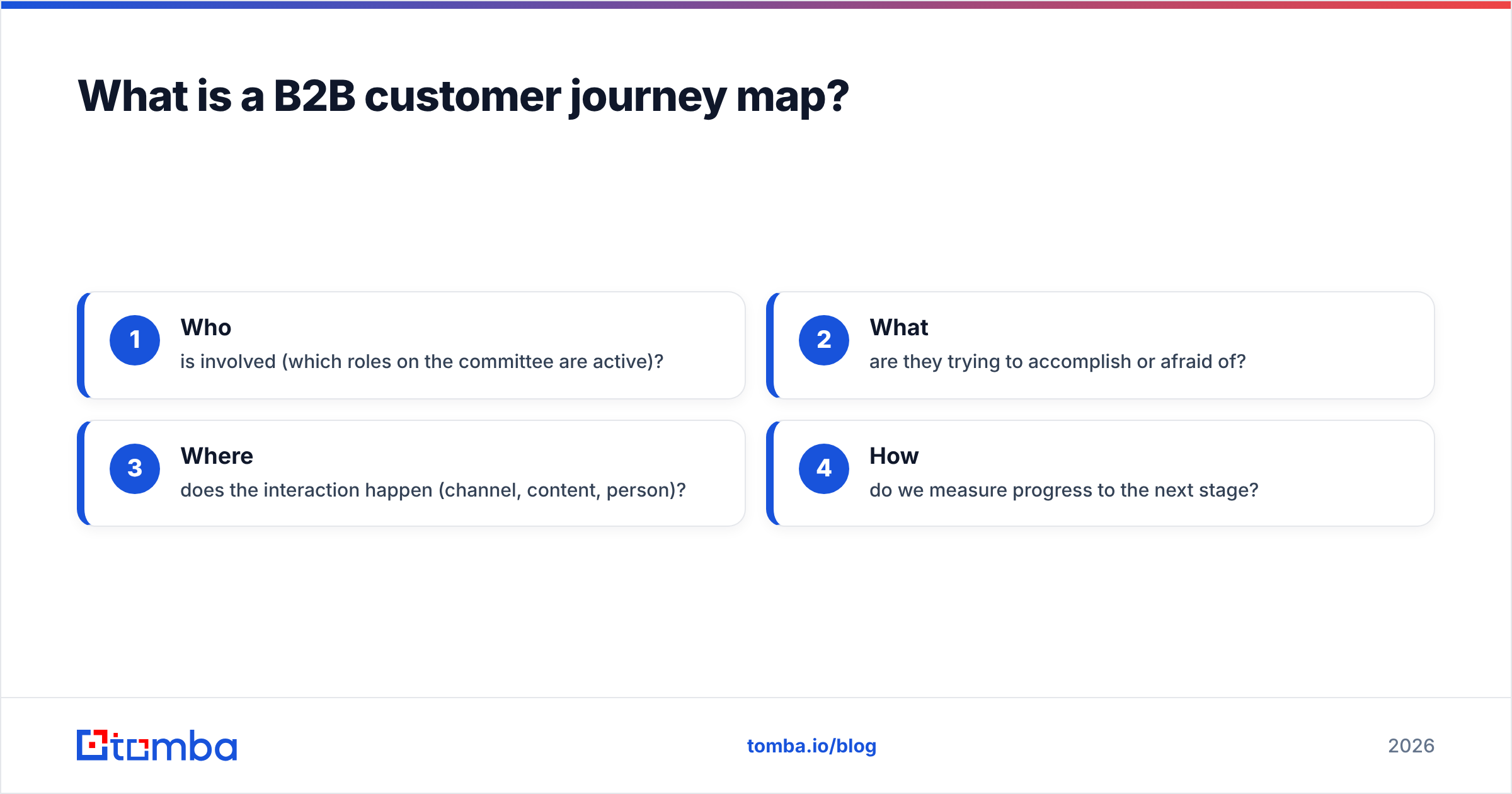
A good map answers four questions for every stage:
- Who is involved (which roles on the committee are active)?
- What are they trying to accomplish or afraid of?
- Where does the interaction happen (channel, content, person)?
- How do we measure progress to the next stage?
Why do B2B journey maps fail?#
Most maps fail because they describe a fantasy. They assume a tidy line from "blog post" to "signed contract," when real buyers loop back, go dark for a quarter, and bring in three new stakeholders the week before close.
The three failure modes are predictable:
- Persona, not committee. Mapping "the VP of Sales" ignores the analyst who actually runs the trial and the procurement lead who negotiates terms.
- No data spine. The map names touchpoints but never connects them to records in your CRM. You cannot measure stage conversion if contacts aren't enriched and matched to accounts.
- Owned by one team. Marketing builds it, hands it off, and nobody updates it. A journey map is a living revenue operations artifact, not a launch deck.
Fixing the first two is mostly a data problem, which is why teams that invest in clean contact records get far more out of mapping than teams that just run more workshops.
What are the stages of a B2B customer journey?#
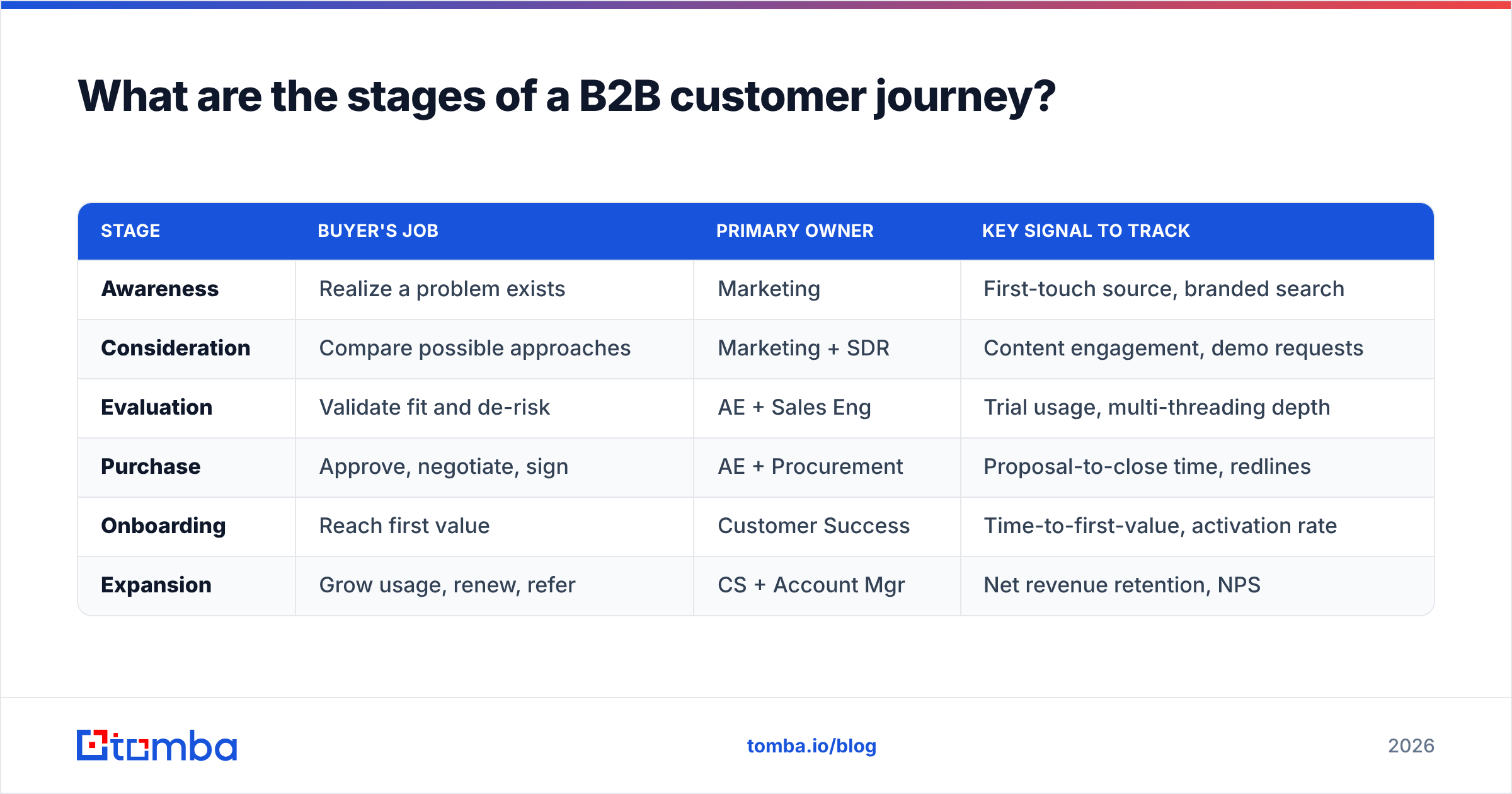
The stages below cover the full lifecycle. Your industry may rename them, but the underlying jobs are consistent. Use this as a structured reference and adapt the owners to your org.
| Stage | Buyer's job | Primary owner | Key signal to track |
|---|---|---|---|
| Awareness | Realize a problem exists | Marketing | First-touch source, branded search |
| Consideration | Compare possible approaches | Marketing + SDR | Content engagement, demo requests |
| Evaluation | Validate fit and de-risk | AE + Sales Eng | Trial usage, multi-threading depth |
| Purchase | Approve, negotiate, sign | AE + Procurement | Proposal-to-close time, redlines |
| Onboarding | Reach first value | Customer Success | Time-to-first-value, activation rate |
| Expansion | Grow usage, renew, refer | CS + Account Mgr | Net revenue retention, NPS |
Notice that ownership shifts three times. Each handoff is a place where the journey breaks if data doesn't travel with the account — the AE needs to see what the SDR learned, and CS needs the context the AE captured during evaluation.
Awareness and Consideration#
Early stages are about reach and education. The buyer often isn't a named lead yet — they're anonymous traffic, a LinkedIn follower, or a name on a colleague's forwarded email. This is where identifying who is actually researching you pays off. Tools that handle website visitor reveal and pattern-based prospecting help you turn that anonymous interest into a real contact you can map.
Evaluation and Purchase#
This is the longest, highest-risk stretch of a B2B journey. Multi-threading — having relationships with several committee members — is the single biggest predictor of win rate. To multi-thread, you need accurate contact details for people the champion hasn't introduced you to yet. That's a direct use case for an email finder and a phone finder: you map the org chart, then fill in the contact gaps so no stakeholder is a black box.
Onboarding and Expansion#
The journey doesn't end at signature. HubSpot's research on retention consistently shows that expansion revenue is cheaper to win than new logos. Map onboarding milestones explicitly, assign a CS owner, and track time-to-first-value as carefully as you track demo bookings.
How do you build a B2B customer journey map? (step by step)#
Here is the workflow that gets a usable map in under two weeks, rather than a quarter-long project that dies in committee.
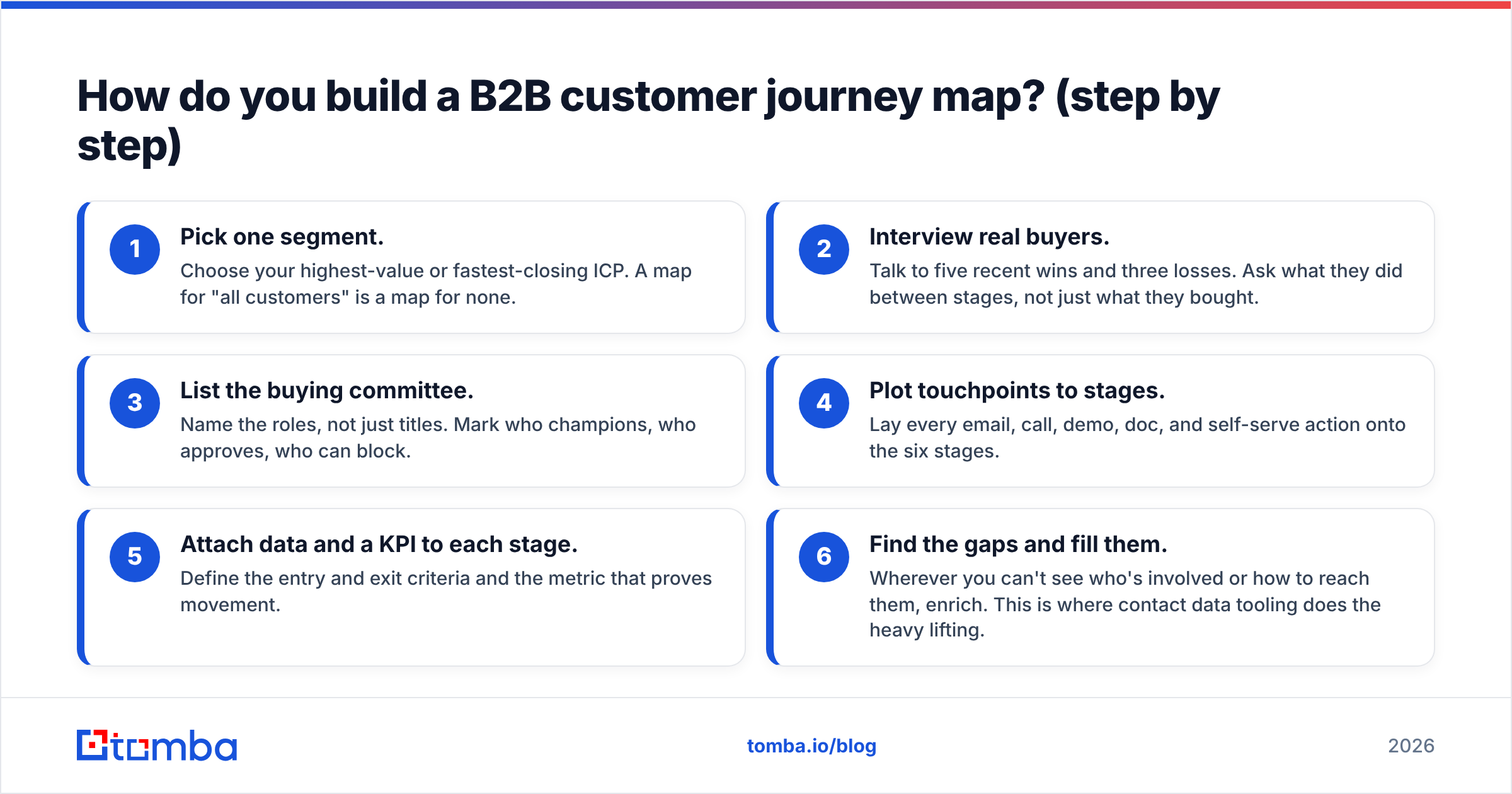
- Pick one segment. Choose your highest-value or fastest-closing ICP. A map for "all customers" is a map for none.
- Interview real buyers. Talk to five recent wins and three losses. Ask what they did between stages, not just what they bought.
- List the buying committee. Name the roles, not just titles. Mark who champions, who approves, who can block.
- Plot touchpoints to stages. Lay every email, call, demo, doc, and self-serve action onto the six stages.
- Attach data and a KPI to each stage. Define the entry and exit criteria and the metric that proves movement.
- Find the gaps and fill them. Wherever you can't see who's involved or how to reach them, enrich. This is where contact data tooling does the heavy lifting.
Step six is the one teams skip and regret. You can map a beautiful evaluation stage, but if 40% of the committee contacts in your CRM bounce, your sequences die and your attribution lies to you. Run new contacts through an email verifier before they enter a sequence, and use domain search to find the stakeholders you haven't met yet at a target account.
What tools support a B2B customer journey map?#
You need three layers of tooling: a place to store the journey (CRM), a way to move buyers through it (engagement/automation), and a data layer that keeps the whole thing accurate. Most teams over-invest in the first two and starve the third.
| Layer | What it does | Examples | Where it fits |
|---|---|---|---|
| System of record | Stores accounts, contacts, stages | Salesforce, HubSpot, Pipedrive | All stages |
| Engagement | Runs outreach and sequences | Outreach, Salesloft, Instantly | Consideration → Purchase |
| Data layer | Finds, verifies, enriches contacts | Tomba, |
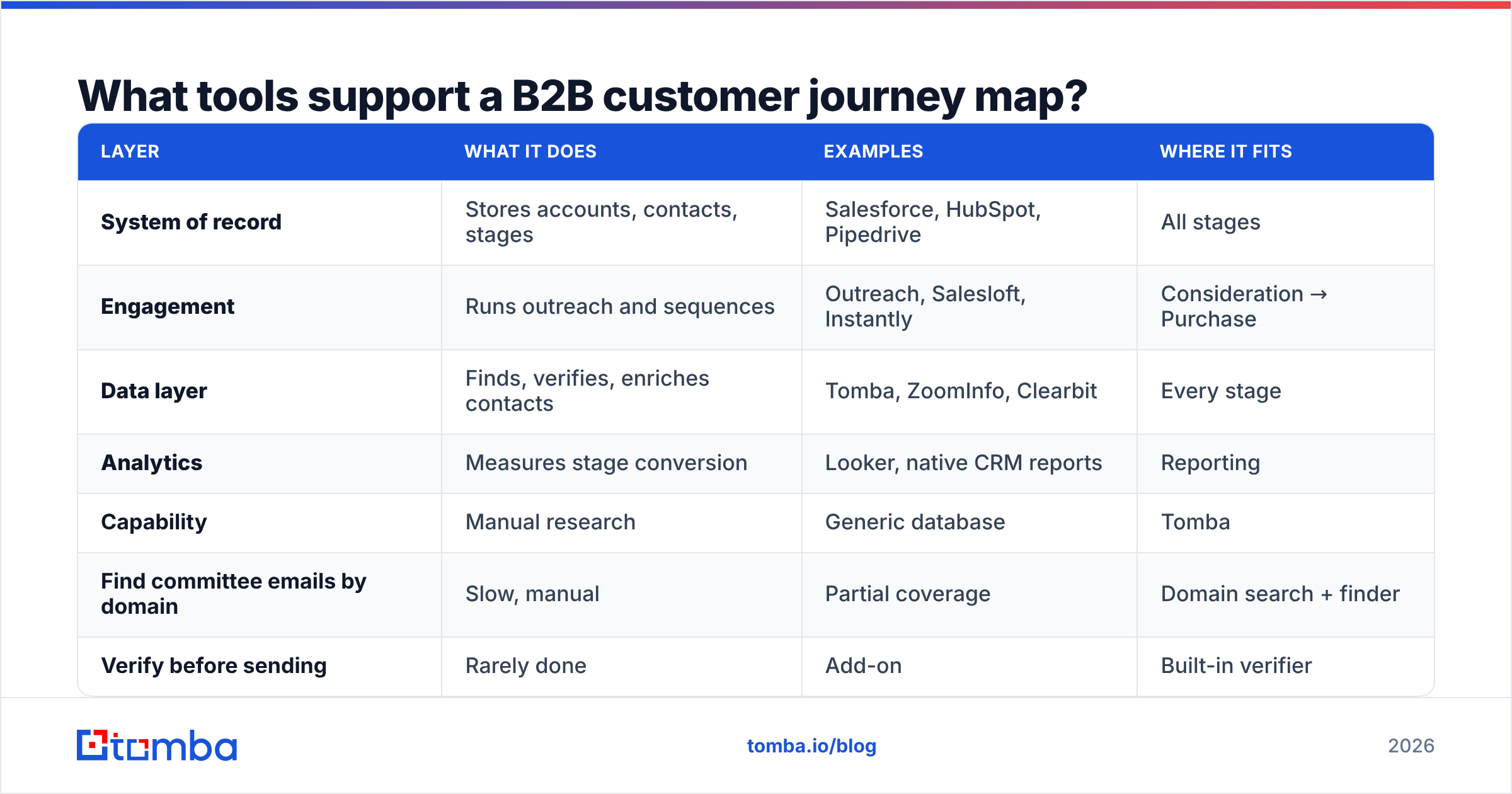
ZoomInfo, Clearbit | Every stage | | Analytics | Measures stage conversion | Looker, native CRM reports | Reporting |
The data layer is where a journey map either becomes real or stays theoretical. Compare a few common approaches:
| Capability | Manual research | Generic database | Tomba |
|---|---|---|---|
| Find committee emails by domain | Slow, manual | Partial coverage | Domain search + finder |
| Verify before sending | Rarely done | Add-on | Built-in verifier |
| Enrich existing CRM records | No | Yes, pricey | Bulk enrichment |
| Starter price | Free (your time) | Often $300+/mo | $49/mo |
| Free tier | n/a | Rare | 25 searches/mo |
You don't need the most expensive stack. You need accurate contacts attached to the right accounts at the right stage. Tomba's pricing starts free at 25 searches a month and moves to $49/mo Starter and $99/mo Growth — enough to instrument a real map without a six-figure data contract.
How do you measure a B2B customer journey?#
Measure conversion between stages, not vanity metrics within them. A thousand awareness touches mean nothing if 1% reach consideration. Track these per stage:
- Stage conversion rate — % of accounts that advance to the next stage.
- Time in stage — how long accounts sit before moving (your bottleneck detector).
- Drop-off reason — coded reasons for stalls, captured by the stage owner.
- Data completeness — % of committee contacts that are verified and reachable. A marketing qualified lead with a dead email is not a lead.
When time-in-stage spikes at Evaluation, the usual culprit is single-threading — you're waiting on one champion. The fix is mapping the rest of the committee and reaching them directly, which loops you right back to your data layer.
Common questions about B2B journey maps#
How is a journey map different from a sales funnel? A funnel is a volume metaphor (many in, few out) owned by sales. A journey map is an experience model owned across the whole revenue org, including post-sale stages a funnel ignores.
How often should you update it? Review quarterly and after any major ICP, pricing, or product change. The map is a living document tied to your sales process, not a one-time deliverable.
Do you need different maps per segment? Yes, if buying behavior differs meaningfully. Enterprise and SMB journeys rarely share the same committee size, evaluation length, or procurement steps.
Turn your journey map into pipeline#
A B2B customer journey map is only as strong as the contact data behind every stage. You can run all the workshops you want, but if you can't reach the CFO who blocks deals or the new VP who just joined the account, the map is fiction.
Start by filling the gaps. Use the Tomba Email Finder to locate every member of a buying committee by name or domain, verify each contact before it enters a sequence, and enrich your CRM so the map reflects reality. The free tier gives you 25 searches a month to test it against your top accounts — enough to see whether better data moves your stage-conversion numbers before you spend a dollar.
Map the journey. Then make sure you can actually reach everyone on it.
Ready to find emails that actually work?
Join 150,000+ professionals who stopped guessing and started sending. Free credits on signup — no credit card required.
Get the Tomba newsletter
Practical outbound tactics and product updates — once every two weeks.
About the author