B2B Customer Lifecycle Marketing: The 2026 Playbook
Map every stage from stranger to advocate, then attach the right data, message, and metric to each one. A concrete 2026 playbook for B2B customer lifecycle marketing.
TL;DR
- B2B customer lifecycle marketing is the practice of mapping a buyer's full journey — awareness, acquisition, conversion, retention, expansion, advocacy — and attaching a specific message, data trigger, and metric to each stage.
- The biggest leak in most programs is not the top of funnel. It's the handoff between stages, where lead data goes stale and ownership gets fuzzy.
- Clean, enriched contact data is the connective tissue. If your records are wrong, every downstream stage inherits the error.
- You don't need a 12-tool stack. You need a CRM, a marketing automation platform, an enrichment source, and clear stage definitions everyone agrees on.
- Measure each stage with one primary metric, not ten vanity metrics. Conversion velocity beats raw volume almost every time.
What is B2B customer lifecycle marketing?#
B2B customer lifecycle marketing is the discipline of treating a buyer relationship as a continuous loop rather than a single sale. Instead of one team chasing leads and another chasing renewals, you design coordinated touchpoints across the entire relationship — from the first anonymous website visit to the moment a happy customer refers a peer.
Think of it like tending an orchard instead of foraging. Foraging is grabbing whatever fruit you find and moving on. Tending an orchard means you plant, water, prune, harvest, and replant on a schedule — the same trees produce for years because you invested in the full cycle. Lifecycle marketing is the orchard model applied to revenue.
Technically, it sits at the intersection of marketing, sales, and customer success, which is why it usually lives under revenue operations. The lifecycle is shared property. Marketing doesn't "hand off" a lead and disappear; it keeps nurturing through expansion. Success doesn't wait for a renewal date; it feeds product-qualified signals back to marketing.

What are the stages of the B2B customer lifecycle?#
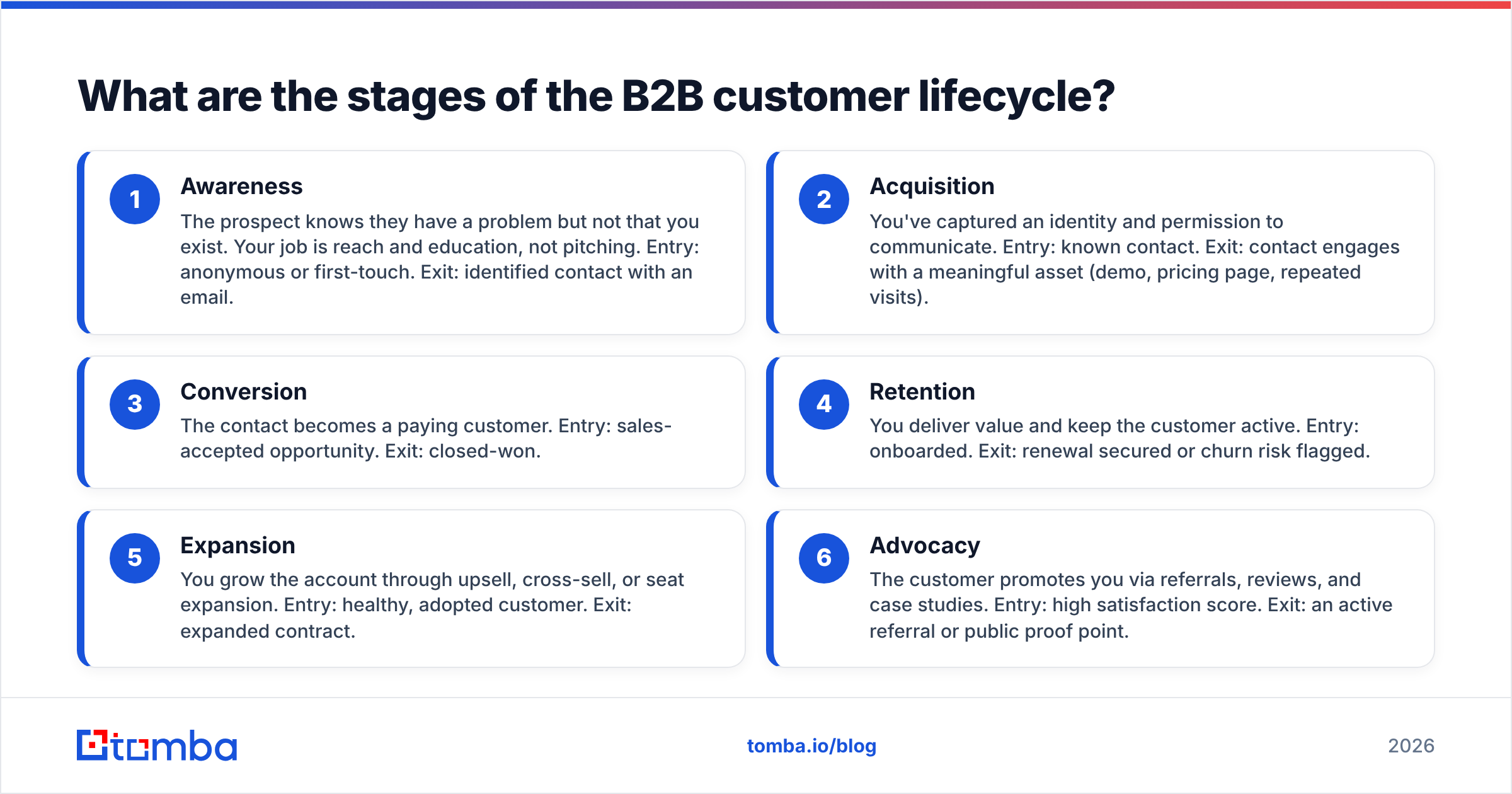
Most teams over-complicate this. You can run a serious program with six clearly defined stages. The trick is agreeing on the exact entry and exit criteria for each one so a contact can't sit in limbo.
- Awareness — The prospect knows they have a problem but not that you exist. Your job is reach and education, not pitching. Entry: anonymous or first-touch. Exit: identified contact with an email.
- Acquisition — You've captured an identity and permission to communicate. Entry: known contact. Exit: contact engages with a meaningful asset (demo, pricing page, repeated visits).
- Conversion — The contact becomes a paying customer. Entry: sales-accepted opportunity. Exit: closed-won.
- Retention — You deliver value and keep the customer active. Entry: onboarded. Exit: renewal secured or churn risk flagged.
- Expansion — You grow the account through upsell, cross-sell, or seat expansion. Entry: healthy, adopted customer. Exit: expanded contract.
- Advocacy — The customer promotes you via referrals, reviews, and case studies. Entry: high satisfaction score. Exit: an active referral or public proof point.
The mistake I see most often is teams obsessing over stages 1 and 2 while ignoring 4 through 6, where the cheapest revenue lives. Acquiring a new B2B customer can cost five times more than retaining one, and expansion revenue carries margins that new logos rarely match. According to HubSpot's research on customer lifecycle stages, the companies that grow fastest treat retention and advocacy as marketing problems, not just success problems.
How is lifecycle marketing different from a sales funnel?#
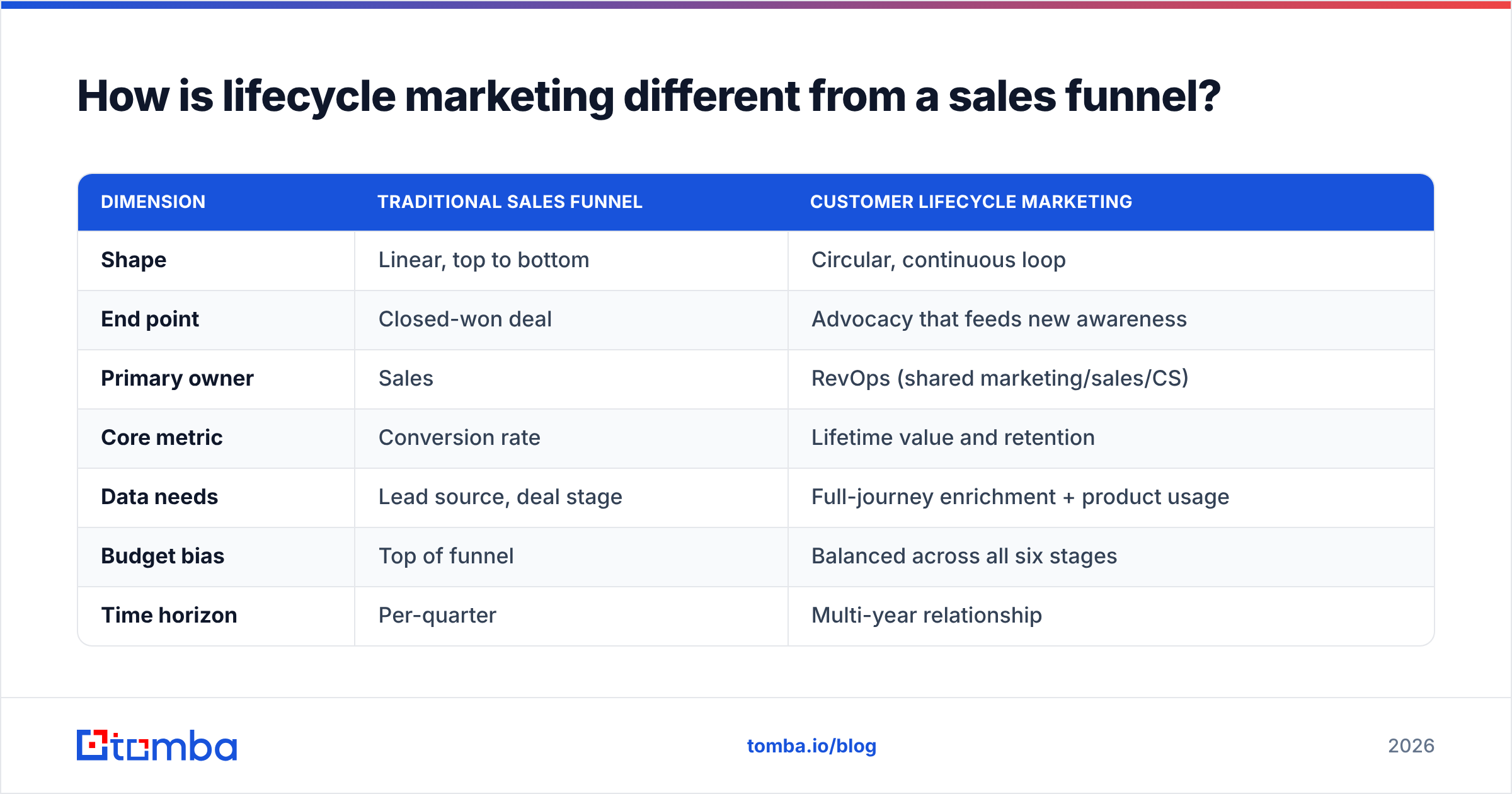
A funnel is linear and ends at the sale. A lifecycle is circular and treats the sale as the midpoint. That single difference changes how you budget, staff, and measure.
| Dimension | Traditional sales funnel | Customer lifecycle marketing |
|---|---|---|
| Shape | Linear, top to bottom | Circular, continuous loop |
| End point | Closed-won deal | Advocacy that feeds new awareness |
| Primary owner | Sales | RevOps (shared marketing/sales/CS) |
| Core metric | Conversion rate | Lifetime value and retention |
| Data needs | Lead source, deal stage | Full-journey enrichment + product usage |
| Budget bias | Top of funnel | Balanced across all six stages |
| Time horizon | Per-quarter | Multi-year relationship |
The funnel isn't wrong — it's just a slice of the lifecycle. If your whole strategy ends the day a contract is signed, you're leaving the highest-margin revenue on the table and forcing marketing to refill the top forever.
Why does data quality decide whether lifecycle marketing works?#
Bad data is the silent killer of lifecycle programs, because errors compound across stages. A misspelled email at awareness becomes a bounced nurture sequence at acquisition, a missing decision-maker at conversion, and a renewal reminder sent to someone who left the company two years ago.
Here's the chain reaction in practice:
- Wrong email at acquisition → your nurture track never reaches the buyer, so they look "cold" when they're actually just unreachable.
- Missing job title or seniority → your lead scoring misfires and sales wastes time on the wrong contact.
- Stale company data → expansion plays target accounts that already downsized or got acquired.
- No verified secondary contact → when your champion leaves, the relationship dies because you only had one email on file.
This is why enrichment isn't a nice-to-have bolted on at the top — it's maintenance you run continuously. You need a reliable way to find the right contact, verify the address is deliverable, and refresh records as people change jobs. Tools like the Tomba Email Finder and a dedicated email verifier exist precisely so the data feeding each lifecycle stage stays accurate. For account-based plays, a domain search lets you map every reachable contact at a target company instead of betting the relationship on one person.
What message and metric belong at each stage?#
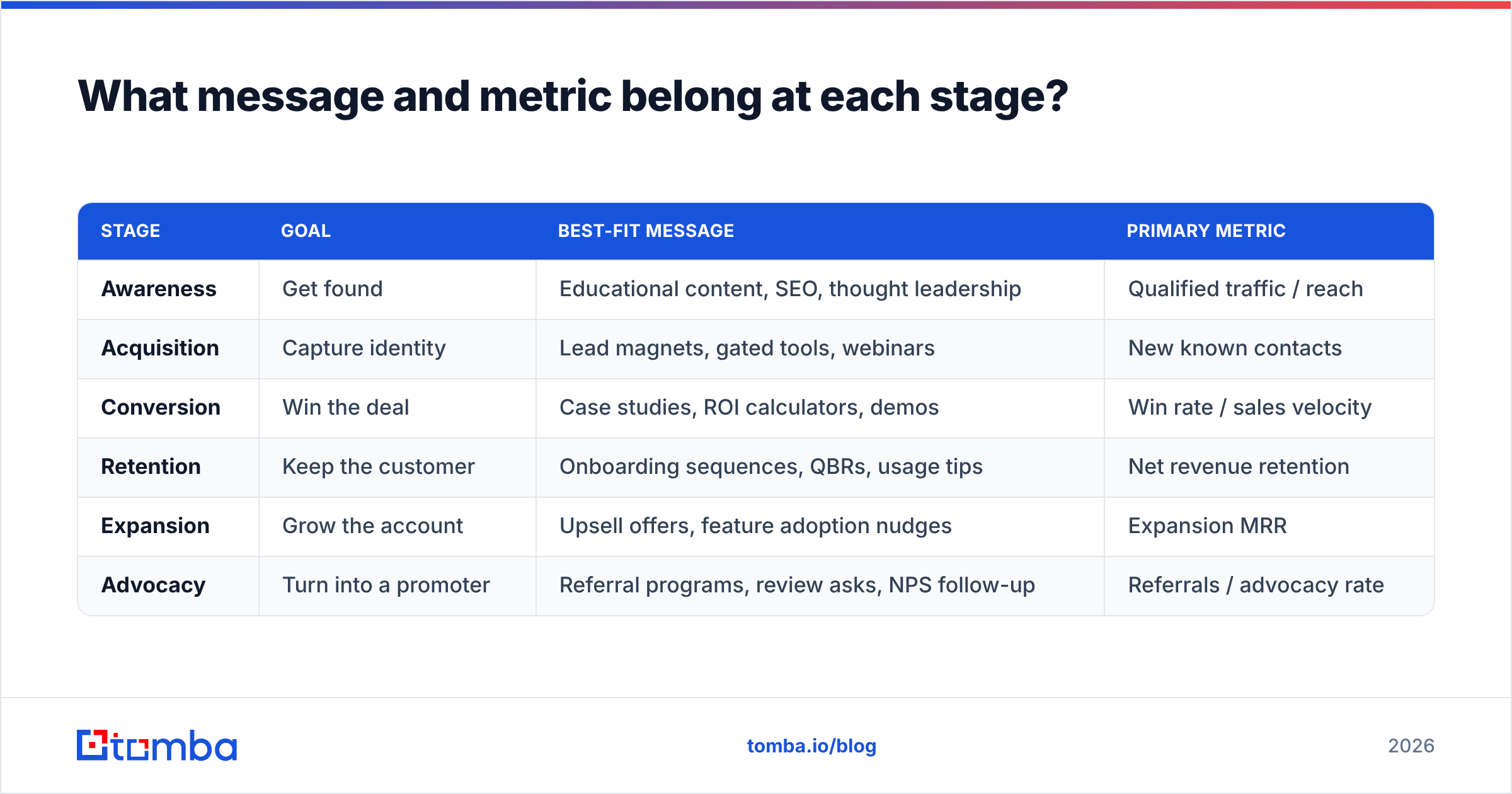
The discipline of lifecycle marketing is matching the right asset and the right number to each stage. A demo offer in the awareness stage feels pushy; an educational blog post at the conversion stage feels like a stall. Here's a concrete mapping you can adapt.
| Stage | Goal | Best-fit message | Primary metric |
|---|---|---|---|
| Awareness | Get found | Educational content, SEO, thought leadership | Qualified traffic / reach |
| Acquisition | Capture identity | Lead magnets, gated tools, webinars | New known contacts |
| Conversion | Win the deal | Case studies, ROI calculators, demos | Win rate / sales velocity |
| Retention | Keep the customer | Onboarding sequences, QBRs, usage tips | Net revenue retention |
| Expansion | Grow the account | Upsell offers, feature adoption nudges | Expansion MRR |
| Advocacy | Turn into a promoter | Referral programs, review asks, NPS follow-up | Referrals / advocacy rate |
Notice that only two of six stages are about acquiring new contacts. If your marketing calendar is 90% awareness and acquisition content, you've built a funnel wearing a lifecycle costume. Rebalance so retention and advocacy get real airtime — the email infrastructure you already own can serve a "feature you're not using" nudge as easily as a cold pitch.
How do you build the tech stack without over-buying?#
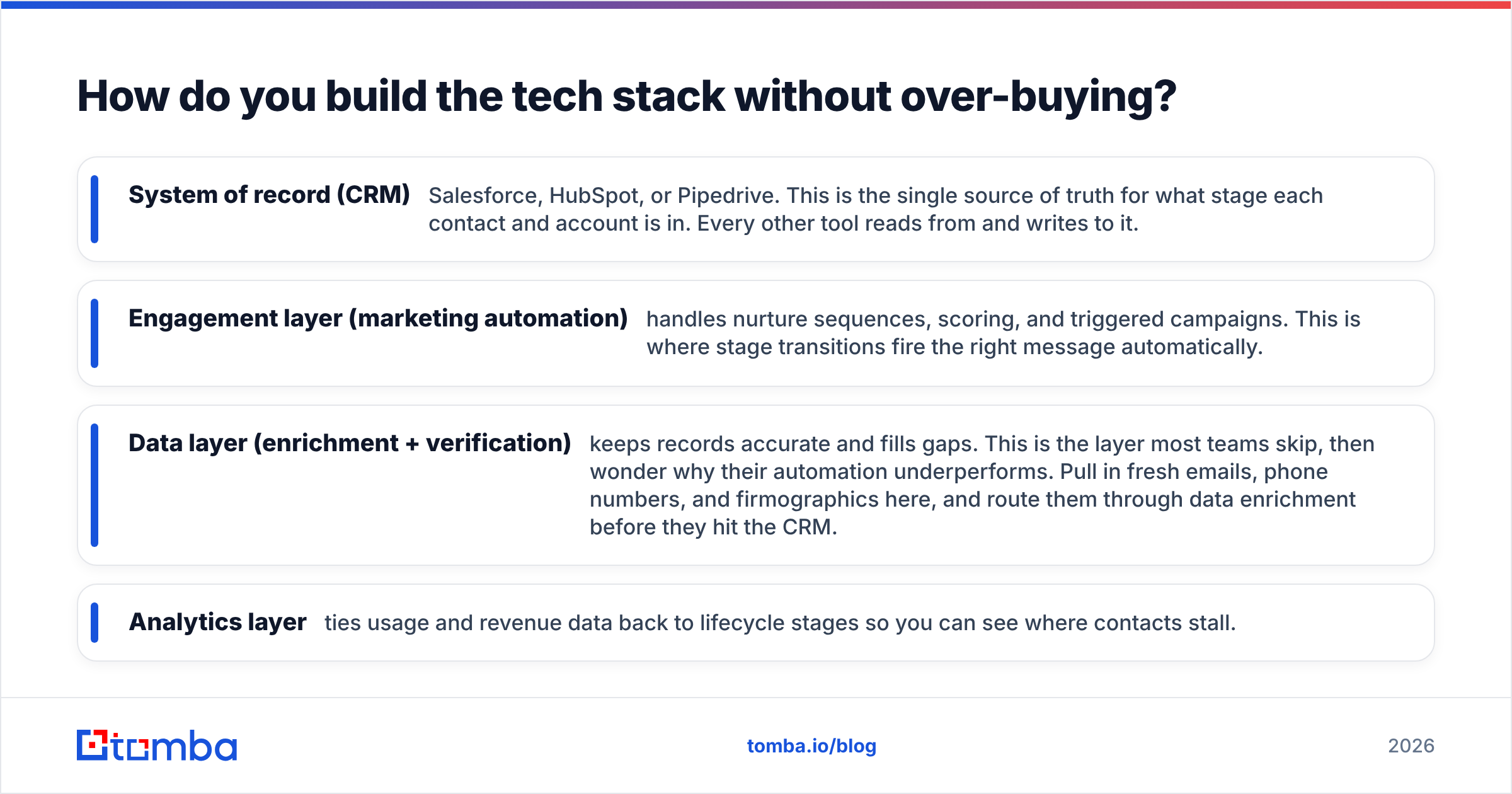
You can run a credible lifecycle program with four layers. Resist the urge to buy a tool for every stage; integration debt will eat the gains.
- System of record (CRM) — Salesforce, HubSpot, or Pipedrive. This is the single source of truth for what stage each contact and account is in. Every other tool reads from and writes to it.
- Engagement layer (marketing automation) — handles nurture sequences, scoring, and triggered campaigns. This is where stage transitions fire the right message automatically.
- Data layer (enrichment + verification) — keeps records accurate and fills gaps. This is the layer most teams skip, then wonder why their automation underperforms. Pull in fresh emails, phone numbers, and firmographics here, and route them through data enrichment before they hit the CRM.
- Analytics layer — ties usage and revenue data back to lifecycle stages so you can see where contacts stall.
The integration logic matters more than any single vendor. When a contact crosses a stage threshold — say, three pricing-page visits in a week — the data layer should confirm the contact is real and complete, the CRM should advance the stage, and the engagement layer should trigger the conversion sequence. If any link in that chain runs on stale data, the whole automation misfires. A platform-level integrations approach with your CRM keeps enrichment flowing without manual CSV gymnastics. For independent vendor comparisons before you commit, G2 grid reports are a sane starting point.
How do you measure lifecycle marketing without drowning in dashboards?#
Pick one north-star metric per stage and one program-level metric overall. The program-level number for lifecycle marketing is almost always net revenue retention (NRR) or customer lifetime value (LTV), because those capture the full loop in a single figure.
Then watch velocity, not just volume. A contact that converts in 14 days is worth more than one that converts in 90, even at the same deal size, because faster cycles mean more cycles per year and less leakage. Track how long contacts sit in each stage and attack the longest dwell times first — that's where your money is stuck.
A few rules that keep measurement honest:
- One primary metric per stage. Secondary metrics are for diagnosis, not for the executive dashboard.
- Measure transitions, not just stages. Stage-to-stage conversion rate reveals leaks that absolute counts hide.
- Tie every metric to revenue. If you can't draw a line from a number to dollars, it's a vanity metric.
- Review cohorts, not snapshots. A single-month snapshot lies; cohort retention curves tell the truth.
Industry analysts at Gartner have long argued that B2B buying is nonlinear — buyers loop back, stall, and re-enter — which is exactly why stage-transition tracking beats a tidy linear funnel report. Build your dashboard around movement between stages, and you'll spot problems a quarter before they hit the revenue number.
What does a stage-by-stage play actually look like?#
Concrete example. Say you sell project-management software to mid-market ops teams.
- Awareness: You publish a guide on reducing sprint slippage. It ranks, and ops managers find it. You capture identity with a free template download.
- Acquisition: The new contact enters a five-email nurture track. Before it sends, you verify the email and enrich the record with company size and the contact's role — confirming they're a decision-maker, not an intern.
- Conversion: Repeated demo-page visits trigger a sales alert. Because the record is complete, the rep opens with a relevant ROI case instead of a discovery call full of basic questions. You also pull the phone number so multi-channel follow-up is possible.
- Retention: Post-sale, an onboarding sequence drives feature adoption. Usage data flows back; low adoption flags a churn risk for success to handle.
- Expansion: Once the team adopts the core feature, an automated nudge introduces the premium tier with a usage-based ROI argument.
- Advocacy: A high satisfaction score triggers a referral ask and a review request — feeding fresh awareness at the top.
Every one of those transitions depends on accurate contact data. That's the unglamorous backbone of the whole program.
Common mistakes that quietly sink lifecycle programs#
- Treating handoffs as endings. When marketing "throws it over the wall," context dies. Shared stage definitions fix this.
- Letting data rot. B2B contact data decays roughly 25–30% per year as people change jobs. Without continuous verification, your lifecycle runs on fiction.
- Over-indexing on acquisition. Spending 90% of budget to fill the top while retention leaks is like bailing a boat instead of patching it.
- Too many tools, no integration. Each disconnected tool is a place where stage data drifts out of sync.
- Vanity metrics. Open rates and impressions feel productive but don't move NRR.
Fix these four and you'll outperform competitors who bought twice your stack. Lifecycle marketing rewards coordination far more than it rewards software spend.
Where should you start?#
Start with stage definitions and data quality — in that order — before you touch a new tool. Get marketing, sales, and success in one room and agree on the exact entry and exit criteria for all six stages. Then audit your contact data: run a sample of your CRM through verification and see how many records are wrong. The number usually shocks people, and it explains a lot of underperformance.
Once your stages are defined and your data is clean, the automation and measurement fall into place. The orchard tends itself once the trees are healthy.
Accurate, deliverable contact data is the foundation every lifecycle stage stands on — and it's the one piece you can fix this week. Start with the Tomba Email Finder to source and verify the right contacts at every stage, from first touch to renewal. Pair it with continuous enrichment and you'll stop losing relationships to bounced emails and stale records. Check the Tomba pricing — there's a free tier with 25 searches a month to test it against your own list before you commit a dollar.
Ready to find emails that actually work?
Join 150,000+ professionals who stopped guessing and started sending. Free credits on signup — no credit card required.
Get the Tomba newsletter
Practical outbound tactics and product updates — once every two weeks.
About the author