B2B Customer Loyalty in 2026: A Practical Retention Playbook
B2B customer loyalty is won in the quarters between renewals, not the week before. Here's how to measure it, protect it, and turn retained accounts into a growth engine in 2026.
B2B Customer Loyalty in 2026: A Practical Retention Playbook
TL;DR
- B2B customer loyalty is the compounding habit of an account renewing, expanding, and advocating — not a one-time satisfaction score.
- Net revenue retention (NRR) above 110% is the clearest signal of loyalty; logo retention alone hides shrinking accounts.
- Loyalty is built in the boring middle of the contract — onboarding, adoption, and proactive value reviews — not in the renewal scramble.
- The cheapest growth you have is the customer you already closed: expansion costs a fraction of new-logo acquisition.
- Clean contact and account data is the quiet backbone of every retention play — you can't save an account you can't reach.
If your 2026 growth plan is 90% new logos and 10% "keep the customers happy," you have the math backwards. In most B2B businesses, the accounts you already won are the cheapest, fastest, and most predictable revenue you will ever touch. This guide is about turning that fact into a system.
What is B2B customer loyalty, really?#
B2B customer loyalty is the measurable tendency of an account to renew, expand, and recommend you — driven by realized value, not switching friction.
That last clause matters. A customer who stays because ripping you out would be a six-month migration nightmare is retained, but not loyal. The moment a credible, low-friction alternative appears, they leave. True loyalty means the account would re-choose you even if switching were free.
Think of it like a gym membership versus a running habit. Anyone can buy the membership (the contract). Loyalty is the customer who actually shows up, sees results, and tells a colleague. The membership renews on autopilot for a while, but if they never get value, the cancellation is only a matter of time.
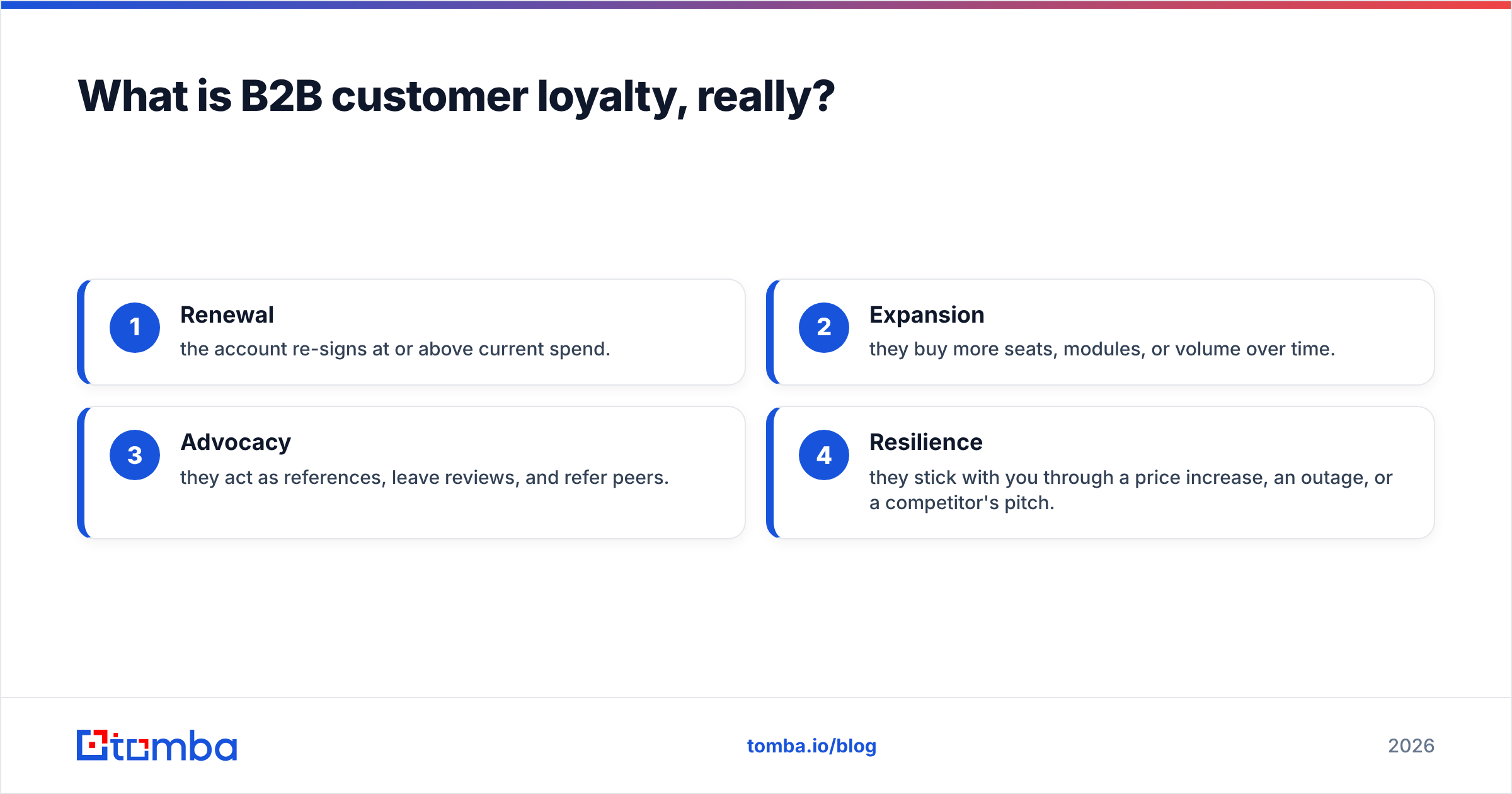
In practice, B2B loyalty shows up as four behaviors:
- Renewal — the account re-signs at or above current spend.
- Expansion — they buy more seats, modules, or volume over time.
- Advocacy — they act as references, leave reviews, and refer peers.
- Resilience — they stick with you through a price increase, an outage, or a competitor's pitch.
Why does B2B loyalty matter more than new logos in 2026?#
Because acquisition got expensive and retention got measurable. Ad costs are up, buying committees are larger and slower, and free trials convert worse than they did three years ago. Meanwhile, every modern stack can now tell you exactly which accounts are healthy and which are quietly drifting.
The economics are blunt. Acquiring a new B2B customer typically costs several times more than retaining an existing one, and existing customers buy more often and at higher average values. A loyal base also de-risks the whole business: predictable renewals smooth out revenue, improve forecasting, and make the company easier to fund or sell.
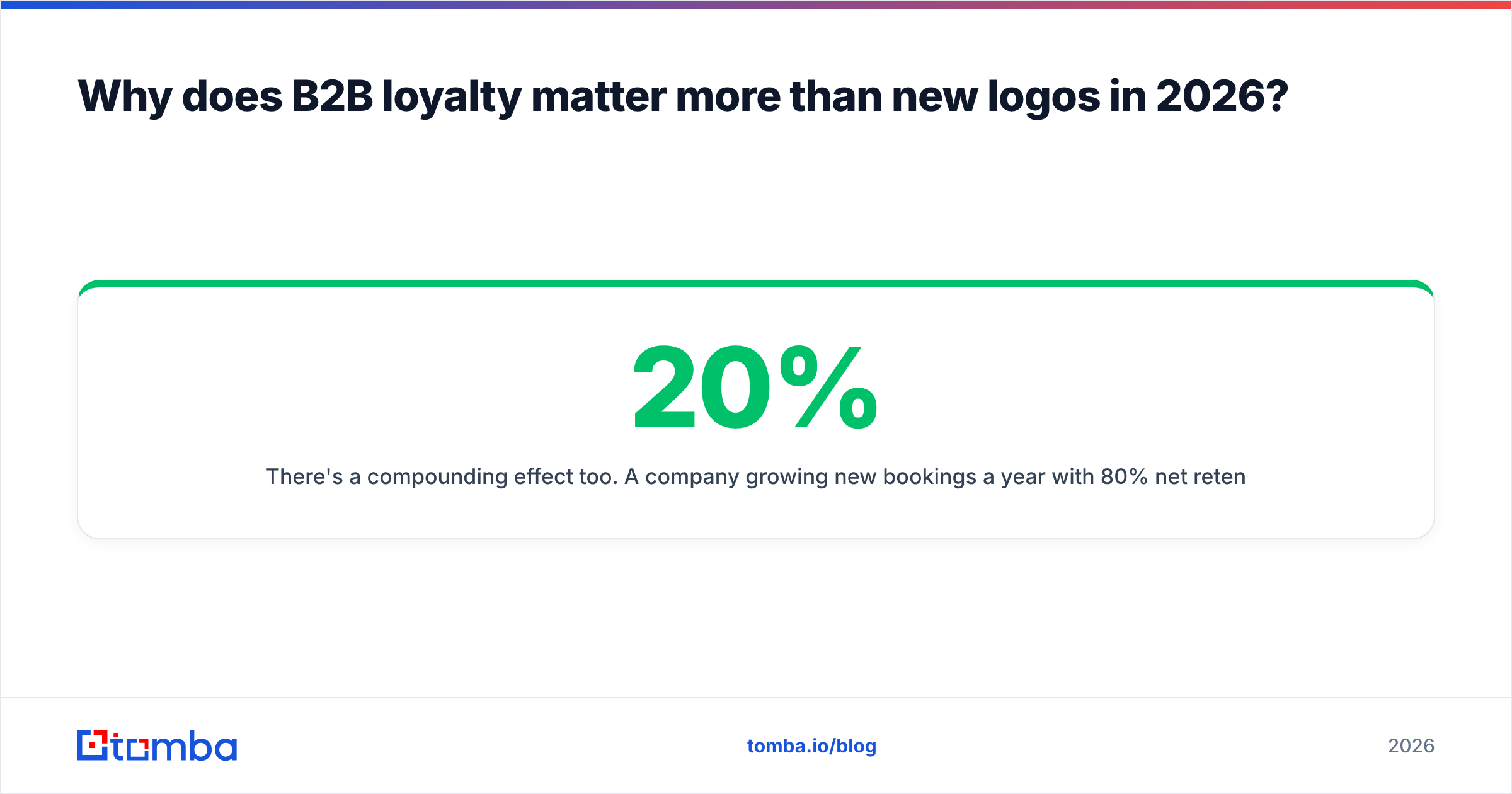
There's a compounding effect too. A company growing new bookings 20% a year with 80% net retention is running up a down escalator. The same company at 115% net retention grows even if new sales stall for a quarter. Loyalty doesn't just protect revenue — it multiplies it.
How do you measure B2B customer loyalty?#
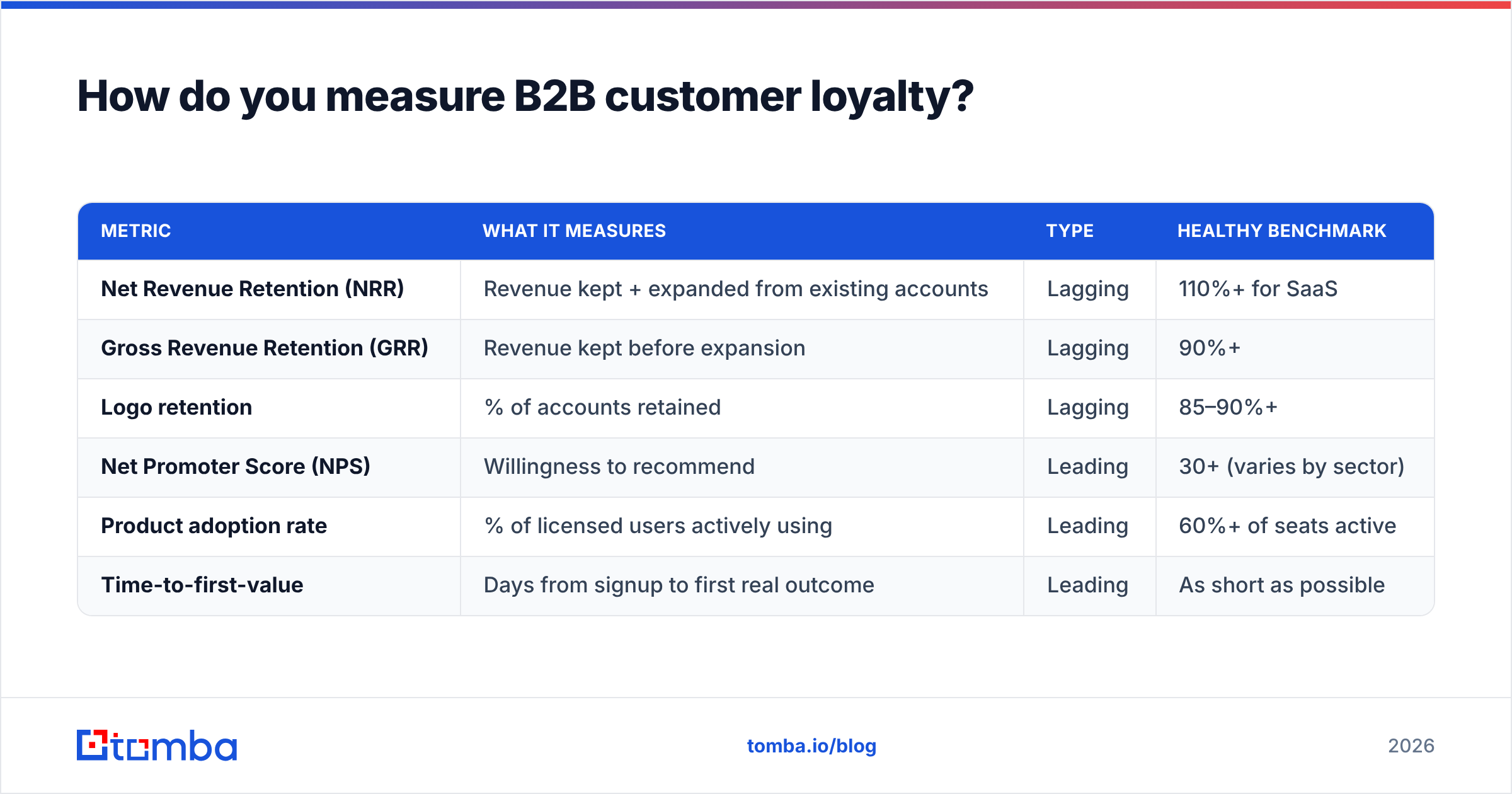
You measure it with a small set of leading and lagging indicators, not a single number. Lagging metrics tell you what already happened; leading metrics tell you what's about to.
| Metric | What it measures | Type | Healthy benchmark |
|---|---|---|---|
| Net Revenue Retention (NRR) | Revenue kept + expanded from existing accounts | Lagging | 110%+ for SaaS |
| Gross Revenue Retention (GRR) | Revenue kept before expansion | Lagging | 90%+ |
| Logo retention | % of accounts retained | Lagging | 85–90%+ |
| Net Promoter Score (NPS) | Willingness to recommend | Leading | 30+ (varies by sector) |
| Product adoption rate | % of licensed users actively using | Leading | 60%+ of seats active |
| Time-to-first-value | Days from signup to first real outcome | Leading | As short as possible |
The trap is reporting only NPS or only logo retention. NPS can look fine while three of your top-ten accounts shrink their spend by 40% — GRR catches that. Logo retention can hit 90% while NRR sits at 95% because every renewal is a downgrade. Track the pair: GRR for defense, NRR for offense.
A practical rule: if a metric can't be tied to a named account you could call this week, it's a vanity number. Loyalty work happens account by account.
Where does loyalty actually get built?#
In the quarters between renewals, not the week before. By the time a renewal is 30 days out, the loyalty verdict is mostly in. The work that moves the number happens earlier, in five stages.
- Onboarding — the single highest-leverage moment. An account that hits first value in week one behaves completely differently from one still "getting set up" in month three. Treat onboarding as a deadline, not a phase.
- Adoption — value compounds only when usage spreads beyond the original champion. One power user is a churn risk; a team that depends on you daily is a renewal.
- Proactive value reviews — quarterly business reviews that show realized ROI, not feature roadmaps. The question every review must answer: "What did this account get for its money since we last spoke?"
- Issue recovery — how you handle the outage, the bug, the billing mistake. A well-recovered problem often produces more loyalty than a flawless quarter, because the customer learns they can trust you when it counts.
- Renewal and expansion — a non-event if the first four stages went well. A loyal account renews because continuing is obviously correct, not because a rep talked them into it.
Mapping these stages and assigning an owner to each is the core of any serious retention program. RevOps usually owns the instrumentation; customer success owns the motion. If you're formalizing this, it's worth grounding the team in a shared definition of revenue operations so handoffs between sales, CS, and marketing don't drop accounts in the gaps.
What are the highest-impact B2B loyalty tactics?#
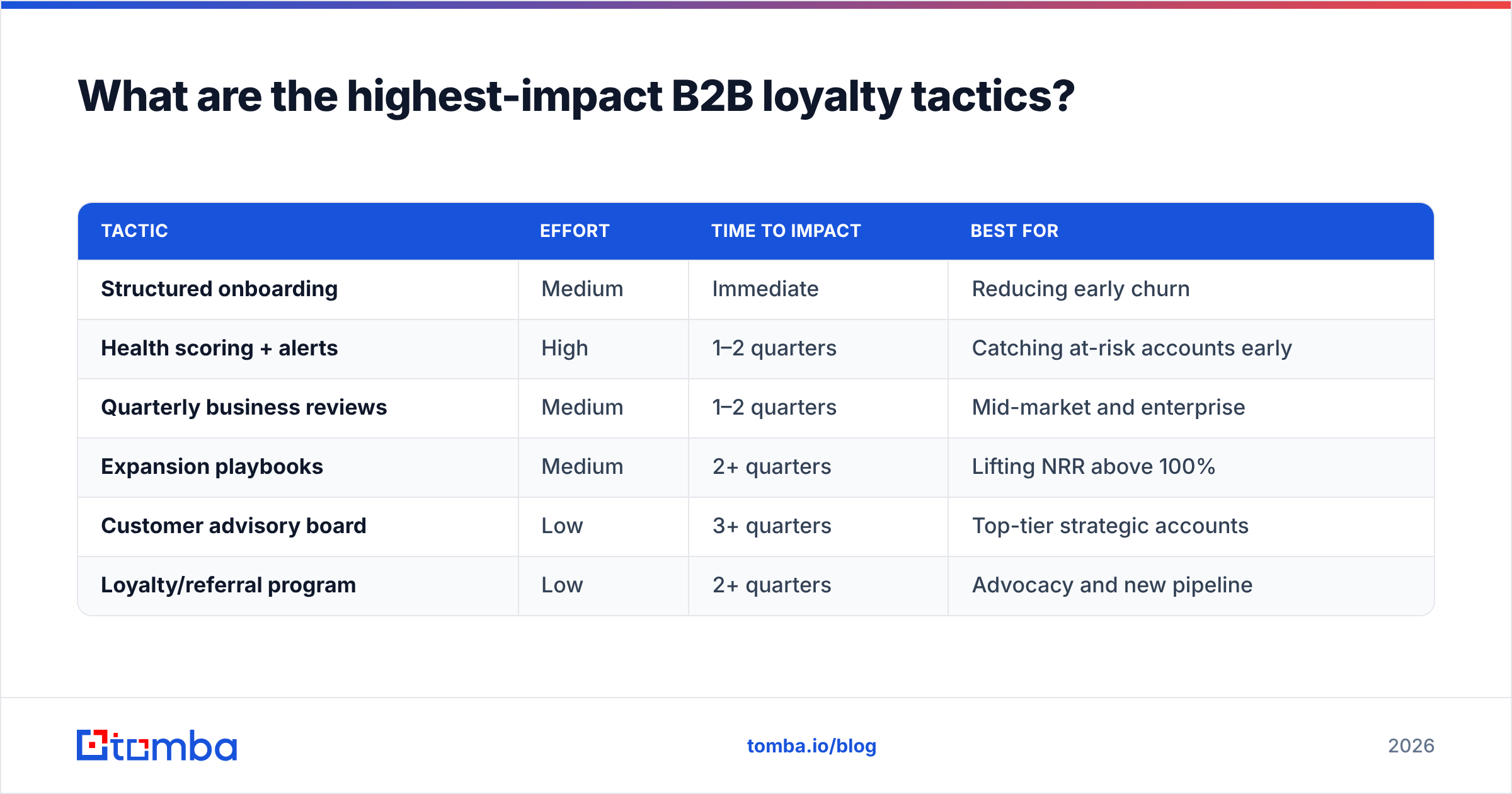
Start with the tactics that touch revenue directly, then layer on the softer programs. Here's how the common plays compare on effort and payback.
| Tactic | Effort | Time to impact | Best for |
|---|---|---|---|
| Structured onboarding | Medium | Immediate | Reducing early churn |
| Health scoring + alerts | High | 1–2 quarters | Catching at-risk accounts early |
| Quarterly business reviews | Medium | 1–2 quarters | Mid-market and enterprise |
| Expansion playbooks | Medium | 2+ quarters | Lifting NRR above 100% |
| Customer advisory board | Low | 3+ quarters | Top-tier strategic accounts |
| Loyalty/referral program | Low | 2+ quarters | Advocacy and new pipeline |
A few principles cut across all of them:
Segment by value, not by logo size. A mid-size account that uses you across five departments is more strategic than a famous brand with one dormant seat. Build your white-glove motion around realized value and expansion potential.
Make the champion's life easy. Your internal champion is often selling you up their own chain. Give them ROI numbers, slide-ready summaries, and benchmarks they can forward. When they get promoted or leave, you need a second and third relationship already in place — which means you need current contact data for the wider buying group.
Recover loudly, then follow up. After resolving a serious issue, don't disappear. A two-week check-in turns a patched problem into proof of reliability.
How does data quality drive B2B loyalty?#
You can't retain an account you can't reach, and you can't expand one you don't understand. Data quality is the unglamorous foundation under every play above.
Three failure modes quietly erode loyalty:
- Stale contacts. Your champion changed jobs four months ago and nobody noticed. The account drifted, the renewal got handed to a stranger, and the first time you hear about a problem is the cancellation email. Refreshing decision-maker contacts on a schedule — and re-finding email addresses when people move — keeps the relationship from going dark.
- Thin account context. When you don't know how many people at the company could use you, you can't size expansion. Running a domain search against an existing customer's company surfaces the other teams and stakeholders your champion hasn't introduced you to yet.
- Dirty CRM records. Bounced QBR invites, duplicate accounts, and wrong titles make every retention motion slower and less credible. Periodic email verification keeps your outreach landing in inboxes instead of spam folders, which protects sender reputation on the lifecycle and renewal emails you actually need delivered.
This is where a lead-enrichment layer earns its keep on the retention side, not just acquisition. The same tooling you use to find and verify prospects keeps your installed base current: who moved, who joined, which new stakeholders entered the account. For programmatic refreshes, the Tomba API can re-enrich customer records on a schedule so your CSMs always open a clean account.
For broader context on how leading vendors frame retention economics, HubSpot's research on customer retention and the analyst coverage at G2 are useful neutral starting points before you commit to any specific platform.
How do you turn loyal customers into a growth channel?#
Treat advocacy as a pipeline stage, not a happy accident. Loyal accounts are your cheapest source of new revenue in two directions: expansion within the account and referrals outside it.
For expansion, build a simple trigger system. When usage crosses a threshold, a new department signs in, or a QBR surfaces an unmet need, that's an expansion signal — route it to the account owner with context. Expansion sold into a loyal account closes faster and at higher win rates than any cold motion, which is exactly why it lifts your win rate overall.
For referrals, ask at the moment of proven value — right after a successful QBR or a public win, not in a generic quarterly blast. A warm intro from a loyal customer to a peer at a similar company is the single highest-converting lead you can get. Capture those referrals as real pipeline, attribute them, and reward the referrer.
The throughline: loyalty isn't a cost center you fund to "keep customers happy." It's a growth engine that produces lower-cost revenue than your paid channels — once you measure it, staff it, and feed it clean data.
Common mistakes that quietly kill loyalty#
- Treating renewals as a sales event. If your CSM only calls 30 days before renewal, the customer learns you only care about their wallet.
- Optimizing NPS instead of behavior. A high score with falling usage is a smiling account on its way out.
- Ignoring the silent majority. The accounts that never complain and never engage are often the ones about to leave — silence is a churn signal, not a comfort.
- Letting data rot. Every stale contact and unverified email is a future blind spot. Loyalty programs run on the assumption that you can actually reach the people who matter.
The bottom line#
B2B customer loyalty is the compounding return on every retention decision you make in the unglamorous middle of the contract. Measure it with NRR and GRR, build it through onboarding and proactive value, and protect it with clean, current account data. The companies that win in 2026 won't be the ones with the biggest ad budgets — they'll be the ones whose customers can't imagine leaving.
Loyalty starts with knowing who's actually in your accounts and being able to reach them. If your CRM is full of stale champions and half-verified contacts, start there: use the Tomba Email Finder to re-find moved decision-makers, surface new stakeholders inside existing customers, and keep every renewal and expansion conversation landing in the right inbox. Check the Tomba pricing plans — the free tier is enough to audit your top accounts this week.
Ready to find emails that actually work?
Join 150,000+ professionals who stopped guessing and started sending. Free credits on signup — no credit card required.
Get the Tomba newsletter
Practical outbound tactics and product updates — once every two weeks.
About the author