B2B Customer Profiling in 2026: Build an ICP That Converts
B2B customer profiling turns scattered account data into a repeatable ICP. Here's the 2026 framework, the data layers that matter, and the tools to build it.
TL;DR
- B2B customer profiling is the structured process of describing the companies and people who actually buy from you — using firmographic, technographic, behavioral, and contact data instead of gut feel.
- A good profile is built from your best existing customers, not your dream accounts. Start with closed-won data, find the patterns, then codify them into an Ideal Customer Profile (ICP) and matching buyer personas.
- Four data layers make a profile usable: firmographics (who the company is), technographics (what they run), intent/behavior (what they're doing now), and verified contact data (how to reach the buyer).
- Profiles decay. Roughly 25-30% of B2B contact data goes stale every year, so enrichment and re-verification have to be continuous, not a one-time project.
- Tools like Tomba's data enrichment and domain search turn a thin account list into a complete, reachable profile in minutes instead of hours of manual research.
What is B2B customer profiling?#
B2B customer profiling is the practice of building a structured, evidence-based description of the organizations and individuals most likely to become high-value customers. Think of it like a detective's case file: instead of a vague hunch about "mid-market SaaS companies," you assemble a dossier of repeatable attributes — company size, industry, tech stack, buying triggers, and the specific roles who sign off.
The output is usually two connected artifacts:
- Ideal Customer Profile (ICP) — the company-level description. The kind of account that closes fast, stays long, and expands.
- Buyer personas — the person-level descriptions inside that account. The economic buyer, the champion, the technical evaluator, and the blockers.
The difference matters. Your ICP tells you which doors to knock on. Your personas tell you who answers, what they care about, and what language moves them. Skip either one and you get the classic failure mode: a great list of companies that nobody on your team can actually reach or convince.
Profiling sits at the front of every efficient go-to-market motion. It decides who gets prospected, how leads are scored, and which accounts deserve a human SDR versus an automated nurture. Get it right and every downstream metric — reply rate, win rate, sales cycle length — improves because you stopped wasting cycles on accounts that were never going to buy.
Why does B2B customer profiling matter more in 2026?#
Because buying committees got bigger and patience got shorter. Gartner's research on B2B buying has consistently found that a typical purchase now involves six to ten decision-makers, each arriving with their own information and biases. If your profile only describes "the company" and not the humans inside it, you're targeting a fraction of the people who actually decide.
Three shifts make profiling non-negotiable this year:
- Data decay accelerated. People change jobs faster, companies restructure, and email patterns shift. A profile built in January is partly wrong by summer. Continuous enrichment is the only fix.
- AI made bad targeting cheaper — and more dangerous. It's trivial to generate 10,000 personalized emails now. If the underlying profile is junk, you just automated spam at scale and torched your sender reputation.
- Budgets tightened. Teams are judged on efficiency, not activity. A sharp ICP is the cheapest way to raise pipeline quality without hiring.
The teams winning in 2026 aren't the ones sending the most outreach. They're the ones who know exactly who to send it to.
What data goes into a B2B customer profile?#
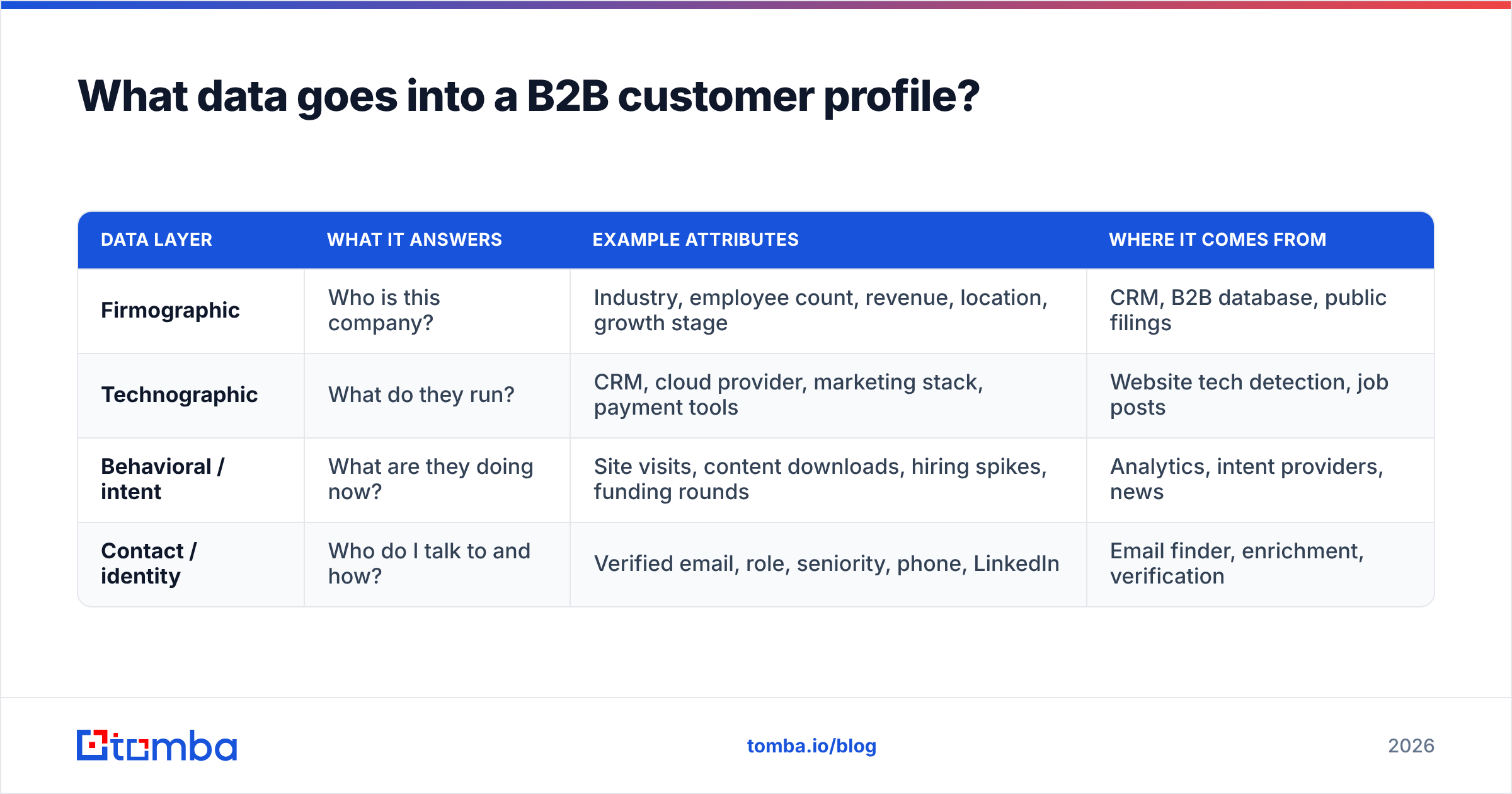
A usable profile is built in layers. Each layer answers a different question, and the value compounds when you stack them.
| Data layer | What it answers | Example attributes | Where it comes from |
|---|---|---|---|
| Firmographic | Who is this company? | Industry, employee count, revenue, location, growth stage | CRM, B2B database, public filings |
| Technographic | What do they run? | CRM, cloud provider, marketing stack, payment tools | Website tech detection, job posts |
| Behavioral / intent | What are they doing now? | Site visits, content downloads, hiring spikes, funding rounds | Analytics, intent providers, news |
| Contact / identity | Who do I talk to and how? | Verified email, role, seniority, phone, LinkedIn | Email finder, enrichment, verification |
The mistake most teams make is stopping at firmographics. "Companies with 50-500 employees in fintech" is a market segment, not a customer profile. It becomes a profile only when you add the technographic signal ("running Stripe and a legacy billing tool"), the behavioral trigger ("just raised a Series B"), and the contact reality ("the VP of Finance is reachable at a predictable email pattern").
That last layer is where most profiles quietly fail. You can describe the perfect account in exhaustive detail, but if you can't reach a verified human inside it, the profile is a museum piece. This is why data enrichment and email verification belong in the profiling workflow, not as an afterthought.
How do you build a B2B customer profile step by step?#
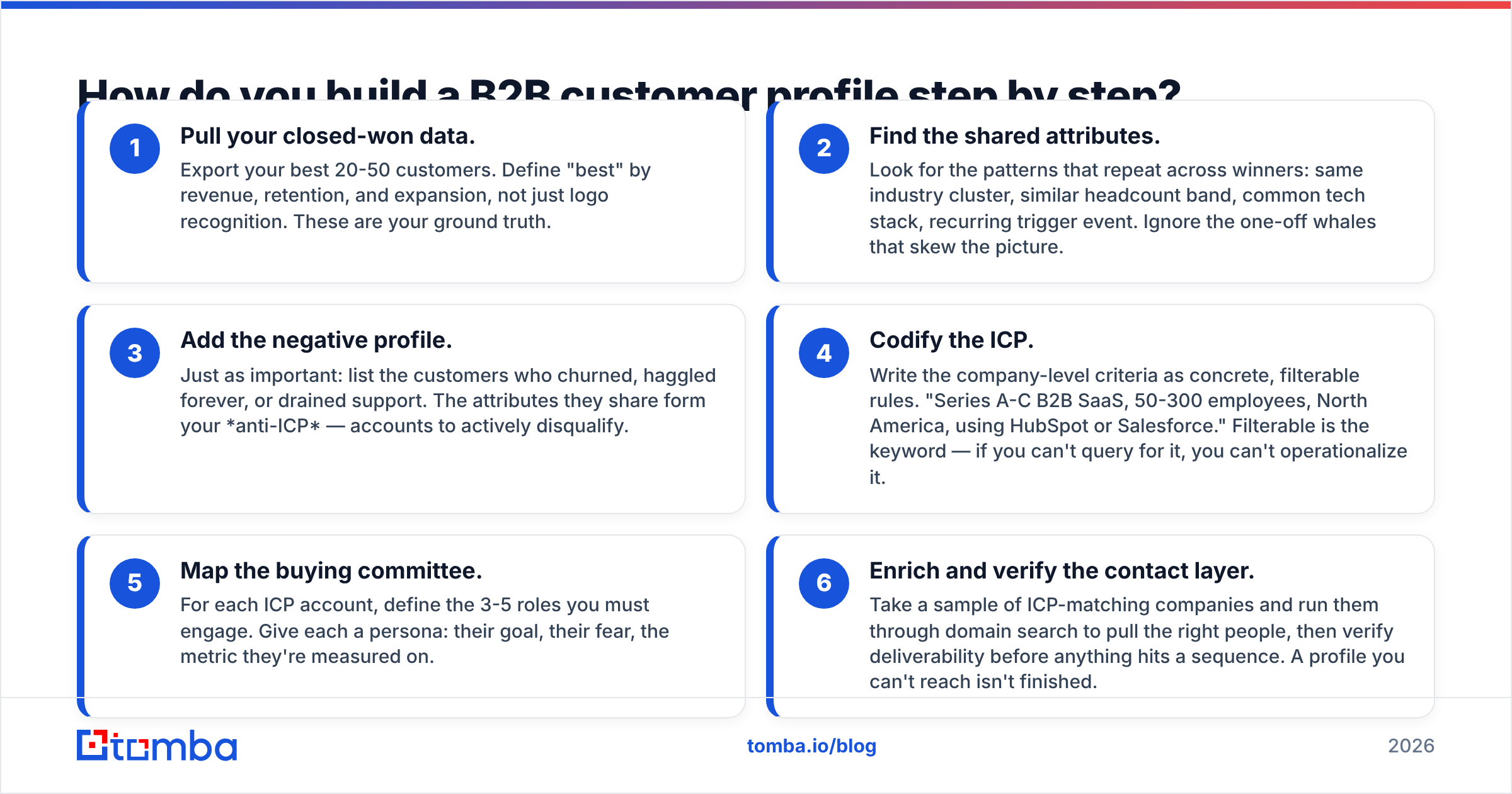
Here's the framework that survives contact with a real sales team. It's deliberately bottom-up — you mine reality before you invent an ideal.
Pull your closed-won data. Export your best 20-50 customers. Define "best" by revenue, retention, and expansion, not just logo recognition. These are your ground truth.
Find the shared attributes. Look for the patterns that repeat across winners: same industry cluster, similar headcount band, common tech stack, recurring trigger event. Ignore the one-off whales that skew the picture.
Add the negative profile. Just as important: list the customers who churned, haggled forever, or drained support. The attributes they share form your anti-ICP — accounts to actively disqualify.
Codify the ICP. Write the company-level criteria as concrete, filterable rules. "Series A-C B2B SaaS, 50-300 employees, North America, using HubSpot or Salesforce." Filterable is the keyword — if you can't query for it, you can't operationalize it.
Map the buying committee. For each ICP account, define the 3-5 roles you must engage. Give each a persona: their goal, their fear, the metric they're measured on.
Enrich and verify the contact layer. Take a sample of ICP-matching companies and run them through domain search to pull the right people, then verify deliverability before anything hits a sequence. A profile you can't reach isn't finished.
Notice that steps 1-3 use data you already own, steps 4-5 are strategy, and step 6 is tooling. You don't need to buy anything to start — you need to read your own CRM honestly first.
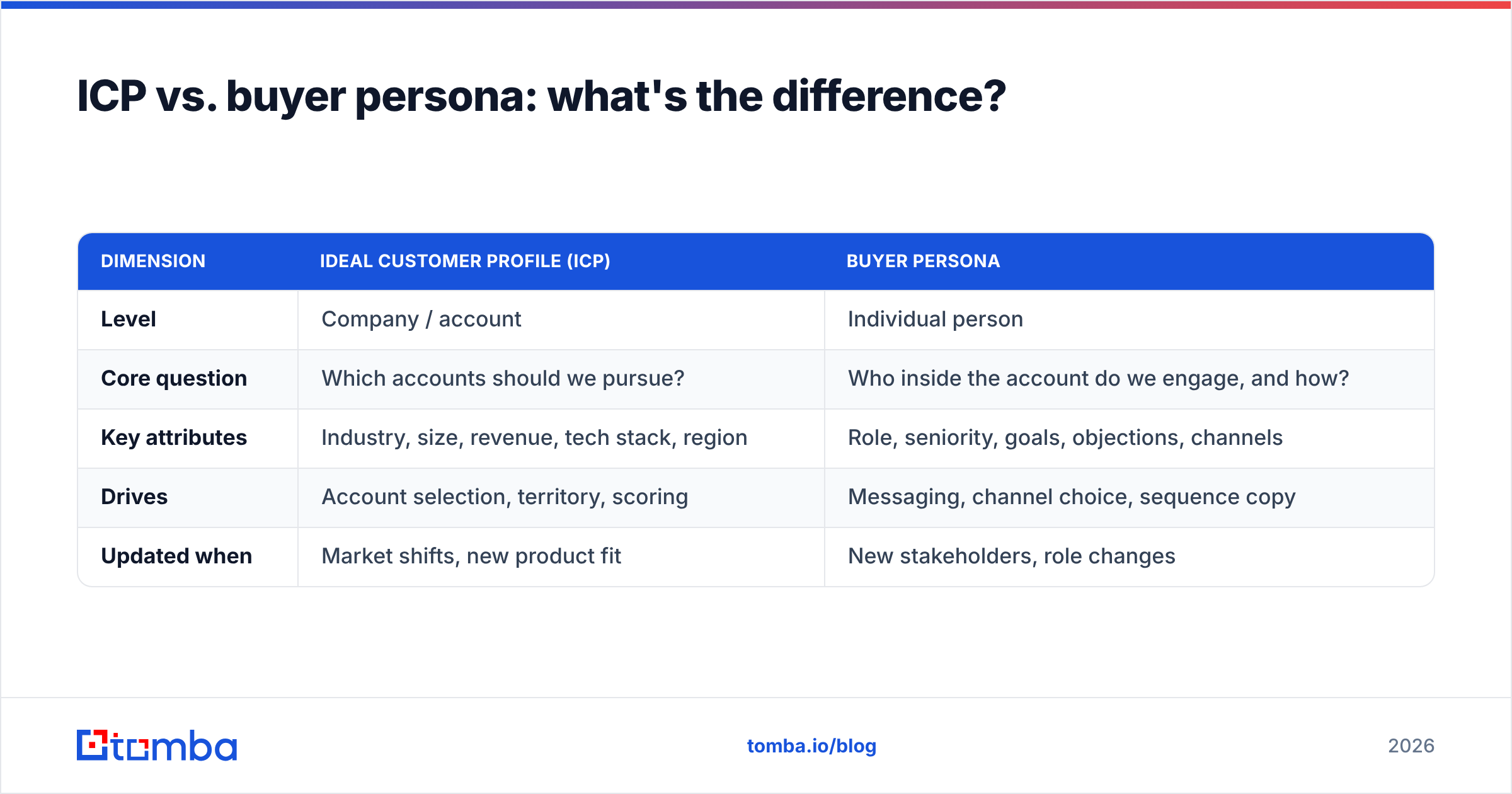
ICP vs. buyer persona: what's the difference?#
They're complementary, not interchangeable. Confusing them is the most common profiling error, so here's the clean split.
| Dimension | Ideal Customer Profile (ICP) | Buyer persona |
|---|---|---|
| Level | Company / account | Individual person |
| Core question | Which accounts should we pursue? | Who inside the account do we engage, and how? |
| Key attributes | Industry, size, revenue, tech stack, region | Role, seniority, goals, objections, channels |
| Drives | Account selection, territory, scoring | Messaging, channel choice, sequence copy |
| Updated when | Market shifts, new product fit | New stakeholders, role changes |
Use them together. The ICP narrows a universe of millions of companies down to a few thousand worth pursuing. The personas then tell your reps which two or three humans in each of those companies to contact, and what to say. One without the other is half a strategy.
For scoring inbound leads against these profiles, it's worth understanding how marketing qualified lead criteria map back to your ICP — a lead that doesn't match the profile shouldn't be "qualified" no matter how many ebooks they downloaded.
How do you keep customer profiles accurate over time?#
You treat the profile as a living system, not a slide deck. The single biggest reason profiling efforts fail is that they're built once, celebrated, and then left to rot while the underlying data quietly goes stale.
A practical maintenance rhythm:
- Re-verify contact data quarterly. Email and phone data decays fastest. Run your active lists through verification before each major campaign so you're not paying in bounces and reputation damage. Tools like ZeroBounce and Tomba's verifier exist precisely because this decay is constant.
- Re-mine closed-won twice a year. Your best customers from two years ago may not match your best customers today, especially if the product or pricing shifted. Refresh the ground-truth set.
- Track profile drift in your win data. If you start winning deals outside your stated ICP, that's a signal — either your profile is too narrow or your market is changing. Both deserve investigation.
- Automate enrichment on entry. Every new lead that enters the CRM should be auto-enriched with firmographic and contact data so reps never start from a blank record.
For high-volume teams, the bulk email finder and API-driven enrichment make this maintenance feasible. Manually re-researching thousands of accounts isn't realistic; programmatic re-enrichment via the Tomba API is.
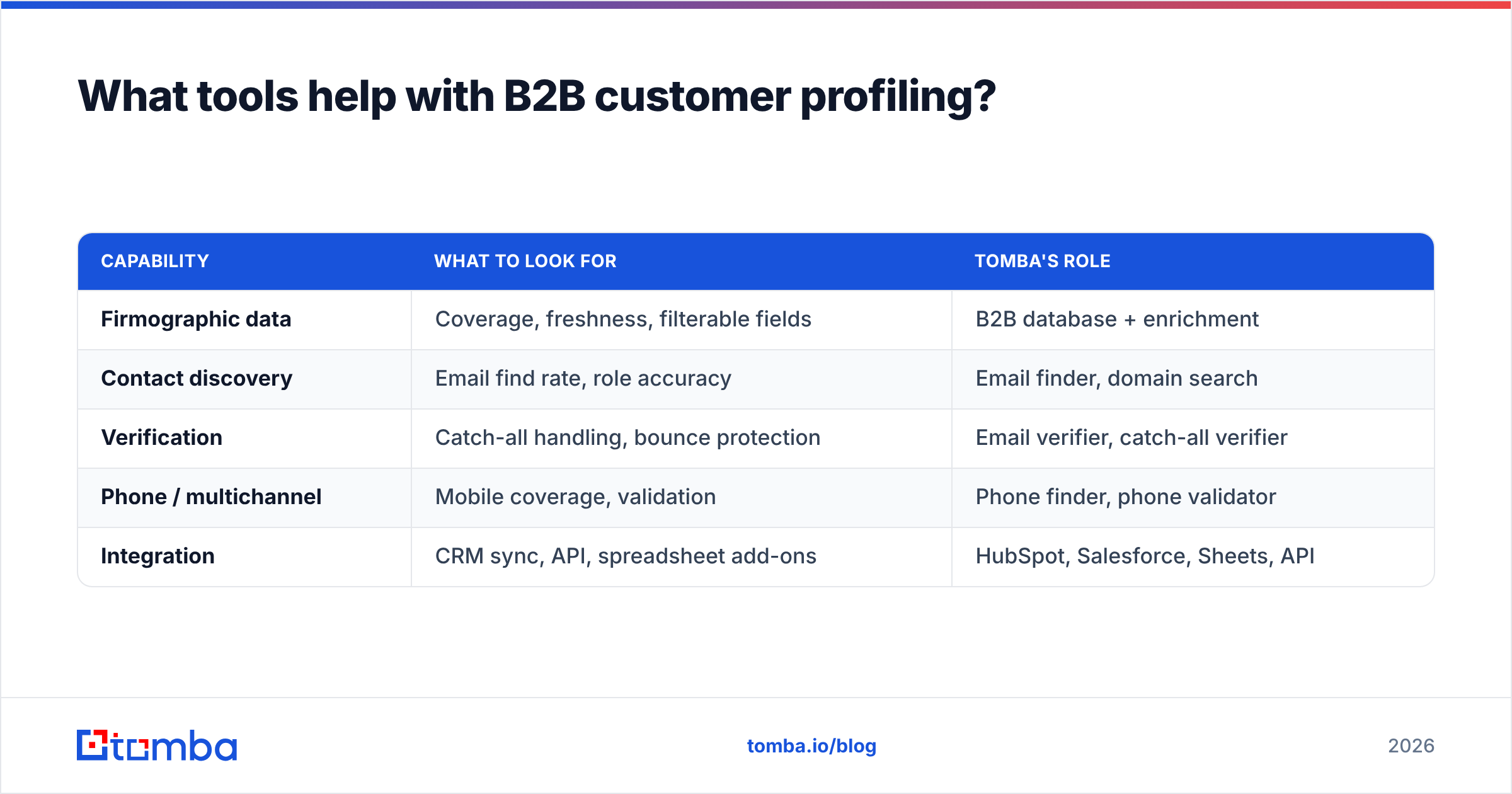
What tools help with B2B customer profiling?#
The tooling stack splits into four jobs: source the account data, detect the tech and intent signals, find and verify the contacts, and store it all somewhere queryable. You can stitch this together from several vendors or consolidate.
| Capability | What to look for | Tomba's role |
|---|---|---|
| Firmographic data | Coverage, freshness, filterable fields | B2B database + enrichment |
| Contact discovery | Email find rate, role accuracy | Email finder, domain search |
| Verification | Catch-all handling, bounce protection | Email verifier, catch-all verifier |
| Phone / multichannel | Mobile coverage, validation | Phone finder, phone validator |
| Integration | CRM sync, API, spreadsheet add-ons | HubSpot, Salesforce, Sheets, API |
A few honest notes on selection. Platforms like Clearbit (now part of HubSpot) are strong on enrichment depth but priced for larger teams. Pure email finders are cheaper but stop at the contact layer. Where Tomba fits is the middle: solid firmographic enrichment plus the highest-leverage part — actually finding and verifying the people you need to reach — without enterprise pricing.
On cost, transparency matters when you're budgeting a profiling program. Tomba's plans run from a free tier (25 searches per month) to Starter at $49/mo, Growth at $99/mo, and Pro at $249/mo, with full details on the Tomba pricing page. That free tier is enough to validate the workflow on a sample of your closed-won accounts before committing budget.
Whatever you choose, the test is the same: can the tool take a company name or domain and reliably return a verified, reachable contact that matches your persona? If it can't close that last mile, it's a data viewer, not a profiling tool.
What does a finished profile look like in practice?#
Concretely, a working B2B customer profile is a one-page, filterable spec that any rep can act on without asking for clarification. It reads something like:
- Company: B2B SaaS, 50-300 employees, Series A-C, North America + UK, using Salesforce and a modern data warehouse, recently posted RevOps or data-engineering roles.
- Anti-profile: Sub-20 employees, agencies, pre-funding, or companies with no dedicated revenue ops function.
- Primary persona: VP/Director of RevOps — measured on pipeline efficiency, fears messy data, reachable by email and LinkedIn.
- Secondary persona: Head of Sales — measured on win rate, cares about rep productivity.
- Contact reality: Email pattern typically
{first}@domain, verified deliverable, phone available for ~60% via phone finder.
That's a profile a team can run on Monday morning. It tells you who to target, who to disqualify, who to message, and how to reach them — backed by data, not vibes.
Start with your data, not your dream account#
The teams that profile well aren't smarter; they're more honest about what their actual best customers look like. They mine reality, codify it, and keep the contact layer fresh.
If you're ready to turn a thin account list into complete, reachable profiles, start with the Tomba Email Finder. Feed it the companies that match your ICP, pull verified contacts for the exact roles in your personas, and enrich the records before they ever reach a rep. The free tier covers your first 25 searches, so you can prove the workflow on your own closed-won data before scaling it across the whole pipeline. Profile honestly, enrich continuously, and let the data decide who's worth your team's time.
// get started
Find, verify and enrich your first contacts today
Start on the free plan with 25 searches a month, then scale when your team is ready.
Free plan · No credit card required · GDPR & CCPA
// about the author