B2B Data for Fintech in 2026: Accuracy, Sources & Compliance
How fintech revenue teams should source, verify, and govern B2B data in 2026 — without burning credits on stale records or tripping compliance.
TL;DR
- Fintech go-to-market lives or dies on data accuracy: a wrong title, a bounced email, or a stale company record costs you deals and your sender reputation.
- The best B2B data for fintech blends firmographics, technographics, and verified contact data — then re-verifies on a schedule, because fintech job changes happen fast.
- Compliance is not optional. GDPR, CCPA, and financial-services KYC expectations mean you need documented sourcing and an easy path to deletion.
- One mega-vendor rarely wins. Most fintech teams stack a verified email finder (like Tomba Email Finder) with an enrichment layer and a CRM-native sync.
- Budget by accuracy, not raw volume. A 95%-deliverable list of 2,000 contacts beats a 70%-deliverable list of 20,000.
Why does B2B data for fintech need its own playbook?#
Because fintech sells into the most data-skeptical buyers on earth — risk officers, compliance leads, CFOs, and heads of payments — and those buyers move companies constantly. A generic contact list that works for a marketing-software vendor will quietly rot when you point it at banks, lenders, neobanks, and payment processors.
Three things make fintech harder than a typical B2B motion:
- Regulated buyers. Your prospects work under their own compliance regimes, so they scrutinize how you reached them. Sloppy sourcing reads as a red flag, not a growth hack.
- High title churn. A VP of Risk at a lending startup in January may be a Chief Compliance Officer somewhere else by April. Data decays roughly 2–3% per month, faster in growth-stage fintech.
- Deliverability sensitivity. Fintech domains often sit behind aggressive spam filtering. One bad bounce run can drag down your email deliverability for weeks.
So the "playbook" is less about finding more people and more about finding the right people with data you can prove is current and compliantly sourced.
What types of B2B data does a fintech GTM team actually need?#
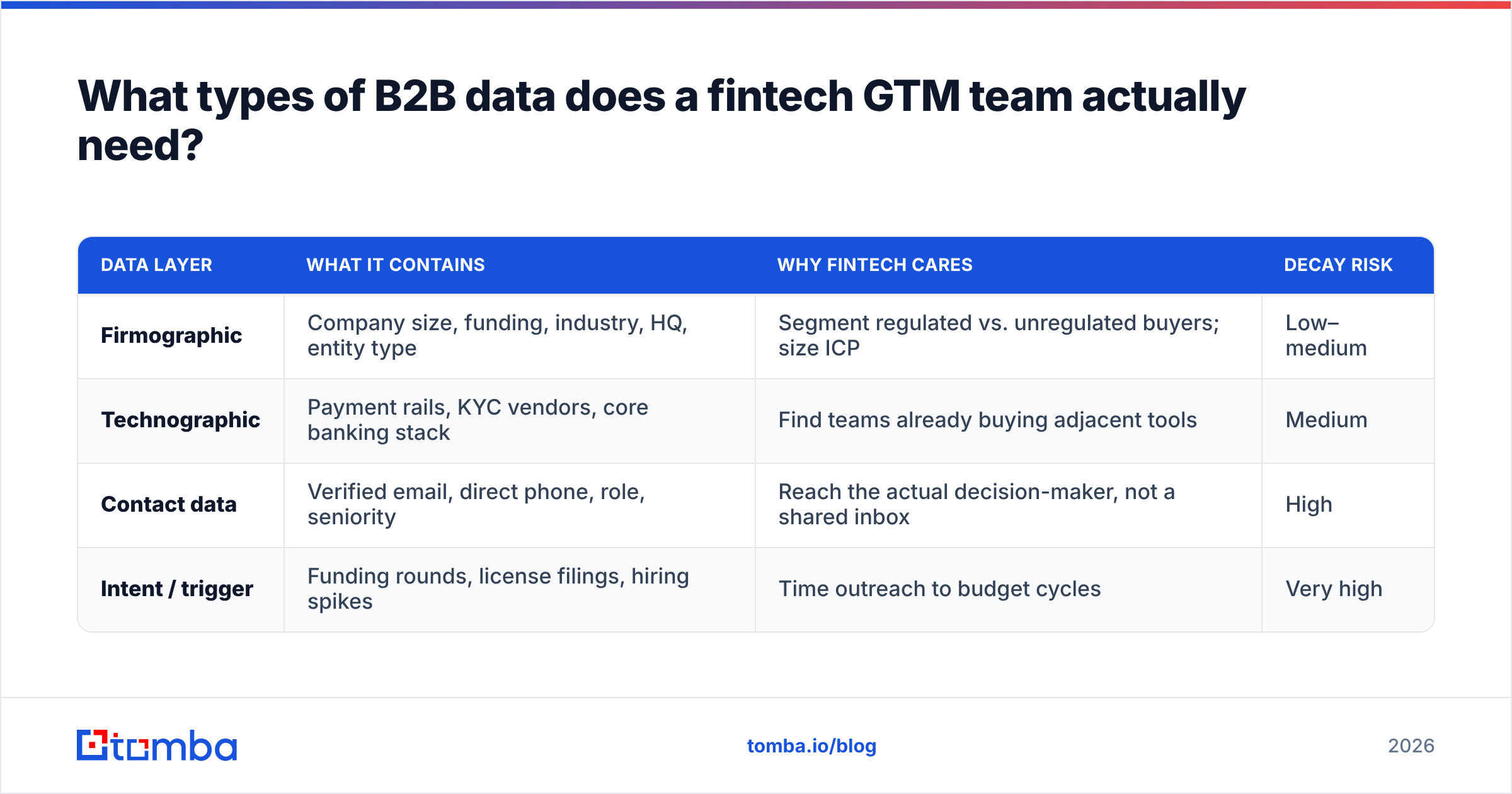
Conclusion first: you need four layers, and most teams under-invest in verification. Here is how they stack up.
| Data layer | What it contains | Why fintech cares | Decay risk |
|---|---|---|---|
| Firmographic | Company size, funding, industry, HQ, entity type | Segment regulated vs. unregulated buyers; size ICP | Low–medium |
| Technographic | Payment rails, KYC vendors, core banking stack | Find teams already buying adjacent tools | Medium |
| Contact data | Verified email, direct phone, role, seniority | Reach the actual decision-maker, not a shared inbox | High |
| Intent / trigger | Funding rounds, license filings, hiring spikes | Time outreach to budget cycles | Very high |
Notice the bottom two layers carry the most decay risk and the most revenue leverage. That is exactly where a verified email finder and ongoing email verification earn their keep — they keep the highest-value, fastest-decaying layer trustworthy.
A common mistake: buying a giant firmographic database and assuming the contact data inside it is equally fresh. It almost never is. Firmographics age slowly; the email of a Series-B compliance lead ages fast.
How do you judge B2B data accuracy for fintech?#
Test it, don't trust the marketing page. Every vendor claims "95% accuracy," but they measure it differently, and few publish how. Run your own benchmark before you commit budget.
A simple, defensible accuracy test:
- Pull a known sample. Take 200 contacts you already have verified inside your CRM.
- Re-source them blind. Ask the vendor to find those same people fresh.
- Measure match + deliverability. What percentage did they find, and of those, how many pass a real-time SMTP check?
- Check the catch-alls. Fintech domains love catch-all configurations, which fake "valid" results. Use a dedicated catch-all verifier to separate genuine inboxes from accept-all traps.
- Re-test in 60 days. Accuracy that holds over time matters more than a one-time snapshot.
If a provider can't survive a catch-all test, its accuracy number is theater. This is the single biggest reason fintech teams over-report "valid" emails and then watch their bounce rate climb. For more on where numbers come from, vendors that publish their data sources deserve more trust than vendors that hand-wave.
Which B2B data tools fit a fintech stack in 2026?#
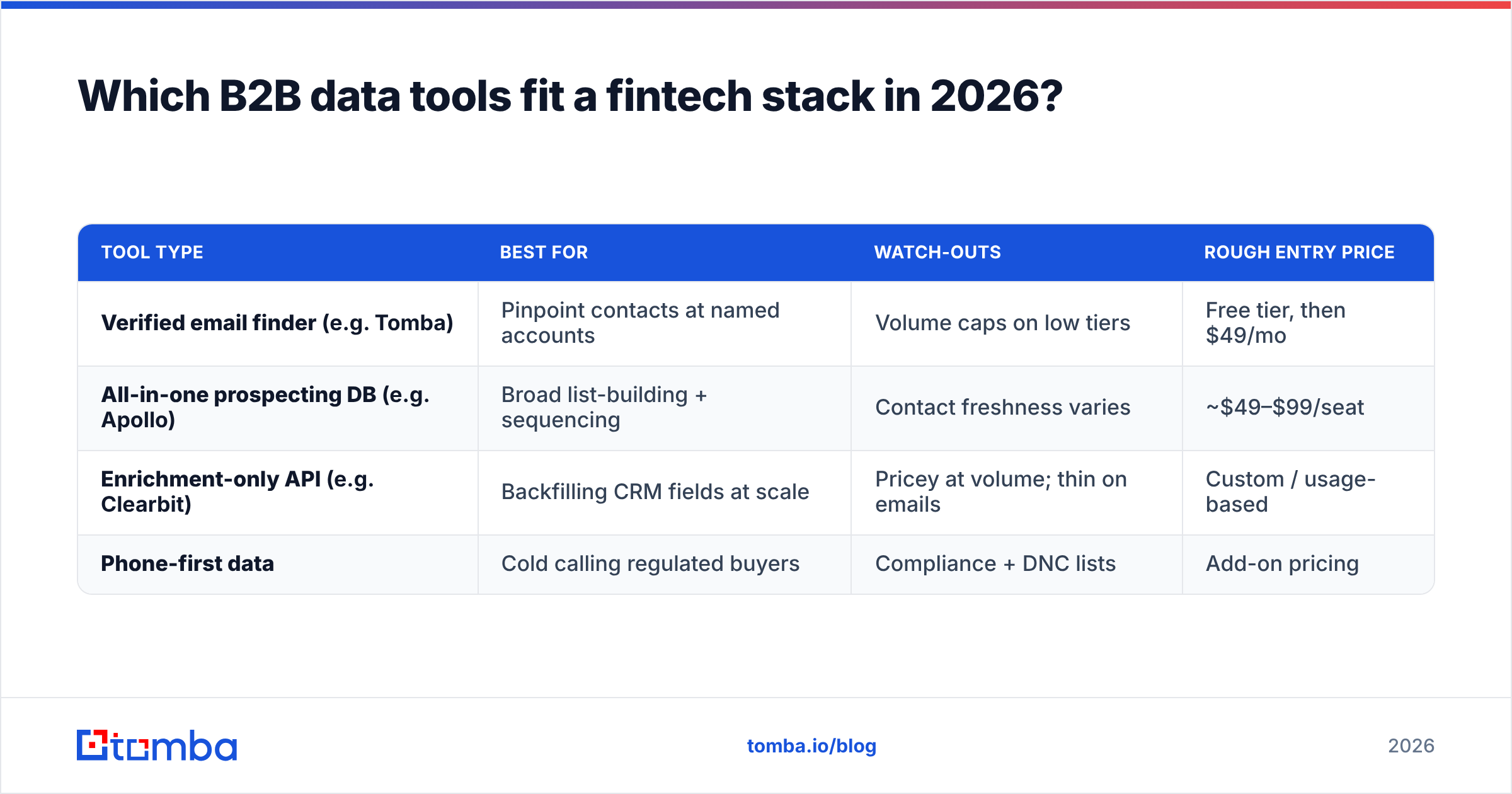
There is no universal winner — there is a right tool per job. Below is how the common categories compare for a fintech revenue team specifically.
| Tool type | Best for | Watch-outs | Rough entry price |
|---|---|---|---|
| Verified email finder (e.g. Tomba) | Pinpoint contacts at named accounts | Volume caps on low tiers | Free tier, then $49/mo |
| All-in-one prospecting DB (e.g. Apollo) | Broad list-building + sequencing | Contact freshness varies | ~$49–$99/seat |
| Enrichment-only API (e.g. Clearbit) | Backfilling CRM fields at scale | Pricey at volume; thin on emails | Custom / usage-based |
| Phone-first data | Cold calling regulated buyers | Compliance + DNC lists | Add-on pricing |
For a fintech team, the pragmatic stack is usually: one accurate finder/verifier for outbound, one enrichment source for CRM hygiene, and a data enrichment routine that runs on a schedule. If you're replacing a bloated contract, an honest Apollo alternative or Clearbit alternative comparison should focus on deliverable contacts per dollar, not seat count.
Tomba's pricing makes this concrete: a Free tier with 25 searches/month, then Starter at $49/mo, Growth at $99/mo, and Pro at $249/mo. You can see the full Tomba pricing breakdown, but the point is you can validate accuracy on the free tier before you spend.
How do you keep B2B data compliant in fintech?#
Treat compliance as part of the data pipeline, not a legal afterthought. Fintech buyers — and regulators — expect you to know where your data came from and to delete it on request.
Practical guardrails that hold up under scrutiny:
- Document your lawful basis. For B2B outreach in the EU, legitimate interest is common, but you must record it and honor opt-outs. Read the GDPR basics on the ICO site before you write copy.
- Use public, professional data. Sourcing business emails from public professional footprints is defensible; scraping personal accounts is not. Prefer providers transparent about methodology.
- Honor deletion fast. Keep a single source of truth so a suppression request actually removes the contact everywhere, not just from one tool.
- Segment by region. CCPA, GDPR, and other regimes differ. Tag every record with its jurisdiction so your outreach rules can branch.
- Re-verify before send. A clean email verifier pass right before a campaign protects both deliverability and your compliance posture — you're not emailing dead or reassigned addresses.
The G2 and Capterra review pages for any vendor will tell you how customers experience their compliance and support. Check the G2 category for sales intelligence and read the one- and two-star reviews — that's where data-quality and compliance complaints surface.
What does a practical fintech data workflow look like?#
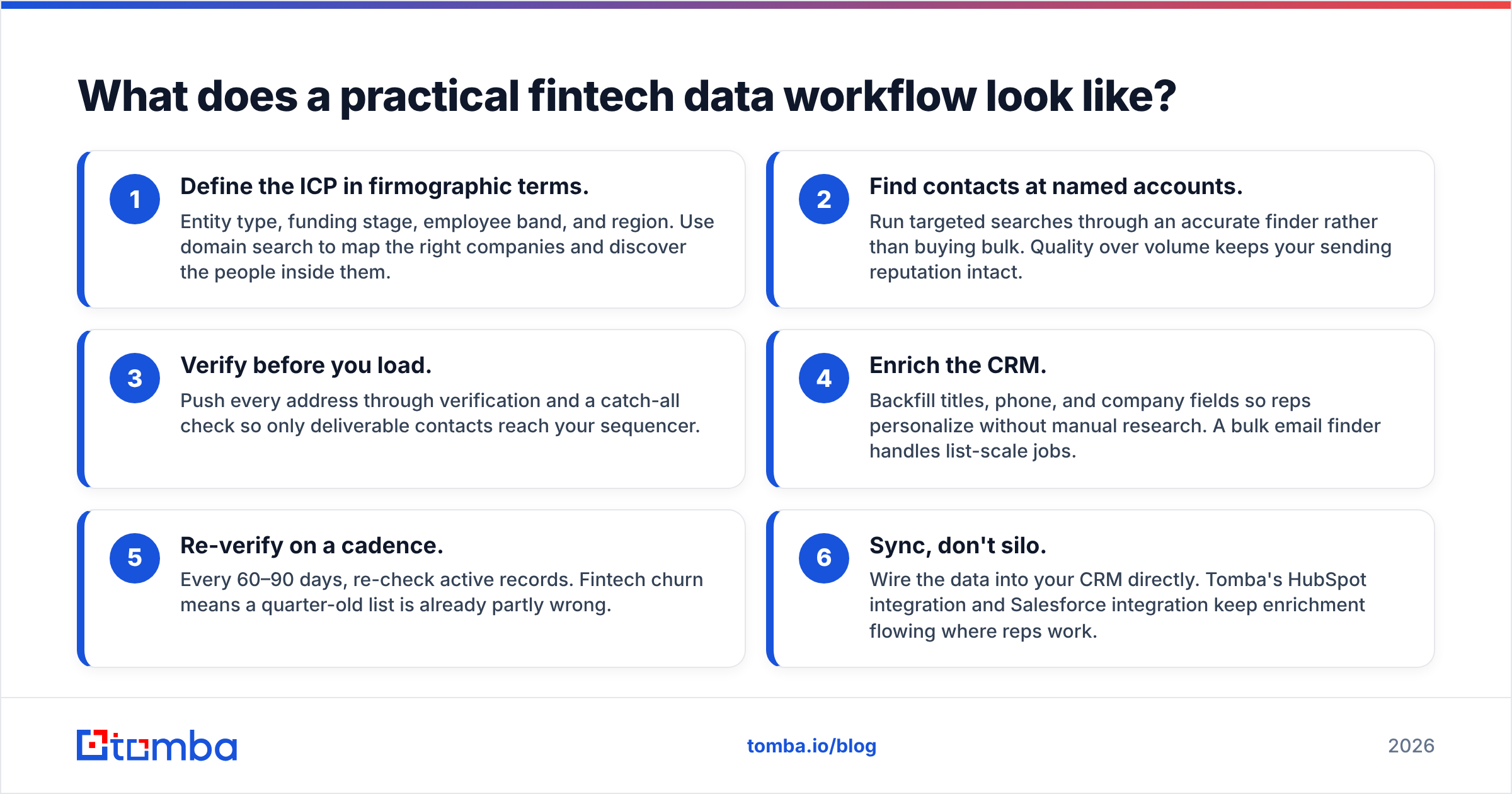
Here's a workflow that balances accuracy, cost, and compliance without a 12-tool sprawl:
- Define the ICP in firmographic terms. Entity type, funding stage, employee band, and region. Use domain search to map the right companies and discover the people inside them.
- Find contacts at named accounts. Run targeted searches through an accurate finder rather than buying bulk. Quality over volume keeps your sending reputation intact.
- Verify before you load. Push every address through verification and a catch-all check so only deliverable contacts reach your sequencer.
- Enrich the CRM. Backfill titles, phone, and company fields so reps personalize without manual research. A bulk email finder handles list-scale jobs.
- Re-verify on a cadence. Every 60–90 days, re-check active records. Fintech churn means a quarter-old list is already partly wrong.
- Sync, don't silo. Wire the data into your CRM directly. Tomba's HubSpot integration and Salesforce integration keep enrichment flowing where reps work.
This loop is deliberately boring. Boring is what keeps bounce rates low and compliance teams calm.
Build vs. buy: should fintech teams build their own data pipeline?#
Buy the contact and verification layer; build only the routing logic on top. Engineering-heavy fintechs are tempted to build everything via raw scraping, but the maintenance cost — proxies, parsing changes, verification infrastructure, compliance audits — rarely pencils out against a metered API.
The reasonable middle path is an API-first finder you call from your own systems. Tomba exposes an email finder API, plus a Tomba CLI and even an MCP server for AI-driven workflows. Your team owns the orchestration and the data model; the vendor owns the unglamorous job of keeping records fresh and deliverable. For most fintech GTM teams, that split is where the margin lives.
If you're enriching at scale inside spreadsheets first, the Google Sheets add-on and Excel add-in let analysts prototype an enrichment flow before engineering wires the API into production.
How much should fintech budget for B2B data?#
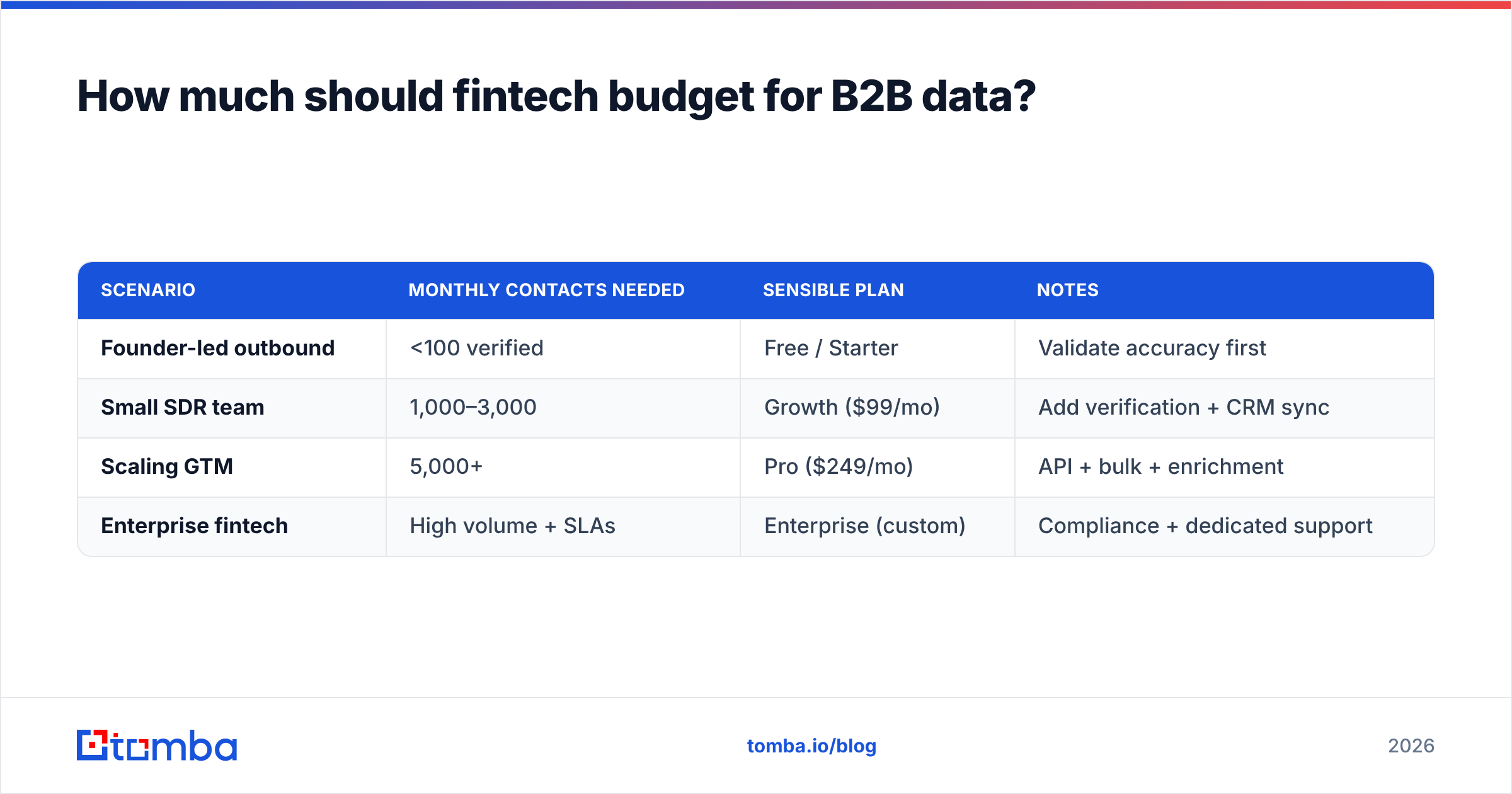
Budget by deliverable contacts, not by record count. A useful rule: estimate your monthly qualified outreach volume, divide your data spend by the deliverable contacts you can actually email, and compare vendors on that cost-per-usable-contact number.
| Scenario | Monthly contacts needed | Sensible plan | Notes |
|---|---|---|---|
| Founder-led outbound | <100 verified | Free / Starter | Validate accuracy first |
| Small SDR team | 1,000–3,000 | Growth ($99/mo) | Add verification + CRM sync |
| Scaling GTM | 5,000+ | Pro ($249/mo) | API + bulk + enrichment |
| Enterprise fintech | High volume + SLAs | Enterprise (custom) | Compliance + dedicated support |
The trap is the cheap mega-list. A 70%-deliverable database that's "unlimited" costs you far more in bounced sends, blocked domains, and rep time than a metered, verified source. Run the math on usable contacts and the picture usually flips toward accuracy.
The bottom line#
B2B data for fintech is an accuracy-and-compliance problem disguised as a volume problem. Win it by sourcing transparently, verifying relentlessly, re-checking on a cadence, and keeping your jurisdiction tags clean. Pick tools that publish their sources, survive a catch-all test, and plug into the CRM your reps already live in.
If you want to start where the payoff is highest — turning named fintech accounts into verified, deliverable contacts — try the Tomba Email Finder. Spin it up on the free tier, run your own 200-contact accuracy test against your CRM, and only scale the plan once the numbers hold. Your deliverability, your compliance team, and your pipeline will all thank you.
// get started
Find, verify and enrich your first contacts today
Start on the free plan with 25 searches a month, then scale when your team is ready.
Free plan · No credit card required · GDPR & CCPA
// about the author