B2B Data Market 2026: Size, Vendors, and How to Buy
The B2B data market is splitting into legacy databases and live-verification APIs. Here's the 2026 landscape, pricing, accuracy benchmarks, and how to buy without overpaying.
The B2B data market is the engine behind every sales sequence, ad audience, and CRM enrichment job your team runs. It is also one of the least transparent corners of the software economy: vendors quote prices in opaque "credits," accuracy claims are rarely audited, and the same record gets resold a dozen times under different labels. If you buy data the way most teams do — sign a big annual contract, dump a list into your CRM, and hope — you are overpaying for decay you can't measure.
This guide breaks down what the B2B data market actually looks like in 2026, who the players are, how pricing really works, and how to buy data that still works six months from now.
TL;DR#
- The market is roughly $10B+ and splitting in two: static "database" vendors selling pre-built records, and live-verification APIs that build and check data on demand.
- Accuracy decays fast — B2B contact data goes stale at 22–30% per year as people change jobs, so a "100M contacts" headline means little without a freshness guarantee.
- Pricing is deliberately confusing: per-credit, per-seat, per-record, and "platform" bundles all obscure the real cost per usable contact.
- The smart buy in 2026 is usage-based, verify-on-demand data instead of giant annual lists you can't audit.
- Match the tool to the job: enrichment APIs for CRM hygiene, email finders for targeted outbound, intent data for prioritization — no single vendor wins all three.
What is the B2B data market?#
The B2B data market is the ecosystem of companies that collect, package, verify, and sell information about businesses and the people who work at them — names, job titles, work emails, phone numbers, firmographics (company size, industry, revenue), technographics (what software a company uses), and behavioral "intent" signals.
Think of it like the produce supply chain. Some vendors are farmers — they gather raw data from public web pages, filings, and user contributions. Others are distributors who buy, clean, and repackage that data. And a few are grocers who sell you the finished product with a guarantee that it's fresh. The problem most buyers hit: it's hard to tell the fresh grocer from the one selling last year's harvest in a shiny box.
According to analyst coverage from firms like Gartner, the broader sales and marketing data category continues to grow double digits annually, driven by outbound automation, AI prospecting, and the collapse of third-party cookies pushing marketers toward first- and second-party B2B records.
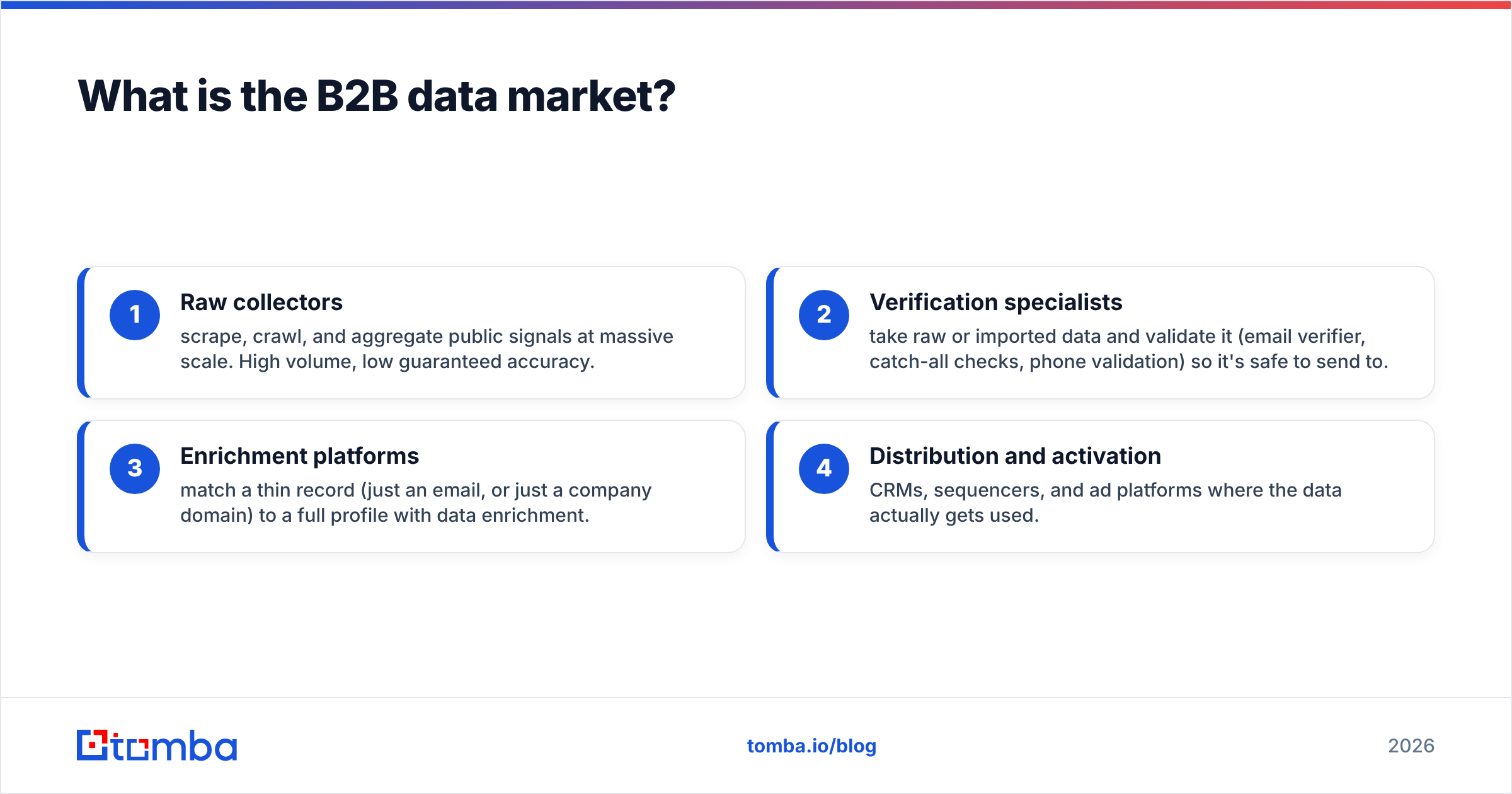
The four layers of the market#
- Raw collectors — scrape, crawl, and aggregate public signals at massive scale. High volume, low guaranteed accuracy.
- Verification specialists — take raw or imported data and validate it (email verifier, catch-all checks, phone validation) so it's safe to send to.
- Enrichment platforms — match a thin record (just an email, or just a company domain) to a full profile with data enrichment.
- Distribution and activation — CRMs, sequencers, and ad platforms where the data actually gets used.
Most "B2B data" vendors you'll evaluate operate across two or three of these layers. The accuracy question is really a question of which layer they're strongest in — and whether they verify at the moment you pull the record or simply hand you whatever was true whenever they last crawled it.

How big is the B2B data market in 2026?#
The conclusion first: the B2B data and sales-intelligence market is comfortably in the $10B+ range globally and growing 11–13% per year, with the fastest growth in API-delivered, usage-based data rather than seat-based platforms.
A few forces are driving that shift:
- AI prospecting agents consume data programmatically. They don't log into a dashboard; they call an email finder API thousands of times. That favors metered, on-demand pricing.
- Privacy regulation (GDPR, CCPA, and newer state laws) raised the cost of holding stale personal data, pushing buyers toward verify-at-use models.
- Cookie deprecation moved ad budgets toward deterministic B2B identity, expanding the buyer base beyond sales into marketing and RevOps.
The headline market-size number matters less than the structural split: buyers are moving money out of big annual database seats and into programmatic, pay-for-what-you-use data. If you're budgeting for 2026, that's the trend to underwrite.
Who are the main B2B data vendors?#
The market clusters into a handful of vendor types. No single category is "best" — they solve different problems, and most mature teams run two or three in combination.
| Vendor type | What it's best at | Typical pricing model | Watch out for |
|---|---|---|---|
| Mega-databases (e.g. |
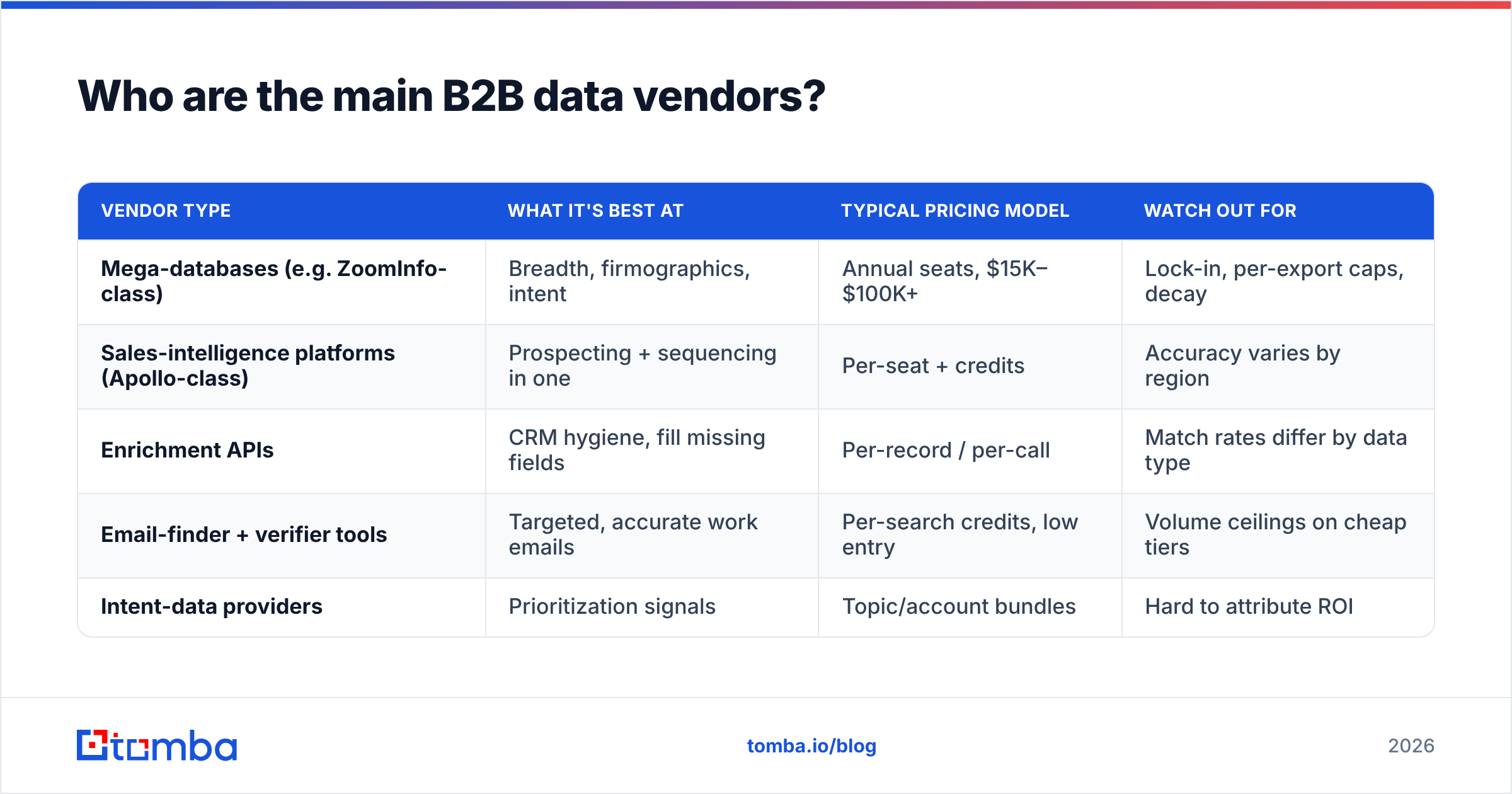
ZoomInfo-class) | Breadth, firmographics, intent | Annual seats, $15K–$100K+ | Lock-in, per-export caps, decay | | Sales-intelligence platforms (Apollo-class) | Prospecting + sequencing in one | Per-seat + credits | Accuracy varies by region | | Enrichment APIs | CRM hygiene, fill missing fields | Per-record / per-call | Match rates differ by data type | | Email-finder + verifier tools | Targeted, accurate work emails | Per-search credits, low entry | Volume ceilings on cheap tiers | | Intent-data providers | Prioritization signals | Topic/account bundles | Hard to attribute ROI |
The practical takeaway: a mega-database gives you reach, but you pay for millions of records you'll never touch and can't easily verify. A focused email finder paired with an email verifier gives you fewer records but higher usable yield per dollar — which is what actually drives reply rates. For a transparent look at where records originate, vendors that publish their data sources are easier to trust than black boxes.
You can sanity-check any vendor's reputation on independent review sites like G2 before signing — pay special attention to reviews mentioning data accuracy and refund/credit policies, not just UI praise.
How is B2B data priced, and what does it actually cost?#
The honest answer: pricing in the B2B data market is engineered to be hard to compare. Vendors deliberately use different units — credits, exports, seats, records, "platform fees" — so you can't line up two quotes side by side.
Here's how the common models really behave:
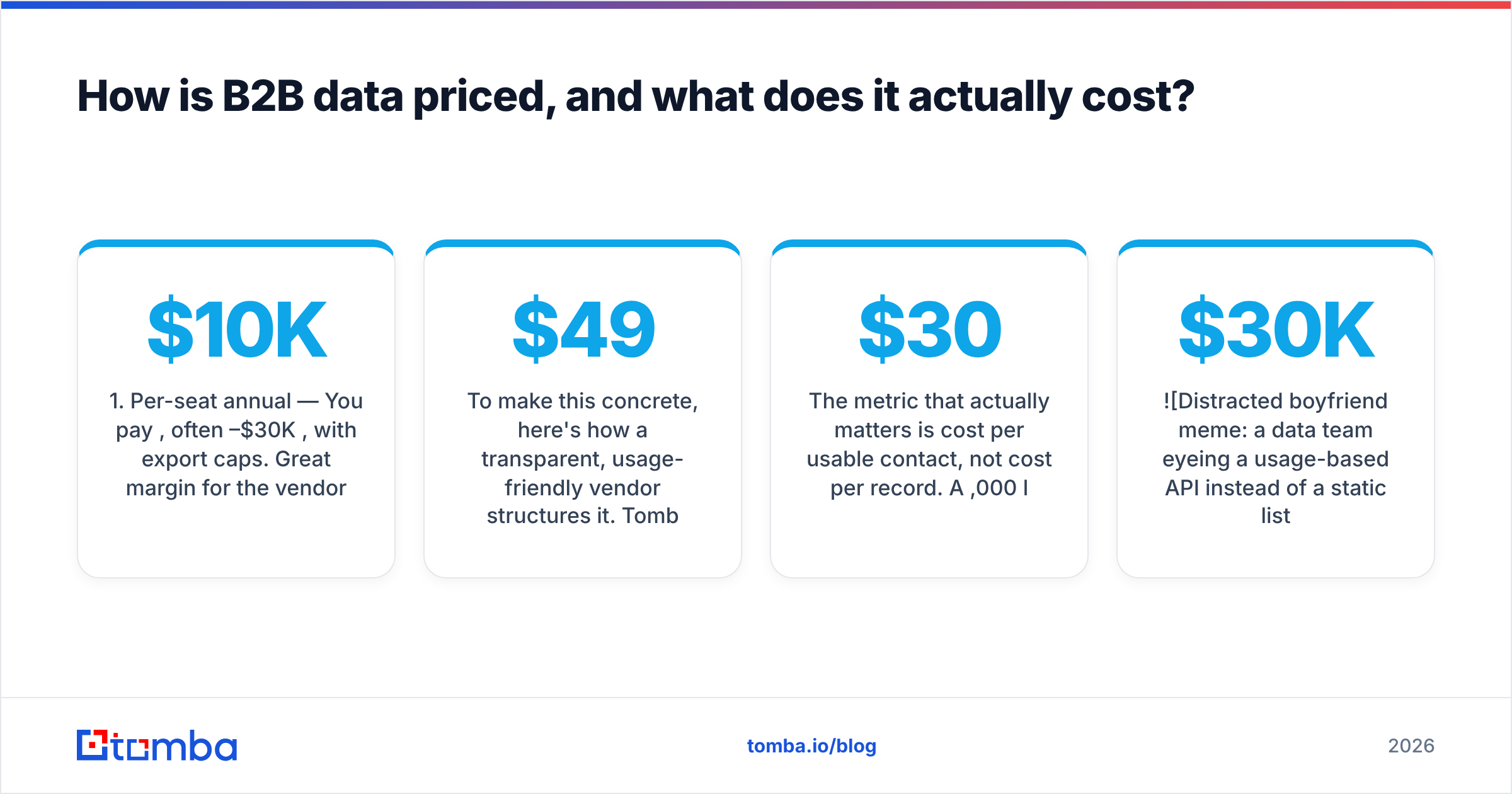
- Per-seat annual — You pay per user, often $10K–$30K per seat, with export caps. Great margin for the vendor, painful if your usage is spiky. You pay the same in a slow quarter.
- Per-credit — One "credit" might equal one email reveal, one phone number, or one enrichment. The catch: credits often expire monthly, so you pay for unused capacity.
- Per-record / per-call (usage-based) — You pay only for data you actually pull. This is the model best aligned with AI-driven, programmatic use and the easiest to forecast against pipeline.
- Freemium + tiers — A free tier to test accuracy, then monthly plans that scale. Best for teams that want to validate quality before committing budget.
To make this concrete, here's how a transparent, usage-friendly vendor structures it. Tomba's pricing runs a Free tier at 25 searches/month, Starter at $49/mo, Growth at $99/mo, Pro at $249/mo, and custom Enterprise — no per-seat tax to simply log in, and you can test accuracy on the free tier before spending a dollar.
The metric that actually matters is cost per usable contact, not cost per record. A $30,000 list of 100,000 contacts sounds cheap at $0.30 each — until a 25% bounce/decay rate means 25,000 are dead, your real cost per usable contact is $0.40, and your sender reputation took the hit for the dead ones.

Why does B2B data accuracy matter more than volume?#
Because volume is a vanity metric and accuracy is the only thing that converts. A database of 200 million contacts where 30% are wrong is worse than a database of 5 million that are verified — the big one quietly destroys your email deliverability every time you blast the dead records.
B2B contact data decays faster than almost any other data type:
- People change jobs at roughly 20–30% per year, which instantly invalidates work emails and direct dials.
- Companies rebrand, merge, and change domains, breaking firmographic matches.
- Catch-all domains accept every address, so a record can look "valid" while being a black hole. This is exactly why a dedicated catch-all verifier exists.
This is the core argument for verify-on-demand over static lists. When you pull and verify a contact at the moment you're about to use it, decay is the vendor's problem, not yours. When you buy a list in January and work it in June, decay is entirely your problem — and you paid up front for it.
Industry research consistently shows that real-time verification cuts bounce rates dramatically versus unverified lists; analyst firms like Forrester have long flagged data quality as the top suppressor of marketing and sales ROI. The fix isn't more data. It's fresher data, checked closer to the moment of use.
How should you buy B2B data in 2026?#
Lead with a test, not a contract. The single biggest mistake buyers make is signing an annual deal before measuring quality on their exact ICP. Here's a buying sequence that protects you:
- Define your ICP narrowly first. Don't evaluate "data quality" in the abstract — test the vendor on the 500 accounts you actually want. A vendor strong in US tech may be weak in EU manufacturing.
- Run a blind accuracy test. Pull 100 contacts from each finalist, verify them independently, and measure real bounce and connect rates. Don't trust the marketing claim.
- Compare cost per usable contact, not per record or per seat. Factor in decay and bounce.
- Prefer usage-based or freemium entry so you can scale spend with results instead of betting a year's budget on a demo.
- Demand source transparency. A vendor that explains where data comes from and how often it's refreshed is structurally more trustworthy than one that won't.
- Separate the jobs. Use an enrichment API for CRM hygiene, an email finder + verifier for targeted outbound, and intent data for prioritization. One bundle rarely wins all three.
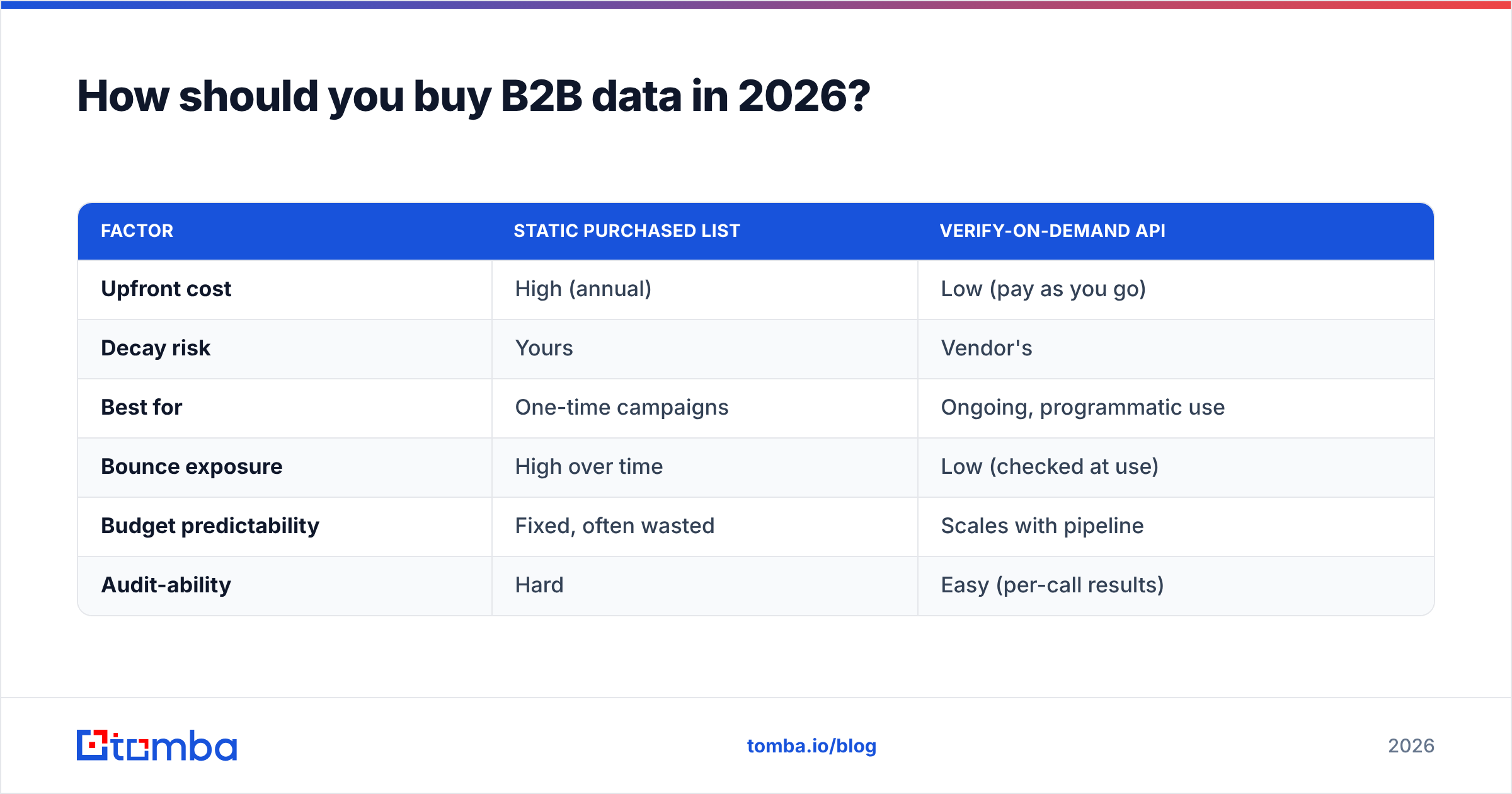
Static list vs. verify-on-demand: the head-to-head#
| Factor | Static purchased list | Verify-on-demand API |
|---|---|---|
| Upfront cost | High (annual) | Low (pay as you go) |
| Decay risk | Yours | Vendor's |
| Best for | One-time campaigns | Ongoing, programmatic use |
| Bounce exposure | High over time | Low (checked at use) |
| Budget predictability | Fixed, often wasted | Scales with pipeline |
| Audit-ability | Hard | Easy (per-call results) |
If your usage is steady and programmatic — AI agents, CRM enrichment workflows, continuous outbound — verify-on-demand almost always wins on cost per usable contact. Static lists only make sense for a narrow, one-time campaign where you'll work every record within weeks of purchase, before decay sets in.
What's next for the B2B data market?#
Three shifts are worth planning around:
- Agentic consumption. AI SDRs and research agents will be the dominant data consumers, and they need APIs, not dashboards. Vendors that expose clean, metered endpoints — like a documented email finder API — win this wave.
- Compliance as a feature. Buyers will increasingly choose vendors that can prove lawful sourcing and honor suppression requests, not just the cheapest records.
- Consolidation of the stack. Teams are tired of paying four vendors for overlapping data. Expect demand for platforms that combine finding, verifying, enriching, and phone lookup under one transparent, usage-based meter.
The winners won't be whoever claims the biggest number of contacts. They'll be whoever delivers the highest usable yield per dollar with sources you can audit.
The bottom line#
The B2B data market in 2026 rewards buyers who stop paying for volume and start paying for verified, on-demand accuracy. Test before you commit, measure cost per usable contact, and keep your data fresh by verifying close to the moment of use.
If you want to start without an annual contract, Tomba's Email Finder lets you find and verify professional emails by name, domain, or company on a free tier of 25 searches a month — enough to run a real accuracy test on your own ICP before you spend anything. Pair it with the built-in email verifier and data enrichment, scale on usage-based pricing that starts at $49/mo, and you get fresh, auditable B2B data without the lock-in. Run the blind test this guide recommends — then let the bounce rate decide.
// get started
Find, verify and enrich your first contacts today
Start on the free plan with 25 searches a month, then scale when your team is ready.
Free plan · No credit card required · GDPR & CCPA
// about the author