What Is a B2B Data Platform? The Complete 2026 Buyer's Guide
A B2B data platform is the system that feeds clean, current contact and company data into your GTM stack. Here's how to evaluate one in 2026 — coverage, accuracy, refresh, and price.
TL;DR
- A B2B data platform is the central system that collects, cleans, enriches, and serves company and contact data to your sales, marketing, and RevOps tools.
- The four metrics that actually matter are coverage, accuracy, refresh rate, and compliance — not the size of the raw database.
- Most teams overpay for a bloated "all-in-one" suite when a focused finder + verifier + enrichment API covers 90% of real GTM work.
- Pricing models vary wildly: per-credit, per-seat, and per-record. Per-credit (like Tomba pricing) is usually cheapest for prospecting teams.
- This guide gives you a scoring framework, a side-by-side comparison table, and a buying checklist you can apply in an afternoon.
What is a B2B data platform?#
A B2B data platform is the data layer underneath your go-to-market motion. Think of it as the water utility for your revenue team: nobody celebrates the pipes, but the moment the water is dirty or stops flowing, every downstream system — your CRM, your sequencer, your ad audiences — breaks at once.
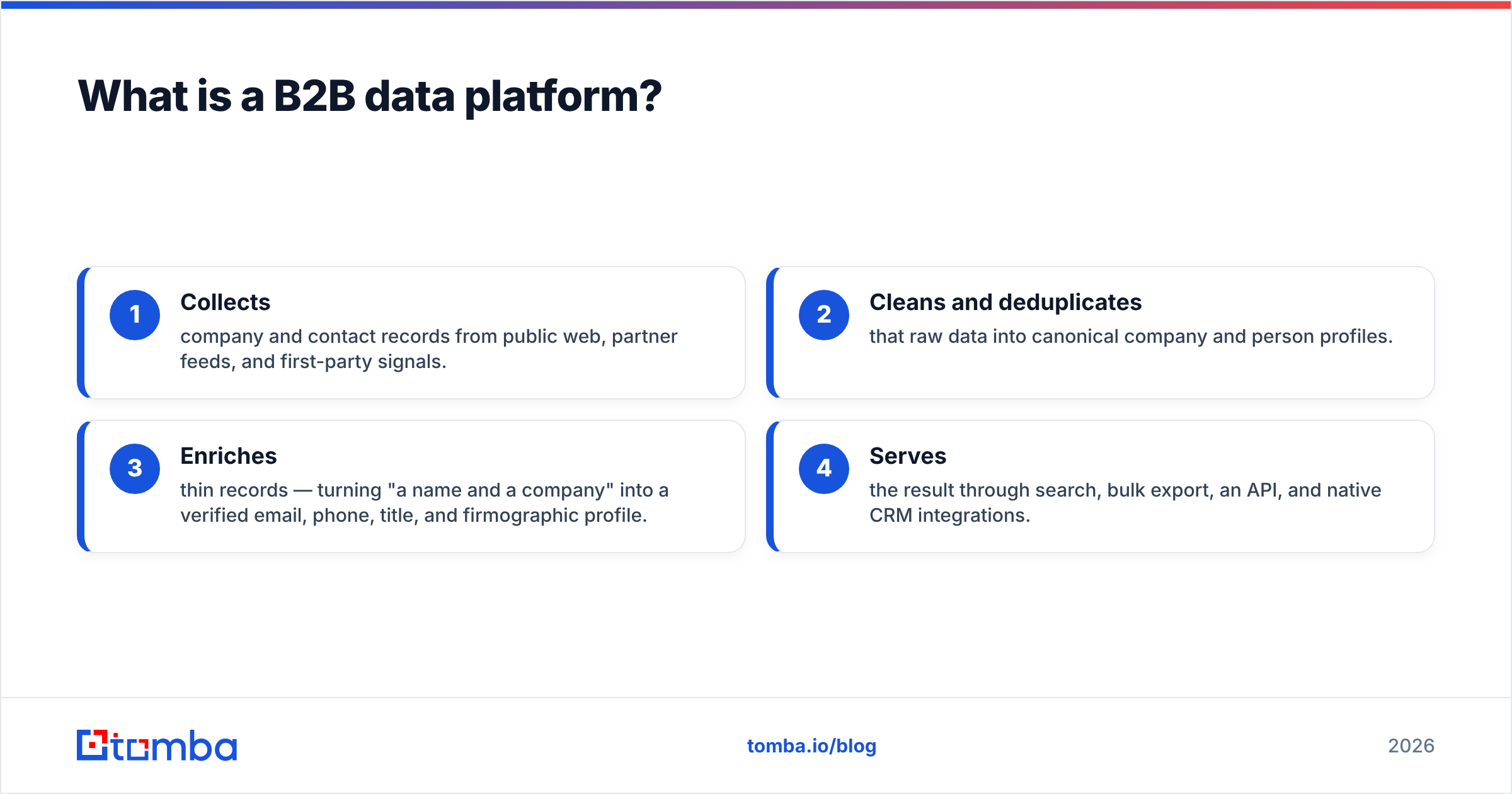
Concretely, a B2B data platform does four jobs:
- Collects company and contact records from public web, partner feeds, and first-party signals.
- Cleans and deduplicates that raw data into canonical company and person profiles.
- Enriches thin records — turning "a name and a company" into a verified email, phone, title, and firmographic profile.
- Serves the result through search, bulk export, an API, and native CRM integrations.
The category overlaps with terms you've seen elsewhere: sales intelligence, lead databases, data enrichment tools, and contact-finding software. The distinction is scope. A pure email finder answers one question ("what's this person's email?"). A data platform answers many ("who works here, what do they do, how do I reach them, and is that still true today?").
)
Why does data quality decide GTM success?#
Bad data quietly taxes every team that touches it. The numbers are sobering: B2B data decays at roughly 25–30% per year because people change jobs, companies rebrand, and domains get retired. A list you bought in January is materially wrong by summer.
Here's the chain reaction when quality slips:
- Deliverability tanks. Sending to dead mailboxes spikes your bounce rate, which damages sender reputation and lands your good emails in spam.
- Rep time evaporates. SDRs spend hours hand-correcting records instead of selling.
- Forecasts drift. Duplicate and stale accounts inflate TAM math and pollute attribution.
- Compliance risk grows. Holding outdated or non-consented personal data is a GDPR and CCPA liability.
This is why "how big is your database" is the wrong opening question. A vendor can claim 700 million contacts and still hand you a 40% bounce rate. What matters is how many of those records are correct today.
What are the core components of a B2B data platform?#
Use this as your feature map when you evaluate vendors. A complete platform covers most of these; a focused tool nails a few of them very well.
- Contact discovery — find verified emails and phone numbers by name, company, or role. This is the email finder at the heart of most platforms.
- Email verification — an email verifier that checks syntax, MX records, and mailbox existence before you send.
- Domain and company search — pull every reachable contact at a target account via domain search.
- Catch-all handling — a catch-all verifier to score risky domains that accept all mail.
- Firmographic enrichment — industry, headcount, revenue, tech stack, location.
- Phone and direct-dial data — a phone finder for outbound calling teams.
- Delivery surfaces — API, bulk CSV, browser extension, and CRM sync.
The teams that get the most value treat these as composable building blocks rather than demanding one monolith. You might run verification through one provider, enrichment through another, and discovery through a B2B database with a strong API.
How do you evaluate a B2B data platform in 2026?#
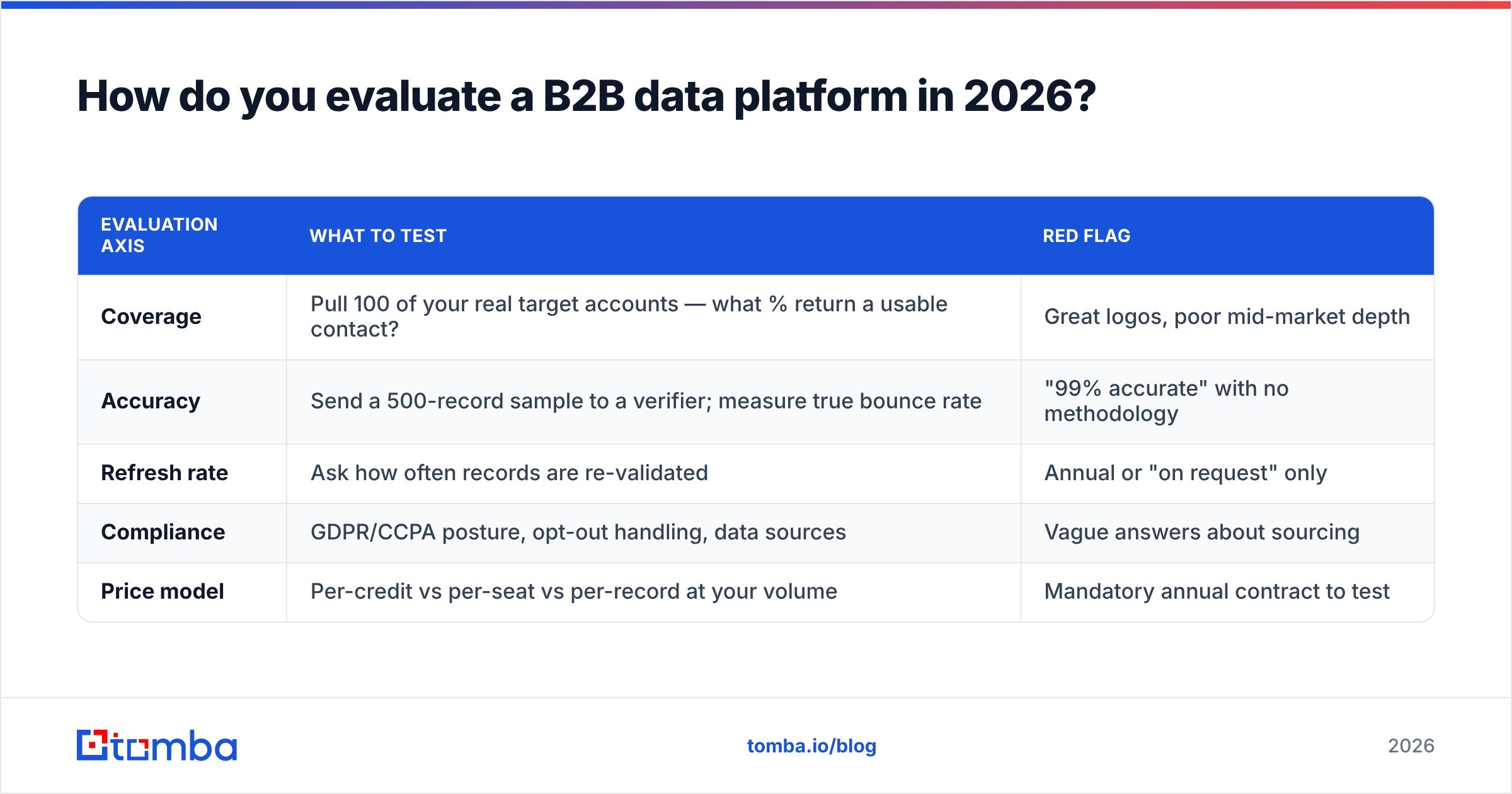
Score every vendor on the same five axes. Weight them to your motion — outbound-heavy teams weight coverage and accuracy; ABM teams weight firmographic depth.
| Evaluation axis | What to test | Red flag |
|---|---|---|
| Coverage | Pull 100 of your real target accounts — what % return a usable contact? | Great logos, poor mid-market depth |
| Accuracy | Send a 500-record sample to a verifier; measure true bounce rate | "99% accurate" with no methodology |
| Refresh rate | Ask how often records are re-validated | Annual or "on request" only |
| Compliance | GDPR/CCPA posture, opt-out handling, data sources | Vague answers about sourcing |
| Price model | Per-credit vs per-seat vs per-record at your volume | Mandatory annual contract to test |
The single most reliable test is the blind sample. Don't trust the marketing accuracy number. Take a list of contacts you already know are correct, run the platform against them, and measure the real hit and bounce rates yourself. According to G2 reviews across the sales-intelligence category, self-reported accuracy and measured accuracy routinely diverge by double digits.
How do the main pricing models compare?#
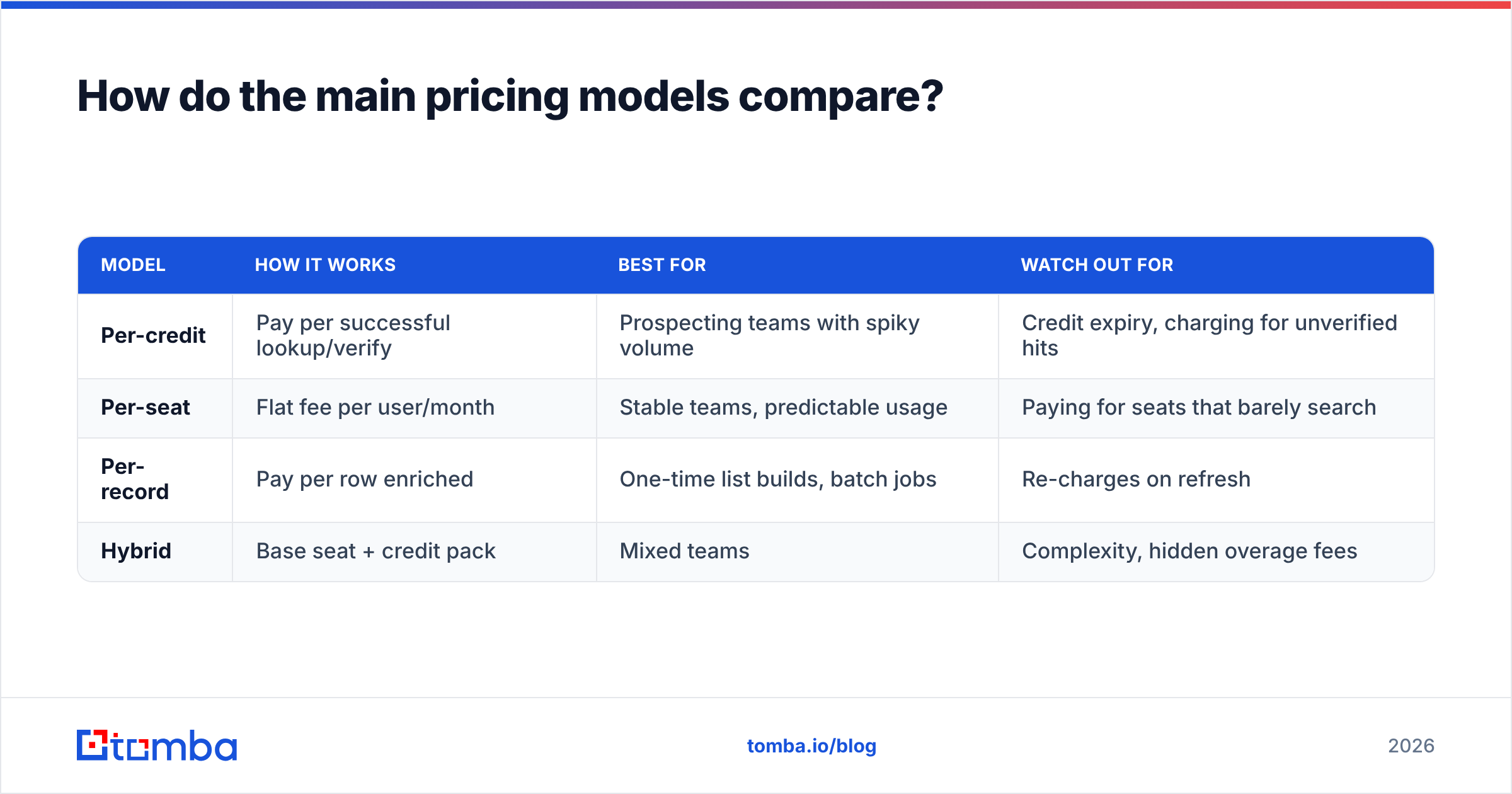
Pricing is where buyers get burned, because the headline number rarely maps to your actual usage. Here are the three dominant models and who each one favors.
| Model | How it works | Best for | Watch out for |
|---|---|---|---|
| Per-credit | Pay per successful lookup/verify | Prospecting teams with spiky volume | Credit expiry, charging for unverified hits |
| Per-seat | Flat fee per user/month | Stable teams, predictable usage | Paying for seats that barely search |
| Per-record | Pay per row enriched | One-time list builds, batch jobs | Re-charges on refresh |
| Hybrid | Base seat + credit pack | Mixed teams | Complexity, hidden overage fees |
For most outbound and demand-gen teams, per-credit billing is the most honest because you pay for outcomes, not chairs. As a concrete reference point, Tomba runs a free tier (25 searches/month), then Starter at $49/mo, Growth at $99/mo, Pro at $249/mo, and custom Enterprise — with credits spanning the finder, verifier, and enrichment rather than locking each behind a separate SKU.
)
One rule: never sign an annual contract before running the blind sample on a free or trial tier. Vendors confident in their data let you test first.
Should you buy an all-in-one suite or compose your own stack?#
Buy the suite if you want one vendor, one invoice, and a built-in sequencer, and you're comfortable with average data in exchange for convenience. Platforms like the big sales-intelligence suites bundle dialer, sequencer, and data — handy, but you pay for modules you may already own.
Compose your stack if you already have a sequencer (Instantly, Smartlead, Salesloft) and a CRM, and you want the best data layer feeding them rather than a mediocre everything-machine. In this model you pick a focused, API-first data platform and wire it into your existing tools through integrations like HubSpot, Salesforce, Pipedrive, and Zapier.
The composed approach almost always wins on data quality and cost per usable record, because you're not subsidizing features you don't use. It loses on simplicity — you manage more vendors. If your team is under five reps, that tradeoff is easy; the suite's "one login" rarely justifies the markup.
A quick decision checklist#
- Do you already own a sequencer and CRM? → Compose. Add a data API.
- Is data accuracy your top pain? → Compose with a verifier in the loop.
- Do you need a dialer + email + data in one place tomorrow? → Suite.
- Is budget tight and volume spiky? → Per-credit data platform, no suite.
How does compliance fit into a B2B data platform?#
Compliance is not optional plumbing in 2026 — it's a selection criterion. A platform that can't tell you where its data comes from is a liability you're inheriting.
Ask every vendor three questions:
- Sourcing: Is the data from public web, partner contributions, or scraped from gated networks? Transparent sourcing is a green flag; documentation like Tomba's data sources page is what good looks like.
- Consent and opt-out: How fast does a removal request propagate? Under GDPR you need this to be days, not "next refresh."
- Region handling: Does the platform respect EU vs US data-handling differences?
For the legal baseline, read the official GDPR text on the European Commission site rather than a vendor's summary. Your data provider's compliance is your compliance — regulators don't accept "our vendor told us it was fine."
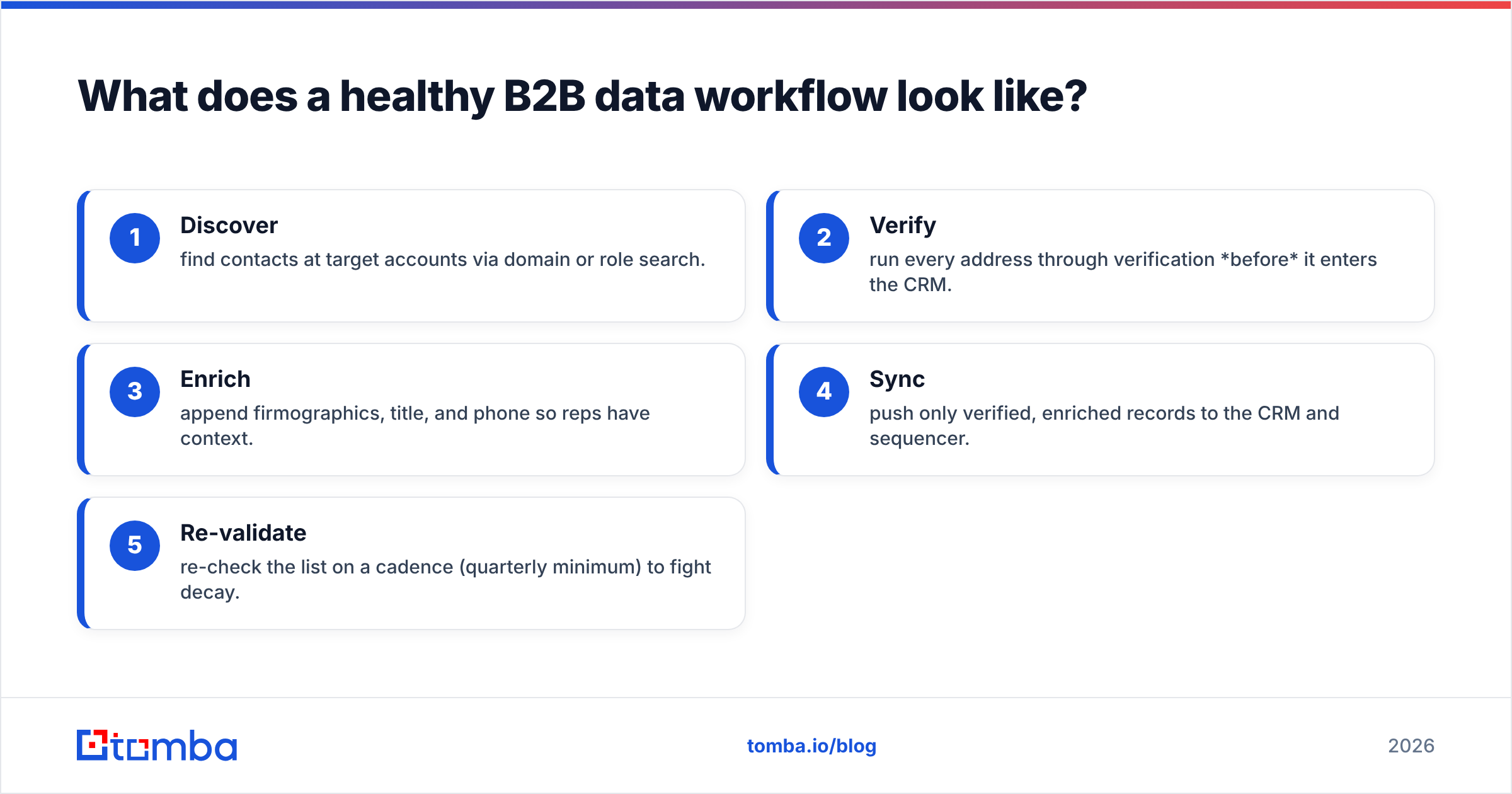
What does a healthy B2B data workflow look like?#
Tools are only half the story. The teams with clean pipelines run a repeatable loop, not a one-time import.
- Discover — find contacts at target accounts via domain or role search.
- Verify — run every address through verification before it enters the CRM.
- Enrich — append firmographics, title, and phone so reps have context.
- Sync — push only verified, enriched records to the CRM and sequencer.
- Re-validate — re-check the list on a cadence (quarterly minimum) to fight decay.
Notice verification sits before the CRM, not after a bounce. That single ordering change is the difference between protecting your email deliverability and slowly poisoning your sending domain. For larger jobs, a bulk email finder plus batch verification handles thousands of records without you babysitting credits one row at a time.
Which type of buyer should pick what?#
- Solo founder / early SDR: Start on a free tier. You need accuracy on a handful of accounts, not 700M rows. A per-credit finder + verifier is plenty.
- Scaling outbound team (5–50 reps): Compose. API-first data platform + your existing sequencer + CRM enrichment on sync.
- ABM / enterprise marketing: Weight firmographic depth and intent signals; you may justify a larger suite, but still benchmark the data layer separately.
- Agencies / data resellers: Prioritize a strong API and clear per-record economics so you can pass costs through cleanly.
The mistake at every tier is buying for the database size on the homepage. Buy for the percentage of your accounts the platform can reach with correct, current data — a number only your own blind sample reveals.
Frequently asked questions#
What is the difference between a B2B data platform and a CRM? A CRM stores and manages your relationships and deals; a B2B data platform supplies and refreshes the underlying contact and company data. The platform feeds the CRM — they're complementary, not competitors.
How accurate is B2B contact data, really? Top platforms verify in the low-to-mid 90s percent on deliverable emails when measured by true bounce rate. Treat any "99%+" claim with no published methodology as marketing, and always run your own sample.
Do I need both an email finder and a verifier? Yes. A finder locates the address; a verifier confirms it's still live. Skipping verification is the most common cause of high bounce rates and damaged sender reputation.
Is per-credit pricing cheaper than per-seat? For most prospecting teams, yes — you pay for successful lookups instead of idle seats. Per-seat only wins when every user searches heavily and predictably every month.
The bottom line#
A B2B data platform lives or dies on four numbers: coverage, accuracy, refresh, and compliance — never on the size of the raw database. Run a blind sample, weight the axes to your motion, and prefer a focused, API-first data layer over a bloated suite unless you genuinely need the bundled sequencer and dialer.
If you want to test that approach today, start with the Tomba Email Finder. The free tier gives you 25 searches a month to run your own blind sample, finder and verifier credits share one balance so you're not double-charged, and the Tomba API drops straight into HubSpot, Salesforce, or your sequencer. Build your stack around data you've actually measured — then scale the plan once the numbers prove themselves.
// get started
Find, verify and enrich your first contacts today
Start on the free plan with 25 searches a month, then scale when your team is ready.
Free plan · No credit card required · GDPR & CCPA
// about the author