Best B2B Data Providers UK in 2026: Top 9 Compared
Choosing between B2B data providers in the UK? Compare coverage, GDPR compliance, pricing, and accuracy across the 9 vendors that actually matter in 2026.
Best B2B Data Providers UK in 2026: Top 9 Compared
Picking a B2B data provider in the UK is not the same problem as picking one in the US. Coverage skews differently, GDPR raises the stakes on where the data came from, and the "global" vendors that dominate American sales stacks often thin out the moment you filter for UK SMEs. This guide compares the nine providers UK revenue teams actually shortlist in 2026 — on coverage, compliance, accuracy, and price — so you can match a tool to your motion instead of a logo to a slide.
TL;DR#
- There is no single "best" UK provider — the right pick depends on whether you need mobile numbers, deep firmographics, or just verified work emails at a fair price.
- Cognism and Lusha lead on UK/EMEA mobile coverage; Apollo and Tomba lead on price-to-coverage value for email-led outbound.
- GDPR compliance is a feature, not a footnote. Ask every vendor for their lawful basis and notification process before you buy.
- Accuracy claims are marketing until you test them. Run a 100-contact pilot against your own ICP and measure bounce rate yourself.
- Most teams overpay by buying a heavyweight platform when a focused email finder plus enrichment would cover 80% of the need.
What counts as a B2B data provider in the UK?#
A B2B data provider sells you contact and company information — names, job titles, work emails, mobile numbers, firmographics, and intent signals — that your sales and marketing teams use to find and reach buyers. Think of it like a phone book that updates itself: the value is not the list, it's how fresh and how legally-sourced the list stays.
In the UK market, providers fall into three rough camps:
- Sales intelligence platforms — Cognism, ZoomInfo, Apollo. Big databases, intent data, CRM integrations, enterprise pricing.
- Prospecting and enrichment tools — Lusha, Kaspr, RocketReach, Tomba. Lighter, faster, often self-serve, priced for SMBs and individual reps.
- Compliance-first list vendors — UK-focused firms selling marketing lists with documented consent and ICO-aware processes.
The lines blur. Tomba, for instance, is best known as an email verifier and finder but also offers data enrichment and a B2B database that overlap with the "platform" camp. The question is rarely "which category" — it's "which capability do I actually pay for."
Which B2B data providers UK teams shortlist in 2026?#
Below is the head-to-head most UK buyers end up running. Prices are entry points in GBP/USD as published in 2026; always confirm current pricing details directly, since tiers shift.
| Provider | UK/EMEA strength | Starting price | Free tier | Best for |
|---|---|---|---|---|
| Cognism | Mobile numbers, GDPR-aware sourcing | Custom (£1k+/mo typical) | No | Outbound calling teams in EMEA |
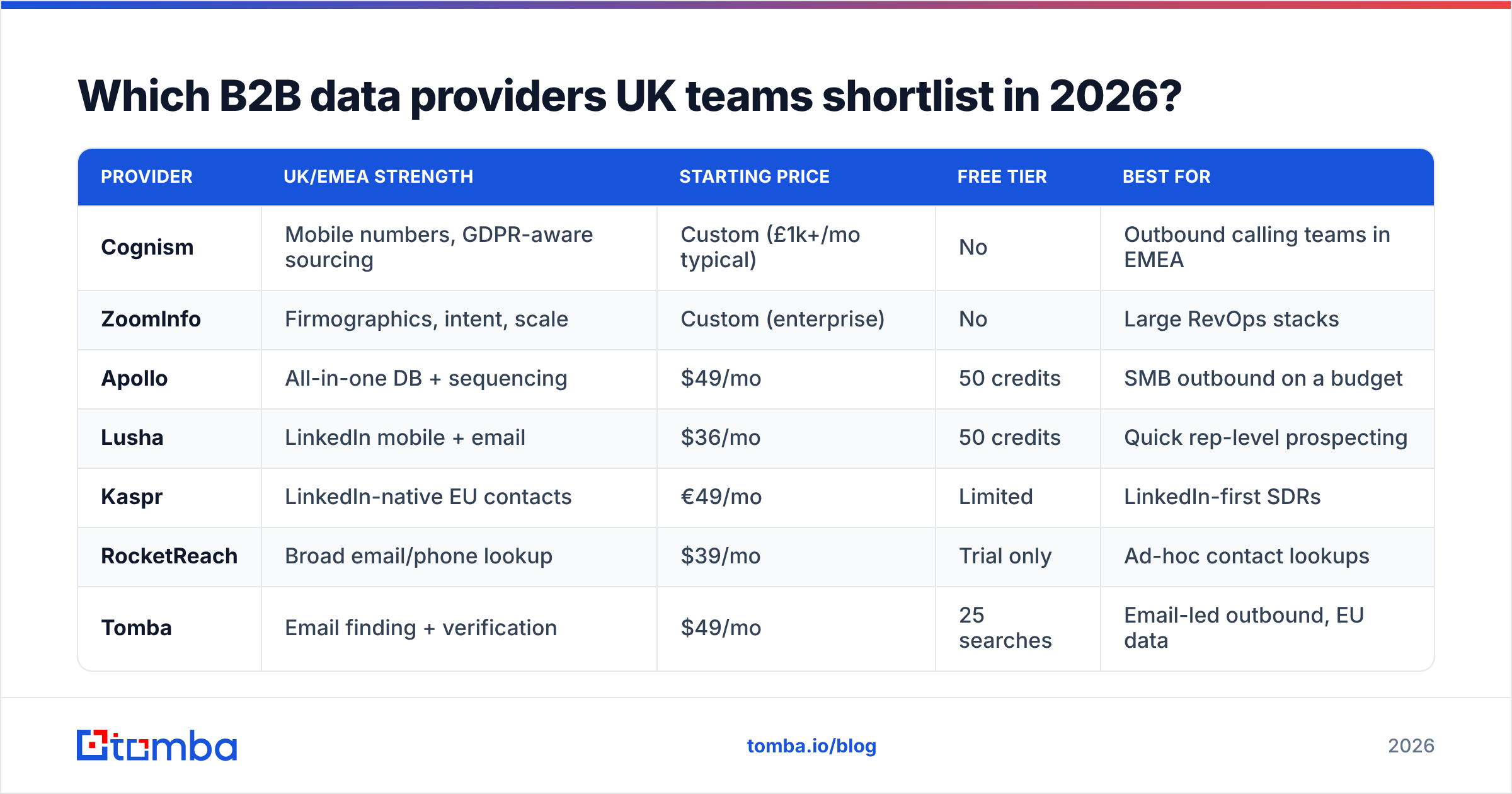
ZoomInfo | Firmographics, intent, scale | Custom (enterprise) | No | Large RevOps stacks | | Apollo | All-in-one DB + sequencing | $49/mo | 50 credits | SMB outbound on a budget | | Lusha | LinkedIn mobile + email | $36/mo | 50 credits | Quick rep-level prospecting | | Kaspr | LinkedIn-native EU contacts | €49/mo | Limited | LinkedIn-first SDRs | | RocketReach | Broad email/phone lookup | $39/mo | Trial only | Ad-hoc contact lookups | | Tomba | Email finding + verification | $49/mo | 25 searches | Email-led outbound, EU data | | Clearbit (Breeze) | Enrichment inside HubSpot | Bundled w/ HubSpot | Limited | HubSpot-centric GTM | | Cognism Kaspr combo | Phone + LinkedIn depth | Custom | No | High-volume calling |
A few honest notes on the table. The "enterprise custom" vendors are powerful but rarely justify their cost below a certain seat count — you are paying for coverage breadth and intent data you may never action. The self-serve tools (Apollo, Lusha, Tomba, RocketReach) get you 80% of the contact accuracy for a fraction of the spend, which is why so many UK SMBs start there and only graduate to a platform when intent data becomes a real bottleneck.
How do you judge B2B data accuracy?#
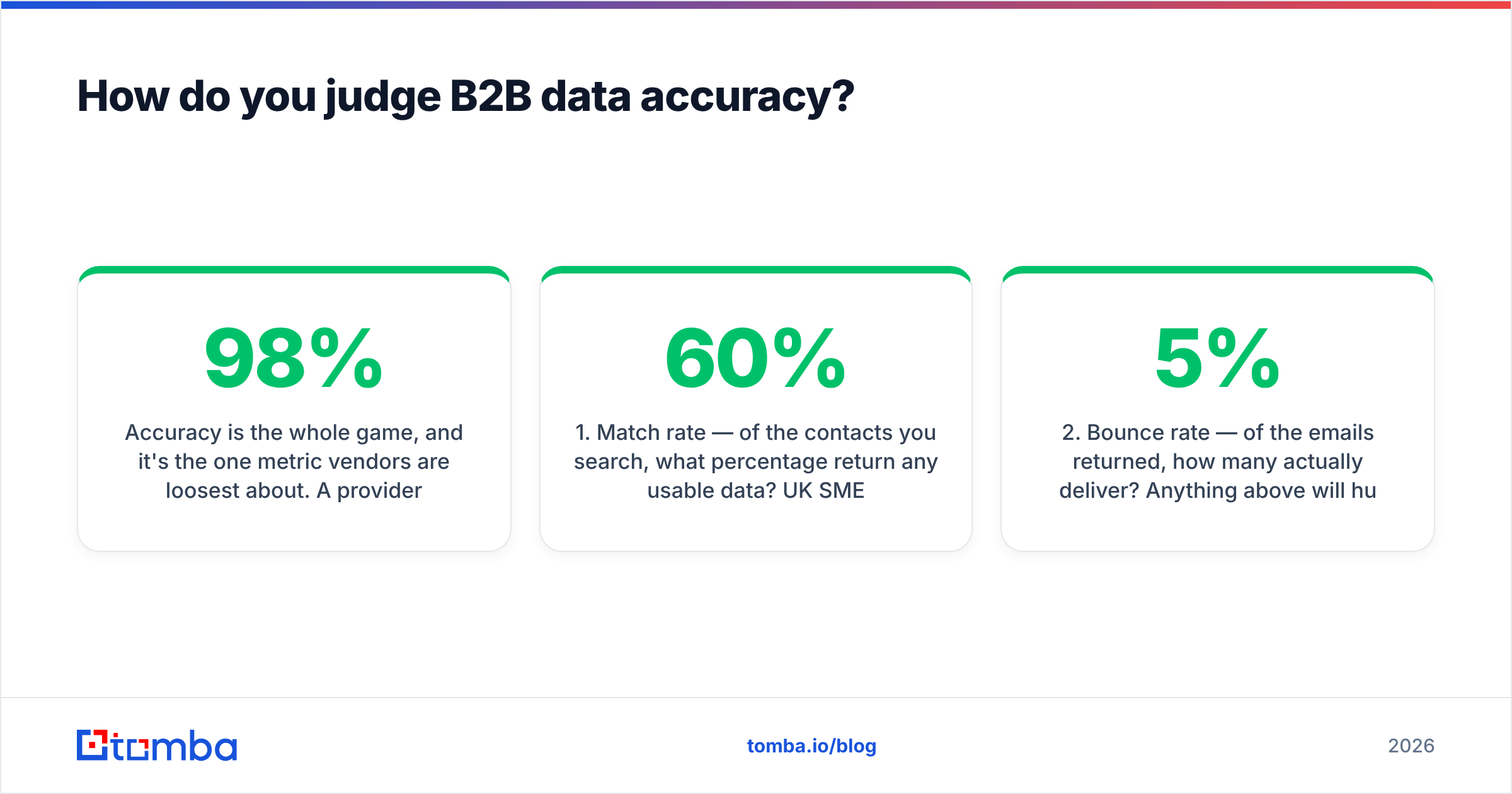
Accuracy is the whole game, and it's the one metric vendors are loosest about. A provider quoting "98% accuracy" is usually measuring deliverability on emails they've pre-filtered — not the hit rate across your messy, real-world ICP.
Judge accuracy on four concrete dimensions:
- Match rate — of the contacts you search, what percentage return any usable data? UK SME coverage is where most global tools quietly fall to 40–60%.
- Bounce rate — of the emails returned, how many actually deliver? Anything above 5% will hurt your sender reputation. Pair any provider with an email verifier to catch the rot before you send.
- Phone connect rate — for calling teams, a "mobile number" that rings a dead line is worse than no number.
- Recency — when was the record last verified? A 2026 record beats a 2023 one even from a "bigger" database.
The only trustworthy test is your own. Take 100 accounts from your real pipeline, run them through each shortlisted vendor's free tier, push the results through a bulk verify pass, and measure bounce and connect rates yourself. Vendors hate this; good ones encourage it. For methodology on how email data is sourced and validated, Tomba documents its data sources openly, which is the kind of transparency worth demanding from everyone on your list.

Is GDPR a problem with B2B data providers in the UK?#
GDPR is not a problem — it's a filter that separates careful vendors from reckless ones. Under UK GDPR and PECR, B2B contact data can be processed under "legitimate interest," but that lawful basis comes with obligations: you must be able to show where the data came from, honour deletion requests, and in many cases notify individuals that you hold their data.
Practically, this means three buying questions you should ask every provider:
- What is your lawful basis, and can you document the source of each record? Vague answers are a red flag.
- Do you notify data subjects, or is that on me? Some EU-first vendors (Cognism's "Diamond Data," for example) bake notification into their process; others leave you exposed.
- How fast do you process erasure requests? The UK's Information Commissioner's Office (ico.org.uk) can fine for slow or ignored requests.
Email-led outreach has a slightly easier path than cold calling under PECR, but neither is a free pass. Treating compliance as part of data accuracy — not a separate legal chore — is what mature UK teams do. A clean, well-sourced, smaller dataset beats a giant scraped one that becomes a liability the first time someone complains.
Cognism vs Apollo vs Tomba: which fits which team?#
These three come up in nearly every UK shortlist because they represent three different bets.
Cognism is the bet on phone-led EMEA outbound. Its mobile coverage across the UK and Europe is genuinely strong, its sourcing is compliance-forward, and its intent data is useful at scale. The catch is price and commitment: it's an annual-contract, four-figures-a-month tool that only pays back if your team lives in the dialler. If you're an Apollo or Cognism alternative shopper purely for email, you're overbuying.
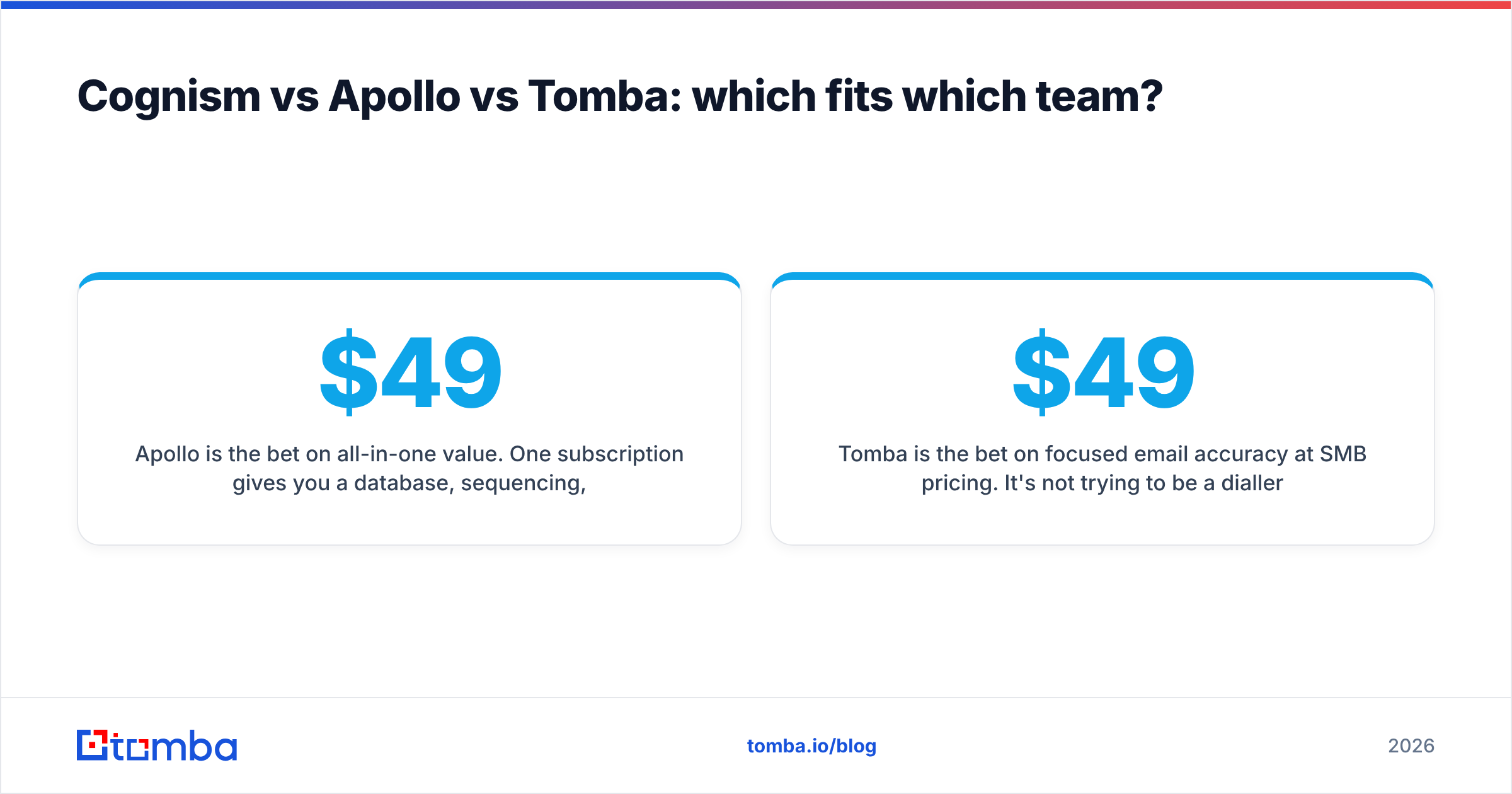
Apollo is the bet on all-in-one value. One subscription gives you a database, sequencing, and a Chrome extension, starting at $49/mo. Coverage is broad but UK SME depth is patchy, and the sequencing engine is fine rather than best-in-class. It's the default "we need everything cheaply" pick — and it's exactly why teams who want better data quality often pair or replace it.
Tomba is the bet on focused email accuracy at SMB pricing. It's not trying to be a dialler or a sequencer — it does email finding, verification, domain search, and enrichment, with an EU footprint and transparent sourcing. The Free tier gives you 25 searches/mo, Starter is $49/mo, Growth $99/mo, and Pro $249/mo. For email-first outbound where deliverability matters more than mobile numbers, it covers the core job without the platform tax.
The decision tree is simple: calling team in EMEA → Cognism. Everything-in-one on a budget → Apollo. Email accuracy and verification as the priority → Tomba, often alongside a lightweight sequencer.
What does a smart UK data stack look like?#
The teams getting the best return don't buy one mega-platform. They assemble a stack where each tool does one thing well and the data flows between them. A typical lean 2026 setup:
- Find — an email finder or domain search to source verified contacts by company.
- Verify — a verification pass to strip catch-alls and dead addresses before they hit your sequencer. A catch-all verifier matters more in the UK than people expect, since many British SMEs run catch-all domains.
- Enrich — contact enrichment to add titles, firmographics, and LinkedIn data to records you already have.
- Route — push clean records into your CRM via native integrations (HubSpot, Salesforce, Pipedrive) so reps never paste data by hand.
This modular approach is cheaper, more GDPR-defensible (fewer redundant copies of personal data), and easier to swap when a vendor's coverage slips. It also sidesteps the classic trap of paying enterprise rates for an intent-data module nobody on the team has the time to act on.
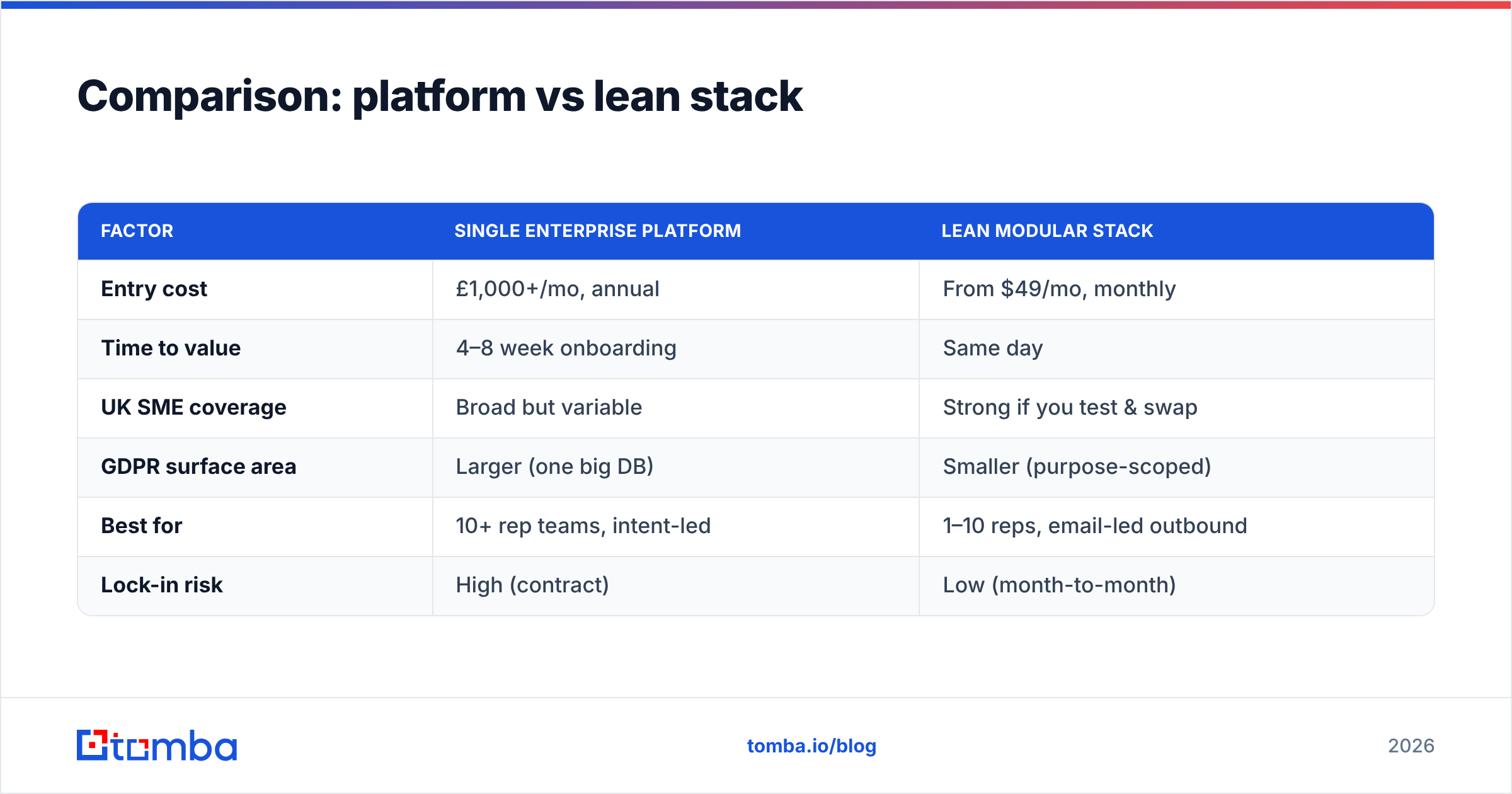
Comparison: platform vs lean stack#
| Factor | Single enterprise platform | Lean modular stack |
|---|---|---|
| Entry cost | £1,000+/mo, annual | From $49/mo, monthly |
| Time to value | 4–8 week onboarding | Same day |
| UK SME coverage | Broad but variable | Strong if you test & swap |
| GDPR surface area | Larger (one big DB) | Smaller (purpose-scoped) |
| Best for | 10+ rep teams, intent-led | 1–10 reps, email-led outbound |
| Lock-in risk | High (contract) | Low (month-to-month) |
Neither column is "correct." A 30-person SDR org running intent-based outbound will get more from a platform. A founder-led or sub-10-rep team almost always wins with the modular stack — and can graduate later without having wasted a year's enterprise spend.
How should you run the buying process?#
Run it like a procurement exercise, not a demo tour. Vendors are good at demos; they are less good at surviving a structured pilot.
- Define your ICP precisely — industry, company size, geography, seniority. Vague ICPs make every vendor look equally mediocre.
- Pull a 100-account test set from real pipeline, not cherry-picked logos.
- Run each shortlisted tool's free or trial tier against that exact set.
- Verify the output independently with a bulk verify pass so you're comparing deliverable data, not raw claims.
- Score on match rate, bounce rate, recency, and price-per-usable-contact — that last metric, not headline pricing, is what actually matters.
- Ask the GDPR questions above and weight compliance as a pass/fail gate, not a tiebreaker.
For broader vendor reviews and verified user feedback, cross-reference your shortlist on G2 and watch for the pattern in complaints — "coverage thin outside the US" is the recurring UK-specific one to look for. Industry analysts like Gartner also publish sales-intelligence market guides worth skimming for the enterprise end of the list.
Frequently asked questions#
Which B2B data provider has the best UK coverage? For mobile-led calling, Cognism is the consensus leader in EMEA. For email-led outbound at SMB pricing, Apollo and Tomba offer the best coverage-to-cost ratio. Always validate against your own ICP — coverage varies wildly by industry and company size.
Are B2B data providers legal in the UK? Yes, when they process data under a documented lawful basis (usually legitimate interest) and honour UK GDPR/PECR obligations. The legality depends on the vendor's sourcing and your use, not the category itself.
Do I need both an email finder and a verifier? Practically, yes. Finders source addresses; verifiers confirm they deliver. Running both keeps your bounce rate low and protects sender reputation — which is why tools like Tomba bundle email verification alongside finding.
Is a free tier enough to evaluate a provider? It's enough to run the 100-account pilot that should drive your decision. Tomba's Free tier (25 searches/mo) and Apollo's 50 credits are designed exactly for this kind of pre-purchase testing.
The bottom line#
The best B2B data provider for your UK team is the one that returns the most usable, compliant contacts per pound — and you can only learn that by testing, not by reading vendor decks. Shortlist three, run the pilot, verify the output yourself, and weight GDPR as a gate.
If your motion is email-led and you want accurate, well-sourced contacts without the enterprise contract, start with the Tomba Email Finder. Find verified professional emails by domain, name, or company, verify them in the same workflow, and enrich what you already have — on a Free tier that lets you run a real test before you spend a penny. Build the lean stack first; graduate to the platform only when your data, not your vendor, tells you it's time.
// get started
Find, verify and enrich your first contacts today
Start on the free plan with 25 searches a month, then scale when your team is ready.
Free plan · No credit card required · GDPR & CCPA
// about the author