B2B Database Platform: How to Choose the Right One in 2026
A B2B database platform is only as good as the contacts it returns. Here's how to compare coverage, accuracy, pricing, and compliance before you sign a 12-month contract.
B2B Database Platform: How to Choose the Right One in 2026
A B2B database platform sells you one thing: contacts and company records you can act on. The pitch is always the same — millions of profiles, verified emails, direct dials, intent signals. The reality varies wildly. Two vendors can both claim "275M contacts" and hand you lists where one bounces at 4% and the other at 22%.
This guide cuts through the marketing. You'll see what a B2B database platform actually is, the attributes that separate a good one from an expensive one, a side-by-side comparison, and a buying checklist you can run before signing anything.
TL;DR#
- A B2B database platform is a searchable store of company and contact records — firmographics, emails, phone numbers, job titles, and increasingly intent and technographic data — sold by seat or by credits.
- Coverage is a vanity metric; accuracy is the one that costs you money. A 270M-record database with 20% stale emails wastes more budget than a smaller, fresher one.
- Pricing models split into two camps: annual platform seats (ZoomInfo, Cognism) that run five figures, and credit-based tools (Apollo, Tomba) that start near free.
- Compliance is non-negotiable in 2026 — GDPR, CCPA, and notify/opt-out obligations decide whether you can legally use a record at all.
- Match the tool to the job. For targeted email finding and verification, a credit-based platform like the Tomba Email Finder beats a six-figure suite you'll use at 10% capacity.
What is a B2B database platform?#
A B2B database platform is a structured, searchable collection of business-to-business contact and company data that sales, marketing, and RevOps teams use to find and reach buyers. Think of it as a phone book that updates itself — except instead of names and numbers, it holds job titles, verified work emails, direct dials, company revenue, headcount, tech stack, and buying signals.
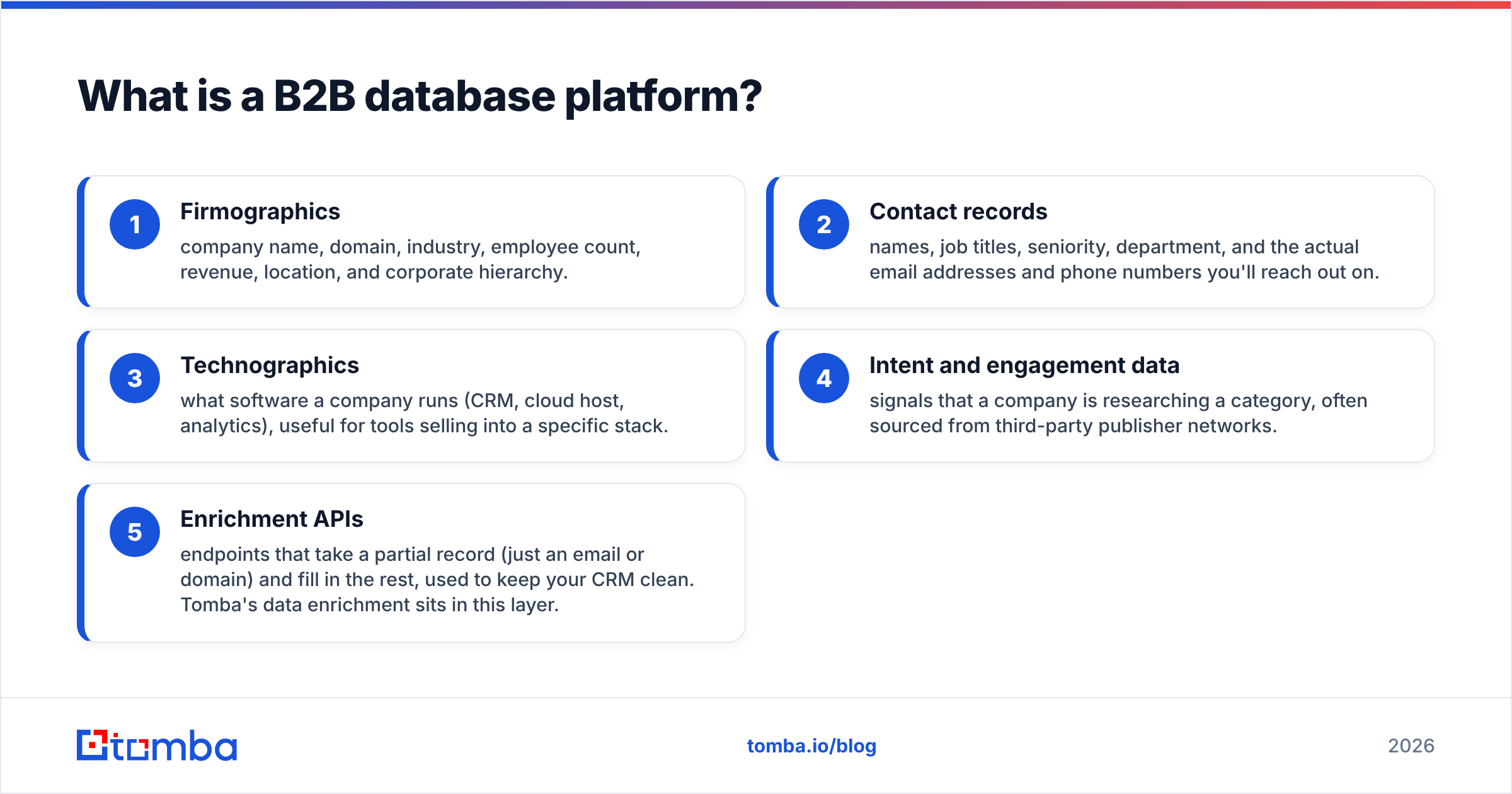
The data inside a typical platform falls into a few layers:
- Firmographics — company name, domain, industry, employee count, revenue, location, and corporate hierarchy.
- Contact records — names, job titles, seniority, department, and the actual email addresses and phone numbers you'll reach out on.
- Technographics — what software a company runs (CRM, cloud host, analytics), useful for tools selling into a specific stack.
- Intent and engagement data — signals that a company is researching a category, often sourced from third-party publisher networks.
- Enrichment APIs — endpoints that take a partial record (just an email or domain) and fill in the rest, used to keep your CRM clean. Tomba's data enrichment sits in this layer.
The platform's job is to keep all of that current. People change jobs every ~2.5 years, companies merge, domains get retired — so a database decays at roughly 2–3% per month if nobody refreshes it. That decay rate is the single most important thing a vendor is selling against, and the thing they advertise least.
Why does data accuracy matter more than database size?#
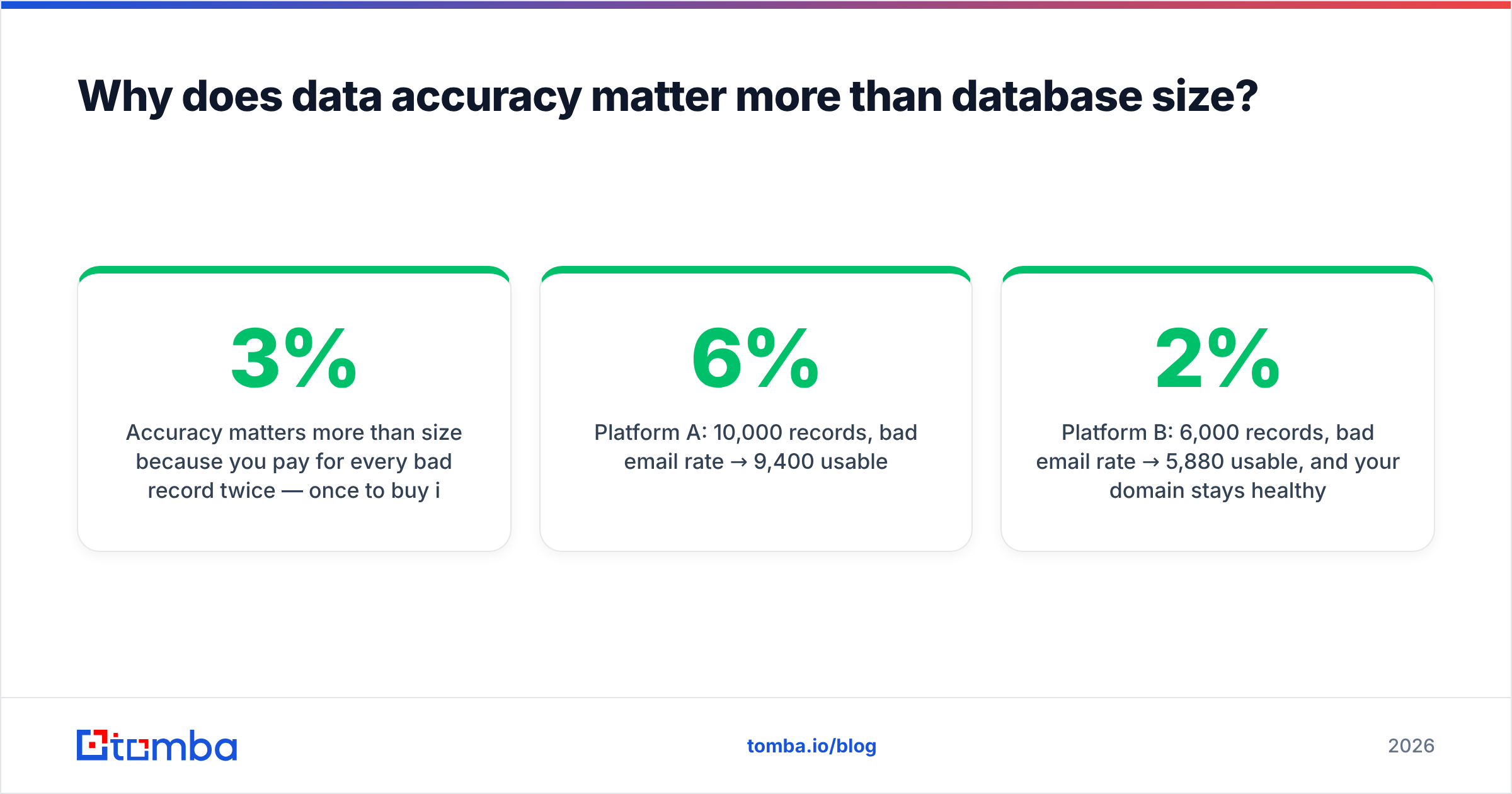
Accuracy matters more than size because you pay for every bad record twice — once to buy it, and again when it burns your sender reputation. A bounced cold email doesn't just fail to land; a bounce rate above ~3% tells inbox providers your list is dirty, and they start routing your good emails to spam too. If you're new to that mechanic, Tomba's primer on email deliverability explains how a few bad addresses poison the whole campaign.
Here's the math that vendors hope you skip. Say you buy 10,000 contacts:
- Platform A: 10,000 records, 6% bad email rate → 9,400 usable.
- Platform B: 6,000 records, 2% bad email rate → 5,880 usable, and your domain stays healthy.
Platform A looks bigger and cheaper per record. But the 600 bounces from a single send can throttle deliverability for weeks. According to HubSpot's research on email engagement, list hygiene is consistently among the top factors in inbox placement — size is not on that list.
This is why a standalone email verifier belongs in your workflow even when your database platform claims its data is "verified." Verification at the platform level happens when the record was added, which could be 14 months ago. Re-verifying at send time is what actually protects you.
What features should a B2B database platform have in 2026?#
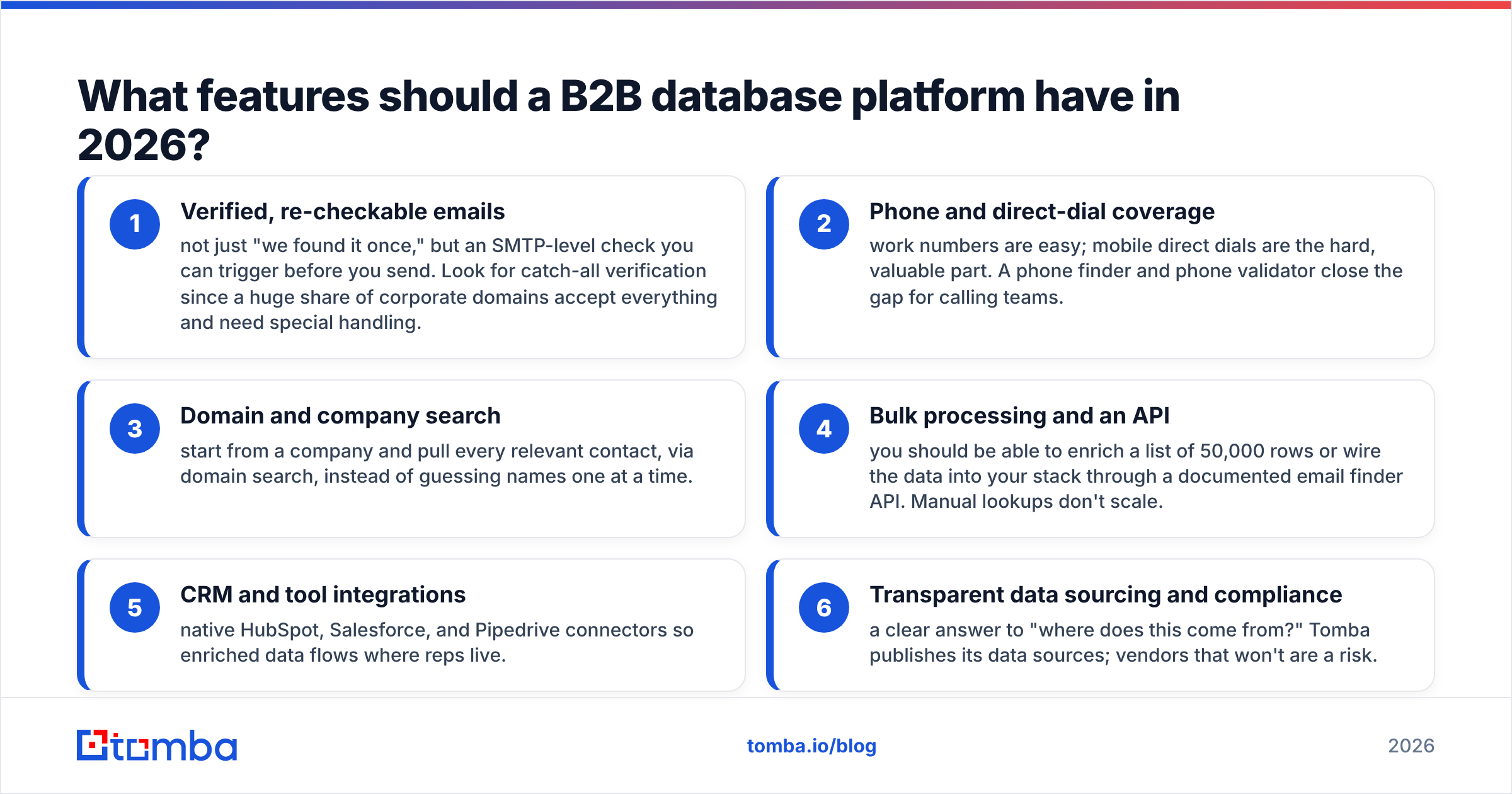
Use this as a structured requirements list when you evaluate vendors. The strongest platforms cover all six; the weak ones over-index on raw count and skip the rest.
- Verified, re-checkable emails — not just "we found it once," but an SMTP-level check you can trigger before you send. Look for catch-all verification since a huge share of corporate domains accept everything and need special handling.
- Phone and direct-dial coverage — work numbers are easy; mobile direct dials are the hard, valuable part. A phone finder and phone validator close the gap for calling teams.
- Domain and company search — start from a company and pull every relevant contact, via domain search, instead of guessing names one at a time.
- Bulk processing and an API — you should be able to enrich a list of 50,000 rows or wire the data into your stack through a documented email finder API. Manual lookups don't scale.
- CRM and tool integrations — native HubSpot, Salesforce, and Pipedrive connectors so enriched data flows where reps live.
- Transparent data sourcing and compliance — a clear answer to "where does this come from?" Tomba publishes its data sources; vendors that won't are a risk.
How do the top B2B database platforms compare?#
The market splits into enterprise suites priced per seat and self-serve, credit-based tools. The table below compares the most-shortlisted options on the attributes that actually drive cost and outcomes. (Prices are entry tiers as published by each vendor; enterprise pricing is quote-only.)
| Attribute | Tomba | Apollo.io |
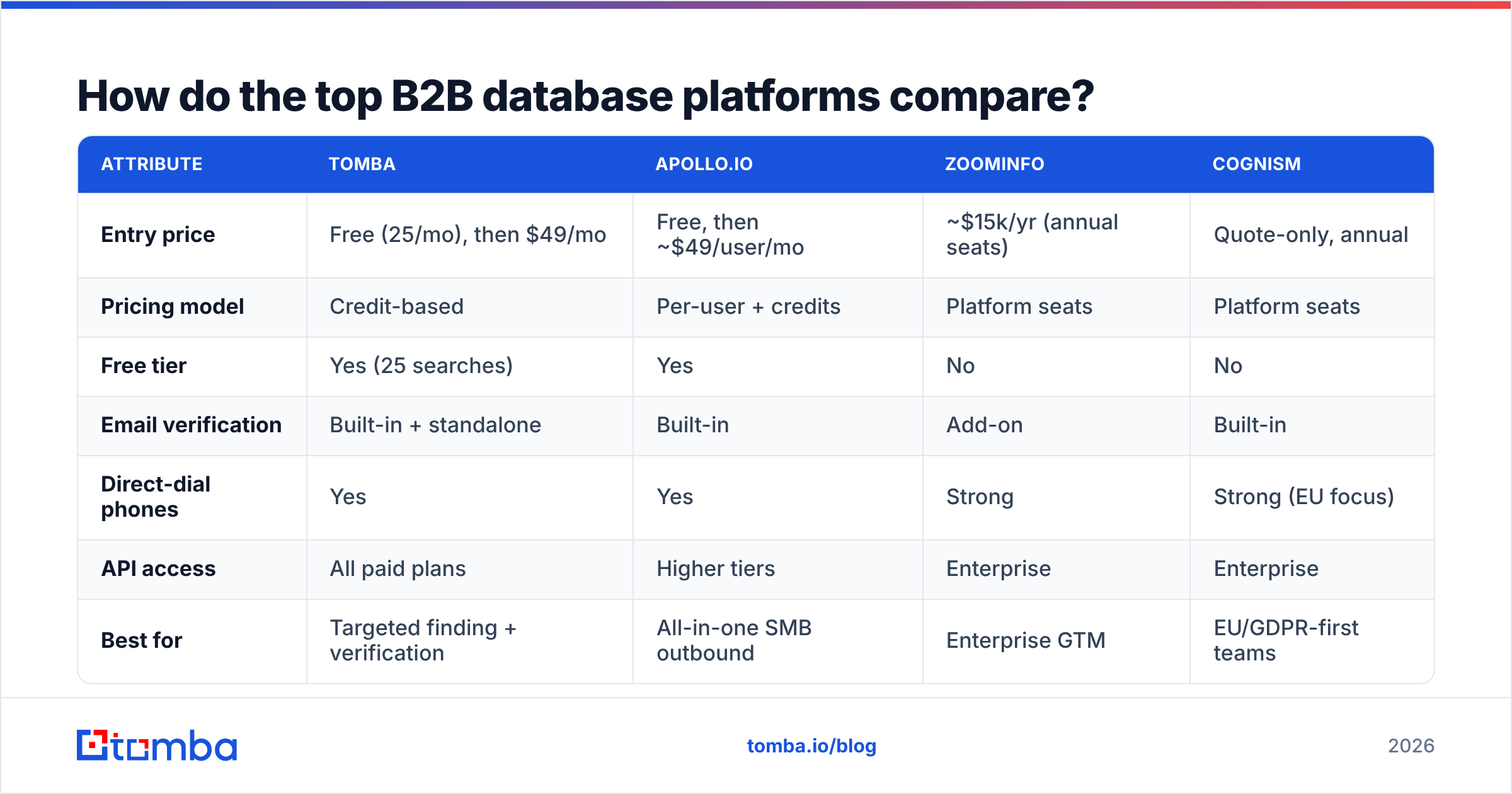
ZoomInfo | Cognism | |---|---|---|---|---| | Entry price | Free (25/mo), then $49/mo | Free, then ~$49/user/mo | ~$15k/yr (annual seats) | Quote-only, annual | | Pricing model | Credit-based | Per-user + credits | Platform seats | Platform seats | | Free tier | Yes (25 searches) | Yes | No | No | | Email verification | Built-in + standalone | Built-in | Add-on | Built-in | | Direct-dial phones | Yes | Yes | Strong | Strong (EU focus) | | API access | All paid plans | Higher tiers | Enterprise | Enterprise | | Best for | Targeted finding + verification | All-in-one SMB outbound | Enterprise GTM | EU/GDPR-first teams | | Contract | Monthly or annual | Monthly or annual | Annual lock-in | Annual lock-in |
The pattern is clear: the enterprise suites bundle intent data, workflow automation, and large seat counts into annual contracts that make sense only if you'll use the whole platform. If your core need is finding and verifying accurate contacts, a credit-based tool delivers the same usable records at a fraction of the commitment. You can see Tomba's full pricing details for how credits map to volume.

Is a cheaper credit-based platform actually good enough?#
Yes — for most teams, a credit-based platform is not a compromise, it's the right tool. The "you get what you pay for" instinct assumes price tracks data quality. It doesn't. Enterprise suites charge for breadth (intent, workflow, analytics, large teams), not for higher per-record accuracy. If you only need accurate contacts and verification, you're paying five figures for features you won't open.
A credit-based B2B database wins when:
- Your team is under ~20 reps and you don't need 50 platform seats.
- You run targeted outbound — specific accounts, specific titles — not blanket list-pulls.
- You want to pay for results (found + verified contacts) rather than shelf space.
- You need an email finder API or bulk lead generation without an enterprise sales cycle.
An enterprise suite earns its price when you genuinely consume intent data, multi-team workflows, and conversation intelligence as a daily system of record. If that's you, tools like ZoomInfo are built for it. For everyone else, the suite is a Ferrari used for grocery runs.
A practical hybrid many teams land on: keep your CRM as the system of record, use a lightweight platform's Chrome extension and Google Sheets add-on for day-to-day finding, and re-verify every list before send. That stack costs a few hundred dollars a month and outperforms a neglected enterprise seat.
How do you evaluate a B2B database platform before buying?#
Run this six-point test during the trial — every reputable vendor offers one, and the free tiers make it cheap to verify claims yourself instead of trusting a sales deck.
- Test on accounts you know. Pull 100 contacts at companies where you already know real people and titles. Check how many match reality. This exposes stale data instantly.
- Measure the real bounce rate. Export a sample, run it through an independent email verification tool, and look at the catch-all and invalid percentages. Anything over 5% invalid is a red flag.
- Check coverage in your actual segment. A platform strong in North American tech may be thin in EU manufacturing. Global counts hide regional gaps.
- Read the compliance docs. Confirm GDPR and CCPA handling, and how opt-outs are processed. Gartner's guidance on B2B data repeatedly flags compliance as a procurement gate, not an afterthought.
- Test the API and integrations. Make a real call. Push a record into your CRM. If the docs are thin or the connector is "coming soon," budget for manual work.
- Compare cost per usable record, not per record. Divide total price by (records × accuracy), so a cheaper, dirtier list shows its true cost.
Check independent reviews on G2 alongside your own trial — but weight your own bounce-test results higher than star ratings, because review scores rarely separate coverage from accuracy.
What about compliance and data sourcing?#
Compliance decides whether you can legally use a record, and in 2026 it's the fastest-moving part of the buying decision. A B2B database platform aggregates personal data — names, work emails, phone numbers — which falls under GDPR in the EU, CCPA/CPRA in California, and a growing patchwork elsewhere.
Two questions separate safe vendors from liabilities:
- What's the lawful basis and notification process? EU-focused platforms typically rely on legitimate interest plus a notification email to each contact. Ask the vendor to show you exactly how that works.
- Where does the data come from? Scraped-only sources carry more risk than data assembled from opt-in networks, public records, and verified submissions. Transparent vendors publish this — Tomba documents its data sources openly.
If a vendor can't answer either question clearly, that's your answer. A cheap list that triggers a regulator complaint is the most expensive data you'll ever buy.
Which B2B database platform should you choose?#
Choose by your dominant use case, not by the longest feature list:
- Targeted finding + verification, lean team, pay-for-results: a credit-based platform like Tomba.
- All-in-one SMB outbound with built-in sequencing: Apollo.
- Enterprise GTM with heavy intent and workflow needs: ZoomInfo.
- EU-first, GDPR-led prospecting: Cognism.
Most teams overbuy. They sign an enterprise contract for the brand name, then use a sliver of it. Start with the job in front of you — accurate contacts you can actually email — and scale up only when you've outgrown a lighter tool.
The bottom line#
A B2B database platform lives or dies on accuracy, not headline contact counts. Validate coverage in your real segment, re-verify before every send, confirm compliance, and price by usable records. Do that and you'll skip the most common expensive mistake: paying enterprise money for data your campaigns can't safely use.
If your core need is finding professional email addresses by name, domain, or company — and verifying them so they actually land — start with the Tomba Email Finder. The free tier gives you 25 searches a month to test accuracy on your own accounts, paid plans start at $49/mo with full API access, and verification is built in so you're not buying a list and a deliverability problem at the same time. Run the bounce test this week before your next contract renewal.
// get started
Find, verify and enrich your first contacts today
Start on the free plan with 25 searches a month, then scale when your team is ready.
Free plan · No credit card required · GDPR & CCPA
// about the author