How to Close a B2B Deal in 2026: The Complete Playbook
A B2B deal lives or dies on the data behind it. Here's the 2026 playbook for moving deals from first touch to signed contract — stages, tactics, and the tools that actually move pipeline.
A B2B deal is rarely lost at the demo. It is lost weeks earlier — wrong contact, stale data, a single-threaded champion who quietly changed jobs. If you want to win more contracts in 2026, you have to treat the deal as a process with measurable stages, not a vibe you ride to close.
This playbook breaks down what a B2B deal actually is, the stages it moves through, the tactics that compress the cycle, and the tooling that keeps your pipeline from rotting between calls.
TL;DR#
- A B2B deal is a structured, multi-stakeholder buying decision — usually 6 to 10 people, weeks to months long, and far more sensitive to data quality than B2C.
- Most deals stall in the middle stages (qualification and evaluation), not at the close. Fix the middle and your win rate climbs.
- Multi-threading — building relationships with 3+ stakeholders — is the single biggest predictor of whether a deal closes.
- Bad contact data silently kills deals: bounced emails, wrong titles, and ghost champions. Clean enrichment is non-negotiable.
- Tools matter, but in a specific order: accurate contact discovery first, then sequencing, then CRM hygiene.
What is a B2B deal?#
A B2B deal is a commercial agreement between two businesses, closed through a structured buying process involving multiple decision-makers. Unlike a B2C purchase — one person, one impulse, one checkout — a B2B deal is a committee decision with budget approvals, security reviews, and procurement gates.
Here is the everyday analogy: a B2C sale is buying coffee. A B2B deal is your family deciding which house to buy. There is a champion (the person who loves it), a financial gatekeeper (who frets about the mortgage), a skeptic (who asks about the roof), and an executive sponsor (who signs). Ignore any one of them and the deal collapses at the table.
According to Gartner's B2B buying research, the typical buying group for a complex solution involves six to ten decision-makers, each armed with their own information. Your job is not to convince one person — it is to arm a coalition.
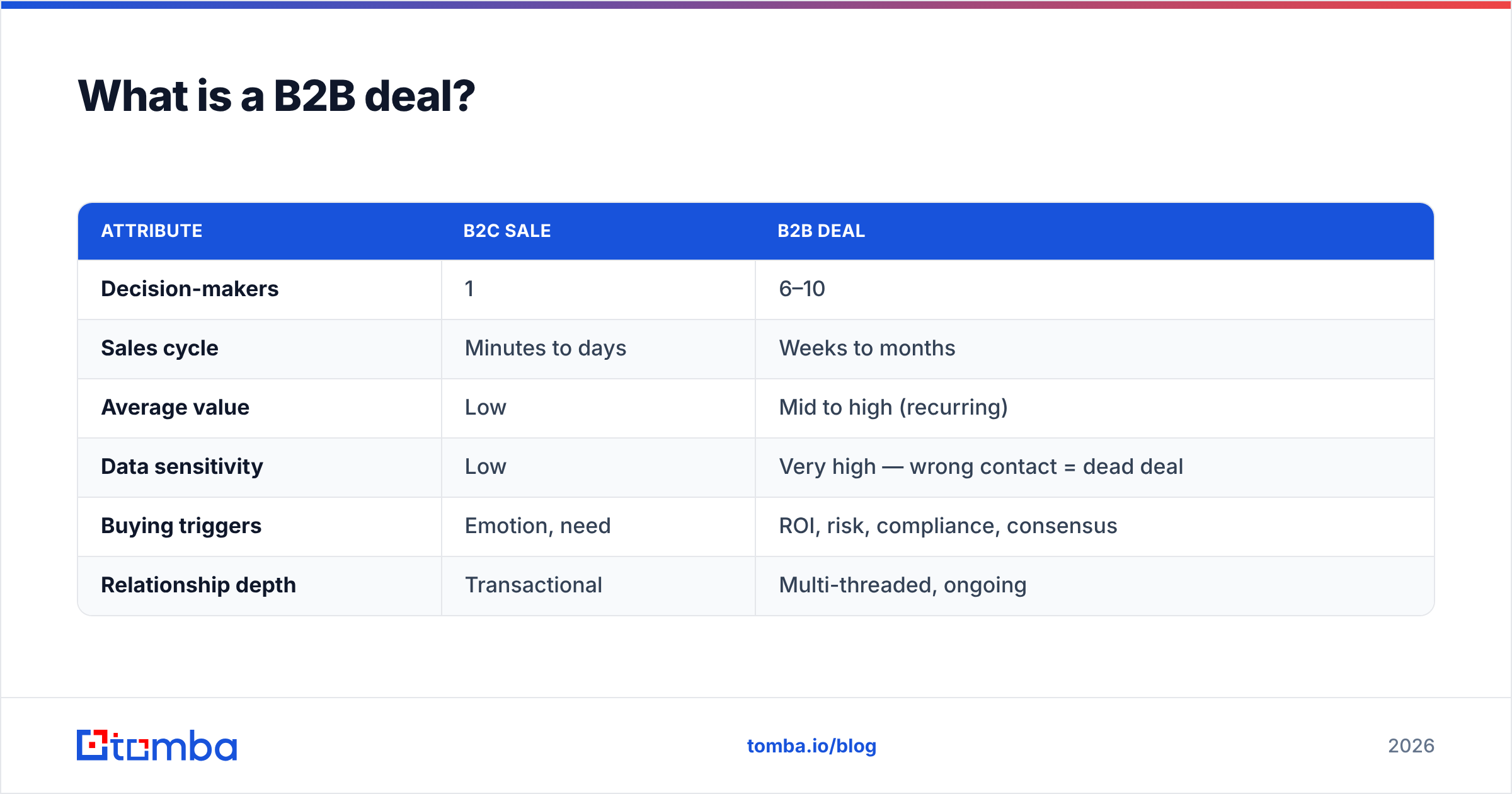
| Attribute | B2C Sale | B2B Deal |
|---|---|---|
| Decision-makers | 1 | 6–10 |
| Sales cycle | Minutes to days | Weeks to months |
| Average value | Low | Mid to high (recurring) |
| Data sensitivity | Low | Very high — wrong contact = dead deal |
| Buying triggers | Emotion, need | ROI, risk, compliance, consensus |
| Relationship depth | Transactional | Multi-threaded, ongoing |
The data-sensitivity row is the one most reps underestimate. In B2C, a wrong email costs you one customer. In a B2B deal, emailing the wrong person — or the right person at a dead address — can stall a six-figure opportunity for a full quarter.
)
What are the stages of a B2B deal?#
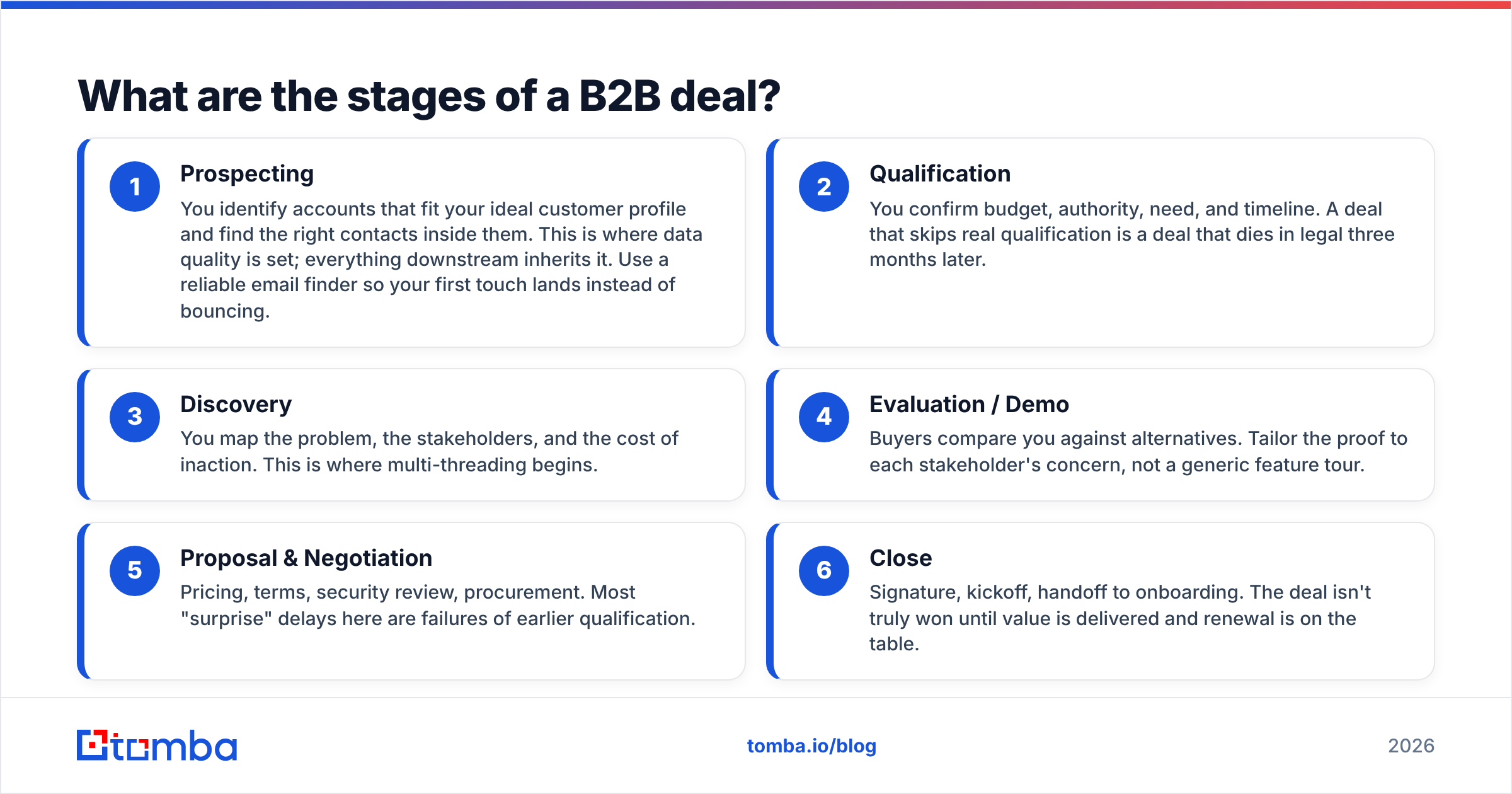
Every healthy pipeline runs deals through the same backbone, regardless of industry. Name the stages, define exit criteria for each, and you stop guessing where a deal really is.
- Prospecting — You identify accounts that fit your ideal customer profile and find the right contacts inside them. This is where data quality is set; everything downstream inherits it. Use a reliable email finder so your first touch lands instead of bouncing.
- Qualification — You confirm budget, authority, need, and timeline. A deal that skips real qualification is a deal that dies in legal three months later.
- Discovery — You map the problem, the stakeholders, and the cost of inaction. This is where multi-threading begins.
- Evaluation / Demo — Buyers compare you against alternatives. Tailor the proof to each stakeholder's concern, not a generic feature tour.
- Proposal & Negotiation — Pricing, terms, security review, procurement. Most "surprise" delays here are failures of earlier qualification.
- Close — Signature, kickoff, handoff to onboarding. The deal isn't truly won until value is delivered and renewal is on the table.
The mistake most teams make is obsessing over stage 6. But pipeline analysis from HubSpot consistently shows deals leak in stages 2 and 4 — qualification and evaluation. That is where a strong sales pipeline earns its keep: it forces honest exit criteria so a "happy ears" opportunity can't masquerade as a real B2B deal.
Why do B2B deals stall?#
Deals stall for predictable, fixable reasons. Here are the four that show up in nearly every lost-deal review.
- Single-threading. You have one champion and no backup. When that person reorganizes, takes PTO, or leaves, the deal goes dark. Multi-threading is insurance.
- Bad contact data. Your champion forwarded the proposal to a "decision-maker" whose email bounced, or whose title was wrong, or who left the company last quarter. You never knew. The deal just went quiet.
- No compelling event. Without a deadline tied to real business pain — a contract renewal, a compliance date, a board mandate — buyers default to "next quarter."
- Skipped qualification. You demoed to someone with no budget authority because they were easy to reach, not because they mattered.
Notice how two of the four are data problems, not selling problems. You can have flawless discovery calls and still lose because the contact layer underneath the deal was rotten. This is why disciplined teams treat data enrichment as part of the sales process, not an afterthought — they re-verify the buying group before every major stage gate.
How do you accelerate a B2B deal?#
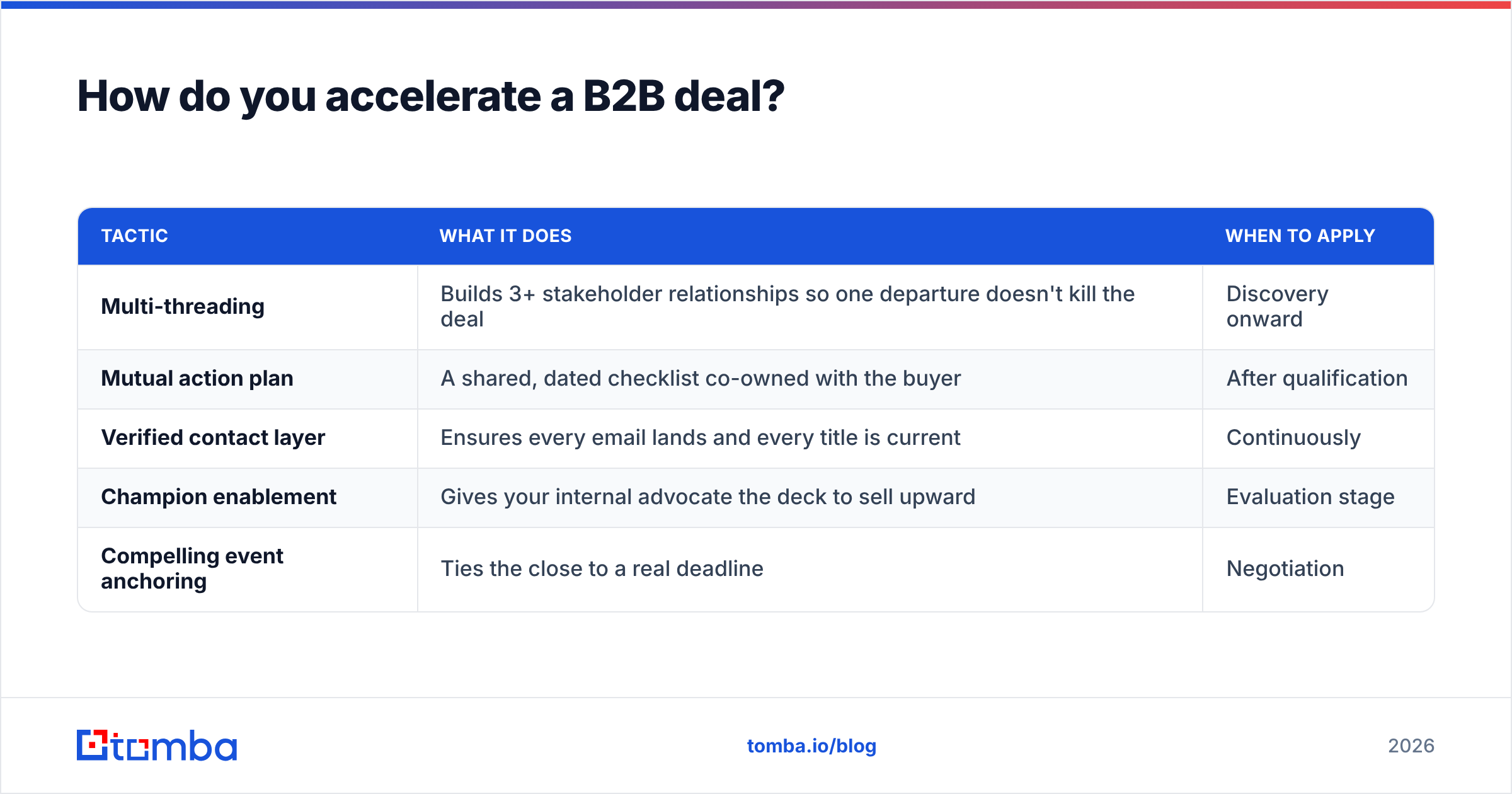
You compress the cycle by removing friction, not by pushing harder. The five tactics below consistently shorten time-to-close.
| Tactic | What it does | When to apply |
|---|---|---|
| Multi-threading | Builds 3+ stakeholder relationships so one departure doesn't kill the deal | Discovery onward |
| Mutual action plan | A shared, dated checklist co-owned with the buyer | After qualification |
| Verified contact layer | Ensures every email lands and every title is current | Continuously |
| Champion enablement | Gives your internal advocate the deck to sell upward | Evaluation stage |
| Compelling event anchoring | Ties the close to a real deadline | Negotiation |
Multi-threading deserves a closer look because it is the highest-leverage move. To multi-thread, you need to actually reach the other stakeholders — the CFO, the security lead, the end-user manager. That means finding their direct contact details, not guessing at a firstname@company.com pattern. A domain search surfaces the verified email patterns and named contacts across an account, so you can expand from one champion to a coalition in an afternoon instead of a fortnight.
For deals where a phone call breaks the logjam faster than email, having accurate B2B phone numbers for each stakeholder turns a stalled thread into a 10-minute conversation.
)
What tools do you need to run B2B deals in 2026?#
The 2026 stack is leaner than the bloated 12-tool setups of a few years ago. You need three layers, in this priority order.
- Contact intelligence (foundation). Accurate email and phone discovery plus enrichment. If this layer is wrong, every tool above it amplifies the error. This is where you find and verify the buying group.
- Engagement (middle). Sequencing, calls, and meeting scheduling. This is where multi-threading happens at scale.
- CRM & RevOps (top). The system of record where deal stages, forecasts, and pipeline hygiene live.
Most teams over-invest in the top layer and under-invest in the foundation — they buy a fancy forecasting tool while feeding it bounced emails and dead contacts. Reverse that. Get the contact layer right first.
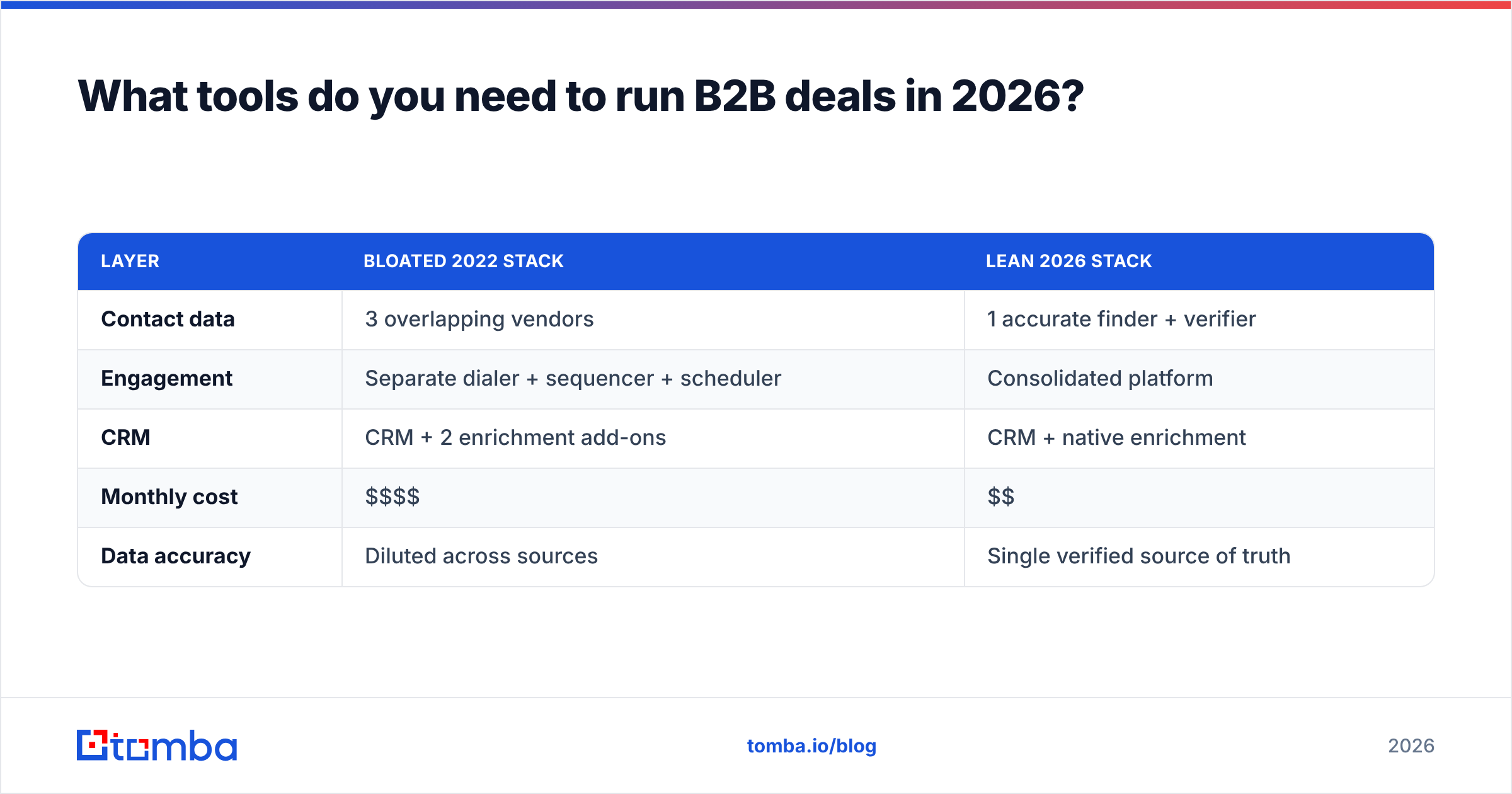
Here is how a focused 2026 stack compares to the bloated approach:
| Layer | Bloated 2022 stack | Lean 2026 stack |
|---|---|---|
| Contact data | 3 overlapping vendors | 1 accurate finder + verifier |
| Engagement | Separate dialer + sequencer + scheduler | Consolidated platform |
| CRM | CRM + 2 enrichment add-ons | CRM + native enrichment |
| Monthly cost | $$$$ | $$ |
| Data accuracy | Diluted across sources | Single verified source of truth |
On the foundation layer specifically, Tomba covers contact discovery and verification without forcing you into a multi-vendor sprawl. Its pricing runs a free tier at 25 searches per month, Starter at $49/mo, Growth at $99/mo, and Pro at $249/mo — so a small team can verify the buying group on every deal without an enterprise contract. Independent reviews on platforms like G2 are worth scanning before you commit to any vendor in this layer.
How do you measure B2B deal health?#
You manage what you measure. These are the metrics that actually predict whether a deal closes — track them per opportunity, not just in aggregate.
- Stakeholder count. How many people in the buying group are you actively engaged with? Below three, your deal is fragile.
- Stage velocity. How long does each deal sit in each stage versus your benchmark? A deal stuck 2x longer than average in evaluation is a flashing red light.
- Email deliverability rate. What percentage of your outreach to this account actually lands? A spike in bounces means your contact data has decayed.
- Champion engagement recency. When did your champion last reply, open, or take a meeting? Silence over two weeks is a stall in progress.
- Next-step commitment. Does every interaction end with a dated, mutually agreed next step? "I'll follow up" is not a next step.
The deliverability metric is the one teams forget to track at the deal level. They monitor it for marketing campaigns but not for the individual B2B deal — yet a quietly decaying contact list is exactly how a promising opportunity goes dark without anyone noticing. Re-verifying the buying group's contact details at each stage gate catches the rot before it costs you the quarter.
What's the biggest mistake in modern B2B deals?#
The biggest mistake is treating contact data as a one-time task instead of a living layer. Reps pull a contact list at the start of a quarter, then run deals against it for three months while titles change, people leave, and emails go stale. By the time they notice, the deal is cold.
B2B data decays roughly 2–3% per month — meaning a quarter-old list is already 6–9% wrong. On a complex deal with eight stakeholders, that math guarantees at least one of your contacts is now incorrect. The fix is not more outreach volume; it is fresher data. Re-enrich and re-verify before every stage gate, and you'll stop losing deals to invisible data rot.
Closing thought#
A B2B deal is won in the foundation — the right people, reachable, verified, and multi-threaded — long before the closing call. Nail your stages, track deal health honestly, and refuse to run any opportunity on stale contact data.
If you want the contact layer of your deals to be airtight, start with the Tomba Email Finder. Find verified emails by domain, name, or company, expand from one champion to the full buying group, and feed your CRM contacts that actually land. The free tier gives you 25 searches a month to test it against your real pipeline — enough to prove that better data closes more deals before you ever pay a cent.
// get started
Find, verify and enrich your first contacts today
Start on the free plan with 25 searches a month, then scale when your team is ready.
Free plan · No credit card required · GDPR & CCPA
// about the author