How B2B Decision Making Works in 2026: The Buying Committee
B2B decision making is now a committee sport with 6-10 stakeholders, longer cycles, and more self-serve research. Here is how to map it, shorten it, and win it in 2026.
TL;DR
- B2B decision making in 2026 is a committee sport: Gartner pegs the typical buying group at 6 to 10 stakeholders, each arriving with their own data and veto power.
- Buyers now spend most of the cycle researching independently — sales reps get a shrinking slice of the buyer's attention, so the team you never speak to still decides.
- The fastest way to lose is to sell to one champion and ignore the rest of the committee. Multi-threading across roles is the single biggest lever on win rate.
- Clean, complete contact data on every stakeholder — not just your champion — is the operational foundation. You cannot multi-thread people you cannot reach.
- Map the committee early, match your message to each role's priorities, and remove friction at every stage to compress the cycle.
What is B2B decision making?#
B2B decision making is the process a company runs to evaluate, approve, and purchase a product or service. Think of it less like a single person at a checkout and more like a jury that has to reach a verdict — except every juror has a different definition of "guilty," and any one of them can hang the trial.
That is the core difference from B2C. When you buy headphones, you are the buyer, the user, the approver, and the budget holder. In B2B, those four roles are usually four (or more) different people who report to different leaders and care about different outcomes. The CFO cares about cost and risk. The end user cares about whether the tool makes their Tuesday easier. The head of security cares about your SOC 2 report. IT cares about integrations. Procurement cares about contract terms.
That fragmentation is why B2B deals are slow, why "we're still discussing internally" stalls so many pipelines, and why a single enthusiastic champion is necessary but almost never sufficient.
Who is actually in the B2B buying committee?#
The buying committee (sometimes called the decision-making unit, or DMU) is the group of people who influence or control a purchase. Research from Gartner consistently shows the group sitting between six and ten people for a typical complex B2B purchase, and larger for enterprise deals.
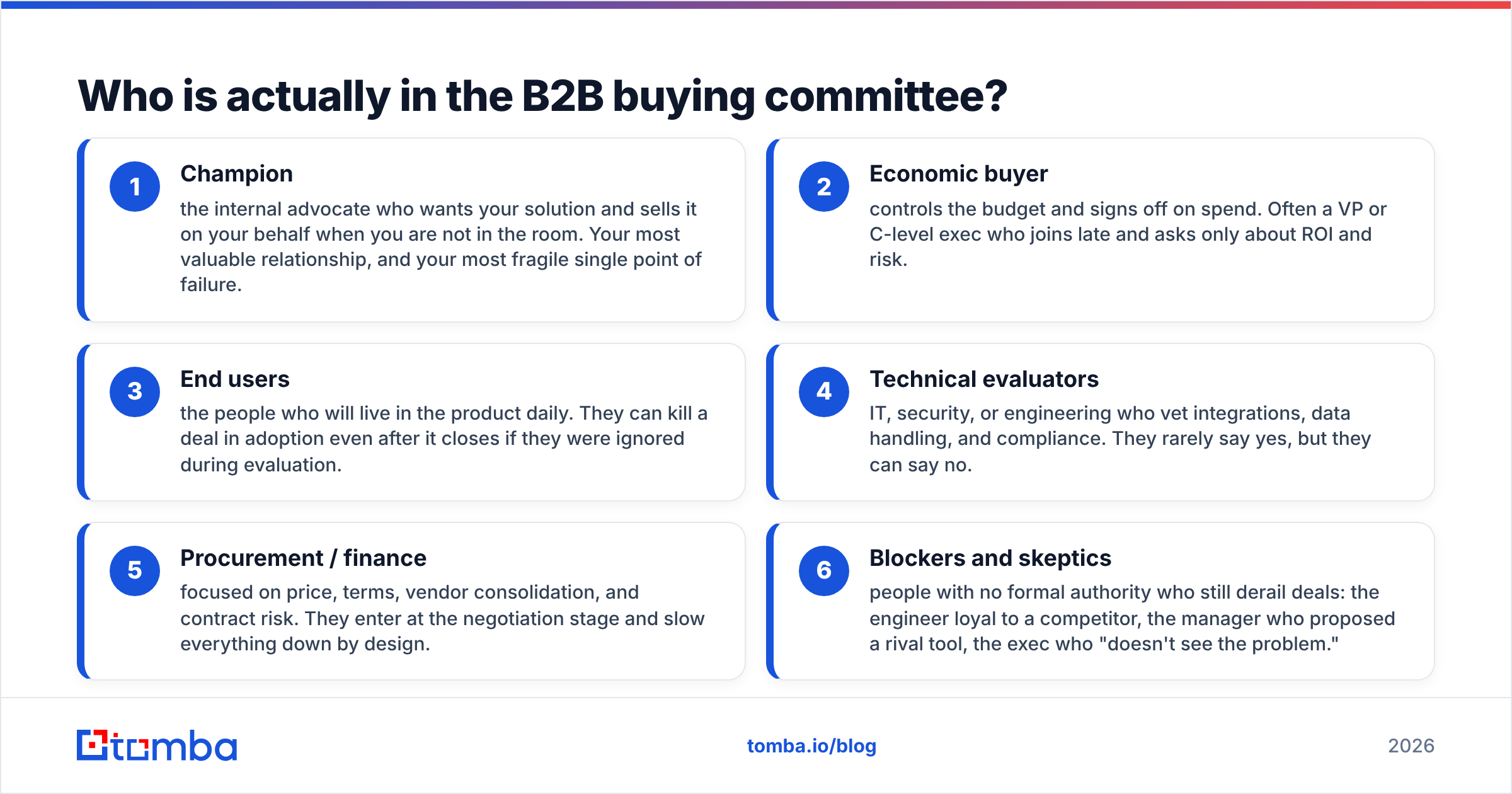
Most committees contain some mix of these roles:
- Champion — the internal advocate who wants your solution and sells it on your behalf when you are not in the room. Your most valuable relationship, and your most fragile single point of failure.
- Economic buyer — controls the budget and signs off on spend. Often a VP or C-level exec who joins late and asks only about ROI and risk.
- End users — the people who will live in the product daily. They can kill a deal in adoption even after it closes if they were ignored during evaluation.
- Technical evaluators — IT, security, or engineering who vet integrations, data handling, and compliance. They rarely say yes, but they can say no.
- Procurement / finance — focused on price, terms, vendor consolidation, and contract risk. They enter at the negotiation stage and slow everything down by design.
- Blockers and skeptics — people with no formal authority who still derail deals: the engineer loyal to a competitor, the manager who proposed a rival tool, the exec who "doesn't see the problem."
The trap is obvious once you name it: most reps build a great relationship with the champion and assume that relationship covers the room. It does not. The economic buyer has never heard your pitch, the security lead found a gap you never addressed, and procurement is comparing you to two vendors you did not know were in the deal.
Why is B2B decision making so much harder in 2026?#
Three structural shifts have made committee buying harder than it was even a few years ago.
Buyers research without you. The majority of the buying journey now happens before a rep is involved, and often without one at all. By the time a buyer books a demo, they have read your pricing page, your competitors' comparison posts, and a dozen G2 reviews. You are walking into a conversation that has already been half-decided by content you did not control.
More stakeholders, more veto points. Economic pressure pushed approval authority downward and outward. Security reviews, data-privacy sign-off, and procurement gates that used to apply only to seven-figure deals now apply to a $99/month SaaS tool. Every added reviewer is another chance for the deal to stall.
Consensus is the bottleneck, not budget. Gartner's research found that buyers who reach consensus easily are far more likely to buy a premium solution — and that the hard part is rarely convincing one person. It is getting six people who disagree to agree on anything at all. Deals do not die because the buyer said no. They die in the silence between "let me check with the team" and a follow-up that never comes.
How do the stages of a B2B buying decision work?#
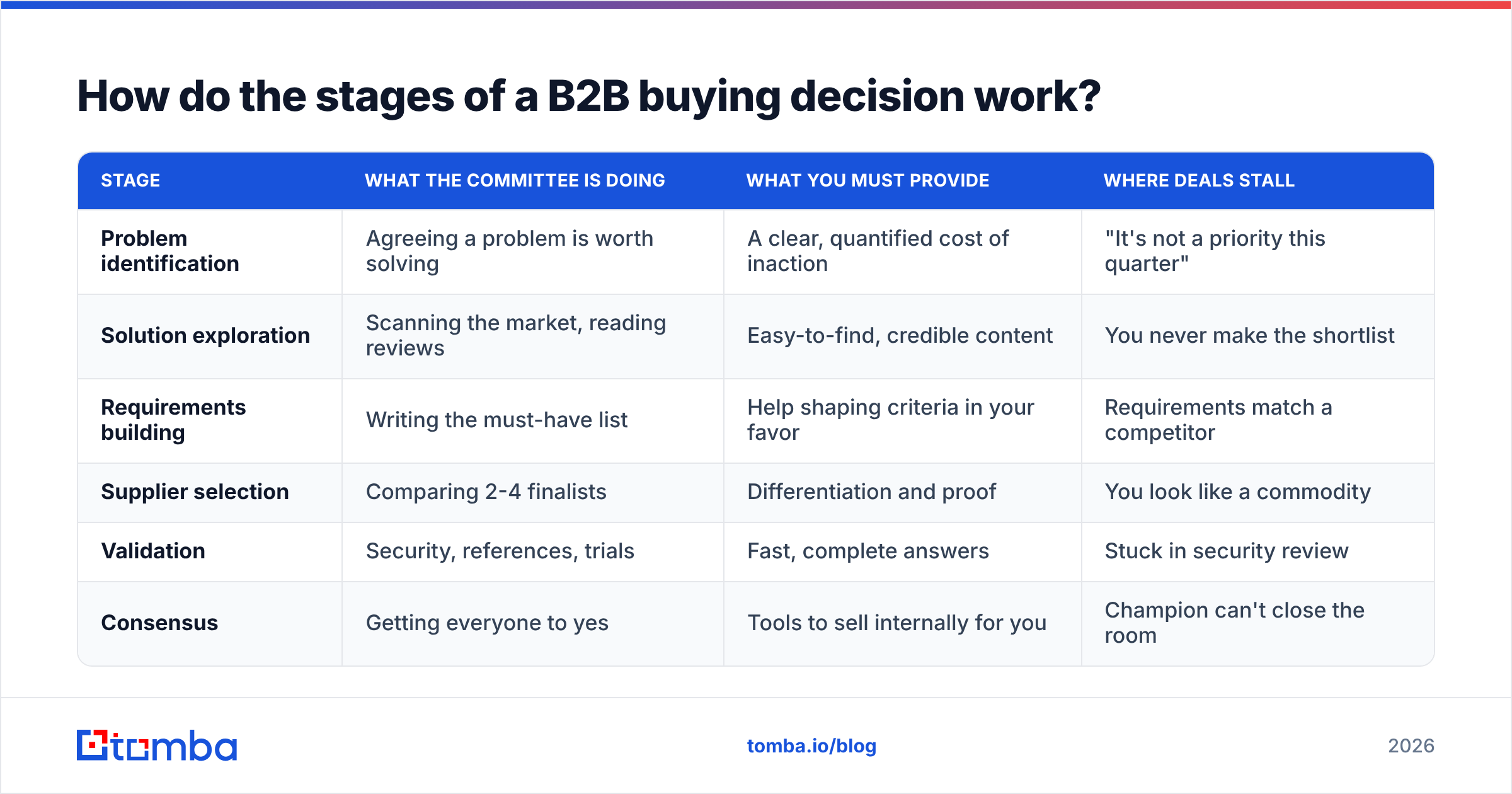
Buyers do not move through a tidy funnel. Gartner describes the journey as a set of "jobs" buyers loop through in any order — problem identification, solution exploration, requirements building, supplier selection, validation, and consensus creation. Still, it helps to map the rough stages so you know what each one demands of you.
| Stage | What the committee is doing | What you must provide | Where deals stall |
|---|---|---|---|
| Problem identification | Agreeing a problem is worth solving | A clear, quantified cost of inaction | "It's not a priority this quarter" |
| Solution exploration | Scanning the market, reading reviews | Easy-to-find, credible content | You never make the shortlist |
| Requirements building | Writing the must-have list | Help shaping criteria in your favor | Requirements match a competitor |
| Supplier selection | Comparing 2-4 finalists | Differentiation and proof | You look like a commodity |
| Validation | Security, references, trials | Fast, complete answers | Stuck in security review |
| Consensus | Getting everyone to yes | Tools to sell internally for you | Champion can't close the room |
The lesson buried in that table: most of your influence happens early, in problem identification and requirements building, but most reps spend most of their energy late, in supplier selection and negotiation. Get in early enough to shape the requirements, and you have rigged the comparison in your favor before it starts.
How do you actually win a committee decision?#
You win by multi-threading — building relationships across multiple stakeholders instead of betting the deal on one person. Here is the practical playbook.
1. Map the committee before you pitch. On your first real call, ask your champion directly: who else needs to be involved, who controls the budget, who has killed a project like this before? Build a simple stakeholder map. You can enrich the names you get into full contact records and reporting lines using data enrichment so you know exactly who you are dealing with.
2. Reach every stakeholder, not just the friendly one. Multi-threading fails most often at the most basic step: you do not have a way to contact the economic buyer or the security lead. This is where reliable contact data becomes operational, not theoretical. Use an email finder to get verified addresses for the full committee, and domain search to map everyone at the account by department before you even ask your champion.
3. Match the message to the role. Send the CFO an ROI model, the end user a workflow demo, the security lead your compliance docs. The same generic deck to all six is how you lose all six.
4. Arm your champion to sell without you. Your champion spends 95% of the cycle in rooms you are not in. Give them a one-page business case, an objection-handling cheat sheet, and ammunition against the specific competitor in the deal. Improving your response rate with non-champions starts with giving the champion something forwardable.
5. Remove friction at every gate. Pre-empt the security questionnaire. Have references ready. Send the redlined MSA before procurement asks. Every day you save in validation is a day the deal cannot die.
Single-threaded vs multi-threaded: does it really matter?#
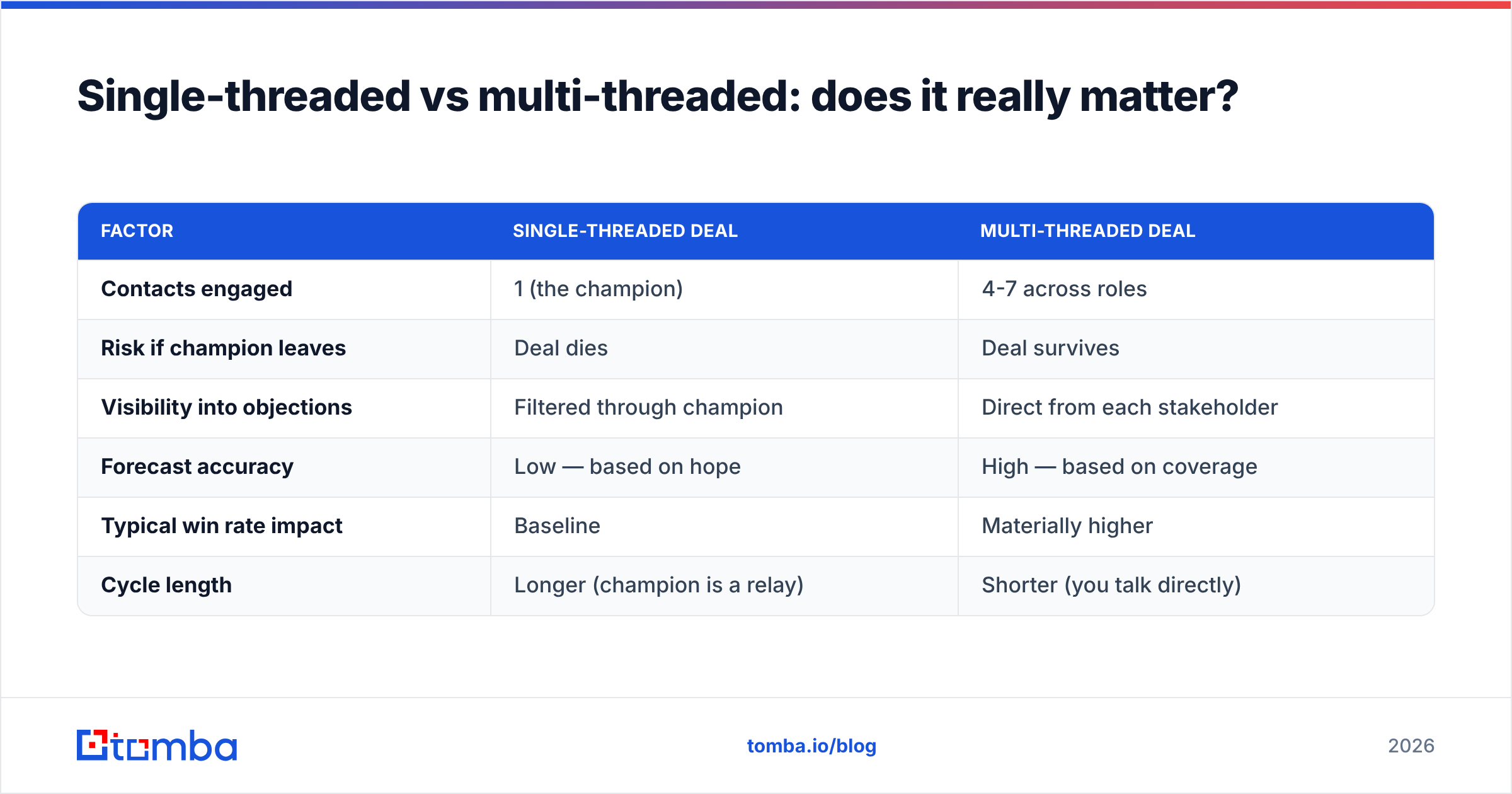
Yes — and it is the most measurable difference in B2B selling. Here is the contrast in plain terms.
| Factor | Single-threaded deal | Multi-threaded deal |
|---|---|---|
| Contacts engaged | 1 (the champion) | 4-7 across roles |
| Risk if champion leaves | Deal dies | Deal survives |
| Visibility into objections | Filtered through champion | Direct from each stakeholder |
| Forecast accuracy | Low — based on hope | High — based on coverage |
| Typical win rate impact | Baseline | Materially higher |
| Cycle length | Longer (champion is a relay) | Shorter (you talk directly) |
The champion-leaves scenario is not hypothetical. In a market where people change jobs constantly, betting an entire deal on one contact is betting on that person staying put for the length of your sales cycle. When they leave — and some will — a single-threaded deal evaporates overnight, while a multi-threaded one has four other people who already know your value.
What data and tools do you need to support committee selling?#
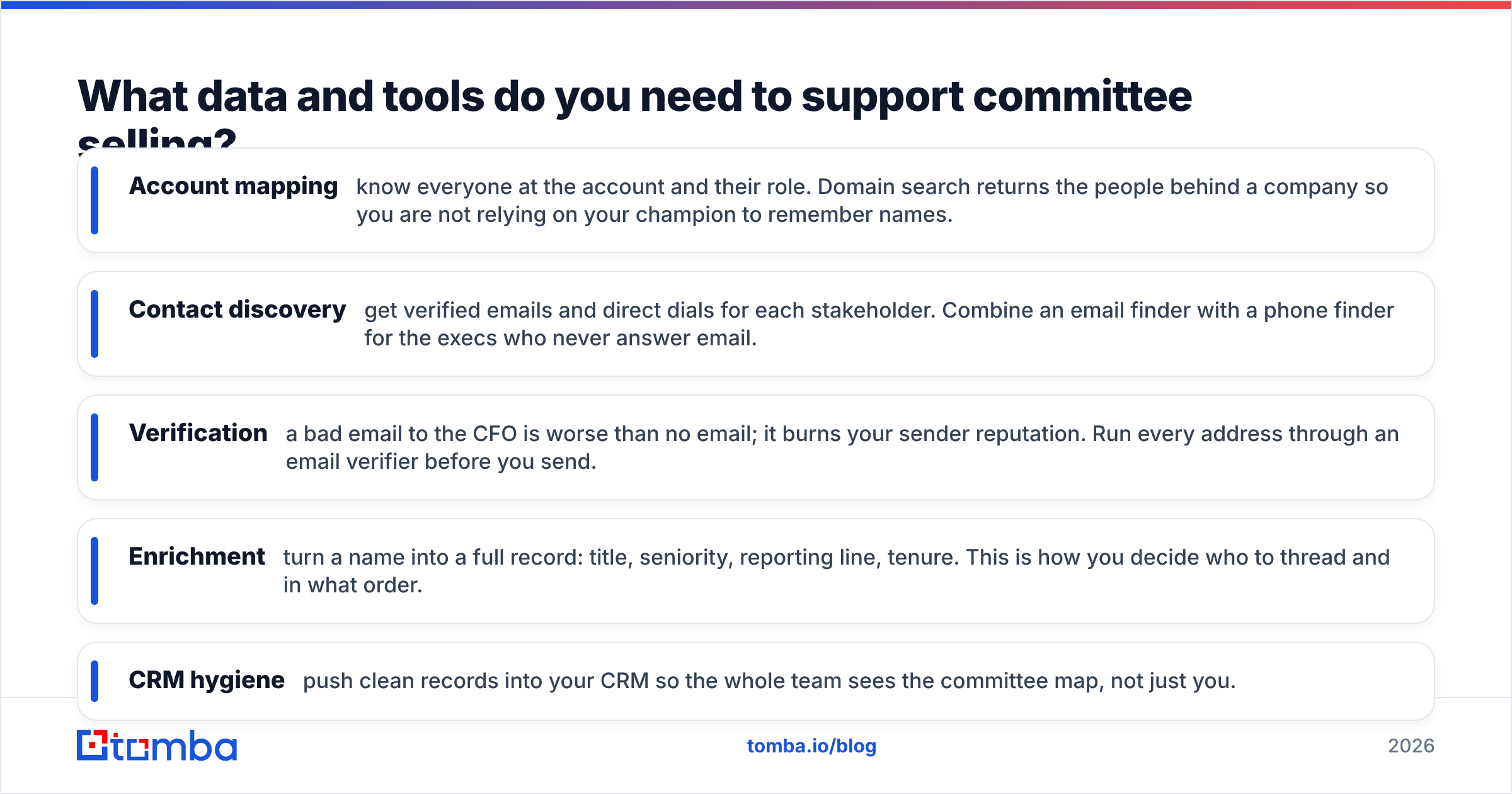
Committee selling is a data problem before it is a persuasion problem. You cannot influence people you cannot identify, and you cannot reach people whose contact details are wrong. The operational stack looks like this:
- Account mapping — know everyone at the account and their role. Domain search returns the people behind a company so you are not relying on your champion to remember names.
- Contact discovery — get verified emails and direct dials for each stakeholder. Combine an email finder with a phone finder for the execs who never answer email.
- Verification — a bad email to the CFO is worse than no email; it burns your sender reputation. Run every address through an email verifier before you send.
- Enrichment — turn a name into a full record: title, seniority, reporting line, tenure. This is how you decide who to thread and in what order.
- CRM hygiene — push clean records into your CRM so the whole team sees the committee map, not just you.
Independent review sites like G2 and vendor evaluations from firms like Forrester are worth checking when you build this stack, because the difference between an 85%-accurate database and a 97%-accurate one is the difference between reaching the economic buyer and emailing a bounced address two weeks before close.
How do you shorten the B2B decision cycle?#
You shorten it by removing reasons to wait, not by pushing harder. A few concrete tactics:
- Create urgency with cost-of-inaction, not discounts. Quantify what the problem costs per month. A committee moves faster against a number than against a deadline you invented.
- Run parallel, not serial. Get security, procurement, and the economic buyer engaged at the same time rather than handing the deal from one gate to the next. Serial reviews are how a 30-day decision becomes 120.
- Pre-build the consensus materials. The internal business case, the comparison grid, the ROI sheet — make them before the committee asks. Every artifact you hand over is friction you remove.
- Keep the data current. People move roles mid-cycle. Re-enriching your committee map with up-to-date contact enrichment means you are not blindsided when your champion gets promoted out of the deal.
Speed comes from coverage and preparation, not pressure. The teams that close committee deals fastest are the ones that did the unglamorous data work first.
The bottom line on B2B decision making in 2026#
B2B decision making is no longer a conversation with a buyer — it is a campaign aimed at a committee. The reps who win in 2026 treat every deal as a multi-stakeholder map from day one: they identify all six-to-ten people, reach each one with verified contact data, tailor the message to the role, and arm their champion to carry the rest. The reps who lose pitch one friendly contact, then wonder why "internal discussions" went quiet.
The unsexy foundation under all of it is data. You cannot multi-thread a committee you cannot see, and you cannot reach stakeholders whose emails bounce. Start by mapping the account and getting verified, accurate contact details for everyone who touches the decision. The Tomba Email Finder gives you verified professional emails for the whole buying committee by name, company, or domain — so you can thread the entire room instead of betting the deal on one person. Pair it with the email verifier to protect your deliverability, and you have turned committee selling from a guessing game into a process. Check Tomba pricing — there is a free tier with 25 searches a month to map your first few accounts before you commit.
// get started
Find, verify and enrich your first contacts today
Start on the free plan with 25 searches a month, then scale when your team is ready.
Free plan · No credit card required · GDPR & CCPA
Get the Tomba newsletter
Product and data updates
// about the author