B2B Demand Generation in 2026: Strategy, Tactics & Tools
A practical 2026 playbook for B2B demand generation: how to build demand, capture it, and turn anonymous interest into pipeline without burning budget on vanity metrics.
TL;DR
- B2B demand generation is the full system of creating, capturing, and converting buyer interest — not a single campaign or a synonym for lead gen.
- The 2026 winners separate demand creation (educating a market that isn't buying yet) from demand capture (catching the small slice that is), and budget both deliberately.
- Vanity MQLs are out; pipeline, influenced revenue, and self-reported attribution are in.
- Your tooling stack matters less than your data quality — accurate contact and account data is what turns "interest" into a routed, contactable opportunity.
- Start lean: one creation channel, one capture channel, clean data, and a tight measurement loop beats a 12-tool stack with garbage records.
What is B2B demand generation?#
B2B demand generation is the end-to-end process of making the right buyers aware of a problem you solve, nurturing that awareness, and converting it into qualified pipeline. Think of it like running a restaurant: advertising the cuisine, the smell drifting down the street, and the menu out front all create hunger; the host who seats a walk-in captures it. Demand gen owns both jobs.
That distinction trips up most teams. They lump "demand gen" together with "lead gen" and "performance marketing," then wonder why a flood of ebook downloads never becomes revenue. Lead generation is one tactic inside demand gen — the capture mechanism. Demand generation is the whole machine.
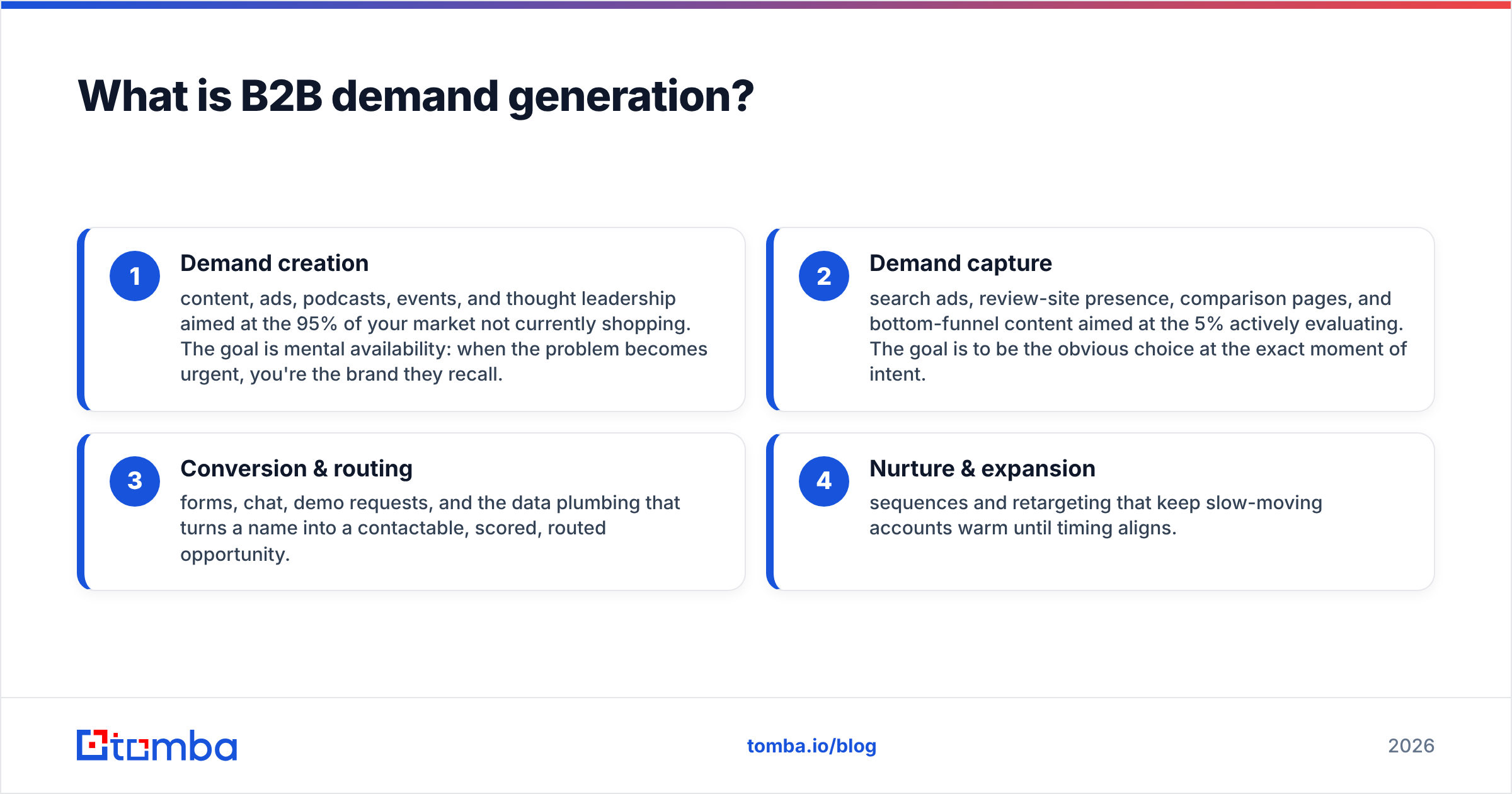
A clean way to frame the two halves of the machine:
- Demand creation — content, ads, podcasts, events, and thought leadership aimed at the 95% of your market not currently shopping. The goal is mental availability: when the problem becomes urgent, you're the brand they recall.
- Demand capture — search ads, review-site presence, comparison pages, and bottom-funnel content aimed at the 5% actively evaluating. The goal is to be the obvious choice at the exact moment of intent.
- Conversion & routing — forms, chat, demo requests, and the data plumbing that turns a name into a contactable, scored, routed opportunity.
- Nurture & expansion — sequences and retargeting that keep slow-moving accounts warm until timing aligns.
Get the split wrong and you either starve your future pipeline (all capture, no creation) or generate awareness you can never cash in (all creation, no capture).
How is demand generation different from lead generation?#
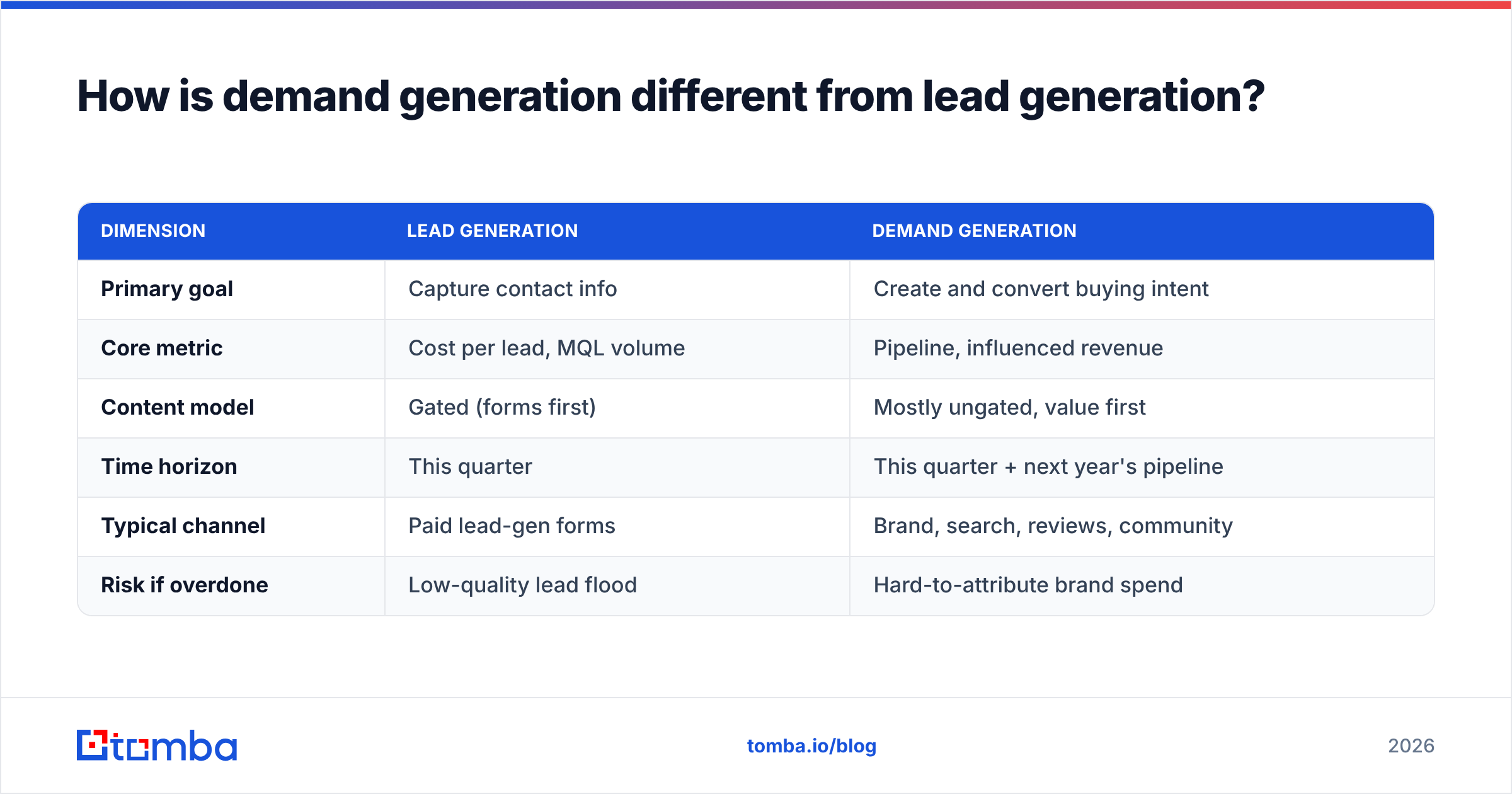
Conclusion first: lead gen counts contacts; demand gen creates and converts buying intent. One is a tactic, the other is the strategy that decides which tactics to run.
The practical difference shows up in what each optimizes for. Lead gen teams chase form fills and cost-per-lead, which pushes them toward gated content and low-intent downloads. Demand gen teams optimize for pipeline and revenue, which pushes them toward ungating useful content, building brand, and capturing high-intent searches. According to HubSpot's research on inbound marketing, buyers complete a large share of their decision journey before ever talking to sales — which means the brand they already trust wins, not the one with the most gated PDFs.
| Dimension | Lead generation | Demand generation |
|---|---|---|
| Primary goal | Capture contact info | Create and convert buying intent |
| Core metric | Cost per lead, MQL volume | Pipeline, influenced revenue |
| Content model | Gated (forms first) | Mostly ungated, value first |
| Time horizon | This quarter | This quarter + next year's pipeline |
| Typical channel | Paid lead-gen forms | Brand, search, reviews, community |
| Risk if overdone | Low-quality lead flood | Hard-to-attribute brand spend |
Neither is "better." A healthy program runs both — but demand gen is the umbrella, and lead gen is one spoke under it. If your marketing qualified lead definition is just "downloaded something," you're doing lead gen and calling it demand gen.
What does a 2026 B2B demand generation strategy look like?#
The 2026 playbook is built on a simple sequence: create demand at scale, capture it precisely, and back the whole thing with data clean enough to act on. Here's the operating model that works.
1. Pick one creation channel and go deep. Spreading thin across six channels produces noise. A weekly podcast, a strong LinkedIn presence from founders, or a genuinely useful newsletter compounds. Depth beats breadth because B2B audiences are small and reward consistency.
2. Own your capture surfaces. When a buyer is ready, they search, they hit review sites, and they look for comparisons. Make sure you rank for your category and competitor terms, your G2 profile is current, and your comparison pages are honest. This is the cheapest pipeline you'll ever buy because the intent already exists.
3. Ungate most content, gate the high-intent stuff. Let your best educational material run free to build trust and mental availability. Reserve forms for genuinely high-intent actions — demo requests, ROI calculators, pricing conversations.
4. Fix the data layer before you scale spend. This is the step everyone skips. A demo request with a personal Gmail address and no company match can't be routed, scored, or enriched — so it dies in a queue. Before you pour budget into top-of-funnel, make sure inbound interest gets matched to a real person and a real account.
5. Measure pipeline, not pop. Track self-reported attribution ("How did you hear about us?") alongside platform data. Gartner's analysis of B2B buying shows buyers move through a nonlinear journey across many touches — so last-click attribution lies. Triangulate.

Which demand generation channels actually drive pipeline?#
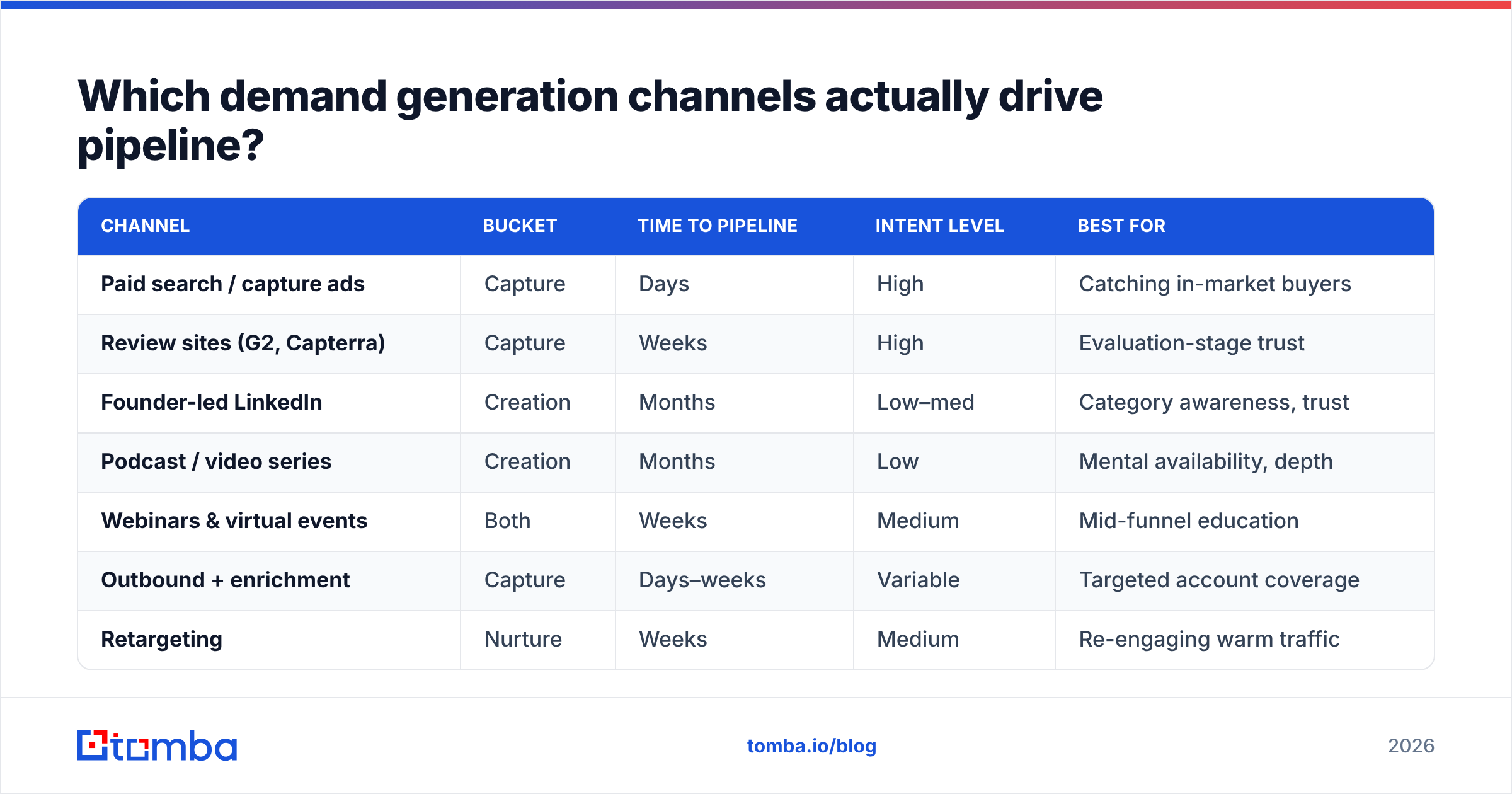
Channels fall into creation and capture buckets, and the best programs run a small number from each. Here's how the main options compare on cost, speed, and intent.
| Channel | Bucket | Time to pipeline | Intent level | Best for |
|---|---|---|---|---|
| Paid search / capture ads | Capture | Days | High | Catching in-market buyers |
| Review sites (G2, Capterra) | Capture | Weeks | High | Evaluation-stage trust |
| Founder-led LinkedIn | Creation | Months | Low–med | Category awareness, trust |
| Podcast / video series | Creation | Months | Low | Mental availability, depth |
| Webinars & virtual events | Both | Weeks | Medium | Mid-funnel education |
| Outbound + enrichment | Capture | Days–weeks | Variable | Targeted account coverage |
| Retargeting | Nurture | Weeks | Medium | Re-engaging warm traffic |
A common mistake is judging creation channels by capture metrics. Your podcast won't show up in last-click attribution, but kill it and watch your branded search and demo-request quality quietly erode over two quarters. Fund creation as an investment, not a campaign.
Outbound deserves a note. Done with random bought lists, it's spam. Done with tight ICP targeting and verified contact data, it's a precise capture channel that fills coverage gaps your inbound misses. The difference is entirely in the data — which is where tooling earns its keep.
What tools and data do you need for demand generation?#
Your stack has three layers: a channel layer (ads, social, content), a system-of-record layer (CRM, marketing automation), and a data layer that connects them. Most teams over-invest in the first two and ignore the third — then can't explain why their pipeline numbers don't reconcile.
The data layer is where demand actually becomes actionable:
- Contact discovery. When a target account shows intent, you need to reach a real decision-maker. An email finder turns a name and domain into a verified, contactable address so outreach and routing don't stall.
- Enrichment. Inbound forms are short on purpose. Data enrichment fills in title, company size, industry, and tech stack so lead scoring and routing actually work.
- Visitor identification. Most site traffic never fills a form. Website visitor reveal surfaces which companies are researching you, feeding your capture and outbound motions.
- A clean B2B database. A maintained B2B database lets you build target lists by firmographics instead of guessing.
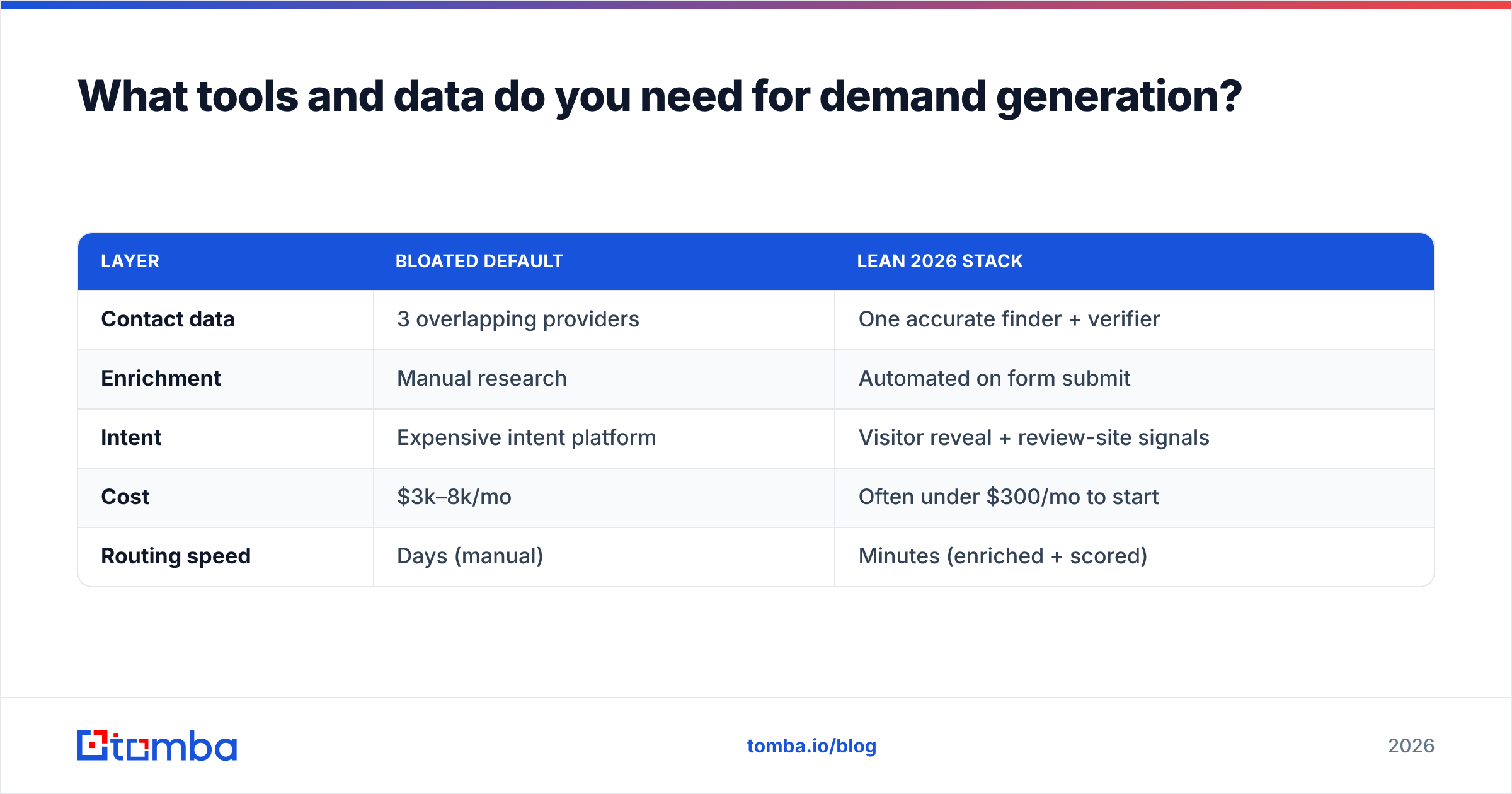
Here's how a lean demand-gen data stack compares to the bloated default most teams drift into:
| Layer | Bloated default | Lean 2026 stack |
|---|---|---|
| Contact data | 3 overlapping providers | One accurate finder + verifier |
| Enrichment | Manual research | Automated on form submit |
| Intent | Expensive intent platform | Visitor reveal + review-site signals |
| Cost | $3k–8k/mo | Often under $300/mo to start |
| Routing speed | Days (manual) | Minutes (enriched + scored) |
You don't need every tool on day one. You need accurate data feeding a CRM you trust. Everything else is optimization.
How do you measure B2B demand generation in 2026?#
Measure pipeline and revenue first, leading indicators second, and treat vanity metrics as diagnostics only. The hierarchy:
- Revenue and pipeline — sourced and influenced. This is the scoreboard.
- Pipeline velocity — how fast opportunities move, which exposes friction creation channels quietly fix.
- Self-reported attribution — the "how did you hear about us" field. It catches the dark-funnel touches platforms miss.
- Capture efficiency — cost per opportunity on high-intent channels.
- Engagement depth — newsletter growth, podcast downloads, branded search. Leading indicators of future demand.
The trap is rewarding MQL volume. A team paid on lead count will hand sales a pile of unqualified downloads, sales will ignore them, and trust between the two functions erodes. Tie demand gen to pipeline and the incentives align. As you scale, audit your data quality monthly — decayed contact records silently drag down every downstream metric, and you'll blame the channel when the real culprit is a 30% bounce rate on stale emails.
Common B2B demand generation mistakes to avoid#
- Confusing activity with demand. Ten webinars don't matter if none influence pipeline. Map every program to a revenue outcome.
- All capture, no creation. You'll hit a ceiling when you've harvested everyone already in-market and have no new demand entering the funnel.
- Gating everything. Forms in front of every asset cut reach by an order of magnitude. Gate intent, not education.
- Dirty data. Routing a demo request to the wrong rep, or letting it bounce, wastes the most expensive lead you'll ever generate. Verify and enrich at the point of capture.
- Chasing every channel. Two channels done well beat six done badly. Concentrate.
Where should you start?#
Start with one creation channel, one capture channel, and a clean data layer — then measure pipeline for a quarter before adding anything. Demand generation rewards focus and punishes sprawl.
If the bottleneck you keep hitting is "we have interest but can't reach the right person," fix the data layer first. The fastest leverage is making every signal — a form fill, an anonymous visit, a target account — resolve to a verified, contactable decision-maker. That's exactly what the Tomba Email Finder is built for: turn a name and domain into an accurate email so your demand gen converts into conversations instead of dead-end records. Pair it with enrichment and verification, start on the free tier, and scale to a paid plan only once the pipeline math proves out. Check Tomba pricing — the free tier covers 25 searches a month, and Starter runs $49/mo when you're ready to grow. Build the demand, then make sure you can actually act on it.
// get started
Find, verify and enrich your first contacts today
Start on the free plan with 25 searches a month, then scale when your team is ready.
Free plan · No credit card required · GDPR & CCPA
// about the author