B2B Demand Generation Agency: 2026 Hiring Guide & Costs
What a B2B demand generation agency actually does, what it costs in 2026, and how to decide between hiring one, building in-house, or running a hybrid model.
TL;DR
- A B2B demand generation agency builds and runs the full pipeline-creation engine — content, paid media, ABM, email, and reporting — so you generate qualified demand instead of one-off leads.
- Expect to pay $5,000–$25,000+ per month on retainer in 2026, or 15–25% of media spend on a percentage model. Project work runs $10,000–$50,000.
- Agencies win on speed and specialist depth. They lose on data ownership, long-term cost, and tribal knowledge that walks out the door when the contract ends.
- The biggest hidden cost is bad data: paying an agency $15k/month to target a list full of dead emails burns budget on both sides.
- A hybrid model — agency for strategy and paid media, in-house for data, list-building, and CRM hygiene — beats pure outsourcing for most companies under $50M ARR.
What is a B2B demand generation agency?#
A B2B demand generation agency is an outside team that creates and captures buyer demand across the full funnel, then hands your sales team pipeline they can actually close. Think of it like hiring a general contractor to build a house: you could buy the lumber and swing the hammer yourself, but a contractor brings the crew, the permits, and the experience to avoid the mistakes that cost you six months.
Demand generation is broader than lead generation. Lead gen is about capturing contact details — a form fill, a gated PDF, a webinar signup. Demand gen is about creating the want in the first place: making your target accounts aware they have a problem, educating them on the solution category, and staying top-of-mind until they're ready to buy. A good agency runs both motions and connects them to revenue.
A typical engagement covers some mix of these workstreams:
- Strategy and positioning — ICP definition, messaging, and channel strategy mapped to your revenue operations goals.
- Content and SEO — pillar pages, comparison posts, and thought leadership that pull in-market buyers.
- Paid media — LinkedIn, Google, and programmatic campaigns with tight conversion tracking.
- Account-based marketing (ABM) — coordinated outreach to a named target-account list.
- Marketing operations — CRM setup, attribution, lead scoring, and reporting dashboards.
- Outbound enablement — supplying SDRs with verified contact data and sequences.
The agencies that deliver real pipeline treat data as the foundation under all six. Everything downstream — ad targeting, email sequences, ABM lists — depends on accurate contact records. Garbage in, garbage out, but you pay agency rates for the garbage.
What does a B2B demand generation agency actually do day to day?#
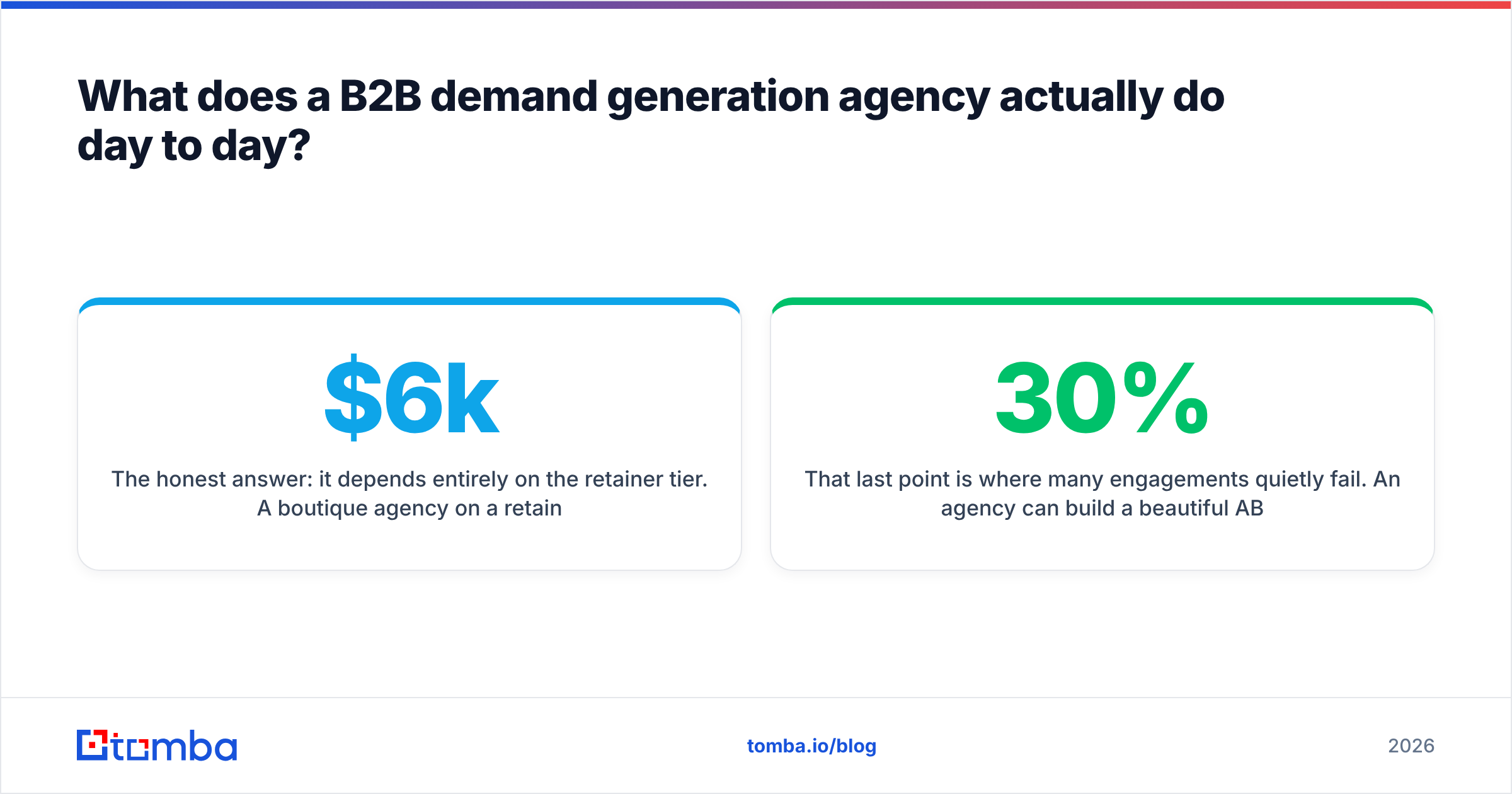
The honest answer: it depends entirely on the retainer tier. A boutique agency on a $6k/month retainer is running one or two channels and a monthly report. A full-service shop at $25k/month is functionally an outsourced marketing department with a dedicated pod — strategist, paid media buyer, content lead, and an ops person.
Across both, the recurring work looks like this:
- Building and refreshing target-account lists, then enriching them with firmographic and contact data.
- Launching and optimizing paid campaigns against pipeline targets, not vanity metrics like impressions.
- Producing content on a calendar and distributing it where your buyers actually spend time.
- Setting up and maintaining attribution so you can see which dollar produced which deal.
- Running QA on the contact data feeding outbound — verifying emails before they hit a sequence so you protect sender reputation.
That last point is where many engagements quietly fail. An agency can build a beautiful ABM program, but if 30% of the email addresses bounce, your domain reputation tanks and the whole motion stalls. This is why smart teams keep an email verifier in the loop regardless of who runs the campaigns.
How much does a B2B demand generation agency cost in 2026?#
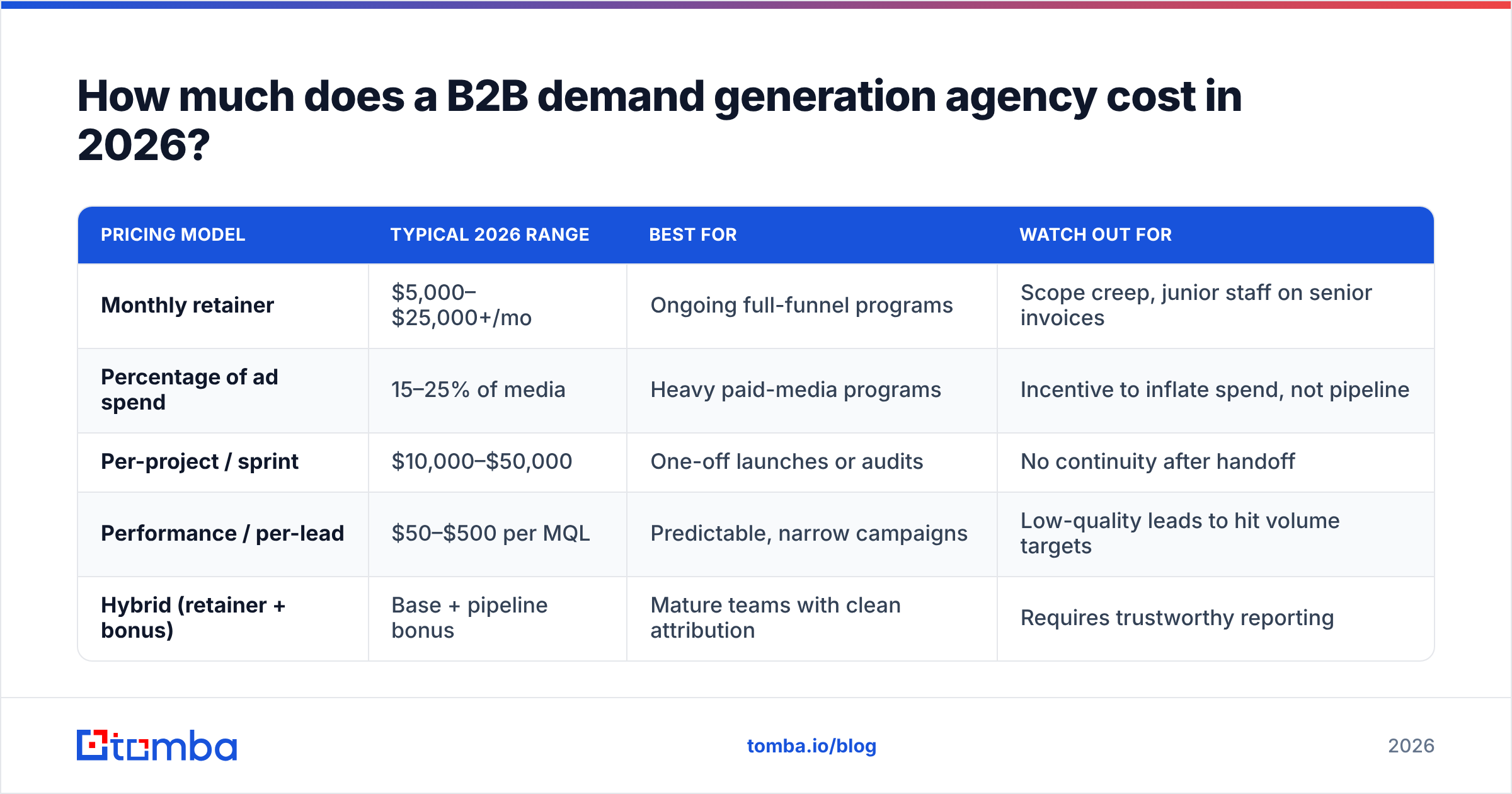
Short answer: $5,000 to $25,000+ per month for an ongoing retainer, with project-based work landing between $10,000 and $50,000. Pricing has crept up since 2024 as agencies bundle in AI tooling and first-party data costs.
Here's how the common pricing models compare:
| Pricing model | Typical 2026 range | Best for | Watch out for |
|---|---|---|---|
| Monthly retainer | $5,000–$25,000+/mo | Ongoing full-funnel programs | Scope creep, junior staff on senior invoices |
| Percentage of ad spend | 15–25% of media | Heavy paid-media programs | Incentive to inflate spend, not pipeline |
| Per-project / sprint | $10,000–$50,000 | One-off launches or audits | No continuity after handoff |
| Performance / per-lead | $50–$500 per MQL | Predictable, narrow campaigns | Low-quality leads to hit volume targets |
| Hybrid (retainer + bonus) | Base + pipeline bonus | Mature teams with clean attribution | Requires trustworthy reporting |
A few realities behind the numbers. The percentage-of-spend model quietly rewards the agency for spending more of your money, not for closing more deals — read the contract for how success is defined. Per-lead pricing sounds safe until you realize "lead" is doing a lot of work; a $75 MQL that never books a meeting is worse than no lead at all. And retainers almost always start with a 3-month minimum and a one-month ramp where you pay full price for setup.
For context on benchmarking vendors before you sign, G2 and Gartner both maintain category reviews worth reading. Cross-reference claimed results against actual customer reviews, not the agency's own case studies.
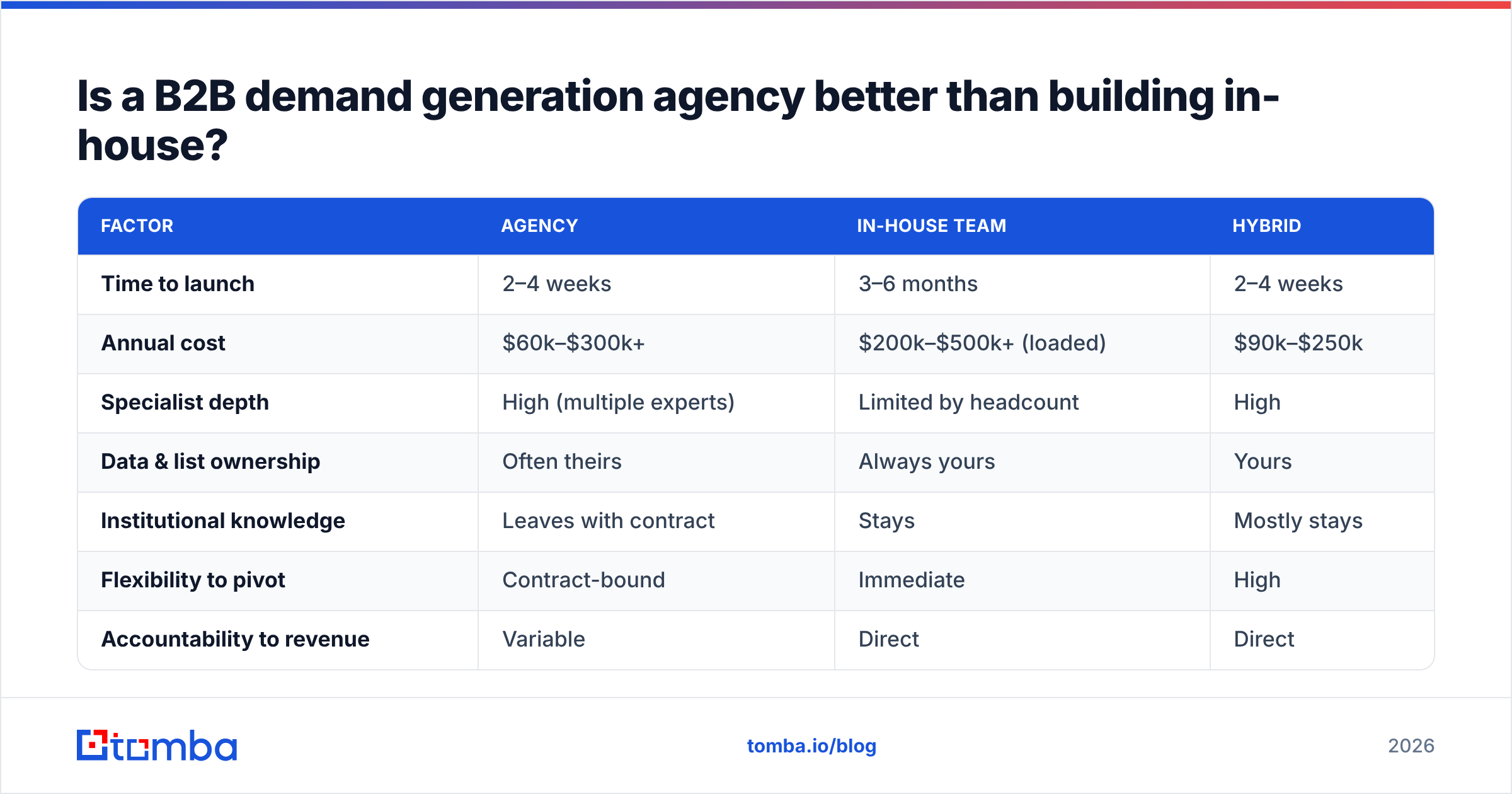
Is a B2B demand generation agency better than building in-house?#
Neither wins outright — it depends on your stage, budget, and how much marketing leadership you already have. The fastest way to decide is to compare them on the dimensions that actually move pipeline.
| Factor | Agency | In-house team | Hybrid |
|---|---|---|---|
| Time to launch | 2–4 weeks | 3–6 months | 2–4 weeks |
| Annual cost | $60k–$300k+ | $200k–$500k+ (loaded) | $90k–$250k |
| Specialist depth | High (multiple experts) | Limited by headcount | High |
| Data & list ownership | Often theirs | Always yours | Yours |
| Institutional knowledge | Leaves with contract | Stays | Mostly stays |
| Flexibility to pivot | Contract-bound | Immediate | High |
| Accountability to revenue | Variable | Direct | Direct |
The pattern most companies under $50M ARR land on is hybrid, and for good reason. You rent the agency's specialist firepower — paid media buyers and ABM strategists are expensive to hire full-time — while keeping the assets that compound in value inside your walls. Your target-account list, your verified contact database, your CRM hygiene, and your messaging knowledge should never live exclusively in a vendor's account.

The data-ownership point deserves emphasis. When an agency builds your prospecting lists inside their tools and their seats, you're renting your own pipeline. The day you churn, that list quality often degrades because the enrichment and verification stops. Owning the contact layer — using a bulk email finder and verification you control — means the agency relationship can end without your pipeline collapsing.
How do you choose the right B2B demand generation agency?#
Pick the agency that can show you pipeline it influenced, not leads it counted, in companies that look like yours. Everything else is secondary.
Run every shortlisted agency through this checklist:
- Revenue proof, not activity proof. Ask for case studies tied to pipeline and closed-won revenue, with named metrics. "We generated 4,000 leads" means nothing without conversion and deal data.
- ICP fit. An agency that crushed it for a $2k/month SaaS may flounder with a $200k enterprise sale. Ask who they've sold motion-for-motion like yours.
- Data transparency. Where do their contact lists come from? How do they verify emails? Can you export and keep the data? If the answer is vague, assume you don't own it.
- Reporting you understand. You should get a dashboard that ties spend to pipeline, refreshed at least weekly — not a pretty PDF once a month.
- The team on your account. Meet the people who'll actually do the work, not just the founder who closes the sale. Senior pitch, junior delivery is the oldest trick in the book.
- A real offboarding plan. What do you keep when you leave? Lists, creative, accounts, and documentation should all transfer to you.
Red flags that should end the conversation: guaranteed lead volumes with no quality definition, refusal to share data sources, locking campaigns inside accounts you can't access, and reporting that emphasizes impressions and clicks over meetings and pipeline. HubSpot's own demand generation playbook is a useful neutral benchmark for what a competent program should include — if an agency can't speak to those fundamentals, keep looking.
What should stay in-house even if you hire an agency?#
Keep the data layer and the relationships in-house — always. Those are the assets that appreciate, and they're the cheapest insurance against a bad agency fit.
Specifically, own these regardless of who runs your campaigns:
- Your CRM and its hygiene. Deduped, enriched, and current. The agency can write to it; they shouldn't be the only ones who understand it.
- Contact discovery and verification. Finding and validating emails is a repeatable, ownable process. Tools like the Tomba Email Finder and a verification step let you build lists on your terms and feed any agency clean data.
- Your messaging and positioning knowledge. Agencies execute messaging; they shouldn't be the sole authors of how you describe your own product.
- Sales-to-marketing feedback loop. The intel about why deals close or stall is too valuable to outsource.
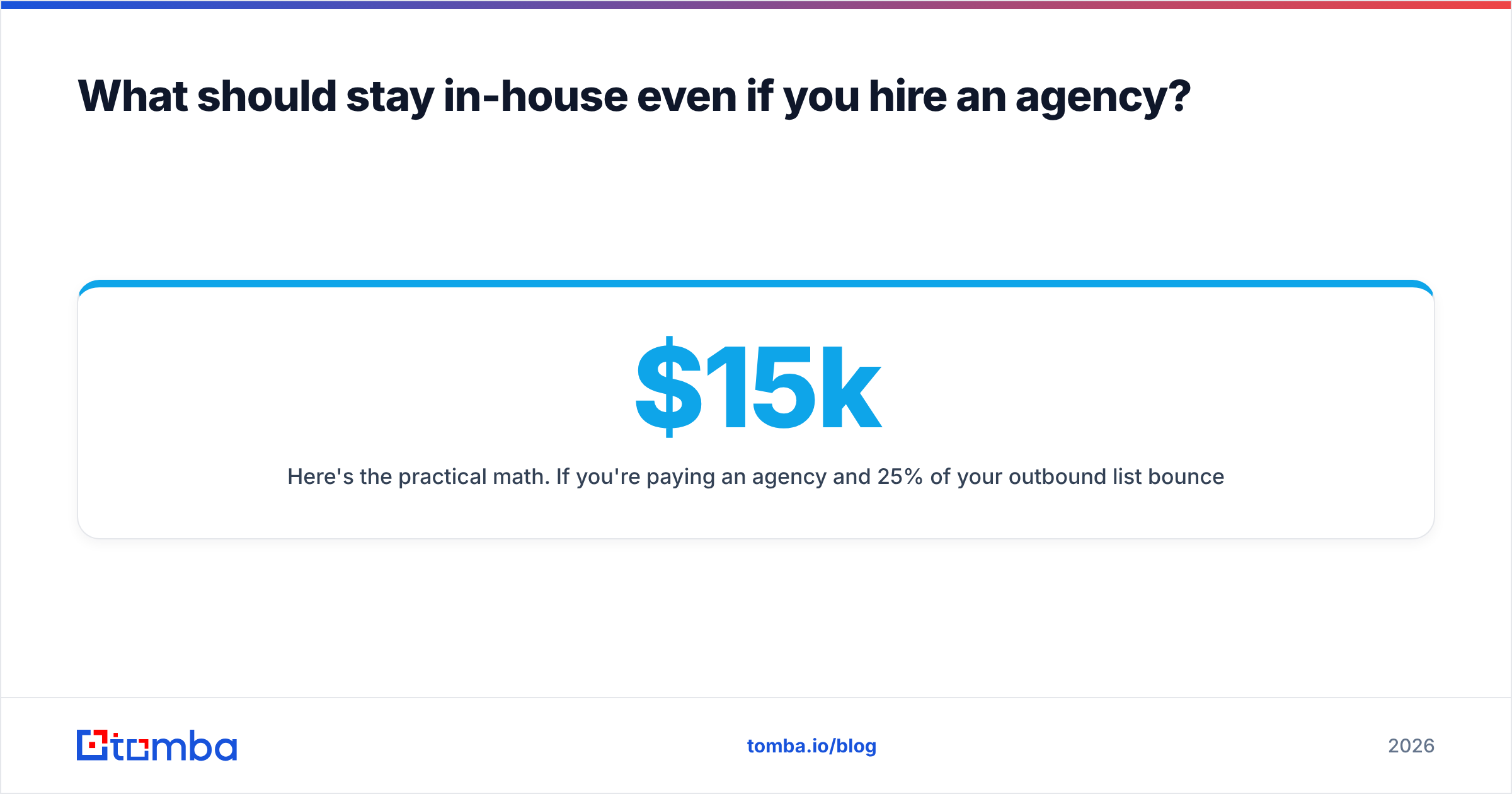
Here's the practical math. If you're paying an agency $15k/month and 25% of your outbound list bounces, you're not just wasting a quarter of that channel's budget — you're degrading deliverability for the leads that were valid. A modest investment in your own domain search and verification workflow protects the much larger spend on top of it. You can review the full Tomba pricing tiers to see how cheap the data layer is relative to an agency retainer: a Growth plan at $99/month is a rounding error against a $15k engagement.
When does a B2B demand generation agency make sense?#
Hire an agency when you need speed, specialist depth, or capacity you can't justify hiring for full-time — and when you have clean data and clear attribution to make their work measurable.
Strong signals it's the right call:
- You're entering a new market or motion and need experienced operators now, not in six months.
- You have budget for paid media but no in-house media buyer.
- Your founder or one generalist marketer is the entire team and is drowning.
- You need a specific capability — ABM orchestration, technical SEO, programmatic — for a defined window.
Weak signals where you should build instead:
- You can't yet measure pipeline or attribute revenue. An agency will just spend faster into a fog.
- Your data is a mess. Fix the foundation first, or you'll pay agency rates to target dead contacts.
- You expect the agency to define your strategy from scratch. The best results come when you bring the strategy and they bring execution.
If you're not ready for a $60k–$300k annual commitment, start by tightening the controllables: clean your list, verify your emails, and run a focused outbound test. You can validate the motion with your own data enrichment and a small SDR effort, then bring in an agency to scale what already works rather than to discover whether anything works at all.
The bottom line#
A B2B demand generation agency is a force multiplier, not a substitute for fundamentals. The companies that get the most from agencies are the ones that walk in with a clean data foundation, clear ICP, and working attribution — then rent specialist execution on top. The ones that get burned hand over strategy, data, and accountability all at once and hope for the best.
Whatever you decide, own your data layer. Before you sign a retainer — or instead of one, if you're testing the motion yourself — build and verify your target lists with the Tomba Email Finder. Find professional emails by domain, name, or company, verify them before they hit a sequence, and keep that pipeline asset on your side of the table no matter which agency comes and goes. Start free with 25 searches a month and scale only when the motion is proven.
// get started
Find, verify and enrich your first contacts today
Start on the free plan with 25 searches a month, then scale when your team is ready.
Free plan · No credit card required · GDPR & CCPA
// about the author