B2B Demand Generation Campaigns: The 2026 Field Guide
Most B2B demand generation campaigns leak pipeline at every stage. Here is the 2026 framework for building campaigns that create demand, capture intent, and convert it into revenue.
TL;DR
- Demand generation is not lead generation. Demand creation builds awareness and intent; demand capture converts that intent into pipeline. Most teams fund one and starve the other.
- A modern B2B demand generation campaign runs on three layers: create (educate the market), capture (catch people already searching), and convert (route clean data to sales fast).
- Vanity MQLs are the silent killer. Optimize for pipeline and revenue per channel, not form fills.
- Your data layer decides whether captured intent becomes a booked meeting or a bounced email. Enrichment and verification are campaign infrastructure, not an afterthought.
- The teams winning in 2026 spend less on more channels and more on fewer, instrumented ones.
What is a B2B demand generation campaign?#
A B2B demand generation campaign is a coordinated, multi-channel program designed to create awareness of a problem, build trust in your solution, and capture buyers at the moment they are ready to act. It spans the full funnel — from a cold prospect who has never heard of you to a sales-ready buyer requesting a demo.
The common mistake is treating "demand gen" as a synonym for "lead gen." They are different jobs. Lead generation captures contact details. Demand generation creates the want in the first place. If you only run capture plays — gated ebooks, retargeting, branded search — you are harvesting demand someone else created. That works until the demand runs dry.
Think of it like a farm. Demand creation is planting and watering the field; demand capture is the harvest. You cannot harvest a field you never planted. A healthy campaign budgets for both, and instruments both so you know which crop actually fed pipeline.
How is demand generation different from lead generation?#
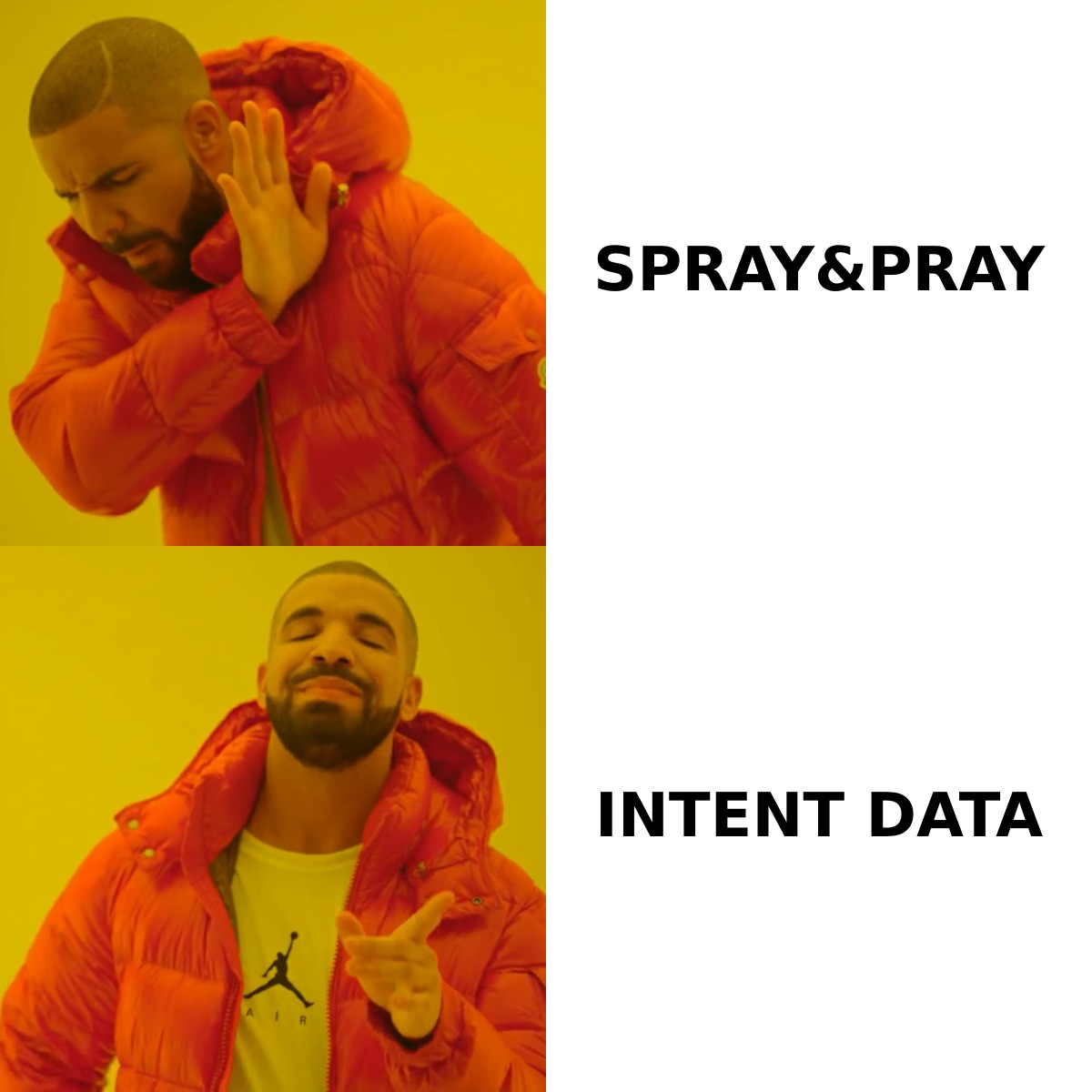
The clearest way to see the difference is to look at what each optimizes for, where it sits in the funnel, and how you measure it.
| Dimension | Demand generation | Lead generation |
|---|---|---|
| Primary goal | Create and capture market intent | Collect contact information |
| Funnel stage | Full funnel (awareness → decision) | Mid/bottom funnel |
| Core metric | Pipeline and revenue influenced | MQLs / form fills |
| Typical plays | Thought leadership, podcasts, communities, intent capture | Gated content, paid forms, list buys |
| Time horizon | Compounding (months) | Immediate (days/weeks) |
| Failure mode | Hard to attribute | High volume, low quality |
Lead generation feels productive because the numbers move fast. But a pile of MQLs that never convert is a cost center wearing a marketing badge. Demand generation is harder to attribute and slower to show results, which is exactly why under-resourced teams abandon it. The fix is not to pick one — it is to fund creation for the long arc and capture for the short, then connect both to a single pipeline number.
For a deeper definition of where this sits in your go-to-market motion, see Tomba's primer on revenue operations, which frames demand gen as one input to a unified revenue engine.
What are the core layers of a 2026 demand gen campaign?#
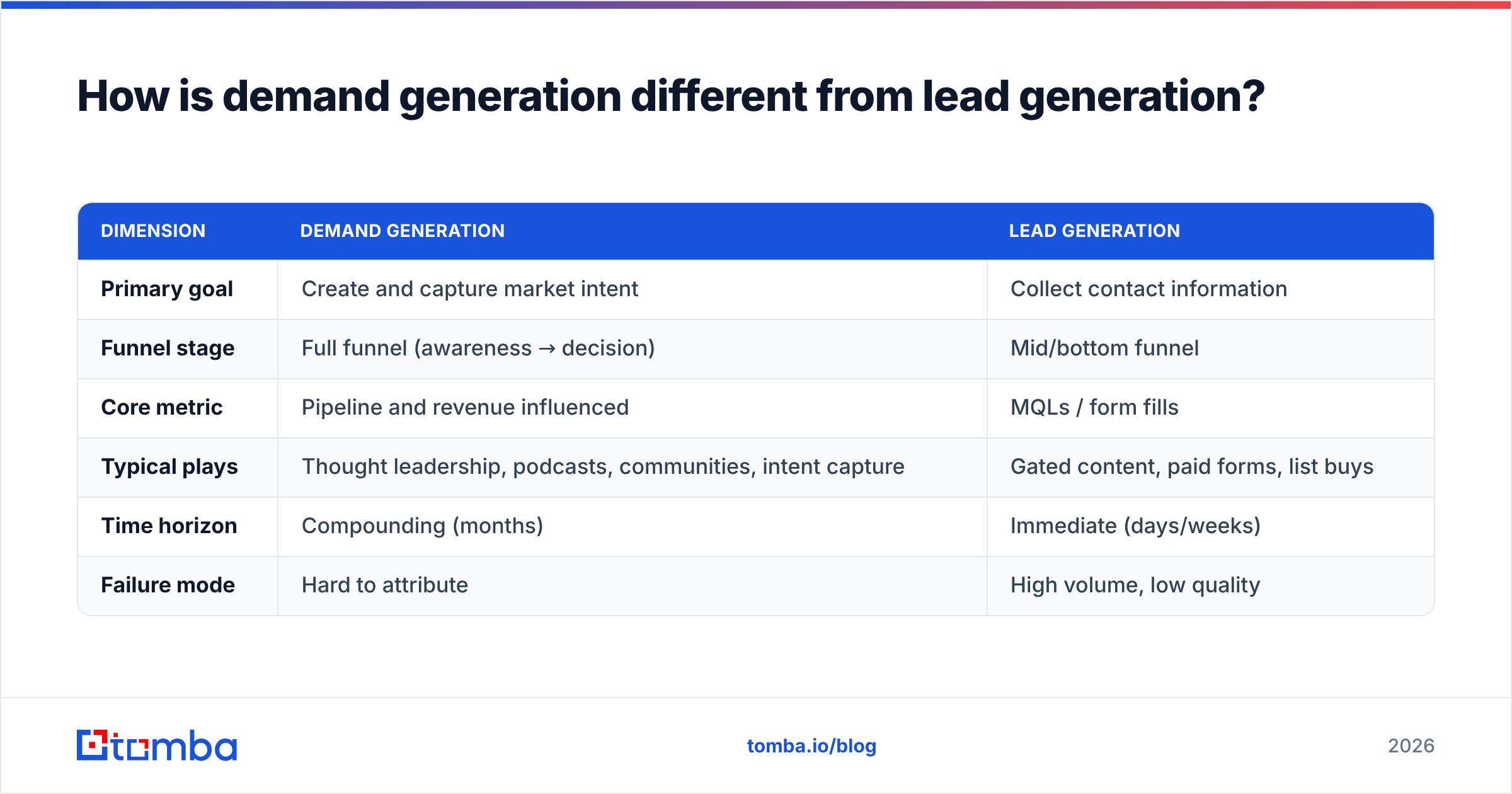
A campaign that compounds is built in three layers. Each has a distinct job, a distinct metric, and a distinct failure mode.
- Create demand — Educate the market on a problem they may not have named yet. Channels: founder-led content, podcasts, YouTube, LinkedIn thought leadership, original research, community. Metric: branded search lift, direct traffic, share of voice. This is where you earn the right to be remembered.
- Capture demand — Catch buyers who are already in-market. Channels: branded and non-branded paid search, SEO comparison content, review sites (G2, Capterra), retargeting, and high-intent webinars. Metric: pipeline from high-intent sources.
- Convert demand — Turn a raw signal into a booked meeting before it goes cold. This is the data and routing layer: enrich the lead, verify the email, score the intent, and route to the right rep in minutes. Metric: speed-to-lead and meeting-booked rate.
- Measure and recycle — Feed closed-won and closed-lost data back into targeting so the next campaign starts smarter. Metric: cost per opportunity by channel over time.
Most teams over-invest in layer 2 and ignore layers 1 and 3. The result is a campaign that captures whatever demand exists but never grows the pool — and then loses a third of what it captures to bad data and slow follow-up.
Which channels actually drive demand in 2026?#
Channel selection is where budgets quietly bleed. The honest answer: fewer channels, deeper. Spreading $50k across eight channels gives you eight under-instrumented experiments. Concentrating it on three gives you signal.
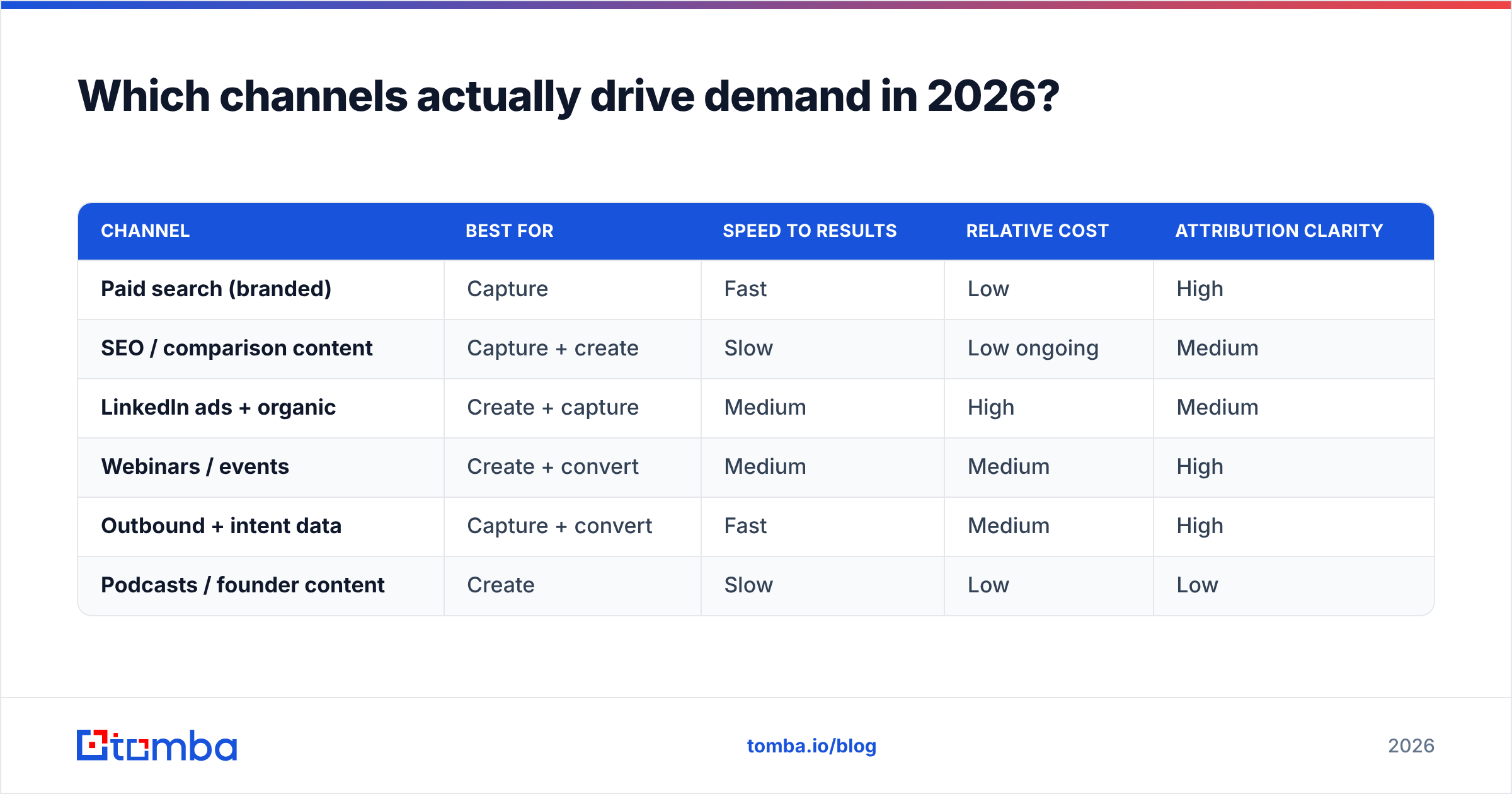
Here is how the main B2B channels compare on the jobs they do best:
| Channel | Best for | Speed to results | Relative cost | Attribution clarity |
|---|---|---|---|---|
| Paid search (branded) | Capture | Fast | Low | High |
| SEO / comparison content | Capture + create | Slow | Low ongoing | Medium |
| LinkedIn ads + organic | Create + capture | Medium | High | Medium |
| Webinars / events | Create + convert | Medium | Medium | High |
| Outbound + intent data | Capture + convert | Fast | Medium | High |
| Podcasts / founder content | Create | Slow | Low | Low |
The pattern: pair a slow compounding creation channel (SEO, content, podcast) with a fast capture-and-convert channel (paid search, outbound). The creation channel grows the pool; the capture channel monetizes it this quarter. If you run only fast channels, you plateau. If you run only slow channels, you starve before they compound.
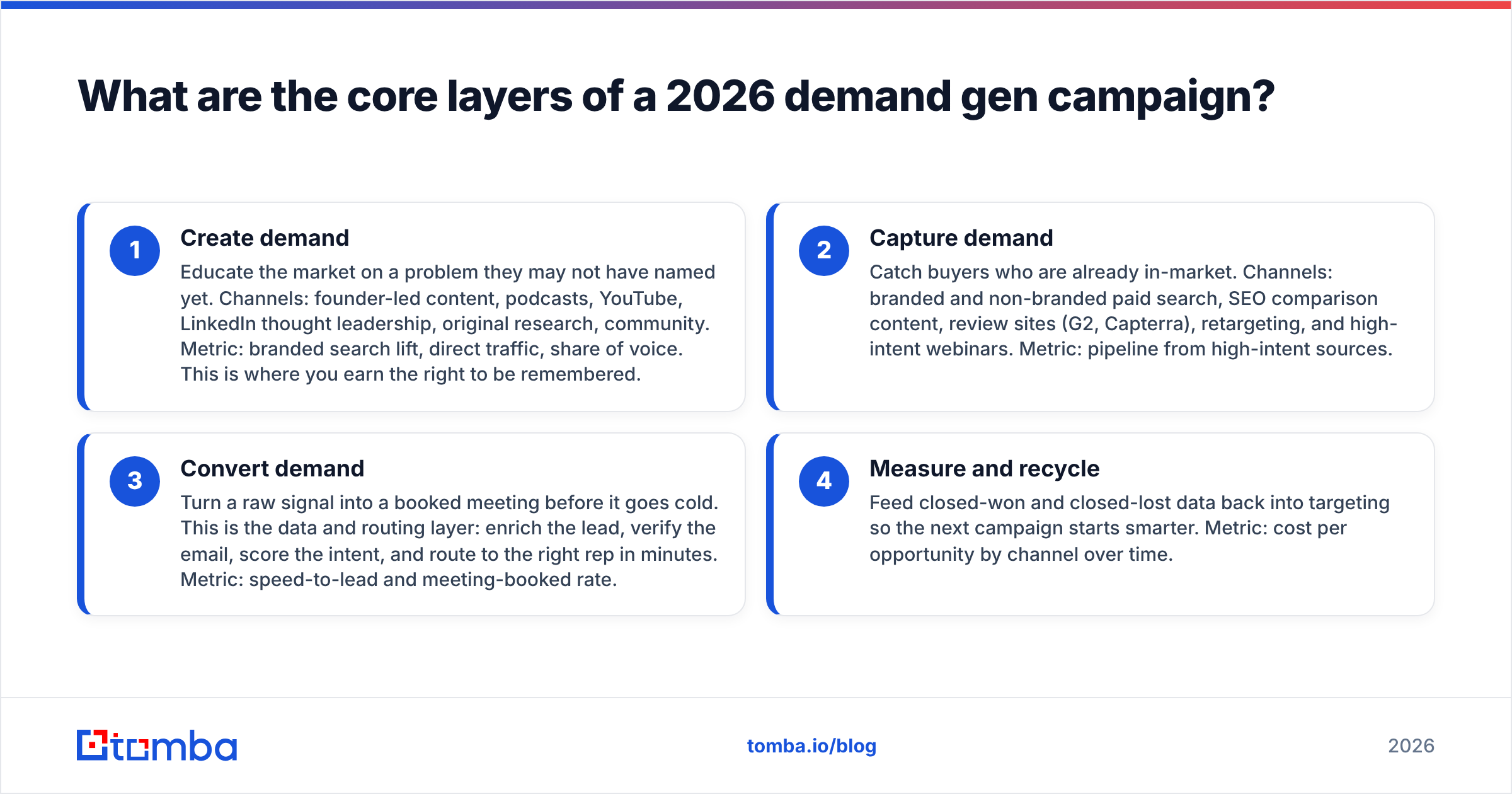
Outbound deserves special mention. When paired with intent data and accurate contact records, outbound becomes a precision capture motion rather than spray-and-pray. The difference is entirely in the data quality — which brings us to the layer everyone underfunds.

Why does the data layer make or break the campaign?#
Your campaign is only as good as the data underneath it. You can run a flawless creation strategy, capture a buyer at peak intent, and still lose the deal because the email bounced or the lead sat in a queue for six hours.
Consider the math. A campaign generates 1,000 captured leads. If 25% of your contact data is stale or wrong — a conservative figure for B2B databases that decay roughly 2–3% per month — you have just thrown away 250 opportunities before sales ever touched them. No creative testing recovers that. It is a data problem, and it is fixable.
Three data jobs run inside every serious campaign:
- Enrichment — Turn a partial signal (a name, a company, a website visit) into a complete, actionable record with role, seniority, and contact details. Use data enrichment to fill the gaps before a lead reaches a rep.
- Verification — Confirm the email is deliverable before you send. A clean list protects your sender reputation and keeps your outbound out of spam. An email verifier should sit between capture and send, not be skipped to save a step.
- Finding — When a high-intent account shows up but you only have a company, you need the right person fast. A domain search surfaces the relevant contacts at that company so the signal does not die for lack of an address.
This is why tooling like an accurate email finder is campaign infrastructure, not a sales nicety. The captured intent has a shelf life measured in hours. Whether you convert it depends on whether your data layer can act before it expires.
According to research syndicated by Gartner, B2B buyers spend only a fraction of their journey with any single vendor's sales team — most of the decision happens during anonymous research. That makes the moment a buyer raises their hand disproportionately valuable. Waste it with bad data and you do not get a second chance.
How do you measure a demand generation campaign correctly?#
Measure pipeline and revenue by source, and stop celebrating MQLs. That is the entire reform in one sentence.
The vanity-metric trap is seductive because top-of-funnel numbers are easy to move and easy to report. But a 40% jump in MQLs that produces zero new pipeline is not a win — it is noise that costs money to process. Build your reporting around metrics that survive contact with the CFO:
- Pipeline created per channel — dollars of qualified opportunity, not lead count.
- Cost per opportunity (CPO) — total spend divided by opportunities, by channel. This exposes the channels that look cheap on cost-per-lead but expensive on cost-per-deal.
- Speed-to-lead — minutes from signal to first sales touch. Faster routing directly raises win rate.
- Pipeline velocity — how fast opportunities move from stage to stage, which tells you whether your captured demand was real or manufactured.
- Channel payback period — how long until a channel's pipeline covers its spend.
Tools like G2 and your CRM's attribution reporting help, but no dashboard fixes a measurement philosophy. If your team is rewarded on MQL volume, you will get MQL volume. Tie incentives to pipeline and the behavior changes within a quarter.
What does a 90-day campaign rollout look like?#
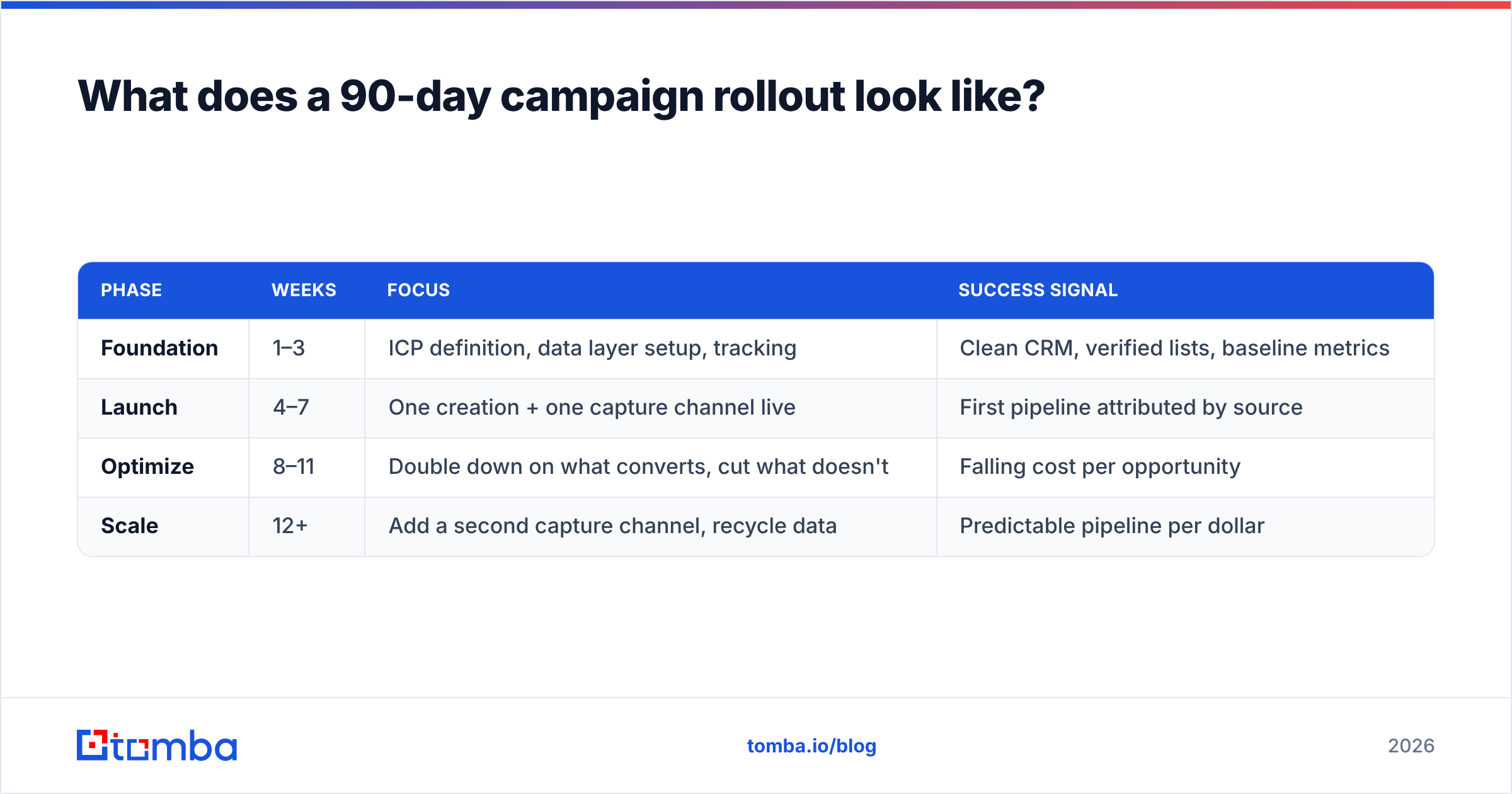
You do not need a year to prove a demand gen motion. You need 90 days, one creation channel, one capture channel, and a tight data layer connecting them.
| Phase | Weeks | Focus | Success signal |
|---|---|---|---|
| Foundation | 1–3 | ICP definition, data layer setup, tracking | Clean CRM, verified lists, baseline metrics |
| Launch | 4–7 | One creation + one capture channel live | First pipeline attributed by source |
| Optimize | 8–11 | Double down on what converts, cut what doesn't | Falling cost per opportunity |
| Scale | 12+ | Add a second capture channel, recycle data | Predictable pipeline per dollar |
In the Foundation phase, resist the urge to launch ads on day one. Define your ICP, connect your enrichment and verification so captured leads arrive complete and deliverable, and set a baseline for every metric above. A campaign launched on a dirty database is a campaign you cannot trust the numbers from.
By the Optimize phase you will have your first honest cost-per-opportunity figures per channel. This is where most of the value is created — not in launching more, but in cutting the channels that capture cheap leads that never convert and reinvesting in the ones that produce real pipeline.
What mistakes kill most B2B demand gen campaigns?#
- Funding capture, starving creation. You harvest until the field is empty, then wonder why results plateaued.
- Optimizing for MQLs. Volume goals manufacture junk. Pipeline goals manufacture revenue.
- Skipping the data layer. Stale and unverified contacts silently waste a quarter of every campaign's budget.
- Too many channels, too shallow. Eight half-instrumented channels teach you nothing. Three well-measured ones teach you everything.
- Slow follow-up. A hot lead routed in six hours is a cold lead. Speed-to-lead is a conversion lever hiding in operations.
- No recycling loop. Teams that never feed closed-won/lost data back into targeting run the same campaign forever and call it consistency.
Avoiding these is mostly discipline, not budget. The cheapest improvement available to most teams is not a new channel — it is cleaning the data and speeding up the handoff between marketing and sales.
Bringing it together#
A B2B demand generation campaign that compounds does three things well: it creates demand the market did not know it had, captures that demand at peak intent, and converts it before the signal decays. The first is a content and brand discipline. The second is a channel and budget discipline. The third — the one most teams skip — is a data discipline.
Get the data layer right and every other layer performs better. Clean, enriched, verified contact data is the difference between a campaign that books meetings and one that fills a CRM with bounces. If you are building or fixing a demand gen motion in 2026, start by making sure the intent you capture actually reaches a human.
That is exactly what the Tomba Email Finder is built for: turning a company, a domain, or a name into an accurate, verified contact you can act on before the moment passes. Pair it with verification and enrichment, wire it into your capture channels, and you stop leaking the pipeline you worked so hard to create. Start free with 25 searches a month, and see Tomba pricing when you are ready to scale your campaign's data layer.
// get started
Find, verify and enrich your first contacts today
Start on the free plan with 25 searches a month, then scale when your team is ready.
Free plan · No credit card required · GDPR & CCPA
// about the author