The B2B Demand Generation Funnel Explained (2026 Playbook)
A practical, stage-by-stage breakdown of the B2B demand generation funnel for 2026 — what each layer does, the metrics that matter, and how to feed it with clean data.
The B2B demand generation funnel is the system that turns strangers into aware buyers, aware buyers into engaged contacts, and engaged contacts into pipeline your sales team can actually close. Get it right and growth compounds. Get it wrong and you pour budget into a leaky bucket.
This guide walks the whole funnel as it actually operates in 2026 — every stage, the numbers that tell you it's working, the leaks that quietly kill it, and the data layer that decides whether any of it converts.
TL;DR#
- Demand generation ≠ lead generation. Demand gen creates and captures interest across the full buyer journey; lead gen is just the capture step at the bottom.
- The modern funnel has five working stages: awareness, interest, consideration, intent, and conversion — plus a post-sale expansion loop.
- Most funnels leak at the handoff, not the top. MQL-to-SQL conversion is where pipeline dies.
- Data quality is the multiplier. A funnel built on stale or guessed contact data wastes every dollar spent above it.
- Measure stage conversion rates and velocity, not vanity volume.
What is a B2B demand generation funnel?#
A B2B demand generation funnel is the structured path a buyer travels from never having heard of you to becoming a paying customer — and the marketing and sales programs that move them along it.
Think of it like a municipal water system. Demand generation is the reservoir, the treatment plant, and the pipes all working together. Lead generation is just the tap at the end. People obsess over the tap, but if the reservoir is empty or the pipes leak, no amount of tap-polishing helps.
The "demand generation" label matters because it covers two jobs that older "lead gen" thinking collapsed into one:
- Demand creation — making buyers aware a problem and a solution category exist (content, ads, events, thought leadership).
- Demand capture — converting buyers who are already searching into known contacts and pipeline (gated assets, demos, retargeting, intent signals).
Skip creation and you fight everyone else for the same small pool of in-market buyers. Skip capture and you build an audience that never converts. The funnel exists to balance both.
What are the stages of the demand generation funnel?#
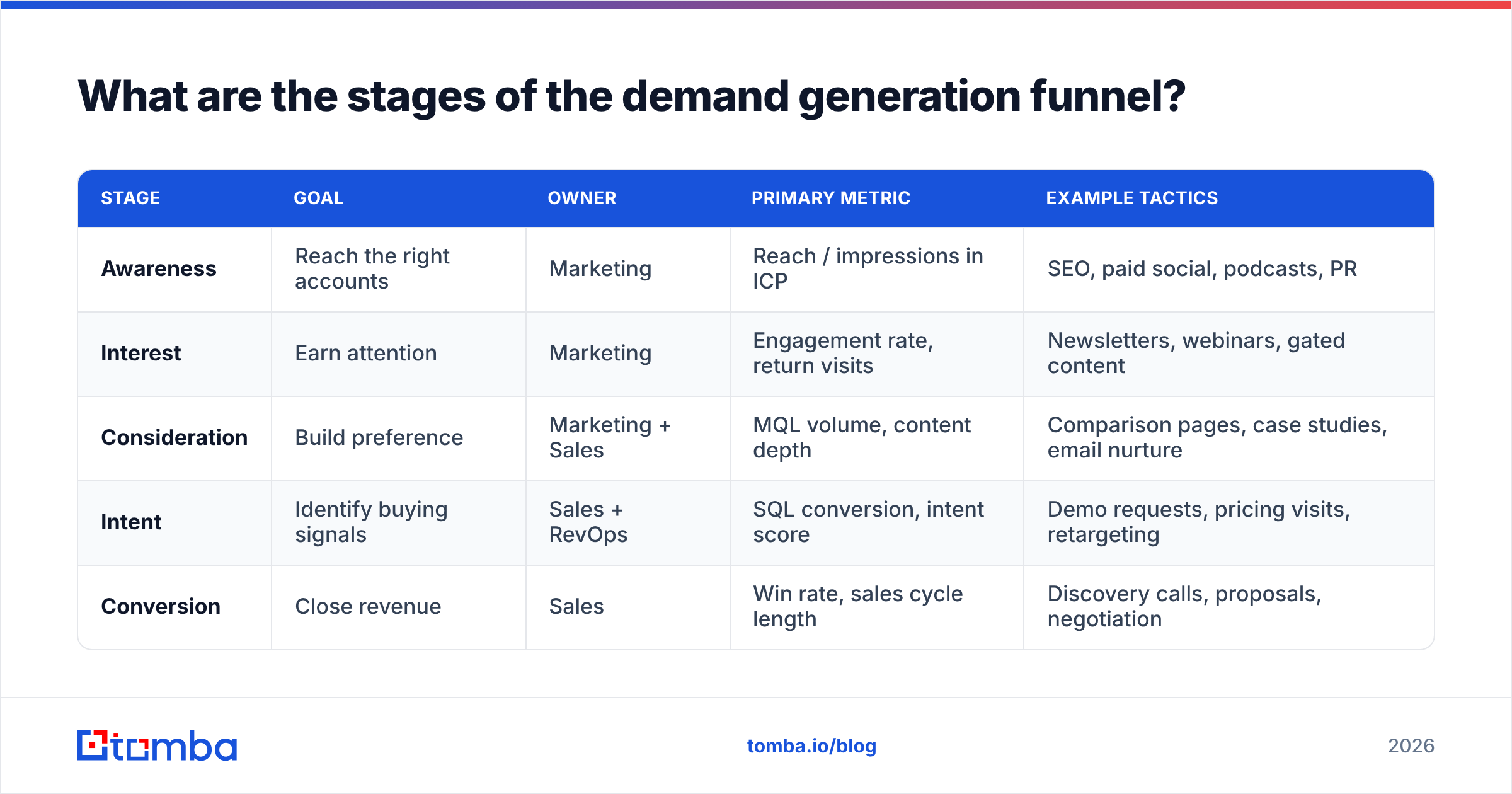
The 2026 funnel is usually drawn in five stages. Here is what each one does, who owns it, and the primary metric that proves it's working.
| Stage | Goal | Owner | Primary metric | Example tactics |
|---|---|---|---|---|
| Awareness | Reach the right accounts | Marketing | Reach / impressions in ICP | SEO, paid social, podcasts, PR |
| Interest | Earn attention | Marketing | Engagement rate, return visits | Newsletters, webinars, gated content |
| Consideration | Build preference | Marketing + Sales | MQL volume, content depth | Comparison pages, case studies, email nurture |
| Intent | Identify buying signals | Sales + RevOps | SQL conversion, intent score | Demo requests, pricing visits, retargeting |
| Conversion | Close revenue | Sales | Win rate, sales cycle length | Discovery calls, proposals, negotiation |
The arrows between stages matter more than the boxes. A stage with great volume but a broken arrow into the next stage is a bottleneck, not a win.
The five stages in detail#
- Awareness — You are not selling yet; you are getting in front of the right accounts. The trap here is reaching volume instead of fit. A million impressions outside your ICP is noise.
- Interest — A buyer trades a little attention (a subscribe, a webinar signup) for value. This is where you earn the right to follow up.
- Consideration — The buyer is comparing approaches. This is your moment for honest comparison content, proof, and a marketing qualified lead definition both teams agree on.
- Intent — Behavior signals real buying motion: pricing-page visits, repeat demos, multiple stakeholders from one account. Score it and route it fast.
- Conversion — Sales takes over with discovery, proof, and a tailored offer. Marketing's job is to keep feeding context, not disappear.
)
Is demand generation the same as lead generation?#
No — and conflating them is the most common reason funnels underperform.
Lead generation is a single function: capturing contact details so you can follow up. Demand generation is the entire engine that creates the conditions for those captures to happen and to convert. Lead gen lives inside demand gen, at the bottom.
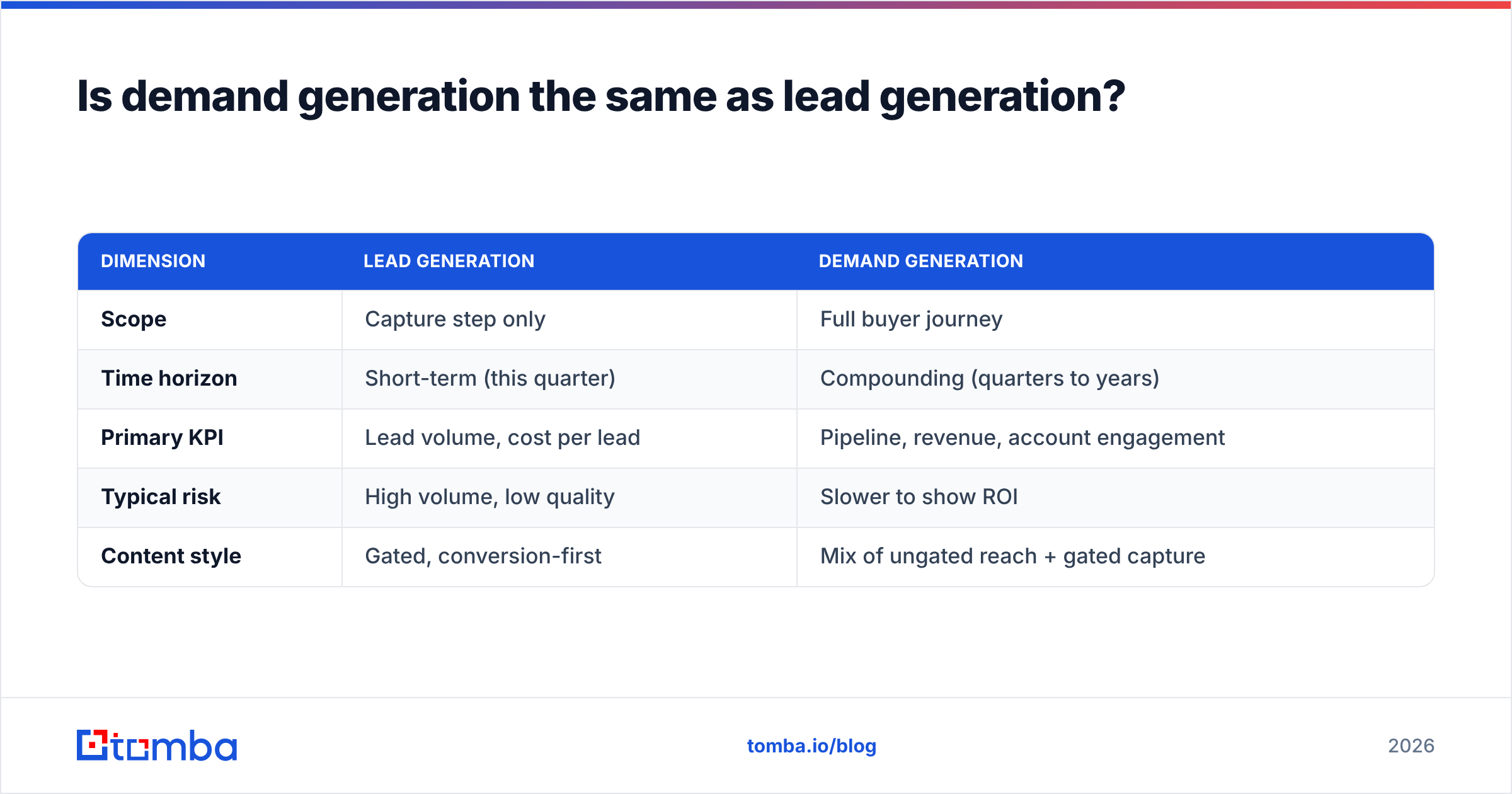
Here is the practical difference in how the two are measured and run:
| Dimension | Lead generation | Demand generation |
|---|---|---|
| Scope | Capture step only | Full buyer journey |
| Time horizon | Short-term (this quarter) | Compounding (quarters to years) |
| Primary KPI | Lead volume, cost per lead | Pipeline, revenue, account engagement |
| Typical risk | High volume, low quality | Slower to show ROI |
| Content style | Gated, conversion-first | Mix of ungated reach + gated capture |
A team that only does lead gen tends to hit volume targets while sales complains the response rate and close rate are terrible. A team that does demand gen properly produces fewer, better-fit leads that close faster. The second one wins on revenue even when it loses on raw lead count.
How do you measure a B2B demand generation funnel?#
Measure conversion rate between stages and velocity through them — not the size of any single stage. Volume at the top means nothing if it doesn't move down.
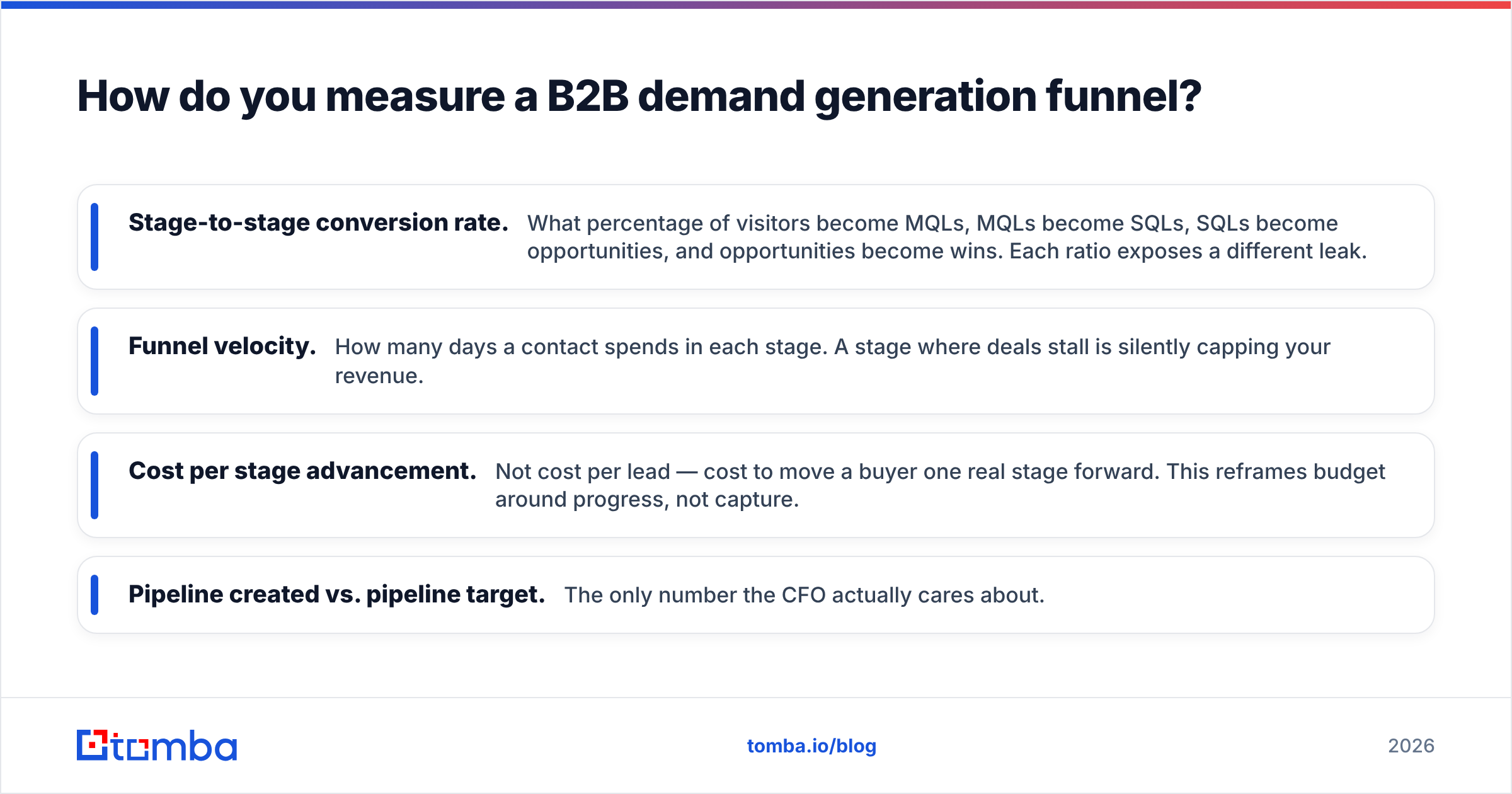
The four numbers worth watching every week:
- Stage-to-stage conversion rate. What percentage of visitors become MQLs, MQLs become SQLs, SQLs become opportunities, and opportunities become wins. Each ratio exposes a different leak.
- Funnel velocity. How many days a contact spends in each stage. A stage where deals stall is silently capping your revenue.
- Cost per stage advancement. Not cost per lead — cost to move a buyer one real stage forward. This reframes budget around progress, not capture.
- Pipeline created vs. pipeline target. The only number the CFO actually cares about.
Benchmarks vary by category, but the handoff from marketing-qualified to sales-qualified is where most B2B funnels lose the most volume. Industry analysts at Gartner and Forrester have documented for years that the majority of "qualified" leads never get meaningfully worked by sales — usually because the data is wrong or the routing is slow.
Where do demand generation funnels leak?#
Funnels rarely fail at the top. They fail at the joints. Here are the four leaks that cause the most damage, in rough order of how much revenue they quietly cost.
1. The MQL-to-SQL handoff#
A lead clicks a form, marketing celebrates, and the record lands in a queue that a rep opens three days later — by which point the buyer has moved on. The fix is fast, automated routing and a shared definition of "qualified" that both teams sign in blood.
2. Bad contact data#
This is the silent killer. You can run a flawless awareness program, but if the email you captured is wrong, the title is outdated, or the account has no other contacts mapped, the buyer never gets reached. Every dollar spent above that point is wasted. Feeding the funnel with verified contacts from an email finder and a real email verifier is the cheapest high-leverage fix most teams ignore.
3. No nurture for the 95% not ready to buy#
Most of your audience is not in-market today. If your only motion is "demo or nothing," you discard the buyers who will purchase in two quarters. A lightweight nurture track keeps you in the consideration set.
4. Sales and marketing measuring different things#
When marketing reports leads and sales reports revenue, nobody owns the middle. A single shared funnel dashboard fixes more leaks than any new tool.
)
How do you fuel the funnel with the right data?#
The funnel is only as good as the contacts flowing through it. In 2026, the teams winning at demand gen treat data acquisition and hygiene as a core part of the engine, not an afterthought.
A practical data layer has four jobs:
- Find the right people. Use domain search to map every relevant contact at a target account, not just the one person who filled out a form. B2B deals have an average of 6–10 stakeholders; capturing one is half a relationship.
- Verify before you send. Bounced emails wreck sender reputation and torch deliverability. Verify every address before it enters a sequence.
- Enrich what you capture. A name and email is a start; title, company size, and tech stack tell you how to route and message. Data enrichment turns thin records into actionable ones.
- Keep it fresh. Contact data decays roughly 25–30% per year. A funnel built on a list from 2024 is mostly fiction by now.
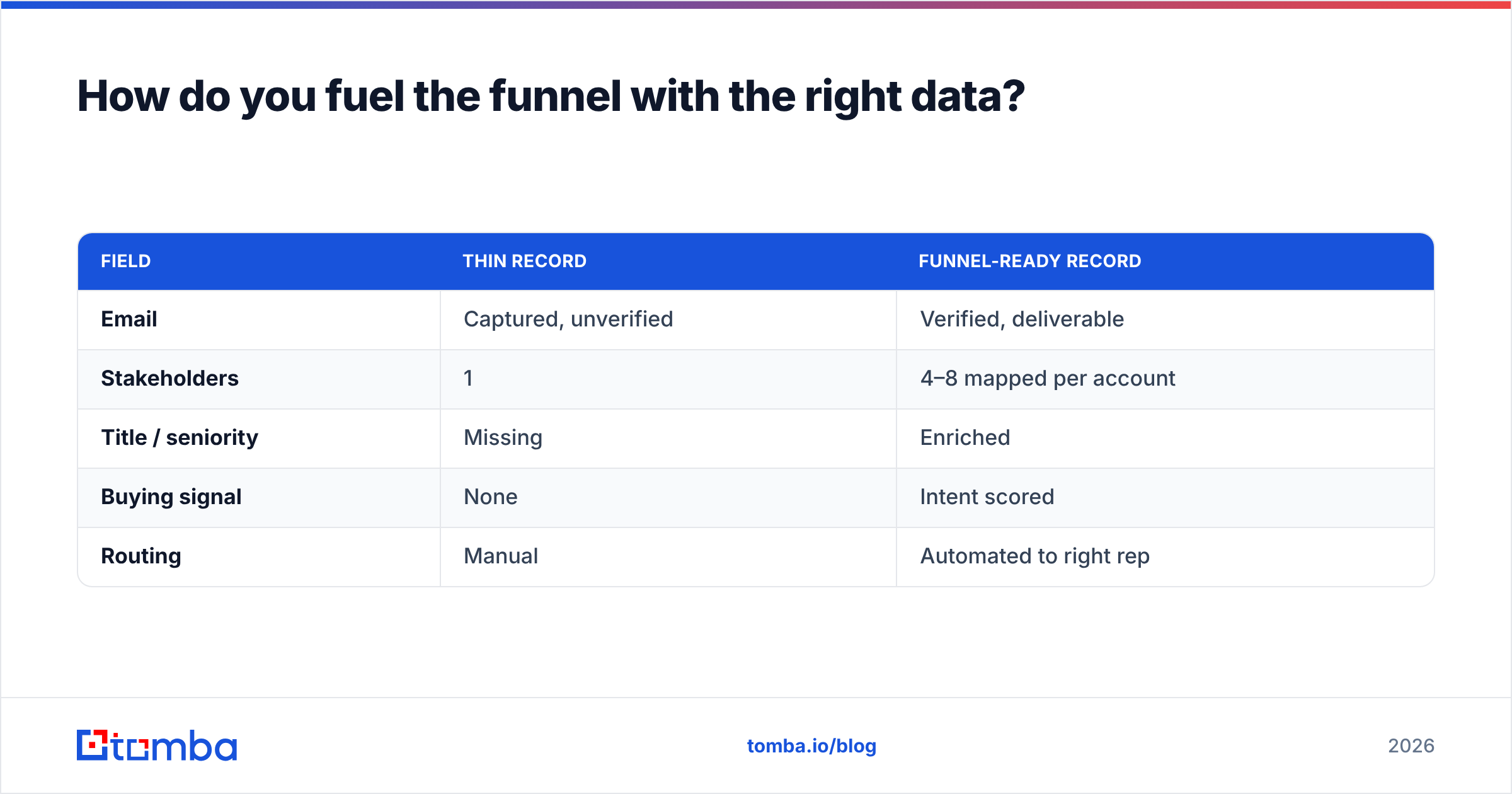
Here is how a thin lead record compares to a funnel-ready one:
| Field | Thin record | Funnel-ready record |
|---|---|---|
| Captured, unverified | Verified, deliverable | |
| Stakeholders | 1 | 4–8 mapped per account |
| Title / seniority | Missing | Enriched |
| Buying signal | None | Intent scored |
| Routing | Manual | Automated to right rep |
The difference between those two columns is the difference between a funnel that converts and one that leaks. Tools and tactics above the data layer get all the attention, but the data layer is where conversion is won or lost.
What does a healthy 2026 funnel look like end to end?#
Picture a single account moving through cleanly:
A VP of Engineering at a target company reads your SEO article (awareness), subscribes to your newsletter (interest), and downloads a comparison guide (consideration). Your data layer enriches her record and surfaces three colleagues in her buying committee. Marketing nurtures all four. Two weeks later, two of them visit your pricing page within a day (intent). Your scoring model flags the account, routes it to the right rep instantly, and the rep reaches verified inboxes on the first try (conversion).
No stage was skipped. No handoff stalled. No email bounced. That is what "the funnel works" actually means — and almost all of it depends on the quality of the contact data underneath.
For teams comparing how to build this engine on a budget, the platform mix matters less than the discipline: create demand, capture it, verify it, route it fast, and measure the joints. You can review realistic tooling costs on the Tomba pricing page when you're scoping the data layer specifically.
Common questions#
How long before a demand gen funnel shows ROI? Demand creation compounds over two to four quarters; demand capture can show results in weeks. Budget for both timelines or you'll cut the long-term engine to chase a short-term number.
Do I need every stage if I'm a small team? Yes, but lightly. Even a two-person team needs awareness, capture, and a clean handoff. You can run nurture from a single automated sequence.
Is the funnel dead in favor of "flywheels" and "loops"? The vocabulary changed; the physics didn't. Buyers still move from unaware to convinced. Loops describe how satisfied customers feed the top — they don't replace the stages.
Start with the data layer#
You can't out-create a broken data layer. Before you spend another dollar on ads or content, make sure the contacts entering your funnel are real, reachable, and complete. The Tomba Email Finder finds and verifies professional emails by name, domain, or company — so every stage above it actually converts instead of leaking. Map your target accounts, verify before you send, and let your demand gen funnel do what it's built to do: turn strangers into pipeline. Start free with 25 searches a month and scale up as your funnel proves itself.
// get started
Find, verify and enrich your first contacts today
Start on the free plan with 25 searches a month, then scale when your team is ready.
Free plan · No credit card required · GDPR & CCPA
// about the author