B2B Demand Generation Strategy: A 2026 Playbook That Works
A practical 2026 framework for building a B2B demand generation strategy that creates real buyer intent, fills the pipeline, and stops wasting budget on leads that never convert.
B2B demand generation is not "more leads." It is the work of making the right buyers want what you sell before a sales rep ever shows up. If your funnel is full of contacts who downloaded a guide and then ghosted, you have a lead capture problem dressed up as a demand problem. This playbook fixes that.
TL;DR#
- Demand generation creates buyer intent; lead generation captures it. You need both, in that order, or you fill the CRM with names that never buy.
- A working 2026 strategy has four layers: audience definition, demand creation, demand capture, and pipeline conversion — each with its own metric.
- Dark social and intent signals beat gated PDFs. Most buying research happens where you can't track it, so optimize for influence, not just clicks.
- Clean data is the multiplier. The best campaign dies on bounced emails and wrong job titles; enrichment and verification are not optional.
- Measure pipeline and revenue, not MQL volume. Vanity metrics are the fastest way to lose your budget in 2026.
What is a B2B demand generation strategy?#
A B2B demand generation strategy is the coordinated plan you use to create awareness and intent in your target market, then convert that intent into qualified pipeline. Think of it like farming instead of hunting. Hunting is chasing one deer at a time with cold outreach. Farming is planting a field — content, community, ads, and education — so that when buyers get hungry, your crop is the obvious thing to eat.
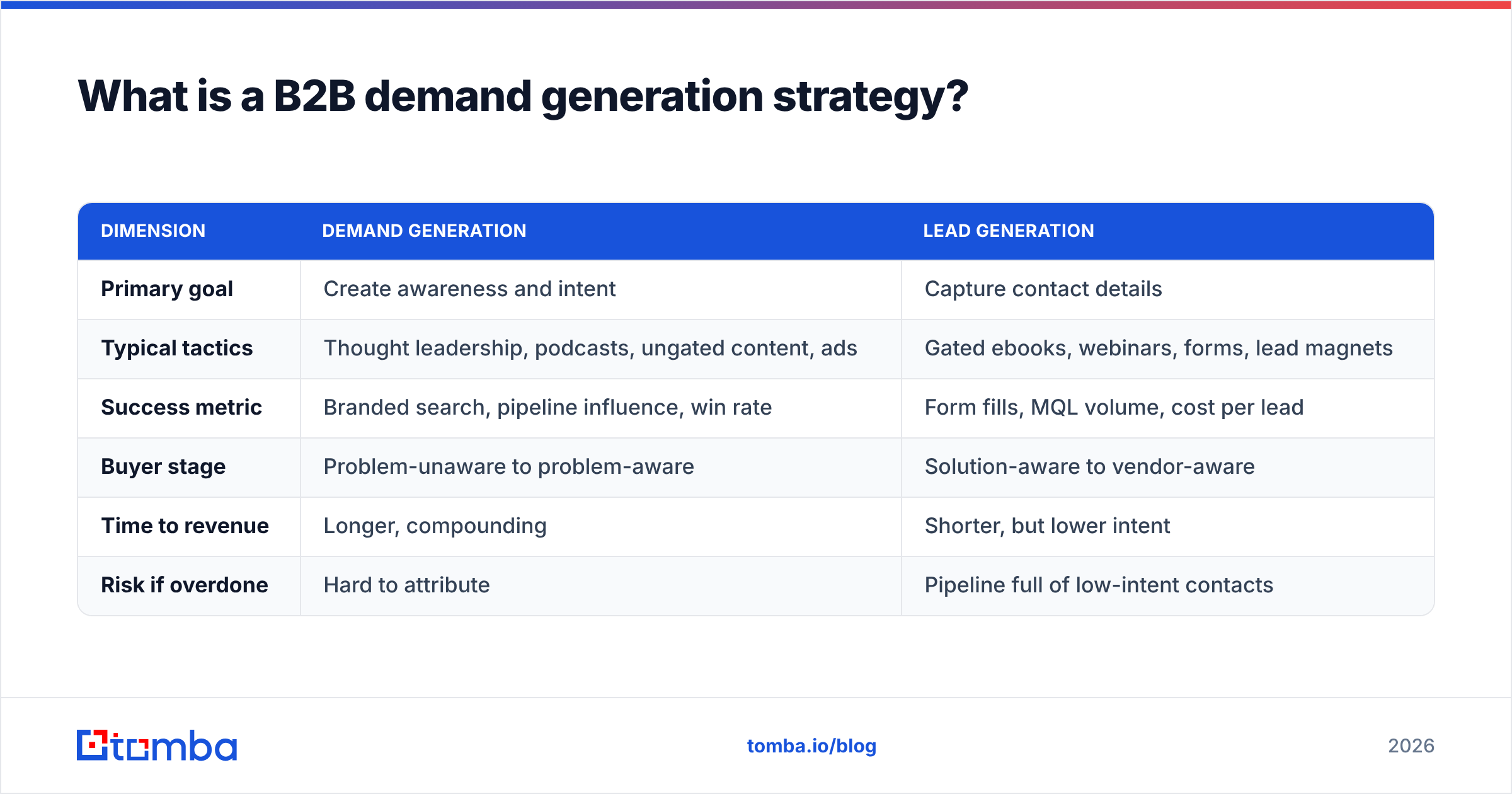
The confusion most teams have is treating demand generation and lead generation as synonyms. They are different jobs with different goals.
| Dimension | Demand generation | Lead generation |
|---|---|---|
| Primary goal | Create awareness and intent | Capture contact details |
| Typical tactics | Thought leadership, podcasts, ungated content, ads | Gated ebooks, webinars, forms, lead magnets |
| Success metric | Branded search, pipeline influence, win rate | Form fills, MQL volume, cost per lead |
| Buyer stage | Problem-unaware to problem-aware | Solution-aware to vendor-aware |
| Time to revenue | Longer, compounding | Shorter, but lower intent |
| Risk if overdone | Hard to attribute | Pipeline full of low-intent contacts |
You need both. The mistake is running only the right column — capturing demand you never created — and wondering why conversion rates are terrible. As HubSpot's research on demand generation repeatedly shows, the brands that win create the category conversation first, then capture the buyers already leaning in.
Why do most B2B demand generation strategies fail?#
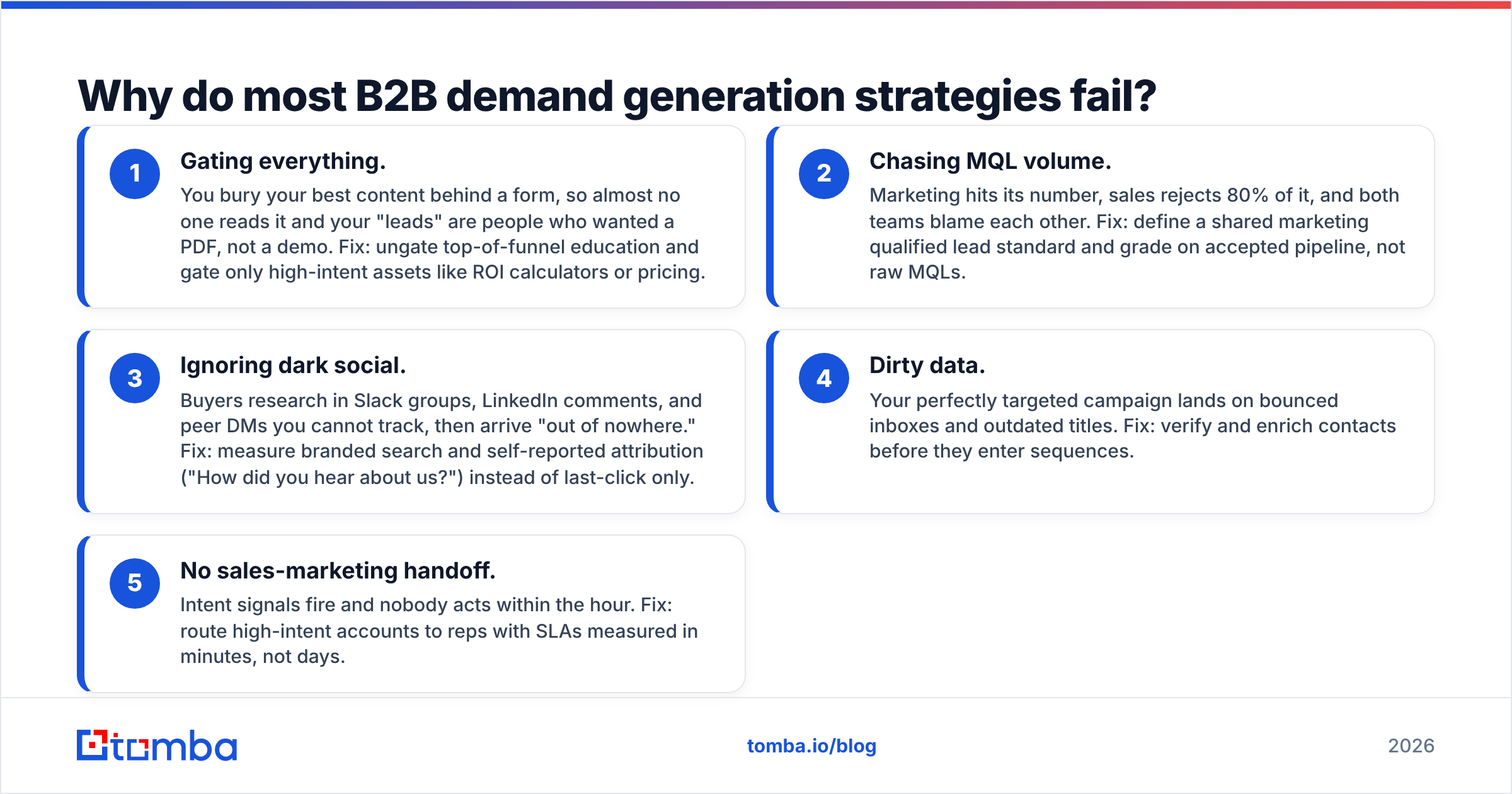
Most strategies fail because they optimize for the metric that is easiest to report, not the one tied to revenue. Here are the failure patterns I see most often, with the fix for each.
- Gating everything. You bury your best content behind a form, so almost no one reads it and your "leads" are people who wanted a PDF, not a demo. Fix: ungate top-of-funnel education and gate only high-intent assets like ROI calculators or pricing.
- Chasing MQL volume. Marketing hits its number, sales rejects 80% of it, and both teams blame each other. Fix: define a shared marketing qualified lead standard and grade on accepted pipeline, not raw MQLs.
- Ignoring dark social. Buyers research in Slack groups, LinkedIn comments, and peer DMs you cannot track, then arrive "out of nowhere." Fix: measure branded search and self-reported attribution ("How did you hear about us?") instead of last-click only.
- Dirty data. Your perfectly targeted campaign lands on bounced inboxes and outdated titles. Fix: verify and enrich contacts before they enter sequences.
- No sales-marketing handoff. Intent signals fire and nobody acts within the hour. Fix: route high-intent accounts to reps with SLAs measured in minutes, not days.
Gartner's B2B buying research is blunt about the underlying shift: buyers spend the majority of their journey doing independent research and only a sliver of it talking to any single vendor. If your strategy assumes you control the journey, it is already broken. You can read more on how the buying journey has fragmented.
What are the core components of a 2026 demand generation framework?#
A modern framework has four layers. Each one feeds the next, and each one has a metric so you know when it is broken.
- Layer 1 — Audience definition. Build a sharp ICP and total addressable list. Who exactly buys, what triggers the need, and which titles sit on the buying committee. Metric: addressable accounts matched and reachable.
- Layer 2 — Demand creation. Earn attention with content, ads, partnerships, and community that teach your market the problem and the better way. Metric: reach, engaged accounts, branded search lift.
- Layer 3 — Demand capture. Be present when intent appears — search, retargeting, comparison pages, and outbound to accounts showing signals. Metric: pipeline created and cost per opportunity.
- Layer 4 — Conversion and expansion. Convert opportunities with sales enablement, then expand and retain. Metric: win rate, ACV, net revenue retention.
The compounding effect matters. Layer 2 makes Layer 3 cheaper, because warm audiences convert at a fraction of the cost of cold ones. Skipping demand creation is why so many teams feel stuck on a treadmill of expensive paid leads that never get less expensive.
How does account data fit into the framework?#
Every layer depends on knowing who you are talking to. You cannot run account-based plays, route intent, or personalize outreach without accurate contact and company data. This is where a B2B database and reliable data enrichment stop being "ops housekeeping" and become the engine that makes the strategy executable. Enrich every account with firmographics, the right buying-committee contacts, and verified emails, and your capture layer suddenly works on the first attempt instead of the fifth.
Which demand generation channels actually work in 2026?#
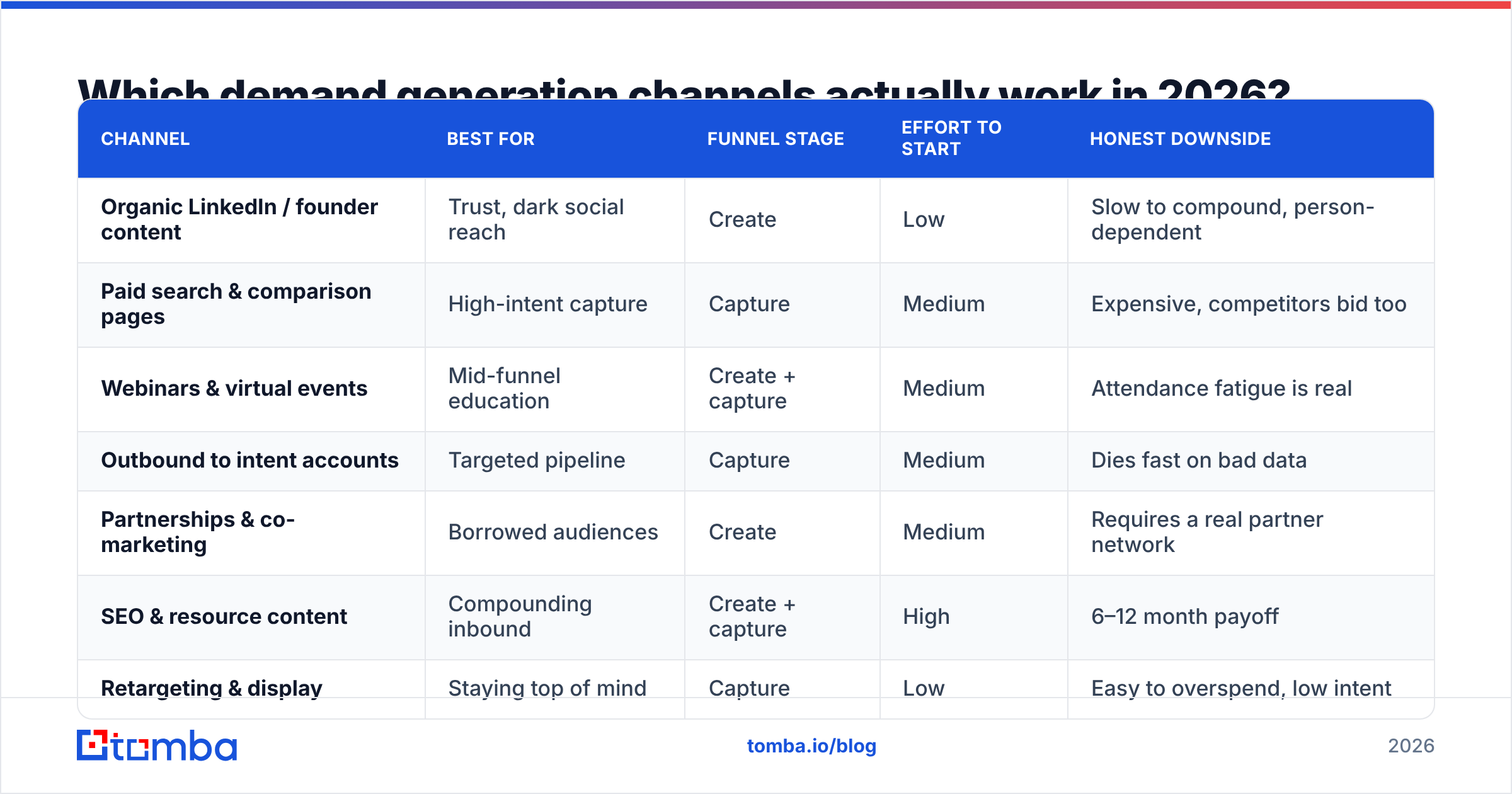
No single channel carries a strategy. The teams that win run a portfolio and measure each channel by its job, not by a blended cost-per-lead that hides the truth.
| Channel | Best for | Funnel stage | Effort to start | Honest downside |
|---|---|---|---|---|
| Organic LinkedIn / founder content | Trust, dark social reach | Create | Low | Slow to compound, person-dependent |
| Paid search & comparison pages | High-intent capture | Capture | Medium | Expensive, competitors bid too |
| Webinars & virtual events | Mid-funnel education | Create + capture | Medium | Attendance fatigue is real |
| Outbound to intent accounts | Targeted pipeline | Capture | Medium | Dies fast on bad data |
| Partnerships & co-marketing | Borrowed audiences | Create | Medium | Requires a real partner network |
| SEO & resource content | Compounding inbound | Create + capture | High | 6–12 month payoff |
| Retargeting & display | Staying top of mind | Capture | Low | Easy to overspend, low intent |
The pattern to notice: creation channels are slow but compounding; capture channels are fast but only pay off if creation has already happened. A balanced 2026 plan puts roughly 60% of effort into creation and community, and 40% into capture and conversion — then shifts toward capture only when you have a healthy warm audience to harvest.

How do you turn intent signals into pipeline?#
Turning intent into pipeline is a speed-and-accuracy problem. A signal is only worth something if you reach the right person while the intent is still warm. Here is the operational loop that works.
- Detect the signal. Website visits, content engagement, review-site activity, or third-party intent data tell you an account is in-market. Tools that handle website visitor reveal turn anonymous traffic into named accounts you can actually act on.
- Resolve the account to people. A company name is not a contact. Identify the specific buying-committee members and pull their verified work emails and roles, so you are not guessing at info@ inboxes.
- Enrich and verify. Append titles, seniority, and a deliverable email before anything enters a sequence. A bounced first touch burns the signal and your sender reputation.
- Route with an SLA. High-intent accounts go to a rep within minutes, with the signal attached so the outreach references a real trigger, not a generic pitch.
- Measure the loop, not the touch. Track signal-to-meeting rate and signal-to-pipeline, then cut the signals that never convert.
The weak link is almost always step 2 and 3. You can buy the best intent data in the market, but if you cannot resolve accounts to accurate, reachable contacts, the signal evaporates. This is the unglamorous reason a fast, accurate email finder sits at the center of so many demand gen stacks: it is the bridge between "an account is interested" and "a real person got a relevant message today."
How do you measure a B2B demand generation strategy?#
Measure pipeline and revenue, and treat everything upstream as a leading indicator — never as the goal itself. The single fastest way to lose executive trust is to celebrate MQL volume while pipeline stays flat.
Build your dashboard in three tiers:
- Leading indicators (weekly): engaged accounts, branded search volume, content consumption by target accounts, reply rates. These tell you if creation is working before revenue catches up.
- Pipeline indicators (monthly): opportunities created, pipeline value, cost per opportunity, sales acceptance rate. This is where demand becomes a business case.
- Revenue indicators (quarterly): closed-won, win rate, average deal size, payback period, and pipeline-to-spend ratio. These are the numbers that defend your budget.
Two practical rules. First, use self-reported attribution alongside your analytics; in a dark-social world, "How did you hear about us?" on the demo form often reveals truth that last-click attribution hides. Second, instrument data quality itself — bounce rate, match rate, and enrichment coverage — because a quietly degrading database will silently tank every downstream metric. If you want third-party benchmarks on tooling, vendor categories on G2 are a reasonable starting point for comparing demand gen and data platforms before you commit budget.
What does a 90-day demand generation rollout look like?#
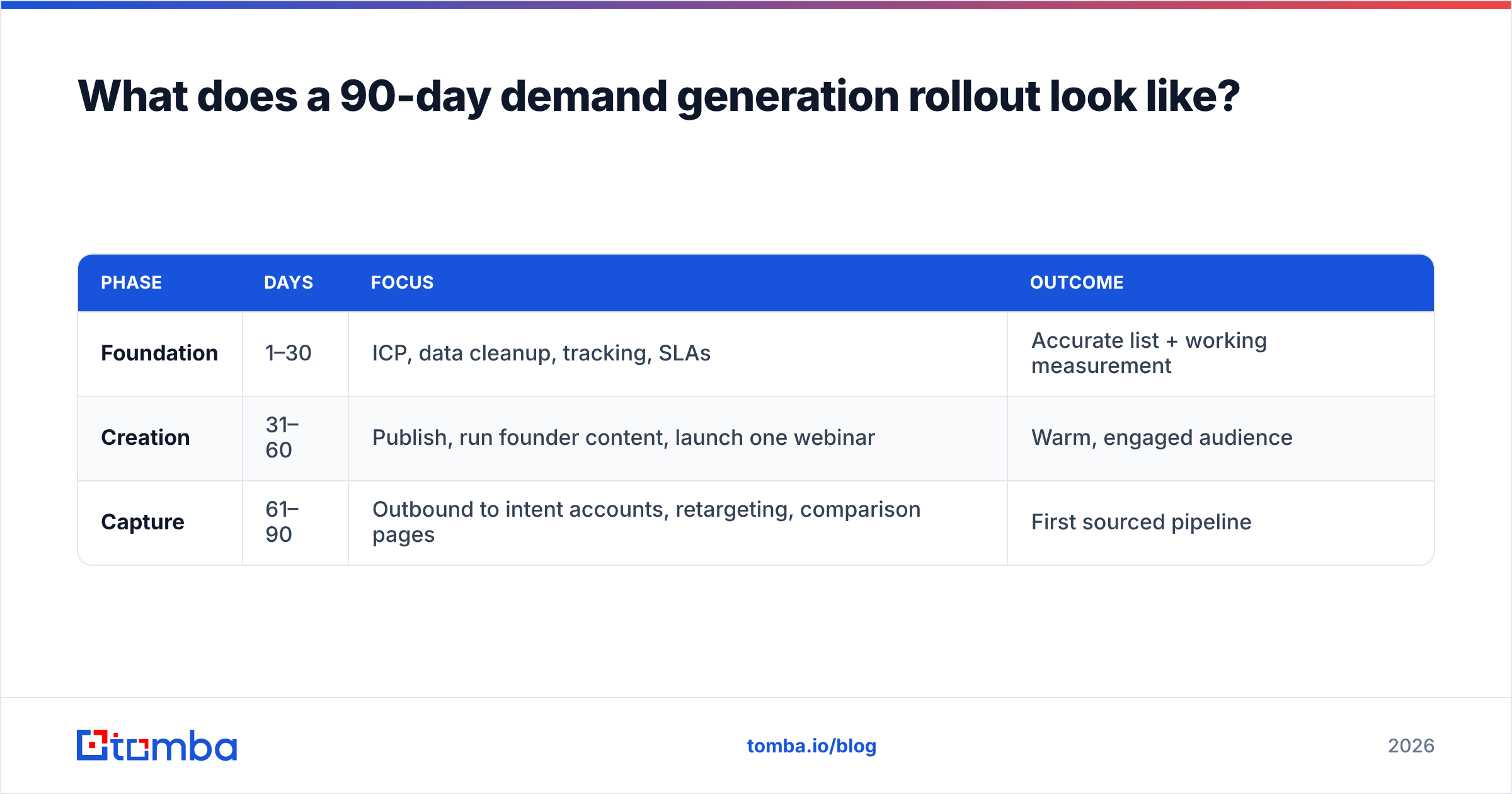
You do not need a perfect strategy to start. You need a sequenced one. Here is a realistic 90-day plan for a team standing this up properly.
| Phase | Days | Focus | Outcome |
|---|---|---|---|
| Foundation | 1–30 | ICP, data cleanup, tracking, SLAs | Accurate list + working measurement |
| Creation | 31–60 | Publish, run founder content, launch one webinar | Warm, engaged audience |
| Capture | 61–90 | Outbound to intent accounts, retargeting, comparison pages | First sourced pipeline |
In the foundation phase, resist the urge to launch campaigns. Spend it making your data trustworthy and your handoff fast, because every later phase multiplies that quality — or that mess. By day 90 you should have a repeatable loop: a creation engine producing warm accounts, a capture motion converting them, and a measurement system that tells you where to pour the next dollar. Check your Tomba plans against the contact volume your capture motion will actually need, so data cost scales with pipeline instead of surprising you mid-quarter.
Frequently asked questions#
Is demand generation just content marketing? No. Content is one tool inside demand creation. Demand generation also includes paid media, community, partnerships, intent-based outbound, and the conversion machinery that turns interest into revenue.
How long until a demand generation strategy pays off? Capture tactics can produce pipeline in weeks; creation tactics compound over 6–12 months. Healthy strategies run both so you get near-term wins while the compounding engine builds.
Do I need intent data to start? No. Start with your own first-party signals — website visits, content engagement, and email replies — then layer third-party intent once the basics are instrumented and acted on quickly.
What kills demand gen ROI fastest? Dirty data. Great targeting and creative are wasted on bounced emails and wrong titles, so verification and enrichment are the highest-leverage fixes most teams ignore.
Where should you start this week?#
Start with the layer that silently breaks everything else: your data. Before you spend another dollar on ads or content, make sure the accounts and contacts you are targeting are real, current, and reachable. A demand generation strategy is only as strong as the buyer it can actually deliver a message to.
Tomba Email Finder is built for exactly this job — turning the accounts your demand engine surfaces into verified, reachable buying-committee contacts, by domain, name, or company. Pair it with verification and enrichment, plug it into your capture motion, and the rest of the framework finally has solid ground to stand on. Start free with 25 searches, then scale on the Starter plan at $49/mo when your pipeline asks for more.
// get started
Find, verify and enrich your first contacts today
Start on the free plan with 25 searches a month, then scale when your team is ready.
Free plan · No credit card required · GDPR & CCPA
// about the author