B2B Demand Generation Tactics That Actually Work in 2026
Lead-gen forms and rented lists are dying. Here are the B2B demand generation tactics that fill pipeline in 2026 — with a tactic-by-tactic comparison and real benchmarks.
TL;DR
- Demand generation creates and captures buyer interest across the full funnel — it is not just "more MQLs." The teams winning in 2026 separate demand creation (awareness, education) from demand capture (forms, search, retargeting).
- The highest-ROI tactics today are dark-social content, customer-led webinars, intent-data targeting, and clean first-party contact data — not gated PDFs.
- Rented lists and spray-and-pray email blasts are actively hurting deliverability and CAC. Accurate, verified contact data is the cheapest lever you have.
- Use the comparison table below to prioritize where your next dollar goes by cost, speed-to-pipeline, and effort.
- Pair your demand-gen motion with a reliable data layer (find, verify, enrich) so sales acts on real contacts, not bounces.
Demand generation in B2B has quietly changed shape. The old motion — gate a whitepaper, capture an email, route it to an SDR, and call it a "lead" — now produces inflated MQL counts and almost no revenue. Buyers research in places you cannot track, talk to peers in private communities, and arrive at your site already 70% through their decision. This guide breaks down the b2b demand generation tactics that map to how people actually buy in 2026, and how to sequence them without lighting your budget on fire.
What is B2B demand generation, really?#
Demand generation is the discipline of creating awareness and intent for your product among the right accounts, then capturing that intent when buyers are ready to act. The key distinction most teams miss: it has two halves.
- Demand creation — educating a market that does not yet know it has a problem. Podcasts, LinkedIn content, communities, original research, and webinars live here. It is measured in reach, branded search lift, and direct traffic, not form fills.
- Demand capture — converting people who are already looking. Paid search, review sites, retargeting, and high-intent landing pages live here. It is measured in pipeline and CAC.
- The data layer — the unglamorous connective tissue. You cannot route, score, or personalize what you cannot identify. This is where a clean B2B database and data enrichment quietly decide whether the first two halves work.
Lead generation is a subset of capture — it is the form-fill moment. Demand generation is the whole system that makes the form fill happen and makes it worth something. According to Gartner, B2B buyers spend only about 17% of their journey meeting with potential suppliers, which means most of your influence happens before anyone raises a hand.

Why are old demand-gen tactics failing in 2026?#
Three forces broke the 2015 playbook.
Attribution went dark. Buyers consume content on LinkedIn, Slack communities, YouTube, and podcasts where last-touch attribution sees nothing. If you only fund what your dashboard can attribute, you defund the channels that actually create demand. This is the "dark social" problem, and it punishes teams that demand a tracked form behind every asset.
Gating kills reach. A gated report seen by 200 people who tolerate a form loses to an ungated version seen by 20,000. The pipeline impact of the second almost always wins, even though the first looks better in a lead-count column.
Data decayed faster than ever. B2B contact data degrades roughly 2–3% per month as people change jobs. Rented lists and stale CRM records mean bounces, spam complaints, and wrecked sender reputation. You can run the smartest campaign in the world into a list of dead inboxes and see nothing.
The fix is not "work harder on MQLs." It is to rebalance toward creation, ungate generously, and treat contact accuracy as a first-class metric.
Which B2B demand generation tactics work best?#
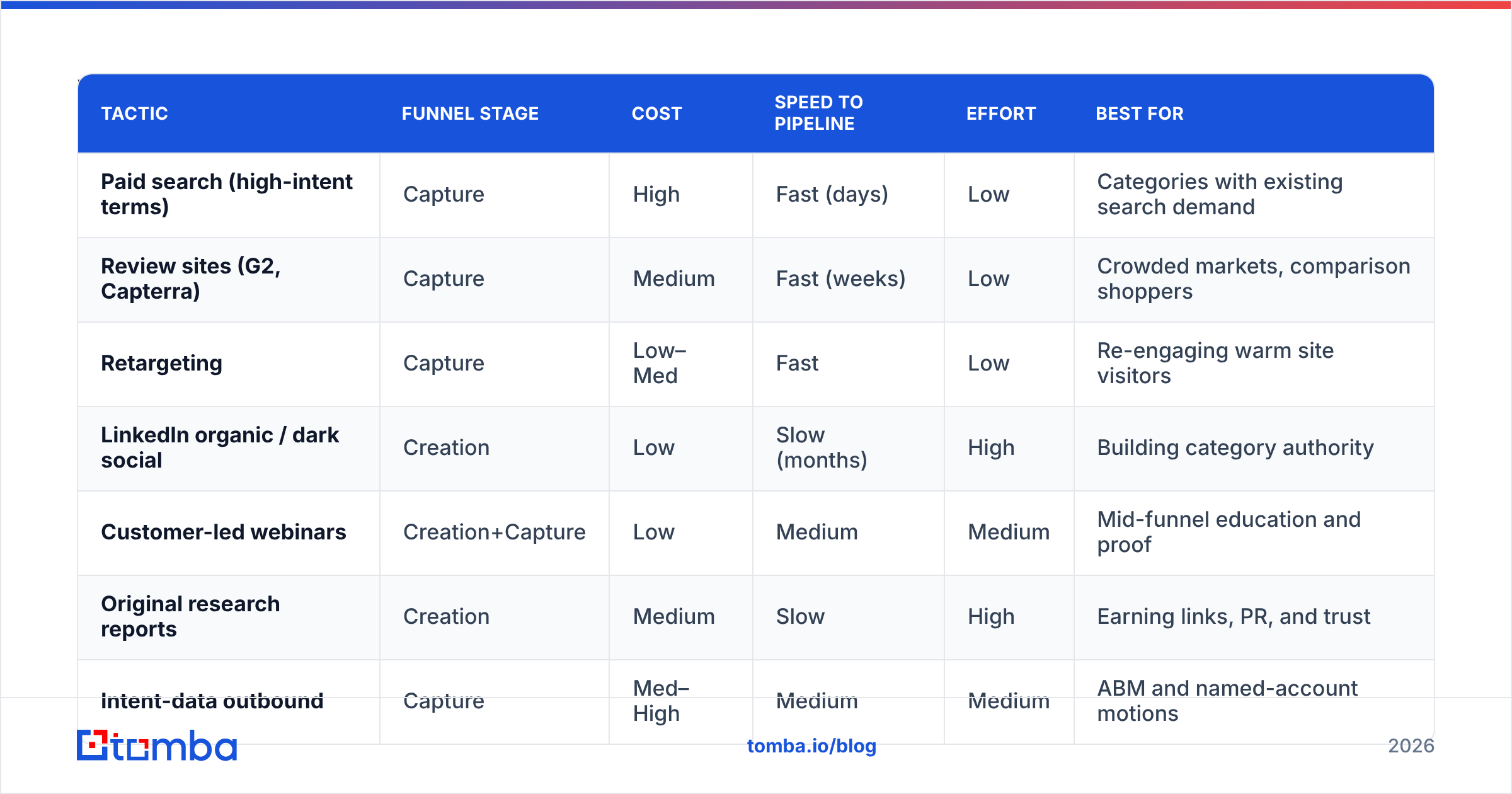
Here is the honest, prioritized comparison. "Speed to pipeline" is how fast you typically see sourced opportunities; "effort" accounts for production and skill required.
| Tactic | Funnel stage | Cost | Speed to pipeline | Effort | Best for |
|---|---|---|---|---|---|
| Paid search (high-intent terms) | Capture | High | Fast (days) | Low | Categories with existing search demand |
| Review sites (G2, Capterra) | Capture | Medium | Fast (weeks) | Low | Crowded markets, comparison shoppers |
| Retargeting | Capture | Low–Med | Fast | Low | Re-engaging warm site visitors |
| LinkedIn organic / dark social | Creation | Low | Slow (months) | High | Building category authority |
| Customer-led webinars | Creation+Capture | Low | Medium | Medium | Mid-funnel education and proof |
| Original research reports | Creation | Medium | Slow | High | Earning links, PR, and trust |
| Intent-data outbound | Capture | Med–High | Medium | Medium | ABM and named-account motions |
| Verified contact data + enrichment | Enabler | Low | Compounding | Low | Making every other tactic convert |
Notice the bottom row. Contact data is not a channel, but it multiplies every channel above it. A retargeting audience built from enriched first-party data converts better; an intent-driven outbound play dies on bad emails.
A practical sequencing for limited budgets#
- Capture what already exists first. Turn on paid search for your top three high-intent terms and claim your G2 and Capterra profiles. This produces pipeline in weeks and funds the slower plays.
- Fix the data layer. Before scaling outbound, verify and enrich your existing list. Garbage in equals wasted spend everywhere downstream.
- Build one creation engine. Pick a single channel — usually a founder or subject-matter expert on LinkedIn, or a recurring webinar — and commit for two quarters. Do not spread thin across six channels.
- Layer intent data onto named accounts. Once capture and data are solid, use intent signals to prioritize outbound to accounts showing research behavior.
- Ungate your best asset. Measure the branded-search and direct-traffic lift, not the form count.
How does intent data fit into demand generation?#
Intent data tells you which accounts are researching your category right now, so you spend creation and capture effort where it has the highest odds of converting. There are two flavors:
- First-party intent — behavior on your own properties (pricing-page visits, repeated docs views, demo-page bounces). This is the most reliable signal you own. Identifying anonymous visitors and matching them to companies turns this from a vanity metric into an action list. Tools that handle website visitor reveal close that gap.
- Third-party intent — research activity across publisher networks (e.g., a target account reading three competitor comparison articles this week). Useful for prioritization, noisier than first-party.
The mistake teams make is buying expensive third-party intent before they have wired up free first-party signals. Start with the behavior on your own site, enrich those companies into named contacts, and route them to sales while the interest is hot.

What content actually creates demand?#
Content that creates demand teaches buyers something they can use whether or not they buy from you. It is generous, specific, and tied to the problems your product solves — not a thinly veiled brochure.
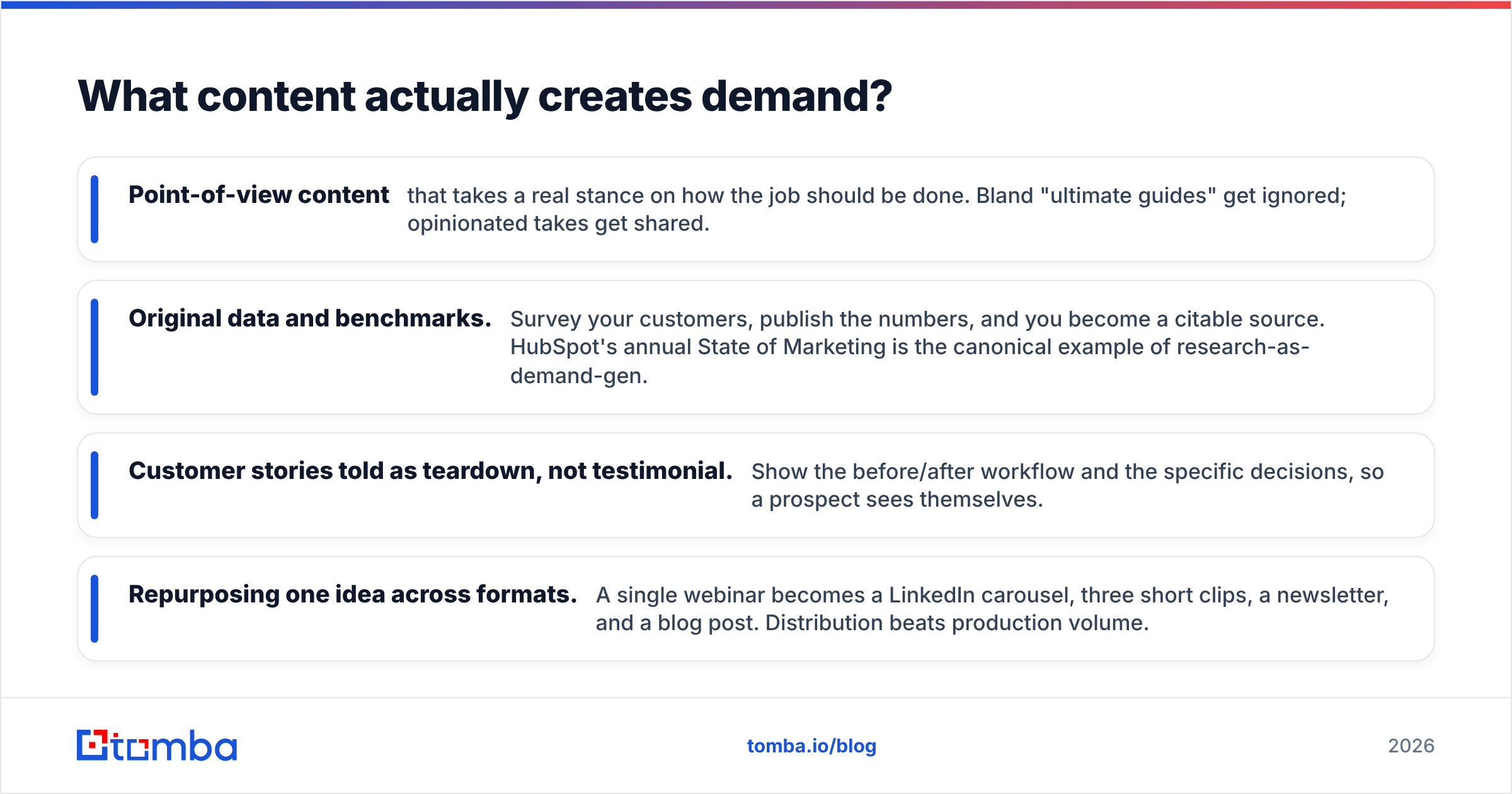
The formats that consistently work in B2B:
- Point-of-view content that takes a real stance on how the job should be done. Bland "ultimate guides" get ignored; opinionated takes get shared.
- Original data and benchmarks. Survey your customers, publish the numbers, and you become a citable source. HubSpot's annual State of Marketing is the canonical example of research-as-demand-gen.
- Customer stories told as teardown, not testimonial. Show the before/after workflow and the specific decisions, so a prospect sees themselves.
- Repurposing one idea across formats. A single webinar becomes a LinkedIn carousel, three short clips, a newsletter, and a blog post. Distribution beats production volume.
Whatever you publish, make sure the call-to-action is the next logical step for the reader, not "book a demo" stapled to every page. Mid-funnel content earns the right to a soft offer — a tool, a template, a teardown — that still leaves you with a contact you can nurture.
How do you measure demand generation without misleading yourself?#
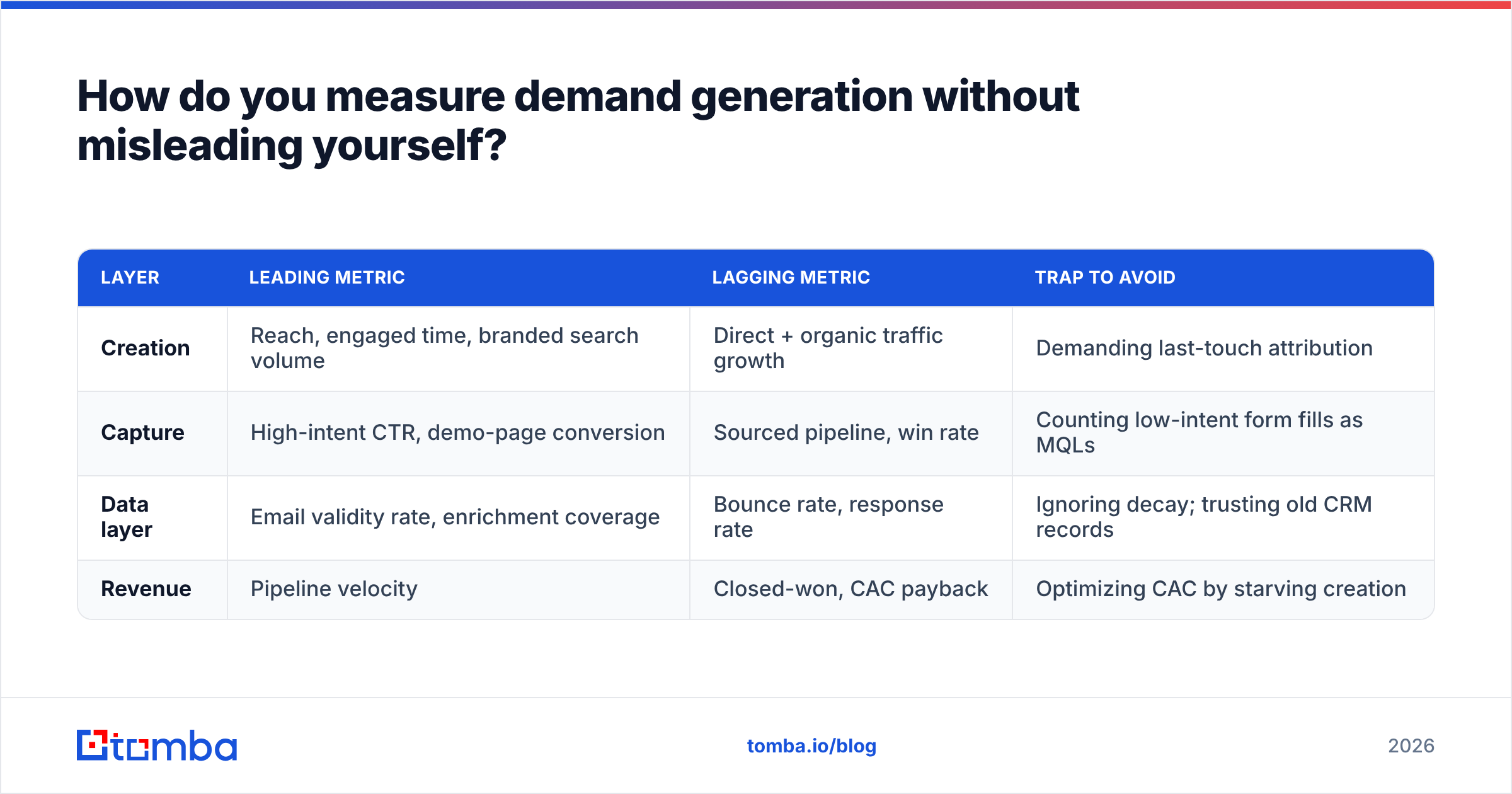
Measure the system, not the form. A useful scorecard separates the two halves and tracks the connective metrics between them.
| Layer | Leading metric | Lagging metric | Trap to avoid |
|---|---|---|---|
| Creation | Reach, engaged time, branded search volume | Direct + organic traffic growth | Demanding last-touch attribution |
| Capture | High-intent CTR, demo-page conversion | Sourced pipeline, win rate | Counting low-intent form fills as MQLs |
| Data layer | Email validity rate, enrichment coverage | Bounce rate, response rate | Ignoring decay; trusting old CRM records |
| Revenue | Pipeline velocity | Closed-won, CAC payback | Optimizing CAC by starving creation |
Two practical rules. First, treat branded search volume and direct traffic as your demand-creation barometer — when creation works, more people search for you by name. Second, audit data quality monthly; a win rate problem is sometimes just a contactability problem in disguise.
How does accurate contact data change the math?#
It changes everything downstream because every demand-gen tactic eventually resolves to "reach a specific person." When that person's email bounces or their data is wrong, you pay twice: once for the wasted touch and again in deliverability damage that suppresses your next campaign.
Concretely, accurate data improves three things at once:
- Deliverability and reputation. Verifying before you send keeps bounce rates low and protects your domain. Pair an email verifier with your sending workflow so you never mail a dead address.
- Routing and personalization. Enriched records — title, company size, tech stack — let you segment and personalize at scale instead of sending one generic blast.
- Speed. When an anonymous account shows intent, you can find the right contact in seconds with a domain search instead of guessing at a generic info@ inbox.
This is the part of demand generation no one puts on a conference slide, and it is also where most pipeline quietly leaks. A clean find-verify-enrich loop is the cheapest performance gain available to most teams.
What should a 90-day demand-gen plan look like?#
A focused first quarter beats an ambitious one. Here is a realistic starting sequence built from the tactics above:
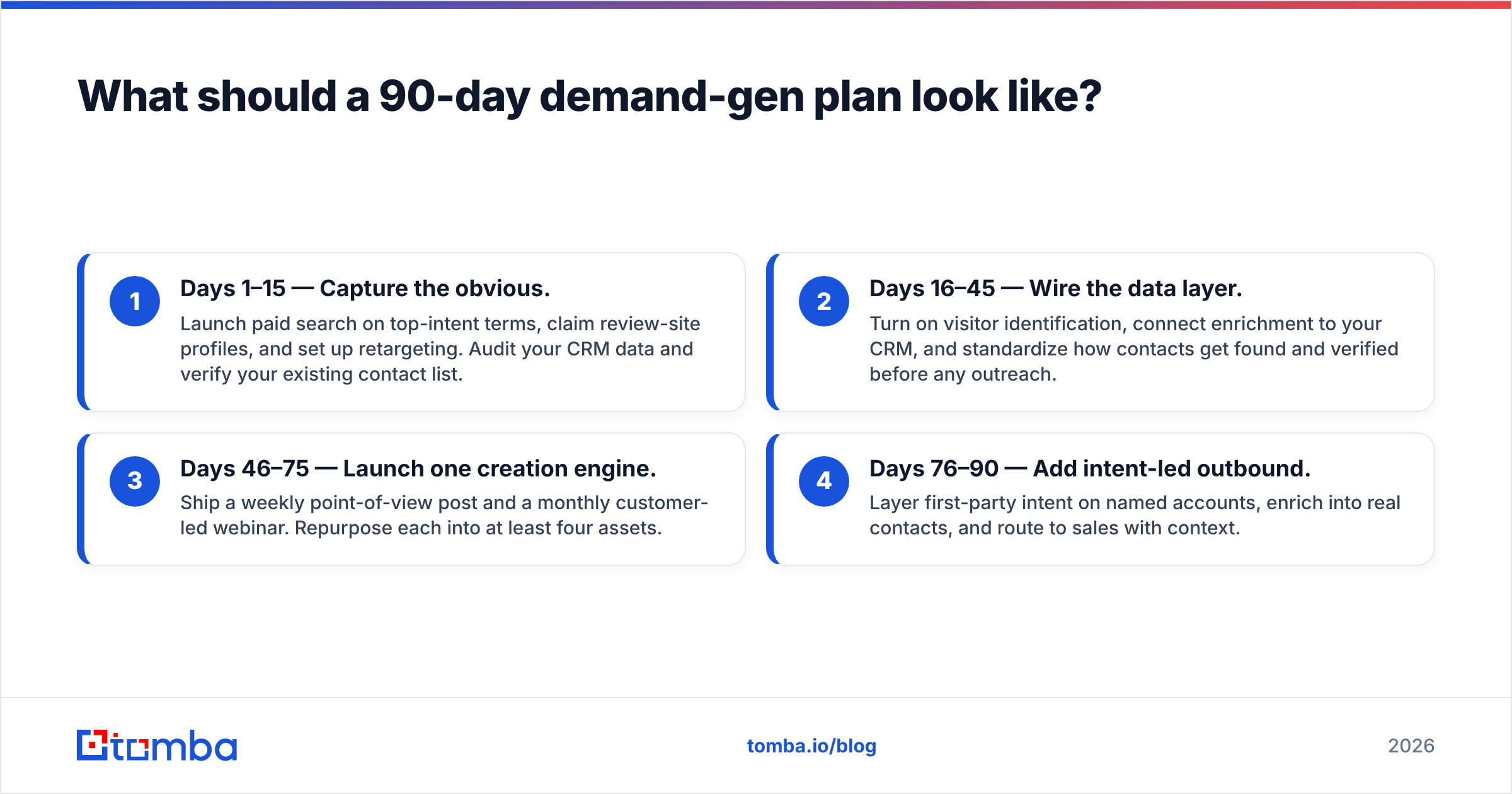
- Days 1–15 — Capture the obvious. Launch paid search on top-intent terms, claim review-site profiles, and set up retargeting. Audit your CRM data and verify your existing contact list.
- Days 16–45 — Wire the data layer. Turn on visitor identification, connect enrichment to your CRM, and standardize how contacts get found and verified before any outreach.
- Days 46–75 — Launch one creation engine. Ship a weekly point-of-view post and a monthly customer-led webinar. Repurpose each into at least four assets.
- Days 76–90 — Add intent-led outbound. Layer first-party intent on named accounts, enrich into real contacts, and route to sales with context.
Resist the urge to run all of this at once. Demand creation compounds slowly and capture pays fast — funding the second lets you afford the first.
Closing: build demand-gen on data you can trust#
The tactics that win in 2026 are not exotic. They are generous content, intent-aware capture, and disciplined sequencing — all sitting on top of contact data that is actually correct. Get the data layer right and every other tactic on this page converts better.
If you are scaling outbound, ABM, or retargeting and want to stop wasting touches on dead inboxes, start with the Tomba Email Finder. Find verified professional emails by name, company, or domain, enrich them into routable records, and feed your demand-gen engine contacts that actually respond. Check the Tomba pricing — there is a free tier (25 searches/mo) to test it against your current list before you commit a dollar.
// get started
Find, verify and enrich your first contacts today
Start on the free plan with 25 searches a month, then scale when your team is ready.
Free plan · No credit card required · GDPR & CCPA
// about the author