The B2B Discovery Call: A 2026 Framework That Wins Deals
A practical 2026 playbook for running a B2B discovery call that qualifies fast, builds trust, and books the next step — with questions, a scorecard, and a prep checklist.
TL;DR
- A B2B discovery call is the first real working conversation with a prospect — its job is to diagnose the problem, qualify fit, and earn the next step, not to pitch your product.
- The best reps talk less than 45% of the call, ask layered questions, and quantify the cost of the prospect's current problem.
- Use a repeatable framework (open → diagnose → quantify → qualify → next step) and score every call against the same rubric so coaching is objective.
- Bad data sabotages discovery before you dial. Verified contacts and enriched context let you skip the small talk and go straight to value.
- Track talk ratio, next-step conversion, and qualification accuracy — not just "calls booked."
What is a B2B discovery call?#
A B2B discovery call is the first structured conversation where you figure out whether a prospect's problem, budget, timeline, and decision process actually match what you sell. Think of it like a doctor's intake appointment: a good doctor never prescribes before asking where it hurts, how long it's been hurting, and what you've already tried. A rep who pitches before diagnosing is guessing — and prospects can smell the guess.
The discovery call sits early in the sales process and pipeline, usually right after a qualified inbound request or a successful cold outreach touch. Its output is binary in spirit: either you both agree there's a problem worth solving together (advance), or you don't (disqualify cleanly and free up the calendar).
What it is not:
- A demo. Demos show features. Discovery uncovers whether features matter.
- A pitch. If you're talking more than half the time, you've turned discovery into a monologue.
- A box-ticking interrogation. Firing 20 BANT questions in a row feels like a deposition, not a conversation.
Why do most discovery calls fail?#
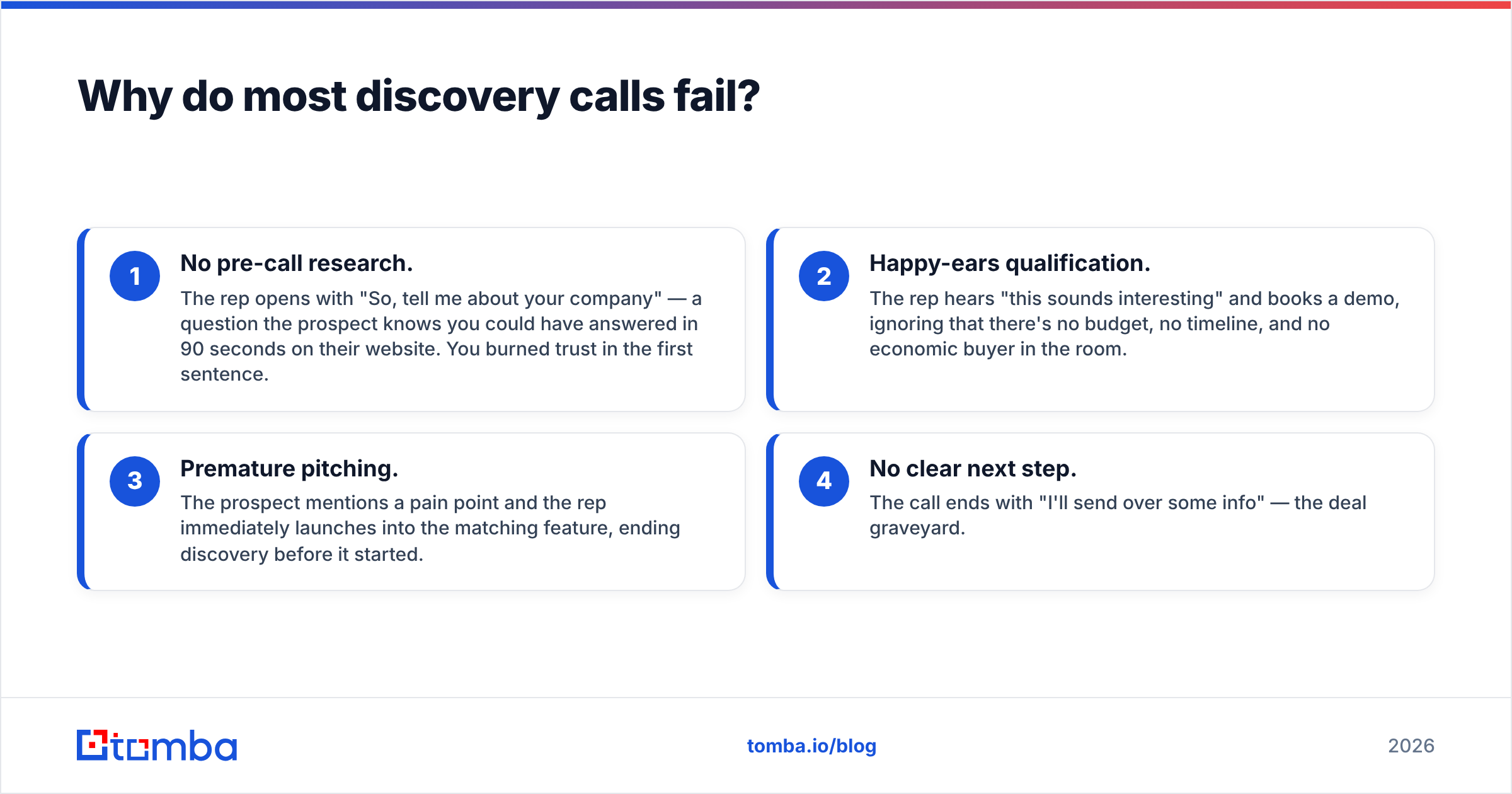
Most discovery calls fail for one of four reasons, and all of them are fixable.
- No pre-call research. The rep opens with "So, tell me about your company" — a question the prospect knows you could have answered in 90 seconds on their website. You burned trust in the first sentence.
- Happy-ears qualification. The rep hears "this sounds interesting" and books a demo, ignoring that there's no budget, no timeline, and no economic buyer in the room.
- Premature pitching. The prospect mentions a pain point and the rep immediately launches into the matching feature, ending discovery before it started.
- No clear next step. The call ends with "I'll send over some info" — the deal graveyard.
The common thread is preparation and discipline. According to Gong's conversation research, top performers keep their talk-to-listen ratio close to 43:57 and ask noticeably more high-quality questions than average reps. You can't listen 57% of the time if you walked in without a plan for what to listen for.
What should you do before the call?#
The call is won or lost before you dial. Spend 10–15 minutes building a pre-call brief so you can open with relevance instead of filler.
Your pre-call checklist:
- Confirm the contact and role. Make sure you're talking to someone who actually owns or influences the problem. A verified, correctly-titled contact beats a generic info@ inbox every time — this is where a reliable email finder and contact enrichment earn their keep.
- Map the account. Company size, recent funding, tech stack, and a likely org chart. Tools like data enrichment append firmographics so you're not flying blind.
- Form a hypothesis. Based on their industry and role, what problem do you expect they have? You'll test it, not assume it.
- Write 3 anchor questions. Not a script — three open questions you must get answered to qualify.
- Define your ideal next step. Demo? Technical scoping call? Multi-threaded intro to the buyer? Know your ask before you pick up.
When your CRM is fed clean, verified data, the brief takes minutes instead of an afternoon. That's the quiet advantage of treating your B2B database as infrastructure rather than an afterthought.
What does a great B2B discovery call framework look like?#
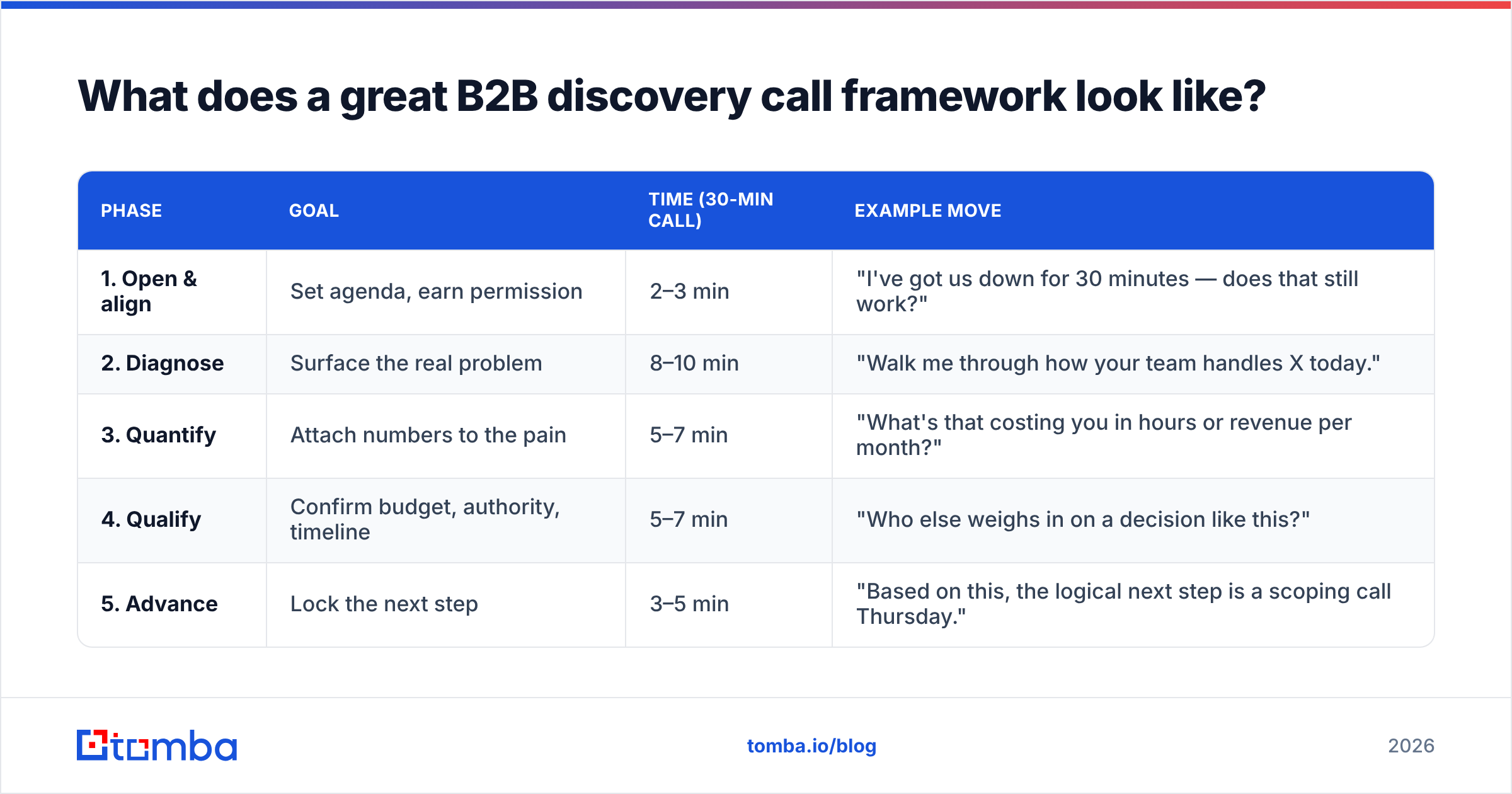
Use a five-phase arc. It's flexible enough to feel conversational and rigid enough to coach against.
| Phase | Goal | Time (30-min call) | Example move |
|---|---|---|---|
| 1. Open & align | Set agenda, earn permission | 2–3 min | "I've got us down for 30 minutes — does that still work?" |
| 2. Diagnose | Surface the real problem | 8–10 min | "Walk me through how your team handles X today." |
| 3. Quantify | Attach numbers to the pain | 5–7 min | "What's that costing you in hours or revenue per month?" |
| 4. Qualify | Confirm budget, authority, timeline | 5–7 min | "Who else weighs in on a decision like this?" |
| 5. Advance | Lock the next step | 3–5 min | "Based on this, the logical next step is a scoping call Thursday." |
The magic is in the order. You don't talk money (phase 3) or process (phase 4) until you've genuinely understood the problem (phase 2). Skipping straight to qualification is what makes BANT feel robotic. Earn the right to ask the hard questions by showing you understand the pain first.
What questions should you ask on a discovery call?#
Great questions are layered: a surface question, then a follow-up that goes one level deeper. Single-layer questions get you brochure answers. Here's a working set organized by phase.
Diagnose the current state
- "How does your team handle [process] today?"
- "What made you take this call now, specifically?" (uncovers the trigger event)
- "Where does that process break down most often?"
Quantify the impact
- "Roughly how many hours a week does that eat up?"
- "If this stayed exactly as-is for another year, what happens?"
- "How are you measuring success for the person who owns this?"
Qualify the deal
- "Besides you, who'd need to be comfortable before moving forward?"
- "Have you set aside budget for solving this, or are we still building the case?"
- "What's driving the timeline — is there a date this needs to be live?"
Test for real intent
- "What have you already tried, and why didn't it stick?"
- "On a scale of 'nice to have' to 'must fix this quarter,' where does this land?"
Notice none of these can be answered with a single word. The follow-up — "Tell me more about that" or "What do you mean by 'too slow'?" — is where the gold is. Silence is your friend here; let the prospect fill it.
How do you qualify without sounding like an interrogation?#
Weave qualification into the diagnosis instead of stacking it at the end. The difference between a great rep and an average one is placement, not content.
A clumsy rep asks: "What's your budget? Who's the decision maker? What's your timeline?" — three closed questions in a row that put the prospect on the defensive.
A skilled rep gets the same answers conversationally: "When teams solve this, they usually loop in finance and ops — is that true for you?" gets you authority and process. "Most folks I talk to are either funding this from an existing budget line or building a business case — which camp are you in?" gets you budget without the awkward direct ask.
Modern qualification frameworks — MEDDICC, GAP selling, the classic BANT — are all just checklists for the same underlying truth: is there a real, costly problem, owned by someone with the power and money to fix it, on a timeline that matters? Pick a framework your team can run consistently. Consistency beats sophistication; a well-run BANT outperforms a sloppy MEDDICC every time. For a deeper dive on scoring fit, see how teams define a marketing qualified lead before it ever reaches a rep.
How should you score and coach discovery calls?#
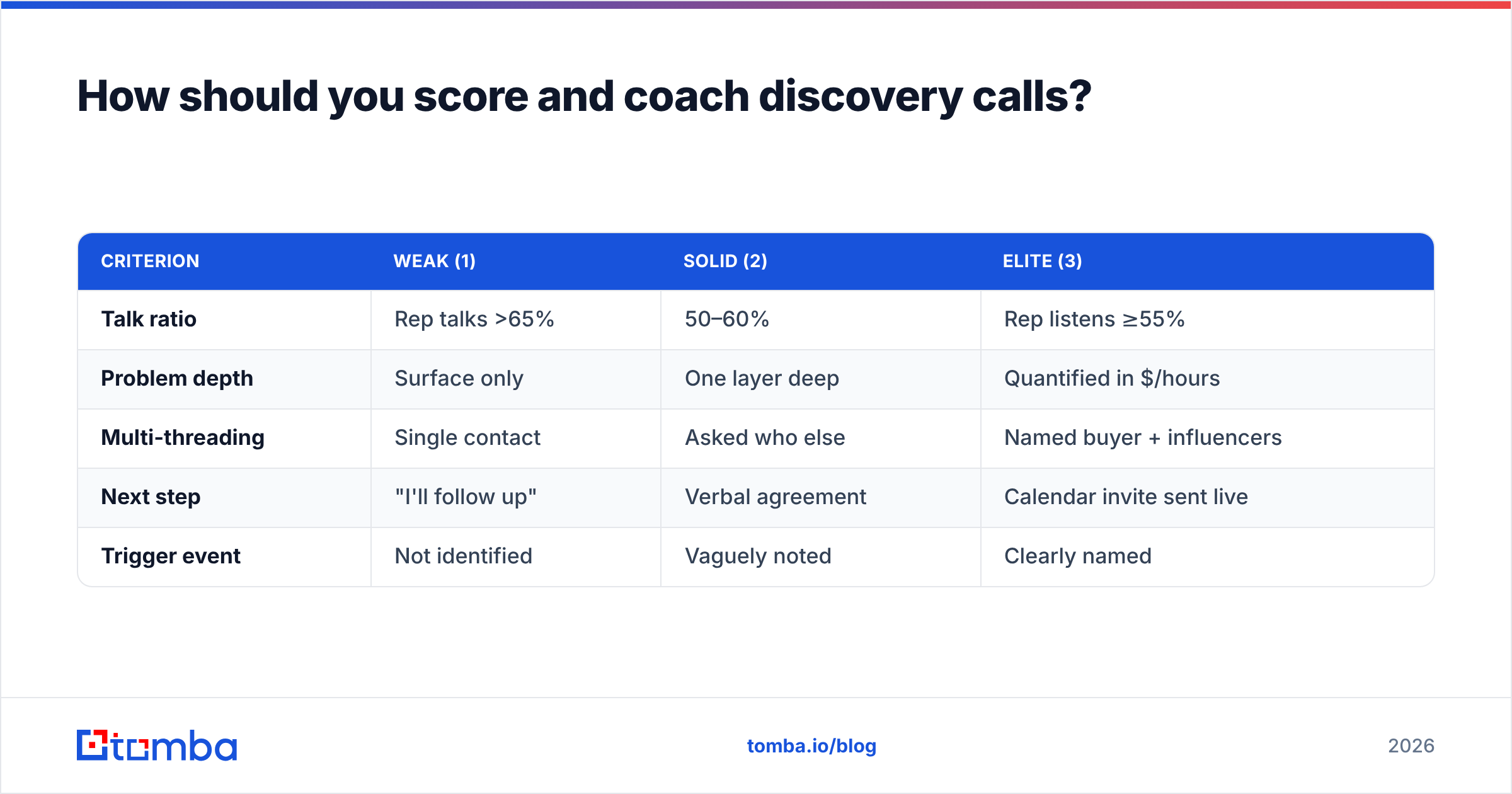
If you can't score it, you can't coach it. Build a simple scorecard and rate every recorded call the same way. Here's a starter rubric.
| Criterion | Weak (1) | Solid (2) | Elite (3) |
|---|---|---|---|
| Talk ratio | Rep talks >65% | 50–60% | Rep listens ≥55% |
| Problem depth | Surface only | One layer deep | Quantified in $/hours |
| Multi-threading | Single contact | Asked who else | Named buyer + influencers |
| Next step | "I'll follow up" | Verbal agreement | Calendar invite sent live |
| Trigger event | Not identified | Vaguely noted | Clearly named |
Average the scores and you get an objective number to coach against — far better than a manager's gut feel. Pair the scorecard with call recordings so reps can hear their own talk ratio. Most are shocked at how much they talk. Tie improvements back to pipeline metrics like win rate and response rate so the coaching connects to revenue, not just vibes.
What metrics prove your discovery calls are working?#
Vanity metrics like "calls booked" tell you nothing about quality. Track the metrics that predict revenue:
- Discovery-to-next-step conversion — what percent of discovery calls advance to a real next step? Below 50% usually means weak qualification or weak closes.
- Talk-to-listen ratio — aim for the rep listening 55–60% of the time.
- Qualification accuracy — of deals you qualified IN, how many actually progressed? Of those you qualified OUT, were any later won by a competitor (a sign you're disqualifying too aggressively)?
- Time-to-next-step — how fast does the follow-up get scheduled? Same-call calendar invites correlate strongly with closed deals.
- No-show rate on the next meeting — a high rate signals a weak next-step commitment, not a calendar problem.
Compare your numbers against industry benchmarks from sources like HubSpot's sales research and adjust quarterly. The goal isn't a perfect number; it's a trend line moving the right direction.
Discovery call vs. demo vs. qualification call: what's the difference?#
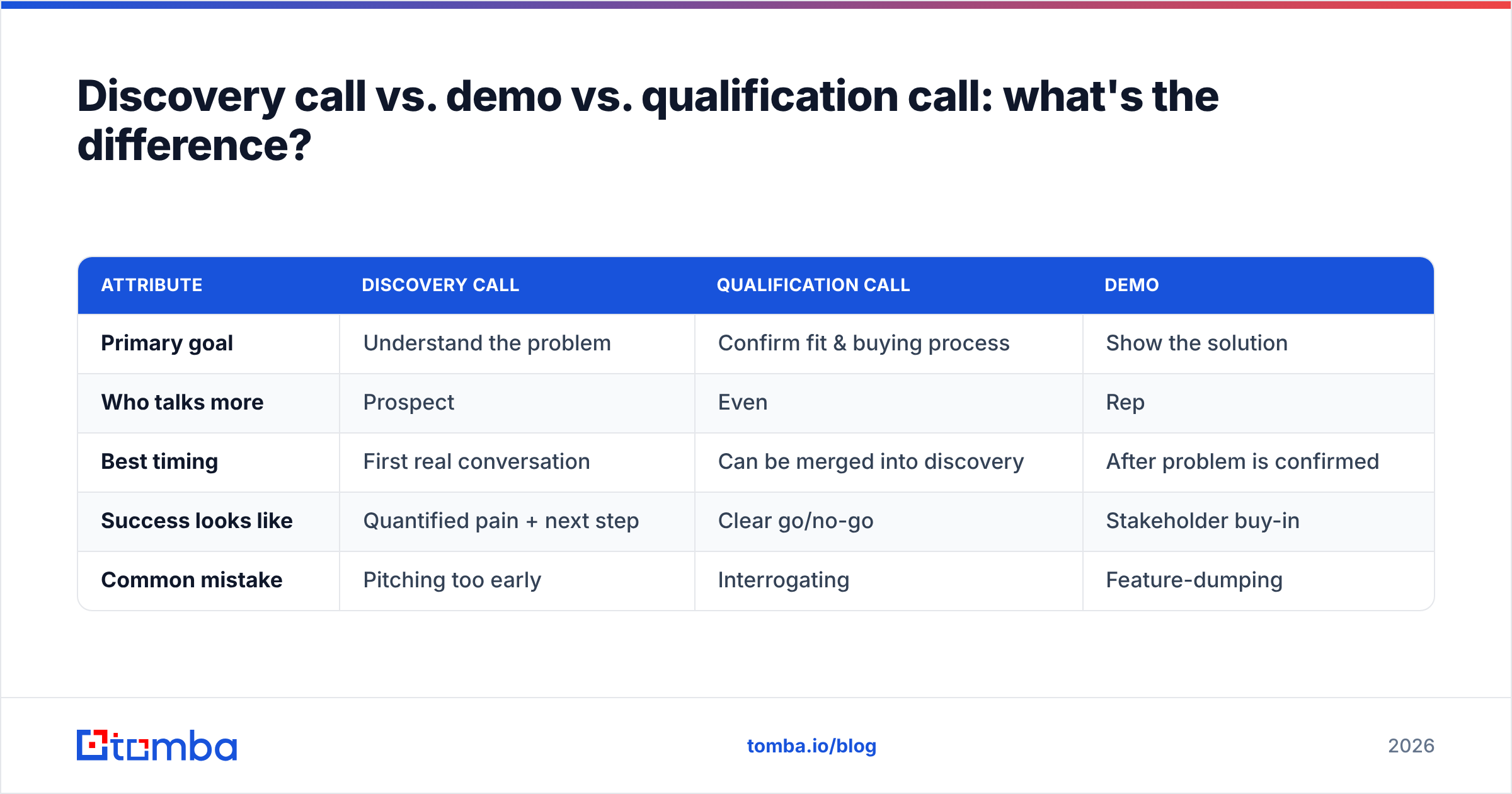
These three get conflated constantly, which leads to calls that try to do everything and accomplish nothing.
| Attribute | Discovery call | Qualification call | Demo |
|---|---|---|---|
| Primary goal | Understand the problem | Confirm fit & buying process | Show the solution |
| Who talks more | Prospect | Even | Rep |
| Best timing | First real conversation | Can be merged into discovery | After problem is confirmed |
| Success looks like | Quantified pain + next step | Clear go/no-go | Stakeholder buy-in |
| Common mistake | Pitching too early | Interrogating | Feature-dumping |
For most B2B deals under a certain complexity, discovery and qualification merge into one 30-minute call — which is exactly the framework above. Reserve the standalone demo for after you've earned it. Showing product before you understand the problem is like a tailor cutting fabric before taking measurements.
How does clean data make discovery calls better?#
Everything in discovery compounds from the quality of who you're talking to and what you already know about them. Reach the wrong contact and the best framework in the world is wasted. Reach a verified decision-influencer with enriched context, and you open with relevance instead of "So, what does your company do?"
That's why the highest-performing teams treat contact data as a first-class part of their discovery motion:
- Right person: a verified email and correct title means you're not re-routing mid-call.
- Right context: firmographic and tech-stack enrichment lets you form a sharper hypothesis before you dial.
- Right volume: bulk lead generation keeps the funnel full so you can afford to disqualify hard on the call.
Discovery is a skill. But like any skill, it performs better with the right inputs — and the input that matters most is who you're talking to.
Run better discovery calls, starting with better data#
The best framework in the world can't fix a call with the wrong person. Before you refine your questions, fix your inputs: make sure every discovery call is booked with a verified, correctly-titled, enriched contact. The Tomba Email Finder helps you find and confirm professional email addresses by domain, name, or company — so your reps spend their prep time building a sharp hypothesis instead of chasing down who to even call. Start on the free tier (25 searches/month) and scale up as your pipeline grows; see full Tomba pricing when you're ready. Better discovery starts before the phone rings.
// get started
Find, verify and enrich your first contacts today
Start on the free plan with 25 searches a month, then scale when your team is ready.
Free plan · No credit card required · GDPR & CCPA
// about the author