B2B Email in 2026: The Complete Outreach and Marketing Guide
A practical 2026 playbook for B2B email that actually lands: list building, deliverability, copy, and the metrics that prove it works.
B2B email is still the highest-ROI channel in outbound sales — but only when the fundamentals are right. Most teams blame their copy when the real problem is a dirty list, a cold domain, or a message that reads like it was blasted to 10,000 strangers. This guide fixes all three.
TL;DR#
- B2B email is direct, permission-aware outreach to business contacts — distinct from B2C blasts in intent, volume, and compliance.
- Deliverability beats cleverness: a verified list and a warmed domain matter more than your subject line.
- Personalization at the segment level (role, trigger, pain) outperforms generic mail-merge tokens.
- Track reply rate and meetings booked, not opens — Apple Mail Privacy Protection made open rates noise.
- The cheapest mistake to avoid is emailing addresses you never verified; bounce rates above 3% tank your sender reputation.
What is B2B email?#
B2B email is any email you send to another business's employees to start or advance a commercial relationship — prospecting, nurturing, onboarding, or upselling. Think of it like knocking on the right office door instead of papering an entire neighborhood with flyers. The audience is smaller, the buying cycle is longer, and the decision usually involves several people, so each message has to earn its place in a busy inbox.
The contrast with B2C email is sharp. A consumer newsletter optimizes for volume and impulse; a B2B sequence optimizes for relevance and timing. You are not trying to convert on the first touch — you are trying to be the obvious choice when the prospect's pain becomes urgent.
Here is how the two models actually differ in practice:
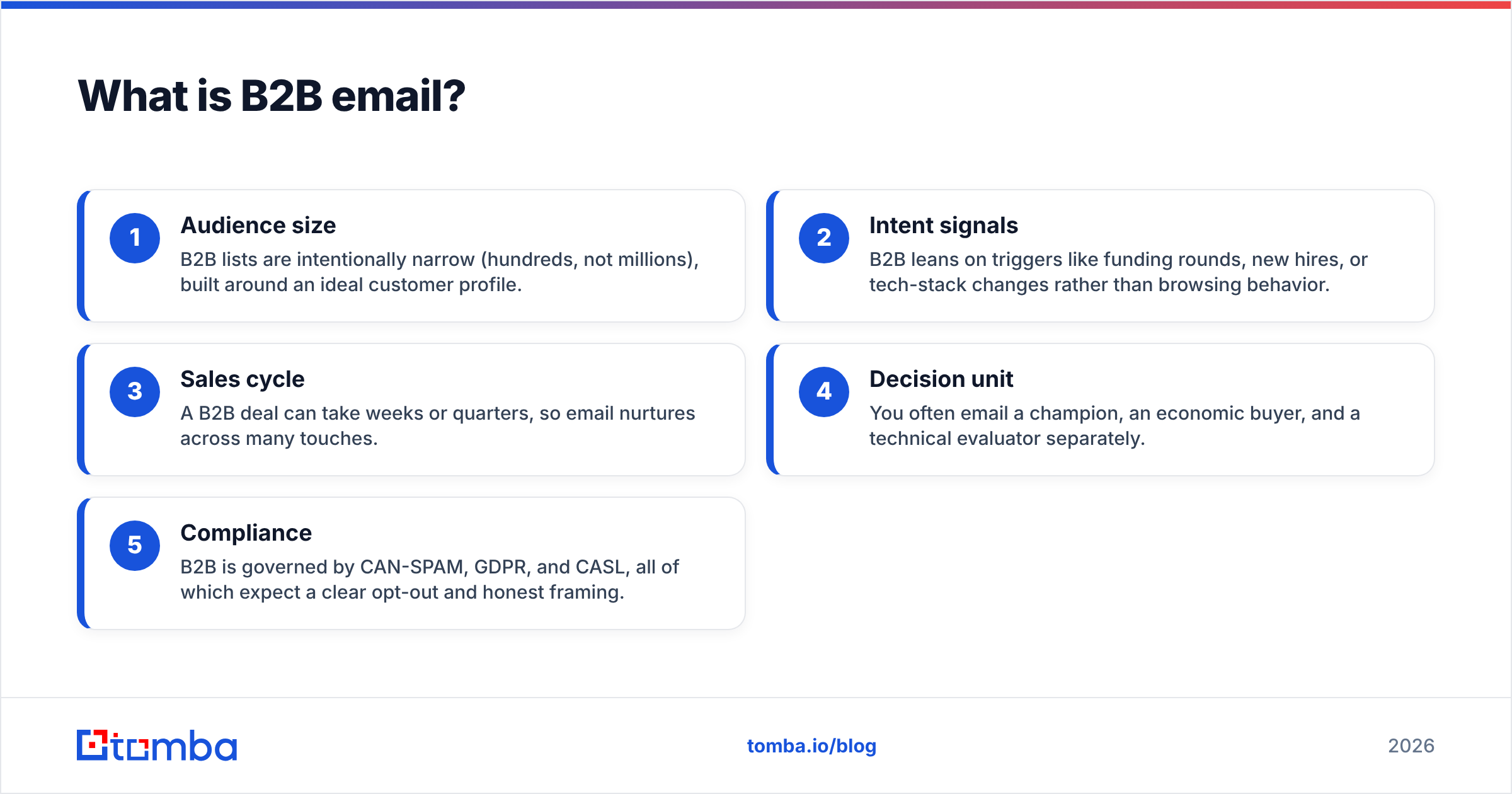
- Audience size — B2B lists are intentionally narrow (hundreds, not millions), built around an ideal customer profile.
- Intent signals — B2B leans on triggers like funding rounds, new hires, or tech-stack changes rather than browsing behavior.
- Sales cycle — A B2B deal can take weeks or quarters, so email nurtures across many touches.
- Decision unit — You often email a champion, an economic buyer, and a technical evaluator separately.
- Compliance — B2B is governed by CAN-SPAM, GDPR, and CASL, all of which expect a clear opt-out and honest framing.
If you want the textbook definition of related terms as you build, Tomba's B2B glossary is a useful reference while you standardize language across your team.
Why does B2B email still beat newer channels?#
Email wins because it is owned, asynchronous, and universal. You do not rent your audience from a platform algorithm, the recipient reads on their schedule, and every professional on earth has a work address. According to HubSpot's research, email continues to deliver one of the strongest returns of any marketing channel — and in B2B specifically, it remains the default for booking meetings at scale.
The catch is that the bar has risen. Inbox providers now score intent, engagement, and authentication aggressively. The teams that win in 2026 treat email as an infrastructure problem first and a creative problem second.
How do you build a clean B2B email list?#
Start with your ideal customer profile, then find the humans inside those companies — not the other way around. A list assembled from a scraped CSV you bought on a forum will burn your domain. A list built from verified, role-targeted contacts will compound.
The workflow that holds up:
- Define the ICP — industry, company size, region, and the specific roles who feel the pain you solve.
- Source contacts by domain — use domain search to pull the right people at a target account instead of guessing addresses.
- Find the individual — when you have a name and company, an email finder returns the professional address with a confidence score.
- Verify before you send — run every address through an email verifier so you never ship to a dead mailbox.
- Enrich for context — append job title, seniority, and company data so your copy can reference something real.
Verification is the step most teams skip, and it is the one that protects your sender reputation. If your bounce rate creeps above 3%, mailbox providers start routing you to spam regardless of content quality. The math is simple: a 95%-deliverable list of 1,000 contacts will out-perform a never-verified list of 5,000 every time.
What separates good B2B email copy from ignored copy?#
Relevance, brevity, and a single clear ask. The best-performing cold emails read like a note from a colleague who did their homework, not a brochure. Lead with the prospect's world — a trigger event, a peer they respect, a metric they care about — and make your value proposition a consequence of that, not the opening line.
A reliable structure for a first-touch B2B email:
- Hook — one line referencing something specific to them (a hire, a launch, a publicly stated goal).
- Relevance bridge — connect that observation to a problem you solve, in their language.
- Proof — one concrete result for a comparable company, with a number.
- Ask — a low-friction question, not a demo demand. "Worth a 15-minute look?" beats "Book a call here."
- Easy exit — a one-line opt-out keeps you compliant and, counterintuitively, lifts reply rates.
Keep it under 120 words. Decision-makers read on mobile between meetings, and a wall of text gets archived on sight. If you need a starting point, Tomba's cold email templates give you proven frameworks you can adapt rather than write from scratch.
How do you keep B2B email out of spam?#
Deliverability is governed by three layers: authentication, reputation, and engagement. Get all three right and your mail lands; miss one and your best copy never gets seen.
- Authentication — publish SPF, DKIM, and DMARC records so providers trust your domain. Verify your setup with an SPF checker before you scale sending.
- Reputation — warm new domains gradually, keep volume steady, and prune unengaged contacts. Google's Postmaster Tools shows your domain reputation directly.
- Engagement — replies, opens, and "not spam" actions raise your standing; spam complaints and bounces sink it.
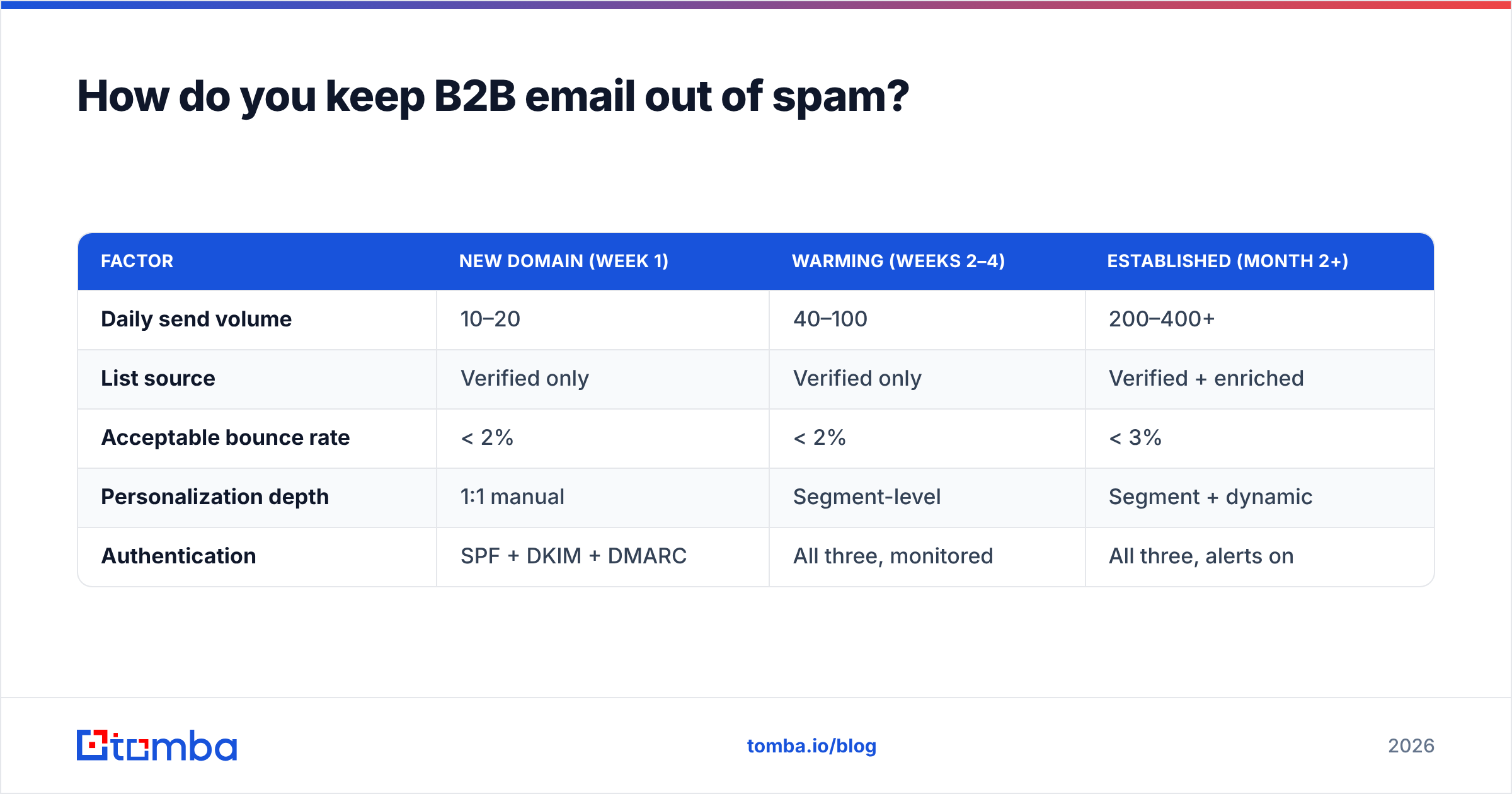
A practical sending ramp matters more than people expect. Jumping a fresh domain from zero to 500 emails a day is the fastest way to get filtered. The table below shows how the inputs to deliverability compare across maturity stages.
| Factor | New domain (week 1) | Warming (weeks 2–4) | Established (month 2+) |
|---|---|---|---|
| Daily send volume | 10–20 | 40–100 | 200–400+ |
| List source | Verified only | Verified only | Verified + enriched |
| Acceptable bounce rate | < 2% | < 2% | < 3% |
| Personalization depth | 1:1 manual | Segment-level | Segment + dynamic |
| Authentication | SPF + DKIM + DMARC | All three, monitored | All three, alerts on |
Notice that "verified only" never leaves the list. Verification is not a phase you graduate from — it is permanent hygiene.
What metrics actually prove B2B email is working?#
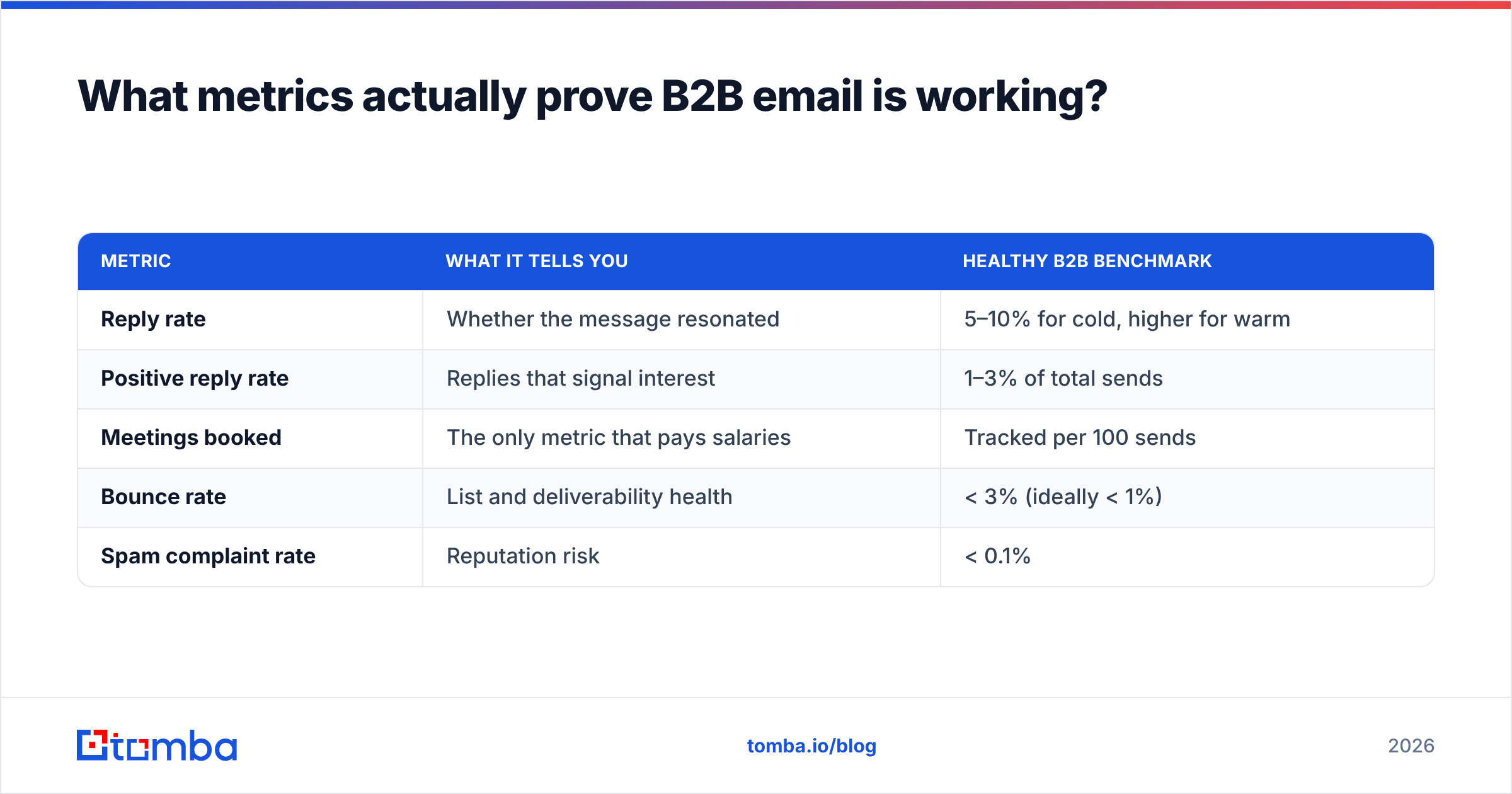
Stop reporting open rates. Apple's Mail Privacy Protection pre-loads images, which inflates opens into meaningless noise for a large share of your audience. The metrics that survive scrutiny are downstream of an actual human deciding to engage.
| Metric | What it tells you | Healthy B2B benchmark |
|---|---|---|
| Reply rate | Whether the message resonated | 5–10% for cold, higher for warm |
| Positive reply rate | Replies that signal interest | 1–3% of total sends |
| Meetings booked | The only metric that pays salaries | Tracked per 100 sends |
| Bounce rate | List and deliverability health | < 3% (ideally < 1%) |
| Spam complaint rate | Reputation risk | < 0.1% |
Reply rate is your north star for messaging; bounce and complaint rates are your guardrails for infrastructure. When reply rate drops, fix copy and targeting. When bounce or complaint rates rise, stop sending and fix your list and authentication first.
How does B2B email fit into a multi-channel sequence?#
Email is the backbone, not the whole skeleton. The strongest outbound motions in 2026 pair email with LinkedIn touches and the occasional call, sequenced so each channel reinforces the others without overwhelming the prospect. Email carries the detail and the paper trail; LinkedIn adds a face and social proof; a call breaks through when text stalls.
A clean two-week cadence might look like this:
- Day 1 — Personalized first-touch email with a single, specific hook.
- Day 3 — LinkedIn connection request, no pitch, referencing the same context.
- Day 5 — Follow-up email adding one new proof point.
- Day 8 — Soft value share (a relevant resource, not a nudge).
- Day 12 — Breakup email that makes it easy to say "not now."
If you are running this at scale, connect your tools so contact data flows automatically. Tomba's HubSpot integration and broader integrations push verified contacts straight into your sequencing platform, so reps spend time writing, not copy-pasting.
For the phone leg of the sequence, a phone finder closes the gap when email and LinkedIn alone are not enough to reach a senior buyer.
How much should B2B email tooling cost?#
You are paying for two things: data quality and the volume you can run. The trap is over-buying seats and credits before you have a repeatable message. Start lean, prove the motion, then scale credits as your reply rate justifies it.
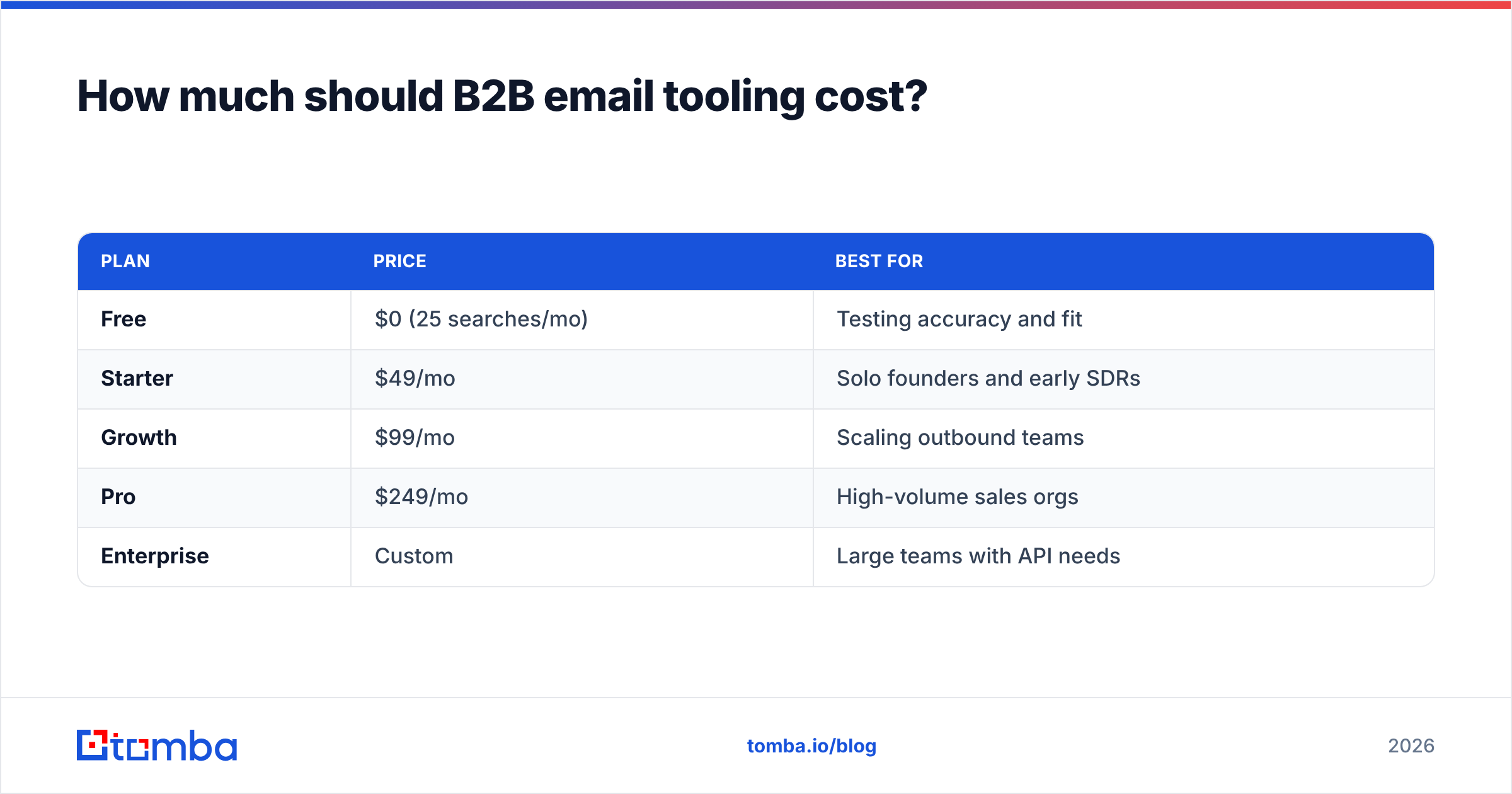
Tomba's pricing is built for that progression — a free tier to test, then plans that scale with volume:
| Plan | Price | Best for |
|---|---|---|
| Free | $0 (25 searches/mo) | Testing accuracy and fit |
| Starter | $49/mo | Solo founders and early SDRs |
| Growth | $99/mo | Scaling outbound teams |
| Pro | $249/mo | High-volume sales orgs |
| Enterprise | Custom | Large teams with API needs |
You can see the full breakdown on the Tomba pricing page. The decision isn't "cheapest tool" — it's "lowest cost per verified, deliverable contact," which is a very different number. A platform that finds an address but never verifies it costs you far more in burned reputation than the few cents you saved.
For comparison shoppers, third-party reviews on G2 are a sober way to sanity-check vendor claims against real user experience before you commit budget.
What are the most common B2B email mistakes?#
The failures cluster into a short, predictable list — and every one is preventable.
- Sending to unverified lists — the single fastest way to wreck deliverability.
- Personalization theater —
{{first_name}}is table stakes, not personalization. Reference something real. - One-and-done outreach — most replies come from follow-ups three through five, yet most reps quit after one.
- Ignoring authentication — no DMARC means providers don't trust you, no matter how good the copy is.
- Measuring opens — chasing a vanity metric leads to optimizing the wrong things.
- Buying scraped data — cheap lists are expensive once your domain is blacklisted.
Fix these in order and your numbers move before you ever touch your copy again.
Where should you start?#
Start with your list, because nothing downstream works without it. Define your ICP, find the right people by domain, verify every address, and only then write the email. Infrastructure first, creativity second — that order is what separates teams who book meetings from teams who land in spam.
If you take one action from this guide, make it verification. A clean, deliverable list is the foundation that every other tactic — copy, cadence, multi-channel — is built on. The Tomba Email Finder lets you find professional email addresses by domain, name, or company and returns a confidence score on each, so the contacts entering your sequence are ones that will actually receive your message. Pair it with the built-in verifier and you start every campaign on solid ground. Grab the free tier, test it against a list you trust, and scale from there.
// get started
Find, verify and enrich your first contacts today
Start on the free plan with 25 searches a month, then scale when your team is ready.
Free plan · No credit card required · GDPR & CCPA
// about the author