B2B Email Drip Campaign: The 2026 Playbook That Converts
A practical, no-fluff guide to building a B2B email drip campaign in 2026 — sequence structure, timing, copy, and the tools that keep your emails landing in the inbox.
B2B Email Drip Campaign: The 2026 Playbook That Converts
A B2B email drip campaign is a pre-built series of emails sent automatically over days or weeks, triggered by a contact's behavior or a fixed schedule. Done right, it turns a cold list into booked meetings without you typing a single follow-up by hand. Done wrong, it's a fast lane to the spam folder.
This guide shows you exactly how to build one that works in 2026 — the sequence math, the timing, the copy, and the data layer most teams ignore until their reply rate collapses.
TL;DR#
- A B2B email drip campaign automates a multi-touch sequence (usually 4–7 emails) over 2–4 weeks, triggered by time or behavior.
- The single biggest lever on results is list quality, not clever copy — verified, accurate contact data beats a better subject line every time.
- Optimal cadence in 2026: send touch 1, then space follow-ups 2–4 business days apart, tapering wider toward the end.
- Personalization at the company and role level outperforms
{{first_name}}token spam by a wide margin. - Measure replies and meetings booked, not opens — open tracking is unreliable post-Apple Mail Privacy and post-Gmail bundling.
What Is a B2B Email Drip Campaign?#
Think of a drip campaign like a drip irrigation line in a field. Instead of dumping a bucket of water on one plant and walking away, you release a steady, measured flow to every plant on a schedule. Each contact gets the right message at the right interval, automatically.
Technically, a drip campaign is an automated email sequence where each step fires based on a trigger (a signup, a download, a date) and a delay (wait 3 days, wait until they open). Unlike a one-off blast, the sequence keeps working while you sleep, and it stops the moment a prospect replies or books a call.
There are two broad types you'll build in B2B:
- Cold outbound drips — sequences to prospects who don't know you yet. Goal: start a conversation. These live or die on data accuracy and relevance.
- Nurture / lifecycle drips — sequences to known leads (trial users, webinar attendees, downloaders). Goal: move them down the funnel with education and proof.
- Re-engagement drips — win back dormant contacts who went quiet.
- Onboarding drips — guide new customers to first value so they stick.
This post focuses mainly on cold outbound and nurture, since those drive the most pipeline for sales teams.
Why Do Most B2B Drip Campaigns Fail?#
Most drips fail before the first email is written. The culprit is almost always the list.
If 20% of your addresses bounce, mailbox providers flag your domain as a low-quality sender, and even your valid emails start landing in spam. Your beautifully written touch 3 never gets seen because touch 1 torched your sender reputation. That's why cleaning your list with an email verifier before you launch isn't optional — it's the foundation.
Here are the failure modes, ranked by how often they kill campaigns:
| Failure mode | Symptom | Fix |
|---|---|---|
| Dirty list | High bounce rate (>3%), spam folder placement | Verify every address before sending |
| Wrong targeting | Low reply rate, "not relevant" responses | Tighten ICP, segment by role and industry |
| Too aggressive cadence | Spam complaints, unsubscribes | Space touches 2–4 business days apart |
| Generic copy | Opens but no replies | Personalize at company + pain-point level |
| No clear ask | Replies that go nowhere | One specific CTA per email |
| Tracking-only metrics | "Great opens, zero pipeline" | Measure replies and meetings, not opens |
Notice that three of the six are upstream of the writing. You can hire the best copywriter alive and still fail if the data underneath is wrong.
How Long Should a B2B Drip Sequence Be?#
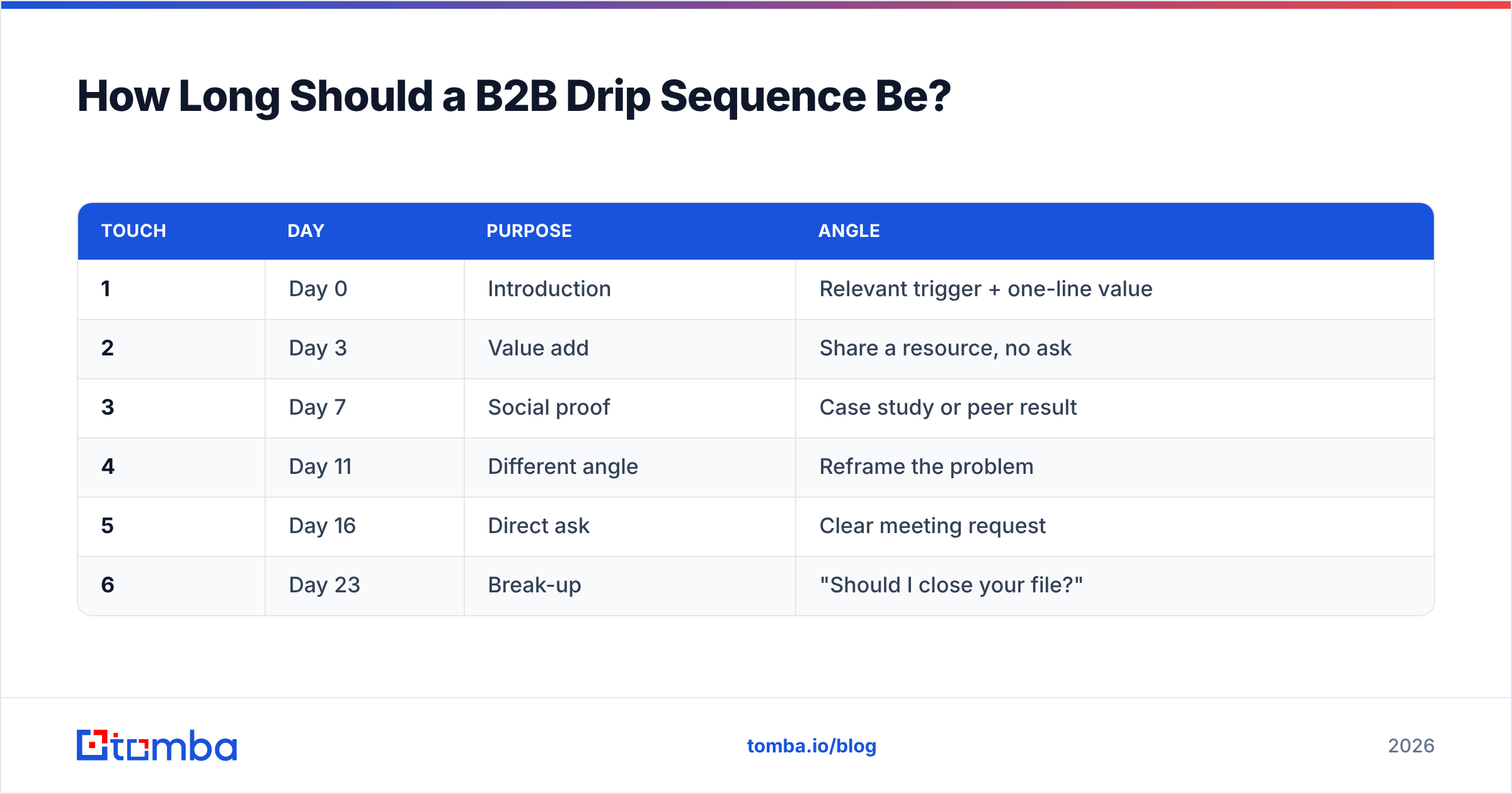
Four to seven emails over two to four weeks is the sweet spot for cold outbound in 2026. Shorter than four and you quit before most buyers even notice you; longer than seven and you cross from persistent into annoying.
Here's a proven cold outbound structure you can copy:
| Touch | Day | Purpose | Angle |
|---|---|---|---|
| 1 | Day 0 | Introduction | Relevant trigger + one-line value |
| 2 | Day 3 | Value add | Share a resource, no ask |
| 3 | Day 7 | Social proof | Case study or peer result |
| 4 | Day 11 | Different angle | Reframe the problem |
| 5 | Day 16 | Direct ask | Clear meeting request |
| 6 | Day 23 | Break-up | "Should I close your file?" |
The break-up email is the unsung hero — it routinely pulls the highest reply rate of the whole sequence because loss aversion kicks in. People who ignored five emails suddenly respond to "I'll stop reaching out."
For nurture drips to warm leads, you can stretch the spacing (5–7 days between touches) and lean harder on education, since these contacts already raised a hand.
What Makes Drip Copy Actually Get Replies?#
Conclusion first: relevance beats cleverness. A plain email that proves you understand the prospect's world will out-convert a witty one that could've been sent to anyone.
Follow these rules for each email in the sequence:
- One idea per email. Don't stack three value props. Pick one pain, one proof, one ask.
- Lead with them, not you. The first sentence should reference their company, role, stack, or a recent event — not your product.
- Keep it under 120 words. Cold emails are read on phones in five seconds. Long = ignored.
- One CTA only. "Worth a 15-minute call Thursday?" beats "Let me know your thoughts, or check our site, or reply with questions."
- Write like a human. No "I hope this email finds you well." No corporate throat-clearing.
A quick template for touch 1:
Subject: quick question about {{company}}'s outbound
Hi {{first_name}}, noticed {{company}} is hiring three SDRs this quarter — usually that means the team is scaling pipeline fast. We help RevOps teams keep their prospect data clean so reps aren't emailing dead inboxes. Worth a quick look at how it'd fit your stack?
If you want help drafting variations, a cold email AI writer can generate first drafts you then sharpen by hand. And before you hit send, run the lines through a spam checker to catch trigger words that hurt deliverability.
How Do You Build the Data Layer Behind a Drip?#
This is the part most "drip campaign" articles skip, and it's the part that decides whether you succeed. Your sequence is only as good as the contacts feeding it.
A reliable data layer has three jobs:
- Find the right people — accurate, current email addresses for your ICP.
- Verify them — confirm each address is deliverable before it enters the sequence.
- Enrich them — add the company, role, and signals you'll personalize on.
You can assemble this yourself. Use a domain search to pull every contact at a target company, the bulk email finder to scale across an account list, and an email verifier to scrub the results. For ongoing programs, the email finder API wires this directly into your sequencing tool so new contacts arrive pre-verified.
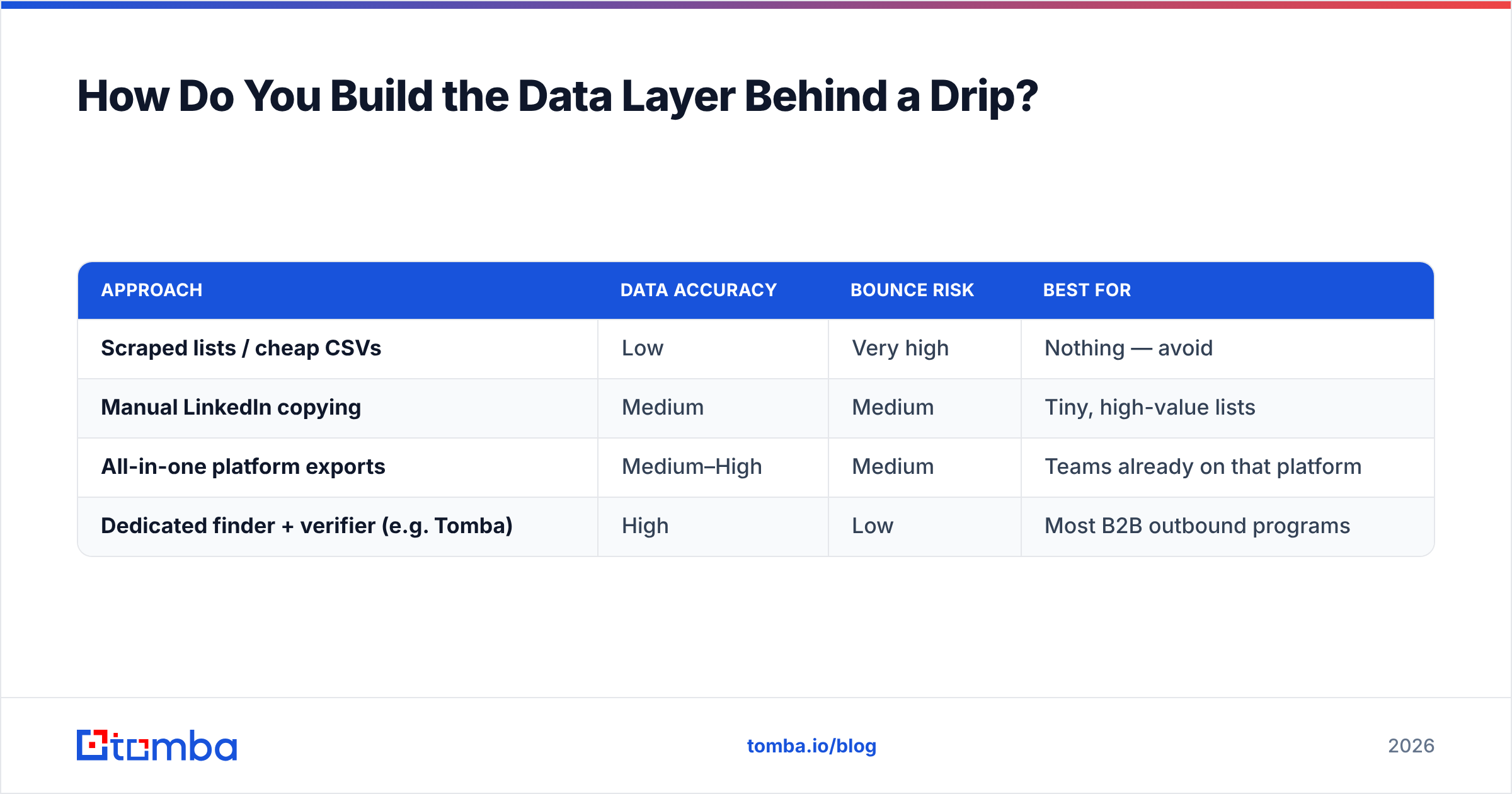
Here's how a dedicated data tool compares to the common shortcuts:
| Approach | Data accuracy | Bounce risk | Best for |
|---|---|---|---|
| Scraped lists / cheap CSVs | Low | Very high | Nothing — avoid |
| Manual LinkedIn copying | Medium | Medium | Tiny, high-value lists |
| All-in-one platform exports | Medium–High | Medium | Teams already on that platform |
| Dedicated finder + verifier (e.g. Tomba) | High | Low | Most B2B outbound programs |
The pattern is simple: the more you invest in clean data upstream, the less you fight deliverability downstream.
What Cadence and Timing Work Best in 2026?#
Send business days only, space touches 2–4 days apart, and taper wider toward the end. That's the short answer. The longer answer depends on your audience's timezone and role.
A few timing principles that still hold in 2026:
- Tuesday–Thursday mornings (recipient's local time) remain the strongest send windows for B2B.
- Avoid Monday floods and Friday afternoons — your email gets buried or ignored.
- Throttle volume. Sending 50 emails a day from a warmed domain beats blasting 500 from a cold one. Use an email warmup calculator to find a safe ramp.
- Respect the reply stop. The instant someone responds, pull them out of the automated sequence and have a human take over.
Deliverability infrastructure matters as much as timing. Make sure your SPF record, DKIM, and DMARC are configured before you scale — Google and Yahoo's bulk-sender requirements have only tightened. Both publish their rules openly; review Google's sender guidelines and Yahoo's equivalent before launching a large program. For broader benchmarks on what "good" looks like, HubSpot's email marketing research is a solid reference point.
How Do You Measure a B2B Drip Campaign?#
Measure replies and meetings booked. Full stop. Opens are now a vanity metric you can't trust.
Apple's Mail Privacy Protection pre-loads images, which inflates open rates, and Gmail's promotions bundling distorts them further. If you optimize for opens, you optimize for noise.
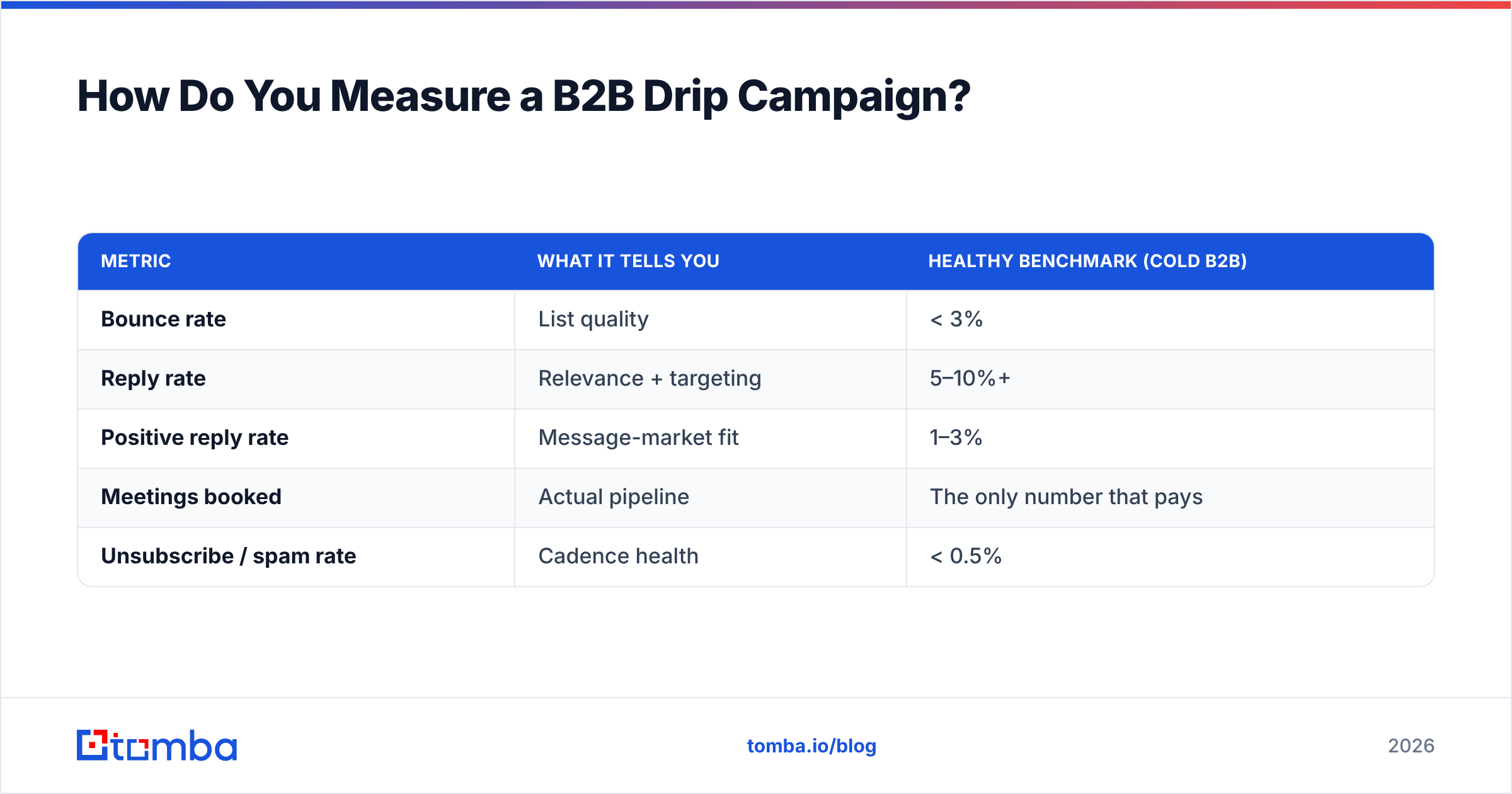
Track these instead:
| Metric | What it tells you | Healthy benchmark (cold B2B) |
|---|---|---|
| Bounce rate | List quality | < 3% |
| Reply rate | Relevance + targeting | 5–10%+ |
| Positive reply rate | Message-market fit | 1–3% |
| Meetings booked | Actual pipeline | The only number that pays |
| Unsubscribe / spam rate | Cadence health | < 0.5% |
If your bounce rate creeps up, stop and re-verify. A rising bounce rate is the earliest warning that your data has gone stale, and it predicts deliverability problems before they hit your inbox placement. Many teams re-clean their active list with an email verifier every 60–90 days because B2B contacts churn jobs constantly.
How Does a Drip Campaign Fit Your Wider Sales Process?#
A drip is one channel, not the whole strategy. The highest-performing teams in 2026 run drips alongside LinkedIn touches and calls in a coordinated sequence, so the prospect hears a consistent message across channels.
A simple multi-channel rhythm:
- Day 0 — Email touch 1 + LinkedIn profile view.
- Day 3 — Email touch 2.
- Day 5 — LinkedIn connection request with a personalized note.
- Day 7 — Email touch 3 (social proof).
- Day 9 — Phone call if you have the number.
- Day 11+ — Continue the email drip.
To add the phone layer, a phone finder gives you direct dials tied to the same verified contacts, so your email and calling efforts hit the same person instead of fragmenting across bad records.
The connective tissue across all of this is data. Whether the touch is an email, a connection request, or a call, it points at one accurately identified human — and that identification is exactly what a dedicated data tool guarantees.
Quick Build Checklist#
Before you launch your next B2B drip campaign, confirm every box:
- ICP defined and segmented by role + industry
- Contacts found via domain search or bulk finder
- Every address verified (< 3% projected bounce)
- Domain authenticated (SPF, DKIM, DMARC)
- Sending domain warmed up
- 4–7 email sequence written, one idea per email
- Cadence set to business days, 2–4 day spacing
- Reply-stop automation enabled
- Tracking set to replies + meetings, not opens
Build Your Drip on a Clean Foundation#
Your sequence copy, timing, and channel mix all matter — but they're multipliers on top of one thing you control completely: the quality of the contacts you're emailing. Garbage in, spam folder out.
Start by getting accurate, verified addresses for the exact people in your ICP. The Tomba Email Finder finds professional emails by name, company, or domain and confirms they're deliverable before they ever enter your sequence, so your drip lands in inboxes instead of bouncing. Pair it with the email verifier to keep your list clean over time, and check the Tomba pricing plans — there's a free tier with 25 searches a month to test it, with paid plans starting at $49/mo when you're ready to scale. Build the data layer first, and every email in your drip works harder.
// get started
Find, verify and enrich your first contacts today
Start on the free plan with 25 searches a month, then scale when your team is ready.
Free plan · No credit card required · GDPR & CCPA
// about the author