The B2B Email Funnel: A 2026 Framework That Converts
Most B2B email funnels leak revenue at every stage. Here's a concrete 2026 framework — stages, metrics, and tooling — to turn cold contacts into closed deals.
A B2B email funnel is the system that moves a business contact from "never heard of you" to "signed the contract" using a sequence of staged, measurable emails. Get the stages and the data right and email becomes your cheapest revenue channel. Get them wrong and you are just adding noise to inboxes that were already full.
This guide gives you a concrete 2026 framework: the stages, the metrics that matter at each one, the tools that run it, and the contact data that quietly decides whether any of it works.
TL;DR#
- A b2b email funnel has four working stages — Awareness (TOFU), Engagement (MOFU), Conversion (BOFU), and Expansion — each with its own goal, message, and metric.
- Funnels do not leak evenly. Most revenue is lost at the top (bad data, wrong people) and the handoff (marketing-qualified leads that sales never works).
- Benchmark targets for 2026: 99%+ deliverability, 40%+ open rate on warm segments, 3-8% reply rate on cold outbound, and a 20-30% MQL-to-SQL conversion.
- Your funnel is only as good as the contact data feeding it — verified emails, correct roles, and current companies. Garbage in, bounce out.
- Tooling splits into four jobs: find/verify data, send/sequence, nurture/automate, and measure. You can assemble best-of-breed or buy a suite.
What is a B2B email funnel?#
Think of it like a water treatment plant. Raw, dirty water (cold contacts) comes in one end. It passes through a series of filters — each removing the wrong-fit people and conditioning the right ones — until clean, usable water (revenue-ready buyers) comes out the other end. Skip a filter and the whole output is contaminated.
Technically, a b2b email funnel is a staged communication system mapped to a buyer's journey. Each stage has a single job, a single primary message type, and a single metric you optimize. Contacts either advance to the next stage, stay for more nurturing, or exit.
The four stages most B2B teams actually run:
- Awareness (Top of Funnel / TOFU) — The goal is a first reply or a click, nothing more. Messages are short, relevant, and personalized to a trigger (new role, funding, tech stack). Metric: reply rate.
- Engagement (Middle of Funnel / MOFU) — The goal is education and trust. You send case studies, comparison content, and useful frameworks. Metric: engagement (opens + clicks over time) and meetings booked.
- Conversion (Bottom of Funnel / BOFU) — The goal is the deal. Messages are proof-heavy: ROI numbers, demos, trials, and clear calls to action. Metric: opportunity-to-close rate.
- Expansion — The goal is retention and upsell after the close. Metric: net revenue retention.
Most teams obsess over stage 3 and underbuild stages 1 and 2. That is backwards. If the top is leaky, nothing downstream can compensate.
Why do most B2B email funnels leak revenue?#
The funnel does not lose contacts evenly. It loses them at two specific chokepoints, and both are fixable.
Chokepoint 1: the top, where data quality lives. If 20% of your list bounces, you are not just losing 20% of contacts — you are damaging sender reputation, which then suppresses delivery to the good 80%. A single bad list can quietly cap an entire domain's email deliverability for weeks. This is why list hygiene is a funnel problem, not a janitorial one.
Chokepoint 2: the marketing-to-sales handoff. According to research compiled by HubSpot, a large share of marketing-qualified leads are never meaningfully followed up by sales — they sit in a CRM and decay. The funnel "works" on paper but the conversion never happens because the baton is dropped.
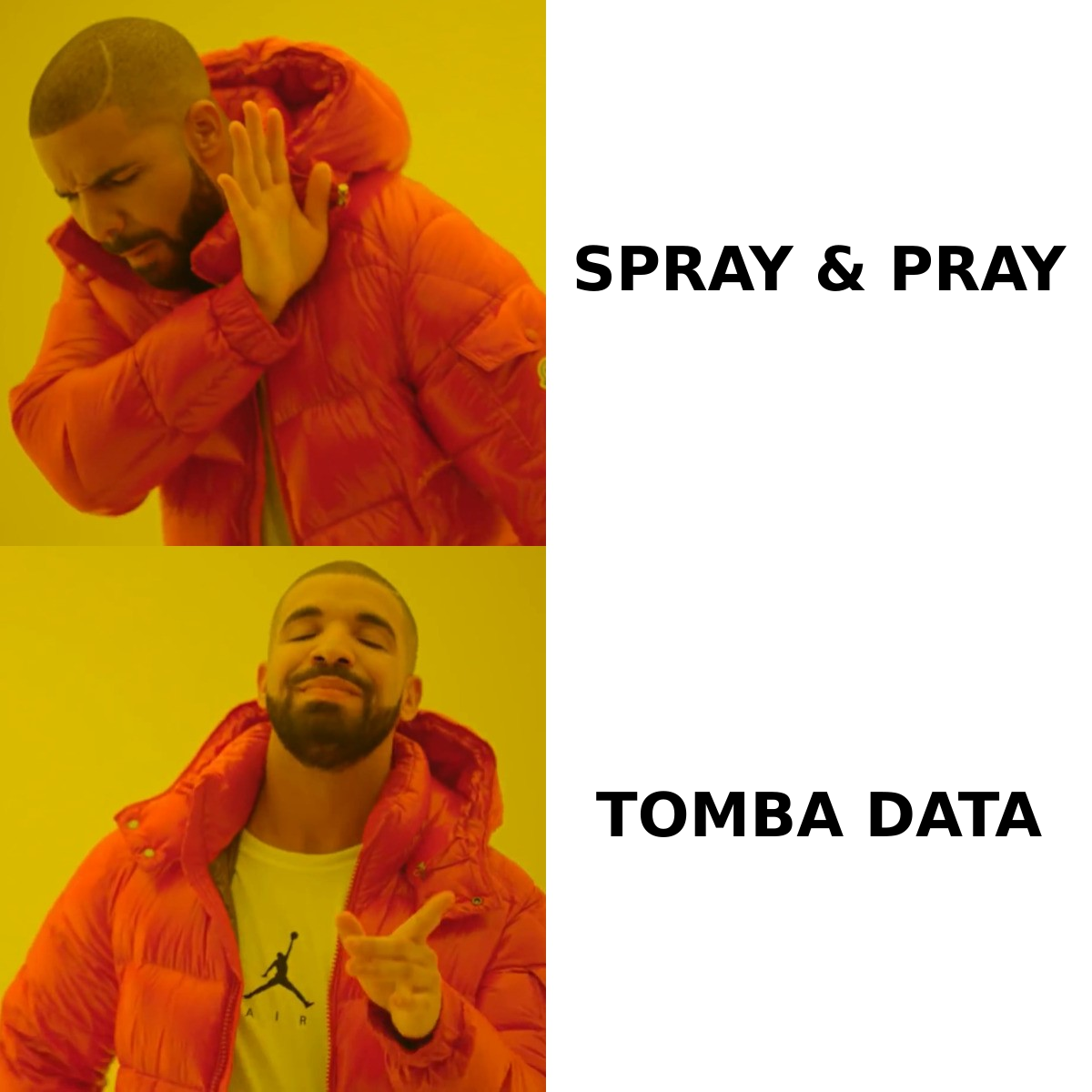
Here is what a leaking versus a tuned funnel looks like at each stage:
| Stage | Common leak | What "tuned" looks like in 2026 |
|---|---|---|
| Awareness (TOFU) | 15-25% bounce, generic blasts | <2% bounce, trigger-based personalization |
| Engagement (MOFU) | One-size nurture, no segmentation | Behavior-branched sequences |
| Conversion (BOFU) | Slow or no sales follow-up | <5 min lead response, clear next step |
| Expansion | No post-sale email at all | Onboarding + upsell automation |
The pattern: leaks at the top are about data, leaks in the middle are about relevance, and leaks at the bottom are about speed.
What metrics should each funnel stage hit in 2026?#
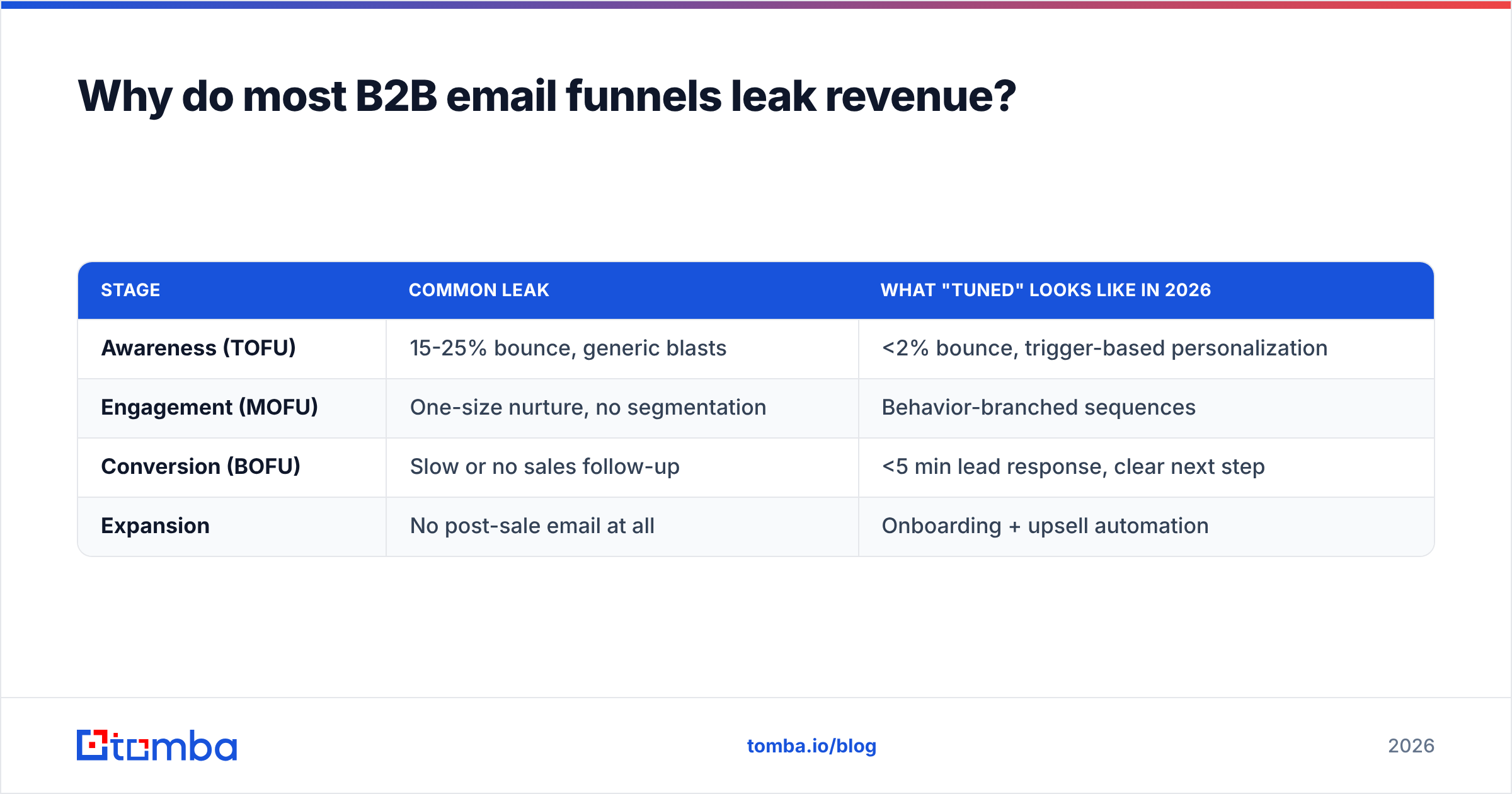
You cannot fix what you do not measure, and you cannot measure a funnel with a single number. Each stage has its own scoreboard. Here are realistic 2026 benchmarks for B2B — treat them as targets, not guarantees, since they vary by industry and list temperature.
| Metric | Cold (TOFU) | Warm (MOFU/BOFU) | Why it matters |
|---|---|---|---|
| Deliverability | 95%+ | 99%+ | Below this, nothing else counts |
| Open rate | 30-50% | 40-60% | Subject + sender reputation signal |
| Reply rate | 3-8% | 10-25% | The real TOFU success metric |
| Click-through | 1-3% | 3-8% | Content relevance signal |
| Meeting booked | 1-3% | n/a | TOFU-to-pipeline conversion |
| MQL → SQL | n/a | 20-30% | Handoff health |
| Bounce rate | <3% | <1% | Data quality alarm |
Two notes on reading this table. First, open rate is increasingly unreliable as a standalone metric thanks to privacy proxies that pre-fetch images — use it as a trend, not gospel, and weight replies and clicks higher. Second, if your bounce rate creeps above 3%, stop sending and clean the list before you do anything else. A rising bounce rate is the single loudest early warning that your funnel is about to stall.
How do you build the data layer that feeds the funnel?#
Everything above assumes you are emailing real people at real companies with real addresses. That assumption is where most funnels quietly fail, so build the data layer deliberately. There are four jobs to cover before a single sequence goes out:
- Find the right contacts. Start from your ideal customer profile, not from whatever list you can scrape. Use a domain search to pull the actual decision-makers at target companies rather than buying a stale list of unknown provenance.
- Get verified email addresses. A name is not a contact. Run every address through an email verifier so you know it resolves before you risk your sender reputation on it.
- Enrich with role and company context. Personalization at the top of the funnel needs fuel — title, seniority, company size, recent triggers. Data enrichment turns a bare email into a targetable profile.
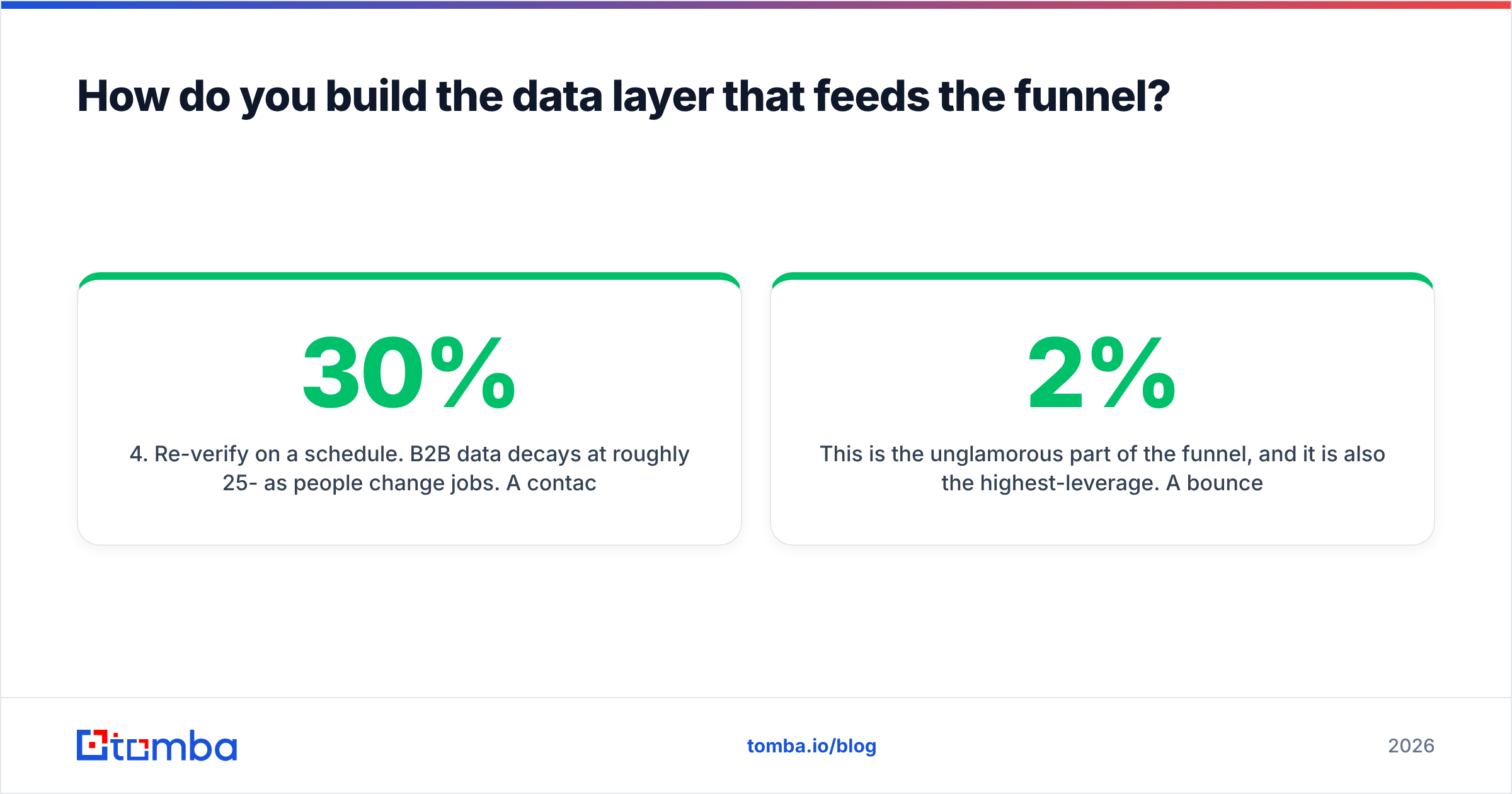
- Re-verify on a schedule. B2B data decays at roughly 25-30% per year as people change jobs. A contact that was valid in January can bounce by September, so re-verification is maintenance, not a one-time task.
This is the unglamorous part of the funnel, and it is also the highest-leverage. A 2% bounce rate instead of 20% does not just save you 18% of contacts — it protects deliverability to the entire rest of the list, which is worth far more than the contacts themselves.
Is a best-of-breed stack better than an all-in-one suite?#
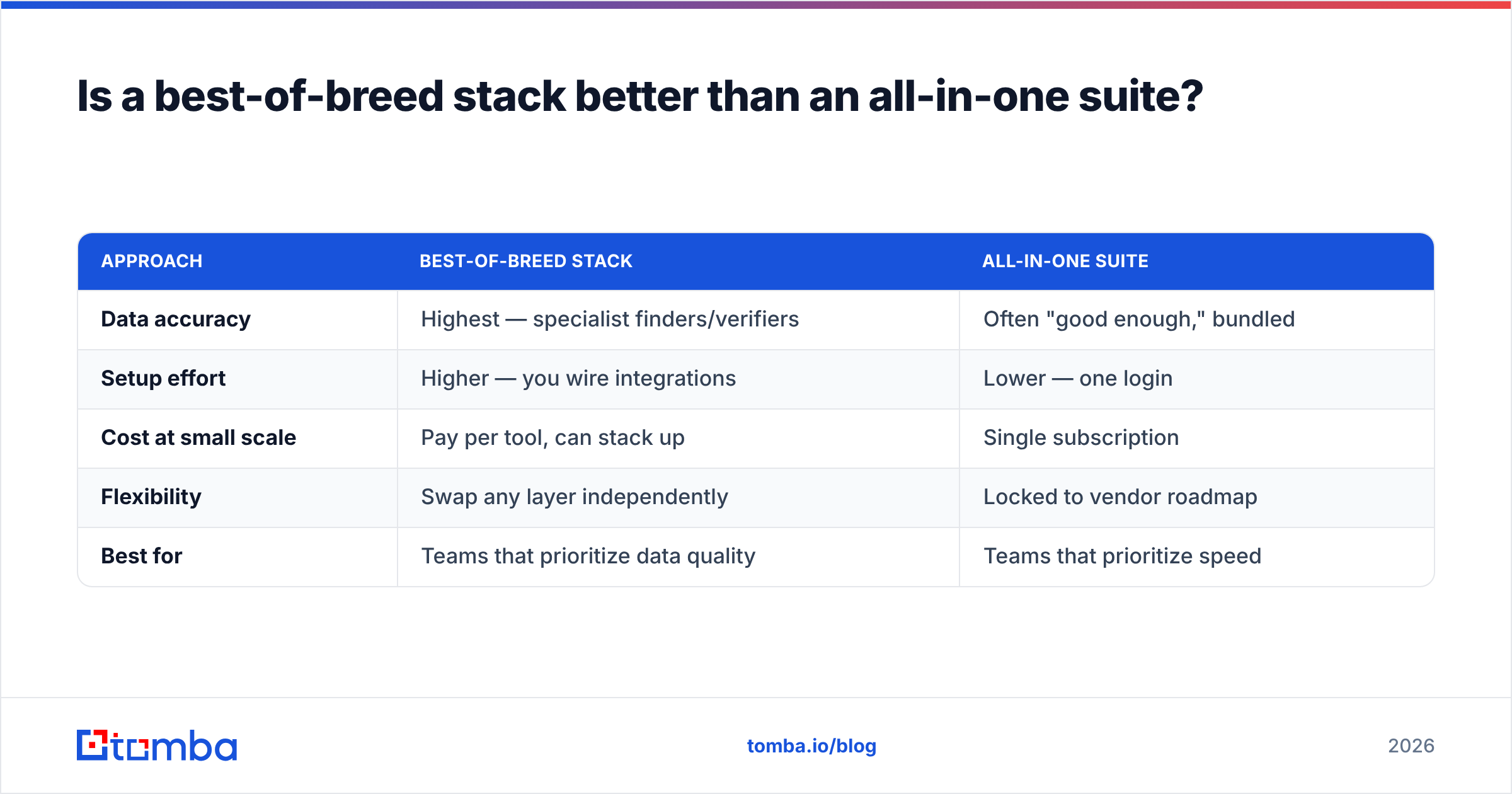
Both work. The right choice depends on team size and how much integration overhead you can absorb. Here is an honest comparison of the two approaches across the jobs a funnel actually requires.
| Approach | Best-of-breed stack | All-in-one suite |
|---|---|---|
| Data accuracy | Highest — specialist finders/verifiers | Often "good enough," bundled |
| Setup effort | Higher — you wire integrations | Lower — one login |
| Cost at small scale | Pay per tool, can stack up | Single subscription |
| Flexibility | Swap any layer independently | Locked to vendor roadmap |
| Best for | Teams that prioritize data quality | Teams that prioritize speed |
For most teams in 2026, the pragmatic move is a hybrid: use a dedicated, accurate data source for the find-and-verify layer — the part where quality compounds — and a suite or sequencer for sending and nurture, where the tools are more interchangeable. The data layer is where you should refuse to compromise, because errors there poison every downstream stage.
If you are evaluating point tools, check independent reviews on G2 rather than vendor landing pages, and look specifically at verified bounce rates and refund policies for bad data — those two signals separate serious data vendors from list resellers.
You can also reach for a bulk email finder when you are loading a fresh segment into the top of the funnel, which keeps the find-and-verify step from becoming a manual bottleneck.
How do you sequence the actual emails in each stage?#
A funnel is a sequence of decisions, not a blast. The structure below is a reliable starting template you can adapt.
Awareness sequence (cold, 4-5 touches over ~2 weeks):
- Email 1: A one-line relevant trigger + a single soft question. No pitch.
- Email 2 (day 3): A short proof point — a result a similar company got.
- Email 3 (day 7): A different angle on the same problem.
- Email 4 (day 12): A direct, easy-to-decline ask ("worth a 15-minute look?").
- Branch: anyone who replies or clicks moves to Engagement; the rest exit or go to a low-frequency nurture.
Engagement sequence (warm, value-led):
- Send education on a 7-14 day cadence: a teardown, a benchmark, a comparison.
- Branch on behavior: two content clicks or a pricing-page visit promotes the contact to Conversion.
Conversion sequence (hot, sales-owned):
- Proof-heavy and fast. ROI math, a tailored demo offer, social proof from their industry.
- The hard rule: respond to any inbound signal in minutes, not days. Speed is the dominant variable here.
Across all three, keep one principle: every email earns the open of the next one. The moment a stage stops earning attention, the contact should branch out, not get blasted again. If you want a faster start, a library of proven cold email templates saves you from drafting from scratch, and an email warmup calculator tells you how aggressively you can safely ramp a new sending domain.
How does the funnel connect to your CRM and pipeline?#
The funnel is not a closed loop — it feeds a pipeline. The connection point is the CRM, and the quality of that connection determines whether marketing's work survives the handoff to sales.
Three rules keep the connection clean:
- Sync verified data only. Never push unverified contacts into the CRM; they corrupt your sales team's reporting and waste rep time.
- Define the MQL→SQL trigger explicitly. "Clicked twice and visited pricing" is a definition. "Seems interested" is not. Automate the promotion so no lead waits in a queue.
- Close the loop on outcomes. Feed won/lost data back to the top of the funnel so you target more of what closes and less of what does not.
Modern data tools push directly into the systems you already use, so contacts arrive enriched and verified — see the available integrations for HubSpot, Salesforce, Pipedrive, and Zapier connections that remove manual CSV juggling from the workflow.
What is the single biggest mistake teams make?#
Optimizing the bottom of the funnel while ignoring the top. Teams will A/B test a BOFU subject line for weeks while feeding the whole machine a 20%-bounce list they bought once and never re-verified.
The fix is boring and it is the highest-ROI move available: verify and enrich your data before you send, and re-verify on a schedule. A funnel built on accurate contact data with mediocre copy will outperform a funnel with brilliant copy built on bad data — every time. Copy is the engine; data is the fuel. You cannot out-write contaminated fuel.
Frequently asked questions#
How long should a B2B email funnel take? From first cold touch to closed deal, expect anywhere from a few weeks to several months depending on deal size and buying-committee complexity. The funnel's job is to keep the contact engaged across that whole window without burning out the relationship.
How many emails per stage? Four to five at the top, then behavior-driven afterward. There is no fixed number for warm stages — you send while the contact keeps engaging and you stop when they stop.
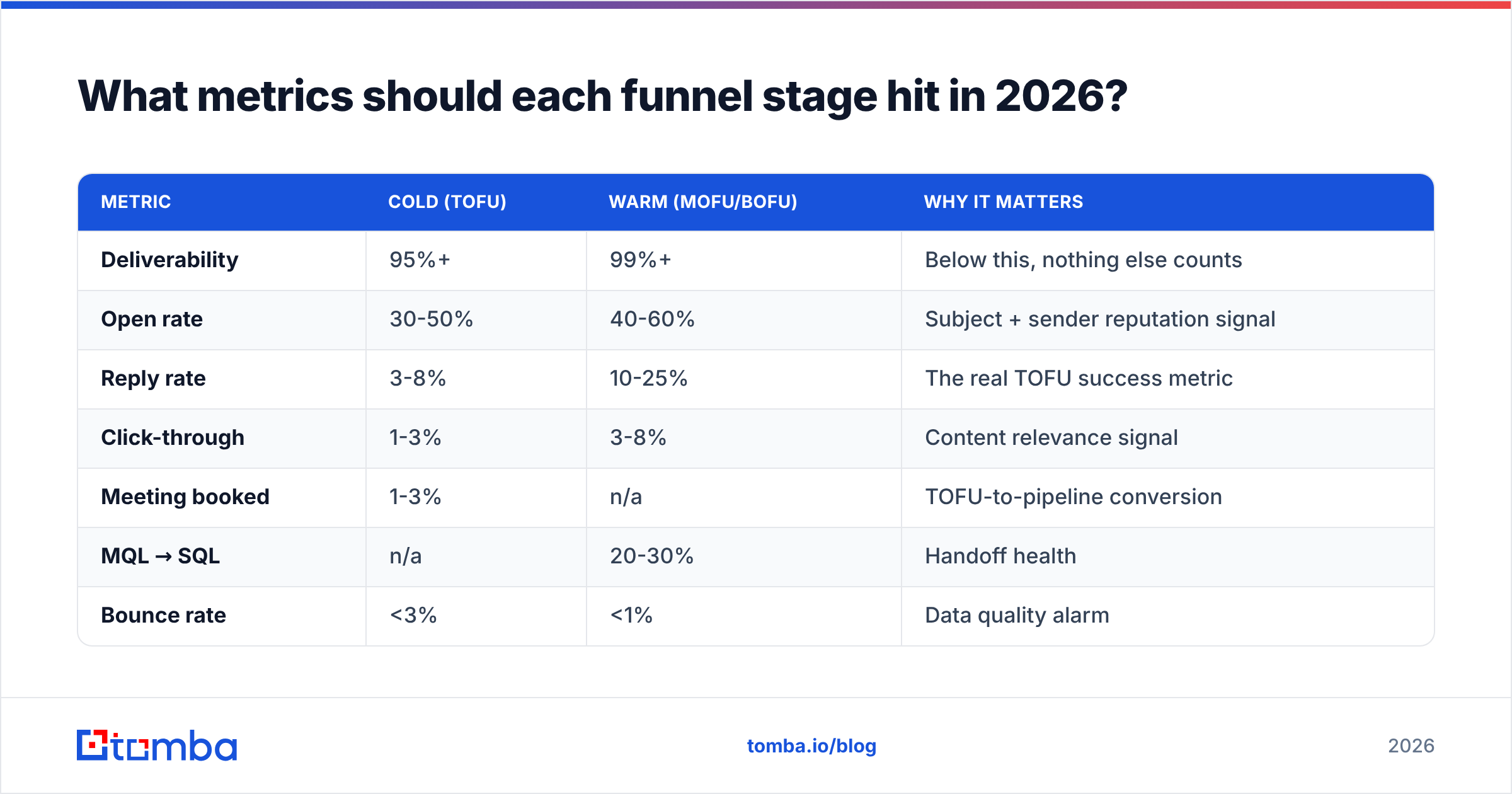
Do I still need cold email in 2026? Yes, but only with verified data and genuine personalization. The spray-and-pray version is dead; the targeted, well-researched version still outperforms most paid channels on cost per opportunity.
What's the most important single metric? Bounce rate, indirectly. It is the early-warning light for the data quality that governs every other number in the funnel.
Build your funnel on data that actually delivers#
The framework above only works if the contacts are real, current, and verified. That is the layer to get right first. The Tomba Email Finder finds professional email addresses by domain, name, or company and verifies them before they ever enter your sequence — so your funnel starts with clean fuel instead of a bounce list. Pair it with the built-in verifier and enrichment, start on the free tier (25 searches a month), and scale into a paid plan when the pipeline justifies it. Check current Tomba pricing — Starter is $49/mo, Growth $99/mo, Pro $249/mo — and build the top of your funnel on data that converts instead of data that bounces.
// get started
Find, verify and enrich your first contacts today
Start on the free plan with 25 searches a month, then scale when your team is ready.
Free plan · No credit card required · GDPR & CCPA
// about the author