B2B Email List Building in 2026: The Complete Playbook
A practical, compliant playbook for B2B email list building in 2026 — sourcing, verification, segmentation, and the metrics that keep your domain out of spam folders.
Building a B2B email list is the difference between an outbound motion that compounds and one that quietly burns your domain reputation. In 2026, the rules are tighter, the inbox providers are smarter, and buying a 100,000-row CSV is the fastest way to get blacklisted. This playbook walks through how to build a list that actually reaches inboxes and books meetings.
TL;DR#
- Build, don't buy. Purchased lists are stale, non-consented, and torch your sender reputation. Source contacts you can verify and segment.
- Verification is non-negotiable. A 3% bounce rate is the line between the inbox and the spam folder. Verify every address before the first send.
- Segment before you scale. A 500-contact list matched to an ICP beats a 50,000-row dump every time.
- Deliverability is a list-building problem. Clean data, gradual ramp, and warmup decide whether your campaign lands.
- Tooling matters. A finder + verifier + enrichment stack (like Tomba Email Finder) turns manual prospecting into a repeatable system.
What is B2B email list building?#
B2B email list building is the process of sourcing, verifying, and organizing the business email addresses of people who match your ideal customer profile (ICP) so you can run outbound campaigns that reach real inboxes.
Think of it like stocking a kitchen before service. You don't grab whatever is on sale — you source specific ingredients that match the menu, check each one for freshness, and organize them so the line moves fast. A bought list is the bin of mystery produce at the back of the cooler: cheap, convenient, and a health-code violation waiting to happen.
Technically, a healthy list is built from three pillars:
- Sourcing — finding contacts from first-party signals, public professional data, and targeted prospecting rather than scraped dumps.
- Verification — confirming each address is deliverable, not a catch-all, and not a spam trap.
- Segmentation — grouping contacts by role, industry, company size, and intent so messaging stays relevant.
Skip any pillar and the whole thing wobbles. You can have perfect copy and a beautiful sequence, but if 20% of your list bounces, mailbox providers will route the rest to spam regardless.
Why does buying a B2B email list fail in 2026?#
Buying a list fails because the economics that made it tempting no longer exist. Purchased data is sold to dozens of buyers, scraped months ago, and almost never collected with consent — which means high bounce rates, spam-trap hits, and legal exposure under GDPR and CAN-SPAM.

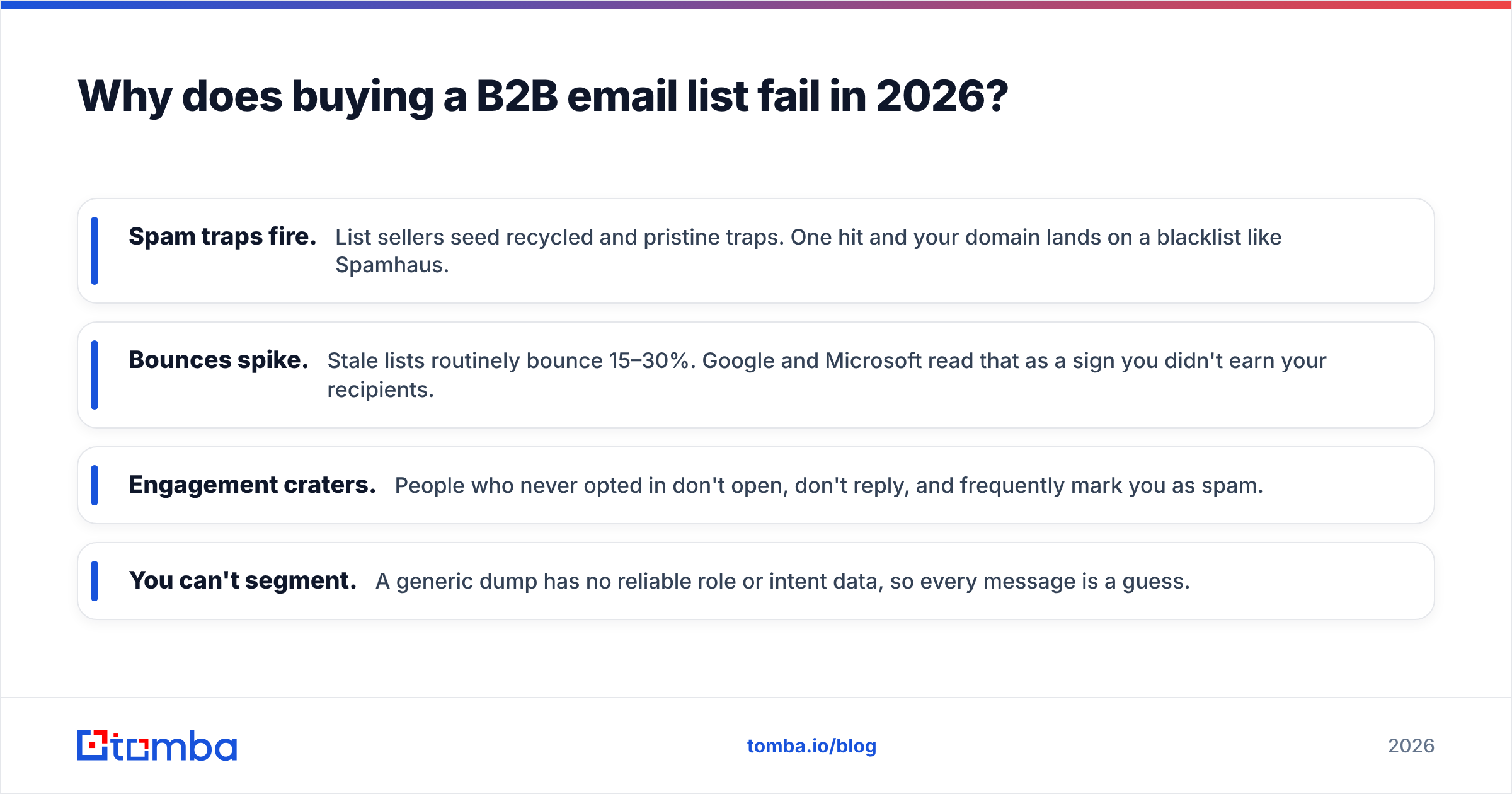
Here's what actually happens when you send to a bought list:
- Spam traps fire. List sellers seed recycled and pristine traps. One hit and your domain lands on a blacklist like Spamhaus.
- Bounces spike. Stale lists routinely bounce 15–30%. Google and Microsoft read that as a sign you didn't earn your recipients.
- Engagement craters. People who never opted in don't open, don't reply, and frequently mark you as spam.
- You can't segment. A generic dump has no reliable role or intent data, so every message is a guess.
A built list flips all four. Because you sourced and verified each contact, bounces stay under 3%, traps are filtered out, and segmentation is baked in from day one. For a deeper breakdown of the signals that move messages to spam, see Google's Postmaster Tools guidance on sender best practices.
Where do you source B2B contacts ethically?#
Source from channels where you either have a relationship signal or access to public professional data, then verify everything. The goal is contacts you can stand behind — not volume for its own sake.
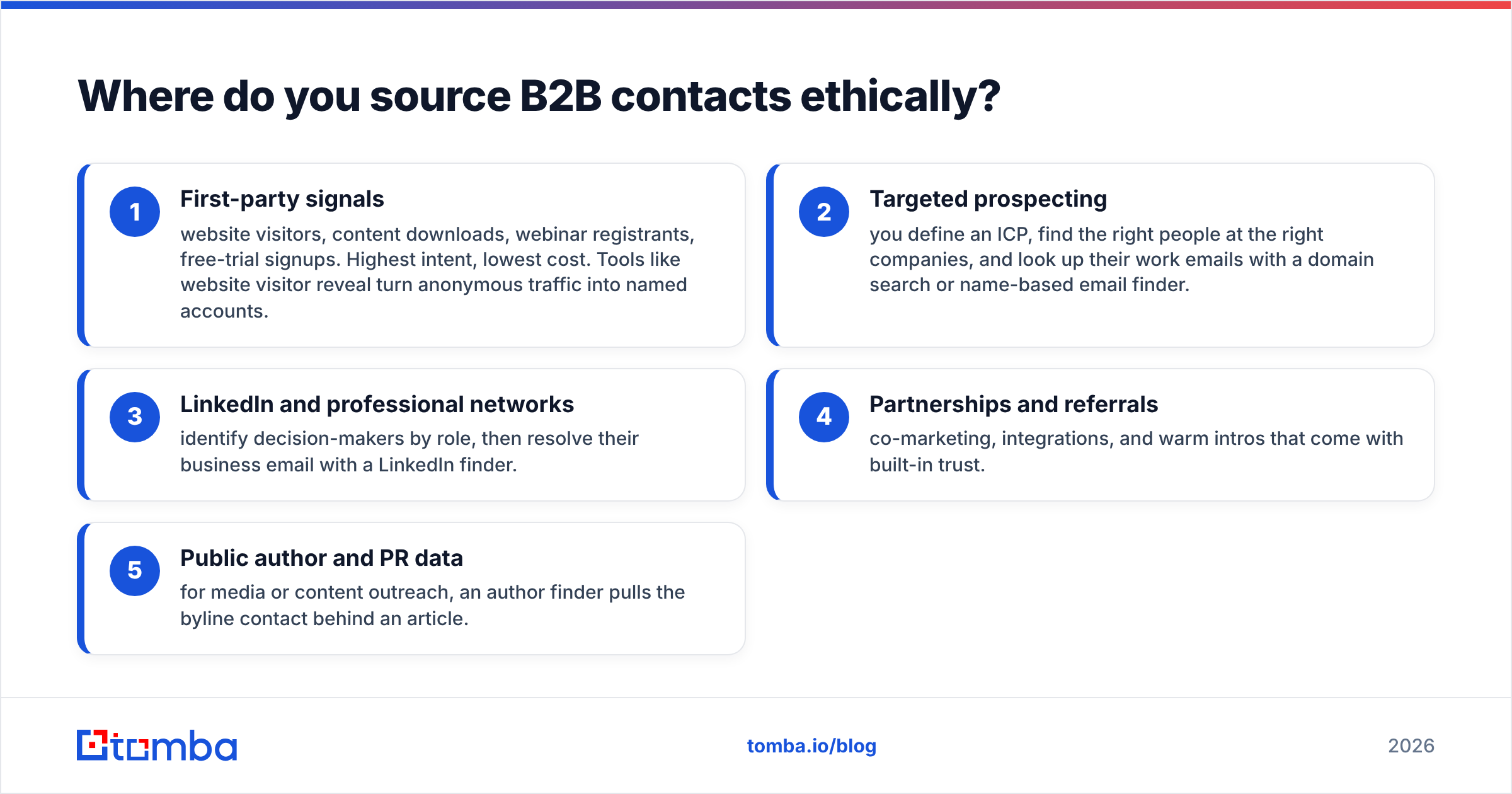
The strongest sources, ranked roughly by quality:
- First-party signals — website visitors, content downloads, webinar registrants, free-trial signups. Highest intent, lowest cost. Tools like website visitor reveal turn anonymous traffic into named accounts.
- Targeted prospecting — you define an ICP, find the right people at the right companies, and look up their work emails with a domain search or name-based email finder.
- LinkedIn and professional networks — identify decision-makers by role, then resolve their business email with a LinkedIn finder.
- Partnerships and referrals — co-marketing, integrations, and warm intros that come with built-in trust.
- Public author and PR data — for media or content outreach, an author finder pulls the byline contact behind an article.
Notice what's missing: scraped social profiles sold in bulk, recycled marketing lists, and "verified" databases of dubious origin. If you can't explain how a contact entered your list, it shouldn't be there.
How do you verify a B2B email list?#
You verify by checking syntax, domain (MX records), mailbox existence via SMTP, and catch-all status — ideally in bulk, before the first send. Verification is the single highest-ROI step in list building because it directly protects deliverability.
A complete verification pass checks five things:
- Syntax — is it a structurally valid address?
- Domain/MX — does the domain accept mail at all?
- Mailbox — does the specific inbox exist (SMTP ping)?
- Catch-all — does the domain accept everything, masking whether the box is real? A catch-all verifier gives you a confidence score instead of a coin flip.
- Risk flags — is it a known spam trap, disposable address, or role account (info@, sales@)?
Run this with an email verifier on the full list, then drop or quarantine anything risky. As a rule, keep your verified-bounce projection under 3% before you hit send. You can sanity-check a single address for free with the free email checker before committing credits to a bulk run.

Build vs. buy: which approach wins?#
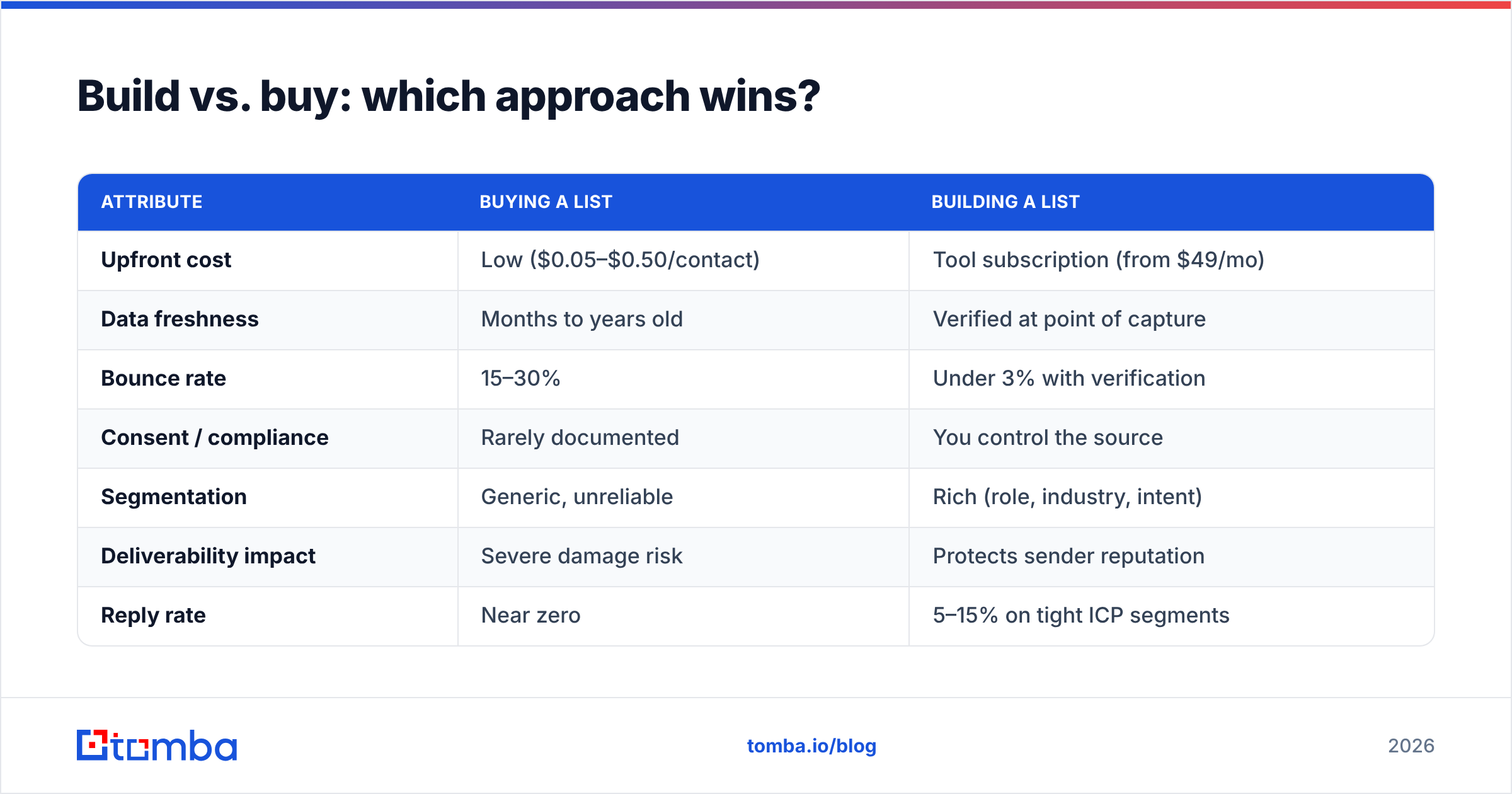
Building wins on every metric that matters except day-one volume — and day-one volume is exactly what gets you blacklisted. Here's the head-to-head.
| Attribute | Buying a List | Building a List |
|---|---|---|
| Upfront cost | Low ($0.05–$0.50/contact) | Tool subscription (from $49/mo) |
| Data freshness | Months to years old | Verified at point of capture |
| Bounce rate | 15–30% | Under 3% with verification |
| Consent / compliance | Rarely documented | You control the source |
| Segmentation | Generic, unreliable | Rich (role, industry, intent) |
| Deliverability impact | Severe damage risk | Protects sender reputation |
| Reply rate | Near zero | 5–15% on tight ICP segments |
| Long-term value | Decays immediately | Compounds with your domain |
The "low upfront cost" of buying is a trap. Factor in the bounces, the blacklisting cleanup, and the lost domain reputation, and a purchased list is the most expensive option on the table. Building with a finder-and-verifier stack costs less and gets better every quarter as your sender reputation strengthens.
How do you segment a B2B list for higher reply rates?#
Segment by the variables that change your message: role, company size, industry, tech stack, and intent signal. A relevant message to 500 people beats a generic blast to 50,000 — both in replies and in deliverability, because engagement is now a ranking factor.
Practical segments that move the needle:
- By seniority — a VP gets an outcome-focused message; a practitioner gets a workflow-focused one.
- By company size — SMB and enterprise have different buying processes and pain points.
- By industry vertical — swap in the language and proof points your prospect's peers use.
- By tech stack — if you integrate with their CRM, lead with it. A website tech checker surfaces what they run.
- By intent — visited pricing twice this week? That's a hotter segment than a cold name.
Enrich your raw list with firmographic and role data so these segments are real, not guesses. Data enrichment appends company size, industry, and seniority to contacts you've already found, turning a flat list into a segmentable asset. For the methodology behind scoring and prioritizing these segments, G2's lead intelligence category is a useful reference point.
What metrics keep a B2B list healthy?#
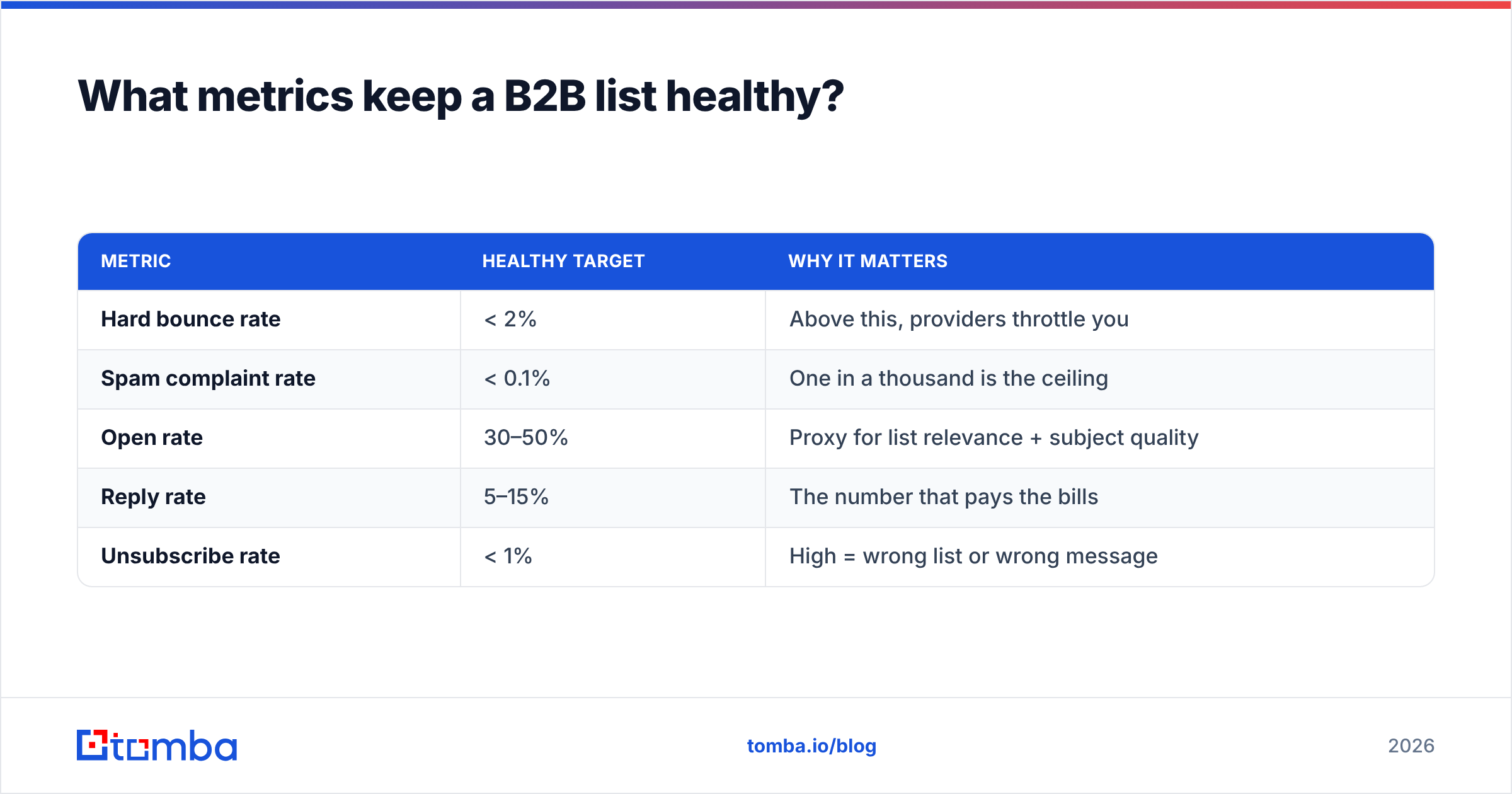
Track bounce rate, spam-complaint rate, open rate, and reply rate — and treat the first two as guardrails, not vanity numbers. If bounces or complaints climb, stop sending and clean the list before you do more damage.
| Metric | Healthy target | Why it matters |
|---|---|---|
| Hard bounce rate | < 2% | Above this, providers throttle you |
| Spam complaint rate | < 0.1% | One in a thousand is the ceiling |
| Open rate | 30–50% | Proxy for list relevance + subject quality |
| Reply rate | 5–15% | The number that pays the bills |
| Unsubscribe rate | < 1% | High = wrong list or wrong message |
These numbers are downstream of list quality. You don't fix a 12% bounce rate with better copy — you fix it with verification and tighter sourcing. If your domain reputation is already shaky, monitor sender reputation and warm up before scaling volume. Microsoft's SNDS dashboard gives you the Outlook-side view of the same health signals.
What does a repeatable list-building workflow look like?#
A repeatable workflow turns ad-hoc prospecting into a system: define ICP, source, find emails, verify, enrich, segment, then sync to your sequencer. Each step feeds the next, and you measure at every gate.
A typical week-one build looks like this:
- Define the ICP — write down the role, company size, industry, and trigger event you're targeting. Be specific enough that you could disqualify a bad-fit contact in five seconds.
- Source the accounts — pull a target account list from your CRM, intent data, or a B2B database.
- Find the emails — run names and domains through the finder. For multi-hundred-contact pulls, the bulk email finder does it in one job.
- Verify everything — bulk-verify, drop the risky addresses, quarantine the catch-alls for a separate low-volume test.
- Enrich and segment — append firmographics, then split into the segments from the section above.
- Sync to your tools — push clean, segmented contacts into your CRM or sequencer via the HubSpot integration or Tomba API.
- Send small, then ramp — start with a warm volume, watch the guardrail metrics, and scale only when they stay green.
The whole loop runs from a Chrome browser extension, a Google Sheets add-on, or programmatically through the API — pick whichever fits how your team already works. Review Tomba pricing to match the volume tier to your monthly contact targets.
Frequently asked questions#
Is it legal to build a B2B email list? Yes, when done correctly. B2B outreach is permitted under most frameworks (including GDPR's legitimate-interest basis and CAN-SPAM) provided you contact people in a professional capacity about relevant business matters, identify yourself, and offer an easy opt-out. Always confirm the specific rules for your recipients' jurisdiction.
How many contacts should a starter list have? Quality over quantity. A tightly segmented list of 200–500 verified contacts in a single ICP will outperform tens of thousands of generic addresses. Start narrow, prove the message converts, then expand the segment.
How often should I re-verify my list? Re-verify before every major campaign and at least quarterly for evergreen lists. B2B email decays roughly 2–3% per month as people change jobs, so a list that was clean six months ago needs another pass.
Can I use role-based addresses like info@ or sales@? Sparingly. Role accounts have low engagement and higher complaint risk. Prefer named individual mailboxes; reserve role addresses for support or partnership context where they make sense.
Start building a list that actually converts#
The fastest path to a list that reaches inboxes is to stop buying and start building — source from real signals, verify every address, and segment before you scale. That's a system, not a one-time purchase, and it compounds with your sender reputation instead of eroding it.
Tomba Email Finder is built for exactly this loop: find professional emails by name, domain, or company, verify them in bulk, enrich for segmentation, and push the clean result straight into your CRM. Start on the free tier with 25 searches a month, and move up to Starter ($49/mo) or Growth ($99/mo) when your pipeline demands it. Build the list once, build it right, and let it pay you back every quarter.
// get started
Find, verify and enrich your first contacts today
Start on the free plan with 25 searches a month, then scale when your team is ready.
Free plan · No credit card required · GDPR & CCPA
// about the author