Best B2B Email List Providers in 2026: A Buyer's Guide
Buying a B2B email list is fast but risky. Here's how the top B2B email list providers compare on accuracy, price, and deliverability in 2026 — and when building beats buying.
Buying a B2B email list feels like a shortcut: pay once, download a CSV, start sending tomorrow. The problem is what arrives in that CSV. Stale records, recycled contacts, spam traps, and addresses that bounce on the first send can wreck your sender reputation before your first reply lands.
This guide compares the main types of b2b email list providers in 2026, what they actually charge, where their data comes from, and when you're better off building a fresh, verified list on demand instead of buying a static one.
TL;DR#
- Pre-built static lists are the riskiest option — they decay ~2.5% per month and often arrive seeded with spam traps that torch deliverability.
- Subscription data platforms (ZoomInfo, Apollo, Cognism, Lusha) sell access to a database, not a one-off file, and refresh records continuously.
- On-demand email finders like Tomba let you build a targeted, verified list at the moment you need it — no buying contacts you'll never email.
- Compliance matters more than ever: GDPR, CAN-SPAM, and CASL all penalize bad sourcing, and "we bought a list" is not a defense.
- Best practice in 2026: target accounts first, find and verify contacts on demand, then enrich — instead of paying for a giant generic list.
What are B2B email list providers?#
A B2B email list provider sells you business contact data — names, job titles, company, and work email addresses — so you can reach prospects without finding each one manually. Think of it like the difference between catching fish yourself and buying frozen fillets: convenience comes at the cost of freshness and control.
There are three broad categories, and conflating them is where most buyers go wrong:
- Static list sellers — You buy a fixed CSV of "50,000 marketing managers in SaaS." It's a snapshot, accurate only on the day it was compiled.
- Subscription data platforms — You pay monthly or annually for access to a living database and pull contacts as needed. Records get re-verified on a rolling basis.
- On-demand email finders — Tools like a Tomba Email Finder generate and verify a specific contact's email the moment you search, so the data is fresh by definition.
The pattern to remember: static = cheapest upfront, most expensive in deliverability damage; on-demand = pay for exactly what you use.

How accurate is bought B2B email data?#
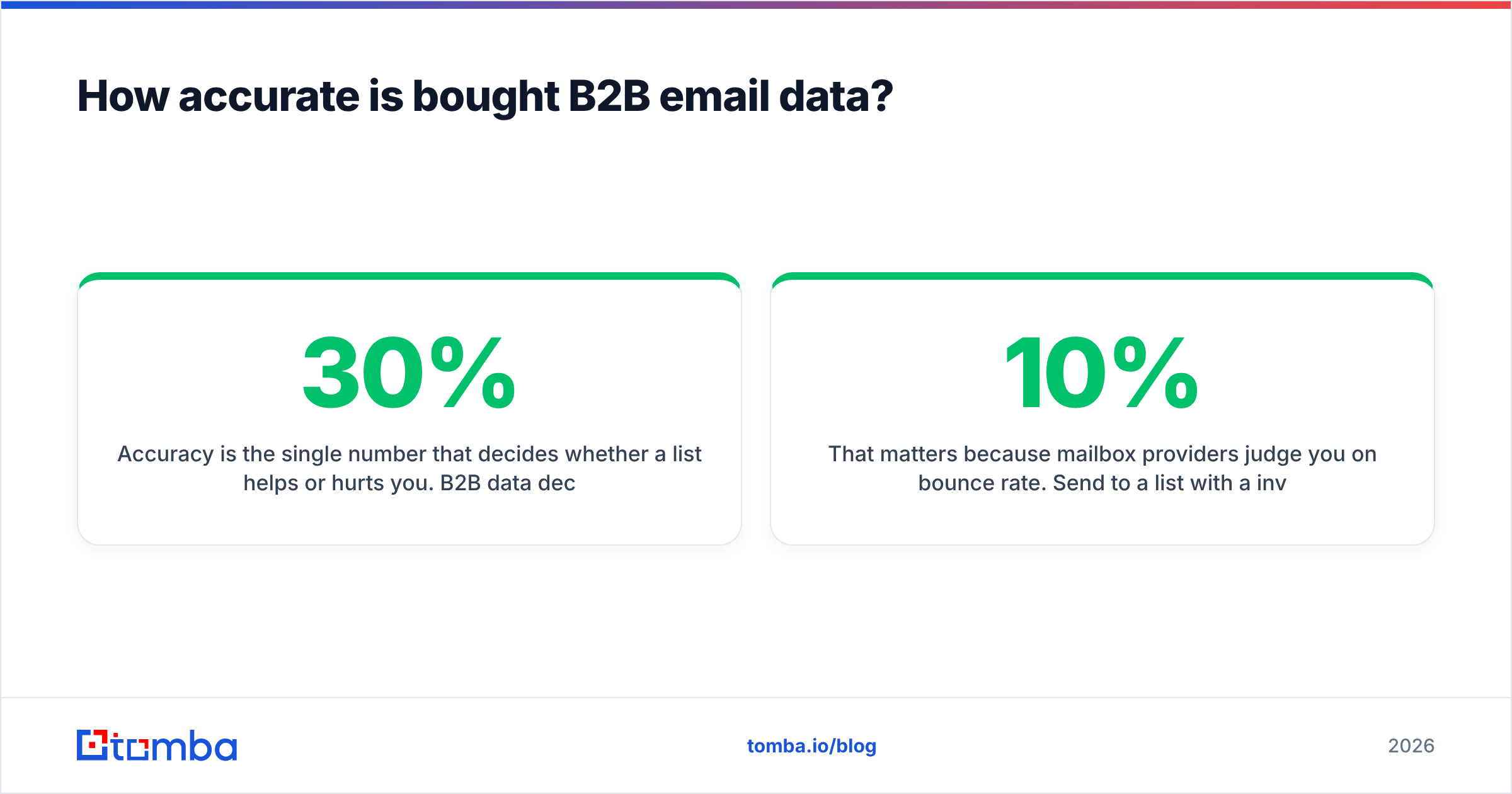
Accuracy is the single number that decides whether a list helps or hurts you. B2B data decays fast — people change jobs, companies rebrand, and email formats shift. Industry research consistently puts B2B data decay around 30% per year, or roughly 2.5% per month. A list compiled six months ago can already be 15% wrong before you send a single email.
That matters because mailbox providers judge you on bounce rate. Send to a list with a 10% invalid rate and Gmail and Outlook will start routing you to spam — punishing the good addresses on the same list too. A clean list isn't a nice-to-have; it's the difference between landing in the inbox and quietly disappearing.
)
This is why verification is non-negotiable. Whatever the source, you should run addresses through an email verifier before sending, and handle catch-all domains carefully since they accept everything and tell you nothing. Strong sender hygiene also depends on email deliverability fundamentals like SPF, DKIM, and warmup — no list quality survives a misconfigured domain.
What do the top B2B email list providers cost?#
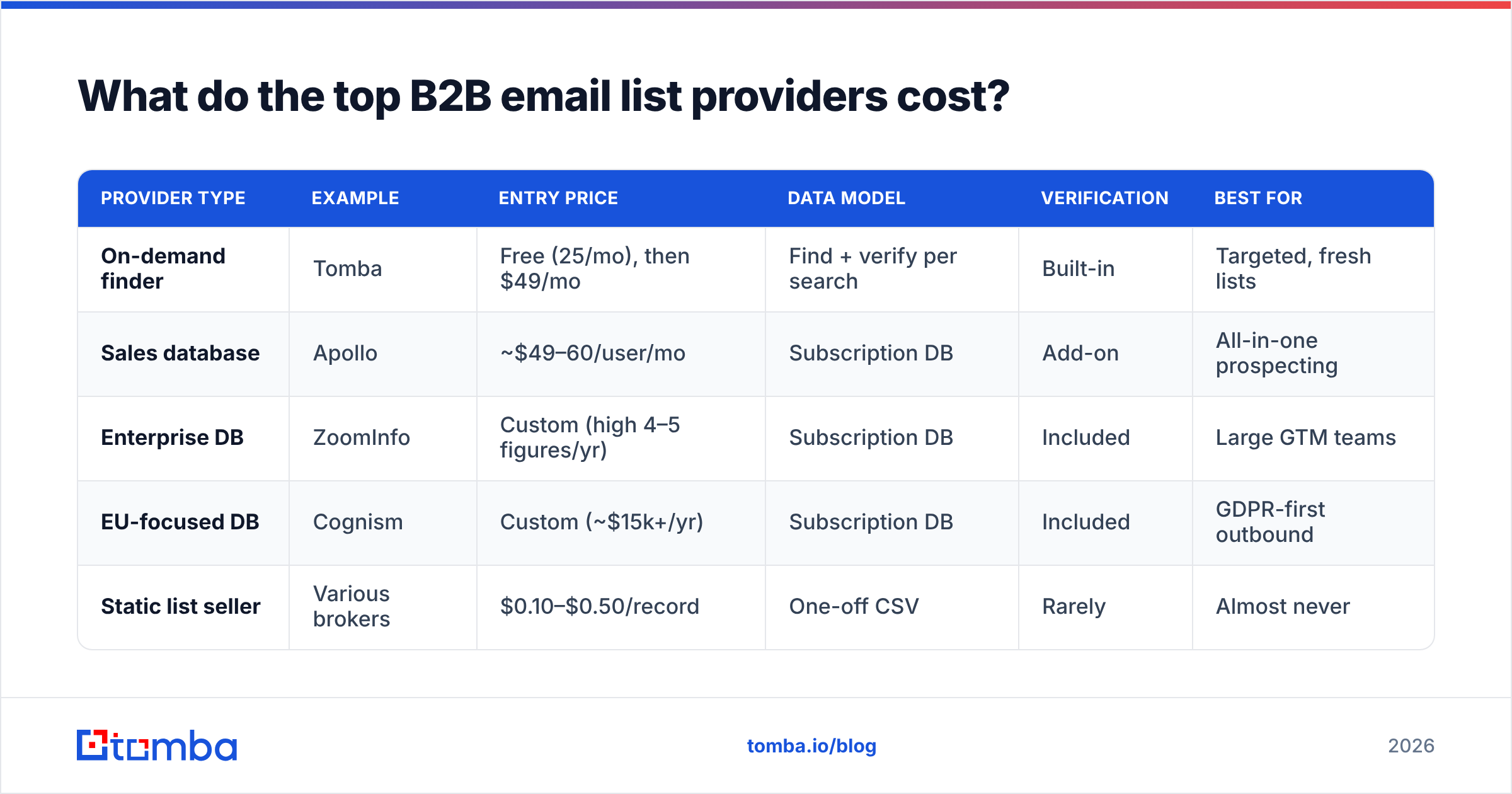
Pricing models vary wildly, which makes apples-to-apples comparison hard. Static sellers quote per-record or per-list; platforms charge for seats and credits; on-demand finders charge per lookup. Here's how the main options stack up in 2026.
| Provider type | Example | Entry price | Data model | Verification | Best for |
|---|---|---|---|---|---|
| On-demand finder | Tomba | Free (25/mo), then $49/mo | Find + verify per search | Built-in | Targeted, fresh lists |
| Sales database | Apollo | ~$49–60/user/mo | Subscription DB | Add-on | All-in-one prospecting |
| Enterprise DB | ZoomInfo | Custom (high 4–5 figures/yr) | Subscription DB | Included | Large GTM teams |
| EU-focused DB | Cognism | Custom (~$15k+/yr) | Subscription DB | Included | GDPR-first outbound |
| Static list seller | Various brokers | $0.10–$0.50/record | One-off CSV | Rarely | Almost never |
A few things jump out. Enterprise platforms like ZoomInfo and Cognism deliver depth but lock you into custom annual contracts that don't fit a small team. Static brokers look cheap per record until you factor in the bounces, the spam-trap risk, and the fact that you're buying contacts you'll never actually email. Tomba pricing sits at the practical end: a free tier to test, then $49/mo Starter, $99/mo Growth, $249/mo Pro, and custom Enterprise — and you only spend credits on contacts you choose to pull.
For teams comparing the database giants specifically, see how an Apollo alternative or Clearbit alternative approach changes the math when you don't need a full sales-engagement suite.
Should you buy a list or build one?#
Build it. In nearly every 2026 scenario, building a targeted list beats buying a generic one — and the gap is widening.
Here's the reasoning in plain terms. A bought list optimizes for volume: lots of contacts, loosely matched to your criteria, decaying from day one. A built list optimizes for relevance: you define the accounts that fit your ICP, then find the specific people who matter at each one. Smaller, fresher, and far more likely to reply.
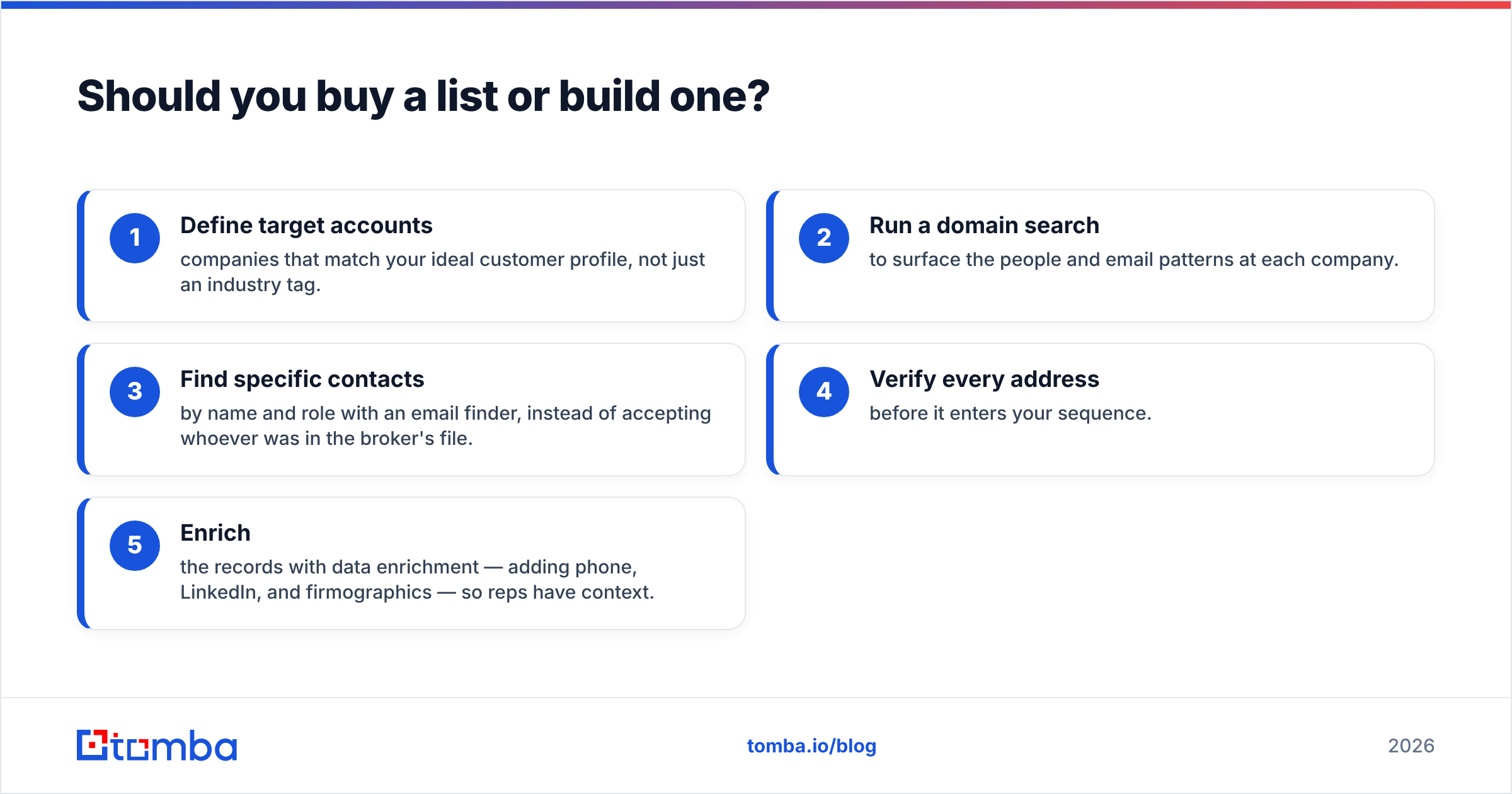
The modern build workflow looks like this:
- Define target accounts — companies that match your ideal customer profile, not just an industry tag.
- Run a domain search to surface the people and email patterns at each company.
- Find specific contacts by name and role with an email finder, instead of accepting whoever was in the broker's file.
- Verify every address before it enters your sequence.
- Enrich the records with data enrichment — adding phone, LinkedIn, and firmographics — so reps have context.
)
This is also where bulk tooling earns its keep. A bulk email finder lets you upload a list of companies or names and get back verified contacts at scale, so "build, don't buy" doesn't mean "do it one row at a time."
Is buying B2B email lists legal and compliant?#
It's legal in some places and flatly risky everywhere. The honest answer: buying a list rarely violates the law by itself, but how you use it usually does, and "the provider said it was opt-in" won't save you.
- GDPR (EU/UK): Requires a lawful basis to process personal data. Cold-emailing a purchased list without legitimate interest documentation or consent exposes you to fines. Cognism and other EU-focused platforms market heavily on this gap.
- CAN-SPAM (US): Doesn't require prior consent, but mandates accurate headers, a clear opt-out, and a physical address. Buying lists isn't banned, but the FTC penalizes deceptive sends.
- CASL (Canada): Among the strictest — implied or express consent is generally required, and penalties are steep.
The practical safeguard is sourcing transparency. Knowing exactly where a record came from — and being able to show it — matters when a complaint lands. That's part of why Tomba's data sources are documented rather than a black box, and why finding a publicly available business email tied to a real role is a cleaner footing than buying an anonymous bulk file. For background on the rules, the official GDPR text and the FTC CAN-SPAM guide are the authoritative references, and review sites like G2 help you vet a provider's reputation before you commit.
What to look for in a B2B email list provider#
Cut through the marketing with these criteria. Score any provider against them before you spend a dollar.
- Verification, not just volume — A provider that brags about "200M contacts" but verifies nothing is selling you bounce risk. Look for real-time verification and catch-all handling.
- Data freshness — Ask how often records are re-checked. Continuous beats quarterly; quarterly beats "compiled once."
- Sourcing transparency — They should tell you where data comes from. Vagueness is a red flag for compliance exposure.
- Pay-for-what-you-use pricing — Avoid paying for millions of contacts you'll never email. Credit-based and per-search models scale with actual usage.
- Integrations and API — Your data needs to flow into your CRM and sequences. Check for a real email finder API, native HubSpot and Salesforce connectors, and spreadsheet add-ons.
- A free tier to test — If you can't trial the data quality before paying, walk away.
A provider that nails verification, freshness, and transparent sourcing will outperform a bigger, cheaper static list every time — measured where it counts, in replies and inbox placement.
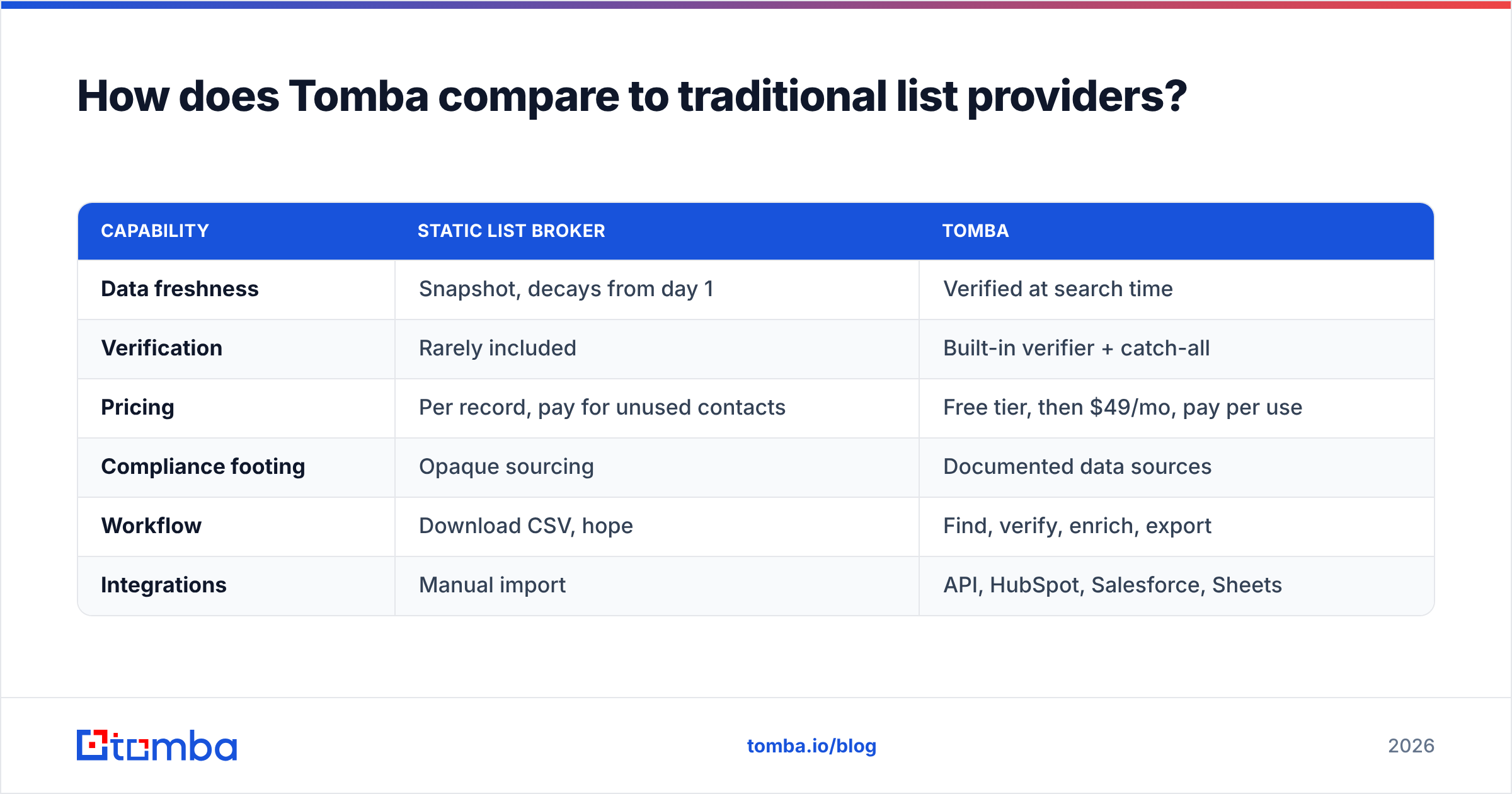
How does Tomba compare to traditional list providers?#
Tomba sits in the on-demand category rather than the static-broker or heavy-enterprise lane. Instead of selling you a frozen file or locking you into a five-figure annual contract, it finds and verifies the specific contacts you need, when you need them.
| Capability | Static list broker | Tomba |
|---|---|---|
| Data freshness | Snapshot, decays from day 1 | Verified at search time |
| Verification | Rarely included | Built-in verifier + catch-all |
| Pricing | Per record, pay for unused contacts | Free tier, then $49/mo, pay per use |
| Compliance footing | Opaque sourcing | Documented data sources |
| Workflow | Download CSV, hope | Find, verify, enrich, export |
| Integrations | Manual import | API, HubSpot, Salesforce, Sheets |
The trade-off is honest: if you genuinely need a massive, undifferentiated blast list and don't care about deliverability, a broker is cheaper per record. For everyone running real outbound in 2026 — where inbox placement and compliance decide whether the campaign works at all — building a fresh, verified list wins.
You can also extend the same workflow beyond email: pull B2B phone numbers for multichannel outreach, or run a reverse email lookup to enrich inbound leads you only have an address for.
The bottom line on B2B email list providers#
Stop thinking "where do I buy a list" and start thinking "how do I build the right one." Static b2b email list providers optimize for the wrong metric — raw volume — while your campaigns live or die on accuracy, freshness, and compliance. Subscription databases solve freshness but often overshoot on price and scope for smaller teams. On-demand finders give you the cleanest path: define your accounts, find the exact people, verify before you send.
If you want to build targeted, verified B2B contact lists without buying contacts you'll never use, start with the Tomba Email Finder. The free tier gives you 25 searches a month to test data quality on your own ICP, and built-in verification means what you export is what actually lands in the inbox. Find emails, verify them, enrich them, and skip the spam-trap roulette of a bought CSV.
// get started
Find, verify and enrich your first contacts today
Start on the free plan with 25 searches a month, then scale when your team is ready.
Free plan · No credit card required · GDPR & CCPA
// about the author