B2B Email Marketing in 2026: The Complete Playbook
A no-fluff 2026 playbook for B2B email marketing: list building, segmentation, deliverability, copy, and the metrics that actually move pipeline.
TL;DR
- B2B email marketing in 2026 still beats every other channel on ROI, but only when your list is verified, your domain is warm, and your segments are tight.
- The biggest lever is not your copy. It is data quality: bad addresses tank deliverability before a single reader sees your subject line.
- Segment by role, intent, and lifecycle stage, then map a distinct message to each. Generic blasts are dead.
- Track reply rate and pipeline influenced, not just opens, which Apple Mail Privacy Protection made unreliable years ago.
- Build your list with a verified email finder, warm your sending domain, and keep bounce rates under 2% to protect sender reputation.
What is B2B email marketing?#
B2B email marketing is the practice of using email to reach decision-makers at other businesses to generate demand, nurture leads, and close revenue. Think of it like a trade show that never closes: instead of one crowded afternoon, you get a standing channel into the inbox of every buyer who matters, as long as you earn the right to stay there.
Unlike B2C email, where you might blast a discount to a million consumers, B2B is a long game played with a smaller, higher-value audience. A single enterprise deal can be worth more than ten thousand consumer purchases, so precision beats volume every time. You are not optimizing for impulse clicks. You are building familiarity with a buying committee of five to ten people over weeks or months.
The channel keeps winning on economics. Industry surveys from vendors like HubSpot consistently put email ROI in the range of $36 for every $1 spent, far ahead of paid social or display. But that number assumes you do the unglamorous work: clean data, a warm domain, and relevant messages.
Why does data quality matter more than copy?#
Your clever subject line is worthless if the email bounces. Mailbox providers like Google and Microsoft watch your bounce rate, spam complaints, and engagement, then decide whether your future emails land in the inbox or the spam folder. A list full of stale or guessed addresses is the fastest way to wreck that reputation.
Here is the everyday version: imagine mailing physical letters where one in five comes back marked "no such person." The post office would start treating everything you send as junk. Mailbox providers do exactly that, just faster and without telling you.
That is why list building should start with a verified source, not a scraped CSV you bought on the internet. Use an email finder to source addresses by name and company domain, then run them through an email verifier before the first send. For domains where the mail server accepts everything, a catch-all verifier gives you a confidence score so you can decide what to risk.
Keep these guardrails in place:
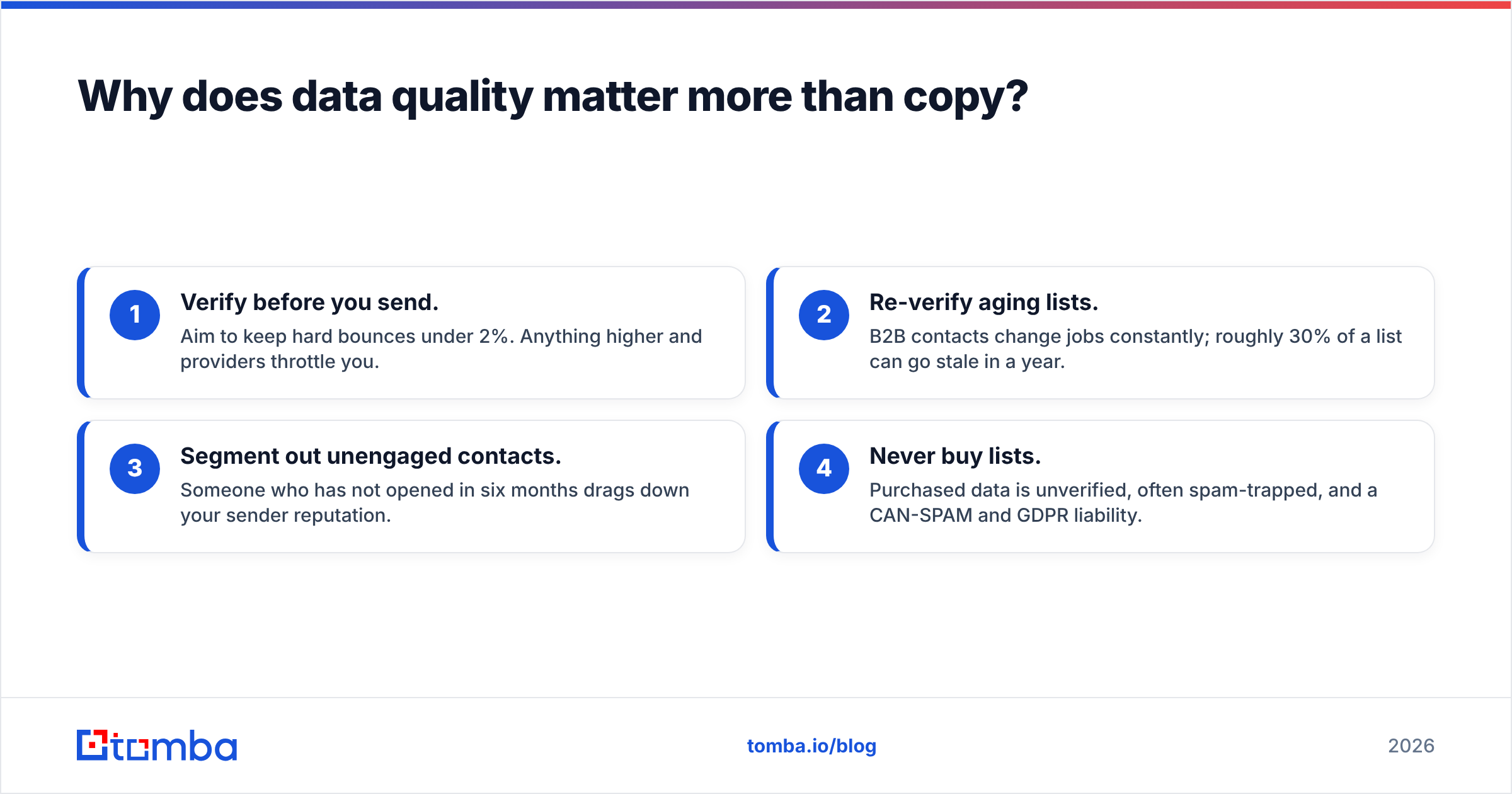
- Verify before you send. Aim to keep hard bounces under 2%. Anything higher and providers throttle you.
- Re-verify aging lists. B2B contacts change jobs constantly; roughly 30% of a list can go stale in a year.
- Segment out unengaged contacts. Someone who has not opened in six months drags down your sender reputation.
- Never buy lists. Purchased data is unverified, often spam-trapped, and a CAN-SPAM and GDPR liability.
How do you build a B2B email list the right way?#
Start from who you want to reach, then find their verified contact details, rather than starting from whatever list you can grab. A small list of 500 right-fit, verified contacts will outperform 50,000 random addresses on every metric that matters.
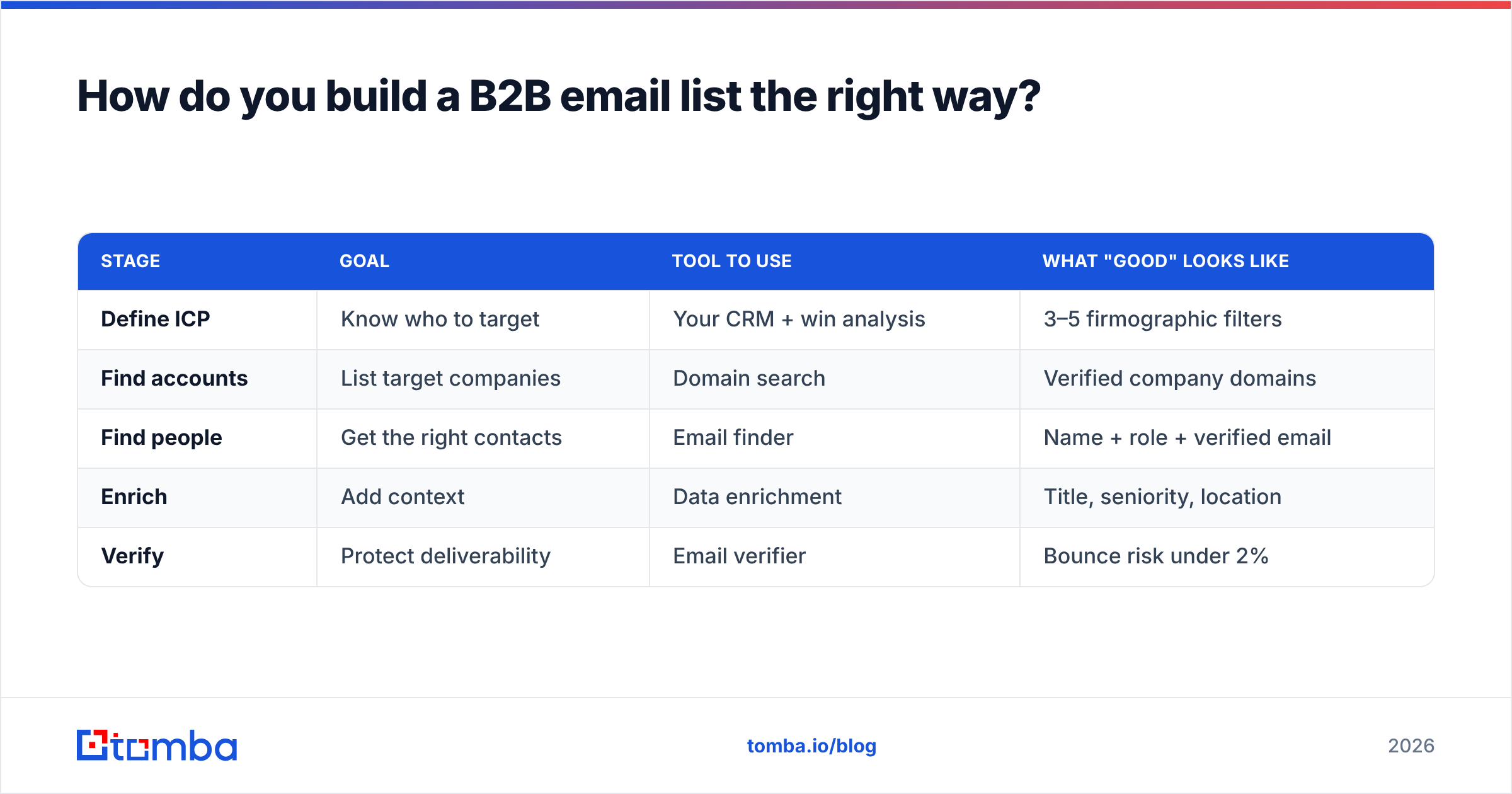
The repeatable workflow looks like this. Define your ideal customer profile, identify target accounts, find the right people inside those accounts, then enrich and verify before importing into your sending tool.
| Stage | Goal | Tool to use | What "good" looks like |
|---|---|---|---|
| Define ICP | Know who to target | Your CRM + win analysis | 3–5 firmographic filters |
| Find accounts | List target companies | Domain search | Verified company domains |
| Find people | Get the right contacts | Email finder | Name + role + verified email |
| Enrich | Add context | Data enrichment | Title, seniority, location |
| Verify | Protect deliverability | Email verifier | Bounce risk under 2% |
For scale, run the whole thing in batches. A bulk email finder lets you upload a list of names and domains and get verified emails back, which is far cheaper than per-deal manual research. If your motion is inbound-heavy, pair this with website visitor reveal to identify anonymous traffic and add those accounts to your outreach queue.
What is the best way to segment a B2B email list?#
Segment along three axes at once: role, intent, and lifecycle stage. A VP of Engineering evaluating a tool needs a different email than a procurement lead who already has a signed contract in front of them, even at the same company.
- By role and seniority. A practitioner cares about features and time saved. An executive cares about revenue, risk, and team capacity. Write to each separately.
- By intent signal. Visited your pricing page? Downloaded a comparison guide? Those are buying signals that deserve a faster, more direct sequence.
- By lifecycle stage. A cold prospect, an engaged lead, and an existing customer up for renewal are three different conversations. Treat a marketing qualified lead differently from a brand-new name.
The mistake most teams make is segmenting once and forgetting. Segments should update automatically as contacts engage. Someone who clicks three emails in a week should move into a hotter segment and get routed to sales, not keep receiving top-of-funnel newsletters.
How do you write B2B emails that get replies?#
Lead with the reader's problem, keep it short, and ask for one specific thing. Nobody at work wants to read three paragraphs about your company's mission. They want to know why you are in their inbox and what you want them to do.
A reliable structure for cold and nurture emails alike:
- Relevant opener. Reference something true about them, their company, or a trigger event. Not "I hope this email finds you well."
- The problem. Name a pain your reader actually feels, in their language.
- The proof. One concrete result or a relevant customer, kept to a single sentence.
- One ask. A single, low-friction call to action. "Worth a 15-minute look next week?" beats a four-option menu.
Keep total length under 120 words for cold outreach. Write at a sixth-grade reading level; busy executives skim. If you are staring at a blank page, a cold email AI draft gives you a starting point you can edit down, and a subject line tester flags spammy phrasing before you hit send.
Personalization at scale is the hard part. The trick is to personalize the opener and the problem statement while keeping the body templated. Pull a custom first line from enrichment data — recent funding, a new hire, a tech-stack detail — and let the rest of the email stay consistent. That gets you 80% of the lift of full personalization at 20% of the effort.
How do you keep B2B emails out of spam?#
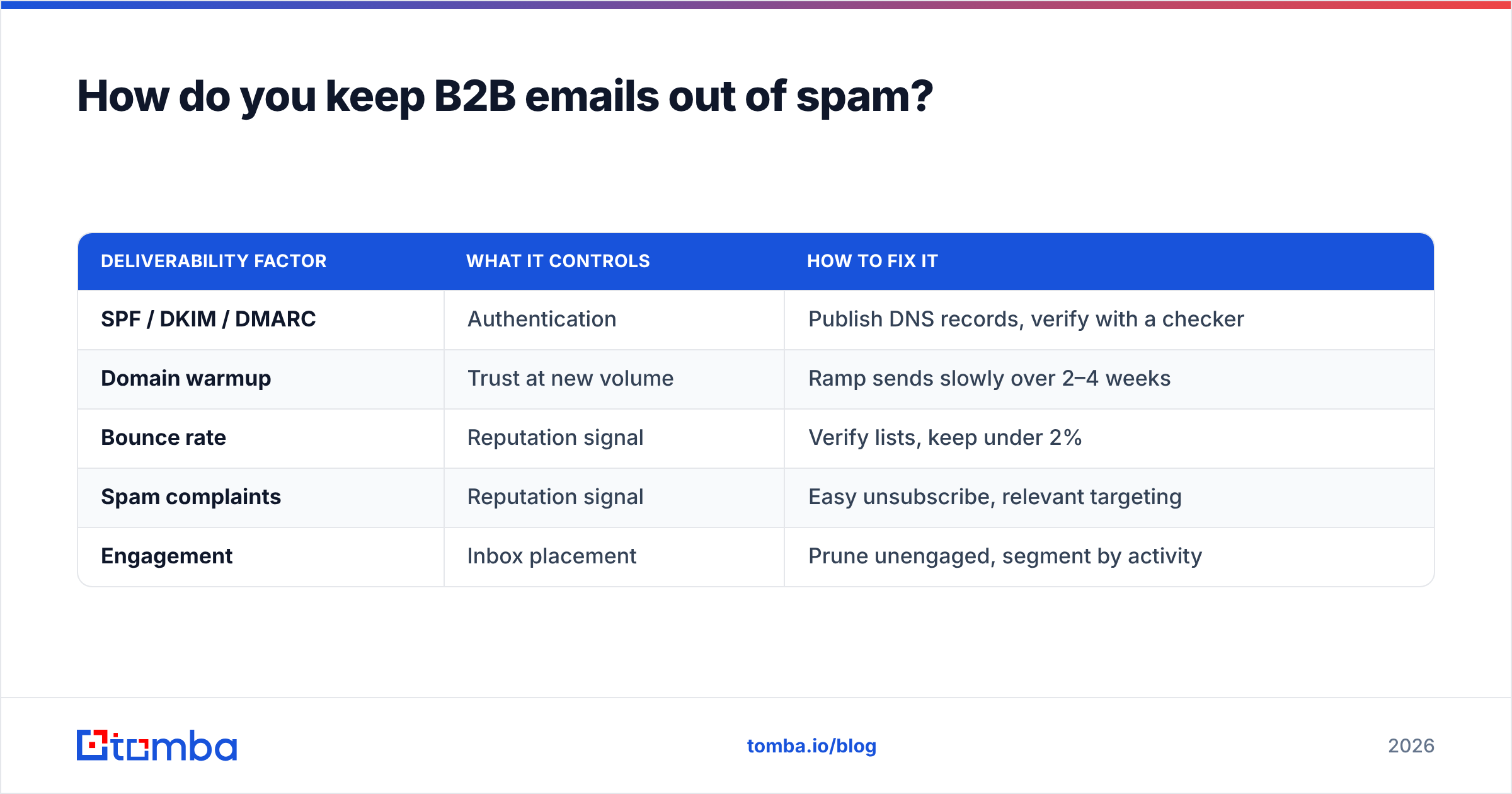
Protect your sender reputation with authentication, a warm domain, and clean lists, in that order. Deliverability is not a setting you flip on; it is a reputation you earn and can lose in a week of careless sending.
Get the technical foundation right first. Publish SPF, DKIM, and DMARC records on your sending domain. You can confirm your setup with an SPF checker and a blacklist checker before you scale volume. Google and Yahoo now require authentication for bulk senders, and Google's own Postmaster Tools is the clearest window into how they see you.
| Deliverability factor | What it controls | How to fix it |
|---|---|---|
| SPF / DKIM / DMARC | Authentication | Publish DNS records, verify with a checker |
| Domain warmup | Trust at new volume | Ramp sends slowly over 2–4 weeks |
| Bounce rate | Reputation signal | Verify lists, keep under 2% |
| Spam complaints | Reputation signal | Easy unsubscribe, relevant targeting |
| Engagement | Inbox placement | Prune unengaged, segment by activity |
Three habits protect you long-term. First, warm a new domain gradually rather than sending 5,000 emails on day one. Second, make unsubscribing trivial; a one-click opt-out costs you one contact but a hidden one earns you a spam complaint, which is far worse. Third, monitor email deliverability as an ongoing metric, not a one-time check. If reply rates suddenly drop, your placement probably slipped before your dashboard caught it.
Which B2B email metrics actually matter in 2026?#
Track reply rate, meetings booked, and pipeline influenced. Open rate is no longer trustworthy after Apple's Mail Privacy Protection began pre-loading images, which inflates opens for a large share of your audience.
Here is how to think about the funnel:
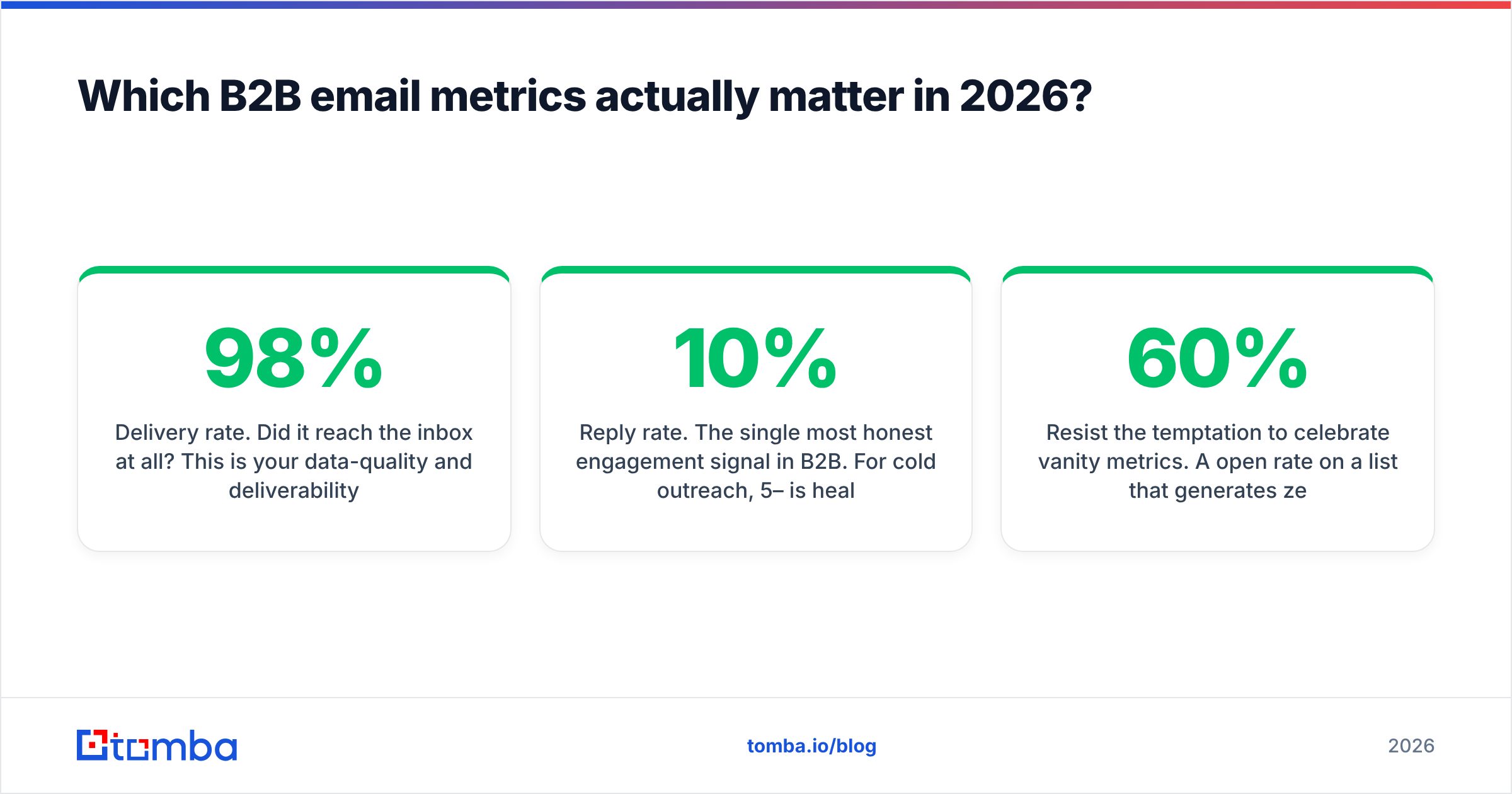
- Delivery rate. Did it reach the inbox at all? This is your data-quality and deliverability score combined. Target 98%+.
- Reply rate. The single most honest engagement signal in B2B. For cold outreach, 5–10% is healthy; for warm nurture, higher.
- Meetings booked. The bridge between marketing and revenue. This is what your sales team cares about.
- Pipeline influenced. Revenue tied to contacts your emails touched. The metric your CFO respects.
- Unsubscribe and complaint rate. Your early-warning system. A spike means your targeting or frequency is off.
Resist the temptation to celebrate vanity metrics. A 60% open rate on a list that generates zero meetings is a failure dressed up as a win. Tie every campaign back to response rate and revenue, and let those numbers, not opens, drive your next iteration.
How does B2B email marketing fit with the rest of your stack?#
Email is the connective tissue between your data, your CRM, and your sales motion, not a standalone island. The best-run programs sync verified contacts into a CRM automatically and trigger sequences off real activity.
Wire your email finder and verifier into your CRM through native integrations like HubSpot or Salesforce, or route data through Zapier for custom flows. The goal is that a new verified contact lands in the CRM, gets enriched, enters the right segment, and starts the right sequence without anyone copying and pasting a spreadsheet.
For teams that prefer to build, the Tomba API lets you verify and enrich addresses inside your own app or onboarding flow, so the data is clean before it ever reaches a marketing tool. Reviewers on G2 consistently rank integration depth as a top buying factor for exactly this reason: the channel is only as good as the data feeding it.
Conclusion: start with clean data#
B2B email marketing in 2026 rewards teams that treat data as the foundation and copy as the finish. You can write the sharpest sequence in your category, but if half your list bounces, your domain reputation collapses and none of it reaches a human.
Get the order right: build a verified list, warm your domain, segment tightly, write to the reader's problem, and measure replies and pipeline. Do that and email remains the highest-ROI channel you own.
Start where the leverage is. Use the Tomba Email Finder to source verified, deliverable contacts by name, company, or domain, then check the Tomba pricing tiers — there is a free plan with 25 searches a month to test the data quality before you commit, and paid plans start at $49/mo when you are ready to scale. Clean data first; everything else compounds from there.
// get started
Find, verify and enrich your first contacts today
Start on the free plan with 25 searches a month, then scale when your team is ready.
Free plan · No credit card required · GDPR & CCPA
// about the author