B2B Email Marketing Lists: How to Build One That Converts in 2026
Bought B2B email marketing lists tank your deliverability and waste budget. Here's how to build accurate, opt-compliant lists that actually convert in 2026.
TL;DR
- A B2B email marketing list is only an asset when it's accurate, permission-aware, and segmented — a raw dump of addresses is a liability that burns your sending domain.
- Buying pre-packaged lists is the fastest way to get blacklisted; bounce rates above 2% and spam-trap hits wreck deliverability for months.
- Building your own list from verified, intent-aligned sources costs less per usable contact and keeps your sender reputation intact.
- Verification and enrichment are non-negotiable: a list decays roughly 22–30% per year as people change jobs.
- The winning workflow is find → verify → enrich → segment → warm up, not "import 50,000 rows and blast."
What is a B2B email marketing list?#
A B2B email marketing list is a structured set of business contacts — name, work email, company, role, and ideally firmographic context — that you can legally and effectively email about a relevant offer. The key word is effectively. Anyone can collect 100,000 addresses; almost no one can collect 100,000 addresses that open, click, and reply.
Think of your list like a freshwater reservoir. The water level (volume) matters, but contamination (invalid addresses, spam traps, uninterested contacts) is what actually determines whether the reservoir is usable. One poisoned inflow can taint the whole supply. In email terms, a handful of spam-trap addresses can drop your domain reputation low enough that even your good contacts stop seeing your messages.
That's why the modern definition of a quality list has shifted. In 2026, a "good" B2B list is measured less by size and more by three properties: validity (the address resolves and accepts mail), relevance (the person plausibly cares about your offer), and permissibility (you have a defensible legal basis to contact them). Miss any one and the list underperforms.
Should you buy or build B2B email marketing lists?#
Build it. Buying is almost always the wrong move, and the math is not close.
Purchased lists are sold to many buyers, scraped without consent, and stuffed with outdated or fabricated addresses. The moment you import one, you inherit every spam trap and abandoned mailbox in it. Mailbox providers like Google and Microsoft treat sudden sends to stale, never-engaged addresses as a textbook spammer signal. The result is predictable: high bounces, spam-folder placement, and a sending domain you may have to abandon.
Building, by contrast, means you control every input. You find contacts that match your ideal customer profile, verify each address before it touches your sequence, and only email people with a plausible reason to hear from you.
Here's the honest comparison most "buy a list" vendors won't show you:
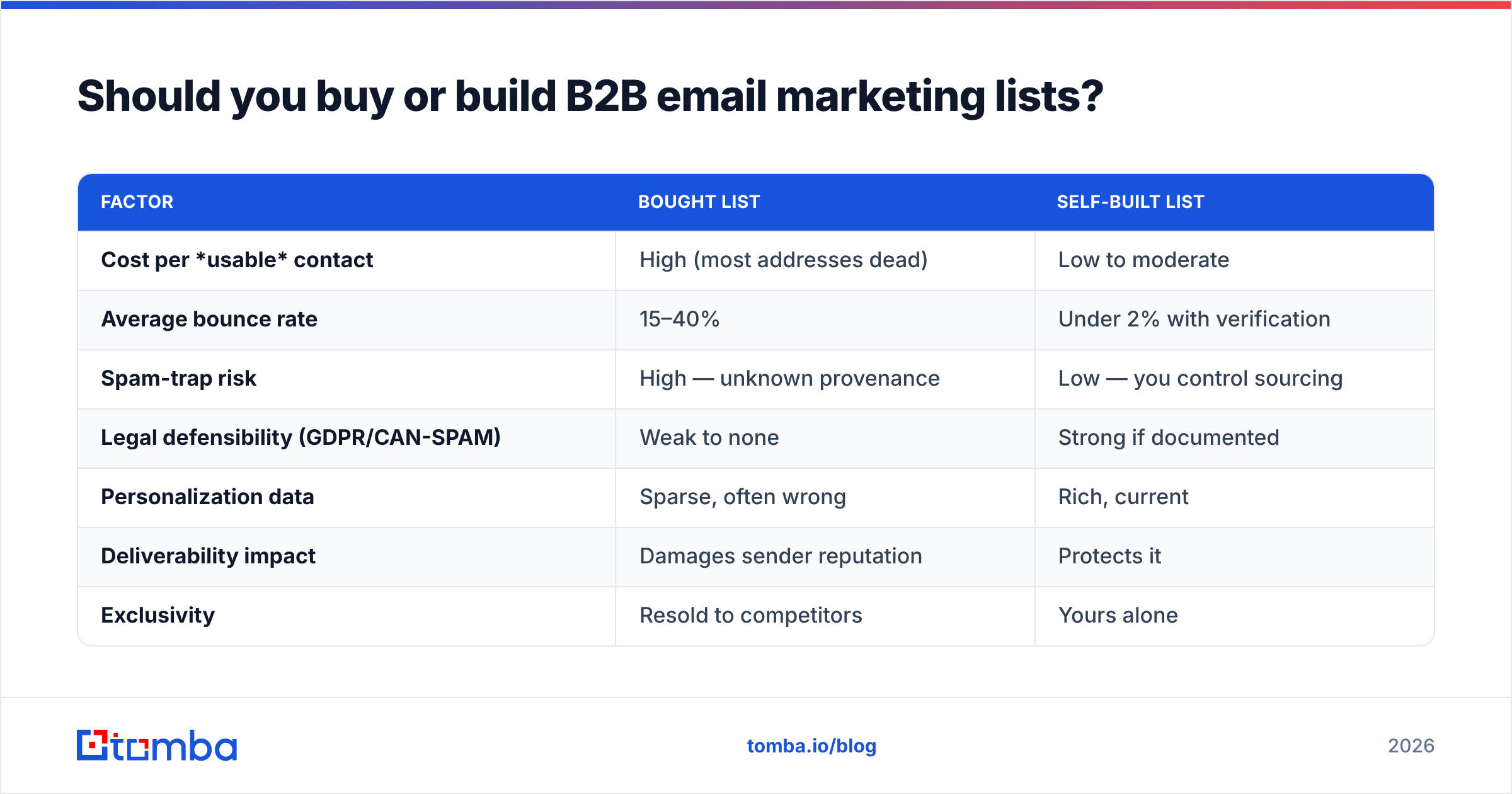
| Factor | Bought list | Self-built list |
|---|---|---|
| Cost per usable contact | High (most addresses dead) | Low to moderate |
| Average bounce rate | 15–40% | Under 2% with verification |
| Spam-trap risk | High — unknown provenance | Low — you control sourcing |
| Legal defensibility (GDPR/CAN-SPAM) | Weak to none | Strong if documented |
| Personalization data | Sparse, often wrong | Rich, current |
| Deliverability impact | Damages sender reputation | Protects it |
| Exclusivity | Resold to competitors | Yours alone |
The build approach is not slower in any way that matters. A modern email finder plus a domain search can assemble a few thousand targeted, verified contacts in an afternoon — and every one of them is exclusively yours.
How do you build a B2B email marketing list step by step?#
Treat list building as a pipeline, not a one-time purchase. Each stage filters out waste before it reaches your outbox.
- Define the ICP first. Before you collect a single address, write down the industry, company size, region, and the specific job titles you sell to. A list of 500 contacts that match your ideal customer profile outperforms 50,000 random addresses every time.
- Source the companies. Build a target-account list from your CRM, LinkedIn searches, conference attendee lists, G2 category pages, and existing inbound interest. Companies first, people second.
- Find the people and their emails. Use a domain search to pull every public address pattern at a target company, then an email finder to resolve specific decision-makers by name and role.
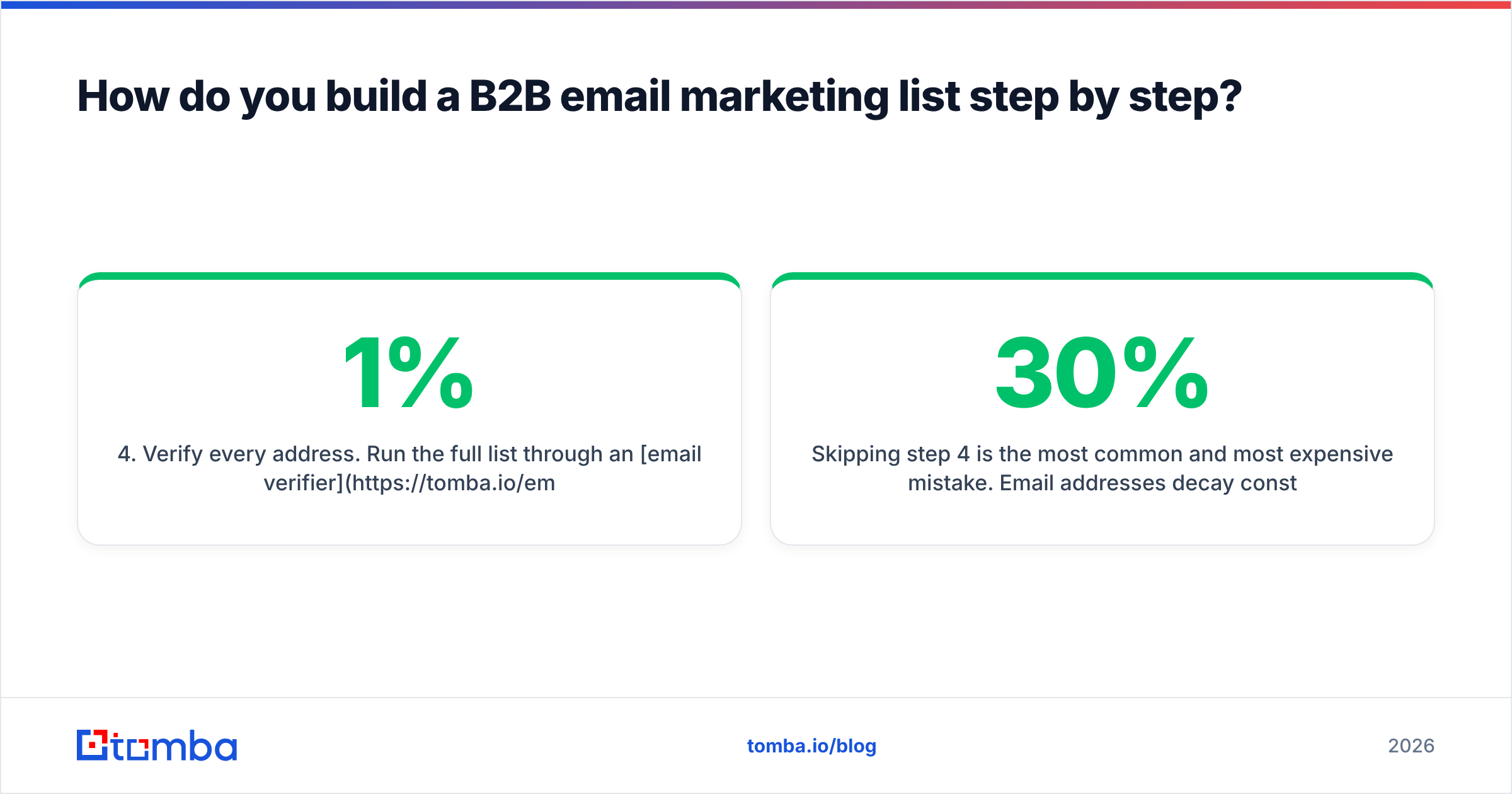
- Verify every address. Run the full list through an email verifier to drop invalid, role-based, and risky addresses before sending. This single step is the difference between a 1% and a 25% bounce rate.
- Enrich for personalization. Add firmographic and role data via data enrichment so you can segment and write messages that don't read like a mail merge.
- Segment and warm up. Split the list by persona and intent, then ramp your sending volume gradually so mailbox providers see steady, engaged activity rather than a sudden blast.
Skipping step 4 is the most common and most expensive mistake. Email addresses decay constantly — people switch jobs, companies rebrand domains, and mailboxes get deactivated. Industry estimates put B2B data decay at roughly 22–30% per year, which means a list you built twelve months ago is already a quarter dead.
Where should you source B2B contacts ethically?#
Good sourcing is about provenance — knowing exactly where each contact came from and why you're allowed to email them. The strongest sources, in rough order of quality:
- Your own inbound and first-party data. Website signups, gated-content downloads, webinar registrants, and trial users. These people raised their hand. Pair this with a website visitor reveal tool to identify companies browsing your site even before they fill out a form.
- Publicly listed business contacts. Company team pages, author bylines, conference speaker lists, and public directories. An author finder is ideal for content and PR outreach where the byline is public.
- Professional networks. Targeted LinkedIn searches matched to verified work emails via a LinkedIn finder, which keeps your sourcing tied to real, current roles.
- Opt-in partnerships and co-marketing. Shared webinars or content swaps where both audiences consented.
What to avoid: scraped personal addresses, lists "guaranteed" to be GDPR-compliant by the seller (the obligation is yours, not theirs), and any source you can't trace back to a clear collection event.
On the legal side, the rules differ by region and you should treat this as orientation, not legal advice. Under CAN-SPAM in the US, you must honor opt-outs, avoid deceptive subject lines, and include a physical address. Under GDPR in the EU, you generally need a lawful basis — for B2B cold outreach that's usually "legitimate interest," which requires relevance, an easy opt-out, and documentation of your reasoning. When in doubt, narrow your list to contacts where the business relevance is obvious.
How do you keep a B2B email list clean and deliverable?#
A clean list is a maintained list. Reputation is earned slowly and lost instantly, so build hygiene into your routine rather than treating it as a one-off cleanup.
The core hygiene practices:
- Verify on entry and on a schedule. Validate every new address at capture, then re-verify the full list every 60–90 days to catch decay. Bulk tools like a bulk email finder and verifier make this practical at scale.
- Handle catch-all domains deliberately. Many companies accept mail to any address, which makes standard verification ambiguous. A dedicated catch-all verifier reduces the guesswork so you're not sending blind into a domain that silently drops mail.
- Suppress and segment by engagement. Stop emailing contacts who haven't opened or clicked in 90+ days. Sunsetting dead weight raises your engagement rate, which mailbox providers reward.
- Authenticate your domain. Set up SPF, DKIM, and DMARC. Without them, even a perfect list lands in spam. Run a quick check with an SPF checker before any major campaign.
- Monitor sender reputation. Watch your sender reputation and bounce trends. A sudden spike is an early warning, not a footnote.
Deliverability and list quality are the same problem viewed from two angles. You can read more on the mechanics in the email deliverability glossary entry, but the short version is: providers grade you on how real recipients react, and a clean list is what produces good reactions.
How do you segment a B2B list for better results?#
Segmentation is where a verified list becomes a converting list. Sending one message to everyone is the marketing equivalent of shouting the same pitch across a crowded trade show — technically efficient, practically useless.
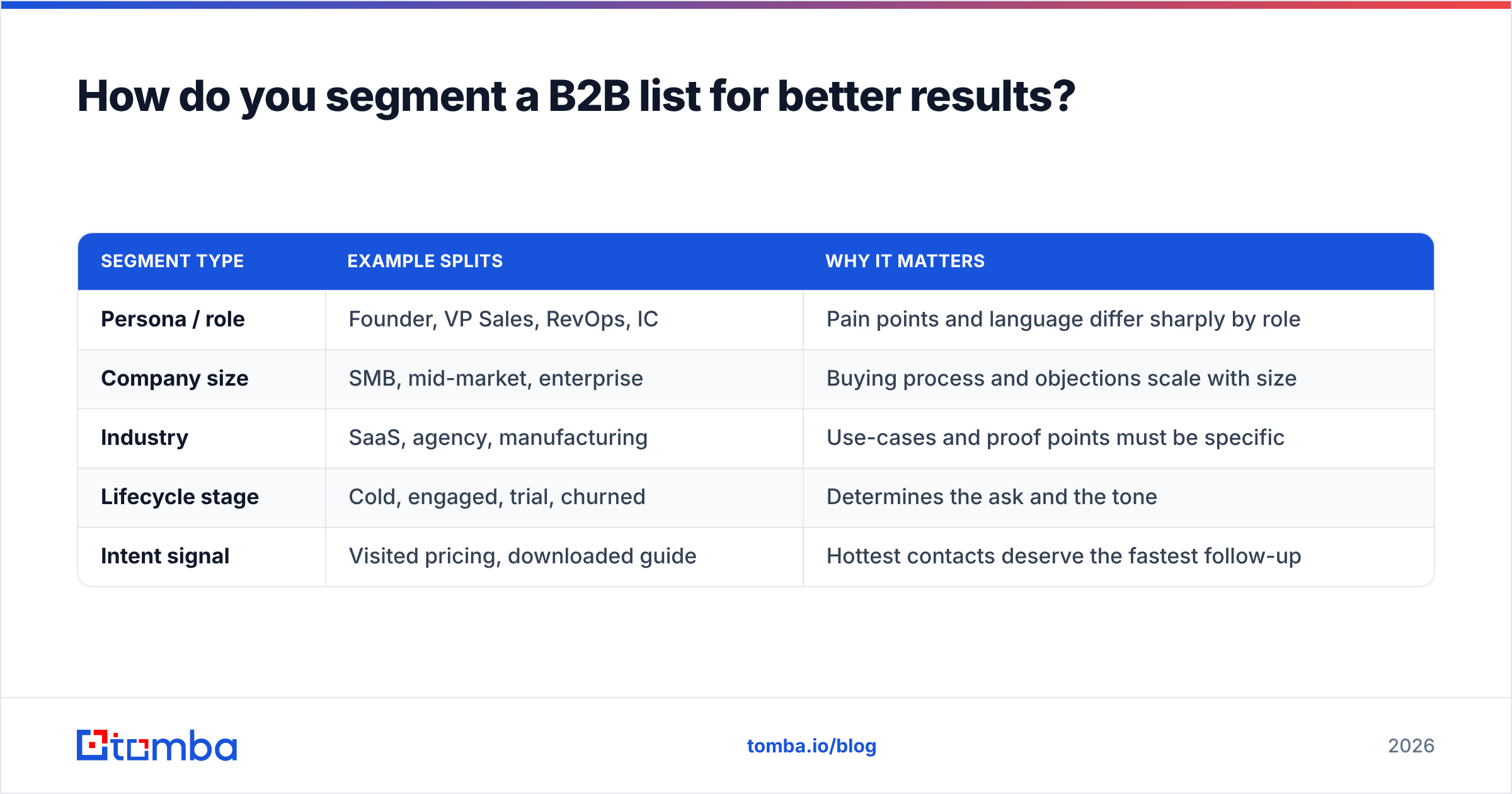
Segment along the dimensions that change what you'd say:
| Segment type | Example splits | Why it matters |
|---|---|---|
| Persona / role | Founder, VP Sales, RevOps, IC | Pain points and language differ sharply by role |
| Company size | SMB, mid-market, enterprise | Buying process and objections scale with size |
| Industry | SaaS, agency, manufacturing | Use-cases and proof points must be specific |
| Lifecycle stage | Cold, engaged, trial, churned | Determines the ask and the tone |
| Intent signal | Visited pricing, downloaded guide | Hottest contacts deserve the fastest follow-up |
A practical rule: if two contacts would receive a meaningfully different first sentence, they belong in different segments. Enrichment data is what powers this — without a reliable B2B database and clean firmographics, you can't segment beyond guesswork. Tie segments to a clear definition of a marketing qualified lead so sales and marketing agree on who gets passed along.
What does a healthy B2B email list cost?#
Costs split into three buckets: sourcing, verification, and the sending platform. The expensive line item people forget is the hidden cost of a bad list — wasted send credits, damaged domain reputation, and the sales hours spent chasing dead contacts.
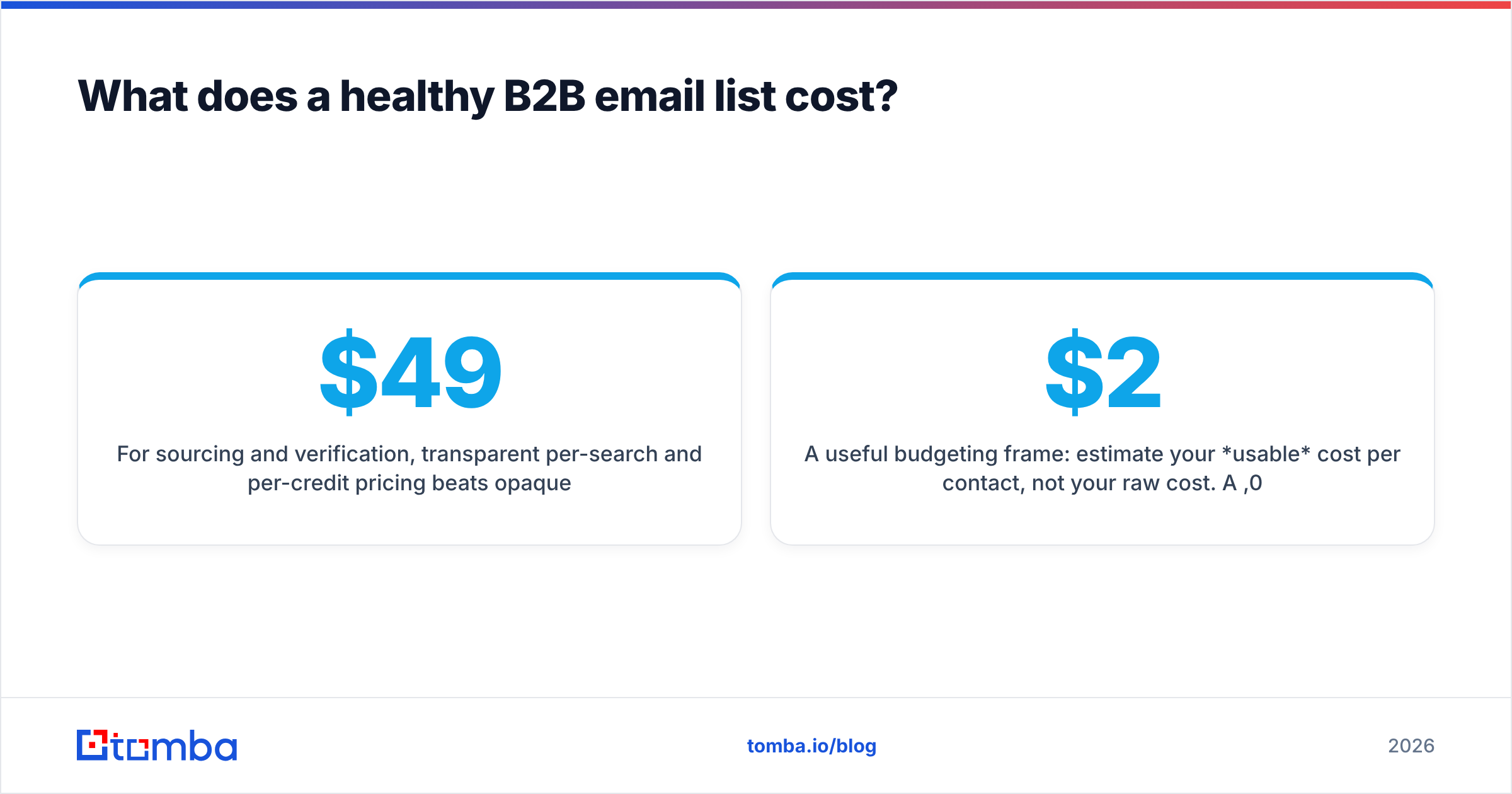
For sourcing and verification, transparent per-search and per-credit pricing beats opaque "contact us for a quote" list brokers. Tomba's plans, for reference, start with a free tier of 25 searches per month, then move to Starter at $49/mo, Growth at $99/mo, and Pro at $249/mo, with Enterprise priced on request — full details are on the Tomba pricing page. The point isn't the specific numbers; it's that you should be able to predict cost per verified contact before you commit, which is impossible with a flat-fee bought list of unknown quality.
A useful budgeting frame: estimate your usable cost per contact, not your raw cost. A $2,000 bought list with a 30% valid rate costs far more per real contact than a self-built list at a higher sticker price with a 98% valid rate. Once you reframe it that way, building wins decisively.
How does this fit your broader outbound system?#
Your list is the foundation, but it sits inside a larger engine. Connect it to your CRM and outreach tools so verified contacts flow straight into sequences without manual exports. Tomba's integrations cover HubSpot, Salesforce, Pipedrive, Zapier, and Google Sheets, and there's a full email finder API if you want to bake list building directly into your own product or internal tooling.
The mindset shift that separates teams who scale from teams who plateau: stop thinking of "the list" as a static file you download once. It's a living system you continuously feed with new verified contacts, prune of decayed ones, and re-segment as your ICP sharpens. Tools like g2.com and analyst coverage from gartner.com can help you benchmark vendors, but the operating principle stays the same regardless of which tools you pick.
The bottom line#
Buying a B2B email marketing list is a shortcut that leads off a cliff — high bounces, spam folders, and a sending domain you'll regret. Building one is methodical but durable: define your ICP, find the right people, verify ruthlessly, enrich for relevance, and segment so every message earns its open.
Start at the source. Use the Tomba Email Finder to pull verified, decision-maker emails by name, company, or domain — then run them through verification before they ever hit a sequence. You'll spend less per usable contact, protect the sender reputation you've worked to build, and own a list no competitor can buy out from under you. Grab the free tier, build your first 25 contacts the right way, and feel the difference a clean list makes on your very next campaign.
// get started
Find, verify and enrich your first contacts today
Start on the free plan with 25 searches a month, then scale when your team is ready.
Free plan · No credit card required · GDPR & CCPA
// about the author