B2B Financial Services Marketing: The 2026 Growth Playbook
A practical 2026 guide to B2B financial services marketing: how to win trust, navigate compliance, build pipeline, and turn cautious buyers into clients.
Selling to a bank, an insurer, a fintech, or a wealth manager is not like selling SaaS to a startup. The buyers are risk-averse, the sales cycles are long, the words you use are governed by compliance, and one careless claim can trigger a regulatory headache. B2B financial services marketing is the discipline of generating demand and pipeline inside those constraints — and in 2026, the firms that do it well are the ones treating trust as a measurable funnel, not a slogan.
This guide breaks down what actually moves the needle: positioning for cautious buyers, staying compliant without going silent, the channels that produce qualified meetings, and the lead data that keeps your outbound from collapsing under bounce rates.
TL;DR#
- Trust is the conversion engine. In financial services, every asset either builds credibility or burns it. Social proof, security signals, and clear compliance language outperform clever copy.
- Compliance is a design constraint, not a blocker. Marketing legal review, recordkeeping, and approved-claims libraries let you publish fast without exposure.
- ABM beats spray-and-pray. Named-account targeting with role-specific messaging fits the multi-stakeholder buying committees typical of banks, insurers, and fintechs.
- Data quality decides outbound survival. Verified contact data and enrichment protect sender reputation and keep cost-per-meeting sane.
- Measure pipeline, not vanity metrics. Tie every program to sourced pipeline, win rate, and customer acquisition cost — not clicks.
What is B2B financial services marketing?#
B2B financial services marketing is how companies sell financial products and services to other businesses — think a core-banking vendor selling to credit unions, a payments processor courting e-commerce platforms, or a commercial insurer targeting mid-market manufacturers. The "B2B" part means you are marketing to a buying committee, not an individual, and the "financial services" part means you operate under heavier regulatory scrutiny and a higher trust bar than almost any other sector.
Two forces shape everything you do:
- Risk aversion. Your buyer is putting money, data, or regulatory standing on the line. They will not move on hype.
- Regulation. Depending on jurisdiction, your claims may fall under bodies like FINRA or the SEC in the US, and equivalents abroad. Marketing copy is often subject to review and retention rules.
The practical upshot: your marketing has to be persuasive and provably accurate at the same time.
Why is marketing financial services so different?#
Three structural differences separate this niche from generic B2B.
The buying committee is larger and more conservative. A typical financial-services deal pulls in the economic buyer, a compliance or risk officer, an IT/security reviewer, and sometimes legal. According to Gartner research on B2B buying, the average committee has grown to roughly 6–10 stakeholders — and in regulated industries it skews to the high end. Each persona needs different proof.
Trust signals carry disproportionate weight. Certifications (SOC 2, ISO 27001, PCI DSS), named client logos, analyst recognition, and uptime guarantees often matter more than feature lists. A single security badge can do more for conversion than a month of clever ad copy.
Content lives and dies by accuracy. You cannot promise returns, imply guarantees, or cherry-pick performance data without compliance exposure. That forces a slower, more rigorous content workflow — but it also raises the credibility ceiling once you clear it.
How do you build a B2B financial services marketing strategy?#
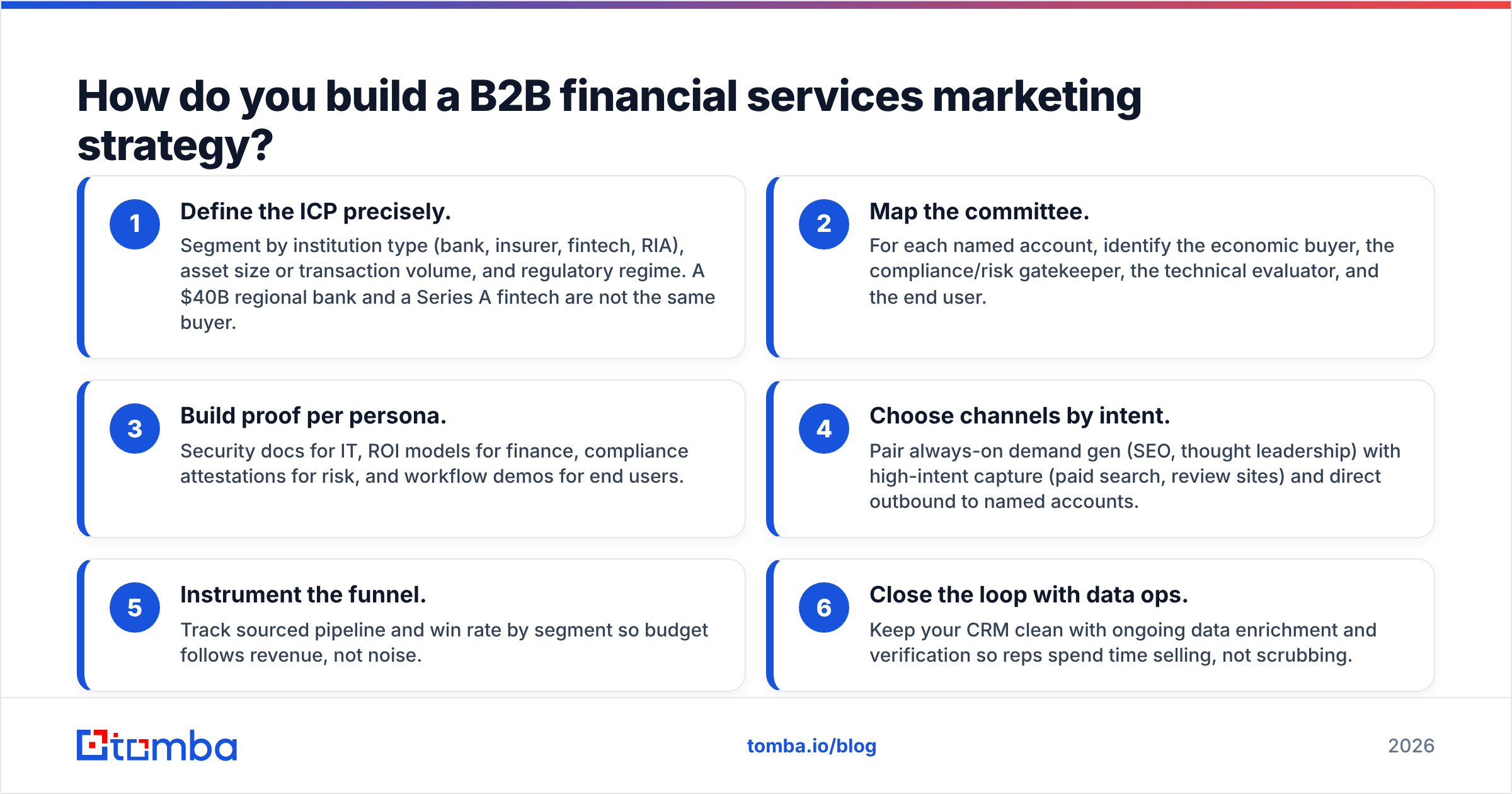
Start with the buying committee, not the product. Map each stakeholder, the objection they raise, and the asset that resolves it. Here is a working framework you can adapt.
- Define the ICP precisely. Segment by institution type (bank, insurer, fintech, RIA), asset size or transaction volume, and regulatory regime. A $40B regional bank and a Series A fintech are not the same buyer.
- Map the committee. For each named account, identify the economic buyer, the compliance/risk gatekeeper, the technical evaluator, and the end user.
- Build proof per persona. Security docs for IT, ROI models for finance, compliance attestations for risk, and workflow demos for end users.
- Choose channels by intent. Pair always-on demand gen (SEO, thought leadership) with high-intent capture (paid search, review sites) and direct outbound to named accounts.
- Instrument the funnel. Track sourced pipeline and win rate by segment so budget follows revenue, not noise.
- Close the loop with data ops. Keep your CRM clean with ongoing data enrichment and verification so reps spend time selling, not scrubbing.
This is essentially an account-based motion. If you want the formal definition of the supporting metrics, the revenue operations discipline is what ties marketing spend to booked revenue.
Which marketing channels actually work in financial services?#
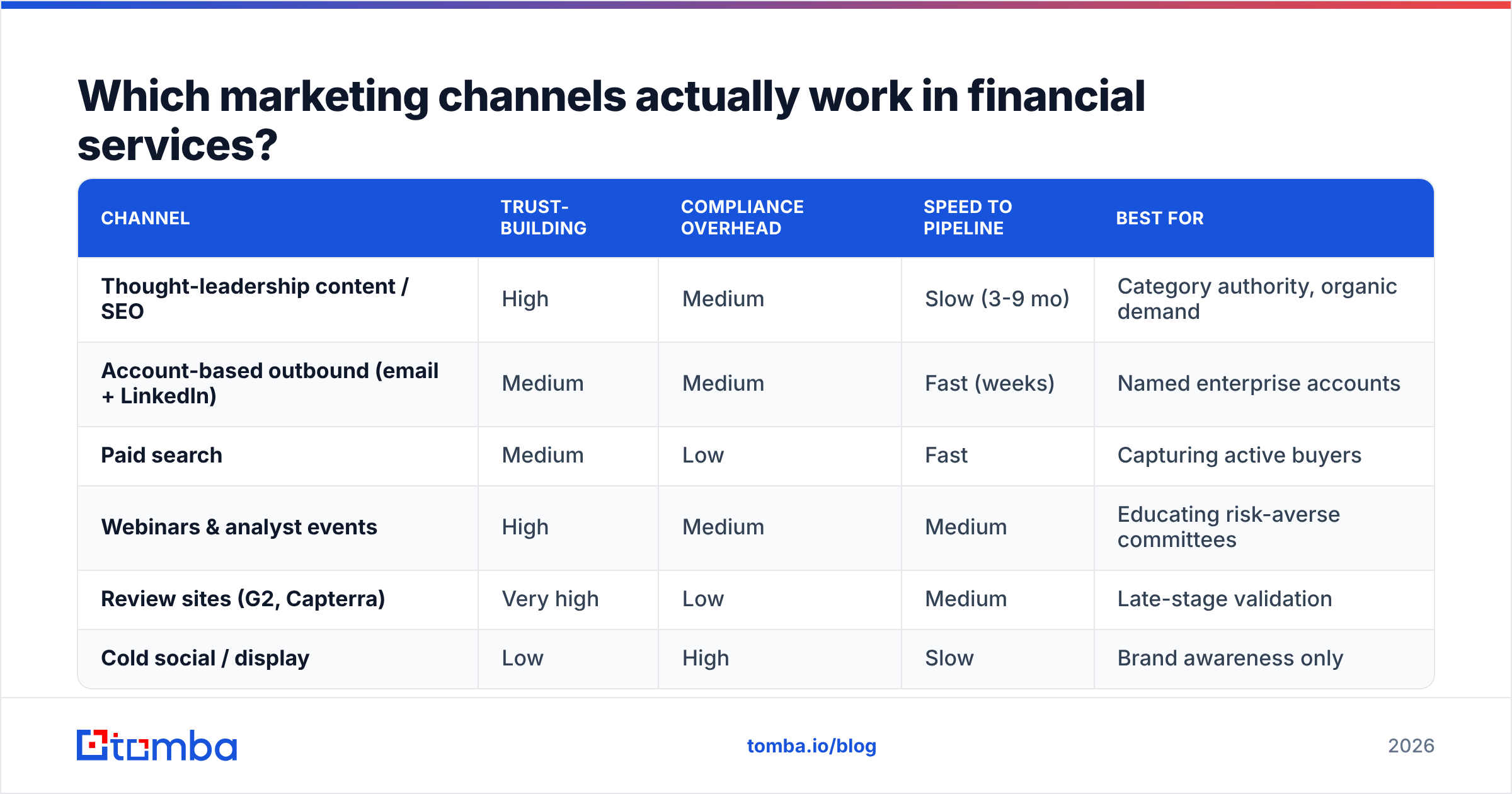
Not all channels convert equally for cautious, regulated buyers. The table below compares the main options on the attributes that matter most in this sector.
| Channel | Trust-building | Compliance overhead | Speed to pipeline | Best for |
|---|---|---|---|---|
| Thought-leadership content / SEO | High | Medium | Slow (3-9 mo) | Category authority, organic demand |
| Account-based outbound (email + LinkedIn) | Medium | Medium | Fast (weeks) | Named enterprise accounts |
| Paid search | Medium | Low | Fast | Capturing active buyers |
| Webinars & analyst events | High | Medium | Medium | Educating risk-averse committees |
| Review sites (G2, Capterra) | Very high | Low | Medium | Late-stage validation |
| Cold social / display | Low | High | Slow | Brand awareness only |
A few notes on reading this table. SEO and thought leadership are slow but compound — they are how you become the firm a compliance officer already trusts before the first call. Review platforms like G2 punch above their weight in financial services because peer validation neutralizes risk perception. And account-based outbound is the fastest reliable path to qualified meetings, provided your contact data is clean.
How does account-based marketing fit financial services?#
Account-based marketing (ABM) is the natural fit because financial-services deals are concentrated, high-value, and committee-driven. Instead of casting a wide net, you pick a finite list of target institutions and orchestrate marketing and sales around each one.
The mechanics look like this:
- Tier your accounts. Tier 1 gets bespoke 1:1 treatment (custom landing pages, exec outreach). Tier 2 gets 1:few campaigns by segment. Tier 3 gets programmatic 1:many.
- Coordinate marketing and sales. Marketing warms the committee with targeted content while reps work the economic buyer. The handoff has to be tight.
- Personalize by role, not just by name. The CISO sees a security story; the CFO sees a cost-of-ownership story.
ABM only works if the underlying account and contact data is accurate. Sending a personalized sequence to a stale or guessed email address wastes the entire play — and worse, it damages your sender reputation. This is where many otherwise-good financial-services campaigns quietly fail.
How do you stay compliant without going silent?#
Compliance is the part that scares marketers into producing bland, low-volume content. It does not have to. Treat it as a repeatable workflow.
- Build an approved-claims library. Pre-clear statements, statistics, and disclaimers with legal once, then reuse them. This removes the per-asset bottleneck.
- Use a review SLA. Agree with compliance on a turnaround time (say, 48 hours) and a fast-track lane for low-risk assets like social posts.
- Keep records. Many regulators require retention of marketing communications. Version and archive everything.
- Avoid forward-looking promises. No guaranteed returns, no "best-in-class" without substantiation, and clear disclosure of material terms.
- Train the team. A 30-minute quarterly refresher prevents most violations far more cheaply than remediation.
The firms that win here turn compliance from a gate into a competitive moat — their content is both more aggressive and more defensible than nervous competitors who publish twice a year.
What role does data quality play in B2B financial services marketing?#
Data quality is the difference between a campaign that books meetings and one that lands in spam. In financial services, where trust is everything, sending email to invalid or risky addresses is a double penalty: you waste budget and you erode the sender reputation that future deliverability depends on.
Here is what disciplined data ops looks like:
- Find the right contacts. Use a reliable email finder to source the specific decision-makers on your target committee rather than buying a generic list.
- Verify before you send. Run every address through an email verifier to strip invalid, role-based, and high-bounce contacts. This protects deliverability and your domain reputation.
- Search by company. When you know the institution but not the people, domain search surfaces the verified contacts at that organization.
- Enrich for personalization. Append titles, seniority, and firmographics so your ABM messaging hits the right persona.
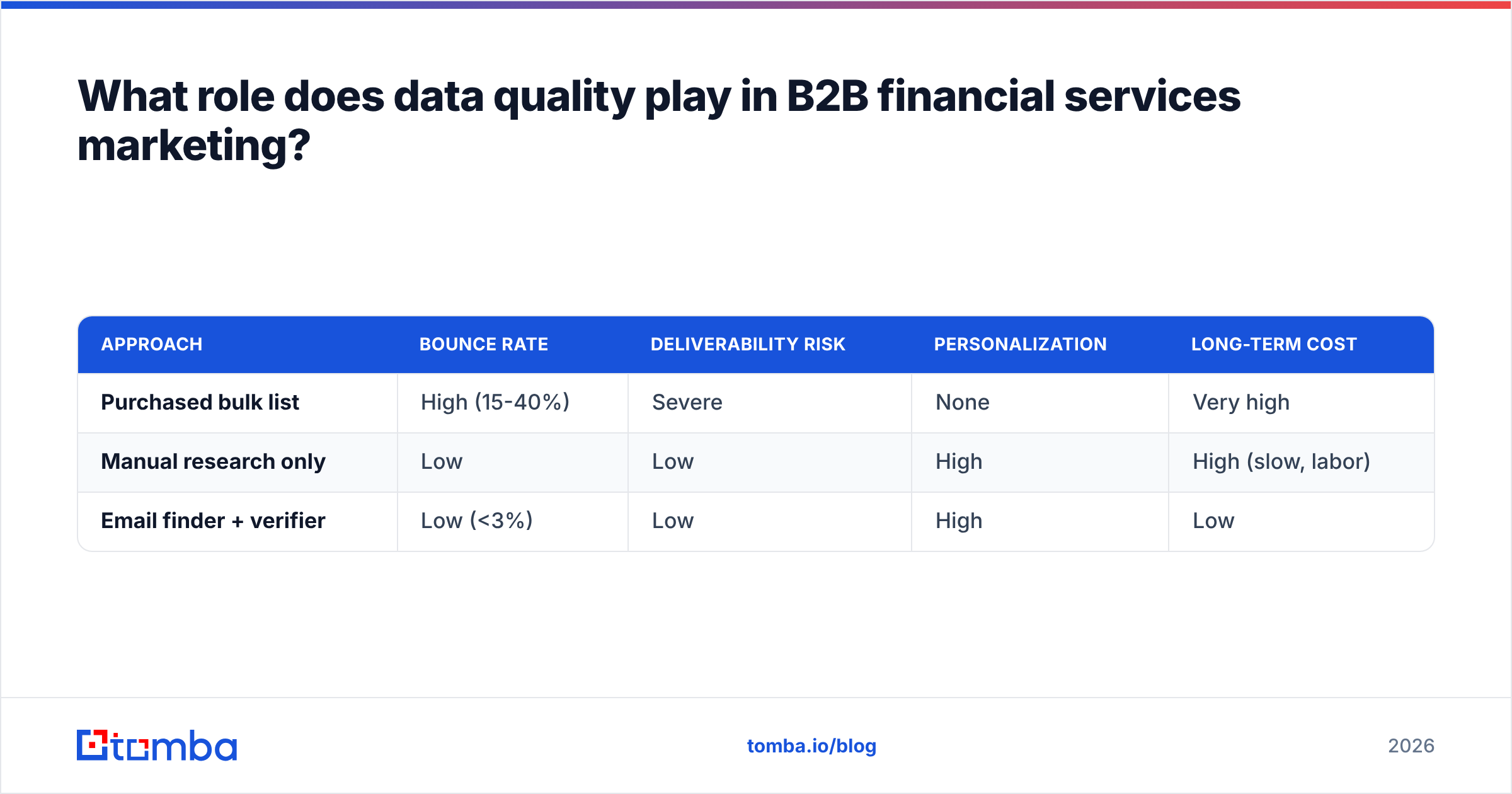
The contrast is stark. Purchased lists are cheap up front and expensive forever — high bounce rates, spam complaints, and blacklisting. Verified, self-sourced data costs a little more per contact but keeps your outbound engine alive.
| Approach | Bounce rate | Deliverability risk | Personalization | Long-term cost |
|---|---|---|---|---|
| Purchased bulk list | High (15-40%) | Severe | None | Very high |
| Manual research only | Low | Low | High | High (slow, labor) |
| Email finder + verifier | Low (<3%) | Low | High | Low |
That middle path — automated finding plus verification — is why a tool stack matters more than list volume. You can scale named-account outreach without torching your domain.
How do you measure B2B financial services marketing?#
Measure pipeline and revenue, not activity. Clicks and impressions tell you nothing about whether a $250K core-banking deal is moving.
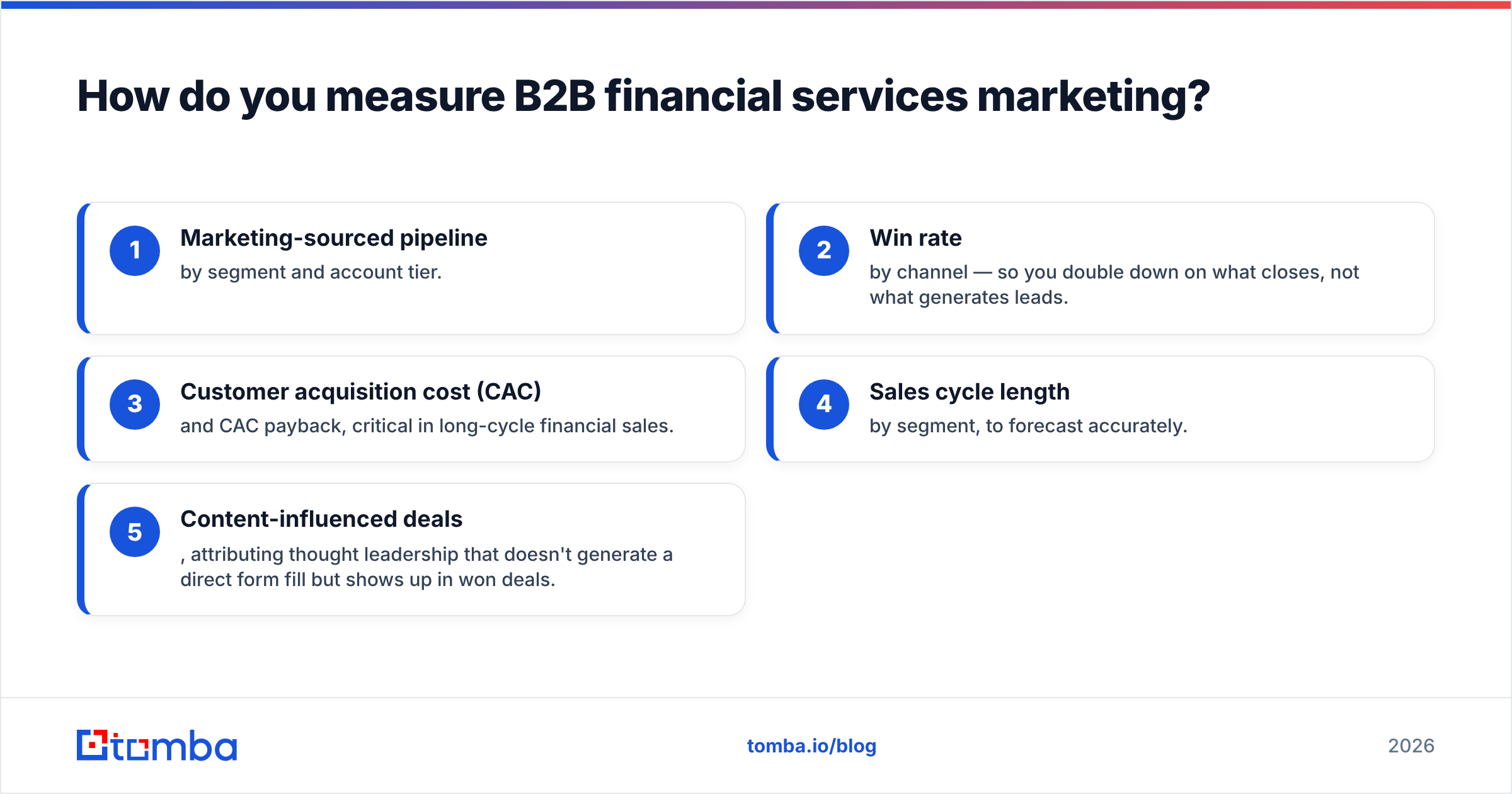
The metrics that matter:
- Marketing-sourced pipeline by segment and account tier.
- Win rate by channel — so you double down on what closes, not what generates leads.
- Customer acquisition cost (CAC) and CAC payback, critical in long-cycle financial sales.
- Sales cycle length by segment, to forecast accurately.
- Content-influenced deals, attributing thought leadership that doesn't generate a direct form fill but shows up in won deals.
A reliable definition of upstream qualification helps here: align with sales on what a marketing qualified lead actually is for your firm, so handoffs don't leak. Feed this back into your CRM — connect your stack through a HubSpot integration or similar so attribution is automatic rather than manual.
What does a 2026 financial services marketing stack look like?#
The modern stack is lean but interconnected. You want demand generation, account intelligence, clean data, and tight CRM attribution working together.
- Content & SEO platform for the slow-compounding authority play.
- ABM/orchestration layer to coordinate targeted campaigns.
- Data layer — finding, verifying, and enriching contacts. A B2B database plus on-demand finding covers both breadth and precision.
- CRM + RevOps tooling for attribution and forecasting.
- Compliance/archiving to satisfy recordkeeping rules.
The data layer is the one most teams under-invest in, and it is the one that quietly determines whether everything else works. Garbage contacts in means garbage pipeline out.
Final takeaway and where to start#
B2B financial services marketing rewards patience, precision, and trust. You win by treating compliance as a moat, building proof for every member of the buying committee, running disciplined account-based campaigns, and — critically — keeping your contact data clean so your outbound actually reaches humans.
If your pipeline depends on reaching the right decision-makers at banks, insurers, and fintechs, start with the foundation: accurate, verified contact data. The Tomba Email Finder lets you find professional email addresses by name, company, or domain, with verification built in to protect your deliverability and your sender reputation. Pair it with verification and enrichment, and your ABM campaigns stop bouncing and start booking meetings. Check the Tomba pricing — there's a free tier with 25 searches a month to test it against your target account list before you commit.
Build the trust funnel. Feed it clean data. Measure the pipeline. That is the 2026 playbook.
// get started
Find, verify and enrich your first contacts today
Start on the free plan with 25 searches a month, then scale when your team is ready.
Free plan · No credit card required · GDPR & CCPA
// about the author