B2B Geographic Segmentation: A Complete Strategy Guide for 2026
Learn how B2B geographic segmentation sharpens targeting, lifts reply rates, and routes pipeline to the right reps — with frameworks, tiers, and data tactics for 2026.
TL;DR
- B2B geographic segmentation groups accounts and prospects by location — region, country, metro, time zone, or sales territory — so you can tailor messaging, pricing, routing, and timing.
- It is not the same as consumer geo-targeting. In B2B you layer geography on top of firmographics (industry, size, tech stack) rather than using it alone.
- Done well, it lifts reply rates, shortens routing time, and keeps reps from stepping on each other's territories.
- The hard part is data quality: HQ vs. branch addresses, remote teams, and stale records wreck segmentation. Clean, enriched contact data is the foundation.
- Start with three tiers (core, expansion, opportunistic), align them to language and time zone, and let your CRM route automatically.
What is B2B geographic segmentation?#
B2B geographic segmentation is the practice of dividing your target market into groups based on where companies and their decision-makers are located, then adapting your go-to-market approach for each group.
Think of it like a delivery company planning routes. A courier does not treat every package the same — a downtown drop, a rural farm, and an international shipment each need a different vehicle, schedule, and cost model. Geographic segmentation does the same for your pipeline: it sorts accounts by location so each "route" gets the right rep, message, and timing.
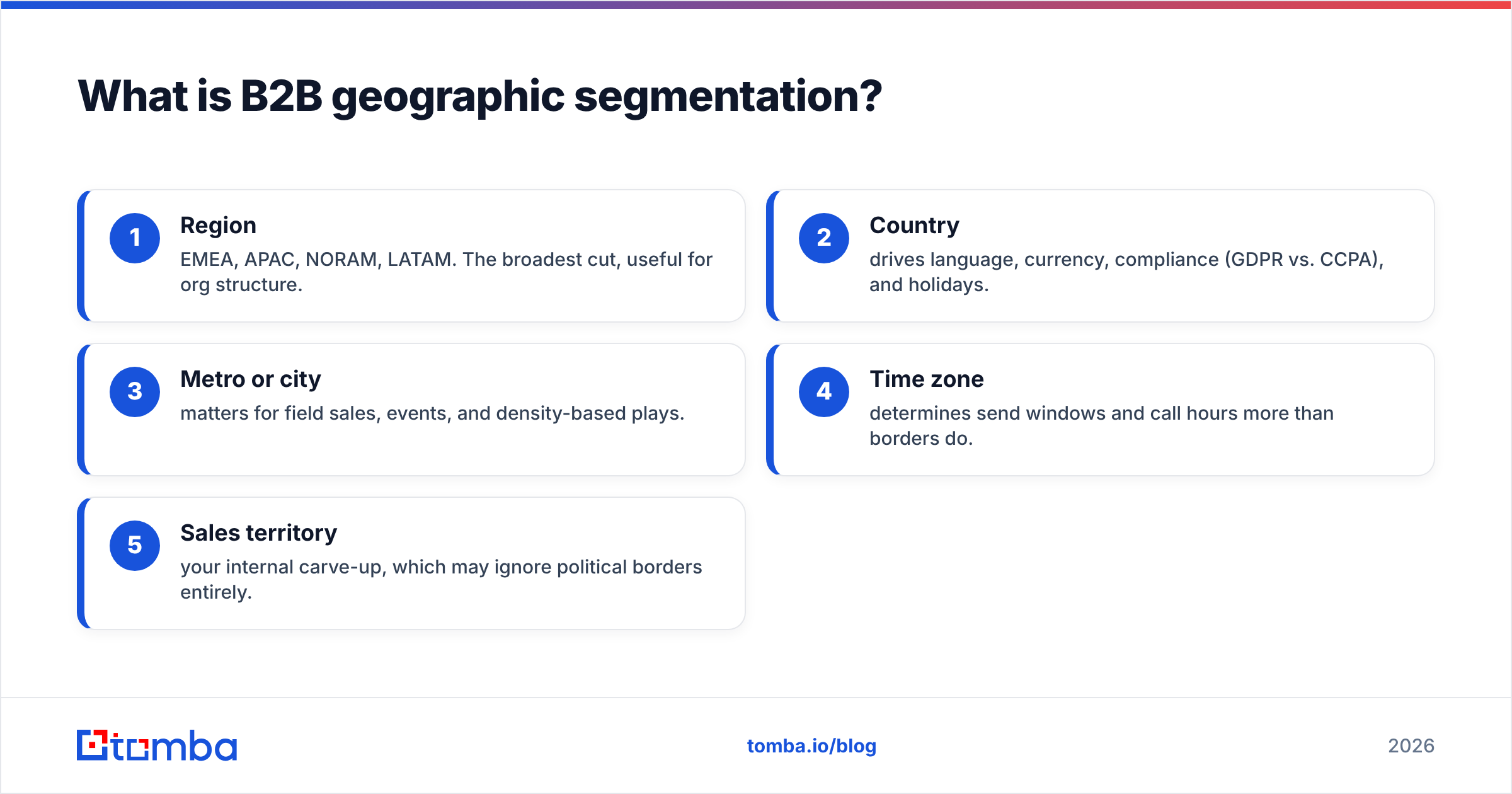
In practice, "geography" can mean several things:
- Region — EMEA, APAC, NORAM, LATAM. The broadest cut, useful for org structure.
- Country — drives language, currency, compliance (GDPR vs. CCPA), and holidays.
- Metro or city — matters for field sales, events, and density-based plays.
- Time zone — determines send windows and call hours more than borders do.
- Sales territory — your internal carve-up, which may ignore political borders entirely.
The mistake most teams make is treating geography as the only axis. In B2B, location is a multiplier on firmographics — a 200-person SaaS company in Berlin is a different buyer than a 200-person manufacturer in Berlin. Geographic segmentation works when it sits beside industry, company size, and intent data, not instead of them.
Why does geographic segmentation matter for B2B sales?#
The short answer: relevance and routing. Buyers respond to messages that reflect their context, and reps close faster when leads land in the right inbox on the first try.
Here is what geographic segmentation unlocks:
- Higher reply rates. A subject line referencing a local regulation, a regional case study, or a same-time-zone meeting offer reads as researched, not blasted.
- Smarter send timing. Sending a 9 a.m. sequence in the recipient's time zone — not yours — is one of the cheapest deliverability and engagement wins available. It also protects your sender reputation by keeping volume steady rather than spiking.
- Clean lead routing. No more "who owns this account?" Slack threads. Territory rules assign owners instantly.
- Localized pricing and packaging. Purchasing power, currency, and competitive intensity differ by market; segmentation lets you price accordingly.
- Compliance by design. EU contacts route through GDPR-aware workflows; US contacts follow CAN-SPAM. Geography is your first compliance filter.
According to HubSpot's research on personalization, tailored messaging consistently outperforms generic blasts — and location is one of the easiest, most reliable personalization signals to capture at scale.
How is geographic segmentation different from firmographic segmentation?#
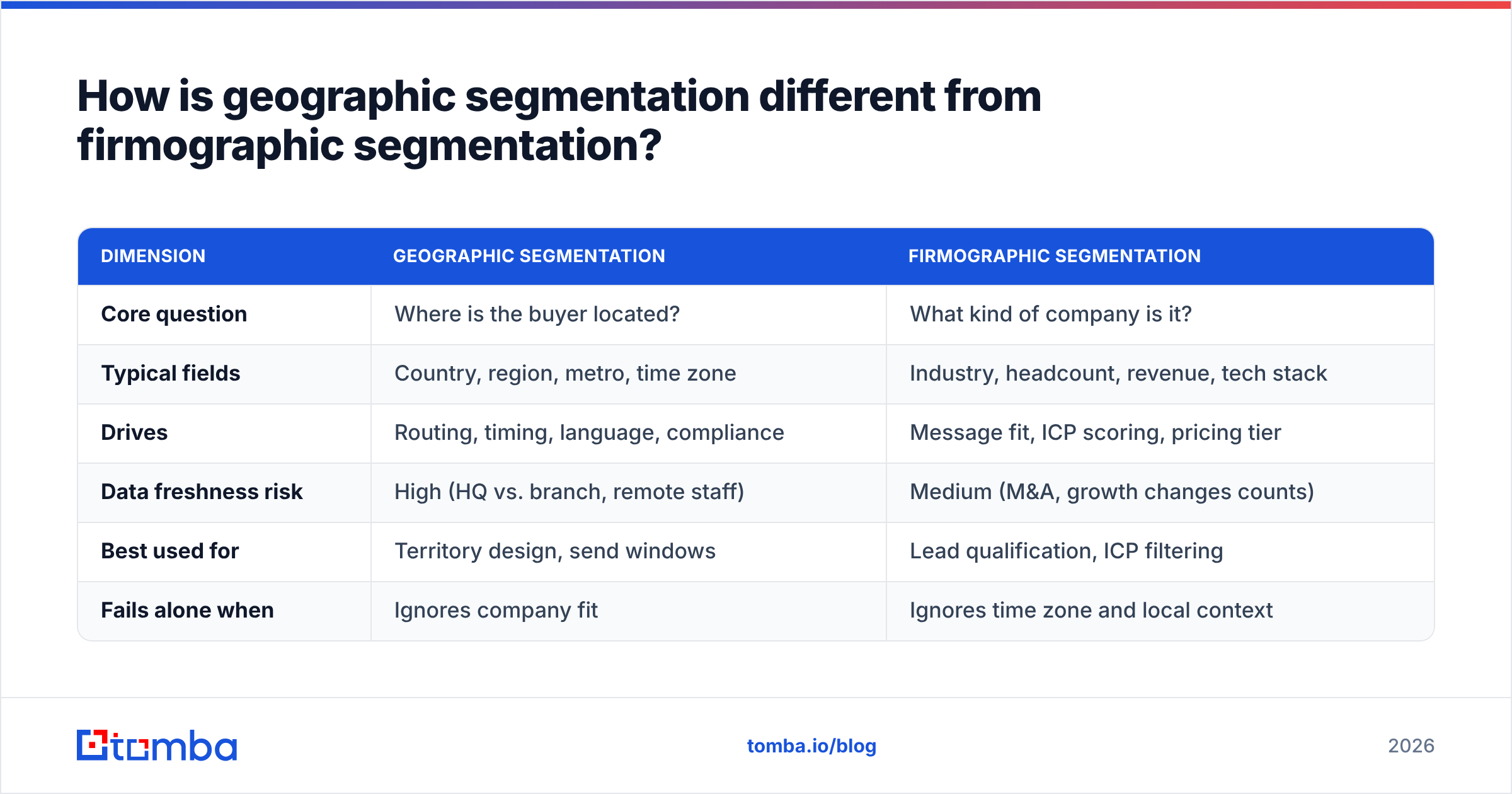
They answer different questions. Firmographics ask what kind of company is this? Geography asks where do they operate and buy? The strongest B2B targeting combines both.
| Dimension | Geographic segmentation | Firmographic segmentation |
|---|---|---|
| Core question | Where is the buyer located? | What kind of company is it? |
| Typical fields | Country, region, metro, time zone | Industry, headcount, revenue, tech stack |
| Drives | Routing, timing, language, compliance | Message fit, ICP scoring, pricing tier |
| Data freshness risk | High (HQ vs. branch, remote staff) | Medium (M&A, growth changes counts) |
| Best used for | Territory design, send windows | Lead qualification, ICP filtering |
| Fails alone when | Ignores company fit | Ignores time zone and local context |
The takeaway: use geography to decide who handles the account and when you reach out, and firmographics to decide whether the account is worth pursuing at all. A marketing qualified lead in your core region with strong firmographic fit is the one that should jump the queue.
What are the main B2B geographic segmentation models?#
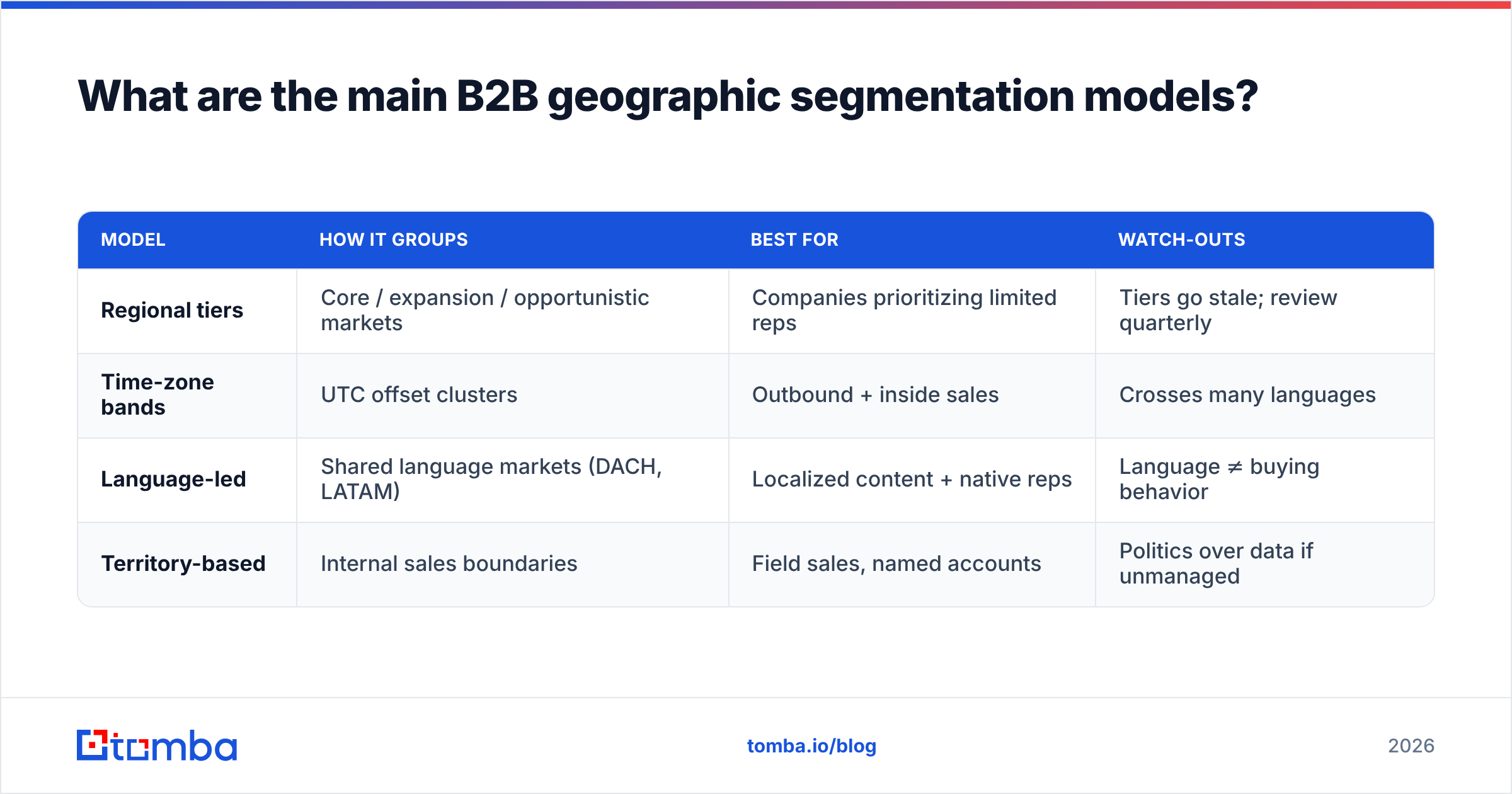
Most teams use one of four models, often blended. Pick based on how your sales org is structured and how field-dependent your motion is.
| Model | How it groups | Best for | Watch-outs |
|---|---|---|---|
| Regional tiers | Core / expansion / opportunistic markets | Companies prioritizing limited reps | Tiers go stale; review quarterly |
| Time-zone bands | UTC offset clusters | Outbound + inside sales | Crosses many languages |
| Language-led | Shared language markets (DACH, LATAM) | Localized content + native reps | Language ≠ buying behavior |
| Territory-based | Internal sales boundaries | Field sales, named accounts | Politics over data if unmanaged |
A practical default for a mid-market team is regional tiers anchored to time zones:
- Core markets — where you have product-market fit, references, and ideally native-speaking reps. Highest investment per account.
- Expansion markets — proven demand, but thinner coverage. Test localized sequences here.
- Opportunistic markets — inbound-led only. You respond, you do not proactively prospect, until volume justifies investment.
Layer time zones inside each tier so your automation knows when to fire. This keeps your team from manually rescheduling sends and protects email deliverability by smoothing volume across the day.
How do you build a geographic segmentation strategy step by step?#
Conclusion first: clean your data, define tiers, map them to firmographics, then automate routing. Skipping the data step is the single most common failure.
Step 1 — Audit and enrich your location data. Pull your CRM records and check what percentage have a reliable country, region, and time zone. Most teams discover 20–40% are blank, wrong, or pointing at a billing address. Enrich the gaps before you segment — segmentation built on bad addresses just scales the error. Tomba's data enrichment fills in company location, headquarters, and contact details so your tiers reflect reality.
Step 2 — Resolve HQ vs. branch. Decide which address governs segmentation. For most B2B motions, the decision-maker's location matters more than corporate HQ. A buyer working remotely from Lisbon for a San Francisco company may belong in your EMEA time-zone band even though the company is "US."
Step 3 — Define tiers against your ICP. Cross your geographic tiers with firmographic fit. Core region + strong ICP fit = top priority. Opportunistic region + weak fit = deprioritize or suppress.
Step 4 — Map language and compliance rules. Tag each segment with its language, currency, and the privacy regime it falls under. This drives template selection and consent handling automatically.
Step 5 — Automate routing. Configure territory rules in your CRM so new leads assign to the right owner and sequence on entry. Most modern platforms support this natively — see Salesforce's territory management docs for one mature implementation.
Step 6 — Measure and rebalance. Track reply rate, meeting rate, and win rate by segment. Promote expansion markets that outperform; demote core markets that have saturated.

What data do you need to segment accurately?#
You need three layers, and each has a failure mode if you cut corners.
- Verified contact location — the country and ideally city of the actual decision-maker, not just the corporate entity. Source this from enriched profiles, not guesswork.
- Company headquarters and footprint — for account-level routing and named-account plays.
- Time zone — derived from city, the most actionable field for outbound timing.
The accuracy problem is real. Remote work has decoupled people from company HQ, M&A reshuffles ownership, and free data sources go stale fast. This is where a reliable email finder and verifier earn their keep: they confirm the contact exists, works where you think, and can be reached — before you pour them into a segment. You can also pull contacts by region using domain search to build out a target market from the company side.
A quick data-hygiene checklist before you segment:
- Verify every email so bounces do not pollute segment metrics.
- Standardize country codes (ISO 3166) so "UK," "U.K.," and "United Kingdom" stop fragmenting your reports.
- Backfill time zones from city, not country (the US spans six).
- Flag catch-all domains that hide whether a contact is real.
- Deduplicate before assigning owners, or two reps will work the same lead.
How do you measure if geographic segmentation is working?#
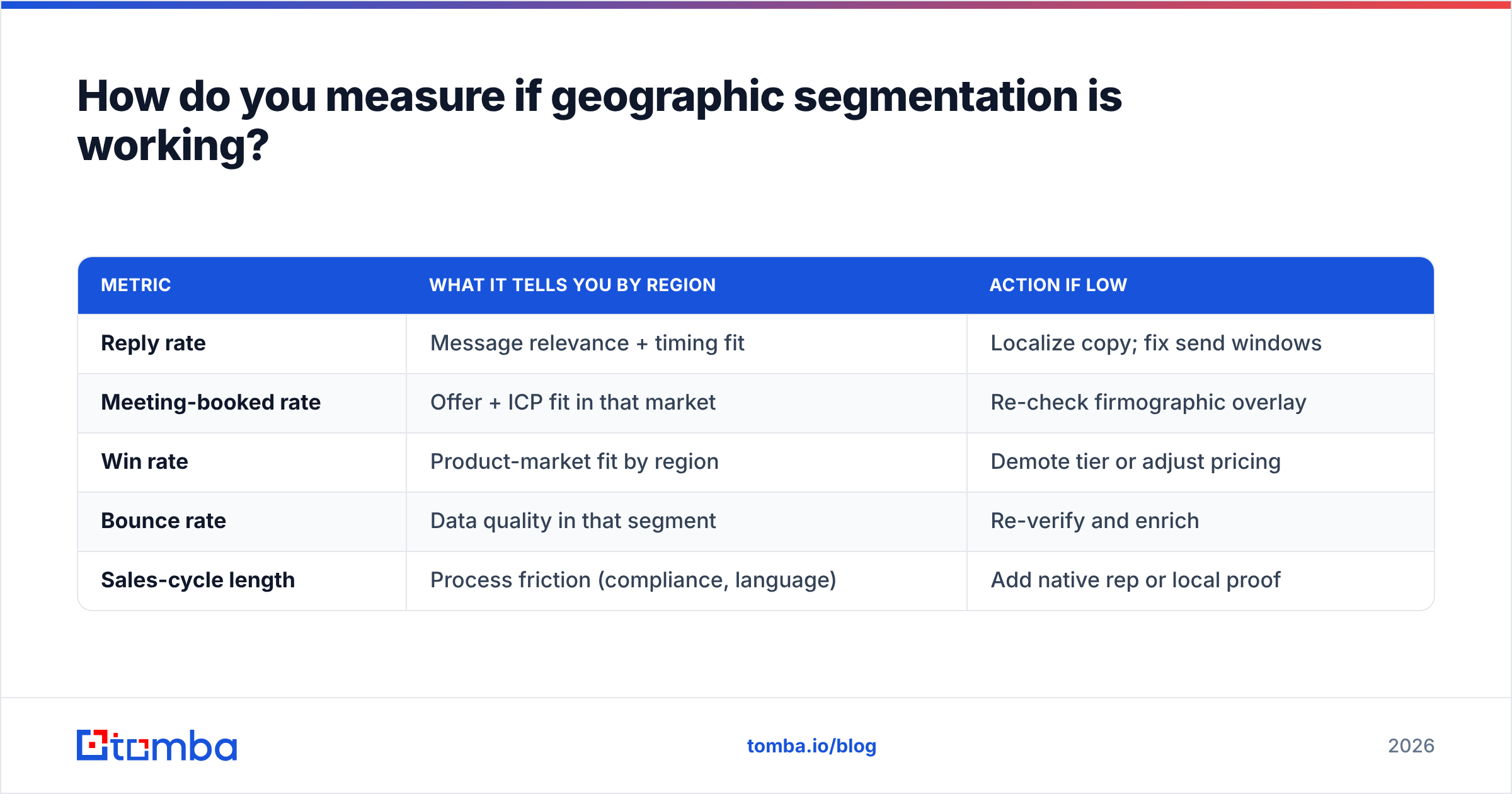
Track the same metrics you always do — but cut them by segment. Aggregate numbers hide the regional truth.
| Metric | What it tells you by region | Action if low |
|---|---|---|
| Reply rate | Message relevance + timing fit | Localize copy; fix send windows |
| Meeting-booked rate | Offer + ICP fit in that market | Re-check firmographic overlay |
| Win rate | Product-market fit by region | Demote tier or adjust pricing |
| Bounce rate | Data quality in that segment | Re-verify and enrich |
| Sales-cycle length | Process friction (compliance, language) | Add native rep or local proof |
If a region shows high replies but low wins, you have demand without fit — usually a pricing or localization gap. If it shows high bounces, your data for that geography is stale, and the fix is upstream in enrichment and verification, not in the copy.
Common mistakes in B2B geographic segmentation#
- Segmenting on billing address. It is often a finance office in a different city or country than the buyer.
- Ignoring time zones inside a country. A single "US" segment that sends at one clock time wastes the coasts.
- Over-segmenting. Forty micro-segments you cannot staff is worse than three you can execute well.
- Letting tiers go stale. Markets shift; review tier assignments at least quarterly.
- Treating geography as personalization theater. Referencing a city in line one while the rest of the email is generic fools no one. Use geography to change substance — proof, pricing, timing — not just the greeting.
How does geographic segmentation fit into your wider GTM?#
Geographic segmentation is one lever inside revenue operations. It feeds territory design, informs hiring (which regions need native reps), shapes event strategy, and sets the routing rules that keep your pipeline clean. When it is wired into your CRM and enrichment stack, it runs quietly in the background — every new lead lands in the right tier, time zone, and rep's queue automatically.
The reason it pays off is compounding: better routing speeds response time, better timing lifts replies, and better data keeps both accurate. None of it works without the data foundation, which is why most teams that struggle with segmentation actually have an enrichment problem in disguise.
Get the location data right first#
Geographic segmentation is only as good as the contact data underneath it. If your records have missing countries, wrong cities, or unverified emails, even the smartest tier model will route leads to the wrong rep at the wrong hour.
Start by building clean, location-accurate prospect lists with the Tomba Email Finder — find decision-makers by company and domain, verify they are reachable, and enrich each record with the location and firmographic fields your segments depend on. Pair it with Tomba's enrichment and bulk tools and you can stand up a fully segmented, well-routed pipeline in days, not quarters. Check the Tomba pricing to find the plan that fits your team — the free tier lets you test segmentation on real data before you commit.
// get started
Find, verify and enrich your first contacts today
Start on the free plan with 25 searches a month, then scale when your team is ready.
Free plan · No credit card required · GDPR & CCPA
// about the author